
Our readers keep the lights on and my morning glass full of iced black tea. As an Amazon Associate, I earn from qualifying purchases.
Specs are compiled from manufacturer listings and verified buyer reviews and can change over time — please confirm the key details on the product page before buying.
You need to match the Cement Glue form to your job: bonding fresh mortar to old concrete, patching a hairline driveway crack, or reattaching a broken statue piece each calls for a different product. The two main families are liquid bonding additives (which you mix into or paint onto surfaces before pouring new concrete) and paste or epoxy fillers (which you apply directly to repair cracks and chips). Choose a liquid additive when bonding new concrete to old; choose a self-leveling paste when sealing an existing crack against water and weather.
I’m Min — the founder and writer behind Gadgets Feed. This guide is built by comparing the manufacturers’ published specifications and the patterns across verified customer reviews, so you get each pick’s real strengths and trade-offs instead of marketing spin.
You need to know which adhesive actually holds up to freeze-thaw cycles and heavy traffic before you spend money on the wrong format. cement glue comes in liquid, paste, and epoxy forms, and each one has a job it does best.
Our Picks at a Glance


How To Choose The Best Cement Glue
Before you buy, decide: are you bonding new material to old, or repairing an existing crack? That single choice tells you if you need a liquid bonding agent or a paste filler — get it wrong and the repair fails no matter how good the product is.
Liquid Bonding Additives vs. Paste Fillers
A liquid bonding additive is mixed into mortar or concrete to strengthen adhesion, or painted onto an old surface before new concrete is poured. A paste or epoxy filler is applied directly into a crack or chip to seal and repair it. For bonding new concrete to old, you want the liquid additive; for sealing an existing crack, you want the self-leveling paste.
Reading Bond Strength and Cure Time
Bond strength, measured in psi, tells you how much force the adhesive can resist before failing, so higher numbers matter for structural repairs like steps and driveways. Cure time matters just as much: a patch that takes days to fully harden will crumble if you walk on it too early, while a paste that never firms up will attract dirt and fail under traffic.
Quick Comparison
| Model | Best For | Form | Key Spec | Container Size | Amazon |
|---|---|---|---|---|---|
| SIKA SikaLatex R★ Best Overall | Bonding new mortar to old | Liquid additive | 500 psi bond strength | 1 Gallon | Amazon |
| Mollor Crack FillerQuick Fix | Quick driveway crack seal | Paste | Self-leveling | 8.8 Floz | Amazon |
| PC-Masonry Epoxy Paste | Vertical and overhead repairs | Two-part epoxy paste | Non-sagging | 8 oz in Two Cans | Amazon |
| DAP Bonding Additive | Leveling and patching | Liquid additive | High moisture resistant | 32 Oz | Amazon |
| Autosel Crack Filler | Multi-surface sealing | Gel | High-elasticity | 2-Pack | Amazon |
| SAKRETE Concrete Glue | Pour-and-go bonding | Liquid | No surface scoring | 1 gal | Amazon |
| E-SDS Polyurethane Filler | Large driveway joints | Paste | Cures in 24–48 hours | 6-Pack | Amazon |
In‑Depth Reviews
1. SIKA SikaLatex R Concrete Adhesive Glue
Our pick — over 4.5★ from 850+ verified ratings; the strongest balance of quality and price.
The gallon-sized bonding additive that turns fresh mortar into a permanent weld on old concrete.
For patching steps, capping walls, or replacing bricks on outdoor masonry, this acrylic latex additive makes new material cling to old. Mix it into Quikrete or Portland-cement mortar as an admixture, or paint it on as a bonding grout, and you get hardened concrete with a 500 psi bond strength (pounds per square inch, a measure of how tightly it grips) — so a repair can survive years of weather instead of peeling away.
This is the pick for cold climates because it is formulated to resist damage from repeated freezing and thawing, so an outdoor stone fireplace or a brick step repair holds its bond through winter. Buyers report mixing it with Quikrete to replace bricks on steps and having those repairs last for years until a full remodel, which is the durability proof that matters most for structural work.
What wins people over is the adhesion and quality, with both earning the most owner votes by far — 51 for each. The trade-off is real, though: owners mention it takes 3 days to dry completely in cold temps, and the drying time gets mixed reviews, so you cannot rush this one. Customers note it “Works as claimed; took 3 days to dry in cold temps,” meaning you must plan around the wait and not disturb the patch while it sets.
Why It Wins
- 500 psi bond strength for structural-grade repairs
- Resists freeze-thaw cycles for outdoor durability
- No dilution needed, so prep is quick
- Won’t produce a vapor barrier
What To Expect
- 3-day dry time in cold temps calls for patience
- Don’t disturb during drying or it crumbles
- Full cure runs a long 30 days
Your best bet if: you are bonding new mortar or concrete to old outdoor masonry and need a bond that survives winter.
Reach elsewhere if: you need a fast-drying patch you can walk on within hours — this one demands days of drying time.
2. Mollor Concrete Crack Filler
The ready-to-use paste that flows deep into sidewalk cracks and seals them in one pass.
When a driveway or patio crack needs a fast, clean repair without mixing anything, this gray paste delivers because it is designed to flow automatically into the depths of a crack rather than just bridging the surface. It dries rapidly into a tough film that blocks water infiltration, which is exactly what you want for outdoor surfaces that see rain and foot traffic.
The kit arrives with the tools you need — gloves, scraper, extended nozzle, sandpaper, and masking tape — so a first-time DIYer can handle a home repair straight from the start. Effectiveness is what owners praise most with 16 mentions, and its high-elasticity formula is meant to resist secondary cracking, which is the common failure point of rigid fillers.
The honest catch is coverage and thickness: durability feedback is mixed, and reviewers point out that a layer applied too thin leaves the crack still visible behind the seal. Apply liberally — owners who added a second, thicker layer solved the issue, so technique matters as much as the material here.
Best approach: this suits a homeowner who wants a complete, no-mix kit for sealing walkway and driveway cracks, but apply it thick and be ready to add a second layer on deeper cracks.
The limitation: durability over years is unproven in owner feedback, so treat it as a solid seal rather than a structural repair.
3. PC Products PC-Masonry Epoxy Adhesive Paste
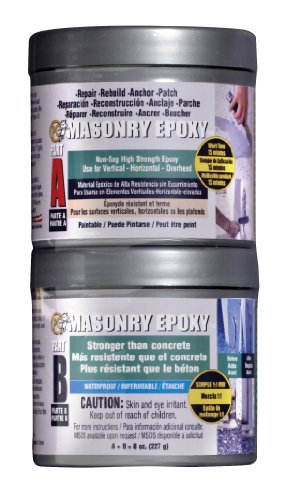
The non-sagging epoxy that stays put on vertical walls and overhead surfaces while it hardens.
This two-part epoxy paste is the specialist for repairs where gravity works against you, because its non-sagging formula can be used on horizontal, vertical, and overhead surfaces without slumping off. It replaces missing concrete or fills cracks on deteriorating masonry, and it bonds to both wet and dry surfaces, which matters when you are repairing a leaky basement or an exterior wall right after rain.
Owners praise quality most (65 mentions), with adhesiveness close behind (34). Mixability and texture get mixed feedback — some find it easy to work with, others hard — and one owner noted it “does have rough gritty remains” after drying, so skip it if you need a glass-smooth finish.
Unlike the paste fillers above, this one gives you a 5-minute working time while moldable, then hardens in 1-2 days like stone. Once fully cured, you can sand, paint, stain, and machine it. Shoppers say it “was easy to use and is still holding up,” and one owner found it held up underwater for two months — a strong sign of moisture resistance.
It handles a wide service temperature range from -20 to +200 degrees F, so it stays strong through extreme cold and heat. Unlike the Mollor filler, there is no self-leveling here — you shape it into place, which actually makes it a better structural adhesive for rebuilding a broken edge or reattaching a piece.
Built For
- Non-sagging on vertical and overhead surfaces
- Applies to wet or dry surfaces
- Hardens like stone in 1-2 days
- Sandable, paintable, and machinable when cured
Watch Out For
- Texture is gritty, not smooth
- Mixability varies batch to batch
- 5-minute working time means work fast
Grab this for: vertical wall repairs, broken statues, flagstone pavers, and any structural rebuild where a sagging paste would fail.
Not for: anyone wanting a silky-smooth cosmetic finish — the cured texture is rough and gritty.
4. DAP Concrete Bonding Additive

The vinyl-based bonding agent that makes fresh concrete grip old slabs for leveling jobs.
Pouring a thin leveling layer over an existing concrete slab always risks the new material lifting away from the old. This Vinyl Acetate Copolymer additive (a type of plastic resin that improves adhesion) mixes into mortar or concrete to create a high moisture-resistant, high-density finish — apply it as a coating or blend it into the mix for patching, resurfacing, and leveling.
Owners specifically call it a must-have when putting concrete on top of concrete for small patching jobs. One buyer found it “works as described,” and another described how leveling material mixed with it dried evenly and beautifully, which is the core promise buyers need from a bonding agent.
Versatility is its strength: the same formula works for capping walls, patching steps, and tuck pointing, and it is suited for both indoor and outdoor applications. The full cure time runs 24 hours, which is substantially faster than the SIKA’s 30-day full cure and makes it a more practical choice for a same-weekend project.
The one gap in the data is that the reviews are thinner on long-term durability proof, so the confidence here rests on the mechanism working as intended rather than years of owner testimony. Within its lane — bonding new material to old, especially for leveling — it delivers exactly what a DIYer expects.
Smart choice for: homeowners leveling or resurfacing a concrete area and wanting a true bond between the old slab and the new pour.
Who it misses: anyone needing to fill an existing crack — this is a bonding additive, not a self-leveling crack sealer.
5. Autosel Concrete Crack Filler
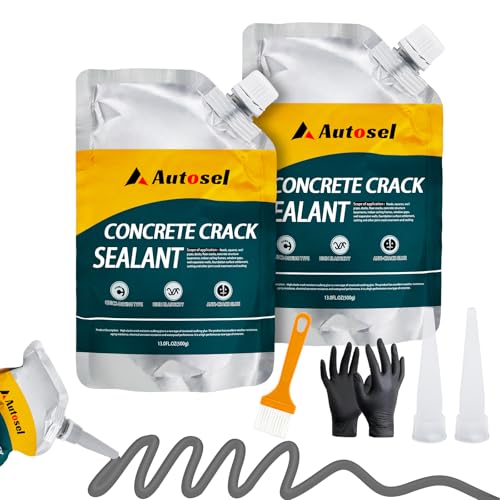
The elastic gel that flexes with ground movement instead of cracking again.
This two-pack hits a wider range of surfaces than the typical concrete-only filler because it is made for concrete, asphalt, brick, tile, and other masonry, and it works on driveways, walkways, roofs, and basement floors. The high-elasticity formula is engineered to adapt to ground movement and settlement, so the seal is supposed to move with the surface rather than re-crack under seasonal shifting.
Application is the thing owners praise most with 45 mentions, and the self-leveling nature earns another 17 positive votes — squeeze it from the nozzle and it flows to a smooth, professional finish without extra tools. Buyers report it dries smooth within hours and survived rain, making it genuinely practical for a quick outdoor repair.
The big caveat is a fit note, not a defect: crack filling gets mixed feedback (51 mentions), and some owners note it does not prevent new cracks from forming — so treat this as a sealant, not a structural repair. It also cures rubbery rather than rock-hard, runs on slopes unless you add sand, and the gray shade does not perfectly match older concrete.
Value for money skews negative in owner feedback, which makes sense when you consider the thicker application needed to fill a sizable gap properly. The recurring owner advice is to warm and knead the packet before use to avoid a watery consistency, and to sprinkle sand over the surface after about 20 minutes so it blends with the surrounding concrete.
Owner Favorites
- Easy squeeze-tube application with self-leveling flow
- Flexible enough to survive ground movement
- Works on asphalt, brick, and concrete
The Human Factor
- Not a fix for active structural cracks
- Runs on slopes — needs sand added
- Cures rubbery, and gray won’t match all concrete
Choose this for: horizontal driveway and walkway cracks where you want a flexible, water-resistant seal that is simple to apply.
Pass if: you need a load-bearing structural repair or a color that blends invisibly with old gray concrete.
6. SAKRETE Concrete Glue
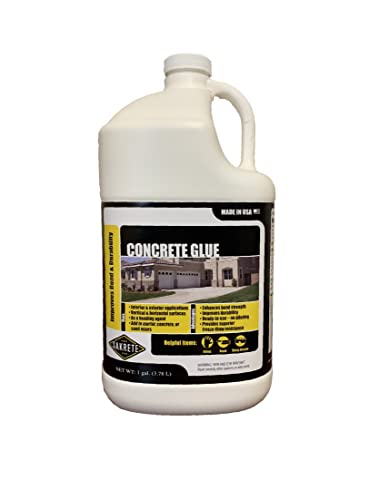
The simplest bonding approach — pour from the bottle with no surface prep required.
If the chore of scoring or roughening an old concrete surface is what has been stopping you from a repair, this clear bonding liquid removes that entire step. It is ready to use straight from the bottle, needs no roughening or scoring of old surfaces, and goes on so easily that a thin layer is all owners mention needing for good adhesion.
The formula uses gypsum as its base material, and the practical result is a clean bonding layer that one owner used to retuck a chimney, finding the glue helped new mortar adhere firmly to the old. Because it is a liquid rather than a paste, it is the closest thing in this list to a set-and-forget bonding agent — you apply it, then lay your new concrete or mortar on top.
The honest trade-off is that durability across a harsh winter is still an open question in owner feedback — one buyer explicitly hoped it holds through the winter weather before recommending it fully. With a full cure time of 7 days, this is a product that asks for a little patience and a little faith in the first seasonal test.
What you get in return is an unusually forgiving application process: no scoring, no dilution, no mixing. Just pour, spread a thin coat, and bond, which makes this the pick for a DIYer who wants the lowest-effort path to a solid new-to-old concrete bond.
The easy road: this suits a homeowner who wants to bond fresh concrete or mortar to old surfaces without scoring or prep work.
The open question: long-term winter durability is still being proven by owners, so expect to verify it holds through one full season.
7. E-SDS Polyurethane Cement Crack Filler

The moisture-cured polyurethane that seals large expansion joints and stays flexible under traffic.
For wide driveway expansion joints and deep cracks, this six-pack of polyurethane sealant handles gaps the paste fillers cannot. It seals horizontal cracks up to 1.5 inches wide and 1/2 inch deep, curing within 24–48 hours to form a smooth, waterproof bond that resists rain, snow, heat, UV rays, and freezing temperatures.
The standout practical fact from owners is coverage: one tube fills a 10-foot long 1/2-inch crack, which makes the six tubes in this pack go a very long way across a full driveway. Effectiveness earns the most owner praise with 16 mentions, and crack coverage adds 13 more, so the core function of filling and sealing is well proven in the feedback.
Because it is moisture-cured and elastomeric, it keeps some flexibility after curing, which is what lets it adapt to ground movement and settlement rather than tearing apart. It even works in submerged conditions like canal and reservoir joints, which is a level of weather and water resistance most crack fillers cannot claim.
The honest caution is in the application: ease of use gets mixed feedback with 24 mentions, and some customers note the material won’t come out of the tube or stays tacky for days. The material is very runny and will flow, so you must use a backer rod underneath it, and it needs to be stored above 5°C or the end of the bottle can freeze solid.
Where It Excels
- One tube fills a 10-foot by 1/2-inch crack
- Cures in 24–48 hours into a waterproof seal
- Flexible enough for ground movement
- Works even in submerged joints
Apply With Care
- Very runny — requires a backer rod underneath
- Some owners battle to dispense it from the tube
- Can stay tacky and sticky for days
Reach for it when: you have long, wide driveway or sidewalk joints to seal and want a flexible, waterproof, traffic-ready result.
Think twice if: you want a simple squeeze-tube fix — this one demands a caulk gun, a backer rod, and careful technique.
Understanding the Specs
Bond Strength in PSI
Pounds per square inch measures how much force the cured adhesive resists before the bond fails. A higher psi number means the glue can handle heavier load and stress, so it matters most for structural repairs like steps, fireplace surrounds, and load-bearing masonry. The SIKA additive delivers a 500 psi bond strength, which is a solid benchmark for outdoor structural work.
Full Cure Time vs. Dry Time
Dry time is when the surface feels set, but full cure time is when the material reaches its maximum strength. The SIKA additive lists a 30-day full cure, while the DAP additive cures in 24 hours, and the E-SDS polyurethane cures in 24–48 hours. If you need to use the repaired surface quickly, look for the shorter full cure time; if you can wait, the longer-curing materials often build a stronger final bond.
FAQ
What is the difference between a bonding additive and a crack filler?
How long does cement glue take to dry?
Can I use cement glue on wet surfaces?
What is a self-leveling cement filler?
Does cement glue work on vertical or overhead surfaces?
Is the SIKA SikaLatex R similar to the DAP bonding additive?
Why does my crack filler stay sticky or tacky?
Can I pour new concrete over old concrete with cement glue?
Final Thoughts: The Verdict
Across the board, the cement glue winner is the SIKA SikaLatex R because it delivers a genuine 500 psi bond strength and freeze-thaw resistance that makes outdoor masonry repairs last for years. If you want a fast, no-mix fix for a driveway crack, grab the Mollor Crack Filler. And for structural vertical repairs where the material must not sag, the PC-Masonry Epoxy Paste is the one to reach for.
How We Picked
We do not accept paid placement. Every pick is matched to a real buyer and a real use-case; we do not hands-on test units.
Sources & Methodology
Specifications: manufacturer listings and product documentation. Review insights: verified customer reviews, as of September 2026. Pricing: not shown on this page (it changes often); check the current price via the retailer link.
As an Amazon Associate, Gadgets Feed earns from qualifying purchases. This does not affect which products we feature.