
Our readers keep the lights on and my morning glass full of iced black tea. As an Amazon Associate, I earn from qualifying purchases.
Specs are compiled from manufacturer listings and verified buyer reviews and can change over time — please confirm the key details on the product page before buying.
Choosing 10x binoculars means seeing distant detail—an eagle’s wingbeat or a player’s jersey number—clearly and comfortably. This guide focuses on lens quality, low-light performance, and ergonomics—the specs that truly shape your view.
I’m Min — the founder and writer behind Gadgets Feed. This guide is built by comparing the manufacturers’ published specifications and the patterns across verified customer reviews, so you get each pick’s real strengths and trade-offs instead of marketing spin.
This guide matches each 10x binocular to its best use—wide views for stadiums, light-gathering for dawn hikes, or portability for travel.
Our Picks at a Glance


How To Choose The Best 10X Binoculars
With 10x magnification, objects look ten times closer than they do with your naked eye. That power lets you see real distance, yet it is not so strong that you need a tripod to hold the view steady in your hands.
Decoding the Second Number
The numbers after the “x” (like 42 or 50) are the diameter of the objective lenses in millimeters—the big lenses at the far end. A larger number gathers more light, which is why a 10×50 is often preferred for dawn, dusk, or stargazing, while a 10×42 is a lighter, more versatile all-rounder.
Field of View: The Scan Factor
Field of view is how wide an area you can see at 1,000 yards. A wider field (like 334 feet versus 170 feet) means you can spot and track a moving bird or a running player without constantly panning the binoculars. This spec is critical for action.
Glasses and Eye Relief
If you wear glasses, you need long eye relief—the distance from your eye to the lens where you can still see the full view. Numbers around 17 millimeters or more generally give glasses wearers the room they need without the black edges (vignetting) that shorter eye relief causes.
Quick Comparison
| Model | Best For | Field of View | Eye Relief | Lens Coating | Amazon |
|---|---|---|---|---|---|
| Vortex Copperhead HD★ Best Overall | Best Overall Clarity | 334 feet | 17 mm | Fully Multi-Coated | Amazon |
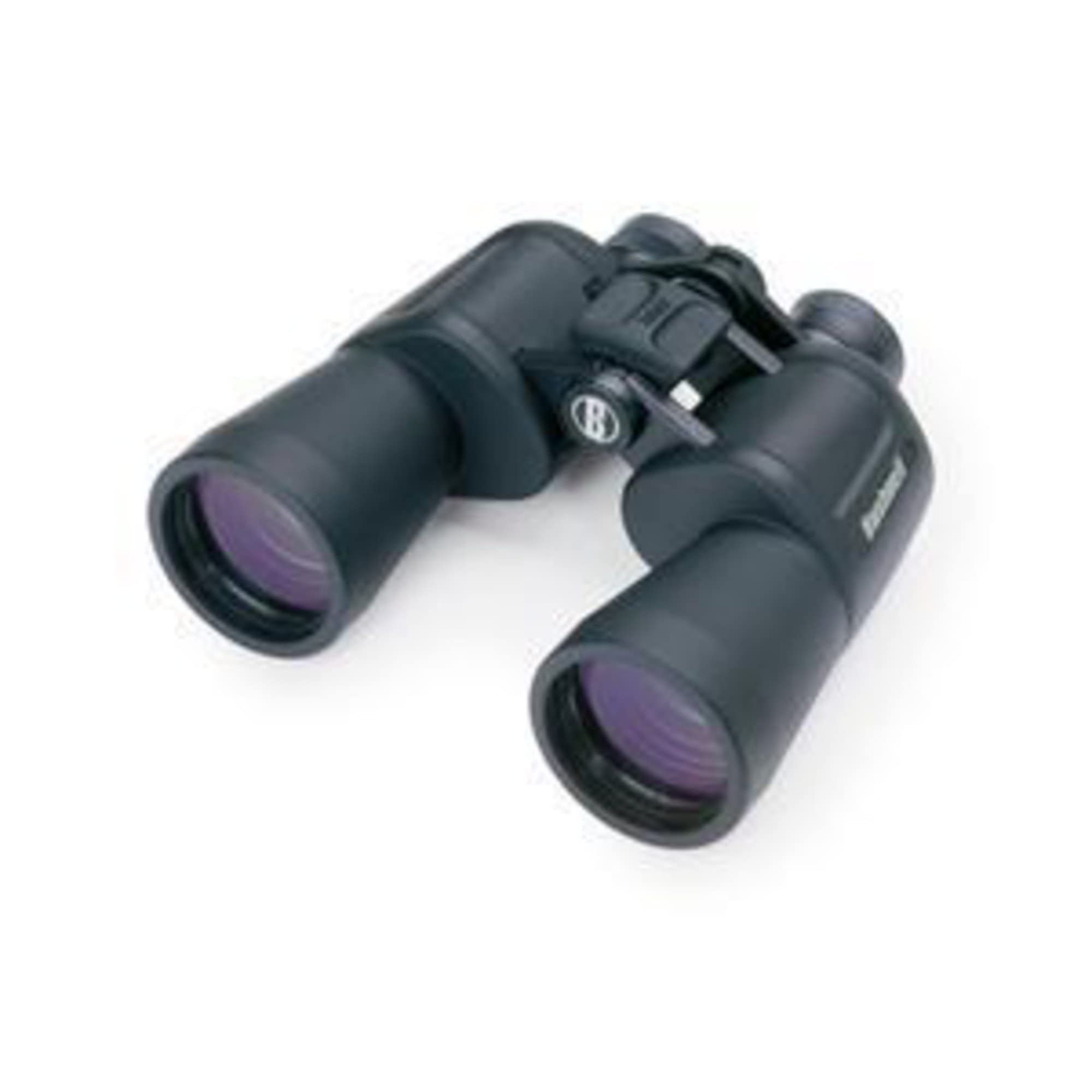
| Bushnell PowerView 10×50No-Focus Pick | Fixed Focus Simplicity | 170 feet | 10 mm | Fully Coated | Amazon |
| Bushnell PowerView 10×42Everyday Classic | Budget Birdwatching | — | — | Multi-Coated | Amazon |
| Leupold BX-1 Rogue 10×25 | Pocket Portability | 5.6 degrees | 15 mm | Fully Multi-Coated | Amazon |
| Sogries 10×50 Astronomy | Stargazing & Travel | — | 22 mm | Fully Multi-Coated | Amazon |
| Celestron Outland X 10×50 | Low-Light Wildlife | 289 feet | 17.4 mm | Multi-Coated | Amazon |
| Bushnell Engage X 10×42 | Weatherproof Hunting | 7 degrees | 18 mm | Fully Multi-Coated | Amazon |
| Nikon PROSTAFF P3 10×42 | Versatile Premium Value | 367 feet | 15.7 mm | Multilayer-coated | Amazon |
| Vortex Viper HD 10×42 | High-End Performance | 6.5 degrees | 17 mm | Proprietary XR | Amazon |
In-Depth Reviews
1. Vortex Copperhead HD 10×42 Binoculars
Our pick — over 4.5★ from 450+ verified ratings; the strongest balance of quality and price.
A sharp all-rounder that brings distant lake details within arm’s reach.
You get a bright, detailed view in a package that owners consistently call “crisp”—the 42mm objective lenses and an HD optical system push light transmission for strong color and edge-to-edge sharpness. It goes beyond the standard too, with fully multi-coated lenses (anti-reflective layers on every air-to-glass surface) that boost brightness, especially useful when you are scanning shadowy shorelines.
The handling details make long glassing sessions comfortable: adjustable eyecups and a diopter (a ring that fine-tunes one eyepiece to match your eyes) let you lock in a custom fit. It is rated waterproof, fogproof, and shockproof, so an Alaska downpour or a drop on a rocky trail won’t end your day. A notable plus is the included GlassPak harness, which distributes the weight across your shoulders instead of your neck.
Buyers report using it for spotting details at a Nautical mile, and many note it holds its own against far pricier brands. The build is sturdy, though a few travelers warn it runs a bit heavy for a carry-on bag. The warranty is a standout, covering repair or replacement for life with no registration or receipt required.
Owners’ Core Strengths
- Quality and clarity are the top praises—glass this sharp at the price point is rare.
- Value for money is a close second, with frequent comparisons to pricier rivals.
- The lifetime, transferable warranty takes the risk out of the purchase.
Trade-offs to Consider
- Heavier than some compact models—a potential issue for weight-conscious travelers.
- Compared to higher-tier optics, edges may be slightly less crisp in very low light.
The verdict: A high-quality, go-anywhere pair that’s the safe recommendation for hikers, birders, and boaters who want one reliable tool for everything.
Worth noting: If your priority is absolute low-light performance above all (like astronomy), a bigger 50mm objective lens will collect more light.
2. Bushnell PowerView 10×50 Wide-Angle PermaFocus Binoculars
A fixed-focus binocular that delivers sharp views without any focusing.
The a neat extra here is Perma Focus, a fixed-focus system that keeps subjects sharp at any distance automatically—perfect for sporting events where you don’t want to fiddle with dials while the action moves. It makes the view easy, as the 10x magnification and 50mm lenses do the heavy lifting on image stability and light gathering.
It’s a different beast from the Copperhead above, with a narrow 170 feet field of view versus the Copperhead’s 334 feet, so you’ll pan more to track fast subjects. The trade-off is a larger exit pupil (50 millimeters versus 4.2 millimeters on the Vortex), which is a big win in low light. Owners mention it is an “excellent value” set of binoculars, but note a shorter 10 millimeters of eye relief, which may push glasses wearers to press their frames close.
At over a pound lighter than some rivals, it feels manageable for a day out hiking to a valley viewpoint, which several buyers cite as its best use case. It’s a rugged full-size tool for nature observation that skips a focus wheel entirely.
The take: A smart pick for anyone who hates adjusting focus and wants big, bright views for casual birding or sideline spectating.
The catch: Tight eye relief and a narrow field make it less ideal for glasses wearers or tracking very fast, close-range action.
3. Bushnell PowerView 10×42 Compact Roof Prism Binoculars
A lightweight, durable workhorse for backyard birding and trailside views.
This mid-size pair uses a roof prism design and BK-7 glass with multi-coated lenses to deliver crisp 10x magnification. Its endurance is a constant theme in owner accounts, with reports of them retaining clarity and working “as new” after many years of steady use.
It arrives with everything you need—neck strap, carry pouch, cleaning cloth, and lens caps—and its diamond-cut texture on the rubber armor gives you a solid, slip-resistant grip, even in Texas-level heat. It’s a versatile everyday pick that suits desk-side office views as well as dedicated birdwatching.
One consideration is that the brightness has mixed feedback. It performs well in normal daylight but doesn’t have the enhanced light transmission of a fully multi-coated lens system found on higher priced models, so it will struggle more at dusk.
The Highlights
- A great value pick with owners praising the price-to-clarity ratio.
- Ease of focus is a top positive—it is simple for any user to quickly dial in.
- Compact enough to grab for quick looks without being pocket-sized.
Know the Limits
- Brightness is mixed; they’re not the best choice for challenging low-light scenes.
- Some owners note minor fogging issues in extreme conditions, a sign the seals aren’t premium.
Reach for these if: You want a dependable every-day binocular for backyard birding, casual travel, or as a first gift for an outdoor enthusiast.
Look elsewhere if: You spend significant time glassing at dawn or dusk and need maximum brightness.
4. Leupold BX-1 Rogue Binoculars 10x25mm

A pocket-sized optic that delivers crisp views despite its tiny footprint.
The Rogue’s superpower is its tiny footprint. Its inverted Porro prism design makes it “incredibly small and lightweight” without sacrificing optical performance, so it’s a natural pick for ultralight hikers, concert-goers, and anyone who wants binoculars available on a whim.
Its housing is wrapped in easy-grip rubber armor, and it is fully waterproof and fogproof, backed by Leupold’s customer care. The fully multi-coated lenses ensure a bright picture for the size, and the 15mm eye relief is better than the Bushnell PowerView 10×50, making it more forgiving for glasses wearers.
Because it packs a 25mm objective lens, it can’t match larger models on raw brightness. Instead, it wins on portability, a trade-off that owners readily accept for the flexibility of always having it on hand.
What wins people over: The ability to slip it into a shirt pocket and always be ready, with the excellent handling and clarity that Leupold is known for.
The caveat: In dim conditions like a twilight stadium, the small lens will yield a dimmer view than a 42mm or 50mm model.
5. Sogries 10×50 High Powered Astronomy Binoculars
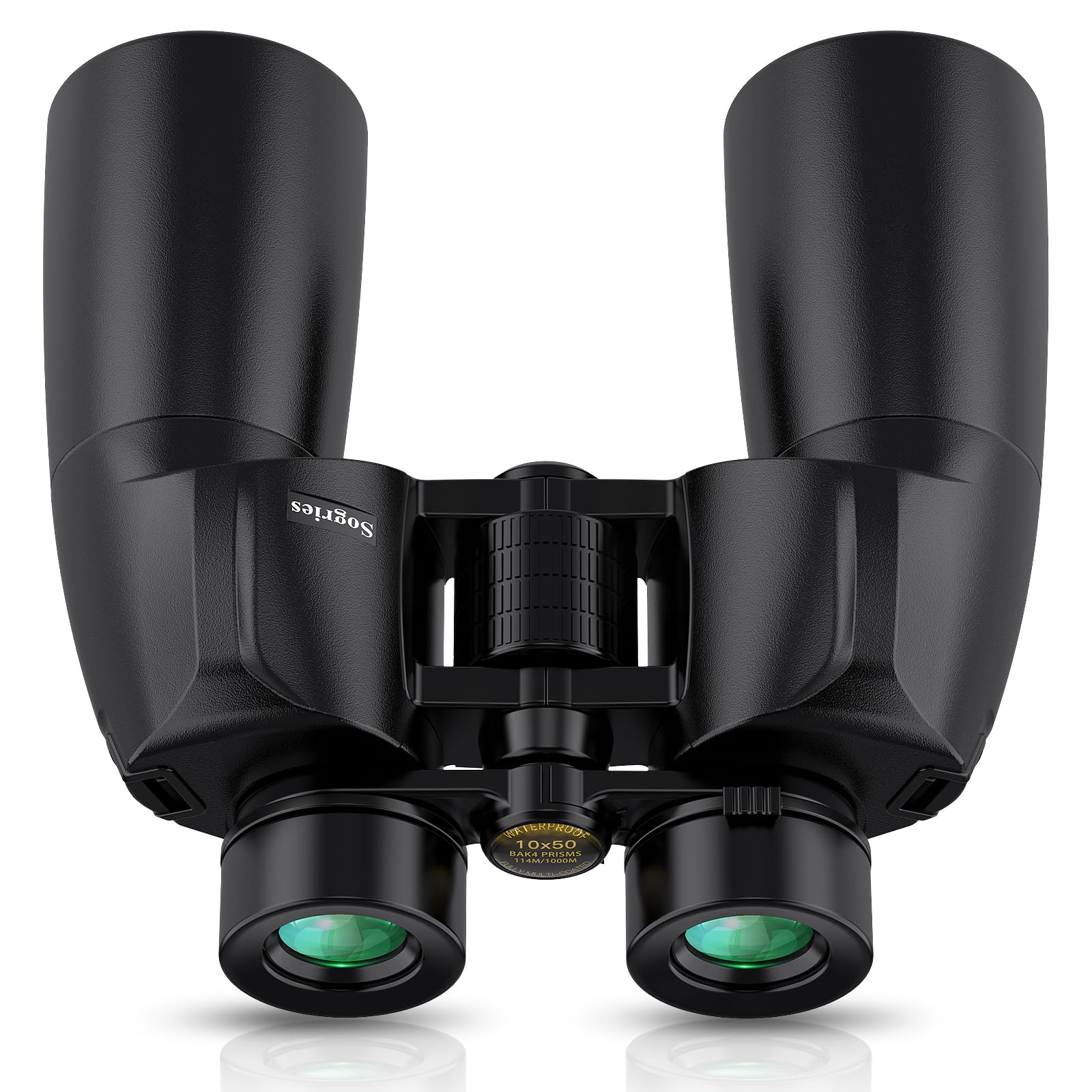
A budget-friendly stargazer that reveals Jupiter’s moons from your backyard.
This binocular is built for stargazing, with high-index BaK-4 prisms (a type of glass that boosts light transmission) and 50mm objective lenses (the front lenses that gather light) to capture far more light than smaller travel models. Customers note crisp views of Jupiter’s moons and the Orion Nebula from light-polluted suburbs, a strong sign of its night-sky performance.
It’s built for the elements with an IPX7 waterproofing rating (meaning it can withstand immersion in 1 meter of water for 30 minutes) and is nitrogen-filled to stop internal fogging on cold, humid nights. The 22mm eye relief is the longest in this list, so glasses wearers will get the full field of view without removing their specs.
The honest trade-off is weight and bulk. At a hefty 1.43 kg, this is not a travel companion; owners recommend a sturdy tripod for extended stargazing. Untethered lens caps also get flagged as a minor annoyance, a safety risk for the glass.
Where it Shines
- Impressive low-light capability for celestial viewing at a fraction of the cost of dedicated astronomy glass.
- Quality is the most praised aspect, with clear optics for both sky and land.
- Waterproof and fog-proof construction make it reliable for boats and stormy hikes.
Who it Isn’t For
- Too heavy and bulky for travel or long hikes; this is a deliberate, stationary tool.
- Untethered lens caps are easy to lose in the field.
Pick this up if: Your main goal is a gateway into astronomy, or you want a weatherproof binocular for a fixed spot like a cabin deck or boat.
Give it a pass if: You need something to sling around your neck for miles of trail hiking.
6. Celestron Outland X 10×50 Binoculars

A rugged, wide-view hunter that brings dim forest edges into vivid focus.
Celestron is a trusted optics brand from California, and the Outland X lives up to that name, with 50mm objective lenses and BaK-4 prisms to deliver bright, color-accurate images in low light. It offers a generous 289-foot field of view at 1,000 yards, which makes following moving wildlife across a field noticeably easier.
It is built for the outdoors, with a rubber-armored polycarbonate body that protects against bumps and drops. The housing is both waterproof and nitrogen-purged, so internal fogging is a non-issue when moving from cold air into warm, humid spaces. It is also tripod-adaptable for those long, steady observation sessions.
Owners generally praise its construction, and it’s proven itself on an Alaskan cruise. A recurring negative is a quality-control issue with the right eyepiece alignment, with several buyers reporting it not twisting up or down smoothly, so check that mechanism on arrival.
The main draw: Lots of light-gathering power in a compact 10×50 body, ideal for dawn patrols and long-distance viewing over water.
Watch out for: A few units ship with a stiff or sticky eyepiece; test the twist-up cups as soon as it arrives.
7. Bushnell Engage X 10x42mm Binoculars

A rugged, weatherproof hunting optic with a lens coating that sheds water and grime.
Bushnell’s Engage X series is designed for the hunter who sits in a treestand through rain and snow. Its signature feature is the EXO Barrier, a permanent coating that repels water, oil, fog, dust, and debris from the lens surfaces, which means less time cleaning smudges and more time locked on the target.
You get clear, true-to-life colors thanks to extra-low dispersion glass (a lens type that reduces color fringing), and a 7-degree field of view lets you scan a wide area for game across a field. It is also IPX7 waterproof, meaning it can survive immersion in 1 meter of water for 30 minutes, so it will not fog up in rain or damp conditions.
Weighing in at under 2 lbs, it manages to keep the profile light despite the heavy-duty build. The full lifetime Ironclad Warranty and high owner satisfaction underscore its reputation as a quality set of binoculars for hunting and travel.
Why it’s a Hunter’s Pick
- The EXO Barrier keeps exterior glass clear in rain, mud, and humidity.
- Quality and image quality are the most praised aspects, with vibrant, clear visuals.
- At only 2 lbs, it’s remarkably lightweight for a fully-featured model.
The Minor Gripes
- Focus mechanism gets mixed feedback; some find it smooth, others a bit stiff.
- The included case is serviceable but not premium, reflecting the mid-range price.
Best suited for: The dedicated hunter or hiker who needs a dependable, waterproof tool that works flawlessly in a downpour.
Who might pass: Casual users who don’t need the ruggedness may find better value in simpler models.
8. Nikon PROSTAFF P3 10×42 Binocular

This Nikon model balances sharp optics with a price that suits most buyers, giving you clear views without overspending.
Nikon brings its reputation for vivid color to the PROSTAFF line. The 10×42 model uses large objective lenses and advanced multilayer coatings that minimize reflections while boosting brightness and contrast, giving you the crisp view Nikon is known for—reviewers point out seeing individual feathers on birds from 50 feet away.
It’s a solid choice for any outdoor activity, from weekend birding to NFL games from the nosebleed section. Its wide 367-foot field of view is the widest on this list, making it incredibly easy to scan a tree line or follow a running quarterback. The turn-and-slide eyecups and long 15.7mm eye relief make it comfortable for glasses wearers.
The ergonomic design is a strong suit, with a smooth central focus wheel for quick, precise adjustments. Owners universally praise its quality and clarity, noting it handles varied light conditions well.
Standout Features
- The 367-foot field of view makes tracking moving subjects easy.
- Top-tier clarity, allowing you to pick out individual details at distance.
- Lightweight and easy to handle for long periods of use.
Minor Complaints
- The included lens covers are a weak point; some find them useless and replace them.
- Some edge softening might be visible to very discerning eyes, but it’s unnoticed in normal use.
A wise upgrade: If you’re moving up from a budget model, this is the most logical step for better clarity without a massive price jump.
A final note: Budget for a third-party lens cap; the stock ones frustrate some owners.
9. Vortex Viper HD Roof Prism Binoculars 10×42

A high-end hunter’s tool with exceptional low-light clarity and buttery-smooth focus.
The Viper HD sits at the top of Vortex’s performance line, and its price reflects that. It’s built to a higher standard, with a high-density optical system delivering exceptional resolution and edge-to-edge clarity that serious hunters demand.
The key is the XR anti-reflective lens coating, which pulls in every photon of available light for stunning views in low-light situations—a true advantage in the last hour of legal hunting light. It’s purged with argon gas (not just nitrogen), providing a lifetime of waterproof and fogproof performance, which Vortex backs with their unlimited, unconditional VIP warranty.
Ergonomics are top-notch, with perfectly placed thumb indents and a smooth, center focus wheel that offers fine, precise control. Owners praise the clarity, balance, and bright view, especially in low light. Some find the focus wheel stiffens in cold weather with gloves on, and others note the eyecups retract a bit too easily.
The High-End Perks
- The XR coatings make it a true specialist for dawn and dusk glassing.
- Argon purging and O-ring seals ensure reliable, all-weather performance.
- The included GlassPak harness enables comfortable, hands-free, all-day carry.
The Honest Trade-Offs
- It’s the most expensive pick here, so it’s an investment for dedicated enthusiasts.
- High-end price doesn’t eliminate minor quirks like stiff cold-weather focus.
Worth the stretch for: The serious hunter or birder who spends hours in the field and needs premium low-light performance and edge-to-edge sharpness.
Think twice if: You’re a casual user—the price is a lot to pay for features you might not fully use.
Understanding the Specs
Exit Pupil: The Brightness Formula
The exit pupil is the diameter of the beam of light that hits your eye, calculated by dividing the objective lens size by the magnification. A larger exit pupil, like the 5mm output of a 10×50, means more light reaches your eye. That’s why they perform better in low-light conditions—your eye can easily align with the beam. A smaller exit pupil (like 4.2mm) still works well in daytime.
Field of View: The Tracking Tool
Field of view is how much horizontal space you see at 1,000 yards, usually measured in feet. A wider field (like 367 feet on the Nikon) is a massive advantage when trying to locate and follow a bird in dense brush or a player crossing the field. A narrow view (like 170 feet on the Bushnell) makes you hunt for the subject, which can be frustrating for tracking movement.
Eye Relief for Glasses Wearers
Eye relief is the distance between your eye and the eyepiece lens where you can still see the entire image. If you wear glasses, you need long eye relief—generally 15mm or more—so you can keep your glasses on and still see the full picture without “blacking out” the edges. The Sogries at 22mm and Bushnell Engage X at 18mm are standouts for glasses wearers.
Nitrogen or Argon Purging
Waterproofing is great, but fog-proofing is what keeps your view clear. High-quality binoculars purge the internal air with an inert gas like nitrogen or argon, replacing the moisture-laden oxygen. When you move from a cold car to a warm, humid forest, gas purging prevents condensation from forming inside the lenses, keeping your view sharp a major step up from a simple seal.
FAQ
Is 10x magnification better than 8x for binoculars?
What does 10×42 mean on binoculars?
Do I need a tripod for 10x binoculars?
Are 10×50 binoculars too heavy for travel?
What is eye relief and why does it matter?
What is the difference between BaK-4 and BK-7 prisms?
Are more expensive binoculars worth the price difference?
How do I adjust binoculars for my eyes?
Final Thoughts: The Verdict
For most people, the 10x binoculars winner is the Vortex Copperhead HD because it balances exceptional clarity, effective light transmission, and a lifetime warranty into one go-anywhere package. If you want a premium tool for low-light hunting conditions, grab the Vortex Viper HD. And for the traveler who wants a pocketable companion, the Leupold BX-1 Rogue is the one to reach for.
How We Picked
We do not accept paid placement. Every pick is matched to a real buyer and a real use-case; we do not hands-on test units.
Sources & Methodology
Specifications: manufacturer listings and product documentation. Review insights: verified customer reviews, as of September 2026. Pricing: not shown on this page (it changes often); check the current price via the retailer link.
As an Amazon Associate, Gadgets Feed earns from qualifying purchases. This does not affect which products we feature.