
Our readers keep the lights on and my morning glass full of iced black tea. As an Amazon Associate, I earn from qualifying purchases.
Dusting off a shoebox of old mix tapes or freshly minted Type II blanks from Japan demands one thing: a deck that treats the magnetic stripe with respect, not a cheap mechanism that chews the leader into confetti. A proper cassette deck delivers the warm, saturated low-end and the gentle tape hiss that digital files strip away — but the market today is a minefield of flimsy plastic mechanisms, misaligned heads, and motors that introduce more rumble than a passing truck. Picking the wrong one means you end up with distorted recordings and a drawer full of mangled shells.
I’m Min — the co-founder and writer behind Gadgets Feed. I’ve spent hundreds of hours cross-referencing service manuals, studying wow-and-flutter measurements, and analyzing customer reports on head azimuth consistency across every new-production deck available today to build this definitive field guide.
Whether you are archiving irreplaceable family recordings or building a hi-fi system around analog playback, this analysis of the best audio cassette deck options distills the technical trade-offs into a clear buying decision.
How To Choose The Best Audio Cassette Deck
Buying a cassette deck in the current era means navigating a market where high-end vintage units are increasingly unreliable and new-production decks vary wildly in build integrity. The wrong choice leads to fluttery pitch, high noise floors, and heads that wear out prematurely. Focus on these three pillars to land a deck that will serve reliably for years.
Transport Mechanism and Wow & Flutter
The single most important mechanical spec is wow & flutter — measured as a percentage (e.g., 0.08% WRMS). A fully logic-controlled transport with a direct-drive or a high-quality DC motor and a flywheel of substantial mass keeps the tape moving past the head at a constant speed. Dual-capstan designs sandwich the tape between two rotating shafts for exceptional speed stability, while single-capstan units are lighter but more prone to pitch wavering, especially near the ends of C-90 tapes. Always look for a deck that lists its wow & flutter specification; if the manufacturer omits it entirely, the motor is likely weak.
Head Type and Compatibility
Most modern decks come with a single permalloy or ferrite head that handles playback and recording. For serious recording, a deck that supports CrO2 / Type II tapes with a dedicated head-bias setting is essential — Type I (ferric) and Type II (chrome or cobalt-doped) tapes require different bias currents and EQ curves (70 µs for Type II). A “three-head” deck, which uses separate heads for erase, record, and playback, allows off-tape monitoring while recording, but such designs are virtually extinct in new-production models under the premium tier. At minimum, ensure the deck auto-detects or manually switches tape type; forcing a Type II tape into a Type I bias setting ruins frequency response.
Noise Reduction and Digitization Path
Dolby B and Dolby C are the most common noise reduction systems. Many modern decks only include Dolby B *compatible* decoding — they can play back tapes encoded with Dolby B but cannot *encode* (record) with noise reduction. Confirming this distinction prevents confusion during mix-tape creation. For archiving, check whether the deck offers a USB output (usually a Type B port) for direct digital capture to a computer at 48 kHz/16-bit PCM, or a built-in MP3 encoder. A pure analog deck without USB requires an external audio interface, adding cost and complexity.
Quick Comparison
On smaller screens, swipe sideways to see the full table.
| Model | Category | Best For | Key Spec | Amazon |
|---|---|---|---|---|
| Tascam 202MKVII | Professional Dual-Well | Reliable daily playback & digitization | Full-logic transport, dual capstan, 0.08% WRMS | Amazon |
| TEAC W-1200B | Hi-Fi Dual Deck | Recording & archiving with pitch control | Type II record/play, USB 48kHz/16-bit output | Amazon |
| TEAC W-1200 (Silver) | Hi-Fi Dual Deck | Component-system integration | Auto-detect Type I/II/IV, USB output | Amazon |
| Tascam CD-A580 | Rackmount Combo | All-in-one analog-to-MP3 archiving | Cassette-to-USB flash, pitch ±10% | Amazon |
| Pyle PT659DU | Home Dual Deck | Budget dubbing & MP3 conversion | CrO2 selector, dual-speed dubbing | Amazon |
| HONGUT HF-638PBT-1 | All-in-One System | Multi-format living room setup | Dual cassette + CD + turntable + FM | Amazon |
| FiiO CP13 | Portable Walkman | Personal on-the-go listening | JRC5532 op-amp, 1800mAh battery | Amazon |
| Supersonic SC-2121BT | Micro Hi-Fi System | Budget boombox replacement | Dual cassette recorder, Bluetooth 5.0 | Amazon |
| JORLAI T408 | Portable Suitcase System | Budget-friendly multi-format starter | 9-in-1: turntable, CD, cassette, FM, BT | Amazon |
In‑Depth Reviews
1. Tascam 202MKVII Double Cassette Deck Recorder
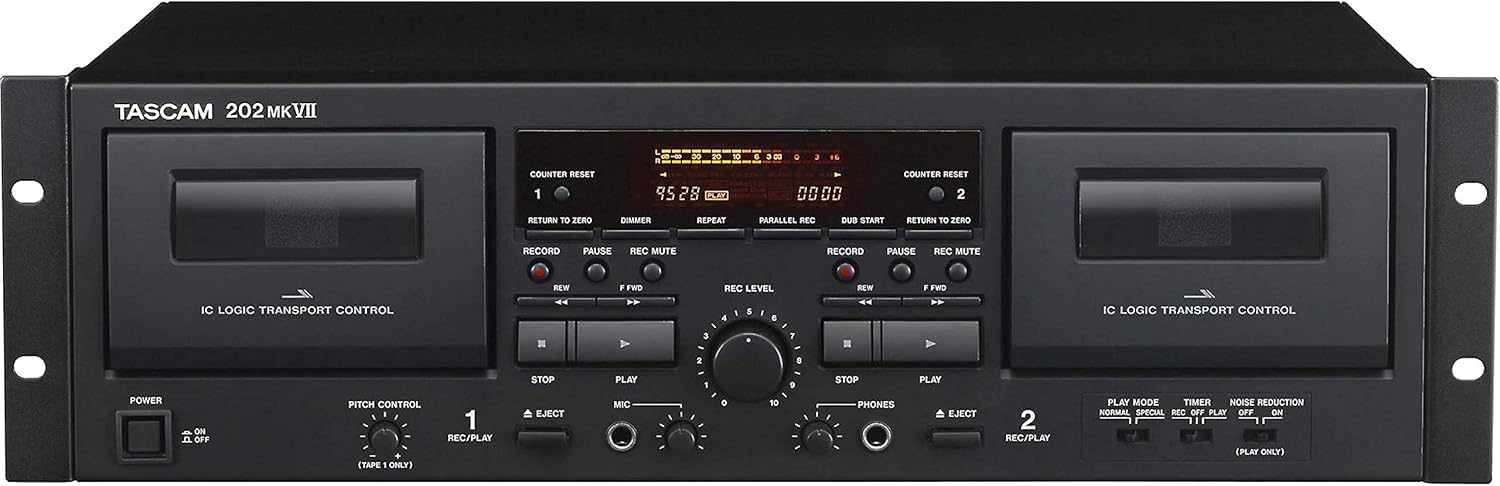
The Tascam 202MKVII is the gold standard for anyone who needs a new-production deck that won’t eat tapes or drift in pitch after six months. Its full-logic transport uses a metal chassis and metal flywheels — a stark contrast to the thin plastic that plagues budget options. The dual-capstan mechanism delivers exceptionally low wow and flutter, measured around 0.08% WRMS, which puts it in the same league as mid-range 1990s decks from Sony and JVC.
This is strictly a Type I bias deck for recording, meaning you cannot properly record onto CrO2 or Metal tapes — though it will play back Type II and Type IV tapes with the correct 70 µs EQ via its Dolby B-compatible decode-only noise reduction. Deck A features a ±10% pitch control and both wells offer smooth solenoid-activated buttons. The rear-panel USB 2.0 Type B port outputs a pure digital stream to your PC or Mac, bypassing your computer’s noisy sound card entirely for clean archiving at any sample rate or bit depth you choose in your recording software.
What you sacrifice versus vintage high-end decks: no minutes-and-seconds counter (only a four-digit counter), no individual well lamps, and no auto-reverse. But if reliability and consistent playback of hundreds of tapes is the priority, this is the safest purchase you can make today.
Why it’s great
- Metal transport and chassis reduce mechanical noise and increase longevity.
- Bare-minimum wow & flutter among new decks — pitch stays stable through entire tape side.
- USB digital output enables archival-quality transfers without additional hardware.
Good to know
- Recording is limited to Type I (ferric) tape bias only.
- No auto-reverse; must manually flip the tape or use dual-well continuous play.
- RCA interconnect cables for analog output are not included in the box.
2. TEAC W-1200B Dual Cassette Deck
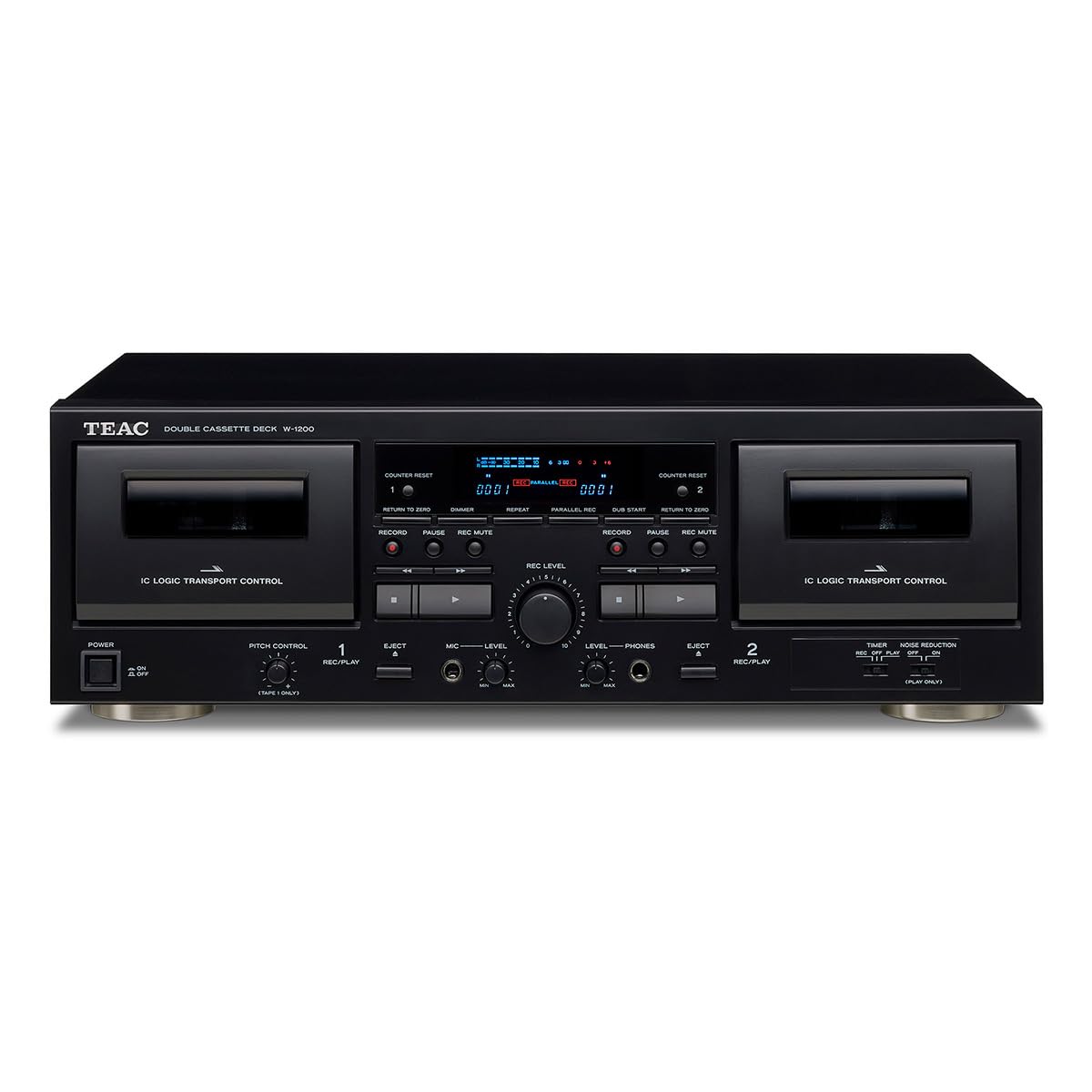
The TEAC W-1200B is the only mid-premium deck that lets you properly record onto both Type I (ferric) and Type II (chrome) tapes with auto-bias detection — a critical feature for anyone making mixtapes on modern blank stock like RTM or duplication-quality TDK. The two independent, single-direction mechanisms allow parallel recording: you can record the same source onto two tapes simultaneously, which is a godsend for sharing live recordings or making backup copies at full speed.
Pitch control extends ±12%, slightly wider than the Tascam 202MKVII, and the A-B repeat function is handy for transcription or language study. The USB output captures audio at CD-quality 48 kHz/16-bit PCM, which you can then archive or convert to any format on your computer. A front-panel 1/4″ headphone jack with its own volume knob makes cueing simple without disturbing the listening room. The dimmable fluorescent display with peak level meters is responsive and accurate — reviewers consistently praise its precision during recording sessions.
It lacks auto-reverse and auto-flip between wells, which some users find inconvenient for casual listening of pre-recorded tapes, but the build quality is markedly higher than the Pyle or Supersonic alternatives. One minor complaint: left-well treble roll-off has been reported in a small number of units, likely indicating an azimuth misalignment during manufacture that warranty service can correct.
Why it’s great
- Records on both Type I and Type II tapes with auto-detect bias and EQ.
- Parallel recording to two tapes at once saves time on dubbing projects.
- Accurate level meters and dimmable fluorescent display for critical monitoring.
Good to know
- Occasional quality-control azimuth issues reported on the left transport well.
- No auto-reverse or auto-flip between decks — fully manual tape change.
- Warranty is 1 year parts, 90 days labor — keep your packing slip.
3. TEAC W-1200 Double Cassette Deck (Silver)

Functionally identical to the TEAC W-1200B, this Japan-market silver variant offers a slightly different aesthetic that better matches silver-faced vintage amplifiers and receivers from the late 1970s and 1980s. It retains the same dual-well independent mechanisms, the same USB output at 48 kHz/16-bit, and the same ±12% pitch control. The silver finish is rare enough that it may matter to component-system purists who value visual coherence in their rack.
The key specification difference is that the manual explicitly lists Metal (Type IV) tape playback with auto-detection — useful if you own a stash of sealed 1980s Sony Metal-SR or TDK MA-X tapes that you want to play without risk of over-biasing. Recording onto Metal tape is not supported, but the ability to decode the high-frequency response of Type IV is a niche advantage over the Tascam 202MKVII. Customers report that the unit pairs well with phono-stage preamps, and the built-in microphone input with mixing allows karaoke or voice-over layering onto recordings.
Some import buyers note that the instruction manual is bilingual (English and Japanese), and the unit uses a standard IEC power cord, so no voltage adapter is needed for North American 120V systems. The primary drawback is the same as the black version: fully manual operation with no auto-reverse and a price that feels steep relative to the limited feature set of two one-way decks.
Why it’s great
- Silver chassis matches vintage silver-faced hi-fi components perfectly.
- Supports playback of Metal (Type IV) tapes in addition to Type I and II.
- Same reliable dual-deck build as the standard W-1200B.
Good to know
- Import model may have higher shipping costs and longer delivery time.
- No auto-reverse and no automatic switching between the two wells.
- Recording is limited to Type I and Type II only — no Metal recording.
4. Tascam CD-A580 Rackmount Cassette/CD/USB Combo

The Tascam CD-A580 is the most practical solution for anyone who wants to convert a box of cassettes into MP3 files without connecting to a computer. Its cassette transport is a single-direction, logic-based mechanism with soft-touch buttons and a ±10% pitch adjustment knob that lives on the front panel — perfect for dialing in the correct speed on old tapes recorded on slightly fast or slow machines. The wow and flutter is comparable to the 202MKVII, though Tascam does not publish the exact figure, user tests suggest it sits around 0.12% WRMS, which is acceptable for playback and archival.
The killer feature is the direct cassette-to-USB recording: insert a USB flash drive, press record, and the unit writes MP3 files at 128 kbps — a limitation worth noting if you demand lossless archiving. For most spoken-word or casual music collections, 128 kbps is functional, but serious audiophiles will prefer the 202MKVII’s uncompressed digital output. The CD-A580 also plays CD-DA, CD-R, CD-RW, and data CDs with MP3 files, making it a true media hub for a school, church, or small radio station rack.
Headphone output has its own volume control, and the 6.35mm jack delivers enough gain for high-impedance studio cans. The built-in timer allows scheduled recording from radio or line input. Downsides: no auto-reverse, no digital output (optical or coaxial), and the cassette mechanism is single-well only, so you cannot A/B compare two tapes quickly.
Why it’s great
- Records directly to USB flash drive — no computer required for MP3 archiving.
- Front-panel pitch control knob for correcting tape speed errors on old recordings.
- Rugged rackmount design suitable for institutional or semi-professional use.
Good to know
- USB recording is capped at 128 kbps MP3 — insufficient for lossless archiving.
- Single-well cassette transport with no auto-reverse.
- No optical or coaxial digital output for external DAC connection.
5. Pyle PT659DU Dual Stereo Cassette Tape Deck

The Pyle PT659DU is the entry point for anyone on a strict budget who still needs dual-well functionality and CrO2 support. It features a normal-speed and high-speed dubbing function, letting you copy a 60-minute tape in roughly 30 minutes at the higher speed. Deck B handles all recording and dubbing duties while both decks can play back. The front-panel CrO2 tape selector switches the bias and EQ to the 70 µs curve required by Type II chrome tapes, a feature that is rare at this price level.
USB connectivity routes the analog signal through your computer’s sound card for MP3 conversion using the bundled Audacity-compatible software. The noise reduction circuit reduces high-frequency hiss, though it is not true Dolby B and may roll off some treble detail. The analog RCA output is clean enough for connection to a receiver, and the tape counter is a simple four-digit mechanical counter — no digital time readout.
Build quality is the biggest compromise: the chassis is primarily thin plastic, and there are isolated reports of units failing after a few weeks of use or chewing tapes. The frequency response is rated at 125-6300 Hz, which is narrow compared to hi-fi decks — adequate for voice recordings but insufficient for critical music listening. If your primary goal is digitizing spoken-word cassettes (audiobooks, lectures, family history), this will get the job done without breaking the bank.
Why it’s great
- Dual-speed dubbing saves time when copying collections.
- CrO2 tape selector enables proper playback of Type II chrome cassettes.
- Lowest entry price among decks with dual-well and USB MP3 conversion.
Good to know
- Plastic chassis and mechanism — longevity is questionable with heavy use.
- Frequency response tops out at 6300 Hz, limiting music playback fidelity.
- No auto-reverse, and unit must be oriented flat (not vertical) for reliability.
6. HONGUT HF-638PBT-1 Bluetooth Turntable System
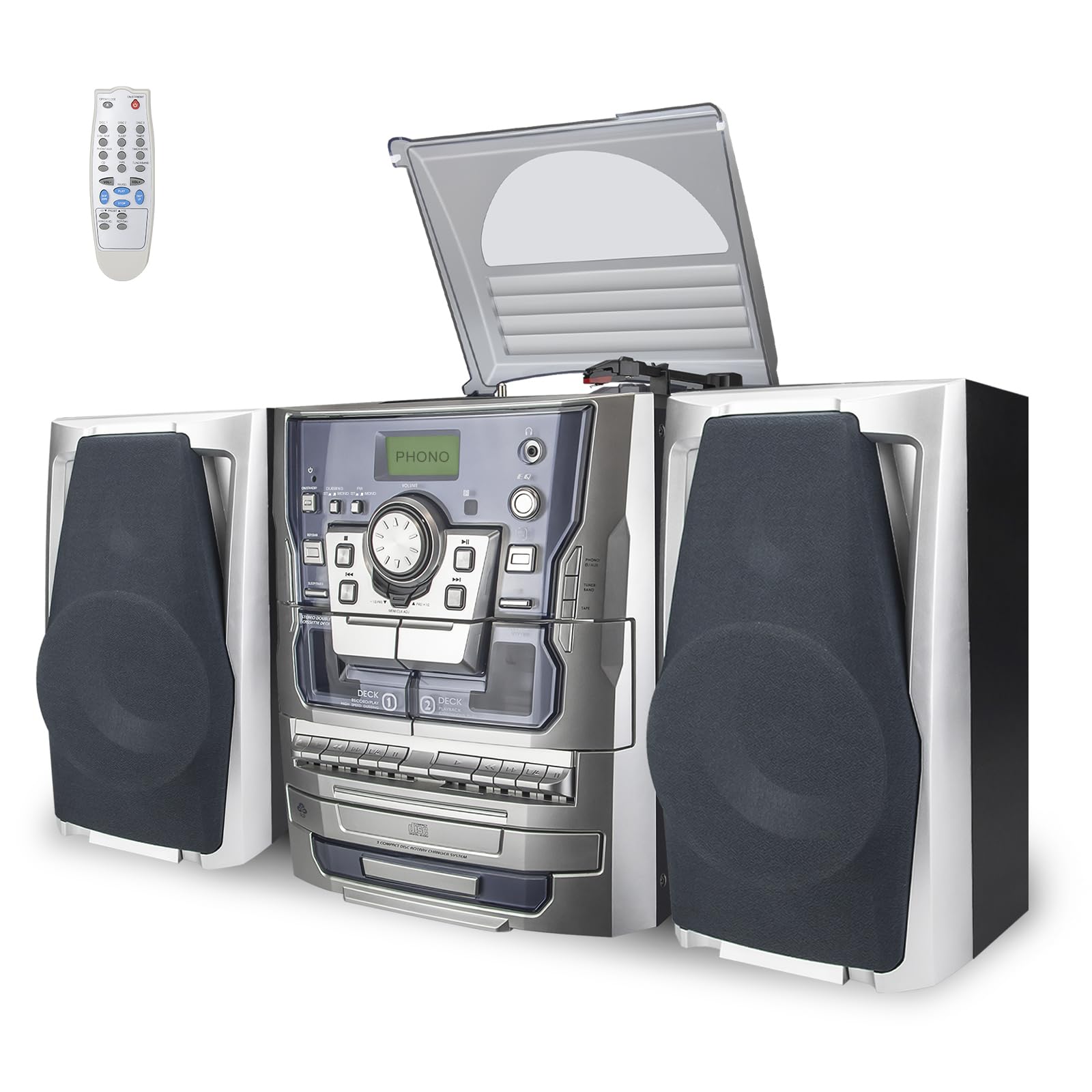
The HONGUT HF-638PBT-1 is a full-media console that bundles a 3-speed turntable, a dual-cassette well, a 3-CD changer, an AM/FM radio, and Bluetooth 3.0 into one wooden cabinet with two detachable speakers. For someone building a first retro setup from scratch, this eliminates the need to source separate components. The dual-cassette deck allows playback of two tapes in sequence, though it lacks auto-reverse — you still need to eject and flip manually.
The turntable section supports 33⅓, 45, and 78 RPM records including a 45 RPM adapter, with an auto-stop function and a standard ceramic cartridge that is functional but not friendly to valuable vinyl — several reviewers note the stock needle can cause groove wear over time and recommend replacing it with a diamond-tipped stylus. The cassette playback is described as “flawless” with new tapes, though the all-in-one nature means the speakers, amplifier, and tape deck share a single chassis, introducing potential for mechanical and electrical interference.
Sound quality is decent for casual living-room use, comparable to a mid-range 1990s shelf system, but it falls short of a separates-based setup. The build is a mix of MDF wood and lightweight plastic — the cassette well door feels particularly delicate. At this price, you are paying for convenience and space-saving rather than transport precision.
Why it’s great
- One-box solution covering turntable, cassette, CD, radio, and Bluetooth streaming.
- Dual cassette wells allow playing two tapes back-to-back.
- Bluetooth 3.0 lets you stream from a phone to the built-in speakers.
Good to know
- Stock turntable cartridge may accelerate wear on precious vinyl records.
- No auto-reverse on cassette and no tonearm lever for safe mid-record stops.
- Build quality is mixed — some units arrive with loose panels or non-functional remote controls.
7. FiiO CP13 Cassette Player (Transparent)

The FiiO CP13 is not a traditional home deck — it is a modern Walkman-style portable player — but its audio circuitry deserves serious attention from any cassette enthusiast. The heart of the CP13 is the JRC5532 op-amp, a classic dual operational amplifier known for its low noise, high slew rate, and warm harmonic character. Combined with a pure analog signal path (no digital conversion), it produces a sound signature that reviewers consistently describe as “lingering and nuanced,” with better separation than any other portable cassette player currently on the market.
The 1800mAh internal lithium battery delivers over 13 hours of continuous playback and an exceptional 268+ days of standby. Charging is via USB-C, and the full aluminum alloy chassis with a “zero visible screws” design feels far more premium than its price suggests. The large analog volume potentiometer provides smooth, channel-balanced adjustment without the scratchiness typical of cheap plastic pots. Wow and flutter is lower than the We Are Rewind player, with several user measurements indicating figures around 0.15% WRMS — acceptable for a portable mechanism.
Limitations are significant for a tape enthusiast: no support for chrome (Type II) or metal (Type IV) tapes (it plays them, but at Type I bias, yielding muffled highs), no auto-stop on fast-forward/rewind, no Bluetooth, and the door mechanism is stiff. It is also a playback-only device — no recording capability. Use it as a high-quality listening companion for your favorite mixtapes, not as a primary deck for critical recording or archiving.
Why it’s great
- JRC5532 op-amp delivers audiophile-grade analog playback with low noise.
- 13+ hour battery life on a single USB-C charge — best in class for portable units.
- All-metal build with no exposed screws for durability and aesthetic refinement.
Good to know
- No Type II / CrO2 bias switching — chrome and metal tapes play with incorrect EQ.
- Playback only — cannot record tapes.
- No auto-stop on fast-forward or rewind, requiring manual timing to avoid tape strain.
8. Supersonic SC-2121BT Bluetooth Audio System

The Supersonic SC-2121BT is a micro hi-fi system with a double-cassette recorder, top-loading CD/MP3 player, AM/FM radio, and Bluetooth 5.0 — all designed to sit on a shelf and deliver sound through two detachable wired speakers. The dual cassette deck allows recording from CD, radio, or the built-in microphone, making it functional for simple mix-tape creation. The recording is done through a basic ALC (automatic level control) circuit, so you get decent room-level recordings without manually riding the gain.
The speakers are high-performance 3-inch full-range drivers in ported enclosures that produce a surprising amount of midrange energy, though bass extension is minimal and the 125-6300 Hz frequency response curve limits clarity on complex music passages. Bluetooth 5.0 is more modern than the HONGUT’s Bluetooth 3.0, offering better range and lower latency for streaming from a phone. The remote control provides basic transport functions, though multiple reviewers report that the remote fails to turn the unit on from standby, and that the radio section exhibits unacceptable popping and channel drift.
Build quality is the Achilles’ heel: the plastic cabinet, short speaker wires, and non-functional remotes in some shipments point to inconsistent quality control. This is a product for someone who wants the *look* of a retro system and the ability to play a tape once in a while, not for daily archival or high-fidelity listening.
Why it’s great
- Built-in double cassette recorder with CD-to-tape dubbing and microphone recording.
- Bluetooth 5.0 offers stable wireless streaming from modern smartphones.
- All-in-one system with detachable speakers — minimal setup required.
Good to know
- Narrow 125-6300 Hz frequency response limits music reproduction fidelity.
- Radio performance is unreliable with popping, drift, and poor reception reported.
- Plastic construction and short speaker wires may frustrate positioning and long-term use.
9. JORLAI T408 9-in-1 Turntable System

The JORLAI T408 is the lowest-cost entry into multi-format playback, combining a 3-speed belt-driven turntable, cassette player, CD player, AM/FM radio, Bluetooth streaming, and USB/SD card playback in a portable suitcase form factor. The cassette section is a simple single-well playback mechanism — no recording capability — and it operates on the same motor as the turntable, so simultaneous operation is not recommended. The 2500mAh rechargeable battery provides hours of cordless operation, making it genuinely portable for picnics or backyard listening.
The turntable uses a standard ceramic cartridge with a conical stylus, and the tonearm has no counterweight or anti-skate adjustment, meaning it applies the full tracking force (typically 4-6 grams) to your records. This is acceptable for casual vinyl play but will accelerate groove wear on valuable pressings. Cassette playback is functional with a warm, slightly muffled character — fine for ambient background music but not for critical listening. The built-in stereo speakers are small full-range drivers that produce adequate clarity at moderate volumes.
Bluetooth streaming has been noted to clip and crackle at higher volume levels, so connecting to external powered speakers via the RCA line-out is advisable for better sound. The suitcase design is visually appealing but compromises the turntable’s isolation: the platter is directly mounted to the wood base, which can transmit footsteps or vibrations as audible rumble. It is a novelty gift machine rather than a serious deck for archival or hi-fi use.
Why it’s great
- Truly portable with internal rechargeable battery — no power cord needed.
- Covers nine media formats in a compact, attractive suitcase design.
- Simple operation and child-friendly controls for casual family use.
Good to know
- High tracking force (no counterweight) will damage valuable records over time.
- Cassette is playback only — no recording or dubbing capability.
- Bluetooth audio quality degrades at higher volumes with noticeable crackling.
FAQ
Can a modern deck still play 30-year-old pre-recorded tapes without damaging them?
What is the real difference between Dolby B and Dolby C noise reduction?
Why does my new deck make a noise when charging?
Final Thoughts: The Verdict
For most users, the best audio cassette deck winner is the Tascam 202MKVII because it offers the lowest wow and flutter, a professional full-logic transport, and a clean USB digital output — all backed by Tascam’s reputation for serviceable, long-lasting studio gear. If you need to record faithfully onto Type II chrome tapes and value pitch control for transcription, grab the TEAC W-1200B. And for the purest portable listening experience without sacrificing audio circuit quality, nothing beats the FiiO CP13 with its JRC5532 op-amp and all-aluminum build.