
Buying your first interchangeable-lens camera is a maze of sensor sizes, mount systems, and confusing spec sheets that can paralyze a beginner before they’ve even taken a single shot. The real pain isn’t choosing between brands — it’s finding a camera that delivers genuine image-quality upgrades over a smartphone without requiring a photography degree to operate.
I’m Min — the co-founder and writer behind Gadgets Feed. I’ve spent hundreds of hours cross-referencing sensor resolution, autofocus point coverage, burst rates, and lens ecosystem depth to separate the cameras that truly serve newcomers from the ones that just claim to.
Determining which interchangeable-lens cameras actually justify their cost for a first-time buyer is the mission behind this guide to the best affordable cameras for beginners.
How To Choose The Best Affordable Cameras For Beginners
The most common mistake new buyers make is fixating on megapixel count while ignoring the camera’s autofocus system, sensor size, and lens compatibility. A 24-megapixel sensor is useless if the autofocus can’t track a moving child or pet. For beginners, the path to better photos runs through faster focusing, larger sensors, and a versatile lens ecosystem, not higher pixel density.
Sensor Size: APS-C vs. Full-Frame
APS-C sensors are the sweet spot for beginners — they offer significantly better low-light performance and depth of field control than smartphone sensors, without the cost and lens expense of full-frame. A full-frame sensor becomes relevant when you need the absolute best dynamic range for landscape or studio work. For family, travel, and everyday shooting, a modern APS-C camera from Sony, Canon, or Panasonic delivers 90% of the image quality at half the system cost.
Autofocus Performance and Coverage
Phase-detection autofocus with face or eye tracking is non-negotiable for beginners. A camera with only 9 or 25 autofocus points forces you to use the center lock-and-recompose method, which misses shots of moving subjects. Look for at least 143 phase-detection points or Sony’s Real-Time Eye AF. The Canon Dual Pixel CMOS AF system is also excellent for both stills and video at this price tier.
Lens Ecosystem and Kit Lens Quality
The kit lens bundled with the camera defines your first year of photography. A stabilized 18-55mm or 12-60mm zoom with a maximum aperture of f/3.5-5.6 is standard, but some kits include a second telephoto lens (75-300mm). More important is the mount system — Canon RF-S and Sony E have strong third-party lens support, while EF-M is a dead end. Investing in a mount with a growing lens library protects your camera body investment.
Quick Comparison
On smaller screens, swipe sideways to see the full table.
| Model | Category | Best For | Key Spec | Amazon |
|---|---|---|---|---|
| Canon EOS R100 | Mirrorless APS-C | Budget mirrorless entry | 24.1MP, 143 AF points, 6.5 fps | Amazon |
| Canon EOS Rebel T7 Bundle | DSLR APS-C | All-in-one starter kit | 24.1MP, 9 AF points, 3.0 fps | Amazon |
| Panasonic LUMIX G85 | Mirrorless Micro 4/3 | Video + stills hybrid | 16MP, 5-axis IBIS, 4K 30fps | Amazon |
| Canon EOS M50 (Renewed) | Mirrorless APS-C | Vlogging on a budget | 24.1MP, Dual Pixel AF, 4K 24p | Amazon |
| Sony Alpha a3000 | Mirrorless APS-C | Budget Sony E-mount entry | 20.1MP, 25 AF points, 1080p | Amazon |
| Canon T7 13-Piece Bundle | DSLR APS-C | Max accessories included | 24.1MP, 9 AF points, 500mm tele | Amazon |
| Sony ZV-E10 | Mirrorless APS-C | Vlog and content creation | 24.2MP, 425 AF points, 4K 30fps | Amazon |
| Canon T7 Double Zoom Kit | DSLR APS-C | Two-lens versatility | 24.1MP, 18-55mm + 75-300mm | Amazon |
| Canon EOS RP | Full-Frame Mirrorless | Entry-level full-frame | 26.2MP, Dual Pixel AF, 4K 24p | Amazon |
| Canon EOS R8 | Full-Frame Mirrorless | Advanced beginner | 24.2MP, 1053 AF zones, 4K 60p | Amazon |
| Sony a7 III | Full-Frame Mirrorless | Pro-level image quality | 24.2MP, 693 AF points, 10 fps | Amazon |
In‑Depth Reviews
1. Sony ZV-E10
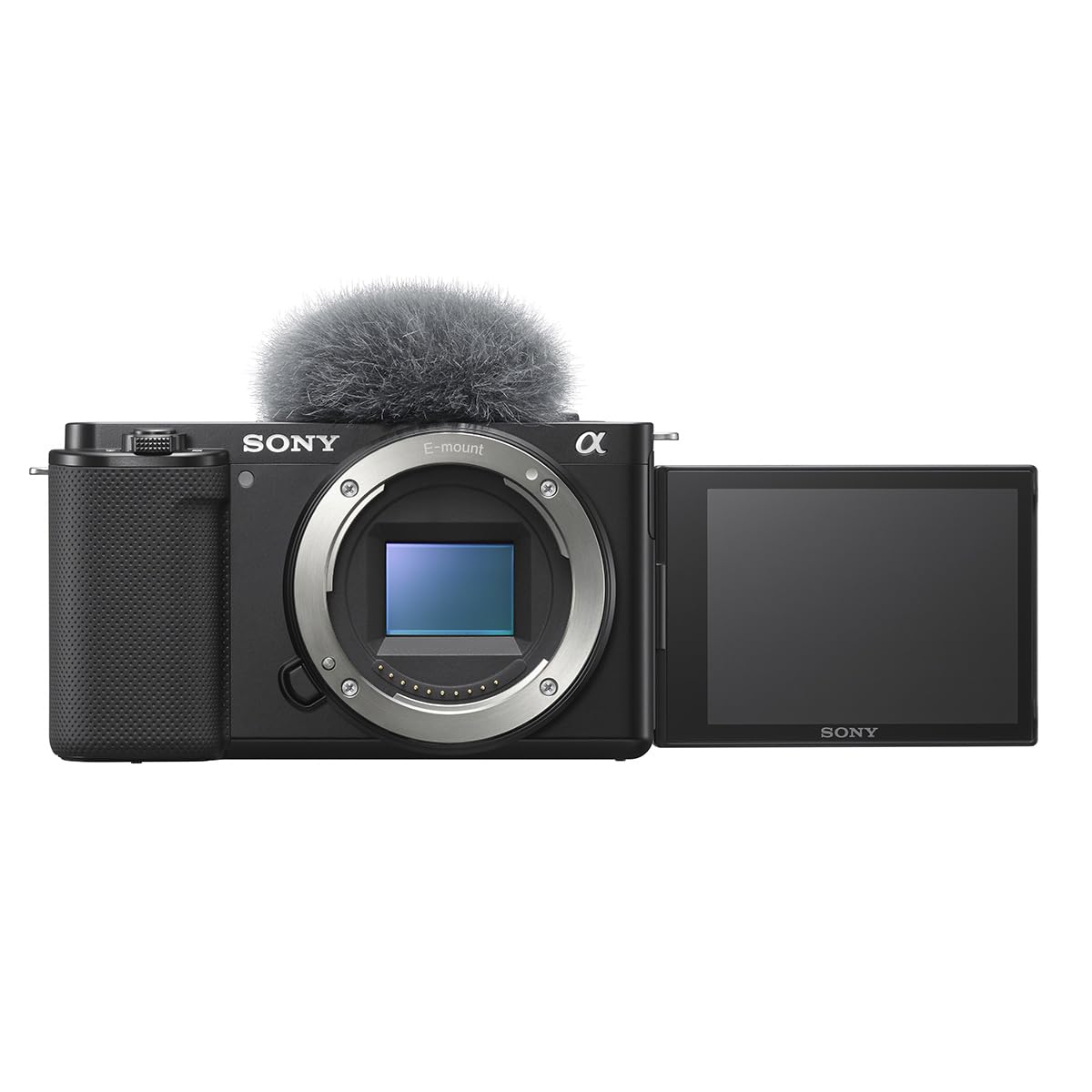
The Sony ZV-E10 brings the proven 24.2MP APS-C Exmor sensor and BIONZ X processor from Sony’s stills-focused lineup into a body purpose-built for content creation. Its Real-Time Eye Autofocus covers 425 phase-detection points across 93% of the frame, making it effortless to keep a moving subject sharp without diving into menu settings. The Product Showcase setting instantly transitions focus from your face to an object held up to the lens — a feature no other camera at this level offers.
Video performance stands out with 4K oversampled from 6K using full pixel readout, delivering noticeably sharper footage than rivals that bin pixels. The flip-out touchscreen faces forward for vlogging, and the Background Defocus button toggles shallow depth of field with one press. Single USB cable live streaming works without capture cards or extra software, which simplifies remote teaching or live Q&A sessions.
The body lacks in-body stabilization, so handheld 4K footage benefits from a gimbal or stabilized lens. Battery life in 4K recording runs about 25 minutes per charge, so a spare is essential for longer shoots. Rolling shutter is noticeable during fast panning. Despite these caveats, the ZV-E10 is the most complete video-stills hybrid for a beginner who wants to grow into serious content creation.
Why it’s great
- Real-Time Eye AF is fast and reliable across a wide coverage area
- 4K oversampled from 6K delivers exceptional sharpness for the price
- Product Showcase and Background Defocus are genuinely useful for content creators
Good to know
- No in-body stabilization — requires a gimbal for smooth handheld 4K
- Battery drains quickly when recording 4K; a spare is mandatory
- Rolling shutter is prominent during fast pans
2. Canon EOS R8

The Canon EOS R8 is effectively the full-frame sensor and DIGIC X processor from the R6 Mark II packaged into Canon’s lightest RF-mount body. It captures uncropped 4K at 60fps oversampled from 6K, and the Dual Pixel CMOS AF II covers the entire frame with 1053 zones and deep-learning subject detection that tracks people, animals, vehicles, and even aircraft. The 40fps electronic shutter with full autofocus is absurdly fast for this price bracket.
Low-light performance is exceptional for a beginner-level full-frame camera, with clean images up to ISO 12800 and usable shots beyond. The vari-angle touchscreen is sharp at 1.62 million dots, and the OLED EVF refreshes at 120fps for smooth composition. Canon Log 3 and HDR PQ output are included for color grading in video post-production — features typically reserved for cameras costing twice as much.
The trade-offs are real. The R8 has no in-body stabilization, so handheld video relies on lens-based IS. The single UHS-II SD card slot offers no backup for paid work, and its LP-E17 battery is rated for roughly 500 stills or under an hour of 4K video. The mechanical shutter maxes at 6fps. If you can tolerate external stabilization and carry spare batteries, the R8 delivers professional-level image quality at a price that redefines entry-level full-frame.
Why it’s great
- Uncropped 4K 60fps oversampled from 6K with Dual Pixel AF II
- 40fps electronic shutter with full autofocus tracking
- Outstanding low-light performance for a camera at this price
Good to know
- No in-body stabilization; lens IS only for video
- Single SD card slot and small LP-E17 battery
- Mechanical shutter limited to 6fps
3. Canon EOS R100

The Canon EOS R100 is the smallest and lightest body in the EOS R series — 356 grams with the RF-S 18-45mm kit lens — making it a natural companion for travel or everyday carry. The 24.1MP APS-C CMOS sensor paired with the DIGIC 8 processor produces the same excellent Canon color science found in higher-end bodies, and Dual Pixel CMOS AF covers 143 zones with human face and eye detection for both stills and video.
Burst shooting reaches 6.5fps in One-Shot AF, and the camera records 4K at 24fps or Full HD at 60fps with an option for 120fps slow motion. The RF-S lens mount gives access to Canon’s growing RF lens ecosystem, including affordable third-party glass from brands like Sigma and Tamron. The optical stabilization in the kit lens delivers up to 4 stops of shake correction, which helps beginners achieve sharper handheld shots.
The R100’s video mode has limitations — 4K recording uses a crop factor, and the touchscreen is a fixed 3-inch LCD rather than a vari-angle design. The menu system is beginner-friendly with a guided Feature Guide, but experienced users will miss the deeper customization of the R50 or R10. For its price, the R100 is the cleanest entry point into the Canon RF system for a pure photography beginner.
Why it’s great
- Smallest and lightest body in the EOS R series — truly travel-friendly
- Dual Pixel CMOS AF with face and eye detection works reliably
- RF-S mount opens the door to Canon’s full RF lens ecosystem
Good to know
- 4K video uses a crop factor and maxes at 24fps
- Fixed LCD screen; no vari-angle for vlogging
- Touchscreen interface is more basic than the R50 or R10
4. Panasonic LUMIX G85

The Panasonic LUMIX G85 stands out as the only camera in this roundup with 5-axis in-body image stabilization (IBIS), which works in tandem with lens-based stabilization for handheld shots that rival gimbal-stabilized footage. The 16MP Micro Four Thirds sensor omits the low-pass filter, boosting fine detail resolution noticeably beyond typical 16MP sensors. The magnesium-alloy body is splash-proof and dust-sealed, unusual for this price tier.
Video recording reaches 4K at 30fps and the 4K Photo mode captures 8MP stills at 30fps with Post Focus — you can change the focus point after taking the shot. The OLED live viewfinder has 2.36 million dots and refreshes smoothly, rivalling much more expensive cameras. The 12-60mm kit lens covers a useful wide-to-short-tele range with Power O.I.S. stabilization that doubles the IBIS effectiveness.
Autofocus in low light is noticeably slower than phase-detection systems in Canon or Sony bodies, especially during 4K video recording. Battery life is short, and there is no headphone jack for monitoring audio. The Micro Four Thirds sensor has a 2x crop factor, which makes it harder to achieve shallow depth of field compared to APS-C or full-frame. For video shooters who prioritize stabilization above all else, the G85 is still a class leader.
Why it’s great
- 5-axis IBIS with Dual I.S. 2 produces exceptionally smooth handheld video
- Weather-sealed magnesium-alloy body is durable beyond its price class
- 4K Photo with Post Focus is a creative tool beginners will love
Good to know
- Autofocus is contrast-based and struggles in low light for video
- Short battery life and no headphone monitoring jack
- Micro Four Thirds sensor limits background blur compared to APS-C
5. Canon EOS M50 (Renewed)

The Canon EOS M50 was one of the most popular beginner mirrorless cameras before Canon pivoted to the RF-S mount, and as a renewed unit it still delivers the core experience at a lower entry point. The 24.1MP APS-C sensor with Dual Pixel CMOS AF provides fast, accurate focusing across 143 zones with human eye detection — exactly the same AF system that made Canon’s DSLR line famous. The OLED EVF with Touch and Drag AF lets you move the focus point using the rear touchscreen while looking through the viewfinder.
Video features include 4K UHD at 24fps and Full HD at 60fps with 120fps slow-motion support. The built-in flash and hotshoe give you lighting options without external gear, and HDMI output works cleanly for streaming or external recording. Body weight with the kit lens is just 522 grams, making it one of the lightest APS-C mirrorless kits available.
EF-M mount is effectively a dead platform — Canon no longer develops new lenses for it, and third-party support is limited. The 4K mode applies a heavy crop factor and lacks Dual Pixel AF. ISO noise becomes noticeable above 3200, and the kit 15-45mm lens is slow in low light. For a beginner content creator who wants Canon color science at a budget-friendly price volume and doesn’t plan on buying many lenses, the renewed M50 is a compelling choice.
Why it’s great
- Dual Pixel CMOS AF is fast, accurate, and beginner-friendly
- Compact and lightweight body with an OLED EVF at a low price
- Canon color science and JPEG processing produce great-out-of-camera images
Good to know
- EF-M mount is a dead end with no new lens development
- 4K mode has a heavy crop and no Dual Pixel AF
- ISO noise is visible above 3200; kit lens struggles in low light
6. Canon EOS RP

The Canon EOS RP is the most budget-friendly full-frame mirrorless camera on the market, bundling a 26.2MP sensor with the RF 24-105mm f/4-7.1 IS STM lens. Full-frame sensors gather significantly more light than APS-C, giving the RP superior low-light performance and dynamic range — images at ISO 6400 are cleaner and retain more detail than any APS-C camera in this guide. The Dual Pixel CMOS AF is the same proven system from Canon’s higher-end bodies.
The RF 24-105mm kit lens offers 5 stops of optical stabilization and a versatile zoom range that covers wide-angle landscapes through medium-telephoto portraits. The vari-angle touchscreen is useful for overhead or low-angle shooting, and the EVF is crisp and responsive. The RP is also one of the lightest full-frame bodies available at just 485 grams.
The RP records 4K video with a significant crop factor and a 30-minute record limit, and the burst rate maxes at 5fps with AF locked. The single UHS-II SD slot offers no redundancy. The RF 24-105mm f/4-7.1 kit lens is soft at the edges, especially at the long end, and it lacks an AF/MF switch. It’s the best option for a beginner who prioritizes still-image quality over video and wants to step into full-frame without stepping up in budget.
Why it’s great
- Full-frame sensor delivers superb low-light and dynamic range for the price
- RF mount opens access to Canon’s excellent and growing full-frame lens line
- Very light body — 485 grams, among the lightest full-frame cameras
Good to know
- 4K video has a heavy crop and a 30-minute record limit
- Single UHS-II SD slot with no backup option
- Kit lens is soft around the edges and lacks an AF/MF switch
7. Sony a7 III

The Sony a7 III remains the benchmark for full-frame hybrid cameras, even years after its launch. Its 24.2MP back-illuminated Exmor R sensor delivers 15 stops of dynamic range and exceptional high-ISO performance — images at ISO 32000 are still usable. The 693 phase-detection and 425 contrast-detection autofocus points cover 93% of the frame, and Real-Time Eye AF for humans and animals is among the fastest and most reliable systems available at any price.
Burst shooting reaches 10fps with full AE/AF tracking, and the silent electronic shutter is genuinely silent — no shutter noise at all. The 4K video output is oversampled from a higher resolution and looks sharp. Battery life is the best in this guide, rated at 710 shots per charge with the NP-FZ100. The dual SD card slots (one UHS-II, one UHS-I) provide backup for event shooting.
The kit 28-70mm lens is decent but not exceptional — many users upgrade to a Sigma 24-70mm f/2.8 or Sony 24-105mm f/4 relatively quickly. The menu system is notoriously dense and can overwhelm beginners. Touchscreen functionality is limited compared to Canon’s implementation. For a beginner who is serious about photography as a long-term pursuit and willing to invest in better lenses, the a7 III offers a professional-grade platform that will still feel capable years from now.
Why it’s great
- 693-point AF with Real-Time Eye Tracking is class-leading and fast
- 15 stops of dynamic range and superb low-light performance up to ISO 32000
- Best battery life in this guide at 710 shots per charge
Good to know
- Menu system is dense and not intuitive for absolute beginners
- Kit 28-70mm lens is underwhelming — budget for a lens upgrade early
- Touchscreen functionality is limited compared to Canon touch interfaces
8. Canon EOS Rebel T7 Bundle
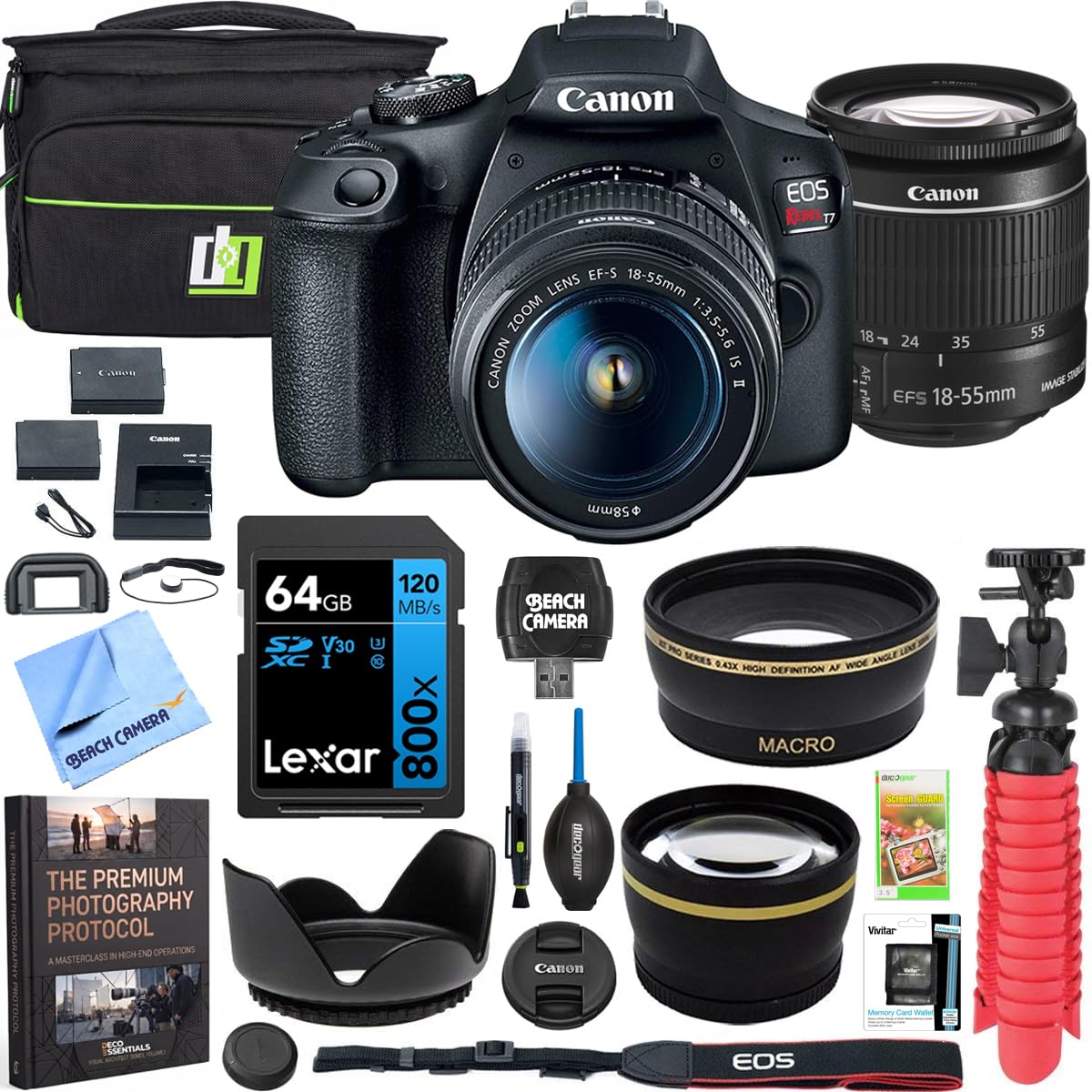
The Canon EOS Rebel T7 is the textbook definition of an entry-level DSLR — a 24.1MP APS-C sensor, DIGIC 4+ processor, and a 9-point AF system that works reliably in good light. The bundle approach makes it the most complete out-of-box experience, including a Deco Gear camera bag, 64GB SD card, spare battery, 60-inch tripod, mini tripod, filter kit, and cleaning tools. For a beginner who wants everything in one box, this eliminates accessory shopping entirely.
The optical viewfinder provides a bright, lag-free view that mirrorless EVFs still struggle to match in direct sunlight. The 18-55mm IS II kit lens has optical stabilization, and the bundled 58mm wide-angle and telephoto attachment lenses give you extra creative flexibility without buying a second lens. Full HD 1080p video at 30fps is adequate for casual recording, and the built-in Wi-Fi and NFC make sharing to a smartphone straightforward.
The T7’s 9-point AF system is ancient by modern standards — it forces a center-lock-recompose technique that misses action shots. The burst rate of 3fps is slow, and the 3-inch LCD has a low 920K-dot resolution that looks dated. The bundled bag is too small for all accessories, and some customers report receiving a 50-inch tripod instead of the advertised 60-inch. For static portrait and landscape photography, the bundle’s convenience is unmatched at this price.
Why it’s great
- Complete bundle includes everything: bag, cards, tripod, filters, cleaning kit
- Optical viewfinder is bright and lag-free — ideal for bright outdoor shooting
- Proven Canon color science and JPEG processing for out-of-camera prints
Good to know
- 9-point AF system is outdated and struggles with moving subjects
- 3fps burst rate is very slow by modern standards
- Bundle bag is small; some customers report tripod size discrepancies
9. Canon EOS Rebel T7 Double Zoom Kit
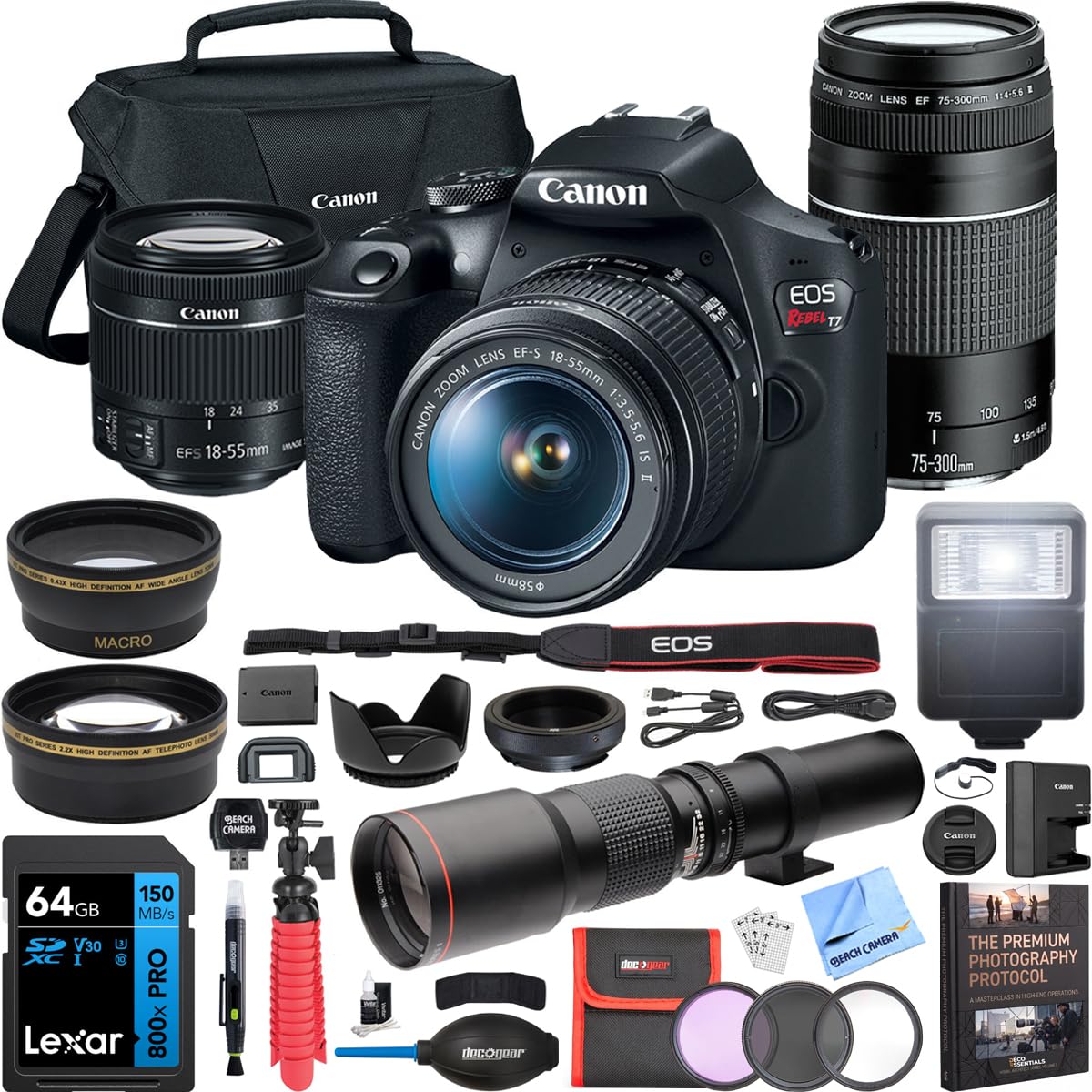
This version of the Canon EOS Rebel T7 bundle adds a 75-300mm f/4-5.6 III telephoto zoom lens alongside the standard 18-55mm kit lens, effectively covering the most common photographic subjects — from wide landscapes at 18mm to wildlife or compressed portraits at 300mm. The bundle also includes a 500mm preset telephoto lens with a T-mount for extreme reach, making birding and moon photography accessible to a beginner without buying separate super-telephoto glass.
The camera itself is identical to the single-lens T7 — 24.1MP sensor, DIGIC 4+ processor, 9-point AF system, and 3fps burst rate. The EF 75-300mm lens is a consumer-grade telephoto with a slow f/4-5.6 aperture, which means you need good light for sharp results at the long end. The included UV, polarizer, and FLD filters protect the front elements and reduce glare in outdoor shooting.
The 75-300mm lens lacks image stabilization, which makes handheld shooting above 200mm challenging — a monopod or tripod is recommended. The 500mm preset lens requires the user to manually focus by turning a ring on the lens body, and it is an f/8 lens, which means the T7’s autofocus may struggle in anything but bright daylight. The bundle’s value lies in giving a beginner the widest possible range of focal lengths to explore before investing in higher-quality glass.
Why it’s great
- Two-lens kit covers 18mm wide-angle through 300mm telephoto
- 500mm preset telephoto allows moon and wildlife shots at very low cost
- All-in-one bundle: filters, memory, tripod, and cleaning accessories included
Good to know
- 75-300mm lens lacks stabilization — blurry shots above 200mm handheld
- 500mm preset telephoto requires manual focus and is f/8, limiting AF
- 9-point AF and 3fps burst rate are outdated for action photography
10. Sony Alpha a3000

The Sony Alpha a3000 is a unique outlier — it is a mirrorless camera with a DSLR-like body shape, featuring a pronounced grip and an electronic viewfinder in a central pentaprism hump. The 20.1MP APS-C Exmor sensor delivers image quality that still competes with modern budget cameras, and Sony’s E-mount ecosystem provides access to a huge library of native and third-party lenses, including affordable options from Sigma, Tamron, and Samyang.
The in-body focus peaking makes manual focusing with adapted vintage lenses simple and accurate, which is a popular hobby among learning photographers. The kit 18-55mm OSS lens has optical stabilization, and the full HD 1080p video recording at 60fps is adequate for casual clips. The a3000 shoots in RAW (ARW) and JPEG, giving beginners room to learn post-processing.
The EVF has a low resolution compared to modern cameras, and the rear LCD is even worse — 250K dots that look pixelated and washed out. Battery life is terrible, draining 20-30% per hour of normal use, and the battery can only be charged inside the camera via USB, which takes roughly five hours. The autofocus system is contrast-detection based with 25 points, which hunts in low light. The a3000 is a budget entry into the Sony E-mount system for someone who prioritizes lens ecosystem over modern features.
Why it’s great
- Full access to Sony E-mount — one of the largest lens ecosystems available
- Focus peaking simplifies manual focus with adapted vintage lenses
- Solid image quality from the 20.1MP Exmor APS-C sensor
Good to know
- EVF and LCD have very low resolution — difficult to judge focus precisely
- Battery life is poor and can only be charged in-camera via USB
- 25-point contrast-detect AF is slow and hunts in low light
11. Canon EOS Rebel T7 13-Piece Bundle
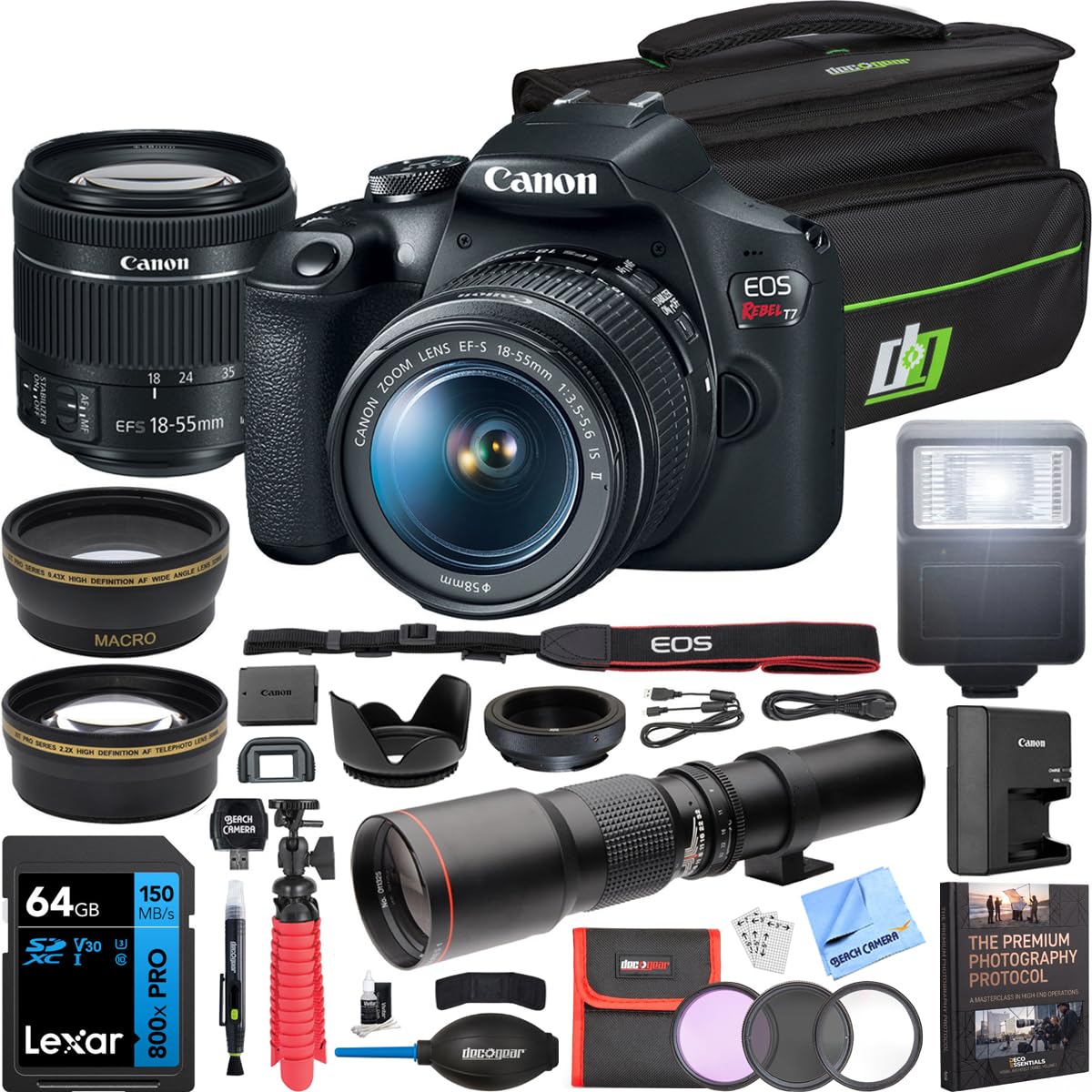
The 13-piece Canon EOS Rebel T7 bundle is the most comprehensive starter package available, packing the 24.1MP T7 body with the 18-55mm IS II kit lens, a 500mm preset telephoto lens, wide-angle and telephoto attachment lenses, a hot-shoe flash, a 12-inch tabletop tripod, a 64GB Lexar 800x SDXC card, a camera bag, filter kit, cleaning tools, and a photography eBook guide. For a buyer who starts with nothing, this bundle literally contains everything except the battery charge.
The camera core is the same 24.1MP APS-C sensor found in the standard T7, producing Canon’s characteristically pleasant JPEG colors. The 500mm telephoto, combined with the included T-mount, lets beginners experiment with extreme reach — bird photography, lunar detail, and distant wildlife — without spending hundreds on a super-telephoto lens. The SF3000 bounce zoom flash adds fill light capability for indoor events.
Every limitation of the base T7 applies: 9-point AF, 3fps burst, DIGIC 4+ processing, and 1080p video at 30fps. The 500mm lens requires manual focusing and is f/8, which confuses the autofocus system. Battery drain is a recurring complaint — some users report the LP-E10 battery dies after 8-10 shots from full charge. Shipping packaging is inconsistent, with some customers receiving loose accessories. For the lowest possible entry price to a full-featured interchangeable lens kit, this bundle delivers unmatched volume of gear.
Why it’s great
- 13 items — a true all-in-one kit including flash, filters, and tripod
- 500mm telephoto lens enables extreme reach at no additional cost
- Includes 64GB Lexar 800x SDXC — fast enough for burst shooting
Good to know
- 9-point AF and 3fps burst are severely outdated for action photography
- 500mm lens is manual focus only and f/8 — difficult to use in low light
- Battery drain issues reported; poor shipping packaging is common
FAQ
What is the best affordable beginner camera for taking photos of moving children?
Is it better to get a DSLR or a mirrorless camera for a beginner?
Should I buy a camera with a kit lens or body only?
Does the Canon EOS R100 overheat during video recording?
Why do some cameras have better image quality with the same megapixel count?
Final Thoughts: The Verdict
For most users, the best affordable cameras for beginners winner is the Sony ZV-E10 because it offers the best balance of 4K video quality, fast 425-point autofocus, and Sony’s deep E-mount lens ecosystem at a price that leaves room for accessories. If you want full-frame image quality for stills, grab the Canon EOS R8 — it delivers professional-level dynamic range and low-light performance in the lightest full-frame body available. And for pure budget value and a complete out-of-box experience, nothing beats the Canon EOS Rebel T7 Bundle that includes a bag, spare battery, and memory card from day one.