
Finding a generator that balances enough surge for your RV’s air conditioner with the quiet operation campgrounds demand is the central challenge of off-grid travel. A unit that’s too heavy defeats the purpose of mobility, while one lacking a clean sine wave can damage your sensitive electronics.
I’m Min — the co-founder and writer behind Gadgets Feed. I’ve spent hundreds of hours analyzing portable inverter generators, cross-referencing start-up surge requirements for common RV appliances with real-world fuel consumption data, to cut through the marketing noise.
This guide distills the research into a clear, practical roadmap for selecting the correct 3600 watt generator for rv use, focusing on what actually matters when you’re parked far from a hookup.
How To Choose The Best 3600 Watt Generator For RV
Selecting the right portable power station for your RV goes beyond simply looking at the peak wattage number. You need to scrutinize the continuous power rating, the cleanliness of the electricity, and how the unit fits your specific camping style, from boondocking to full-hookup parks.
Starting vs. Running Watts
An RV air conditioner can demand up to three times its running wattage during startup. A generator rated for 3600 starting watts might only deliver 2900 to 3200 running watts. You must verify that the unit’s starting surge can handle your AC’s LRA (Locked Rotor Amps) while still leaving headroom for your refrigerator and converter.
Inverter vs. Conventional Generator
Conventional generators produce power with higher Total Harmonic Distortion (THD), which can slowly damage sensitive electronics like laptops, battery chargers, and smart TVs. An inverter generator provides clean, stable sine-wave power with THD below 3%, making it safe for all your gear and far quieter in operation.
Fuel Type and Runtime
Gasoline is widely available, but it degrades over time and requires carburetor maintenance. Propane burns cleaner and has an indefinite shelf life but delivers slightly lower running watts. Dual-fuel models offer the flexibility to switch between both, giving you backup options during emergencies or extended trips.
Quick Comparison
On smaller screens, swipe sideways to see the full table.
| Model | Category | Best For | Key Spec | Amazon |
|---|---|---|---|---|
| A-iPower 4600W | Inverter | Lightweight Power | 4600W peak / 3600W running | Amazon |
| Westinghouse 4000W | Dual Fuel | Quiet Remote Start | 4000W peak / 3300W running | Amazon |
| Champion 4000W | Dual Fuel | Long Propane Runtime | 4000W peak / 3000W running | Amazon |
| Generac iQ5200 | Dual Fuel | Electric Start | 5200W peak / 4200W running | Amazon |
| FIRMAN W03382 | Inverter | Electric Start Comfort | 3650W peak / 3300W running | Amazon |
| WEN DF360iX | Dual Fuel | Dual Fuel Flexibility | 3600W peak / 2900W running | Amazon |
| AIVOLT 4300W | Inverter | Digital Display | 4300W peak / 3450W running | Amazon |
| WEN 56360i | Inverter | Ultra-Light Portability | 3600W peak / 2900W running | Amazon |
| PowerSmart 3800W | Inverter | 59 dBA Quiet | 3800W peak / 3200W running | Amazon |
| PowerSmart 3600W | Inverter | Best Value | 3600W peak / 3200W running | Amazon |
| Aceup Energy 4000W | Inverter | Compact Budget Pick | 4000W peak / 3200W running | Amazon |
In‑Depth Reviews
1. A-iPower 4600W RV-Ready Quiet Portable Inverter Generator

This A-iPower unit delivers a genuine 4600 starting watts and 3600 running watts from a 149cc engine, placing it solidly in the sweet spot for powering a 15,000 BTU RV air conditioner plus a refrigerator and lights simultaneously. The open-frame inverter design keeps it 56 lbs, which is light enough for one person to lift into a truck bed without a ramp.
With a 2.6-gallon fuel tank, it runs up to 16 hours at 25% load, meaning you can make it through a full weekend of moderate use without refueling. The included TT-30R adapter lets you plug directly into your RV’s power inlet, eliminating the need for a separate dogbone connector.
Real-world users confirm that it handles the startup surge of an RV AC without stalling, and the low idle technology significantly reduces noise when power demand drops. The CO sensor and low oil shutdown add essential safety layers for enclosed camping setups.
Why it’s great
- Excellent 16-hour runtime at low load
- Lightweight for its power class
- Includes RV-ready adapter
Good to know
- No built-in hour meter
- Open frame is louder than fully enclosed models
2. Westinghouse 4000W Dual Fuel Portable Inverter Generator

The Westinghouse 4024 stands out for its exceptional noise profile, rated as low as 52 dBA, which makes it one of the quietest generators in this category. The dual-fuel capability lets you run it on either gasoline or propane, and the telescoping handle and wheel kit make moving the 59-pound unit feel effortless.
The LED data center displays fuel level, power output, remaining runtime, voltage, and lifetime hours, giving you complete awareness of your power status at a glance. The remote start fob allows you to start or stop the generator from inside your RV, a major convenience during bad weather or late-night restroom breaks.
Users consistently praise its fuel efficiency, with reports of running a full-size refrigerator, furnace, and lights for over 14 hours on a single tank of gas in eco mode. The CO sensor provides automatic shutdown for peace of mind in partially enclosed spaces.
Why it’s great
- Extremely quiet 52 dBA operation
- Remote start and stop convenience
- Rotating digital display for key metrics
Good to know
- Heavier than some competitors at 59 lbs
- Remote start requires manual power switch activation
3. Champion Power Equipment 4000W Dual Fuel Inverter Generator

Champion’s 4000-watt dual-fuel inverter offers an industry-leading 25 hours of runtime on a 20-pound propane tank, making it the top choice for extended boondocking where fuel logistics are critical. Switching between gasoline and propane requires no tools, just a simple turn of the fuel selector knob.
At 64 dBA from 23 feet, it’s slightly louder than the Westinghouse but still quiet enough for most campgrounds, and the 149cc engine provides clean power under 3% THD. The parallel kit (sold separately) lets you link two Champion units for double the output, which is useful if you later upgrade to a larger RV.
Users report reliable performance running two refrigerators and a freezer simultaneously on propane, with the added benefit of zero carburetor maintenance since propane burns clean. The free 3-year warranty and lifetime technical support add long-term confidence.
Why it’s great
- Up to 25 hours runtime on propane
- Tool-free fuel switching
- Parallel ready for future expansion
Good to know
- 64 dBA is louder than premium competitors
- Some units reported quality control issues
4. Generac iQ5200 Dual-Fuel Portable Inverter Generator
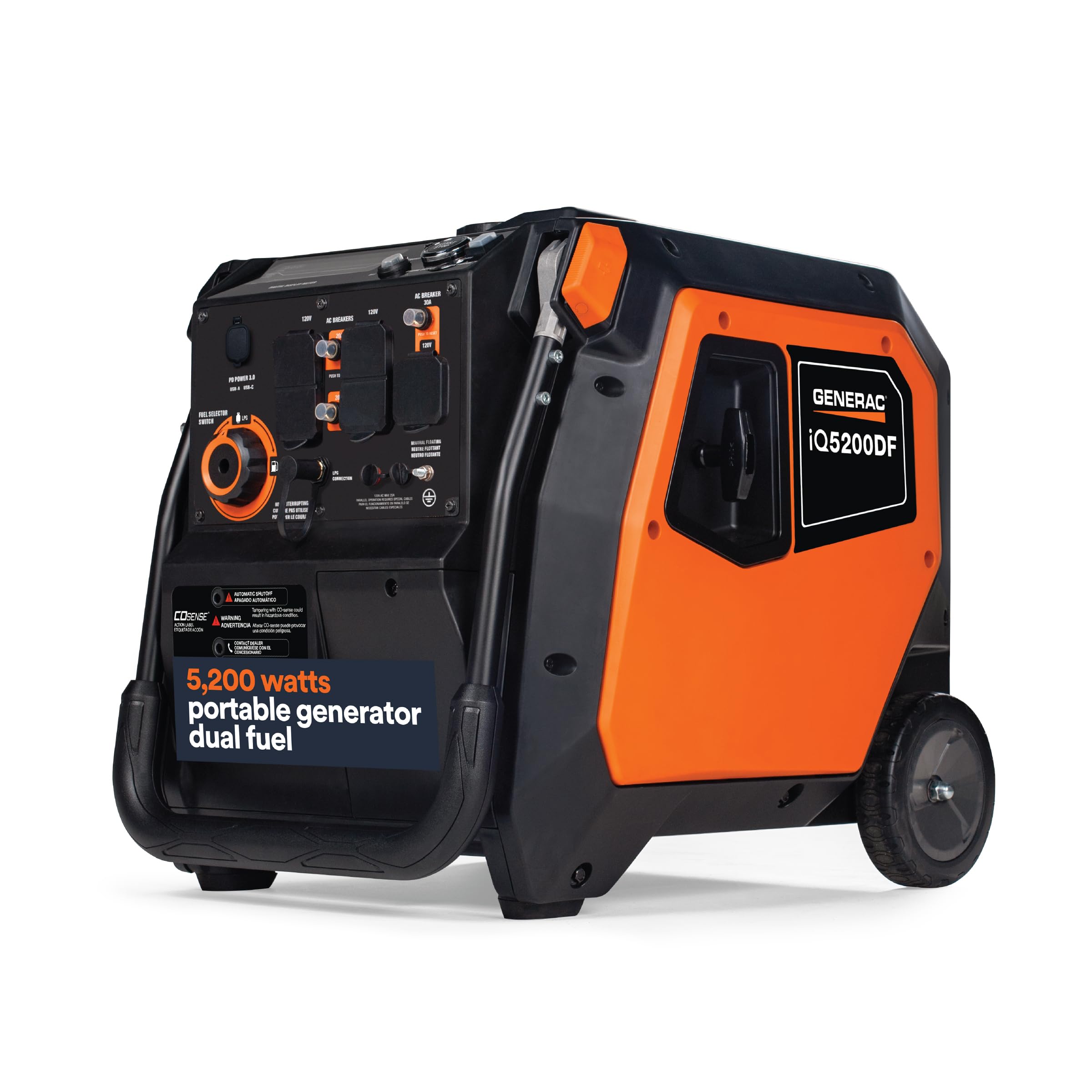
The Generac iQ5200 delivers a massive 5200 starting watts and 4200 running watts, making it the most powerful unit in this roundup. It’s designed for larger RVs or those who want headroom for simultaneous high-draw appliances, like a microwave, AC, and electric water heater.
The electric start with included battery means no pull-cord struggle, and the fully enclosed case keeps noise levels impressively low for its output. The COsense technology automatically shuts the unit down and activates an alarm if dangerous carbon monoxide levels are detected.
Users appreciate the seamless fuel switching between gasoline and LP gas, and the parallel-ready capability allows you to pair two units for up to 10,400 watts. The trade-off is weight — at 107 pounds, it’s heavy and requires two people or a ramp for loading.
Why it’s great
- Highest power output in class
- Convenient electric start with battery
- Fully enclosed for quiet operation
Good to know
- Very heavy at 107 pounds
- Some reports of battery issues on early units
5. FIRMAN W03382 3650W Gas Inverter Generator
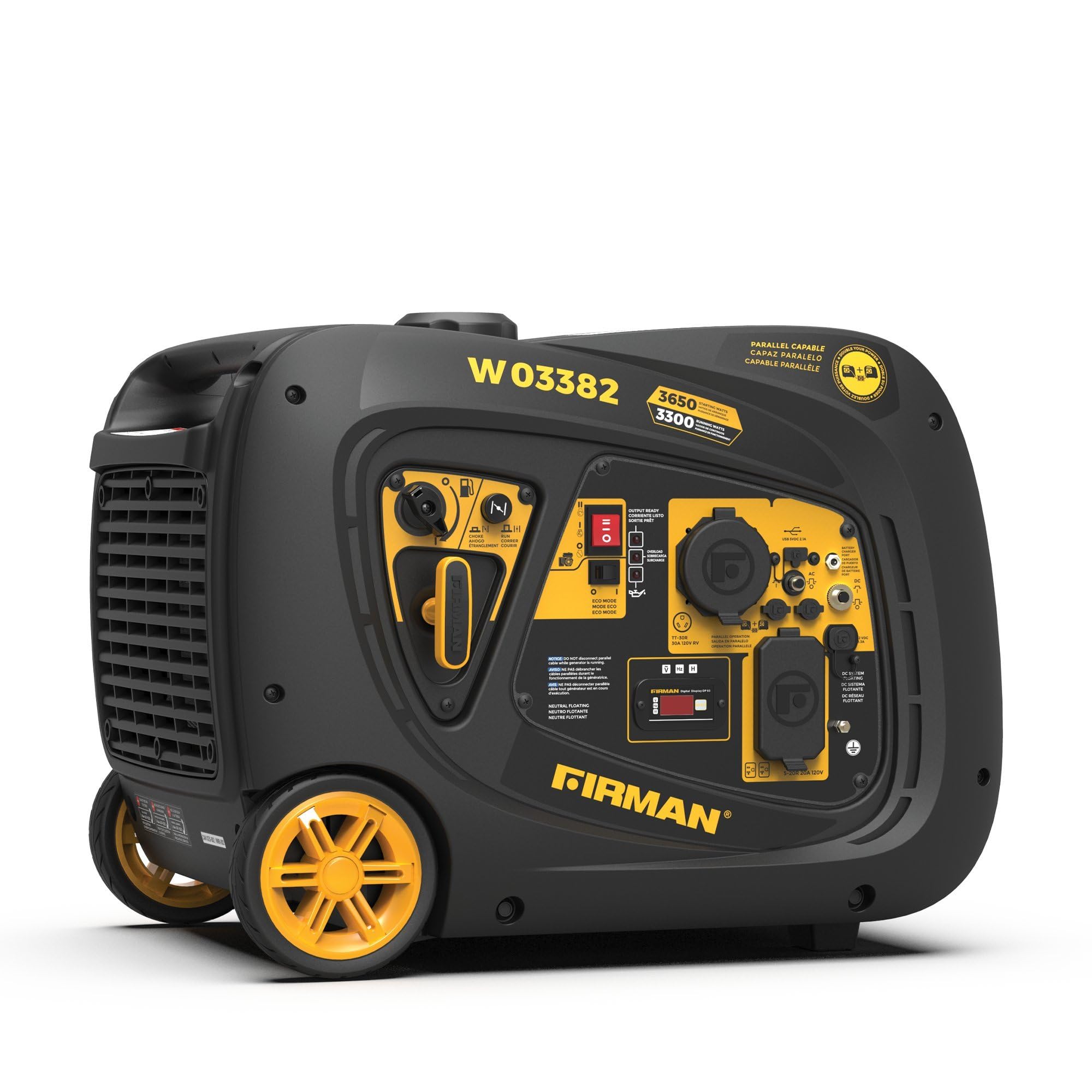
FIRMAN’s W03382 pairs a larger 193cc engine with electric start, giving you 3650 starting watts and 3300 running watts. The larger displacement engine runs cooler and more efficiently, contributing to the Whisper Series muffler’s low noise output.
The 1.8-gallon fuel tank delivers up to 10 hours of runtime in eco mode, and the clean power technology keeps THD under 3% for safe operation of sensitive electronics. The built-in wheels and handle make the 103-pound unit manageable on flat ground.
Owners in extreme conditions, including Alaska backcountry, report long-term reliability with only basic oil changes. The unit powers a 13,500 BTU RV AC without issue, and the electric start eliminates the pull-cord hassle for those with limited mobility.
Why it’s great
- 193cc engine for cooler operation
- Electric start with included battery
- Proven reliability in harsh conditions
Good to know
- Heavy at 103 pounds
- Gasoline only; no dual fuel option
6. WEN DF360iX Dual Fuel Inverter Generator

The WEN DF360iX delivers 3600 surge watts on gasoline and 3500 on propane, with a lightweight 49-pound frame. The dual-fuel design includes a tool-free LPG quick-connector, making it simple to switch between fuel sources in seconds.
The integrated CO Watchdog sensor automatically shuts down the generator if dangerous carbon monoxide levels accumulate, adding a critical safety layer for RV camping. The fuel shut-off feature lets you run the carburetor dry before storage, preventing gumming and extending engine life.
Users confirm first-pull starts even in cooler weather, and the digital display shows volts, frequency, runtime, and load percentage. When running on a standard 20-pound propane tank, it can power an RV AC and basic appliances for extended periods without fuel degradation concerns.
Why it’s great
- Lightweight at just 49 pounds
- Dual fuel with quick-connector
- CO Watchdog safety sensor
Good to know
- Lower running watts on propane
- Some reports of loosely fitting 20A outlets
7. AIVOLT 4300W Inverter Generator
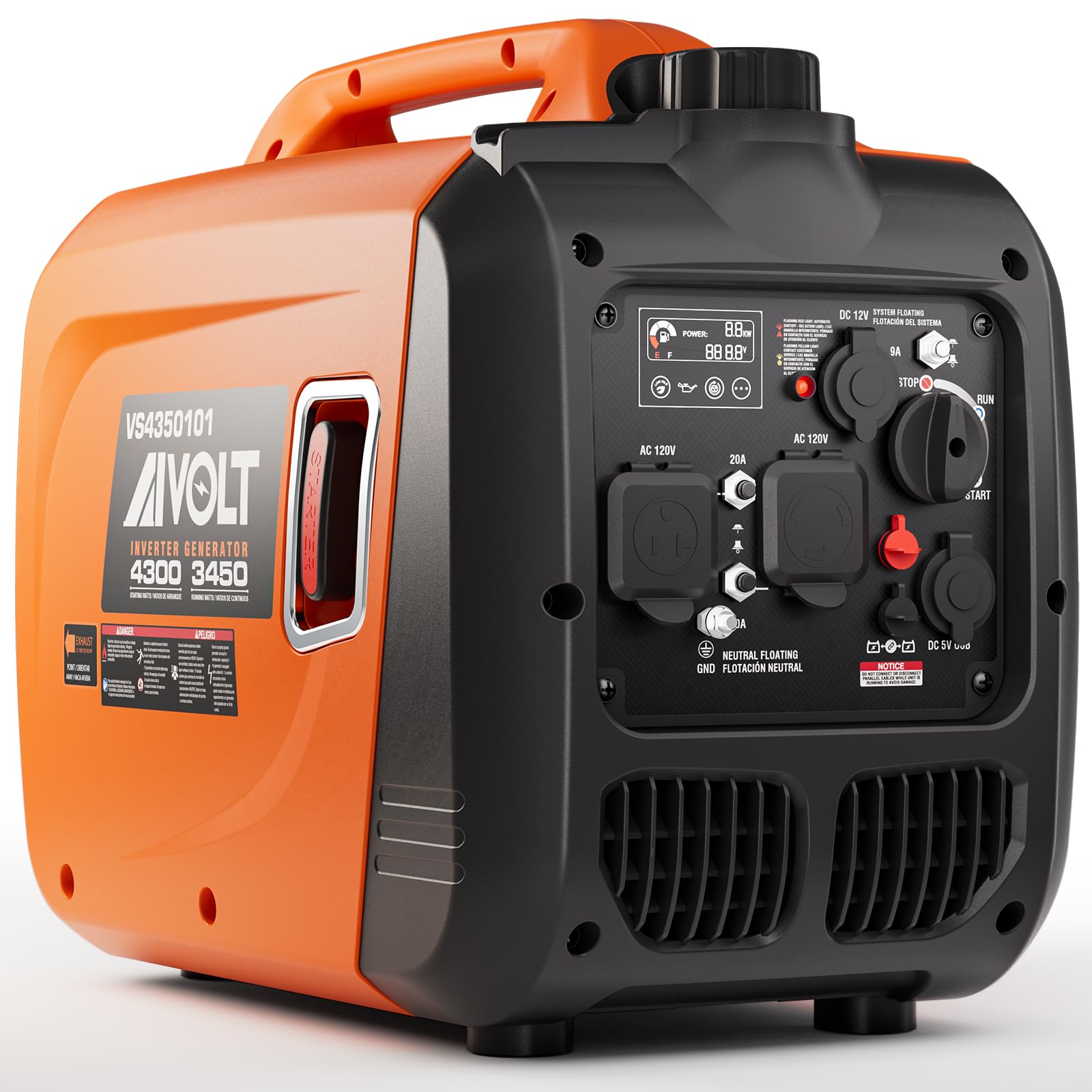
The AIVOLT inverter generator punches above its class with 4300 starting watts and 3450 running watts, all within a compact 51-pound frame. The copper-wound 149cc engine delivers cleaner power and better heat dissipation than aluminum-wound competitors.
The 5-in-1 LCD display provides real-time feedback on oil level, fuel status, overload warnings, and current operating conditions. The control panel includes both type-A and type-C USB ports, plus an RV-ready 30A locking outlet and a 12V DC charging cable.
CO Alert technology provides automatic engine shutdown if carbon monoxide reaches unsafe levels, and the eco mode extends runtime to over 5.5 hours at 25% load. Users note that the inverter technology produces noticeably cleaner power than standard generators, with no flickering on sensitive electronics.
Why it’s great
- Copper-wound engine for durability
- Informative 5-in-1 LCD display
- Includes type-C USB port
Good to know
- 45-minute cool-down required before restarting
- No engine oil included
8. WEN 56360i 3600W Inverter Generator

At just 46 pounds, the WEN 56360i is the lightest generator in this comparison, making it ideal for solo travelers or those with limited lifting capacity. Despite the low weight, it still delivers 3600 surge watts and 2900 rated watts, enough to handle a 13,000 BTU RV AC and basic household loads.
The fuel shut-off feature is a standout for long-term storage: you turn off the fuel valve and let the carburetor run dry, which prevents ethanol-related gumming and extends the life of the engine. The control panel includes two USB ports, a TT-30R RV receptacle, and a 12V DC outlet.
Users report reliable starts even in cold weather down to 14°F, with the generator powering an entire camper including furnace, lights, and battery charging for about 5 hours on one gallon of gas. The three-year warranty provides strong protection for a unit at this price point.
Why it’s great
- Ultra-lightweight at 46 pounds
- Fuel shut-off for long-term storage
- Three-year warranty
Good to know
- Only 2900 running watts
- Shorter runtime under heavy load
9. PowerSmart 3800W Portable Inverter Generator
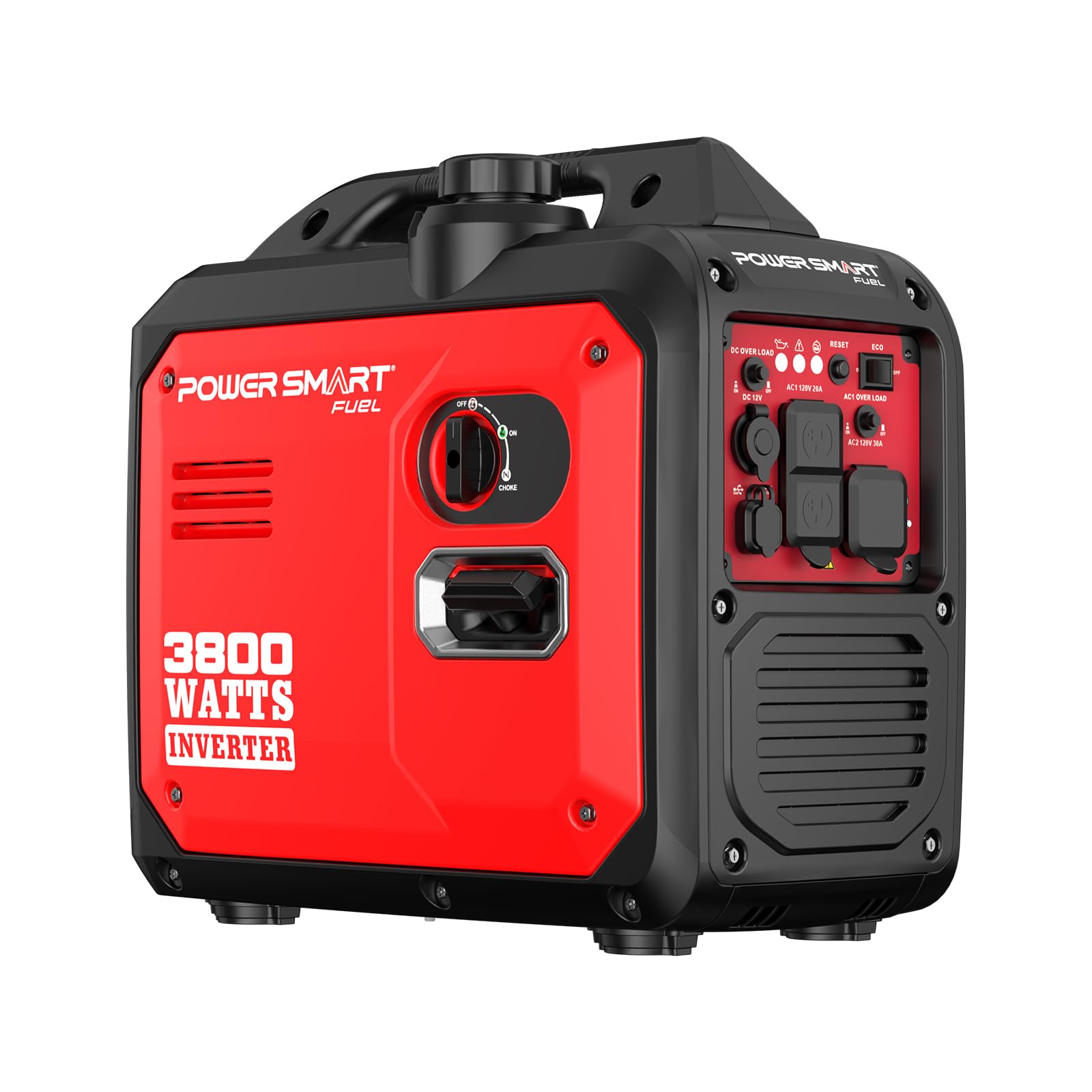
The PowerSmart DB5068 delivers 3800 starting watts and 3200 rated watts from a 143cc engine, with a noise output of just 59 dBA from 23 feet. That’s quieter than a normal conversation, making it ideal for campgrounds with strict noise ordinances.
The economy mode automatically adjusts engine speed based on load, maximizing fuel efficiency during light use. The parallel-ready capability lets you connect two PowerSmart units for double the output, and the included USB port keeps your devices charged without an adapter.
Users report that the generator starts effortlessly on the first pull, and it runs continuously for over 24 hours when properly cycled, handling a mix of fans, refrigerator, water cooler, TV, and even a window AC. The compact 52-pound frame with ergonomic handle makes it easy to store in RV compartments.
Why it’s great
- Very quiet 59 dBA operation
- Economy mode for fuel savings
- Parallel ready for power expansion
Good to know
- Limited to 4.5 hours runtime at 50% load
- Only one USB port
10. PowerSmart 3600W Portable Inverter Generator

This entry-level PowerSmart model matches the same 3600 starting watts and 3200 running watts as the more expensive WEN units, but at a fraction of the cost. The 149cc engine delivers clean inverter power under 3% THD, safe for laptops and phone chargers.
The 1.3-gallon fuel tank provides up to 8 hours of runtime at 25% load, which covers a full night of RV AC operation. The parallel connection capability means you can add another PowerSmart unit later to double your power without replacing the first generator.
Owners consistently praise the first-pull start and quiet operation, with one user powering lights, TV, internet, refrigerator, and freezer simultaneously without any starting issues. The compact 50.7-pound design with integrated carry handle makes it easy to move from storage to campsite.
Why it’s great
- Excellent value for the power output
- Clean inverter power under 3% THD
- Parallel ready for future expansion
Good to know
- No fuel gauge
- 1.3-gallon tank limits runtime
11. Aceup Energy 4000W Portable Inverter Generator
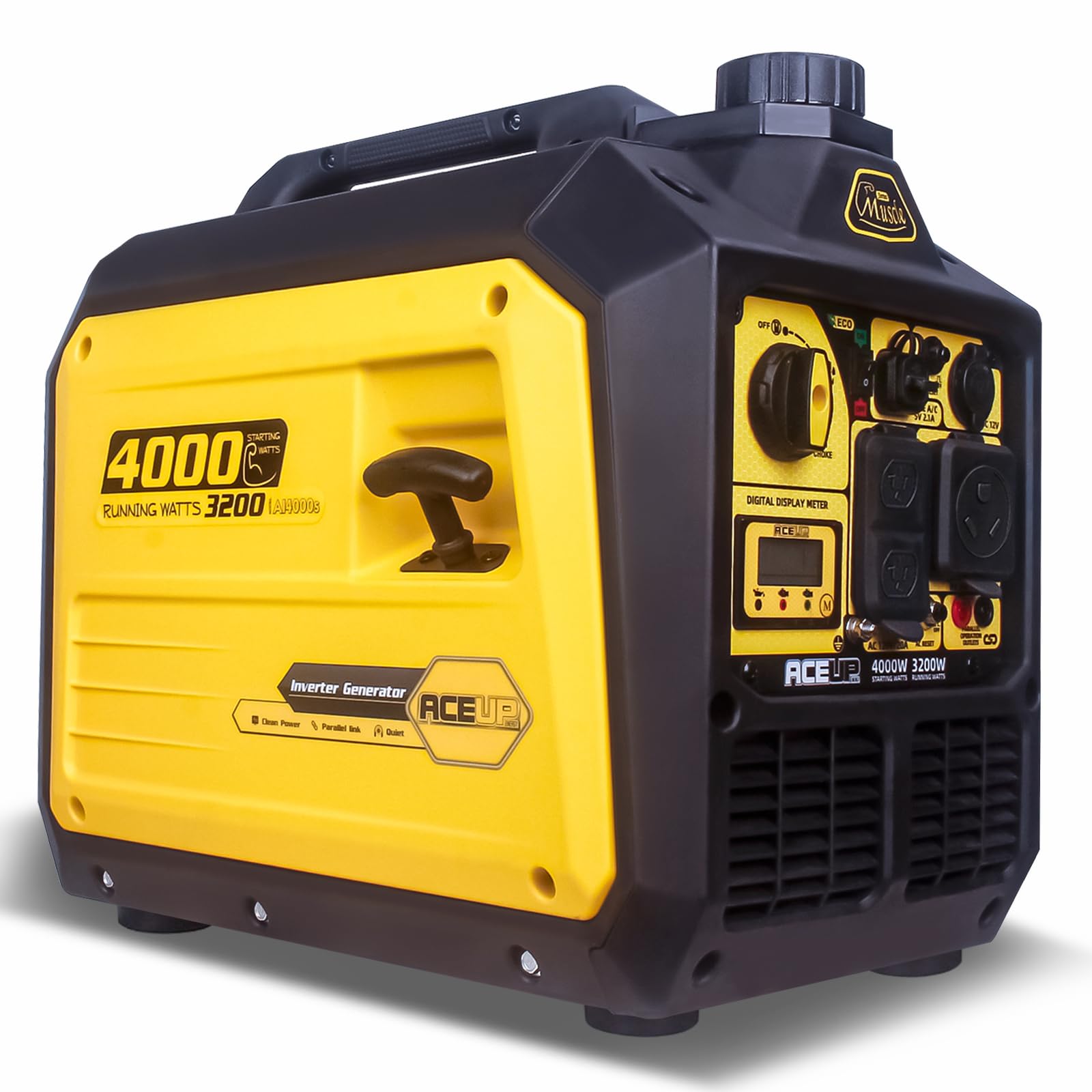
The Aceup Energy AI4000s-1 provides 4000 peak watts and 3200 rated watts from a 149cc engine, all packed into a compact 50-pound frame. The digital gauge tracks voltage, runtime, fuel level, hertz, and power output, giving you comprehensive monitoring without additional tools.
The 5-in-1 control knob simplifies startup by combining fuel on/off, choke, and engine on/off into a single switch, reducing the chance of user error. The fully enclosed design keeps noise levels manageable, and the parallel-ready functionality allows connection with a second unit for doubled output.
Users report that the generator fits perfectly in side compartments of campers, and runs a full-size RV air conditioner with ease. While some noted the tank design requires careful storage to prevent collapse, the overall value for portability and power is highly rated by buyers.
Why it’s great
- Lightweight at 50 pounds
- Informative digital gauge
- Simple 5-in-1 control knob
Good to know
- Only 1.32-gallon fuel tank
- Some reports of tank collapse if stored improperly
FAQ
Can I run my RV AC directly from a 3600 watt generator?
What is the real difference between gasoline and propane for RV generators?
Final Thoughts: The Verdict
For most users, the 3600 watt generator for rv winner is the A-iPower 4600W because it delivers the highest running watts at the lowest weight, with excellent fuel economy. If you want remote start and ultra-quiet operation, grab the Westinghouse 4000W. And for extended boondocking on propane, nothing beats the Champion 4000W with its 25-hour runtime.