
Our readers keep the lights on and my morning glass full of iced black tea. As an Amazon Associate, I earn from qualifying purchases.
Specs are compiled from manufacturer listings and verified buyer reviews and can change over time — please confirm the key details on the product page before buying.
If you want one camera that survives a muddy switchback, a rain shower, and a pocket toss without complaining, the DJI Osmo Action 4 Adventure Combo is the safest pick on this list. It packs three batteries, a waterproof body that shrugs off 18 meters of water, and image quality that owners routinely say beats the big-name action brand. Below you will find nine genuinely trail-worthy cameras, sorted by what they actually do well on a hike — not by marketing noise.
I’m Min — the founder and writer behind Gadgets Feed. This guide is built by comparing the manufacturers’ published specifications and the patterns across verified customer reviews, so you get each pick’s real strengths and trade-offs instead of marketing spin.
With that context, here are nine tested-in-the-wild picks that answer the question of the budget camera for hiking without overspending, covering waterproofing, battery, and zoom in plain terms.
Our Picks at a Glance


How To Choose The Best Budget Camera For Hiking
Hiking gear lives a harsh life: rain, grit, sweat, and the occasional drop onto rock. The right camera here is one you can clip to a strap and forget about until the view opens up. Four things decide whether a camera earns that trust — waterproofing depth, battery hours, stabilization quality, and how much zoom flexibility you get without adding bulk.
Waterproofing Is Your First Filter
You want a camera rated in meters or feet, not a “water-resistant” label with no number attached. A rating of 10 meters covers rain, splashes, and a dunk in a stream. A 15-meter rating handles snorkeling and heavier submersion. For action cams with a waterproof housing, the housing itself becomes the seal, so check that it’s included before you commit. Any camera that only claims “water-resistant” without a depth figure means it survives damp weather and nothing more.
Battery Capacity Decides Your Day Length
Look for a battery capacity figure in mAh (milliamp-hours — a measure of how much charge the battery holds) and a rated hours figure. A 2500mAh pack that runs 4.5 to 5 hours is a full hiking day of intermittent shooting. A 1770mAh battery rated at 150 minutes keeps you covered for a shorter trek or a vlog run. If you plan multi-day hikes, a camera that ships with spare batteries is worth far more than a slightly better sensor.
Why Stabilization Matters On Rough Trails
Downhill descents and rocky paths shake everything. Electronic image stabilization (a software system that counteracts your hand shake) keeps footage watchable without a gimbal. Some cameras here use a three-axis gimbal (a motorized arm that physically holds the lens steady) that produces even smoother video. If your hiking is mostly stopping to photograph views, stabilization is a nice-to-have. If you’re shooting while moving, it’s essential.
Zoom: Optical Beats Digital Every Time
Optical zoom moves the actual lens elements to magnify a subject, so image quality stays sharp. Digital zoom just crops into the image and enlarges the pixels, which softens detail fast. A 5x optical zoom is genuinely useful for wildlife at a distance. An 18x digital zoom gets you closer on paper but loses clarity at the long end. On a hiking trip, one clear optical zoom shot beats a fuzzy digital one every time.
Quick Comparison
| Model | Best For | Waterproofing | Battery | Video Resolution | Amazon |
|---|---|---|---|---|---|
| DJI Osmo Action 4 Adventure Combo★ Best Overall | All-around trail action | 18m (waterproof) | 1770mAh / 150 min | 4K 3840px at 120fps | Amazon |
| 8K Underwater Camera 70MP with 32GBBest for Long Trails | Long hike battery life | 33ft / 10m | 2500mAh / 4.5–5 hrs | 7680 × 4320 8K | Amazon |
| KODAK PIXPRO FZ55Easiest to Carry | Pocketable everyday shots | Not waterproof | Rechargeable li-ion | 1080p Full HD | Amazon |
| AKASO Brave 7 LE | Budget action first-timers | 131ft / 40m with case | 2× 1350mAh / 2 hrs | 4K at 30fps | Amazon |
| Yatao 6K Flip Screen Camera | Beginner vlog kits | Not waterproof | 2 batteries + stand | 6K Ultra HD | Amazon |
| Kodak PIXPRO WPZ2 Bundle | Snorkeling and river trips | 15m / 49ft | 4+ hrs (review) | 1080p Full HD | Amazon |
| PENTAX WG-1000 | Tough work-site camera | 15m / 1 hr | Standard li-ion | High-res stills | Amazon |
| Xtra Muse Gimbal Camera | Smooth cinematic hiking video | Not weather rated | 161 min | 4K at 120fps | Amazon |
| DJI Osmo Action 5 Pro Hiking Bundle | Premium all-day recording | IP68 / 20m | 1950mAh / up to 4 hrs | 4K UHD | Amazon |
In‑Depth Reviews
1. DJI Osmo Action 4 Adventure Combo
Our pick — over 4.5★ from 2,500+ verified ratings; the strongest balance of quality and price.
The 1/1.3-inch sensor and 18m waterproof body make this the best all-around action cam for dawn hikes and wet trails.
What makes this the top pick is a 1/1.3-inch sensor with 2.4μm pixel size — the size of each dot of light the sensor captures, and bigger dots pull in more light. That means a dawn ridge walk at 6 a.m. still gives you crisp footage rather than grain. It records 4K at 120fps with a 155-degree ultra-wide field of view, so sweeping valley shots fill the whole frame without cropping out the edges.
The Adventure Combo turns a strong camera into a complete hiking kit. You get three 1770mAh batteries, a multifunctional battery case, a 1.5m Extension Rod, and a quick-release adapter mount. The battery lasts up to 150 minutes per charge, and it keeps working down to -20°C (-4°F) — which is the difference between a camera that survives a cold alpine start and one that quits. Waterproofing reaches 18 meters straight from the body, no case needed.
You can switch angles or flip the camera vertical in seconds at a viewpoint, thanks to the magnetic quick-release mount. Three stabilization modes (electronic shake correction) smooth out the bumps from a downhill run. Owners who use it as a helmet cam report it also works as a top-quality webcam off the trail. The spec sheet shows this camera records at 3840 pixels effective video resolution, while the cheaper 8K camera claims 7680 pixels. So the budget option wins on raw pixel count, but it loses the DJI’s color science and stabilization.
Trail-Ready Stabilization
- 1/1.3-inch sensor with 2.4μm pixels delivers clean low-light shots
- Three 1770mAh batteries plus case — a full weekend of filming
- Operates down to -20°C for cold-morning hikes
- Image quality is the most-praised detail, ahead of value and video quality
Battery Drain at 4K
- Durability feedback is mixed — treat the body with care
- Requires the DJI app, so a phone is part of the workflow
- 4x digital zoom only — not for distant wildlife
Reach for this if: you want one rugged camera for hiking, biking, and water days with batteries to spare.
Think twice if: you need long-range zoom or prefer a camera you can operate without an app.
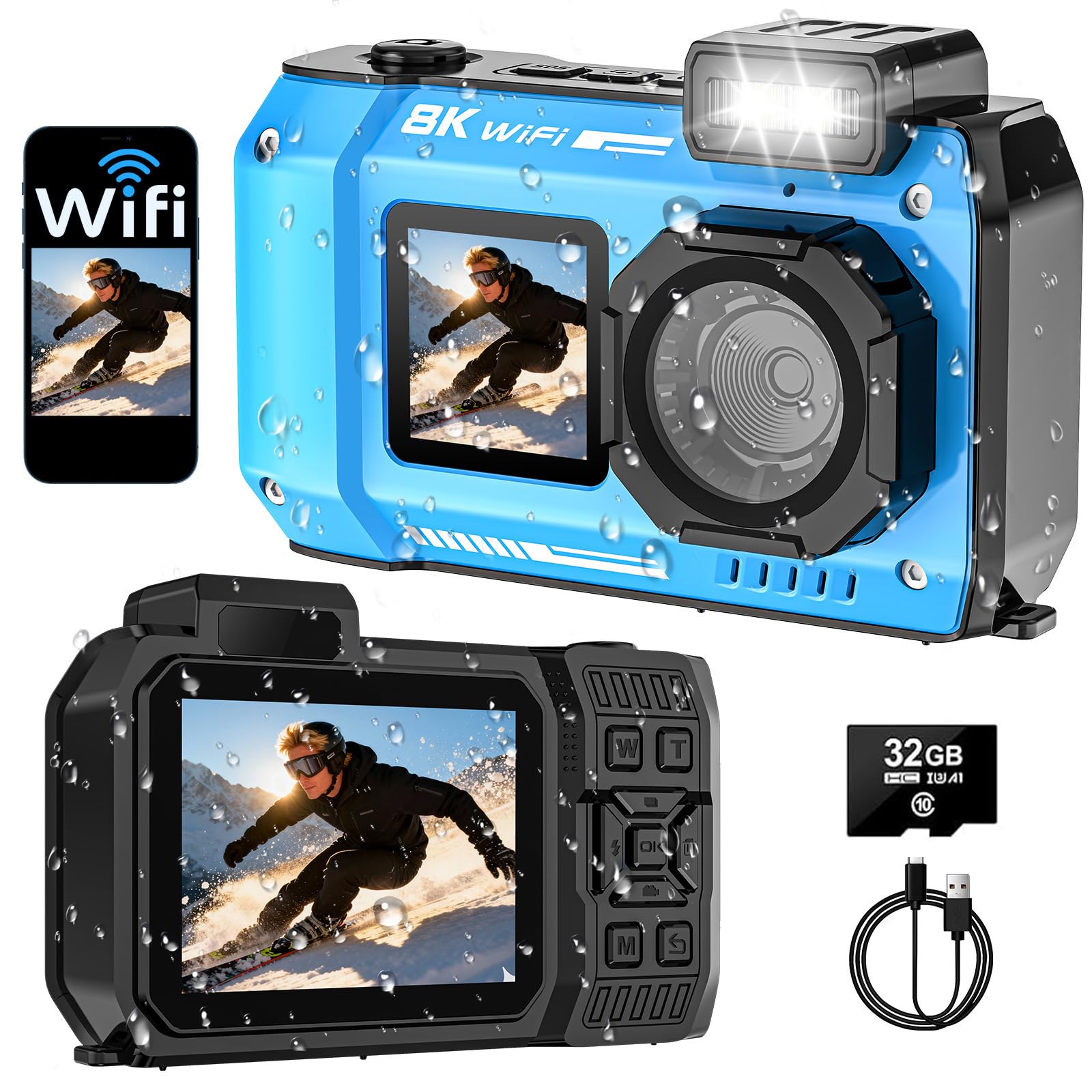
2. 8K Underwater Camera, 70MP 33FT Waterproof with 32GB
Its 2500mAh battery runs 4.5 to 5 hours, the longest runtime on this list.
If your hike stretches from sunrise to sunset, this is the pick. Its 2500mAh lithium-ion battery runs 4.5 to 5 hours of continuous operation and stores over 10,000 high-resolution photos on the included 32GB card. Compare that to the DJI Osmo Action 4’s 1770mAh, and this camera carries 41% more capacity — enough that you can leave the spare pack at home. The 8K capture at 7680 × 4320 pixels also beats the Action 4’s 3840-pixel effective video resolution, with the maker describing roughly four times the pixel count of traditional 4K cameras.
The waterproofing is rated to 33 feet (10 meters), with a fully sealed double-lock body that is also dustproof, sandproof, and freeze-resistant. It takes a 4-foot drop. Zoom runs to 18X digital — well beyond the DJI’s 4x digital zoom — which helps flag a distant peak even if clarity softens at the far end. There is also an autofocus system that hunts for a lock in low light, and an SOS emergency signaling feature for remote trails.
Up close, owners consistently rate the build quality and image quality highest. The dual-screen design — a 2.88-inch front screen and 1.44-inch rear — makes selfies and vlogging easier to frame. One genuine catch: Wi-Fi only works above water, with a range of roughly 5 meters, so you can’t upload from the middle of a lake. For most hikers that’s a non-issue, but worth knowing before you buy.
Deep Water Still Shots: build quality and image quality tie as the top-mentioned strengths, so durability is not just a marketing line here.
Struggles in Low Light: a small number of units arrive with a sticky power button that can wipe photos mid-trip — rare, but enough to mention.
Best matched to: long-mileage hikers who want big battery, big storage, and get-it-wet waterproofing in one package.
Look elsewhere if: you need reliable Wi-Fi transfer deep into a hike or pro-grade color grading.
3. KODAK PIXPRO FZ55 16MP Compact Digital Camera
A 5X optical zoom in a body small enough for a hip belt pocket.
Not every hike needs to survive a waterfall. For dry trails, ridgeline walks, and camp evenings, this Kodak delivers the one thing phones struggle with: a real 5X optical zoom built from a 28mm wide-angle lens with 8 groups and 8 elements. That means wildlife across a meadow actually stays sharp, because the lens physically magnifies rather than cropping pixels. It shoots 1080p Full HD video and stores to cards up to 512GB, so days of clips fit on a single card.
The 16MP CMOS sensor captures detailed photos, and the 2.7-inch LCD screen makes framing straightforward. The rechargeable li-ion battery is the weak link worth flagging — buyers report it typically lasts well, but some units run into charging trouble. For a weekend hike, carrying a spare battery solves that cleanly. The camera itself handles candids and quickly grabbed shots well, with strong indoor and outdoor low-light performance for its class.
Owners describe the whole package as easy to use and genuinely pocket-friendly, and there’s a nostalgic charm to the classic compact body that phone shooters notice. It’s not waterproof, so a dry bag matters if rain is in the forecast. And it’s beginner-friendly, not a professional tool — the autofocus takes a practice shot or two to learn, then locks in reliably.
The balance: casual hikers who want dependable stills and video without carrying bulk or worrying about batteries for a weekend.
Skip this if: your trails cross rivers or you plan to shoot in the rain — it needs protection from water.
4. AKASO Brave 7 LE 4K Action Camera
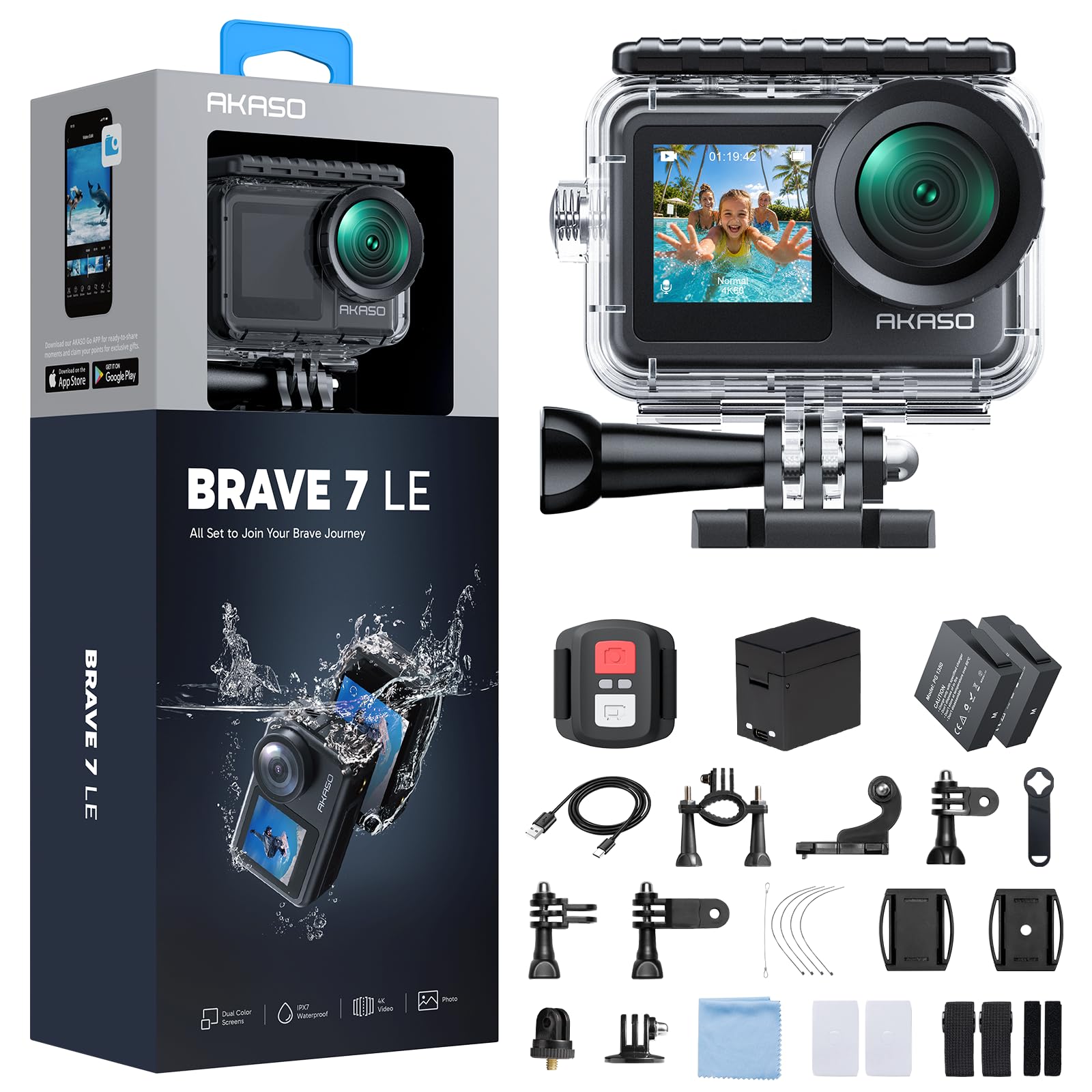
A 4K action cam with a 40m waterproof housing, two batteries, and a remote for under flagship money.
Here’s the honest math on the Brave 7 LE: it shoots 4K at 30fps (3840 x 2160 pixels, 30 frames per second) and 20MP photos, runs for about 2 hours on its 1350mAh batteries (milliamp-hours, a measure of charge capacity), and comes with two of them plus a remote and a waterproof housing. That housing takes it to 131 feet (40 meters) deep — far deeper than the 15-meter Kodak WPZ2 and the 33-foot waterproofing on the 8K camera. For a hike that ends in a lake jump or a rainy ridge, the housing makes it a serious contender.
The dual-display design is genuinely useful on a trail. A 2-inch rear touchscreen handles menus and playback, while the front screen makes selfies and vlog framing easy when you’re catching your breath at a summit. Press and hold the Mode button to flip between them. The 6-axis EIS 2.0 electronic stabilization is a step above the basic shake correction on cheaper action cams, keeping walking and biking footage smooth.
What owners like most is the overall quality for the price — it’s widely described as a strong GoPro alternative. Cyclists, snorkelers, and beach-goers report the included accessories cover most scenarios right from the start. The trade-off is low-light video, which is soft compared to the DJI, and audio that sounds thin unless you plug in an external microphone. Buttons also need a firm press. Both are fair limits at this tier, not dealbreakers.
Depth-Tested Durability: one diver took it to 85 feet and reported the waterproof case performed identically to dry land.
No Image Stabilization: stabilization needs a steady enough subject; a fast sprint still shakes the frame.
Designed for: hikers who want an action cam in the case and a familiar app, without the flagship spend.
Not designed for: low-light filming or serious audio work without an external mic.
5. Yatao 6K WiFi Flip Screen Digital Camera

A 6K flip-screen camera bundled with two batteries, a mic, and a fill light for trail vlogging.
This one skips action-cam ruggedness and goes for the vlogger’s toolkit instead. The core spec is a dual-lens system — a wide-angle lens for wide landscapes plus a macro lens for close-ups — with 6K Ultra HD video and 16X zoom. It captures 64MP stills and includes slow motion, continuous shooting, and a built-in flash. That macro lens is surprisingly handy on a forest trail, letting you snap mushrooms and moss patterns without changing gear.
The flip screen is the standout for anyone filming while walking. It swivels around so you can see yourself while recording, which matters for vlogging, selfies, and creative angle work. The bundle is what seals it: a 64GB card, two batteries with a charging stand, a microphone for clean audio, a bi-color fill light for warm or cool tones, and a lens hood to cut glare. USB-C doubles as a webcam connection for live streaming.
The catch is honest and worth flagging: it isn’t waterproof or even water-resistant. Rain and river crossings are off the menu unless you bag it. Menu navigation also takes some trial and error — the manual helps, and after a session or two most users find it intuitive. Owners describe it as a great beginner camera that overdelivers for the casual and family-level use it’s built for; it isn’t designed for professional YouTube output.
Ideal for: hiking vloggers who want an all-in-one kit with batteries, mic, and light included.
Not the tool for: wet trips or anyone expecting flagship-grade weather sealing.
6. Kodak PIXPRO WPZ2 Rugged Waterproof Bundle
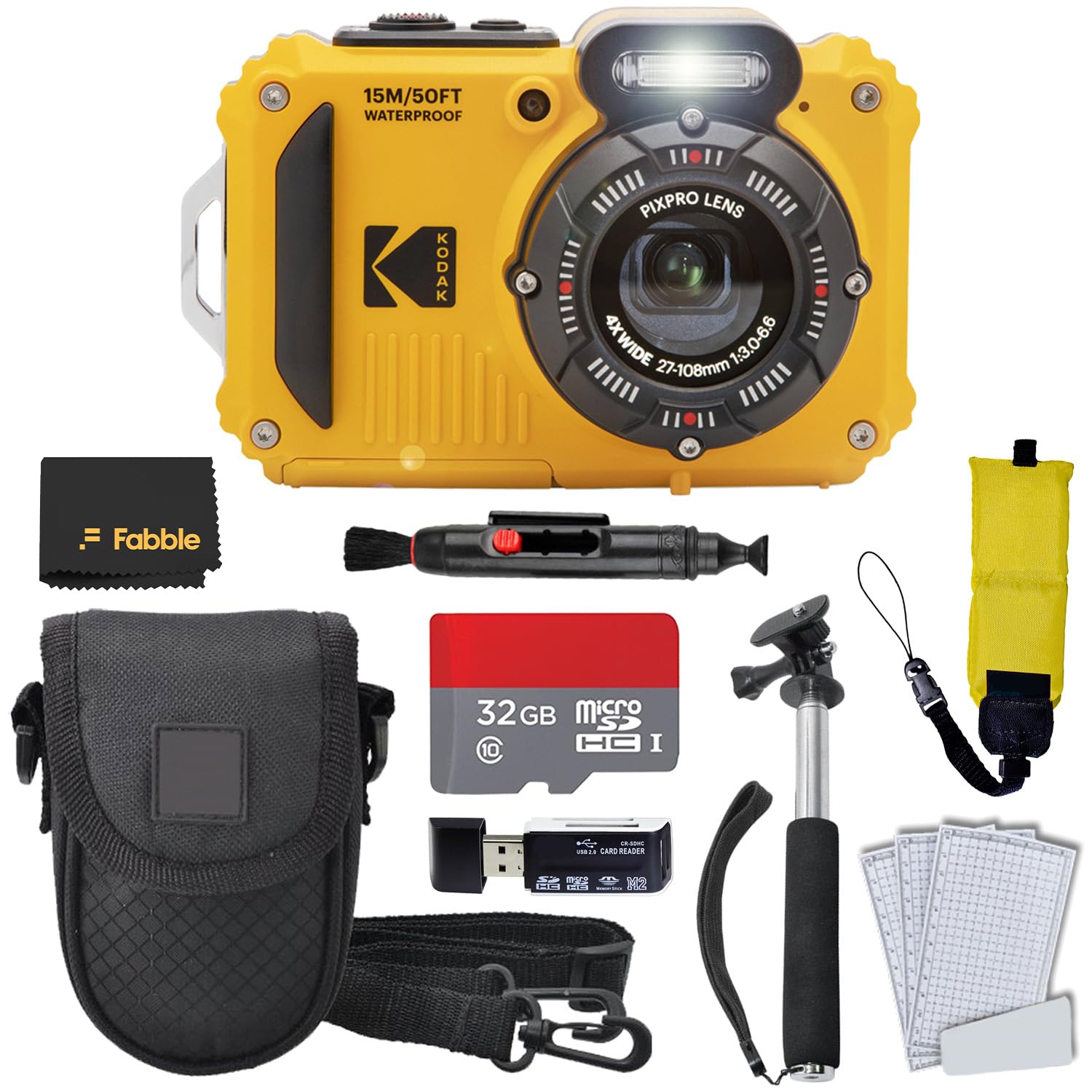
Waterproof to 15m with a floating strap and 32GB card already in the box.
The WPZ2 is built for the moment your trail meets a river. Waterproof to 15 meters (49 feet) and shockproof from a 2-meter drop, it takes grit, salt, and sand without complaint. The 16MP sensor captures lifelike detail, and the 4X optical zoom spans 27-108mm — enough to isolate a bird across a canyon without the quality drop that digital-only zoom brings. Continuous shooting runs at 6 frames per second with a 0.17-second gap between shots, so fast-moving subjects don’t slip through.
The bundle is the real draw here. It ships with a Black point-and-shoot case, a lens pen, a monopod, a USB card reader, a screen protector, a cleaning cloth, a USB card with adapter, a wrist strap, a 32GB SD card, and a floating strap. That floating strap is a small detail with big consequences — if the camera slips into a lake, it stays up. Owners specifically call out the buoyant strap as a genuine win for snorkeling and river trips.
Picture quality is well-regarded, particularly underwater and at the beach. The audible shutter helps when a snorkel mask fogs up and you can’t see the screen clearly. Battery life runs past 4 hours in real use. One honest caveat: the battery door is fiddly and the camera is slightly heavy in the hand. For a compact hiking camera, that’s a small tax to pay for real waterproofing without a housing.
The match for: river trips, lake days, and coastal hikes where you want waterproofing without a separate case.
Consider another: if you want top-tier image detail above water — this is built for splash and submersion.
7. PENTAX WG-1000 Olive Waterproof Camera

Waterproof to 15m for an hour, dustproof, and shockproof from 2m, with a carabiner strap for your pack.
The WG-1000 leads with toughness. The body is waterproof to a depth of 15 meters for up to one hour of continuous operation, dustproof against dirt and stains, and shockproof from a 2-meter fall. The included O-CC180 Protector Jacket shields it from scratches and the O-ST180 carabiner strap attaches it straight to a backpack strap. It has a 4X optical zoom with a 27mm wide-angle lens and shoots at ISO 3200 for low-light scenes. A choice of seven capture modes, including Underwater and Manual, covers most trail scenarios. Two accessory modes stand out: 20 color modes (from Sepia to Japan Style to Sketch) and the ability to sterilize the body with ethanol or chlorine dioxide solutions.
What’s honest about this one: the imaging side is where it gets mixed reactions. Image quality draws negative feedback, with wearers reporting the pictures aren’t great and video is not usable for serious work. Controls take learning — some find buttons confusing and the on-screen information unclear. Autofocus and low-light performance are the weaker points versus the DJI action cameras in this list. The charging and SD ports sit behind a cover that has to come off for every transfer, which slows down workflow.
Where it genuinely shines is in the environments other cameras won’t survive: rain, dirt, sandstorms, muddy work sites, and conditions where the sterilization feature actually matters. Owners describe it as a competent hip-shooter in auto and manual modes. This isn’t a deep-photography tool, and it isn’t trying to be. Frame it as a rugged documentation camera rather than an image-quality champion.
Buy it for: brutal conditions where toughness, dustproofing, and sterilization matter more than pixel-perfect images.
Pass it up for: hikes where crisp photos and smooth, shareable video are the main goal.
8. Xtra Muse 1″ CMOS 4K/120fps Gimbal Camera

A 3-axis motorized gimbal holds the 1-inch sensor steady for 4K at 120fps.
Where the action cams fight shake with software, the Xtra Muse uses hardware. A 3-axis gimbal stabilizer — a motorized arm that physically holds the sensor steady — smooths footage while you run, dance, or hike, and it records through a 1-inch CMOS sensor at 4K and 120fps. That’s the same 4K 120fps headline figure as the DJI Osmo Action 4, but here the stabilization is mechanical rather than electronic. The 2-inch touchscreen flips between horizontal and vertical shooting without removing the camera.
The color tools are more serious than the pocket form suggests. True 10-bit X-Log color delivers up to one billion colors for post-production flexibility — that’s a real gain for anyone editing sunrise and sunset footage. Master Follow keeps a moving subject centered, so a summit photo walk where you keep walking stays in frame. Portability is the other big draw; owners compare it to a DJI Pocket 3 alternative and note that DJI Pocket 3 accessories fit.
The catch is consistency. Owners mention excellent picture and video quality, particularly in 4K, and praise the gimbal’s effectiveness. But functionality and connectivity feedback is mixed — the Android app has historically trailed the iOS version, and some units have thrown SD card format errors during 4K60 video. X-Log also requires downloading a separate file from the maker’s site. Battery life is rated at 161 minutes, and while some owners get good runtime, others report it draining fast. It’s also not weather-resistant.
Gimbal-Smooth Footage: a professional shooter ranked its image quality against gear at roughly four times the cost in good lighting.
Heavy and Bulky: no weather sealing, so keep it in a dry bag on wet trails.
Right for: hikers who want silky cinematic footage and are comfortable editing in 10-bit color.
Wrong for: Android-first users or anyone needing rain protection built in.
9. DJI Osmo Action 5 Pro Hiking Bundle
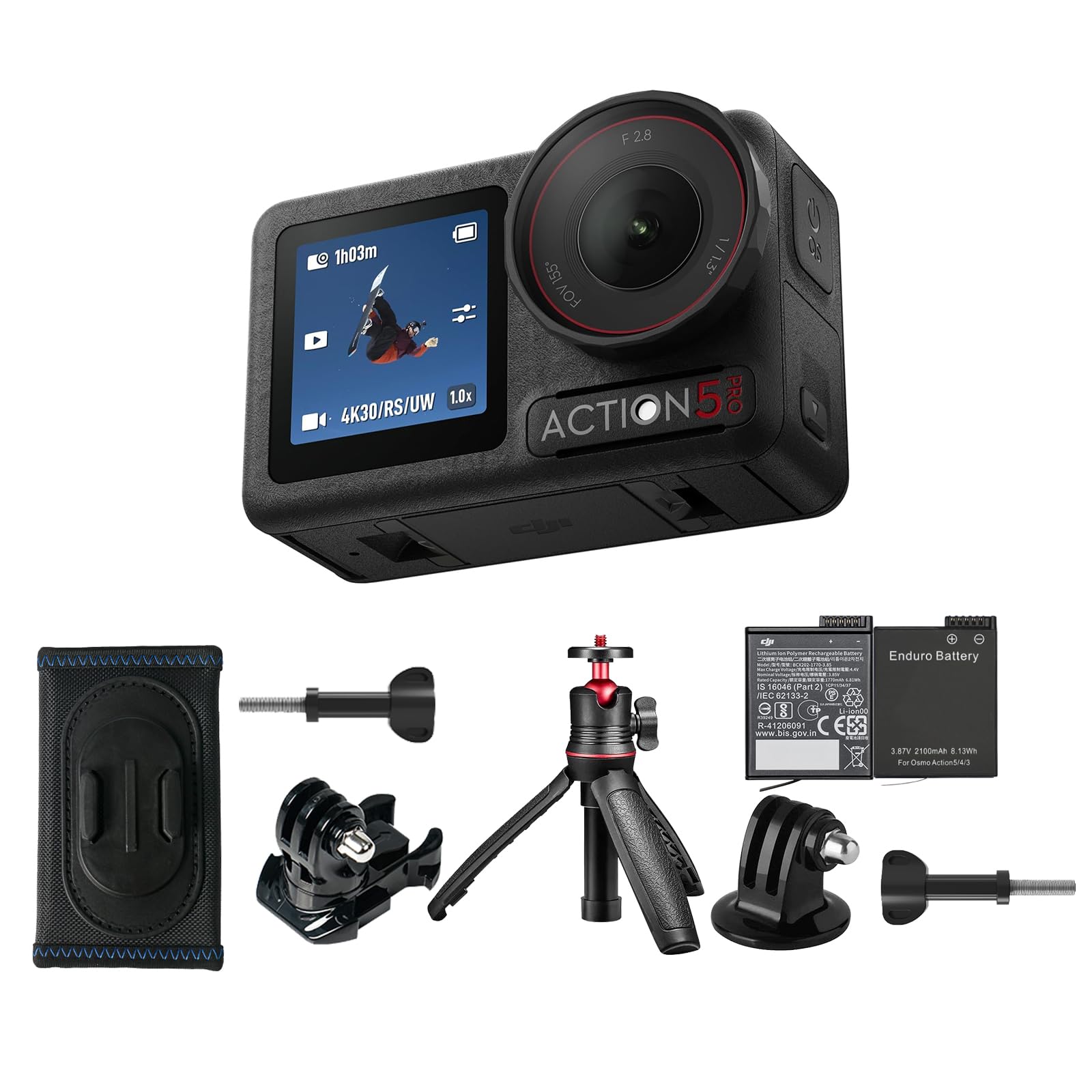
The premium kit that runs all day on one battery and films in the dark without grain.
This is the upgrade path over the Action 4, and the biggest jump is battery. A 1950mAh cell delivers up to 4 hours of recording, and 3.6 hours even at -20°C (-4°F). The Action 4’s 1770mAh lasts up to 150 minutes, so this version nearly doubles the recording window — a genuinely different experience on a full-day trek. The body is IP68-rated for 20 meters underwater without any housing, deeper than the Action 4’s 18-meter rating.
The imaging upgrades are real too. A 1/1.3-inch sensor with 2.4μm pixels and 13.5-stop dynamic range captures low-light scenes with more detail than its cheaper sibling. A 4nm chip keeps moving subjects centered in either 16:9 or 9:16. The 360° HorizonSteady stabilization keeps the horizon level even through rolls that would ruin electronic stabilization. Front and rear OLED touchscreens stay readable in bright sun, which is a real trail advantage.
The bundle wraps it up for hikers specifically: two 1950mAh batteries, an Osmo Action Mini Extension Rod, an Osmo Backpack Strap Mount, quick-release mounts, and adhesive bases. Voice control works within a meter, so you can start recording with a phrase while both hands are on trekking poles. DJI Mic 2 or Mic Mini transmitters connect wirelessly for clean audio. A color temperature sensor handles automatic white balance underwater and on land without filters. One honest size note: the follow-cam feature works best in calm conditions.
Premium Hiking Kit
- Up to 4 hours of recording from a 1950mAh battery
- IP68 rated for 20m underwater, no case needed
- Dual OLED touchscreens visible in direct sunlight
- Includes backpack strap mount and mini extension rod
Expensive Accessories
- Reliability and water resistance both draw mixed-to-negative owner feedback
- Higher premium tier — you’re paying for the extra battery and sensor
- Requires DJI Mic 2 or Mic Mini for best audio quality
This is your camera if: you want the longest battery, deepest waterproofing, and best stabilization on the trail, and you’ll pay for it.
Save your money if: the Action 4 already covers your mileage and you don’t need 4 hours on a single charge.
Understanding the Specs
Waterproofing Ratings in Meters and Feet
A depth rating is a promise. “IP68” means the camera is sealed against dust and submersion, often with a specific depth figure attached — the DJI Osmo Action 5 Pro’s IP68 rating is good for 20 meters. Lower numbers don’t mean a worse camera; they mean a different use case. A 33-foot rating (about 10 meters) covers stream crossings and lake dunks. A 15-meter rating handles snorkeling. A “water-resistant” label without a number only covers rain and splashes, which is enough for a dry trail but not a river. If a camera needs a waterproof housing to hit its number, that housing must be attached before you get near the water.
Battery Capacity and Rated Hours
Battery capacity is measured in mAh — milliamp-hours, which is essentially how much charge the pack holds. Bigger numbers generally mean longer runtime, but the camera’s electronics and sensor size also draw power, so a 2500mAh pack in the 8K Underwater Camera lasts 4.5 to 5 hours while the AKASO Brave 7 LE’s 1350mAh runs about 2 hours. Look for a stated runtime in hours or minutes, because that’s the number you’ll actually experience. Cold temperatures reduce runtime, though the Osmo Action 4 and 5 Pro both work down to -20°C, which matters on alpine starts. Spare batteries are the simplest insurance for a multi-day trip.
Stabilization Systems Compared
Three kinds of stabilization appear in this list. Electronic image stabilization (EIS) uses software and gyro data to counter shake — it’s what the AKASO Brave 7 LE’s 6-axis EIS 2.0 uses. A three-axis gimbal physically holds the sensor steady with motors, which is what the Xtra Muse packs; it produces the smoothest footage at the cost of a bulkier body. Hybrid systems like DJI’s RockSteady and HorizonSteady blend electronic correction with horizon leveling, keeping things flat and level through rolls that would otherwise tip the frame. All three beat no stabilization, but the hardware gimbal has the smoothest edge and EIS is the most compact solution.
Optical and Digital Zoom Explained
Optical zoom moves real lens elements, keeping image quality intact — the Kodak PIXPRO FZ55’s 5X optical zoom and the Kodak WPZ2’s 4X optical zoom both work this way. Digital zoom crops and enlarges the picture, so quality softens as you zoom. The 8K Underwater Camera offers 18X digital zoom and the DJI Osmo Action 4 offers 4x digital zoom — good for tight shots but noisy at full extension. The PENTAX WG-1000 sits in between with a 4X optical zoom. For distant wildlife or dramatic canyon framing, optical zoom is the one that preserves the shot; digital zoom is a framing convenience, not a quality tool.
FAQ
How much does waterproofing matter on a hike that doesn’t cross any water?
Do I really need a spare battery for a hiking trip?
Is a digital zoom useful on a hiking camera or a waste?
Will an action camera housing leak if I take it snorkeling?
Does stabilization actually matter when I’m just walking a flat trail?
Can I transfer photos off these hiking cameras without a computer?
How much memory do I need for a multi-day hike?
Should I pick an action camera or a compact waterproof camera?
Final Thoughts: The Verdict
For most hikers shopping this list, the budget camera for hiking winner is the DJI Osmo Action 4 Adventure Combo because it pairs a 1/1.3-inch low-light sensor, 18-meter waterproofing, three batteries, and a proven magnetic mount in one kit. If the priority is battery life rather than stabilization, the 8K Underwater Camera runs on a 2500mAh pack for 4.5 to 5 hours straight. And for wet hikes where a rugged waterproof body and floating strap matter most, the Kodak WPZ2 Bundle is the one to reach for.
How We Picked
We do not accept paid placement. Every pick is matched to a real buyer and a real use-case; we do not hands-on test units.
Sources & Methodology
Specifications: manufacturer listings and product documentation. Review insights: verified customer reviews, as of September 2026. Pricing: not shown on this page (it changes often); check the current price via the retailer link.
As an Amazon Associate, Gadgets Feed earns from qualifying purchases. This does not affect which products we feature.