
Our readers keep the lights on and my morning glass full of iced black tea. As an Amazon Associate, I earn from qualifying purchases.
Specs are compiled from manufacturer listings and verified buyer reviews and can change over time — please confirm the key details on the product page before buying.
You do not need a barista to get a real espresso shot before your commute — you need a machine that plugs into your car’s 12V socket (the cigarette-lighter port) and does the heating itself. That is the whole game with an automobile coffee maker. The espresso makers below split into two families: self-heating machines that carry their own battery and brew anywhere, and 12V kettles that heat water straight from your car’s outlet. Which one is right for you depends on one question: do you want to brew while parked, or brew while driving?
I’m Min — the founder and writer behind Gadgets Feed. This guide is built by comparing the manufacturers’ published specifications and the patterns across verified customer reviews, so you get each pick’s real strengths and trade-offs instead of marketing spin.
Most buyers assume a portable machine means weak, lukewarm coffee — that myth falls apart once you understand pressure and battery capacity. Our rundown of the automobile coffee maker field covers the pressure ratings, cup counts, and heating times that actually decide your morning shot.
Our Picks at a Glance
How To Choose The Best Automobile Coffee Maker
Two specs separate a car coffee maker you love from one you leave in the glovebox — the pressure pump that pushes water through the grounds, and the battery or 12V draw that heats that water. Get those two right and everything else (size, cleaning, cup count) falls into place. Here is what the numbers on the box actually mean in your daily drive.
Bar pressure decides whether you get crema or brown water
Pressure is measured in bar, and it is the single biggest factor in whether your shot tastes like an espresso or like sad drip coffee. The machines here run 18 to 20 bar. In plain terms, that pressure is what forces water through a compacted puck of coffee and pulls out the oils that create crema — the golden foam on top. Lower pressure gives you a thin, flat cup; the higher-bar pumps in this category give you the syrupy texture you would otherwise pay a café for.
Battery capacity and 12V draw decide your cup count
A self-heating machine runs on a battery measured in mAh (milliamp-hours — roughly, how much charge it can store). The bigger the number, the more cups you brew before you hunt for a cable. Two of the picks here carry 13,500mAh and 15,000mAh packs. The 12V-only machines skip the battery entirely and pull power from your car’s outlet, which means they never run out — but they also only work while plugged in.
Check your capsule format before you buy
Nothing kills the joy of a new machine faster than pods that will not lock in. The most common fit is the original Nespresso capsule, usually shortened to NS. A few machines also take ground coffee, and one here takes the larger DG pods. If you already own a capsule stash, match the machine to that format — buying a machine that takes a pod type you do not own is the most common reason these get returned.
Heat-up time sets your morning patience budget
Self-heating machines need two to five minutes to bring cold water up to brewing temperature. A 12V kettle takes far longer. If you fill the machine with pre-heated water instead, you skip the wait and save battery — a move owners lean on heavily. Know your tolerance for sitting in the driveway before you commit to a cold-water machine.
Quick Comparison
| Model | Best For | Power Source | Pressure | Capacity | Amazon |
|---|---|---|---|---|---|
| CONQUECO Self-Heating Portable Espresso Machine★ Best Overall | Daily driver & RV brewing | 13500mAh battery + USB-C | 18 bar | 80 ml | Amazon |
| Vagizm 12V Portable Espresso MachineFastest Heat-Up | Fast-heating road trips | 15000mAh battery + PD 30W | 20 bar | 80 ml | Amazon |
| Winwj Portable Electric Espresso Machine | Camping & long trips | 71000 mAh battery + 5V 2A | 20 bar | 60 ml | Amazon |
| zxfcfo Portable Coffee Maker Espresso Machine | Starter capsule brewing | 7500mAh battery + USB-C | 20 bar | 150 ml/min | Amazon |
| FVPE 12V/24V Car Electric Kettle | Hot water for tea & pour-over | 12V/24V socket (no battery) | — | 13.5 ounces | Amazon |
In‑Depth Reviews
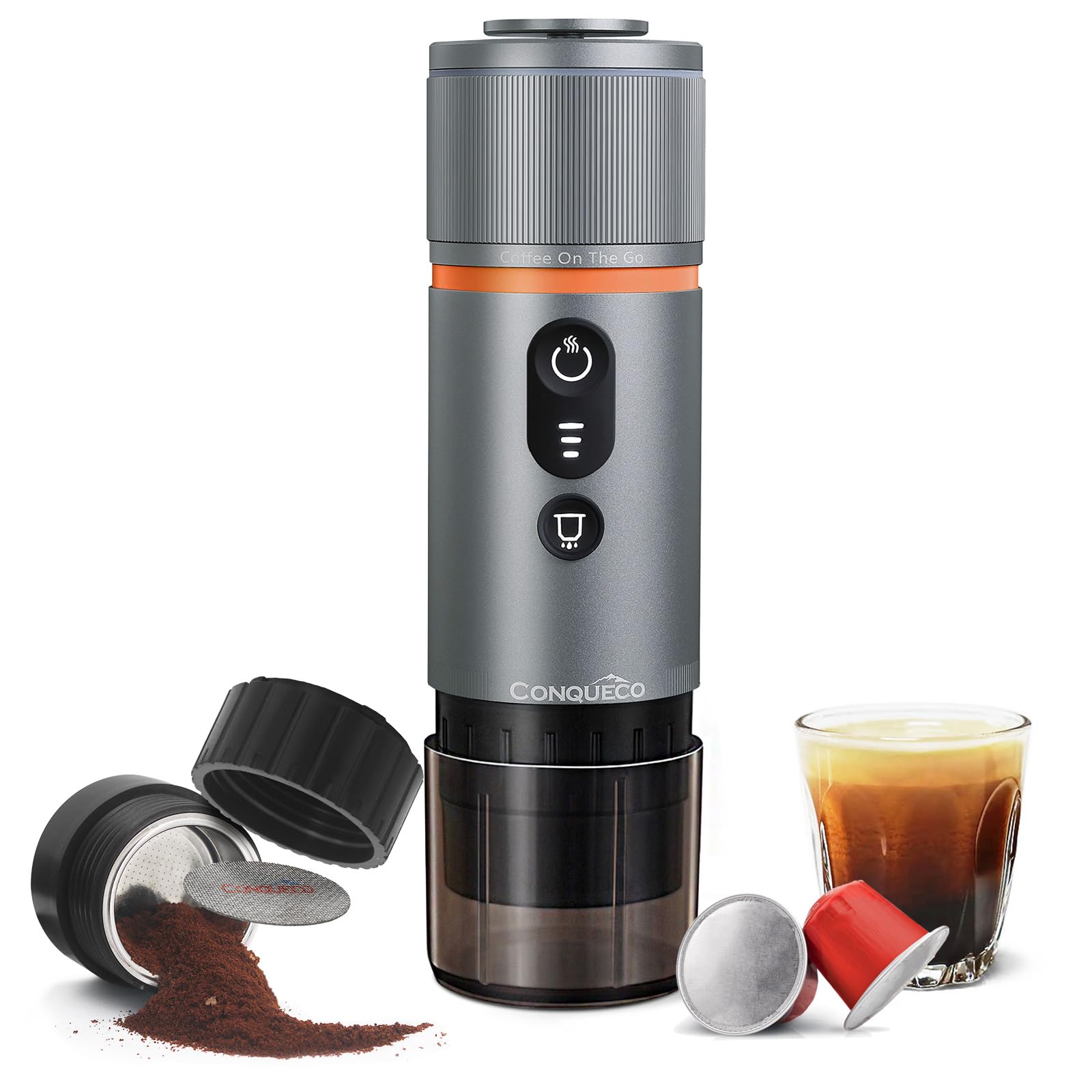
1. CONQUECO Self-Heating Portable Espresso Machine
Our pick — 4.5★ from 30+ verified ratings; the strongest balance of quality and price.
A water-bottle-sized espresso bar that fits your cup holder and brews in about two minutes.
For a driver who wants a real shot on the way to work — or an RVer who has no kitchen counter — this is the machine to beat. Its 13,500mAh battery is the headline: that is the biggest pack among the self-heating espresso makers here, and it lets you brew up to 8 hot shots at 1.35oz or 5 hot shots at 2.7oz on a single charge. Owners confirm the practical version of that number, with buyers reporting they “can make 6 cups at 80 ml when battery is fully charged.” There is also a brew-only mode that skips the heating step entirely when you pour in water you already warmed.
The pump is rated at up to 18 bar, which is a touch under the 20 bar of the Vagizm and zxfcfo — but owners do not seem to notice the gap. The consistent verdict is that the coffee itself is excellent with original Nespresso capsules. Where this machine earns its keep is patience: the improved heating system pushes out 1.35oz in 2-3 minutes, or 2.7oz in 4-5 minutes, which is fast enough to brew before the light turns green. It runs on USB-C, fits most car and truck cup holders, and takes both ground coffee and original Nespresso capsules.
The honest catch here is the auto-dispense behavior. Buyers report it starts pouring the moment the water hits temperature with no manual trigger, so you have to be ready with your cup or you get overflow. A few also gripe that the instructions are thin and that the 2 lbs body topples easily on uneven surfaces. For a daily in-cup-holder machine that is a minor annoyance; for a serious backpacker counting ounces, the weight is the deal-breaker.
Where it pulls ahead
- 13,500mAh battery brews up to 8 hot shots at 1.35oz per charge
- Fast heating: 1.35oz shot in 2-3 minutes on cold water
- Dual input — works with ground coffee or original Nespresso capsules
- Compact water-bottle build that fits most cup holders
Where it asks for care
- Auto-dispenses as soon as water heats, with no manual stop button
- 2 lbs body topples easily on uneven ground
- No dosing funnel included, so grinding your own beans is fiddly
Settle on this if: you commute by car or truck daily and want a hot shot without hunting a café.
Walk past it if: you are a backpacker — that 2 lbs is real weight on a long trail.
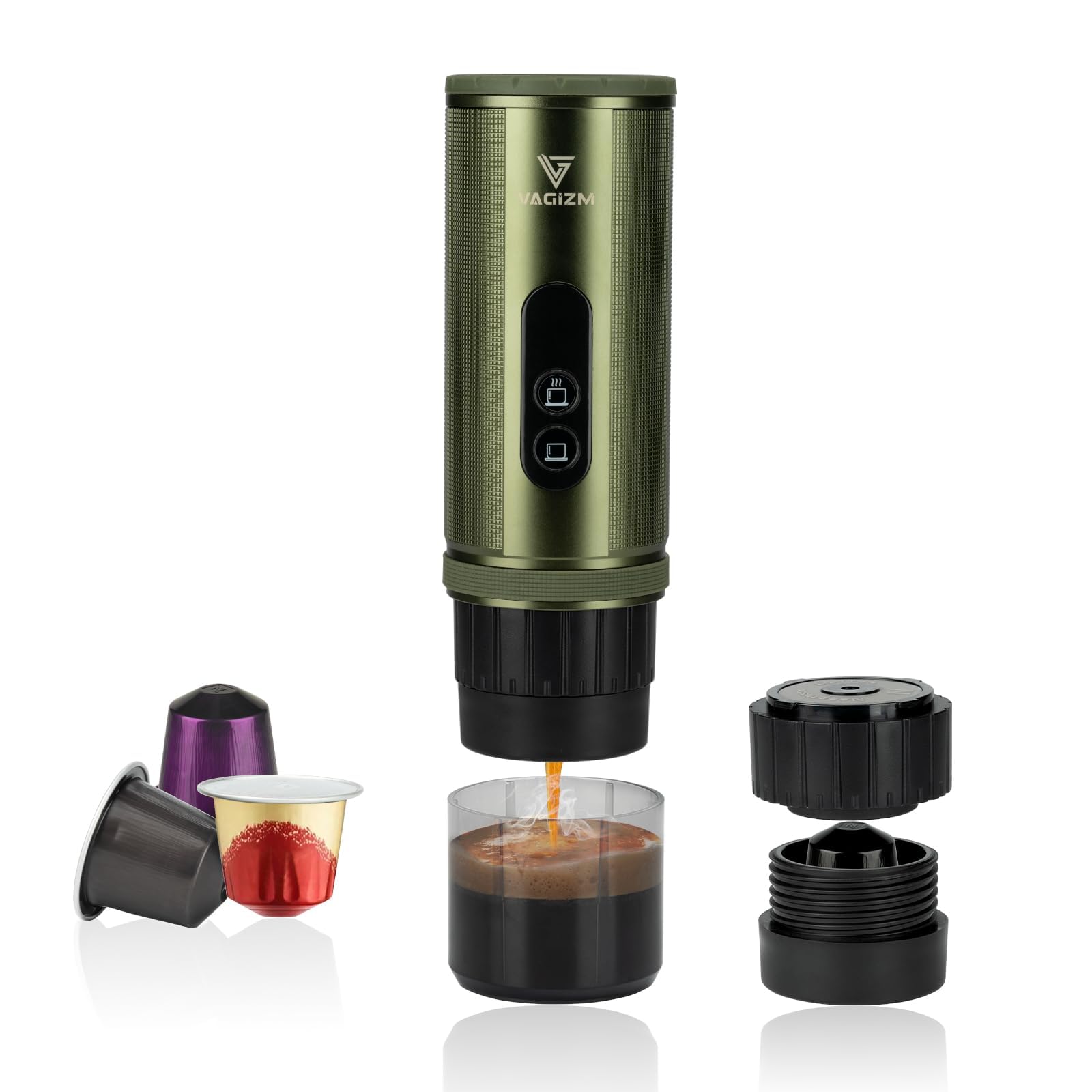
2. Vagizm 12V Portable Espresso Machine
The one that beats the CONQUECO on raw power — 20 bar and a bigger battery, with a 150-second heat-up.
If your priority is speed and pressure, this is the pick. Its pump is rated at 20 bar versus the CONQUECO’s 18 bar, and its 15,000mAh battery edges past the CONQUECO’s 13,500mAh. The number that really changes your morning is the heating claim: this machine is built to bring 40ml of water from 77°F to 198°F (25 to 92 °C) in about 150 seconds, and it holds up to 8 cups per charge. It charges on PD 30W (a fast-charge standard that tops the battery faster than a basic cable), going from empty to full in about two hours.
The interface is built for drivers who should not be reading a manual at a red light. There is an LCD temperature display that shows the heat-up progress in real time, and two buttons — one for heating cold water, one for direct brewing when you already have hot water. It takes NS Original capsules plus LOR, Starbucks, Lavazza, and illy originals. Note the fit limit: it is aluminum capsules only and will not work with reusable pods. Owners call the two-button, LCD-guided operation easy and reliable.
Where this machine needs a warning is consistency. The recurring theme in owner feedback is that it can leak from the sides right after a full charge, and the suspicion is that the 20 bar pump is pushing water harder than a standard Nespresso pod likes. Most units brew smoothly, but if yours weeps from the seams, use the one-year warranty rather than fighting it. The other thing to know: heat mode effectively cuts your cup count down to a couple of brews before a recharge, so hot water from the tap keeps the battery happy.
Pressure you can taste: 20 bar is the top of this group, and it pulls a richer crema than the 18 bar CONQUECO. If the shot texture matters more to you than the last sip of battery, this is the upgrade.
The honest limit: owners mention it can get very warm and weep from the seams after a full charge — a real fit-note for heavy users who want zero fuss.
Reach for it: if you want the fastest heat-up and the most pressure in a 12V-friendly espresso maker.
Look elsewhere: if you need dead-reliable, no-drama brewing and prefer the track record of a machine with simpler internals.
3. Winwj Portable Electric Espresso Machine

The endurance champ for long trips — a huge battery and a light 510g frame.
This machine solves the one problem every other battery brewer here still has: running out of charge in the middle of nowhere. It carries a 71000 mAh battery, charges via a 5V 2A cable in about 3 hours, and is rated for up to 4 cups of hot coffee in heating mode — or up to 100 cups in direct-brew mode when you supply hot water yourself. That is a wildly different use case from the espresso machines above: this is the one for a week off-grid or a long-haul drive where a wall outlet is theoretical.
At 510 grams (about 1.1 lbs) it is the lightest of the brewing machines here — the CONQUECO tips in at 2 lbs and the Vagizm sits in between. It runs a 20 bar pump, same as the Vagizm and zxfcfo, and it heats 60ml of room-temperature water to 85 °C in 300 seconds. Owners like the straightforward two-mode operation: press the button twice to heat, or hold it for two seconds to brew straight through hot water. It takes both ground coffee and capsules, so it works with Nespresso as well as the larger format pods.
The small cavity is the thing to plan around. At 60ml capacity you are brewing one cup at a time, not filling a travel mug — owners working from remote sites call it exactly that: one coffee per go, with the water needing a few minutes to heat sufficiently. The condenser-like tradeoff is that heating cold water eats the battery fast; fill it with warm water from the tap and the charge lasts noticeably longer. For solo drinkers it is near perfect; for couples sharing it, plan two cycles.
Why owners keep it
- 71000 mAh battery — the largest here — rated for up to 4 heated cups or up to 100 direct-brew cups
- Light 510g (about 1.1 lbs) frame made of food-safe stainless steel
- Two-mode design: heat cold water or brew straight through hot water
- Works with ground coffee and capsules
Plan around this
- 60ml capacity brews one cup at a time — small for sharing
- Heating cold water drains the battery quickly
- Cold-water heat-up takes a few minutes, not seconds
Buy it for: the off-grid trip or road-trip week where the biggest battery in the group matters more than a second cup.
Think twice if: you brew two mugs every morning — the 60ml cap means two pours.
4. zxfcfo Portable Coffee Maker Espresso Machine
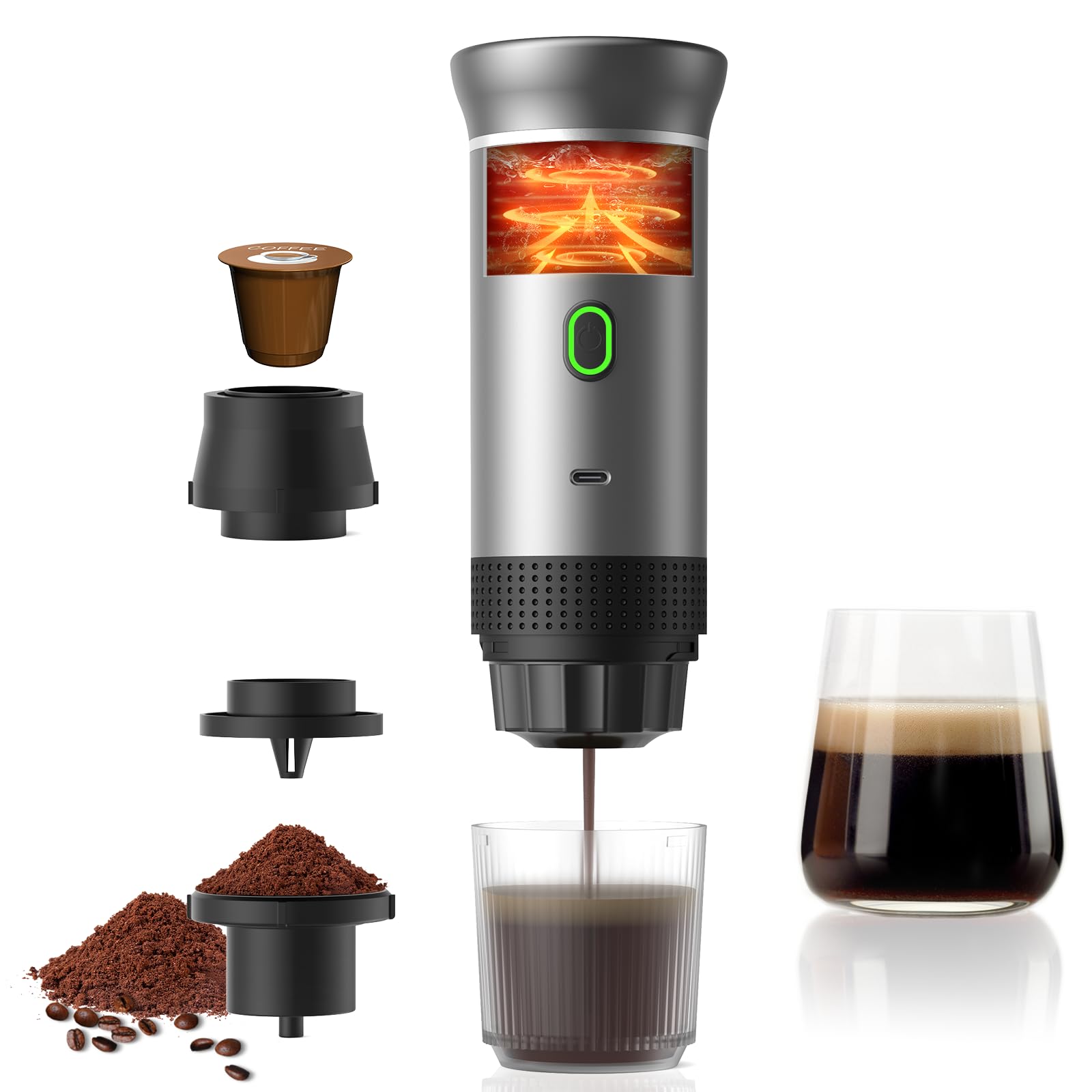
The entry-level 3-in-1 that takes ground coffee, NS capsules, and DG pods at a budget-friendly price.
For someone testing the whole car-coffee idea for the first time, this is the low-risk way in. It is the most flexible pod machine here: 3-in-1 support means ground coffee, NS capsules, and DG pods all work. It runs a 20 bar pump, matching the Vagizm and Winwj, and holds a 7500mAh rechargeable battery rated for 3-5 cups per charge — the smallest battery among the espresso makers here, and the number that tells you what you’re buying.
At 700 grams (about 1.5 lbs) it splits the difference between the Winwj featherweight and the 2 lbs CONQUECO, and it charges via USB-C so you can top it up from a laptop brick. It also supports 12V/24V car charging, which means you can keep the battery fed straight from your outlet on a long drive. Owners in outage-prone areas call it a lifeline: one bottle-sized machine that still brews a real cup. Customers note roughly 20 cups per full charge in direct-brew mode.
The caveat is that this is the least consistent brewer in the group — its functionality ratings are the most mixed, and a handful of buyers have received units that poured lukewarm or nothing at all. That’s a minority outcome, but a real fit-note for anyone who wants zero troubleshooting. The other honest gripe, seen across reviews, is that the coffee temperature lands on the cool side. If you want a hot cup and you don’t mind the extra step, pour pre-heated water and it fixes both the temp and the battery drain.
The pitch: a 3-in-1 brewer with 20 bar output, USB-C charging, and 12V/24V support — the widest capsule fit here at the entry tier.
The fine print: it is the machine most likely to need a patient first setup, and the coffee finishes cooler than the 20 bar pumps that cost a step up.
Start here if: you’re curious about the whole category and want pod flexibility without committing to a premium machine.
Step up instead if: you value a hot cup and predictable performance over the 3-in-1 pod range.
5. FVPE 12V/24V Car Electric Kettle
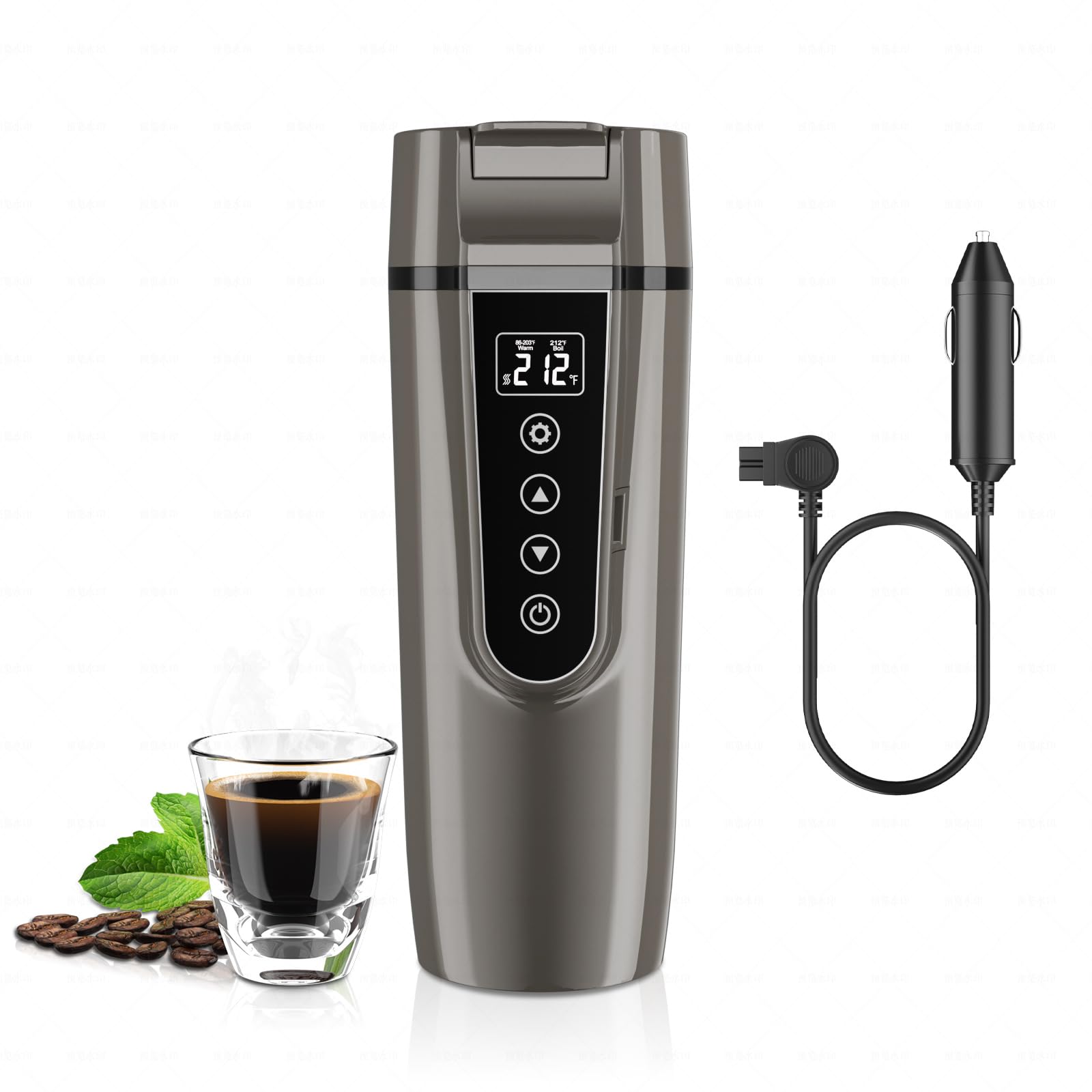
Not an espresso machine at all — a 12V water boiler for anyone who pours their own.
If your coffee routine is a pour-over cone, French press, or instant, a kettle beats an espresso maker — and this is the car kettle to consider. It draws straight from your 12V or 24V outlet with no battery to charge, holds 400 mL (about 13.5 ounces), and lets you dial in an exact temperature. There are two modes: a keep-warm function adjustable from 86°F to 203°F, and a full boil function. The large LCD display with touch controls shows the real-time temperature and lets you adjust with a tap.
The build is where this earns its reputation — the inner liner is 304 stainless steel (the food-grade kind used in kitchen pots), and owners rank build quality as the standout, along with the convenience of heating water on the go. It fits a cup holder, has a flip lid with small drinking holes, and the temperature is memory-adjustable, so it holds your last setting. For tea drinkers and instant-coffee commuters, that precision is exactly the point: you get to choose 180°F for green tea or 203°F for a proper black tea steep.
The number that will make you hesitate is the boil time. The manufacturer rates it at approximately 28-35 minutes to boil 400 mL on 12V power — this is a slow machine, and reviewers split on whether it heats well. Owner reports range from 4-5 minutes to about 10 minutes for coffee water, while the brand rates it at 28-35 minutes — heat time depends heavily on your vehicle’s voltage and outlet. Durability is the other concern to weigh: some reviewers point out the cord or connector failing within months, so treat the cable gently and consider this a fair-weather companion for road trips rather than a daily-driver appliance.
What it nails
- 400 mL (13.5 oz) capacity with keep-warm adjustable from 86°F to 203°F
- Works on both 12V and 24V systems — car, truck, or RV
- 304 stainless steel liner and a large touch LCD for precise temp control
- No battery to charge — runs entirely from your car’s outlet
Where it stumbles
- Slow to boil at 12V — rated around 28-35 minutes for 400 mL
- Temperature resets each use, needing several clicks to re-set
- Cord and connector are the most-cited durability weak point
Pick this for: pour-over, tea, and instant coffee drinkers who want adjustable temperature and no battery to manage.
Skip the idea if: you want a fast espresso shot — you need one of the battery machines above for that.
Understanding the Specs
Bar Pressure
Bar is the unit of pressure that pushes hot water through your coffee. The machines in this roundup run 18 to 20 bar, and that pressure is what pulls out the oils and sugars that form crema — the golden foam on a proper espresso shot. Lower pressure gives you a thin cup, so when you compare models, higher bar means a richer, thicker shot. Every self-heating espresso maker here sits at 18 bar or 20 bar; the 12V kettle does not apply since it only heats water.
Battery Capacity (mAh)
mAh stands for milliamp-hours — a measure of how much charge a battery stores. The self-heating brewers here carry 7,500mAh, 13,500mAh, and 15,000mAh packs (with one outlier at 71000 mAh). Higher capacity means more cups per charge, but heating cold water drains it far faster than brewing straight through pre-heated water. If you want maximum cup count, larger mAh plus warm tap water is the combination that works.
Heat-Up Time
This is how long the machine takes to bring cold water to brewing temperature without a stove. The espresso makers here manage it in roughly 2-5 minutes (one claims 150 seconds for 40ml). A car kettle is much slower — rated around 28-35 minutes to boil 400 mL on 12V. If you’re impatient, choose a brewing machine and fill it with water you already warmed.
Capsule Compatibility
Capsule fit is the spec that most often sends a machine back. The most common standard is NS Original — the classic aluminum Nespresso pod. Some machines here also take ground coffee or the larger DG pods. Reusable capsules are the frequent gap: two of these machines explicitly exclude refillable pods and only accept aluminum originals. Confirm your pod format before you commit.
FAQ
Can an automobile coffee maker really brew hot espresso without a stove?
Will my Nespresso capsules fit these portable machines?
How many cups can I brew on a single charge?
Does a 12V coffee maker work in a 24V truck or RV?
How long does heating cold water take in a car coffee maker?
Can I use ground coffee instead of capsules?
Is a 12V kettle better than a portable espresso machine for tea?
What is the most common problem with portable car coffee makers?
Do these car coffee makers need a special adapter or charger?
Can I use a car coffee maker while the vehicle is moving?
Final Thoughts: The Verdict
For most drivers, the automobile coffee maker winner is the CONQUECO Self-Heating Portable Espresso Machine because its 13,500mAh battery and fast 2-3 minute heat-up make a real espresso shot a genuine daily habit, not a camping novelty. If you want the fastest heat-up and the top pressure of the group, the Vagizm 12V Portable Espresso Machine and its 20 bar pump are worth the step up. For tea, pour-over, or a week off-grid, reach for the FVPE 12V/24V Car Electric Kettle or the big-battery Winwj Portable Electric Espresso Machine. Whichever fits your drive, the CONQUECO is the safest place to start — the crowd favorite of this group.
How We Picked
We do not accept paid placement. Every pick is matched to a real buyer and a real use-case; we do not hands-on test units.
Sources & Methodology
Specifications: manufacturer listings and product documentation. Review insights: verified customer reviews, as of September 2026. Pricing: not shown on this page (it changes often); check the current price via the retailer link.
As an Amazon Associate, Gadgets Feed earns from qualifying purchases. This does not affect which products we feature.