
Our readers keep the lights on and my morning glass full of iced black tea. As an Amazon Associate, I earn from qualifying purchases.
Specs are compiled from manufacturer listings and verified buyer reviews and can change over time — please confirm the key details on the product page before buying.
If your engine has started ticking on cold mornings or burning a little oil between changes, the fix is usually simpler than you think: the right 5W-20. This guide cuts through the bottle-label noise and lines up nine oils that real owners keep buying again — from a deposit-cleaning full synthetic to a high-mileage blend built for engines past 75,000 miles.
I’m Min — the founder and writer behind Gadgets Feed. This guide is built by comparing the manufacturers’ published specifications and the patterns across verified customer reviews, so you get each pick’s real strengths and trade-offs instead of marketing spin.
You will see which oils clean, which ones quiet a noisy engine, and which stretch a drain interval the furthest. Every pick below is genuine 5W-20, so whatever your owner’s manual calls for, there is a match here that fits your engine and your budget.
Our Picks at a Glance
How To Choose The Best 5W20 Oil
Buying 5W-20 oil depends on three things: the grade, the volume, and the drain interval. The grade is fixed — 5W-20 — so the real decisions are simpler than the shelf makes them look: how much you need, how long you want to go between changes, and whether your engine has already crossed the high-mileage line.
Match the grade exactly, then count your quarts
5W-20 is a specific viscosity grade — the “5W” half tells you how freely it flows when the engine is cold, and the “20” half tells you how thick it stays once the engine is at full operating temperature. Your owner’s manual names this grade for a reason, so buy the exact one it lists. Next, check your manual’s capacity: most four-cylinder and V6 engines take somewhere in the four-to-six quart range, which is why you see both 5-quart jugs and 6-packs of 1-quart bottles here. A 5-quart jug covers a single change on many cars with a little left over; a 6-pack of quarts gives you the same oil in easier-to-pour, easier-to-store bottles.
Full synthetic versus synthetic blend
A full synthetic oil is built entirely from synthetic base stock, which resists breaking down at high heat better than a blend. A synthetic blend mixes synthetic and conventional base oils, which keeps the cost down while still improving on plain conventional. If your manual says “full synthetic required,” buy full synthetic. If it says “synthetic blend acceptable,” the blend will do the job — particularly on a higher-mileage engine, where seal conditioners in a high-mileage formula matter more than the base-oil badge.
Know your drain interval before you pour
Some oils here are rated for extended drain intervals and some are not. If you drive short trips, tow, or sit in traffic, you fall under “severe service” in most manuals and should change on the shorter schedule regardless of what the bottle claims. Match the oil’s rated interval to how you actually drive, and you will never stretch a change past what the oil can take.
Quick Comparison
| Model | Best For | Volume | Format | Rated Drain Interval | Amazon |
|---|---|---|---|---|---|
| Valvoline Restore & Protect Full Synthetic 5W-20★ Best Overall | Cleaning deposits from a tired engine | 5 quarts | Single jug | — | Amazon |
| Quaker State Full Synthetic 5W-20Budget Champion | Cheapest full synthetic for routine changes | 160 fluid ounces | Single jug | — | Amazon |
| Valvoline MaxLife High Mileage 5W-20 BlendHigh-Mileage Pick | Engines past 75,000 miles with leaks or oil use | 32 fluid ounces | 6 × 1-quart bottles | — | Amazon |
| Mobil 1 Truck & SUV Full Synthetic 5W-20 | Trucks that tow and haul | 160 fluid ounces | Single jug | 20,000 miles | Amazon |
| K&N Motor Oil 5W-20 Full Synthetic | Engines that burn oil between changes | 5 quarts | Single jug | — | Amazon |
| Mobil Full Synthetic 5W-20 | Upgrading from conventional oil | 192 fluid ounces | 6 × 1-quart bottles | Up to 7,500 miles | Amazon |
| TRIAX Synergy SRT 5W-20 Full Synthetic | Longest drain interval you can buy | 5 quarts | Single jug | Up to 20,000 miles or 2 years | Amazon |
| Pennzoil Ultra Platinum Full Synthetic 5W-20 | High-performance engines, one-quart top-offs | 32 fluid ounces | 6 × 1-quart bottles | — | Amazon |
| Royal Purple HPS 5W-20 Synthetic | Modified and performance engines | 32 fluid ounces | 6 × 1-quart bottles | — | Amazon |
In‑Depth Reviews
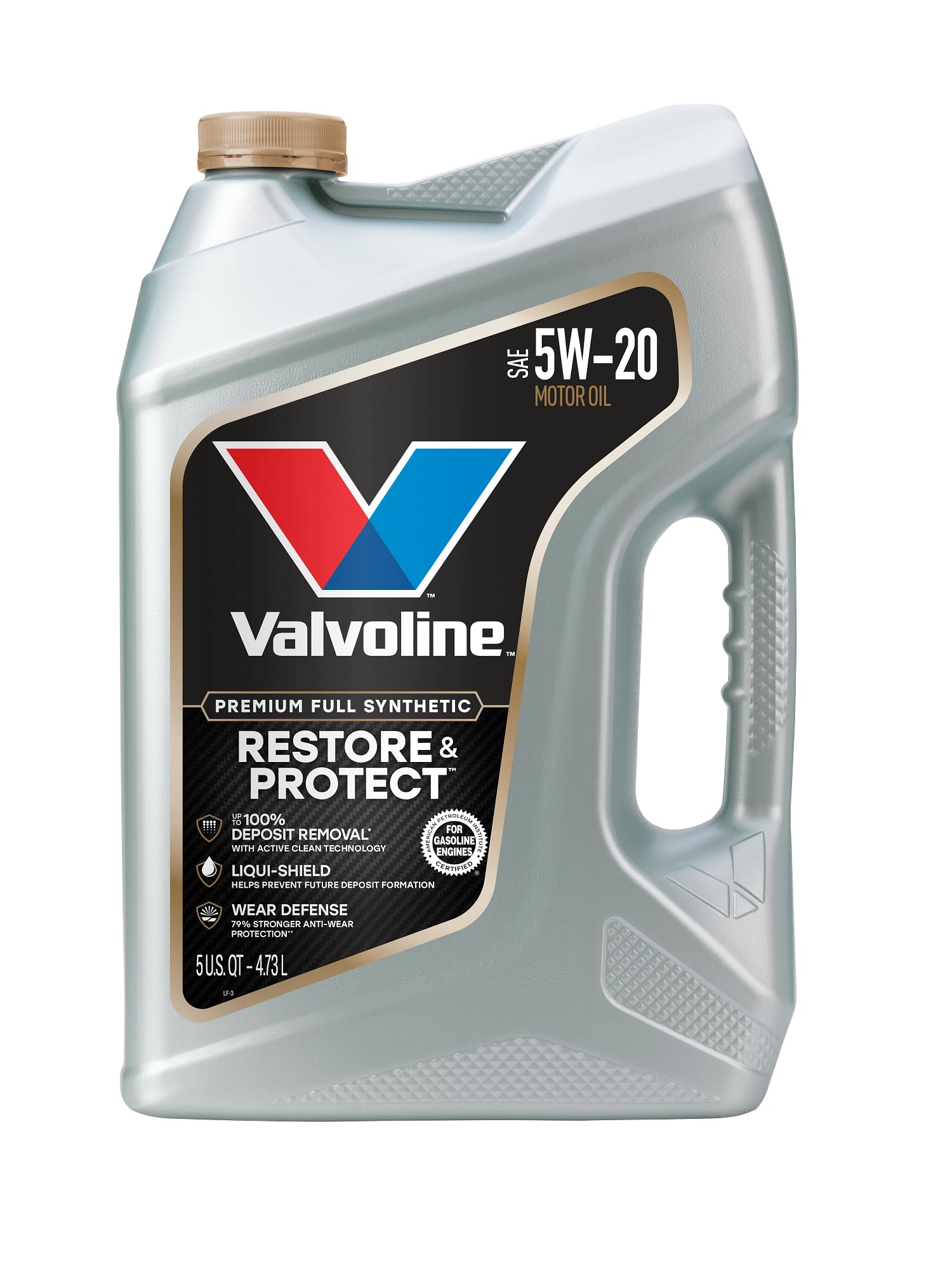
1. Valvoline Restore & Protect Full Synthetic 5W-20 Motor Oil 5 Quart
Our pick — over 4.5★ from 950+ verified ratings; the strongest balance of quality and price.
The engine-cleaning full synthetic that owners say returns a tired motor to a quieter, smoother idle
This is the pick for the owner of a car that has gone the distance — a 150,000-mile truck, a 200,000-mile Jeep, a 2010 sedan that has seen better days. Valvoline’s take on the problem is unusual: instead of only protecting against future deposits, the maker says this oil removes hidden piston deposits, describing the result as pistons returning to factory clean. That is the manufacturer’s claim, and it is why the bottle reads the way it does. What owners actually report is far more everyday: a smoother idle at red lights, less lifter noise, and an engine that simply feels like it is running easier.
Two hard numbers separate it from the 5-quart pack beside it. Its flash point — the temperature at which the oil’s vapor can ignite — is 394 °F, against the 390 °F of the Valvoline MaxLife High Mileage blend further down this list. It also carries 79% stronger anti-wear protection than a GF-6 qualified oil, according to the maker. If you have ever heard a tick from the left bank of a V8 on a cold morning, this is the oil buyers specifically name for stopping it, and buyers report a real-world fuel gain: “Gained 2mpg after the first 500 miles of using this oil.” You also get the coverage that matters for a modern engine — the bottle meets ILSAC GF-7A, API SQ, and Ford WSS-M2C960-A1, so it suits a new car’s first oil change as readily as a high-mileage one.
The honest catch sits in the cleaning claim itself. Deposit removal is a gradual process, not a one-and-done — the kind of result that shows up across several oil changes rather than the first one. Owners running it in multiple vehicles note that some engines look cleaner after three changes while others stay dark for two. Buy the 5-quart jug for a single change on most cars, and expect the benefit to build over a few intervals. That is what earns it the top spot here: the crowd favorite at 4.9 stars across 990+ ratings, and the one pick where cleaning and protection arrive in the same bottle.
What wins people over
- Oil quality is the thing owners praise most — the single most-discussed aspect of this pick by a wide margin.
- Owners repeatedly describe a smoother, quieter engine after switching, especially at idle.
- 79% stronger anti-wear protection than a GF-6 qualified oil, per the maker.
- Meets ILSAC GF-7A, API SQ, and Ford WSS-M2C960-A1 — broad modern coverage.
Where it asks a little patience
- The cleaning benefit builds across several oil changes, not the first one.
- Some engines stay visibly dark even after two changes.
- 5 quarts covers most single changes but not a large-capacity sump.
Reach for this if: your engine ticks, idles rough, or has a lot of miles behind it and you want cleaning plus protection in one jug.
Look elsewhere if: you want the absolute lowest price per quart and your engine is already clean and healthy.
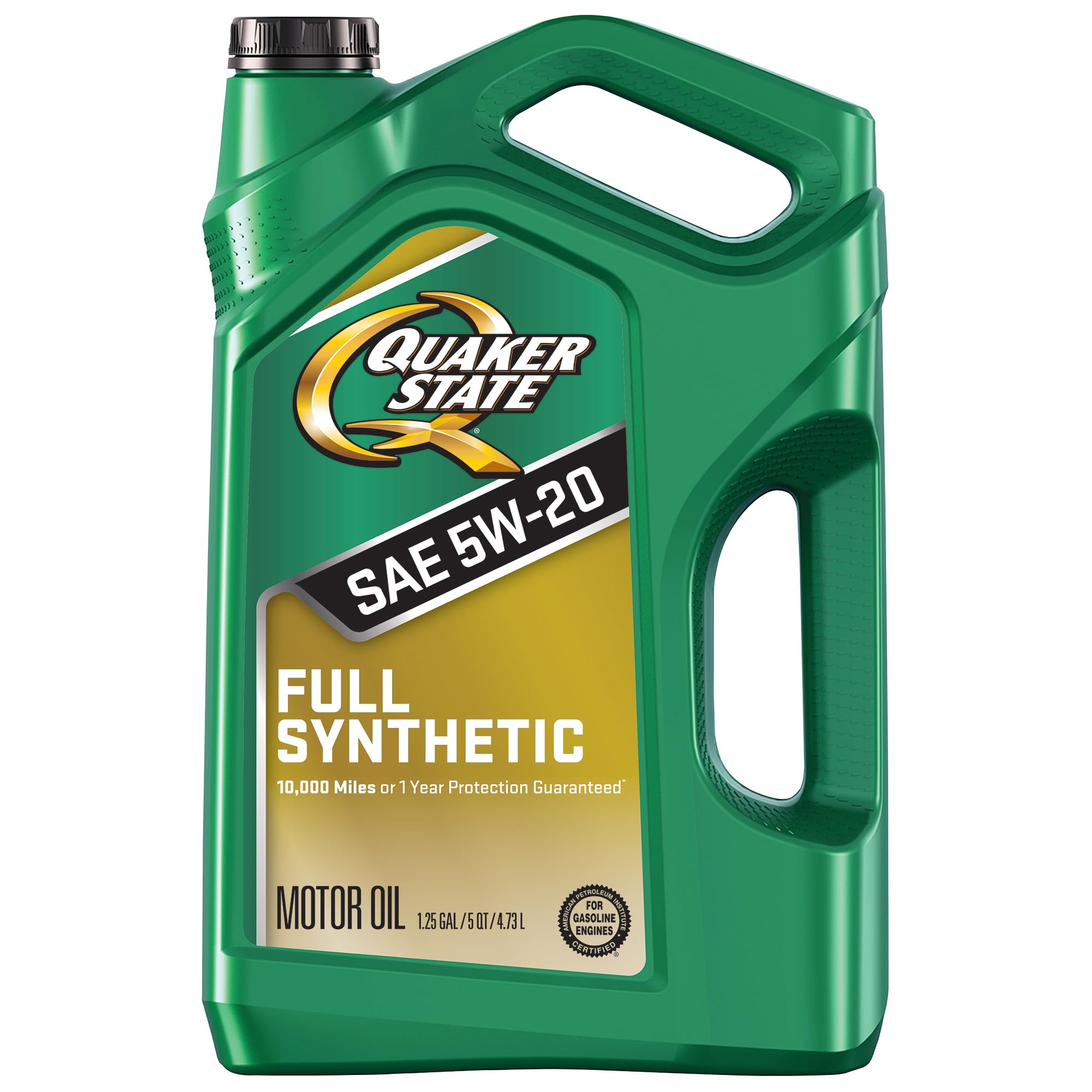
2. Quaker State Full Synthetic 5W-20 Motor Oil, 5-Quart
The full synthetic that undercuts nearly everything here while still meeting your manual’s spec
Here is the math that matters: 160 fluid ounces of full synthetic, against the 32 fluid ounces in the Valvoline MaxLife 1-quart 6-pack — a full 5.0x more oil in one container. If you are doing a routine change on a healthy engine and you want the cheapest way to put a full synthetic in the sump, this is the jug. The 5-quart size covers a single change on most four-cylinder and V6 engines, and it arrives in a bottle with a clear measuring gauge molded into the handle, which is a small thing that makes topping up far less messy than eyeballing it.
You do give up some things. This oil meets API SP Resource Conserving and ILSAC GF-6A, but its flash point is not published the way Valvoline’s is, and it does not advertise the extended drain intervals that the TRIAX or the Mobil 1 Truck & SUV carry. One owner who runs it in a 2019 Ford Mustang GT reports changing every 5k miles, and that at around 3k miles the car requested a change — worth knowing if you drive hard. Deposits are addressed, though: the maker points to Sequence IIIH and VH tests on sludge control, and buyers consistently report a smoother, quieter engine after switching.
What buyers keep coming back to is the value. That is the top aspect owners mention by a wide margin, ahead of performance, which tells you who this oil is really for — someone who wants full-synthetic protection without paying premium-brand money. It is not the oil for a twin-turbo engine run hard in desert heat, and it is not the pick if you care about the brand name on the cap. But for the ordinary commuter change, it does the job that needs doing.
Who it suits: the do-it-yourselfer with a healthy engine who wants the lowest cost-per-quart full synthetic on this list. The clear measuring gauge on the handle is a genuinely useful touch for anyone pouring by hand.
Buy it when: budget leads and your manual calls for a standard full synthetic on a normal drain schedule.
Step up if: you tow, run turbocharged, or push long intervals — the oils rated for those jobs are further down this list.
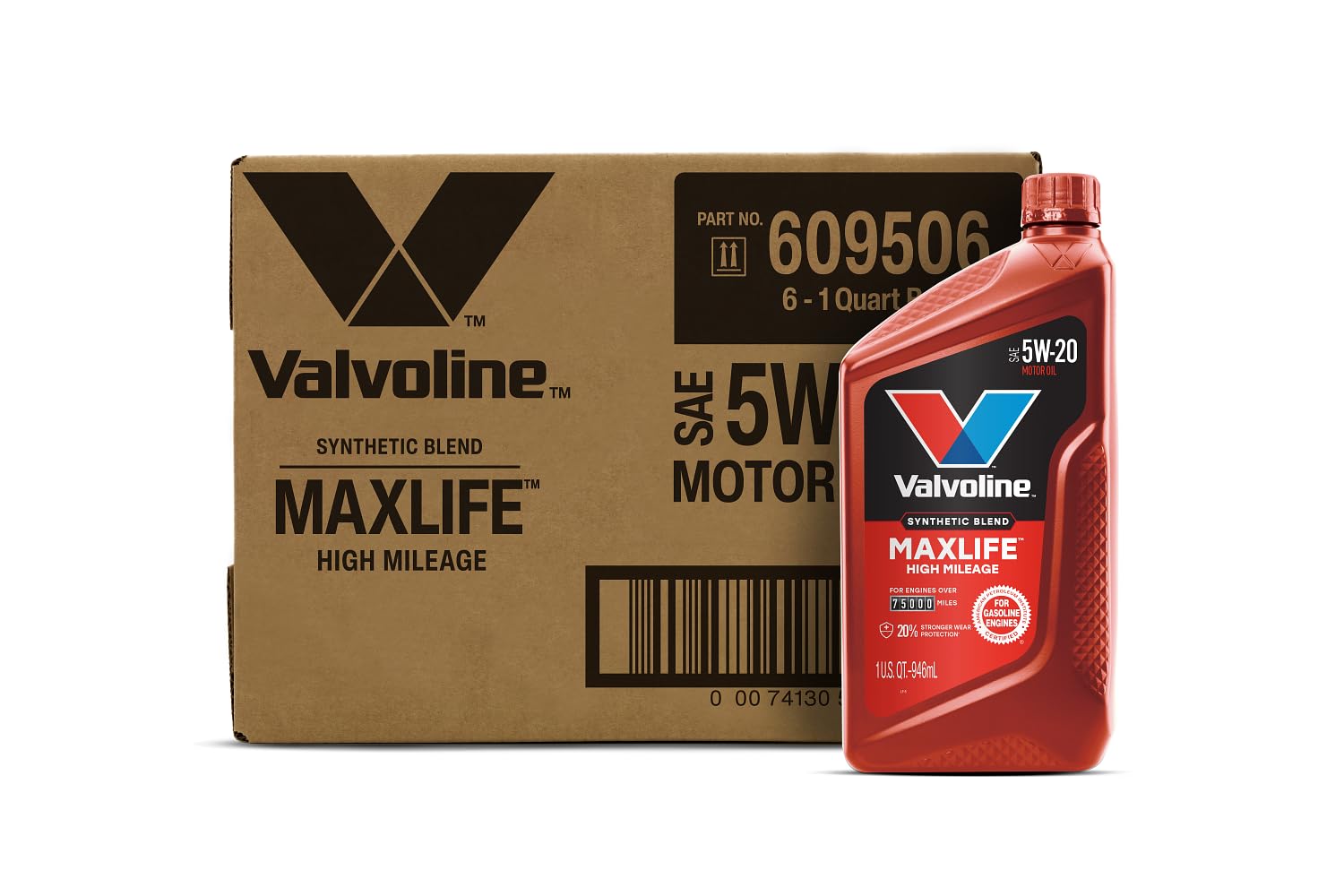
3. Valvoline MaxLife High Mileage 5W-20 Synthetic Blend Motor Oil 1 Quart, Pack of 6
Six quarts with seal conditioners for the car that has already earned its wrinkles
Once an engine crosses 75,000 miles, the oil that used to work fine can start disappearing between changes. That is the problem this oil was formulated to answer: a synthetic blend with seal conditioners meant to help prevent leaks and reduce oil consumption, plus extra detergents aimed at keeping a high-mileage engine clean and a friction-fighting additive package aimed at fuel efficiency. The maker rates it at 20% better wear protection and 15% better sludge defense than industry standards. If your driveway has a small dark spot under it, this is the pick built for that.
The format is worth understanding before you buy. You get 6 × 1-quart bottles instead of one 5-quart jug — six separate quarts against the one jug of the Valvoline Restore & Protect above, which is the mirror image of the same brand’s approach. That is six more chances to top up from a fresh bottle, and it suits engines with a slightly larger sump. The easy-pour spout comes up repeatedly as the thing that keeps the job clean. Just note the pack size matters: some buyers need six quarts, some need four, so check your manual’s capacity before ordering.
Owners mention engines that run quietly and smoothly, and they describe the oil holding up well past the interval they expected — the kind of “held up for 5000 miles of my driving” confidence you want from a blend. The recurring gripe, and it is worth knowing, is oil leakage. The leakage aspect carries a mixed verdict in buyer feedback, which makes sense: a seal conditioner is a maintenance product, not a repair, and an engine with genuinely failed seals needs a mechanic, not a better oil. If your leak is a real one, start with a diagnosis first.
Built for the long-haul engine
- Formulated specifically for engines with 75,000 miles or more.
- Seal conditioners aimed at preventing leaks and reducing oil consumption.
- Six 1-quart bottles suit a larger sump and make top-offs easy.
- Easy-pour spout keeps the job tidy.
Keep expectations realistic
- Leakage is the most mixed-read aspect — it helps minor weep, not failed seals.
- A blend, not a full synthetic, so it gives up some high-heat durability.
- Six quarts may be more than a small engine needs.
Best matched to: an engine past 75,000 miles that uses a little oil or shows early weeping around seals.
Not the fix for: an actual leak you can see dripping — get that checked before you buy any oil.
4. Mobil 1 Truck & SUV Full Synthetic Motor Oil 5W-20, 5 Quart
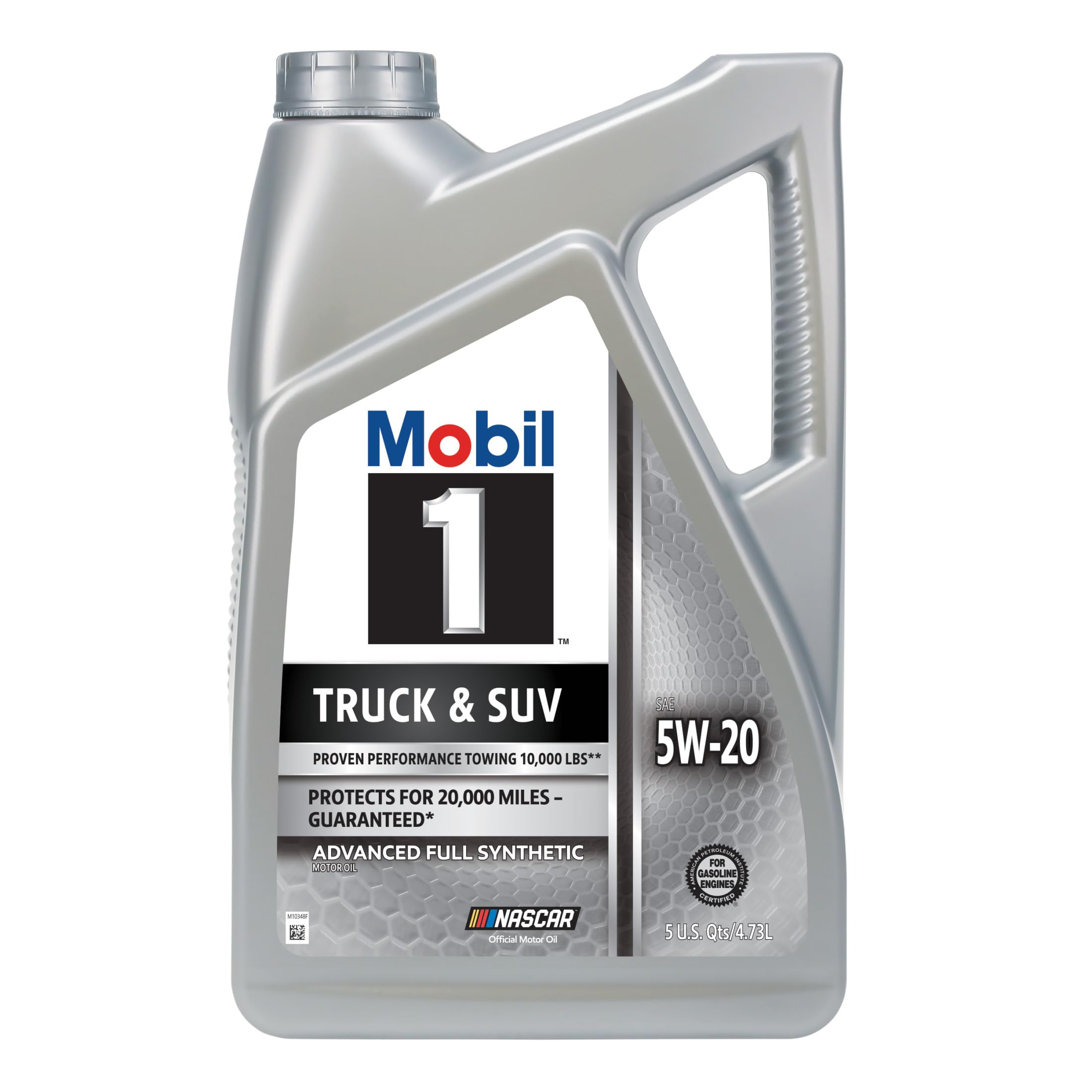
Built for the truck that spends its weekends pulling a trailer, not idling in a driveway
Towing and hauling are the hardest things you can ask an oil to survive. The load builds heat, and heat is what breaks oil down. Mobil 1 designed this blend for exactly that job: it lists heavy load protection, wear and corrosion control, and all-weather reliability right in the product highlights, and contains additives to help fight sludge. The rated interval is the headline, though — the maker guarantees protection for 20,000 miles. That is a longer claimed stretch than the Mobil Full Synthetic’s 7,500 miles, so if you drive a lot and change the oil yourself, the interval is doing real work for you.
Owners of hard-working trucks are the ones who gravitate here, and their feedback has a practical, no-nonsense tone. A Tundra owner running over 200,000 miles reports towing a 19-foot travel trailer and sometimes stretching changes to 10,000 miles, and notes the oil still looked reasonably good and the truck ran well. Another buyer who has used Mobil 1 for over 35 years reports changing at 10,000-mile intervals and having vehicles exceed 350,000 miles before being sold. Those are individual stories, not guarantees, but they tell you who this oil is built for.
The trade-off is price and volume: you pay a premium for the 20,000-mile rating, and the 5-quart jug may fall short of a larger truck sump. And the 5 quarts covers a typical truck sump but may fall short if your engine holds more. If your 5W-20 vehicle mostly handles a short commute, you are paying for capability you will never use, and the Quaker State above is the smarter buy.
Where it earns its place: the heavy-load and all-weather protection are aimed squarely at towing, and a rated interval of 20,000 miles is the longest claim on this list after the TRIAX. If you have ever watched an oil light worry you mid-trailer-pull, that is the scenario this oil is built to answer.
Pick this one if: you tow, haul, or rack up serious highway miles and want the longest rated interval from a familiar premium brand.
Skip the splurge if: your truck only does light-duty short trips where a budget full synthetic handles the same change for less.
5. K&N Motor Oil: 5W-20 Synthetic Engine Oil: Premium Protection, High Mileage, 5 Quarts

The full synthetic buyers reach for when their engine has started vanishing oil between changes
Some engines are simply thirsty. If you are topping up midway between changes, you already know the frustration. K&N’s formula is built around an additive package the brand calls SyntheMax, aimed at protecting critical components, cutting sludge, and reducing wear in both cold and hot conditions. Owners of oil-burning engines are the ones who report the most striking results: a 2016 Malibu with 115,000 miles that had been burning oil between intervals stopped losing it after the switch, with no top-offs needed since the last service. Whether that holds for your engine is something only your own dipstick will tell you, but it is the exact scenario this oil seems to be bought for.
Independent-minded buyers put it up against a well-known competitor in head-to-head testing. In a 90-day comparison against Pennzoil Ultra Platinum, a buyer reports no oil burn and the level sitting near full after 1,700 aggressive miles, with smoother running and quicker gear changes — rating the K&N superior. That is one driver’s comparison, not a lab result, but it is consistent with what the manufacturer promises about the additive package doing its job under stress.
The one number worth flagging is coverage: the warranty listed here runs 3 months, which is short compared with the 20-year, 750,000-mile coverage Pennzoil attaches to its Ultra Platinum. That is the clearest structural difference between the two, and it matters if warranty confidence is part of why you buy a premium oil. Fit is broad — universal fit for cars — and the 5-quart size covers most single changes. If low oil consumption rather than a paper warranty is your priority, the K&N fits that brief well.
The standout: owners of oil-burning engines report real reductions in consumption after switching — the specific problem this oil is bought to solve.
The asterisk: a 3-month stated warranty is the shortest on this list, so the value here rests on the formulation, not the coverage.
Made for: an engine that drinks oil between changes and a driver who wants a premium full synthetic to address it.
Think twice if: a long warranty is part of what you are paying for — the coverage here is brief.
6. Mobil Full Synthetic Motor Oil 5W-20, 1 Quart (Pack of 6)

The six-quart step up from conventional oil for the driver who just wants a clean, sensible upgrade
If you have been running conventional oil or a blend and want to move to full synthetic without overthinking it, this is the intended landing spot. Mobil formulates it for vehicles upgrading from conventional or synthetic blend, or for those whose manuals require full synthetic. The rated interval is up to 7,500 miles, which the maker frames as 1.5X longer than its conventional and synthetic blend oils. That 7,500-mile figure is the maker’s rating under normal conditions, so check it against your manual’s severe-service schedule before you plan to run it that far.
You get 192 fluid ounces across 6 × 1-quart bottles. That is the largest total volume of any pick here, worth knowing if your engine holds more than five quarts — the Quaker State’s single 5-quart jug would leave you short, while this pack covers a six-quart sump with nothing left over. The bottles also mean easy top-offs. Additives here are aimed at preventing sludge and deposit formation, resisting oil breakdown, and keeping viscosity stable at high operating temperatures, and the oil is rated for gasoline engines including turbocharged ones, meeting API SP resource-conserving.
Owner feedback is plain and reassuring: good quality, good value, performs as expected, and a buyer who works as a high-end auto mechanic says he always runs synthetic for the protection. This is not an oil for someone chasing a 20,000-mile interval or a cleaning claim — it is the sensible middle of this list. Buy it if you want the upgrade done right and the bill kept reasonable.
Why it makes sense
- 192 fluid ounces — the largest total volume on this list.
- Rated interval up to 7,500 miles, stated as 1.5X its conventional oil.
- Suits turbocharged gasoline engines and meets API SP resource-conserving.
What to weigh
- No cleaning claim like the Valvoline or the TRIAX.
- 7,500-mile interval is shorter than the tow-rated and long-drain picks.
- Six quarts may be more than a small engine needs.
Ideal for: the first-time synthetic buyer upgrading from conventional who wants a big six-quart pack and a clear interval.
Not for: a driver chasing extended drains or a specific deposit-cleaning result.
7. TRIAX Synergy SRT 5W-20 Full Synthetic Engine Oil API SQ/ILSAC GF-7A Licensed | 20,000 Miles of Protection (5 Quart)

The one that promises 20,000 miles between changes without a familiar badge on the jug
Drain interval is the number that separates the true long-haul oils from the rest, and this one leads the field: up to 20,000 miles or 2 years under normal operating conditions. Against the Mobil Full Synthetic’s 7,500 miles, that is a different category of product — the kind you buy if you hate changing oil and want to do it as rarely as the bottle allows. It is API SQ and ILSAC GF-7A licensed, which is the current standard many late-model engines ask for, and it covers LSPI protection, timing chain wear control, and engine cleanliness.
The formulation leans on advanced friction modifiers — nano boron and moly — to reduce startup friction and smooth out operation in turbocharged, GDI, and naturally aspirated engines. The maker’s wear numbers are striking: up to 84% less engine wear, 80% less camshaft wear, and 97% less oxidation, with the anti-wear chemistry aimed at cams, bearings, pistons, turbochargers, timing chains, and valvetrain components. Universal fit covers a wide spread of US and Asian gasoline vehicles, from Fords and GMs to Toyotas, Hondas, and Hyundais. The catch worth knowing is that this is a brand without the household name recognition of Mobil or Valvoline — you are buying on specification and owner experience rather than badge.
That owner experience is strong. Buyers who have moved over from name brands report their vehicles running smoother and quieter, and one who switched from a well-known competitor says the oil cleaned visible dirt out after the first 5,000 miles. A Powerstroke owner credits it with improving stiction. Owners consistently report boutique-brand quality at a lower price per quart. For an owner willing to trust a smaller name on specs, this is the interval champion.
The case for it: 20,000-mile drain intervals, API SQ and ILSAC GF-7A licensing, and a friction-modifier package aimed squarely at modern turbo and GDI engines.
The honest note: buyers switching from known brands report cleaning results over the first several thousand miles, so give it a full cycle before judging — and if you drive severe-service miles, that 20,000-mile figure does not apply to you.
Choose this if: you want the longest interval on the list and you buy on spec and owner feedback over brand names.
Choose a familiar brand if: badge recognition or a longer stated warranty matters more to you than interval length.
8. Pennzoil Ultra Platinum Full Synthetic 5W-20 Motor Oil, 1 Quart (6 Pack)

The natural-gas-based synthetic with a warranty longer than the car it goes into
Pennzoil builds this oil from natural gas, which is the detail behind its reputation for a clean base oil. It is designed for high-performance engines and aimed at protecting against loss of power, and it comes with a 20-year, 750,000-mile warranty — by far the longest coverage on this list, against the K&N’s 3-month term. If you plan to keep a vehicle for the long haul, that warranty is the single most persuasive number on the label.
It arrives as six 1-quart bottles — 32 fluid ounces total, the same per-bottle format as the Valvoline MaxLife pack but a different job entirely. That makes it convenient for topping up a performance engine that sees hard use, though it does mean six bottles to store rather than one jug. Part numbers and Dexos1 GM Gen 3 approval matter here: one buyer notes it is Dexos1-approved and cites a lower additive PPM than competitors as evidence of a superior base oil, which is the kind of spec-first reasoning this oil tends to attract.
Customers note strong, specific results. Smooth acceleration comes up often, and gas mileage gains are a recurring theme, with buyers reporting a 2-3 mpg increase over factory oil and noting the oil does not need frequent changes. Engines run quieter, and value for money is consistently praised. The one area that reads mixed in buyer feedback is the material composition itself — matter of taste rather than a defect. One owner sums the reputation up well: “Best affordable mass market oil available.”
Why performance drivers like it: high-performance formulation, smooth acceleration, and reported gas mileage gains point to an oil built for engines that get worked.
The fine print: the 6-quart format means many engines will not use all six bottles in a single change, which is fine for top-offs but worth knowing if you prefer one simple jug.
Best for: a performance or high-output engine owner who wants a long warranty and turns their own wrenches.
Pass if: you want the simplicity of a single jug and are not chasing the warranty term.
9. Royal Purple (36520-6PK HPS 5W-20 Synthetic Motor Oil with Synerlec Additive Technology – 1 Quart, (Case of 6)

The purple-hued synthetic for modified engines that ask more than a commuter ever will
Royal Purple is the enthusiast’s oil, and the HPS line with Synerlec additive technology is aimed at performance and modified engines. The label claims maximum wear protection, increased horsepower and torque, and exceptional oxidation stability — the kind of claims that only make sense for an engine being pushed. That is where its buyers live: a supercharged Roush 4.6L V8 with 488 rear-wheel horsepower, owned for 20 years, running this oil with the owner reporting minimal wear at 250,000 miles where a conventional oil showed wear at 50,000. That is one owner’s account rather than a warranty, but it shows the modified-engine crowd this oil is built for.
Rotary owners find it too. An RX8 owner running a 144,000-mile Renesis rotary reports less oil usage than with Pennzoil, less burn-off smell, a quieter engine, and a clean burn that protects the apex seals. That is a very specific engine with very specific needs, and the fact that Royal Purple is a name RX8 owners reach for says a lot about how it is regarded in modified-engine circles. A buyer comparing the HPS to the regular Royal Purple formula reports the HPS gaining 2.7-4 mpg versus 2.3-2.7 for the regular, plus quieter running, more power, and 45-62 extra miles per tank.
The consideration here is that you are paying enthusiast prices, and in practice, that includes the shipping format. Quarts have arrived slightly overfilled or leaking for one buyer, without protective bags — worth a check when your case arrives. For a stock commuter engine, this is more oil than you need; for a built motor, it is exactly the kind of protection the label promises.
The Purple difference: Synerlec additive technology, horsepower and torque claims, and exceptional oxidation stability make this the clear pick for modified and performance builds rather than daily commuters.
One to check on arrival: a buyer reported quarts arriving slightly overfilled or leaking without protective packaging, so inspect the case when it lands.
This one is for: a modified, supercharged, or rotary engine where the owner knows the build demands it.
Overkill for: a stock commuter that would run just as happily on the budget full synthetic.
Understanding the Specs
SAE Viscosity Grade (5W-20)
Viscosity grade is how oil thickness is measured. The “5W” part is the cold-weather rating — the lower the number, the more freely the oil flows when you first start the engine on a cold morning, which is what protects the top end in the seconds before oil pressure builds. The “20” is the hot rating — how thick the oil remains once the engine is at full operating temperature. When a bottle says 5W-20, both halves matter and both are matched to your engine’s design clearances. That is why you should never substitute a 5W-30 or a 0W-20 just because the bottle is on the shelf: the grade must match what your manual specifies.
Flash Point
Flash point is the temperature at which an oil’s vapor can ignite — think of it as a rough measure of how well the oil stands up to heat before it starts breaking down. Higher is generally better, and for most drivers it is background information rather than a daily concern. Where you feel it is the extreme end of the scale: a heavily loaded engine, a hot summer, a long climb with a trailer on the back. Bigger gaps in flash point reflect different base-oil and additive choices, and they are worth weighing only if you routinely push your engine into that kind of heat.
FAQ
Can I use 5W-30 instead of 5W-20 in an emergency?
How often should I change 5W-20 full synthetic oil?
Is full synthetic 5W-20 worth it over a synthetic blend?
What does high mileage oil actually do for my engine?
Do I need 5 quarts or 6 quarts for a single oil change?
Will 5W-20 oil work in a turbocharged engine?
Is it safe to mix two different 5W-20 oils in one engine?
Do 5W-20 oils really clean piston deposits?
Does 5W-20 oil improve gas mileage?
Should I switch to a high-mileage 5W-20 before my engine needs it?
What happens if I run 5W-20 past its rated drain interval?
Final Thoughts: The Verdict
For most drivers, the 5w20 oil winner is the Valvoline Restore & Protect Full Synthetic 5W-20 Motor Oil 5 Quart because it is the rare oil that both cleans a tired engine and protects it — the maker’s deposit-cleaning claim is backed by the highest rating here, and its 394 °F flash point edges out the Valvoline MaxLife blend’s 390 °F. If you are chasing the longest gap between changes, reach for the TRIAX Synergy SRT and its 20,000-mile rating. And if you want the cheapest full synthetic for a routine change, the Quaker State Full Synthetic at 160 fluid ounces is the one to grab — more volume in one jug than any pick under it.
Match the oil’s rated interval to your driving and confirm the 5W-20 grade in your owner’s manual before you buy.
How We Picked
We do not accept paid placement. Every pick is matched to a real buyer and a real use-case; we do not hands-on test units.
Sources & Methodology
Specifications: manufacturer listings and product documentation. Review insights: verified customer reviews, as of September 2026. Pricing: not shown on this page (it changes often); check the current price via the retailer link.
As an Amazon Associate, Gadgets Feed earns from qualifying purchases. This does not affect which products we feature.