
Our readers keep the lights on and my morning glass full of iced black tea. As an Amazon Associate, I earn from qualifying purchases.
Specs are compiled from manufacturer listings and verified buyer reviews and can change over time — please confirm the key details on the product page before buying.
If your rim brakes howl in the rain and grab like wet wood, the fix usually is not a new bike — it is a better set of cantilever brakes. This guide covers the seven cantilever and mini-V options worth your money, from a featherweight cyclocross race brake to a budget replacement that gets an old touring bike rolling again.
I’m Min — the founder and writer behind Gadgets Feed. This guide is built by comparing the manufacturers’ published specifications and the patterns across verified customer reviews, so you get each pick’s real strengths and trade-offs instead of marketing spin.
Every brake here squeezes a rim, but they differ wildly in stance width, pad clearance, and how much fussing the setup demands. Below you will find the honest pick for every rim-brake bike, which is what a real search for the best cantilever brakes should actually deliver.
Our Picks at a Glance

How To Choose The Best Cantilever Brakes
The first thing to settle is what your frame and levers will actually accept, because a cantilever brake and a linear-pull V-brake are not interchangeable on the same lever. Cantilevers pull a straddle cable from above, so they work with standard short-pull road levers and the integrated STI shifters found on cyclocross and touring bikes. Linear-pull V-brakes pull more cable and want a long-pull lever, which is why a V-brake set often ships with its own levers.
Stance Width And Mud Clearance
A cantilever can be set wide or narrow, and that single choice changes the whole character of the brake. A wide stance keeps the straddle cable low and opens up room for mud and knobby tires to pass through. A narrow stance raises the mechanical advantage so the same hand squeeze bites harder on the rim. On wet, gritty commutes the wide setting sheds debris and cuts the grinding noise you get when grit is trapped between pad and rim.
Straddle Cable And Yoke Height
The straddle cable is the short wire bridging the two brake arms, and the yoke is the little carrier it runs through. Raising or lowering that yoke adjusts the angle of pull, and the angle of pull decides how much of your lever force reaches the pads. Too much yoke length and the brake feels mushy no matter how hard you squeeze. This is the single setup detail that separates a brake that feels sharp from one that feels vague.
Pads, Rims, And Squeal
Most howling brakes are not broken — they are running the wrong pad compound on the wrong rim, or the pads are toed in badly. Standard cartridge pads swap out in seconds and let you try a wet-weather compound on alloy rims. Threaded-post pads and side-mount pads take different replacement parts, so check which style your brake arms use before you buy spares.
Quick Comparison
| Model | Best For | Weight | Stance | Set Contents | Amazon |
|---|---|---|---|---|---|
| Avid Shorty Ultimate Front Cantilever Brake★ Best Overall | Cyclocross and wet-weather racing | 1.6 ounces | Wide or narrow | 1 brake | Amazon |
| Sunlite Alloy Cantilever BrakeBest Value | Reviving vintage touring and MTB frames | 7.36 ounces | Cantilever | 1 brake plus straddle cable | Amazon |
| Chooee Mountain Bike Linear V-Brake Set Front and Rear | Budget bike brake overhaul | — | Linear-pull | 2 brakes plus levers, cables, noodles | Amazon |
| CNC Mountain Bike V Brake Set | Straight-swap V-brake replacement | 9.28 ounces | Linear-pull | 2 brakes plus 4-finger levers | Amazon |
| SHIMANO Cantilever-Brake BR-CT 91 (Design: RW) | MTB and touring cantilever replacement | — | Cantilever | 1 brake | Amazon |
| SHIMANO Altus BR-CT91 Right Hand Cantilever Brake | Direct-fit Shimano Altus replacement | 251 g | Cantilever | Pair for the front fork | Amazon |
| Paul Component Engineering Mini Moto Brake Black | Premium mini-V for cyclocross and touring | 7.36 ounces | Direct-pull mini-V | 1 brake | Amazon |
In‑Depth Reviews
1. Avid Shorty Ultimate Front Cantilever Brake
Our pick — over 4.5★ from 70+ verified ratings; the strongest balance of quality and price.
The featherweight racer that eats mud and still bites hard in the wet
For cyclocross racing or wet-weather drop-bar riding, this brake sets the standard for the rest of the list. It weighs just 1.6 ounces, while the Sunlite Alloy Cantilever Brake weighs 7.36 ounces — so it is much lighter, which helps when you carry the bike up a run-up. It works with short-pull centerpull levers (levers that pull a short amount of cable), so it fits the road and STI levers already on most cyclocross and touring bikes.
What wins people over is the braking itself. The wide-or-narrow stance setup lets you open the arms for mud clearance on wet race days or close them for maximum bite on dry hardpack. The open design lets debris fall through instead of packing against the rim. The height-adjustable pads and the adjustment barrel on the straddle carrier make dialing tension straightforward once the brake is on the bike. The anodized straddle pivots and alloy straddle carrier are the kind of parts that keep working season after season. Just plan on sourcing the install guide from the SRAM website, since it does not ship with one — the setup is doable from scratch but not a five-minute job.
The honest catch is pad replacement. The pads are non-standard looking, and a few owners have had trouble figuring out where to order spares — so buy a spare set with the brake and save yourself the scavenger hunt later. And be deliberate with the front brake: owners describe the power as strong enough that an over-hard grab on the front wheel can send you over the bars. On wet alloy rims the stopping is planted and consistent. Buyers report the pads lasting roughly four months at 400 miles a month.
What sets it above the rest
- Wide or narrow stance lets you trade mud clearance for bite in seconds
- Height-adjustable pads and a straddle-barrel adjuster make tension tuning simple
- Open arm design sheds mud and debris instead of packing it in
- Weighs 1.6 ounces, the lightest brake in this lineup by a wide margin
The fine print you should know
- No install manual in the box; download it from the SRAM site
- Replacement pads are non-standard and sometimes hard to source
- Powerful enough on the front wheel that a hard grab needs care
Built for: Cyclocross racers and wet-weather commuters running short-pull road or STI levers who want the sharpest rim brake in this list.
Think twice if: You want a bolt-on-and-forget brake with common pads — the odd pad standard will have you hunting for spares.
2. Sunlite Alloy Cantilever Brake
The cheap rescue part that gets an 80s touring frame stopping again
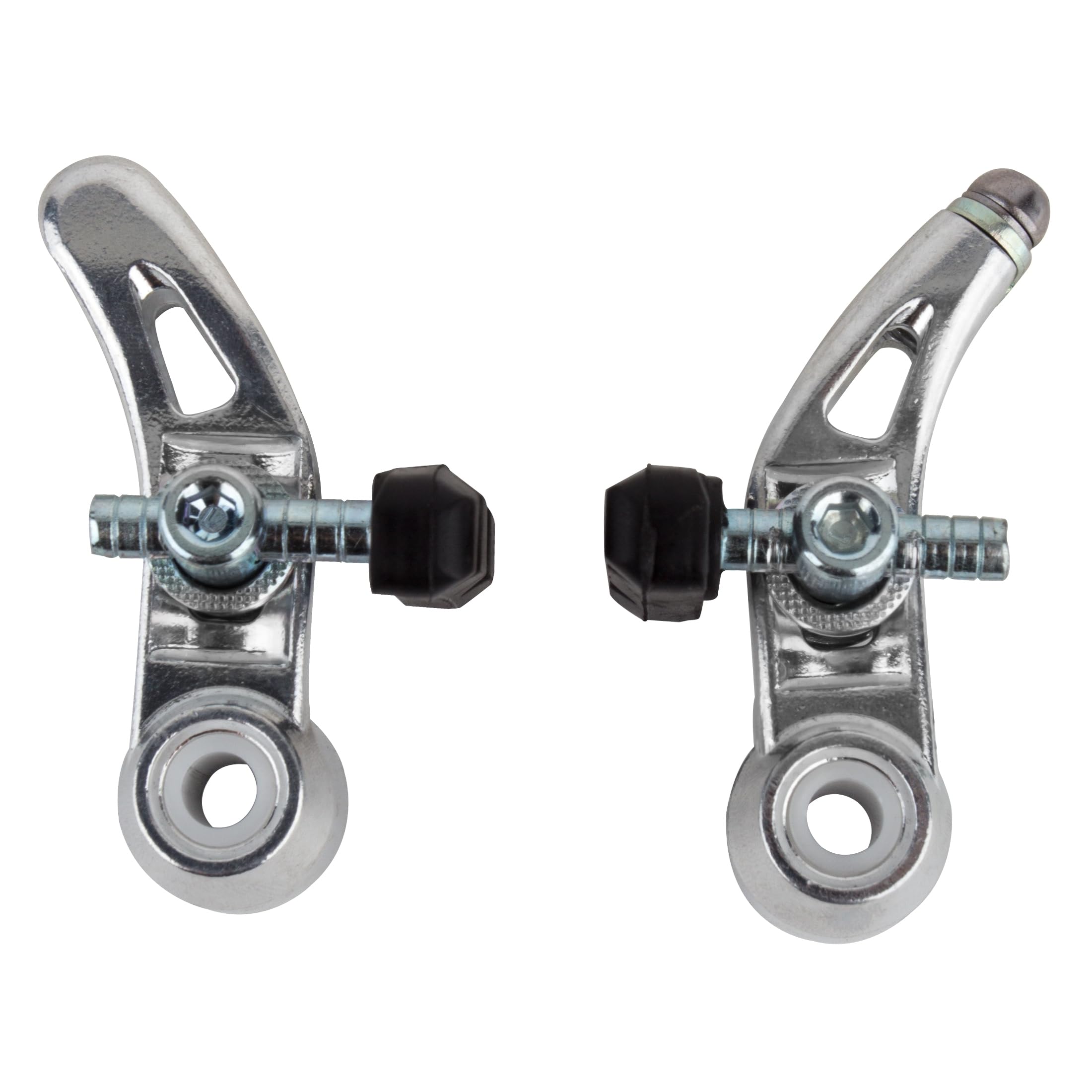
The first thing anyone does with an old Miyata or Trek is find a brake that fits the existing posts without a frame swap. That is exactly what this forged aluminum cantilever does — it slides onto vintage mounts and works with the original levers, so no disc conversion, no new wheels, no new bike. It comes in silver with a quick-tool-adjust linear spring so you can tune pad tension without pulling out an allen key. The package includes the straddle cable, which is the piece most budget brakes skimp on.
Buyers love how easy it is to install: bolt the arms to the posts, thread the straddle cable (the cable that connects the two brake arms), set pad toe (the angle where the front of the pad touches the rim first), and tension the spring. One owner said, “Easily attached to my bike in about 15 minutes with common hand tools.” Owners replacing broken Shimano Altus or worn Alivio cantilevers report an exact fit on mid-90s and 80s-era frames, which is the main reason to buy a part like this. Owners say its forged-alloy build quality matches brakes that cost several times more.
One design quirk is worth knowing before you buy. The Shimano-style connector yoke that ships in the box runs roughly 95mm long, which is about 20 to 30mm more than ideal for smaller 26-inch frames — the extra length softens the mechanical advantage on the rear brake. The fix is either to swap to a shorter 62mm or 73mm cross-connector, available separately, or to run a simple cross-wire and cradle between the arms. A second thing to watch: on some Schwinn post setups the concave washer does not match the lever profile, which can make pad adjustment fussy. Neither issue is a dealbreaker, but if you are chasing maximum bite on the rear, plan the shorter yoke from the start.
Where the value lands: For the price of a couple of coffees you get a forged-alloy cantilever that fits vintage mounts, ships with its straddle cable, and installs with hand tools. That combination makes it the go-to when you are bringing a 1980s touring or mountain frame back to life.
Where to spend the saved money: If your frame is a smaller 26-inch size, put the savings toward a shorter cross-connector — the 95mm yoke (the cable connector) is the one part of this kit that limits the brake’s real stopping power.
Best match: Anyone restoring a vintage touring or MTB frame where a modern brake will not fit and a disc swap is out of the question.
Look elsewhere if: You are a current-generation cyclocross racer chasing the sharpest lever feel — the long stock yoke costs you some bite on the rear.
3. Chooee Mountain Bike Linear V-Brake Set Front and Rear

Everything in one box to make a tired bike actually stop
Buying two brakes, two levers, cables, noodles, boots, and screws as separate parts adds up fast and leaves you guessing on compatibility. This set folds all of it into one purchase, which is why it lands as the best complete kit here. You get two V-brakes, two 2.5-finger levers, two brake cables, and all the small hardware, so a single order turns a bike that barely stopped into one that does. The arms measure 110mm and the pads are 70mm, which is the standard arch size for a mountain-bike frame.
Owners put this on everything from budget Roadmaster commuters to 90s-era mountain bikes, and the pattern is consistent: the stock brakes were unsafe and this set fixed that. The spring tension is adjustable at each arm, so centering the brake over the rim is a matter of small turns rather than fighting a fixed pivot. Owners mention the fit was spot-on for a 90s MTB, and that the stopping is a huge step up over what came on the bike.
Two honest limits. First, this is a fix for basic bikes — if you already have decent brakes, swapping to this set is a lateral move rather than an upgrade. Second, the return springs arrive on the weak side, and a few owners have polished the pivots to get the arms moving freely — that is the bite you accept for the price. Expect to make adjustments after install; a 4-out-of-5 owner noted that adjustment is necessary for proper function, which is normal for any V-brake but worth flagging if you wanted a zero-fuss swap.
Why it is the practical pick: This is the only product here that hands you a full conversion kit — brakes, levers, cables, and hardware — with no need to source anything else. For someone who just wants a bike that stops without a parts spreadsheet, that completeness is the whole point.
Reach for this if: You are upgrading a budget bike whose factory brakes barely slow you down and want one order to cover everything.
skip it if: Your bike already has working V-brakes — this is a lateral swap, not a real upgrade, and you would be better off with better pads.
4. CNC Mountain Bike V Brake Set, Bicycle V Brake for Front/Rear,Linear Pull Bike Rim Brakes for MTB BMX Road Bike Cantilever Brakes.
The forged-alloy V-brake set that quietly outclasses its price tag
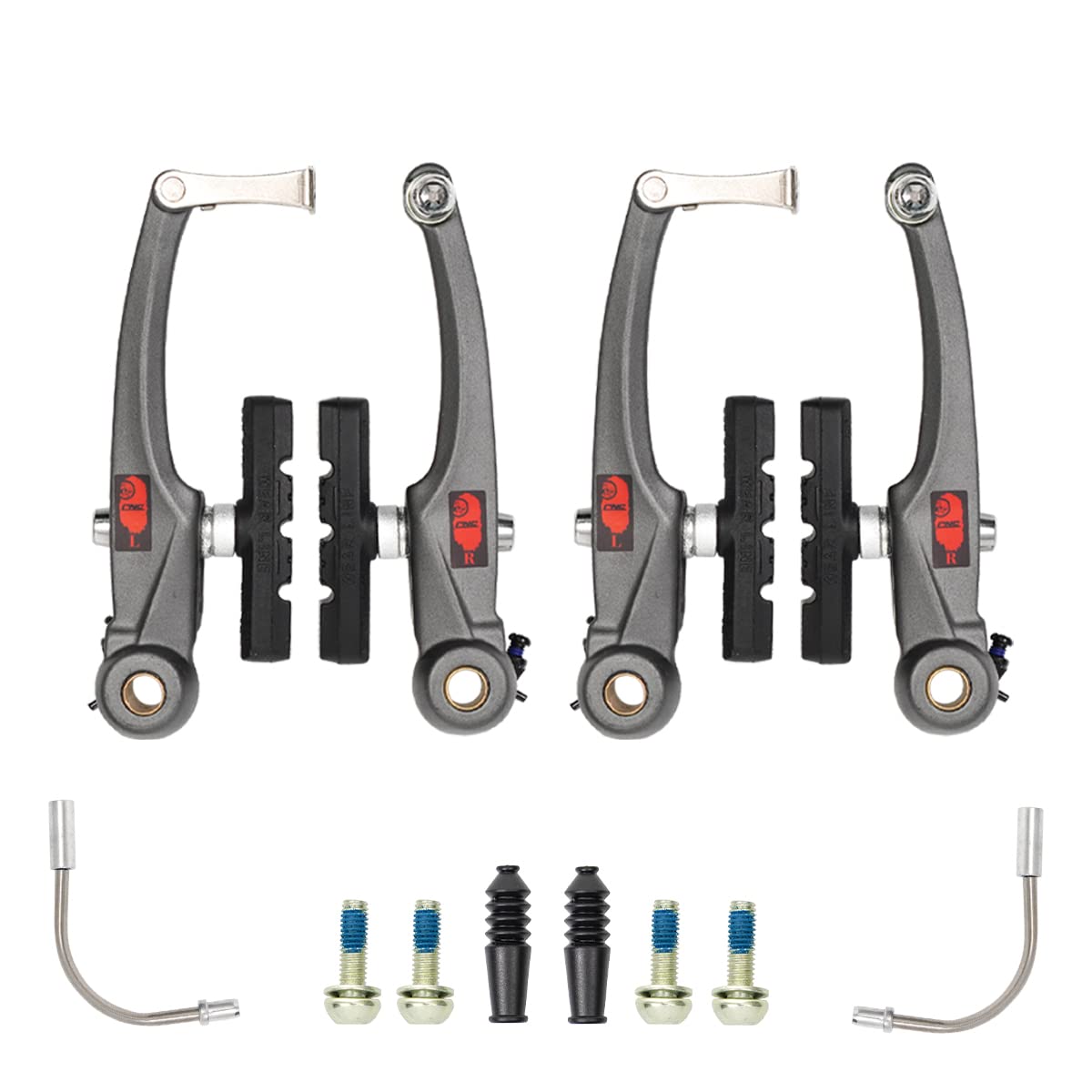
This is the swap you make when you want your V-brakes to feel tighter than the set the bike came with, without paying boutique money. The arms are forged aluminum, run through a CNC process, and finish with an anodized coat — the kind of machining that usually signals a significant price jump. The brake pads carry an EN14766 rating, which is a European standard for bicycle brake performance, so you are not trusting an unbranded pad with your stopping distance. Arms measure 110mm, and the rubber pads are 60mm.
What makes it better than the Chooee kit is the lever feel and the hardware. The CNC set (computer-controlled machined parts) comes with 4-finger levers and metal balance adjusters that hold their setting — a problem on cheaper V-brake sets, where plastic adjusters slip after a few weeks. Owners say the V-brakes and pads grip as well as Shimano at a fraction of the price, and the 110mm arms fit most road, MTB, and BMX frames. The 110mm arm length is the standard size for this type, so you will not need special mounting hardware.
Two trade-offs to know. The levers feel light and a bit sloppy compared to higher-end hardware — they work, and the reach adjuster is functional, but the hand feel is where the cost was shaved. And this is not a direct replacement for cantilever or drop-bar levers: it needs the long-pull lever that ships in the box, or a separate pulley if you insist on keeping drop bars. Check your existing lever type before ordering.
The real strength: Forged, CNC-finished, anodized arms with metal adjusters are the parts that typically mark a jump into premium territory, and this set bundles them at a price point that undercuts most competitors. The brake itself pulls hard and holds tune.
The catch: The levers feel hollow and cheap in hand, and the set does not include the brake cables or hand grips — if you are starting from bare bars, factor in the extra parts before you install.
This one suits: Riders who already have a straight-pull frame and want V-brakes that feel like a step up without boutique pricing.
Rule it out if: You are staying on drop bars — the levers here are long-pull and will not play nicely with cantilever-style road levers.
5. SHIMANO Cantilever-Brake BR-CT 91 (Design: RW)

The plain-Jane OEM brake that keeps a working bike working
Sometimes the right answer is not a performance brake at all — it is the exact brake your bike already had, back when it left the factory. This Shimano cantilever is built for MTB and touring use and is the sort of OEM-grade part that just bolts on where the original was. It ships as a single brake, so if you need front and rear you order two. The value proposition is straightforward: a known-quantity Shimano cantilever that does not ask you to research compatibility fit charts.
Owners who bought it to replace worn cantilevers say the arms line up on the standard posts and the included pads bed in cleanly for smooth, quiet stopping. German-market reviews especially note the brake fits the original mounting hardware cleanly and adjusts without trouble, which is what you want from a replacement part. This is not the brake you buy to transform a bike — it is the brake you buy to restore one.
The limitation is scope. There is no stance adjustment, no fancy straddle carrier, no built-in quick release — just a workmanlike Shimano cantilever. If you are chasing wide-mud clearance or the lightest possible weight, this is not that brake. But if your existing cantilever failed and you want OEM reliability rather than an experimentation project, the narrow, boring competence of this part is precisely its appeal. Note that the price reflects Shimano’s brand and OEM sourcing, so you are paying a small premium over generic substitutes for the name on the casting.
Right for you if: Your existing cantilever died and you want a drop-in OEM-quality replacement without researching new mounts or lever types.
Pass on it if: You want tunability — there is no stance adjust or quick-release here, so a rider chasing custom feel should look at the Avid or Paul options.
6. SHIMANO Altus BR-CT91 Right Hand Cantilever Brake
A front-fork pair that slides straight onto the original Shimano mounts
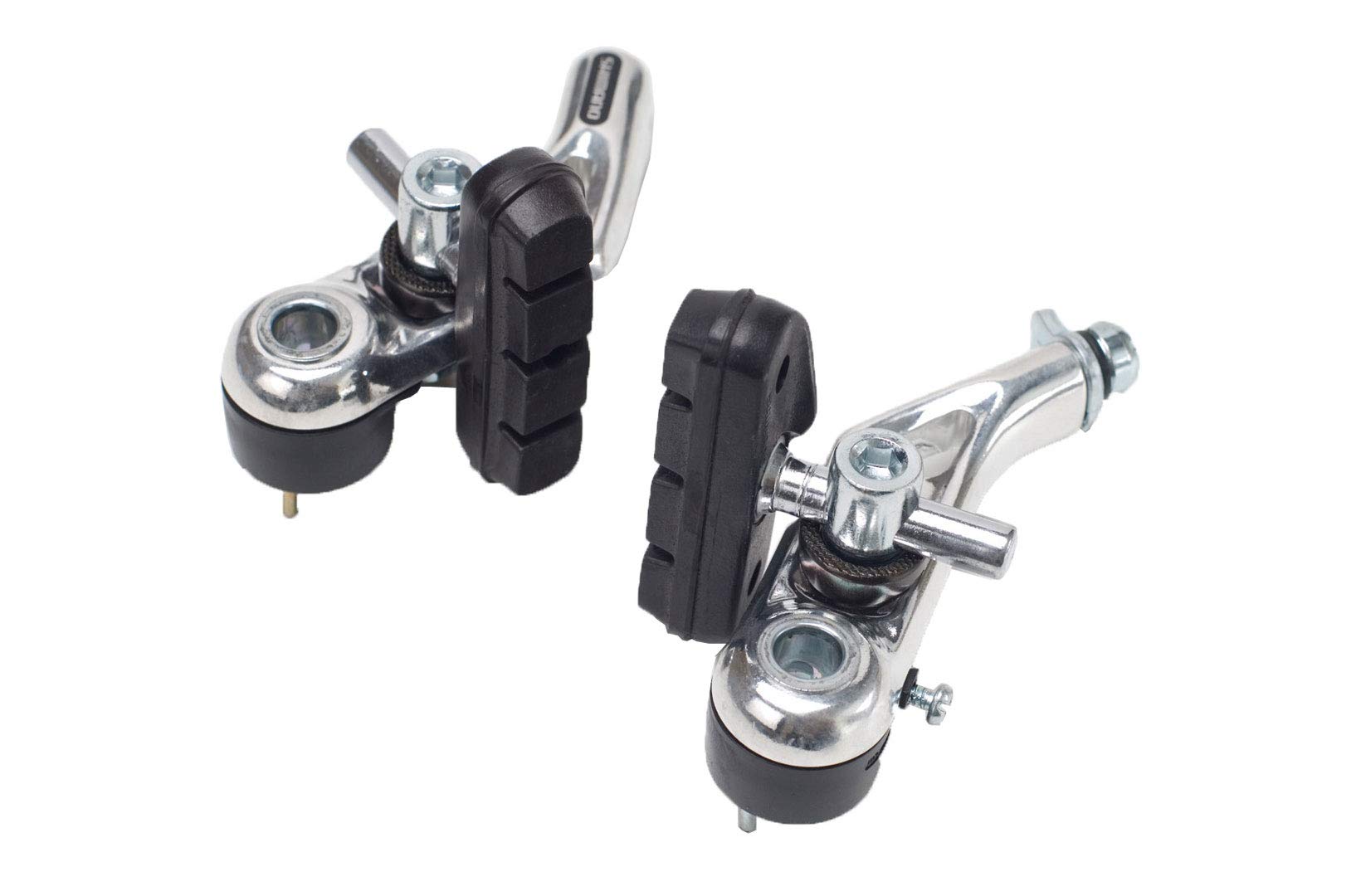
Unlike the other Shimano on this list, which is a single brake, this one ships as a pair — that matters if you are replacing both arms on a front fork. Each arm weighs 251 grams, uses side-mount brake pads for quick swaps, and has its own spring tension adjuster — a small screw you turn to center the brake arms over the rim without fighting the whole assembly. If you have ever tried to center a fixed-spring cantilever, you know why that adjuster is useful. The pads are Shimano’s own and come mounted and ready to go.
Owners call it a clean, compatible replacement for the Altus BR-CT90 — the two calipers look identical, so the “right hand” label on the box just means you get one of the pair that goes on the front fork. The part comes in a Shimano box with instructions, which you should read before tightening the springs. Owners who replaced identical units say the fit was perfect and the included pads saved a trip to the parts counter.
The catch is that the “right hand” designation can confuse buyers — if you need both front and rear, this pair will cover the front fork but you may need to sort the rear separately. Reach for this one when you are refreshing the front end of a Shimano-equipped mountain or touring bike and want to keep everything in the same OEM family. The 251g weight is not featherlight, but it is not what you buy this brake for — you buy it for the fit.
Made for: Owners of Shimano-equipped MTB or touring bikes who need a pair of OEM-matched cantilevers for the front fork in one purchase.
Not the pick if: You are outfitting both front and rear in one order — the pair here is oriented for the fork, so plan the rear side separately.
7. Paul Component Engineering Mini Moto Brake Black

The hand-machined mini-V that turns a commuter into a confidence machine
Ready to spend real money to never think about your brakes again? This is the answer. It is machined in the USA from 6061 aluminum, a lightweight but stiff alloy, and finished with Teflon-lined noodles and sealed stainless steel pivots so grit and rain do not gum up the mechanism. The springs tighten via independent adjusters with a satisfying turn rather than the tiny frustrating screws on most brakes. It is a mini-V, meaning it uses a direct-pull configuration that simplifies installation versus a traditional cantilever. It ships with Salmon Kool Stop Thinline pads and spherical washers for a clean pad-to-rim fit.
What separates it from every other brake here is the tire clearance and the setup. The narrow profile and short curved arms open up room for knobby cyclocross tires and wide fenders, which is the clearance problem that frustrates mini-V buyers elsewhere. Owners upgrading from 24-year-old cantilevers describe the stopping as dramatically improved, with the screeching gone and the lever feeling planted. One owner reports zero loosening after 500 miles of riding.
The honest trade-off is price. You can get the same build quality from cheaper mini-V brakes, and one owner who disagreed recommends trying a Tektro 926 mini-V first to see if it will do the job. Also, at install time, the order of steps matters on the arm setup, and owners say the company explained that only afterward — so read the setup notes carefully before tightening springs. A few also dislike the squared-off CNC look, but that is taste, not performance.
Why customers come back for it
- Sealed stainless pivots and Teflon-lined noodle survive wet weather without sticking
- Narrow profile clears knobby cyclocross tires and wide fenders
- Independent spring tension adjusters are easier to work with than small screws
- Direct-pull mini-V design works with standard short-pull road levers
What to weigh before you buy
- The premium is real — cheaper mini-V brakes deliver similar stopping
- Order of assembly on the arms matters; read the setup notes first
- Squared-off machined look is a taste call, not everyone’s style
Built for: Cyclocross and touring riders running short-pull road levers who want mini-V braking without swapping to discs or cantis.
Weigh the cost if: You are just trying to stop a commuter bike — a cheaper mini-V will get you there, and this pays for the craftsmanship, not a different feeling brake.
Understanding the Specs
Stance Width
The setting that decides whether your brake prioritizes mud clearance or raw stopping bite. Wide keeps the straddle cable low and opens the gap between the arms so mud, grit, and wide tires pass through. Narrow raises the mechanical advantage so the same hand squeeze clamps the rim harder. If you ride wet gravel or grass, wide is your friend. If you chase maximum lever bite on dry hardpack, narrow is the trade.
Straddle Cable and Yoke
The wire bridging the two brake arms and the carrier it runs through. A yoke that is too long spreads the arms and softens the pull, so your lever feels mushy. A shorter yoke tightens the angle of pull and delivers more force to the pad. This is the setup detail most people skip, and it is the one that most affects how sharp the brake feels on the road.
Pad and Cartridge Standard
Threaded-post pads and side-mount pads use different mounting hardware, so a spare set from one brake will not always fit another. Standard cartridge pads slide out and swap fast, which matters when you are changing compounds for wet season. Check your brake arms first and buy a spare set with the brake if the pad standard is unusual.
Lever Pull Ratio
Cantilever and mini-V brakes work with short-pull levers, the same ones on most road bikes and cyclocross drop bars. Linear-pull V-brakes need a long-pull lever to move the extra cable. If you mix a V-brake with a road lever the pull is mismatched and the brake feels dead. Match the lever type first, then pick the brake.
FAQ
Will cantilever brakes fit my bike if it currently has V-brakes?
What is the difference between cantilever and mini-V brakes?
How long do brake pads last on a cantilever brake?
Why do my cantilever brakes squeal?
Do I need special tools to install cantilever brakes?
Can I run cantilever brakes with cyclocross tires and fenders?
Is it worth upgrading a 24-year-old cantilever brake?
What should I do if replacement pads for my brake are hard to find?
Can I mix a Shimano cantilever brake with a non-Shimano frame?
Are sealed pivots worth paying more for on a cantilever brake?
Final Thoughts: The Verdict
For most riders, the best cantilever brakes pick is the Avid Shorty Ultimate Front Cantilever Brake. It ships at 1.6 ounces, sets up wide for mud or narrow for bite in seconds, and the front-wheel stopping is the sharpest thing on this list. If you want the full conversion kit that turns a budget bike into a stopper without a parts hunt, grab the Chooee Mountain Bike Linear V-Brake Set. And if you are restoring a vintage frame where the mounts just will not take anything modern, the Sunlite Alloy Cantilever Brake earns its spot — forged alloy, straddle cable included, and it fits frames from the 80s.
One last thing: the Avid Shorty Ultimate has the highest score of any brake here because it consistently delivers the stopping feel riders want. Buy a spare set of pads with it, and you can ride low-maintenance for the whole season.
How We Picked
We do not accept paid placement. Every pick is matched to a real buyer and a real use-case; we do not hands-on test units.
Sources & Methodology
Specifications: manufacturer listings and product documentation. Review insights: verified customer reviews, as of September 2026. Pricing: not shown on this page (it changes often); check the current price via the retailer link.
As an Amazon Associate, Gadgets Feed earns from qualifying purchases. This does not affect which products we feature.