
When the grid goes dark, a 10 kW generator is the line between a minor inconvenience and a full-blown crisis. You need enough muscle to run your refrigerator, well pump, lights, and a central air conditioner — all at the same time — without flinching. The wrong choice means voltage drops, tripped breakers, or a unit that struggles to spin up your AC compressor.
I’m Min — the co-founder and writer behind Gadgets Feed. I’ve spent hundreds of hours analyzing surge ratings, transfer-switch compatibility, fuel consumption curves, and real-world owner experiences to separate the units that truly deliver 10,000+ watts from those that merely claim it on the box.
To help you navigate this market, I’ve compiled the most thorough breakdown available of the best 10 kw generator options, covering everything from the fuel type that fits your situation to the inverter technology that protects your expensive electronics.
How To Choose The Best 10 KW Generator
A 10 kW generator sits in a sweet spot: it’s powerful enough to run a typical 2,000–3,000 square foot home off a transfer switch, but not so massive that it becomes impossible to move or maintain. The key is matching the generator’s surge wattage to your home’s heaviest starting loads — think central AC unit, well pump, or sump pump — while keeping the running wattage comfortably above your steady-state draw.
Surge Watts vs Running Watts
Every motor-driven appliance — a refrigerator compressor, a well pump, a window AC — needs several times its running watts to start up. A 10 kW (10,000 watt) running generator typically offers 12,000 to 16,000 surge watts. If your AC draws 4,000 running watts but spikes to 7,000 on startup, that surge capacity is what prevents the generator from stalling. Pay close attention to the surge rating; it’s the number that determines whether your lights dim or stay bright when the compressor kicks in.
Inverter vs Conventional (Open Frame)
Inverter generators use advanced electronics to produce clean, stable power with less than 3% total harmonic distortion (THD). This is critical for modern homes loaded with variable-speed heat pumps, induction cooktops, and smart TVs. Conventional open-frame generators may have higher THD (5% to 12%), which can shorten the life of sensitive electronics. Inverter models also throttle down when loads are light, saving fuel and reducing noise. The trade-off is a higher upfront cost, but the fuel savings and electronic safety often justify it for whole-home setups.
Fuel Type: Gasoline, Propane, or Natural Gas
Gasoline is the most accessible fuel but has a short shelf life (3–6 months with stabilizer). Propane stores indefinitely and burns cleaner, but delivers about 10% fewer watts. Natural gas offers the ultimate convenience — no refueling — but you’re limited by your home’s gas line capacity. Tri-fuel models (gas, propane, and natural gas) give you the most flexibility, letting you switch fuels based on availability during a multi-day outage. For a 10 kW generator, dual-fuel (gas and propane) is the most common sweet spot.
Transfer Switch Readiness and Voltage
A 10 kW generator should output both 120V and 240V through a 50-amp or 30-amp locking outlet. This is required to safely backfeed a home’s breaker panel via a manual interlock kit or an automatic transfer switch (ATS). Without a transfer switch, you risk backfeeding the grid and endangering utility workers. Look for models with a 14-50R (50A) outlet — the same type used for RVs — as it’s the standard for whole-home connections.
Quick Comparison
On smaller screens, swipe sideways to see the full table.
| Model | Category | Best For | Key Spec | Amazon |
|---|---|---|---|---|
| Champion 201407 | Inverter | Quiet whole-home backup | 64 dBA at 23 ft | Amazon |
| Westinghouse iGen12000DFc | Dual Fuel Inverter | Fuel flexibility + low THD | 12,000W peak / 9,000W running (gas) | Amazon |
| Pulsar PGD105TiSCO | Tri Fuel Inverter | Natural gas home integration | 8,500W running (gas) / 6,800W (NG) | Amazon |
| Gidrox GNV | Tri Fuel Inverter | Budget tri-fuel with remote start | 11,000W peak / 21 hrs runtime | Amazon |
| GENMAX GM10500iETC | Tri Fuel Inverter | Smart protection suite | 8,500W running (gas) | Amazon |
| DuroMax XP10000E | Conventional | Value-priced heavy lifting | 10,000W surge / 8,000W running | Amazon |
| AIVOLT VS12000411 | Dual Fuel Inverter | CARB-compliant quiet power | 11,250W peak / 9,000W running (gas) | Amazon |
| Westinghouse WGen14500TFc | Tri Fuel Conventional | Massive surge for large homes | 18,000W peak / 14,500W running (gas) | Amazon |
| Honda EM6500S | Conventional | Legendary reliability | 6,500W running | Amazon |
| EcoFlow GE305 + DP3 | Smart Hybrid | Battery + generator ecosystem | 4,096Wh battery / 3,200W gen | Amazon |
| EcoFlow Delta Pro 10.8kWh | Solar Generator | Clean, fume-free home backup | 3,600W output / 10.8kWh capacity | Amazon |
| Generac Guardian 10kW | Standby | Permanent whole-home automation | 10,000W / 100A transfer switch | Amazon |
| DuroMax XP16000iH | Dual Fuel Inverter | High-output inverter for heavy loads | 16,000W peak / 13,000W running | Amazon |
In‑Depth Reviews
1. Champion Power Equipment 201407

The Champion 201407 is a 11,000-watt surge / 9,000-watt running inverter generator that redefines quiet for its class at just 64 dBA from 23 feet. That noise level is roughly half of a typical open-frame 10 kW generator, which means you can hold a conversation next to it without raising your voice. The 459cc Champion engine is paired with a wireless remote key fob that works from up to 80 feet away, and the built-in Cold Start Technology ensures reliable startup even in sub-freezing temperatures.
Real-world owners report powering entire homes — including mini-splits, heat pumps, well pumps, and kitchen appliances — at less than 30% load. The inverter produces under 3% THD, which is safe for sensitive electronics like laptop power supplies and variable-speed HVAC controls. On a full tank of 5.5 gallons of gasoline, runtime stretches to 10–12 hours at medium load. Owners in California appreciate that it is CARB-compliant, making it legal for purchase in all 50 states.
The CO Shield carbon monoxide auto-shutoff system adds a critical safety layer, but a handful of users have reported that the CO sensor can be overly sensitive, causing shutdowns even in well-ventilated outdoor placements. This is a common complaint across brands with integrated CO detection, and Champion’s warranty support generally resolves the issue. The unit weighs 200 pounds — manageable with the included wheel kit but too heavy for one person to lift into a truck bed. Overall, the 201407 delivers the best balance of clean power, quiet operation, and remote-start convenience in the 10 kW ballpark.
Why it’s great
- Extremely quiet 64 dBA for an 11kW inverter
- Wireless remote start/stop with 80-ft range
- Under 3% THD safe for sensitive electronics
Good to know
- CO sensor can trigger false shutdowns
- No floating neutral switch for portable use
- Included oil not suitable below 23°F
2. Westinghouse iGen12000DFc
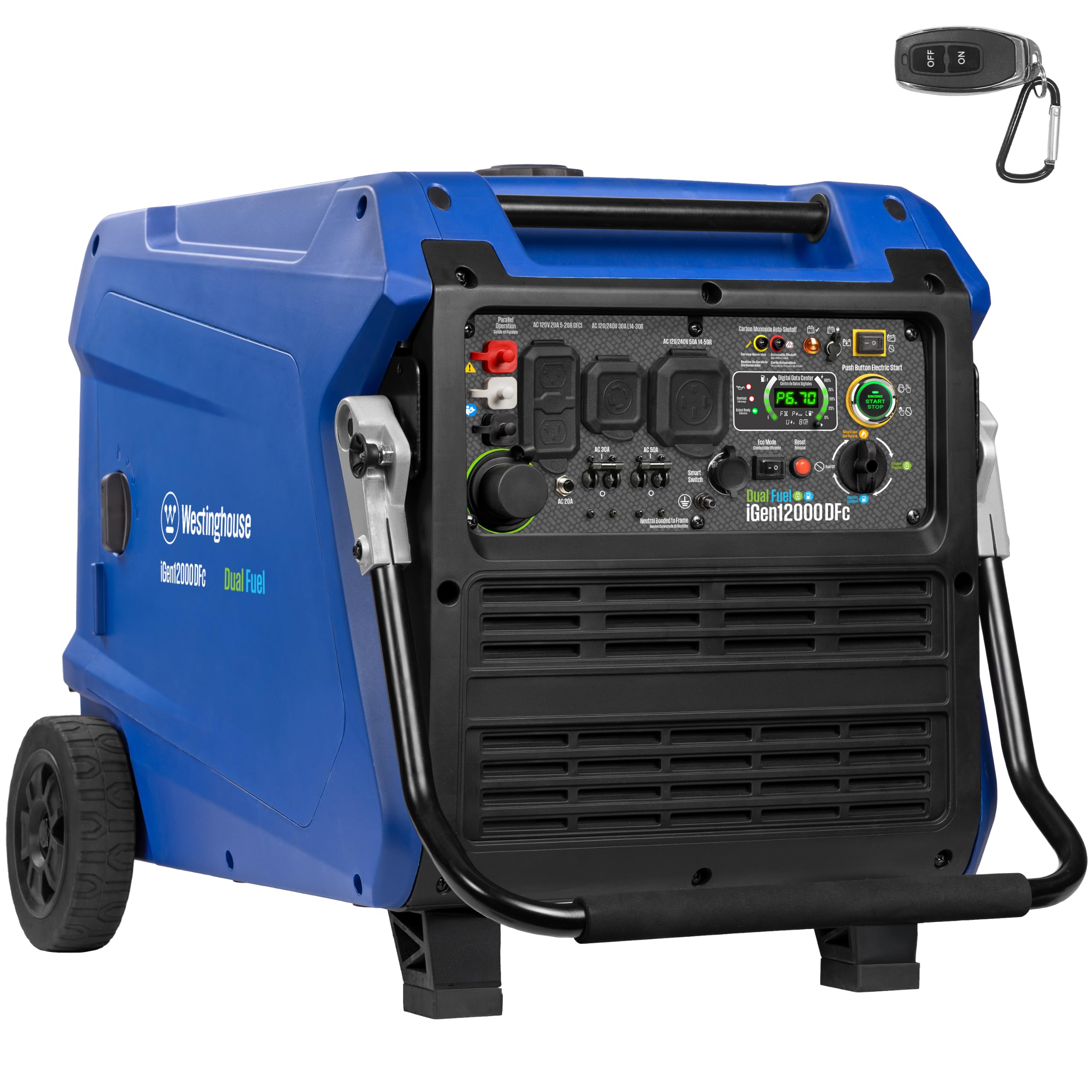
The Westinghouse iGen12000DFc is a dual-fuel inverter generator that delivers 12,000 surge / 9,000 running watts on gasoline and 11,000 surge / 8,100 running watts on propane. The 457cc OHV engine uses Eco Mode to match speed to load, cutting fuel consumption by up to 50% compared to a conventional generator. At 64 dBA, it is as quiet as the Champion 201407, but the Westinghouse adds a digital LED data center that displays fuel level, remaining runtime, voltage, and lifetime hours in real time.
Owners have successfully powered their entire home — including a 3-ton heat pump, a Tesla at 20–25 miles of charge per hour via the 50A outlet, and standard kitchen appliances — using a transfer switch or interlock kit. The 7.9-gallon fuel tank provides up to 19 hours of runtime at 25% load on gasoline. The parallel capability allows you to link a second iGen12000DFc for double the output, a useful feature for larger homes or RV setups.
The dual-fuel selector switch is intuitive and allows fuel swapping while the generator is running. However, some owners noted that the included 10W-30 oil is not suitable for sub-freezing temperatures; a 5W-30 synthetic is recommended after the 5-hour break-in. The 50A outlet uses a 14-50R receptacle, which matches the standard RV plug and many home interlock kits. The CO sensor adds safety, but like all sensor-equipped generators, it can trip if exhaust recirculates near an open window.
Why it’s great
- Dual-fuel gas/propane with hot-switch
- 19-hour runtime at 25% load on 7.9 gallons
- Digital data center with real-time metrics
Good to know
- Oil needs upgrading for cold weather
- Fuel efficiency drops noticeably under heavy load
- 187 lbs — needs wheel kit for solo moves
3. DuroMax XP10000E

The DuroMax XP10000E is a straightforward conventional generator that delivers 10,000 starting watts and 8,000 running watts from a 439cc OHV engine. It does not use inverter technology, so THD is higher (around 12–15%), but it compensates with DuroMax’s MX2 technology, which lets you harness full power from each 120V receptacle. This means you can draw the maximum wattage from both 120V legs simultaneously or run 240V through a single output — a rare feature at this price level.
Real-world owners have run their entire house — lights, TVs, fridges, microwaves, coffee makers, and central AC — through a 50-amp transfer switch for 77 continuous hours during Hurricane Irma. The electric start works reliably, and the included wheel and handle kit makes it easier to move the 210-pound unit. Runtime at medium load is approximately 10 hours on an 8.3-gallon tank. The XP10000E is EPA and CARB approved for all 50 states, a major plus if you live in California or Colorado.
The biggest compromise is noise: owners describe it as loud as a lawnmower, which may not be neighbor-friendly in close residential areas. The 50-amp twist-lock plug is included, but the generator does not come with a matching receptacle adapter, so you may need to purchase one separately. The instruction manual has been criticized for having an incorrect fuel-valve direction diagram. Despite these quirks, the XP10000E offers the most raw power per dollar in this class.
Why it’s great
- Excellent value for 10,000 surge watts
- MX2 tech delivers full 120V power from both legs
- EPA/CARB approved for all 50 states
Good to know
- Loud operation similar to a lawnmower
- High THD not safe for sensitive electronics
- Manual diagram errors and missing receptacle adapter
4. Pulsar PGD105TiSCO

The Pulsar PGD105TiSCO is a tri-fuel inverter generator that runs on gasoline (10,500 peak / 8,500 running watts), propane (9,500 peak / 8,000 running), and natural gas (8,400 peak / 6,800 running). The 458cc OHV engine is EPA and CARB compliant, making it legal in all 50 states. At 62 dBA, it is among the quietest 10 kW generators on the market — quieter than a normal conversation — making it suitable for suburban neighborhoods where noise ordinances apply.
Owners have used it to power entire homes during hurricanes, connecting via a 240V 50A inlet with an interlock kit. The digital control center shows hours, voltage, load, and frequency, helping you monitor performance in real time. The 6.9-gallon fuel tank supports up to 9 hours of continuous operation at half load on gasoline. When connected to a natural gas line, the PGD105TiSCO eliminates refueling entirely — a huge advantage during multi-day outages when gas stations may be closed or without power.
The tri-fuel capability means you get three hoses in the box (propane and natural gas regulators included), but the 247-pound weight requires planning for permanent placement or a dolly. A few owners reported that the LowIdle mode is not ideal for motor loads like well pumps, as it can cause the engine to hunt. Others noted that the hidden oil plug was loose from the factory, so checking all bolts before first startup is recommended. Overall, this is the top pick if natural gas is available at your property.
Why it’s great
- Tri-fuel: gas, propane, and natural gas
- Very quiet 62 dBA operation
- Natural gas eliminates refueling during long outages
Good to know
- Heavy at 247 pounds
- LowIdle mode not ideal for motor loads
- Hidden oil plug may be loose from factory
5. Gidrox GNV

The Gidrox GNV is a tri-fuel inverter generator offering 11,000 watts peak output with under 3% THD. What sets it apart is the oversized 8.7-gallon fuel tank, which supports up to 21 hours of runtime at light load — one of the longest durations in the 10 kW class. It runs on gasoline, propane, or natural gas, and the box includes both NG and LPG hose kits, so you have everything needed for immediate hookup without a trip to the hardware store.
The push-button electric start comes with a remote key fob and manual recoil backup. Owners report that the engine cranks in two or three cycles and stays running. The GNV features an ATS (automatic transfer switch) port, making it ready for seamless integration with a home standby setup. The CO sensor automatically shuts down the unit if dangerous carbon monoxide levels are detected, and the ECO mode adjusts engine speed to match the load for fuel efficiency.
Some owners reported that the manual pull-start handle came off after a few pulls, though the electric start continued to work fine. The weight is listed at 258 pounds empty, so plan for a two-person lift or a sturdy furniture dolly. The included documentation could be clearer, and a few users noted that the dimensions (32.5″ L x 27.5″ H x 23″ W) require careful measurement to ensure it fits in your intended storage or installation spot. Given the generous feature set for the price, the GNV is a solid mid-range tri-fuel option.
Why it’s great
- Long 21-hour runtime on 8.7-gallon tank
- Tri-fuel with included NG and LPG hoses
- ATS-ready with remote start
Good to know
- Pull-start handle may detach
- Heavy at 258 pounds
- Manual could be more detailed
6. GENMAX GM10500iETC

The GENMAX GM10500iETC is a tri-fuel inverter generator that delivers 10,500 surge / 8,500 running watts on gasoline, 9,500 surge / 8,000 running on propane, and 8,400 surge / 6,800 running on natural gas. The 458cc OHV engine features a full suite of protection devices: overload, overvoltage, undervoltage, overcurrent, short circuit, overspeed, and low oil shutdown. This makes it one of the most electrically safeguarded generators in its class, ideal for users who want to protect both the generator and their connected loads.
Owners report powering a 3-ton central AC and a well pump simultaneously with proper load management. The floating neutral design makes it simple to bond the generator for home standby use or leave it unbonded for portable job site operation. The 50A (14-50R) outlet and 30A (L14-30R) outlet are both available, and the included ATS cable allows for direct connection to an automatic transfer switch. The remote start works from a key fob, and the battery charger keeps the starting battery topped off.
Some owners received their unit without a physical manual due to GENMAX’s paperless policy, but customer support emails the PDF quickly. A few users reported surging or overload lights when fridge/freezer compressors started, suggesting that the voltage regulator might need calibration on some units. The delivery packaging has also been criticized for the heavy unit shifting during transit. Despite these issues, the support team is responsive, and the 3-year warranty adds peace of mind.
Why it’s great
- Extensive protection suite (8+ auto shutoffs)
- Tri-fuel with ATS-ready wiring
- Floating neutral for easy bonding flexibility
Good to know
- Some units have surging under compressor load
- No physical manual included
- Heavy and fragile packaging during shipping
7. AIVOLT VS12000411
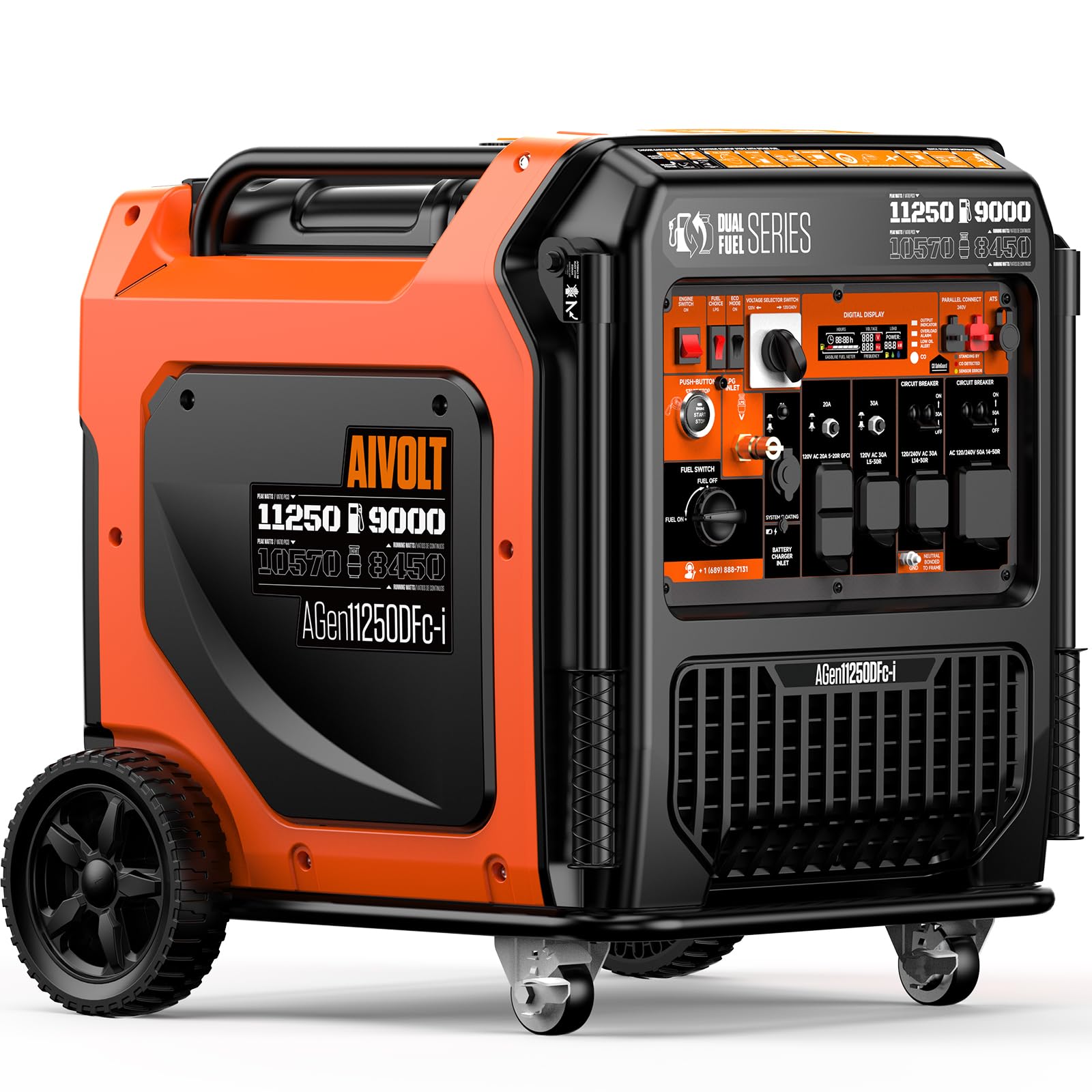
The AIVOLT VS12000411 is a dual-fuel inverter generator that outputs 11,250 surge / 9,000 running watts on gasoline and 10,570 surge / 8,540 running on propane. It is EPA and CARB compliant, legal in all 50 states including California. The unit is designed with a 50-amp RV-ready outlet (14-50R), making it a natural fit for RVers who want to run a full 50A coach with two air conditioners. The digital display shows fuel level, voltage, and runtime.
Owners praise the premium build quality and quiet operation. The remote start lets you fire up the generator from inside your RV or home before you step outside. The Eco Mode extends runtime to over 19 hours at lighter loads, and the dual-fuel selector can be switched without shutting down. For food truck operators and job site users, the multiple 120V GFCI outlets offer flexibility for various tools and appliances.
One recurring issue: shutting off the generator requires a cool-down period before restarting. If you turn it off while hot, the safety mode can prevent restart for up to an hour. A small number of owners reported complete failure within the first few hours — one unit ran rough for an hour then lost voltage entirely. AIVOLT’s support is based in China, which can make warranty resolution slower than US-based brands. Still, for a budget-friendly dual-fuel inverter with 50A output, the VS12000411 offers strong value.
Why it’s great
- 50A outlet ready for large RVs
- EPA & CARB compliant for all 50 states
- 19+ hour runtime in Eco Mode
Good to know
- Hot shutoff requires cool-down before restart
- Customer support based in China
- Early failure reports on a small number of units
8. Westinghouse WGen14500TFc
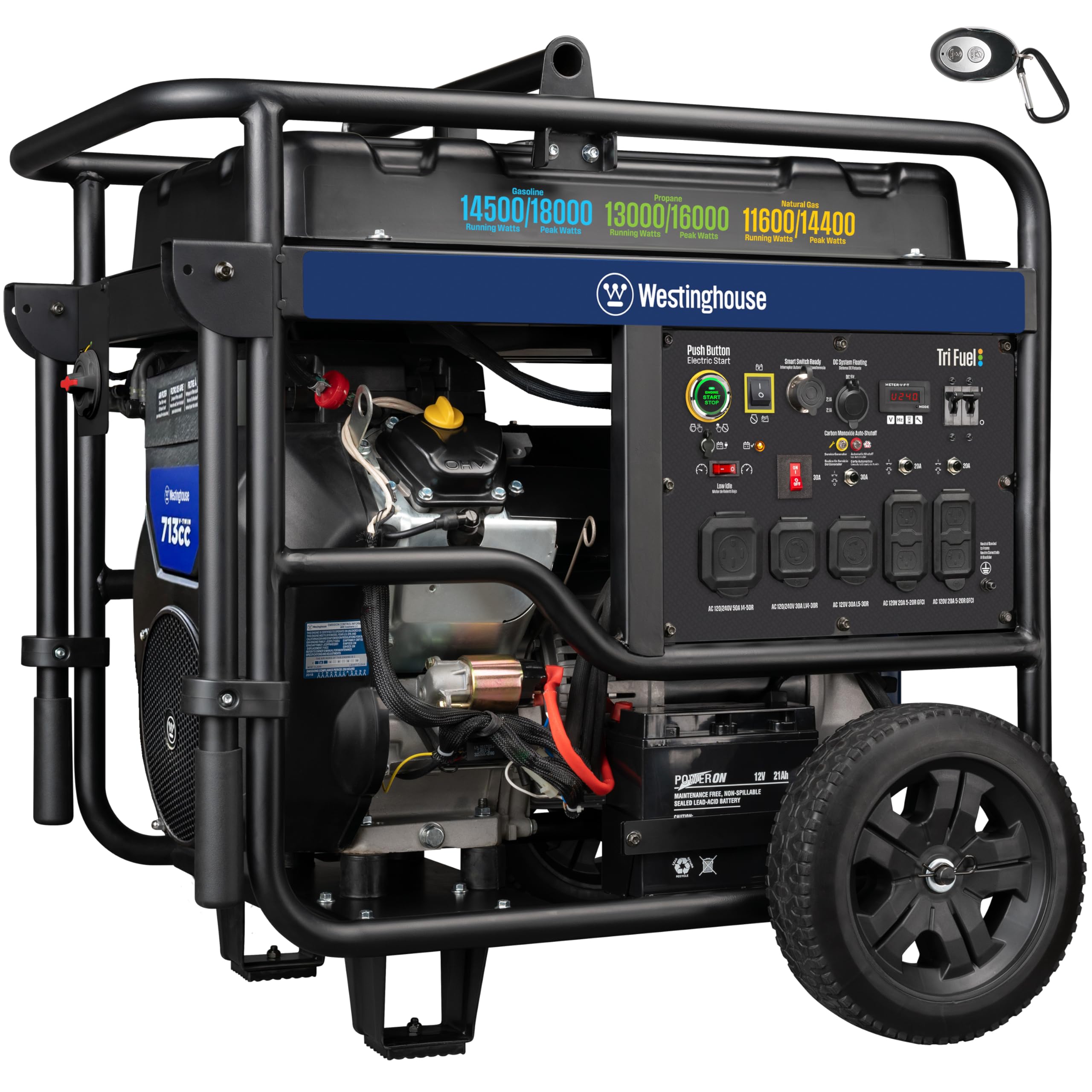
The Westinghouse WGen14500TFc is a tri-fuel conventional generator that produces 18,000 surge / 14,500 running watts on gasoline — enough to handle an entire home plus a welder or heavy construction tools. The 713cc V-Twin OHV engine is a substantial step up from the single-cylinder units above, providing smoother power delivery and a low 5% THD. On natural gas, it delivers 14,400 surge / 11,600 running watts, which is exceptional for a portable unit connected to a gas line.
Owners have run central AC, well pumps, and multiple appliances off the 50A (14-50R) and 30A (L14-30R) outlets without any dip in voltage or frequency. The VFT data center displays voltage, frequency, and lifetime hours. The push-button and remote start are included, and the reinforced steel handles and lift bar make it easier to maneuver despite the 348-pound weight. The CO sensor adds the safety auto-shutdown for carbon monoxide detection.
The main trade-off is noise: at 74 dBA, it is louder than inverter models. Additionally, the THD of 5–6% is higher than an inverter’s sub-3%, so it is less ideal for sensitive electronics without a separate power conditioner. A few owners noted that the fuel shutoff solenoid can stick from the factory, preventing gasoline flow — a quick check and manual freeing of the plunger resolves it. For users who need maximum surge capacity and have a natural gas hookup, the WGen14500TFc is unmatched in the portable class.
Why it’s great
- Massive 18,000 surge watts
- Tri-fuel with 11,600W running on natural gas
- 713cc V-Twin engine for smooth operation
Good to know
- Loud at 74 dBA
- 5-6% THD not ideal for sensitive electronics
- 348 lbs — difficult to move without helpers
9. Honda EM6500S
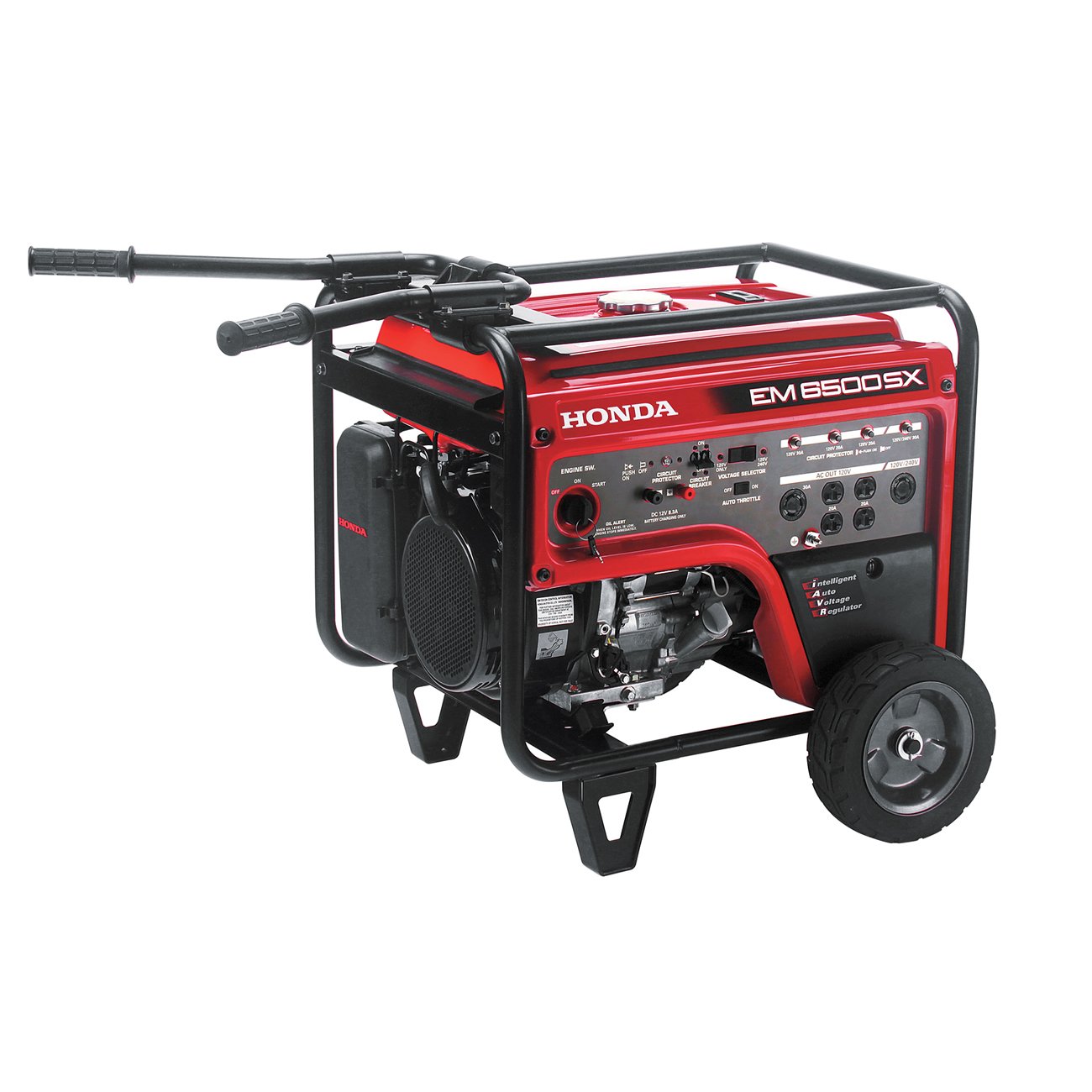
The Honda EM6500S is a 6,500-watt running (not 10 kW) conventional generator that earns a place on this list because of its legendary reliability and build quality. Powered by a 418cc Honda GX-series engine, this unit is engineered for commercial-grade endurance with cast-iron cylinder sleeves, a large carbon-fiber muffler, and an automatic voltage regulator (AVR). While its surge output is lower than the 10 kW class, the Honda handles its rated load flawlessly — it will run a 2,000-square-foot home minus central AC without breaking a sweat.
Owners in hurricane-prone regions such as Florida have run the EM6500S for four days straight with only 30-minute breaks every 8 hours for oil changes. The electric start works reliably even in humid salt-air environments. The fuel tank holds roughly 5 gallons, providing approximately 8–10 hours of runtime at half load. The wheel kit included in the box makes it relatively easy to move the 234-pound unit onto a patio or driveway.
The biggest limitation is the price-to-wattage ratio — the EM6500S costs significantly more than many 10 kW generators while delivering fewer watts. It also does not have a 50A outlet; the standard model provides a 30A L14-30R locking receptacle and two 20A GFCI duplex outlets. This means it cannot directly power an RV with a 50A service. For buyers who prioritize reliability over raw power and have a modest house load, the Honda EM6500S is a long-term investment that will likely outlast multiple cheaper generators.
Why it’s great
- Legendary Honda GX-series reliability
- Proven endurance during multi-day hurricane outages
- Electric start with reliable cold-weather startup
Good to know
- Lower wattage than 10 kW competitors
- No 50A outlet — limited to 30A L14-30R
- High cost per watt compared to other units
10. EcoFlow GE305 + Delta Pro 3
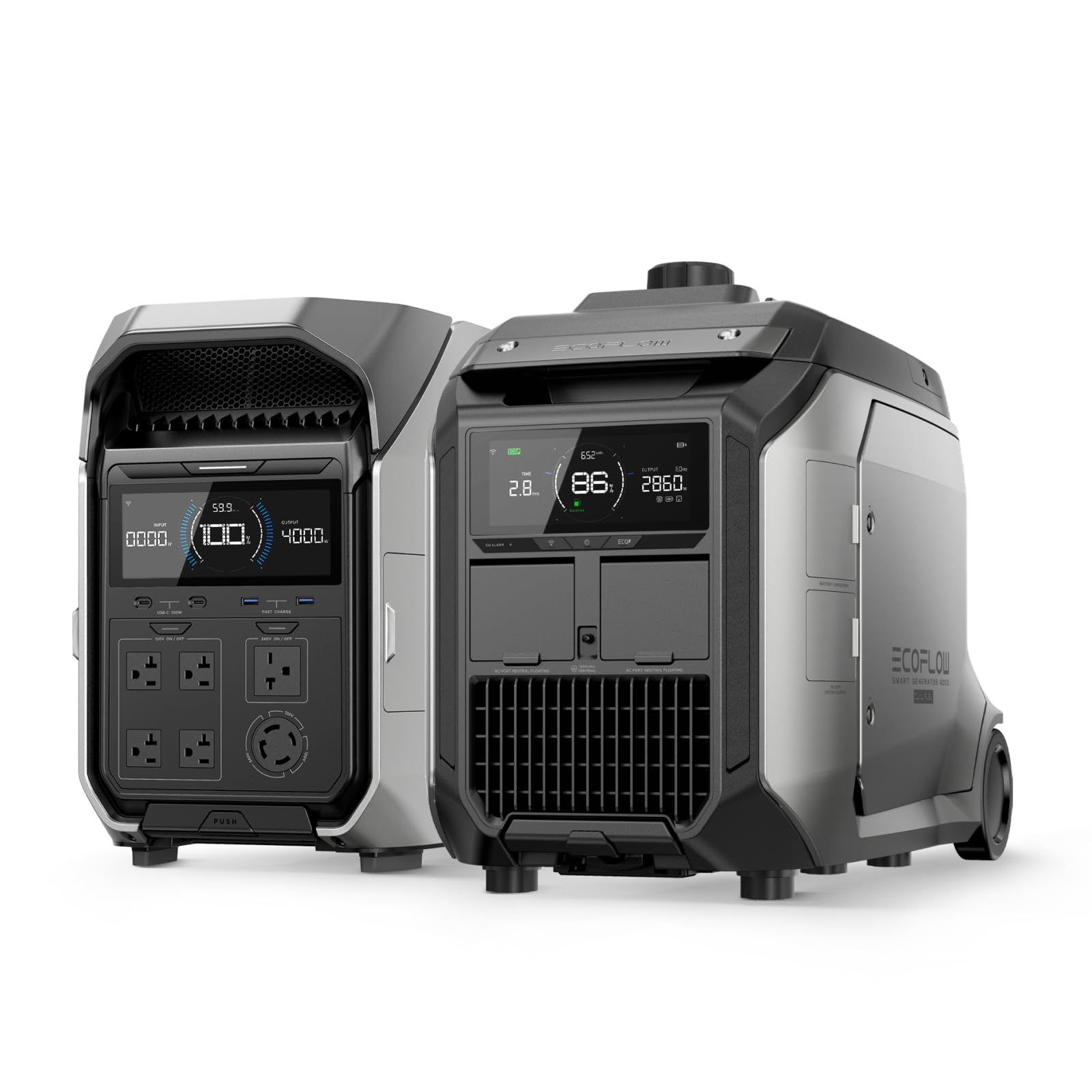
The EcoFlow GE305 Dual Fuel Generator combined with the Delta Pro 3 power station represents a completely different approach to 10 kW backup: a smart hybrid ecosystem. The Delta Pro 3 packs a 4,096Wh LFP battery that can output up to 3,600W (expandable to 7,200W with two units). The GE305 dual-fuel generator (gasoline or propane) acts as a fuel-efficient battery charger, automatically starting when the Delta Pro 3’s battery dips below a set level and shutting off once it is recharged. The system achieves roughly 40% better fuel efficiency than running a generator continuously.
Owners report using this setup to power all the essentials — fridge, freezer, Starlink internet, fans, and medical devices — for days without refueling, as the generator runs only 4–6 hours per day to top off the battery. The EcoFlow app provides real-time monitoring of energy usage, remaining runtime, and charge state. The system is virtually silent during battery-only operation and only 70 dBA when the generator is running. It also produces no fumes indoors, making it the only safe-to-use-inside option on this list.
The catch is that this package is not CARB-approved, so it cannot be shipped to California. The setup also requires an initial investment in the battery ecosystem. The GE305 generator itself outputs a maximum of 3,200W, so it cannot power a 10 kW load directly — the battery handles surges. This system is best for users who want to minimize fuel consumption and noise, and who are willing to manage a software-defined power system rather than a plug-and-play generator.
Why it’s great
- 40% fuel savings vs running a generator 24/7
- Silent battery-only operation for day-to-day use
- EcoFlow app for real-time energy monitoring
Good to know
- Not CARB-approved — cannot ship to CA
- Generator output limited to 3,200W
- High upfront cost for the complete ecosystem
11. EcoFlow Delta Pro 10.8kWh
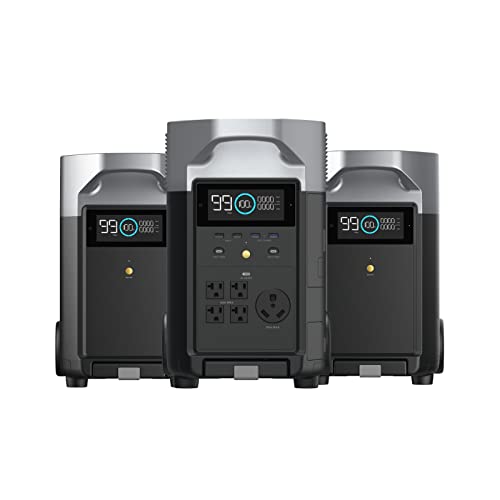
The EcoFlow Delta Pro with two extra batteries offers 10.8 kWh of LFP battery storage and a 3,600W AC output (expandable to 4,500W with X-Boost). This is a fully electric, zero-emission backup system that replaces the need for a combustion generator entirely for light to moderate loads. It can power a refrigerator, freezer, lights, internet router, and a TV for 12–18 hours before depletion. The 15 versatile outlets include five AC outlets, two USB-C ports, and a 12V car port.
Recharge time using a 240V outlet is 1.8 hours, making it possible to top off between grid outages. Owners praise the EcoFlow app for its intuitive energy flow visualization and adjustable charging settings. The LFP battery chemistry provides 3,500+ full cycles (10+ years of daily use). When paired with solar panels, the Delta Pro can run indefinitely during daylight, making it the ultimate clean energy hub for homeowners with solar.
The 330-pound system (combined with extra batteries) is not truly portable — it is best placed in a garage or utility room and left connected. The lack of built-in handle cutouts on the box has been criticized. The price per kWh is high compared to a gas generator, but owners who have experienced 7-hour outages note that the system does not require refueling, produces no fumes, and operates silently. For users who prioritize air quality, noise elimination, and integration with solar, the Delta Pro 10.8kWh is the premier battery backup solution.
Why it’s great
- Zero-emission, silent operation
- 10.8 kWh capacity powers essentials for 12-18 hours
- Fast 1.8-hour recharge with 240V outlet
Good to know
- Expensive compared to gas generators
- Heavy at 330 lbs — not truly portable
- Some firmware update hurdles reported
12. Generac Guardian 10kW

The Generac Guardian 10kW is a permanent home standby generator designed to automatically power your entire house within seconds of a grid outage. It comes with a 100-amp automatic transfer switch (ATS) that handles 16 circuits, and it runs on your home’s existing natural gas or LP supply — no refueling required. The G-Force 400 series engine is purpose-built for the high duty cycle of standby operation, with a heavy-duty steel enclosure that weathers rain, snow, and sun.
True Power Technology delivers clean, stable power with less than 5% harmonic distortion, making it safe for sensitive electronics. The Mobile Link WiFi connectivity lets you monitor generator status, run weekly exercise cycles, and receive maintenance alerts from your phone. The unit is designed for outdoor permanent installation on a concrete pad, and certified electricians typically install it in a few hours. Owners report units lasting 24+ years with proper maintenance, and the 5-year limited warranty provides long-term assurance.
Installation is not a DIY project — most owners recommend budgeting – for the concrete pad, electrical work, and gas line connection, depending on distance from the panel and gas meter. The 10 kW rating is suitable for a home up to about 2,500 square feet; larger homes may need the 14 kW or 20 kW model. Unlike portable generators, the Guardian is always ready — it automatically tests itself weekly and will start within 10 seconds of a power failure. This is the definitive choice for those who want a set-it-and-forget-it whole-home backup solution.
Why it’s great
- Automatic whole-home standby with ATS
- WiFi remote monitoring via Mobile Link
- Runs on natural gas — no refueling needed
Good to know
- Professional installation required (costs +)
- 10 kW may not cover very large homes
- Heavy at 338 lbs — fixed placement
13. DuroMax XP16000iH
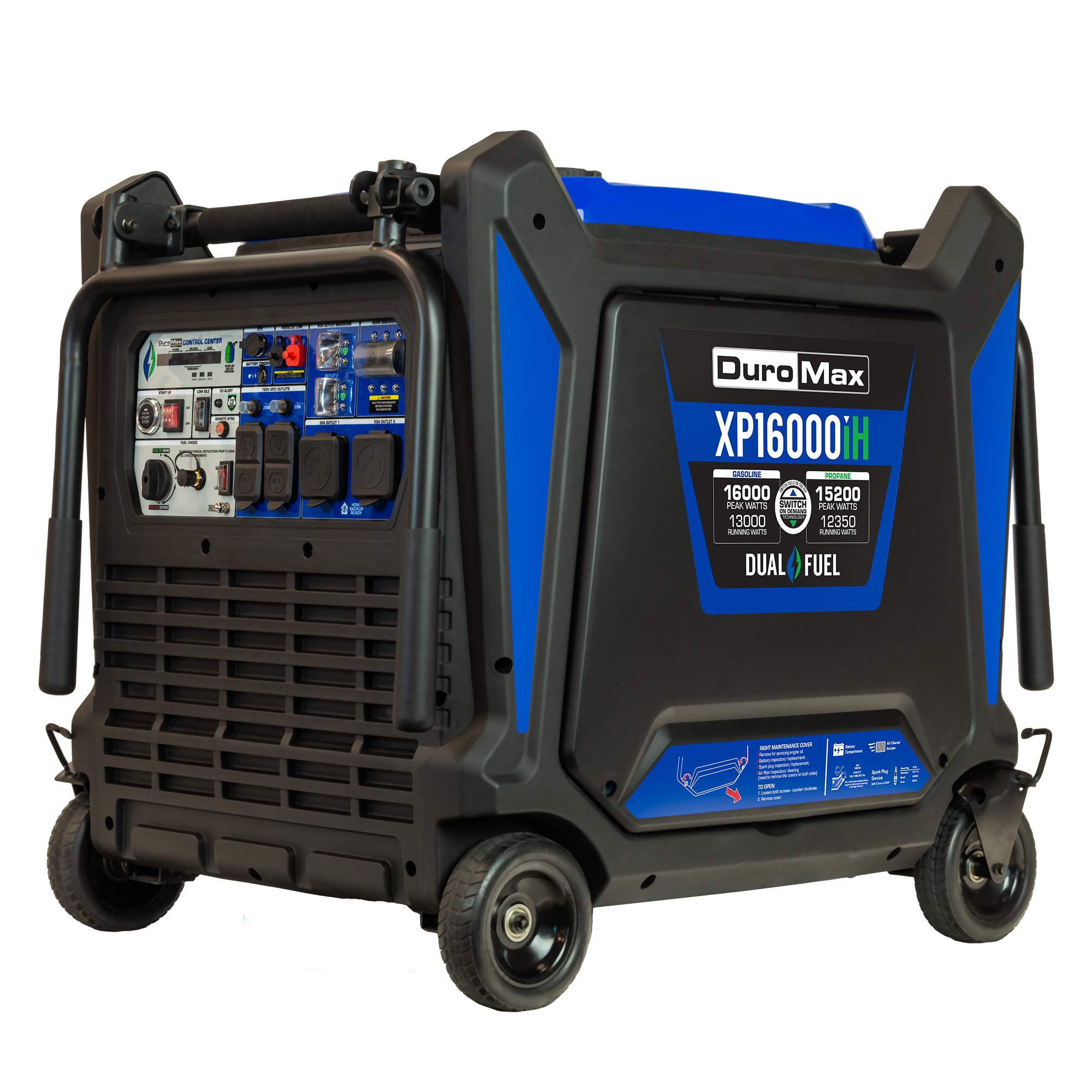
The DuroMax XP16000iH is a dual-fuel inverter generator that delivers 16,000 surge / 13,000 running watts — one of the highest outputs in a portable inverter format. It runs on gasoline or propane, and the inverter technology keeps THD low enough for sensitive electronics. The digital control center shows runtime hours, voltage output, and load level on an LCD display. The included battery tender keeps the starting battery charged and ready, and the remote start lets you fire it up from inside your home or RV.
Owners have used the XP16000iH to run entire 2,000-square-foot homes plus camp equipment at 6,500 feet elevation, with runtime lasting 8–12 hours non-stop. The dual-fuel capability provides flexibility during long outages when gasoline may be scarce. The unit is EPA and CARB approved for all 50 states. The 50A (14-50R) outlet and 30A (L14-30R) outlet are both present, making it compatible with standard home interlock and RV connections.
The weight is a significant factor at 368 pounds, requiring two people or a heavy-duty dolly to move. Some owners have reported quality control issues: a few units failed during break-in with excessive metal in the oil, and one unit caught fire between the alternator and exhaust due to a major component failure. DuroMax’s customer support has been described as difficult to work with for warranty claims. The XP16000iH offers enormous power in an inverter format, but the reliability track record is more uneven than the top-rated Champion or Westinghouse models.
Why it’s great
- 16,000 surge watts in a portable inverter
- Dual fuel for fuel flexibility
- LCD data center with real-time metrics
Good to know
- Heavy at 368 lbs — needs two people
- Quality control failures reported (metal in oil, fire risk)
- Customer support difficult for warranty claims
FAQ
Can a 10 kW generator run a central air conditioner?
What is the difference between dual fuel and tri fuel generators?
Do I need a transfer switch or interlock kit for a 10 kW generator?
How much fuel does a 10 kW generator use per hour?
Are 10 kW generators CARB compliant for California use?
Final Thoughts: The Verdict
For most users, the best 10 kw generator winner is the Champion 201407 because it delivers the lowest noise (64 dBA), the convenience of wireless remote start, and clean inverter power under 3% THD — all at a price that undercuts premium competitors. If you want a dual-fuel inverter with the longest runtime, grab the Westinghouse iGen12000DFc. And for whole-home automation with no refueling, nothing beats the Generac Guardian 10kW.