
Our readers keep the lights on and my morning glass full of iced black tea. As an Amazon Associate, I earn from qualifying purchases.
Specs are compiled from manufacturer listings and verified buyer reviews and can change over time — please confirm the key details on the product page before buying.
Buying a 14 inch masonry blade is really a decision about two things: how fast the blade eats through concrete, brick, and stone, and how many cuts you get before the diamond grit wears down and the blade starts dragging. Get either wrong and you are either standing over a slow cut all afternoon or buying a replacement blade mid-project.
I’m Min — the founder and writer behind Gadgets Feed. This guide is built by comparing the manufacturers’ published specifications and the patterns across verified customer reviews, so you get each pick’s real strengths and trade-offs instead of marketing spin.
This guide separates the blades that hold their edge from the ones that quit early, so you can pick the right 14 Inch Metal Masonry Blade for your saw and your material.
Our Picks at a Glance
How To Choose The Best 14 Inch Metal Masonry Blade
A 14 inch blade is the size that fits full-size masonry saws, chop saws, and handheld cut-off saws, so the first job is confirming the blade will actually mount on the tool you own. After that, the material you cut most often decides the rim type, and the segment height decides how long the blade keeps cutting before you replace it.
Match the arbor to your saw before anything else
The arbor is the center hole that slides over your saw’s spindle. A 1 inch arbor is the common standard on 14 inch saws, and many blades ship with a reducer ring so the same blade also fits a smaller spindle. If the hole is too big the blade wobbles; if it is too small it simply will not go on, so check your saw’s spindle size before you order anything.
Segmented rim versus continuous rim
A segmented rim has slots cut between the diamond segments. Those gaps throw out slurry and heat, which is why segmented blades are the fast cutters for concrete, brick, and block. A continuous rim has no gaps and leaves a smoother edge, but it cuts slower and is a different tool for a different job.
Quick Comparison
| Model | Best For | Arbor | Segment Height | Pack Size | Amazon |
|---|---|---|---|---|---|
| Trabo 14 Inch 3 Pack★ Best Overall | Multi-material cutting across several tools | 1 Inch with ⅞ Inch reducer | 10mm rim | 3 Blades | Amazon |
| VSS 14 inch Dry or WetBest Value | Light to medium duty wet or dry cuts | 1″ with 20mm bushing | 10mm | Single | Amazon |
| GRAFF 14 Inch Diamond BladeAngle Grinder Pick | Angle grinder work on stone and brick | 1 Inch with 25/32 Inch Adapter | 0.394 Inch | Single | Amazon |
| FEWELL 14 Inch Diamond Concrete Saw Blade | Wet saw and circular saw paver work | 25.4 mm with 1″-20mm adapter | 15 mm | Single | Amazon |
| RHAPSODY 14Inch Laser Welded | Heavy cutting in reinforced concrete | 1″ with 20mm bushing | 15mm | Single | Amazon |
| Cougar HS 14 Inch | Repeat cured-concrete cutting jobs | 1″ with 20mm bushing | 12MM | Single | Amazon |
| Benchmark Abrasives Type 1 | Ferrous metal and drywall stud cutting | 1″ | — | 10 Pack | Amazon |
| SHDIATOOL 14 Inch Metal Cutting Diamond Blade | Rebar, steel, and tough mixed materials | 25.4mm (1 In.) with pin hole | — | Single | Amazon |
| VTXMax 14 inch 5 Pack | Stocking up for a big concrete job | 1″ with 20mm bushing | 10mm | 5 Blades | Amazon |
In‑Depth Reviews
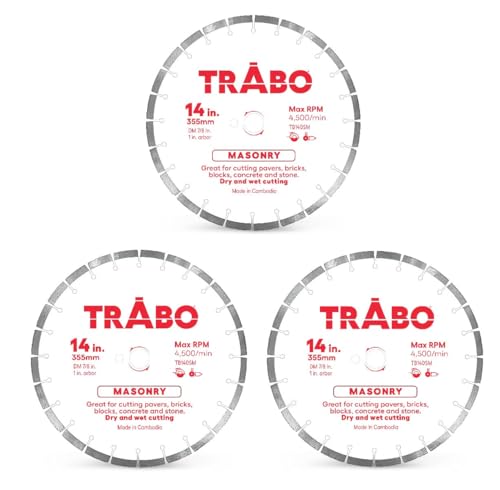
1. Trabo 14 Inch 3 Pack Masonry Segmented Rim Diamond Metal Bond Blades
Our pick — over 4.5★ from 350+ verified ratings; the strongest balance of quality and price.
Three blades in one box, so the saw never sits idle waiting on a replacement.
It sits at the top because you get three blades instead of one. That 3 versus 1 gap is the whole argument — when one blade slows down mid-job, you swap in a fresh one and keep cutting. The segmented rim is built for speed, and the diamond grit is embedded in every blade for cutting cement, pavers, concrete with rebar, and natural stone.
What wins people over is the cutting itself. Whether you are slicing landscape block for a small retaining wall or trimming engineered quartz on an old circular saw, the blade tracks straight, the cuts land clean with no chips, and the included brass reducer ring locks the blade tight onto the spindle so nothing shifts mid-cut. The 10mm rim is the reason it keeps going, and buyers pushing it through asphalt and rebar report it cutting like butter without binding at max depth.
Here is the honest catch. This is a fast, aggressive cutter, not a thick-slab monster. On light work — bricks, small mortar jobs, hardie backer boards — it shines. But going through very thick concrete in a single pass is a job for a different class of blade, so plan your cuts accordingly and let the blade do the work rather than forcing it.
Built for speed and volume
- Three blades per box means less downtime mid-project
- 10mm diamond rim holds its edge through plenty of material
- Brass reducer ring lets it fit a wider variety of power tools
- Segmented rim stays cool and clears debris fast
Where it stops
- Not built to punch through very thick concrete in one pass
- Best performance comes from letting the blade set the pace
Grab this one: anyone cutting cement, pavers, concrete with rebar, or natural stone who wants fast cuts and spares on the truck.
Look elsewhere: if your daily job is thick-slab concrete and you need a blade designed around that single task.
2. VSS 14 inch Dry or Wet Cutting General Purpose Power Saw Segmented Diamond Blades
Runs dry on a miter saw or wet on a table saw without missing a beat.
What sets this blade apart is its 36-tooth rim. It carries 36 teeth against the Trabo’s 14 — a 2.6x gap — and that denser segmented rim is why it slices smoothly through pavers, brick, cinderblock, and stone whether you run it dry or with water. It is sized 14″x.125″x.395″/10mm with a 1″ arbor, and it ships with a 20mm heavy-duty bushing for flexible mounting.
That wet-or-dry versatility holds up on the jobsite. It threads onto a cheap sliding miter saw, choke up on a table saw, or spin it on a chop saw and it keeps going. Concrete-wood fiber siding, patio pavers, retaining wall blocks — the segmented rim cuts clean, and dry cutting makes it a tool you can grab without dragging a hose across the jobsite.
The one thing to weigh: this is a light to medium duty cutter, and blade longevity is a genuine mixed bag. It eats through plenty of material before slowing, but long single-session projects that demand hundreds of cuts can wear it faster than heavier blades. If you have a small-to-medium run of cutting, it is a strong pick. For marathon pours, keep a spare within reach.
Where it earns its place: the 36-tooth rim does the smooth-cutting work whether you run dry on a chop saw or wet on a table saw.
The one caveat: blade life is a mixed story — steady for small projects and shorter than expected under a full day of continuous cutting.
Reach for this if: you cut a mix of brick, block, and pavers and want one blade that works both dry and wet.
Think twice if: your project is a non-stop cutting marathon where you need maximum blade life in one go.
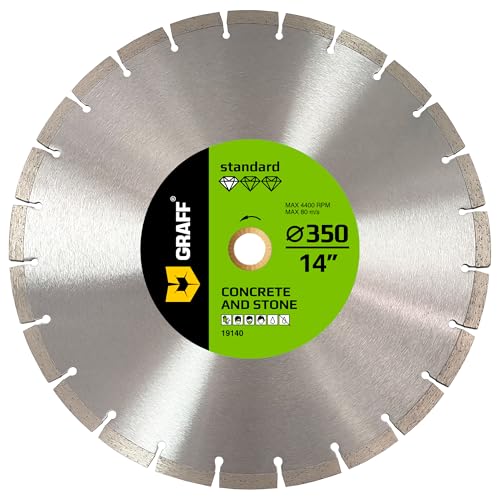
3. GRAFF 14 Inch Diamond Blade for Angle Grinder Arbor 7/8″-5/8″
A 14 inch blade tuned for the angle grinder crowd rather than the big masonry saw.
The number that matters most here is the arbor kit: it comes sized to fit all standard 1″ and 25/32″ spindles with the included adapter, and it is built for both dry and wet cutting. That compatibility matters because angle grinders have their own spindle sizing, and a blade that refuses to mount is useless. Cutting width comes in at 0.134 Inch with a 0.087 Inch thick body, and the 24 diamond-encrusted segments are spaced so debris clears out as you go.
Owner feedback keeps returning to one word: control. It cuts without grabbing, holds together through concrete without shattering or chipping, and the segment spacing keeps it from bogging down in stone. It handles stone, marble, granite, brick, masonry, and concrete, so it is the versatile option for a mixed-material day.
Two things to plan around. It wears down with heavy, repeated use — it will happily clean up a patio repair, but a full week of solid cutting will slow it down to a serviceable but slower pace. And the blade needs the right saw: it is angled toward grinder work, so if you are on a dedicated masonry saw, one of the other picks will be a straighter fit.
Control on the grinder
- Fits standard 1″ and 25/32″ grinder spindles with the included adapter
- 24 segments clear debris and resist chipping
- Runs both dry and wet for flexible jobsite use
- Non-grabbing cut tracking through mixed masonry and stone
Keep in mind
- Wears down and slows after a few days of solid cutting
- Grinder-focused design is not the ideal match for a full masonry saw
Made for: home and DIY users running an angle grinder across stone, marble, granite, brick, or concrete.
Move on if: you need a blade for a dedicated masonry saw or plan to cut nonstop for days straight.
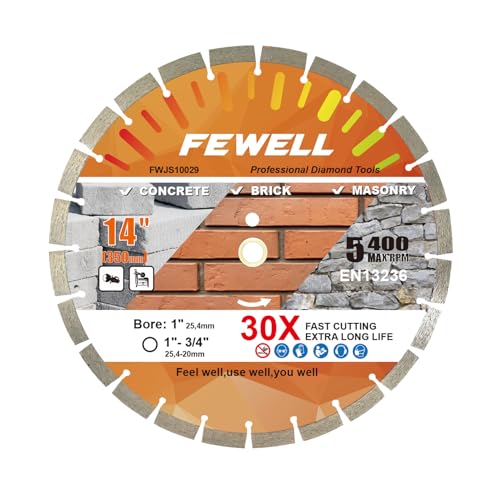
4. FEWELL 14 Inch Diamond Concrete Saw Blade with 15mm Segment
A tall 15mm segment that keeps cutting long after thinner rims have worn down.
Start with the raw numbers: 14″/350 mm diameter, 3.2 mm thickness, a 15 mm segment height, 24 segments, and a 25.4 mm bore with a 1″-20mm adapter included. That taller segment is the story — more diamond depth means the blade keeps biting into brick and block long after a shorter-rim blade would be polishing a bare steel edge.
Owners put that depth to work on real projects. It runs on wet saws through full-size solid bricks, cuts pavers for backyard patios with little pressure, and handles asphalt driveways to set a straight line for pavers. The segmented gaps between the rim do the cleanup — they throw out debris so the blade does not bog down, and the 1″-20mm adapter opens it up to circular saws, masonry saws, table saws, handheld saws, and road cutting machines.
The honest read: this is a great general-purpose blade, but it is not built to speed through very thick, dense concrete in one aggressive pass. It rewards you for letting it cut at its own pace, and heavy continuous use will wear the rim down like any other. For DIY and home project work at a budget-friendly price, it is a hard pick to argue with.
Detail that matters: a 15 mm segment height and 24 segments, paired with a 1″-20mm adapter that lets one blade serve a circular saw, masonry saw, table saw, or handheld saw.
Fair warning: it excels at DIY-scale projects and brick or paver work — very thick concrete in a single pass is asking more than the blade is built for.
Best for: DIYers running wet saws, circular saws, or handheld saws through brick, block, pavers, and stone.
Not for: someone looking to blast through very thick, dense concrete in one aggressive pass.
5. RHAPSODY 14Inch Laser Welded Diamond Saw Blade Segmented General Purpose
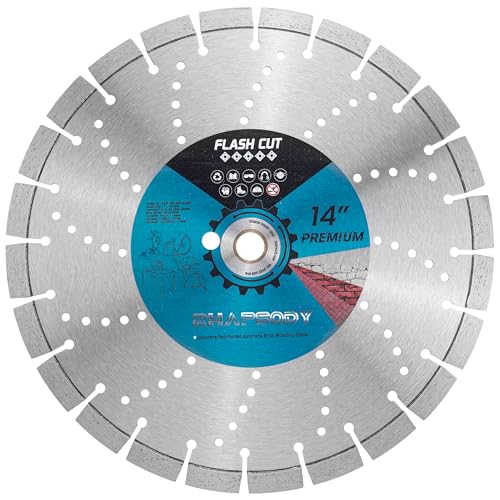
Laser-welded segments that stay put when you are chewing through reinforced concrete.
The headline feature is the construction method: the diamond segments are laser welded to the steel core rather than brazed on, so they should not fly off or crack during heavy cutting. It is sized 14″ diameter X.125 thick X 1″ arbor with a preinstalled 20mm bushing, carries 24 teeth, has a 15mm segment height, and is rated to a max 5,400 rpm.
What buyers keep coming back to is endurance on nasty material. Old concrete foundation with reinforcement mesh and large old bolts is exactly the kind of job that eats cheap blades, and this one grinds through it. It also switches cleanly onto a slow-speed metal cutting chop saw, and the segmented gaps dissipate heat so it does not overheat and deform during long runs.
Now the caveat, said plainly. Quality is the most-discussed aspect here, and the feedback on it is not unanimous — cutting performance draws the strong praise, while the overall quality picture is mixed. That does not mean it fails; it means this blade rewards you for running it within its limits and pairing it with a saw it was built for. Run it too hard and you will get uneven life.
Why it holds up
- Laser-welded segments resist falling off or cracking
- 24-teeth segmented rim runs fast through concrete and reinforced concrete
- Dual dry and wet cutting with 5,400 max RPM rating
- Segmented gaps dissipate heat and clear debris
The trade-off
- Overall quality feedback is mixed, cutting performance is the star
- You will get the longest life by running it within its rated limits
Well suited to: heavy cutting jobs in concrete, reinforced concrete, masonry, block, and brick where a dropped segment would ruin your day.
Second-guess it if: you want rock-solid quality consistency and prefer a blade with no mixed reviews behind it.
6. Cougar HS 14 Inch Diamond Concrete Saw Blade, Premium General Purpose Segmented Blade
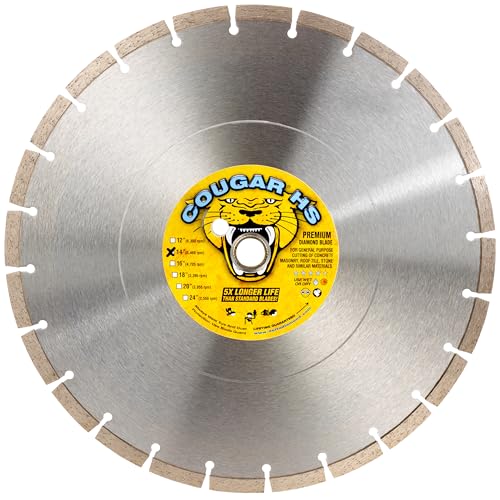
The one blade in the lineup that comes with a lifetime warranty against warping and cracking.
That warranty is the standout. Delta Diamond Products backs this blade against warping, cracking, and material defects — a rare bit of long-term confidence in a category where blades are usually a consumable you toss when they wear out. Physically it runs 14″ diameter X.125 thick X 1″ arbor with a 20mm bushing, has 12MM tall segments, 24 teeth, and a max 5,460 rpm rating.
Repeat buyers cite the balance between cut quality and cost per cut. The maker rates the diamond segments to last up to 5X longer than standard-grade blades, and buyers report clean edges on planter walls, drives, and curbs. The adequate thickness is what keeps it from warping when it heats up, which is exactly what thinner blades do.
The one recurring gripe is the arbor hole. It runs smaller than advertised on some units, so you may need to punch out the brass ring before it slips onto a 1″ spindle. It also slows a bit if you force it through a long run of concrete blocks. Neither is a deal-breaker — the blade keeps cutting steadily as long as you let it set the pace — but it is worth knowing before you mount it.
Why it lasts: 12MM tall segments and a lifetime warranty against warping, cracking, and material defects set it apart from blades sold without one.
Mounting note: the arbor hole can run snug, so you may need to punch out the brass ring before the blade fits a 1″ spindle.
Choose it for: repeat concrete and masonry cutting where a covered blade and steady cost per cut matter most.
Bear in mind: some units need the arbor ring removed before mounting, so budget a minute for fitting.
7. Benchmark Abrasives Aluminum Oxide Type 1, 14 Inch Chop Saw Blade, 10 Pack
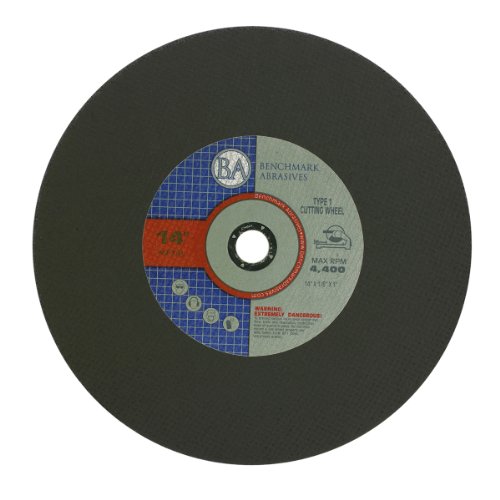
This one cuts metal, not concrete — a ten-pack of chop saw wheels for ferrous stock.
Read the title carefully here, because this is a different animal from the diamond blades above. It is a Type 1 (flat) abrasive cut-off wheel, 14″ diameter with 1/8″ thickness and a 1″ arbor, made from aluminum oxide rather than diamond. It is built for ferrous metals — iron, steel, tubes, pipes, and light gauge material like drywall studs — not for masonry at all.
The 10-pack format means a long stretch of shop work without rationing wheels. It fits a wide range of saws — Dewalt, Milwaukee, Makita, Bosch, Metabo, Ryobi, Black & Decker, Kobalt, Craftsman, Skil, Porter Cable, Ridgid, and 14″ electric chop saws — and it is precision balanced for low vibration, so the cuts land cleaner. It also uses a reinforced fiberglass mesh for strength during hard cutting.
The trade-off is one of scope, not quality. This wheel is not the tool for brick, block, pavers, or stone — if you bought it expecting to cut masonry, it will disappoint. But for anyone in a metal fabrication or metal stud shop, buying these in bulk is how you avoid running out mid-job.
Built for the metal shop
- 10-pack covers a long run of ferrous metal cutting
- Aluminum oxide with reinforced fiberglass mesh for strength
- Fits a very wide range of 14″ chop saws and cutoff saws
- Precision balanced for low-vibration, accurate cuts
Honest limits
- Not a diamond blade — unsuitable for brick, block, pavers, or stone
- Abrasive wheels are consumables that require periodic replacement
Get this if: you cut ferrous metal, steel, tube, pipe, or drywall studs on a chop saw and want a bulk supply ready to go.
Skip if: your material is masonry — this is the wrong blade type for brick, block, or stone.
8. SHDIATOOL 14 Inch Metal Cutting Diamond Blade All Purpose Cut Off Wheel
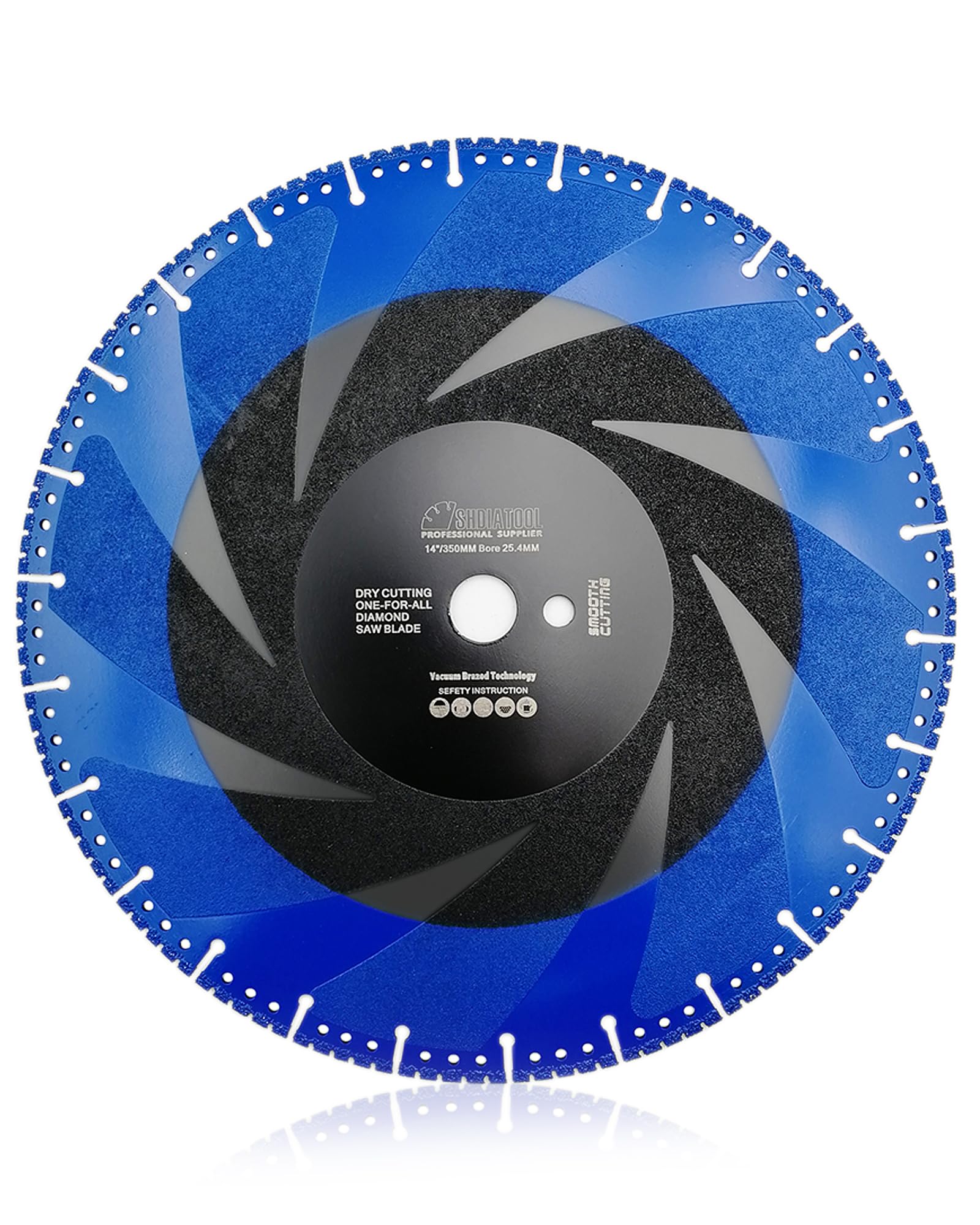
A diamond blade that eats steel, rebar, and reinforced concrete without overheating.
The defining spec is the vacuum brazing. The diamond grains are permanently brazed to the edge of the steel core under vacuum, creating segments the maker describes as unbreakable and extremely heat resistant. It measures an outer diameter of 350mm, an incision thickness of roughly 3.2mm, a 25.4mm bore, has 130 teeth, and a maximum safe operating speed of 4,365 RPM.
The application list is broader than almost anything else here: granite, marble, Aluminum, auto body panels, cast iron, copper pipe, corrugated roofing, drywall, ductile iron pipe, fire door, masonry, plastic, PVC, rebar, reinforced concrete, steel metal, stucco, and wood. It cuts through 14-gauge steel without wobbling and it holds its shape — the heat-treated high-speed steel core resists the heat that bends lesser blades.
Two real trade-offs. The most-mentioned issue is cutting speed: this blade is not a sprinter, and trying to force it faster just bogs your saw. And it is a premium-priced option, so it is a genuine buy-once proposition rather than a cheap throw-in. Run it at its own pace and the longevity backs up the outlay.
The core idea: vacuum-brazed diamond grains brazed directly to a heat-treated high-speed steel core, so it survives dry, fast cuts that would wreck a standard blade.
Where it stumbles: cutting speed is the recurring knock — this is a deliberate, patient blade rather than a fast one — and the price reflect its premium build.
Worth it for: anyone cutting mixed tough materials — steel, rebar, reinforced concrete, granite, or pipe — who wants one blade to handle them all.
Not ideal if: you demand fast cuts through soft masonry and want a budget-friendly consumable.
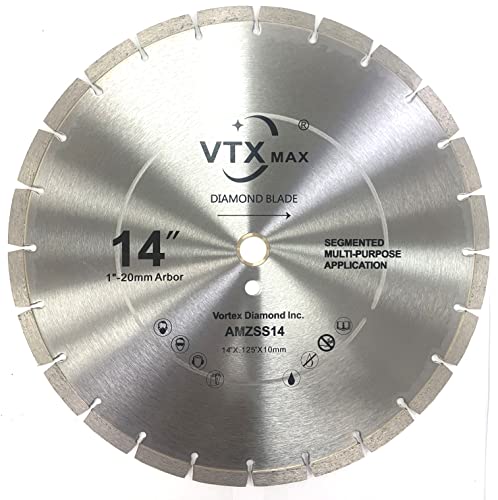
9. VTXMax 14 inch Dry or Wet Cutting General Purpose Segmented High Speed Diamond Saw Blades, 5 Pack

Five general-purpose segmented blades for anyone facing a mountain of concrete work.
Five blades in one box cover light to medium duty cutting. It is built to the same general-purpose specification as its single-blade cousin — 14″x.125″x.395″/10mm, 1″ arbor, 20mm heavy duty bushing, sintered diffusion bonded, and usable either wet or dry.
The bulk works because these blades are dependable rather than flashy. They cut concrete slabs, retainer wall block corners, slate ledge, and floor drains, and they stand up to the kind of long job where you would otherwise be swapping in a fresh blade every few days. The 5-pack is the point: on a big job the per-cut cost drops and you never stop working to reorder.
The honest catch is blade life. These are cutters, not marathon blades — they slow down and wear out faster than the premium single blades above, so the trade is quantity over endurance. Buy them for a job with a known end, not for a blade you expect to keep for years.
Why buy the five-pack
- Five general-purpose blades keep you cutting through a big job
- Wet or dry use with a 20mm heavy duty bushing included
- Sintered diffusion bonded rim holds together through block and slab
- Very budget-friendly way to stock up for a project
Where it falls short
- Shorter blade life than premium single blades
- Intended for light to medium duty cutting, not relentless heavy use
Best for: contractors and DIYers with a defined, high-volume concrete or block job who want blades on hand.
Not the pick if: you need maximum blade endurance and would rather own one premium blade than five general-purpose ones.
Understanding the Specs
Arbor Size and Adapter Rings
The arbor is the center hole that mounts the blade onto your saw’s spindle. A 1 inch arbor is the standard for 14 inch saws, and most blades here ship with a reducer ring so they also fit smaller spindles. Match the arbor to your saw before ordering — a blade that will not mount is a blade that will not cut. Keep the reducer ring with the blade so it is there when you switch tools.
Segment Height in Millimeters
Segment height is how deep the diamond grit sits on the rim, measured in millimeters. A taller segment like 15mm carries more diamond material, which keeps the blade cutting longer before it needs replacing. A 10mm segment is common on general-purpose blades, while thinner or shallower rims wear through sooner under heavy use. If long runs of cutting are your norm, favor the taller segment.
FAQ
Will a 14 inch blade fit my chop saw or masonry saw?
What is the difference between a diamond blade and an abrasive cut-off wheel?
Can I cut concrete dry with these blades?
How long should a 14 inch diamond blade last?
Will a 14 inch blade cut through concrete with rebar?
Do I need a different blade for cutting steel than for masonry?
What does segment height mean on a diamond blade?
Is it better to buy a multi-pack of blades or a single premium blade?
Do these blades reduce dust when I cut concrete or brick?
Final Thoughts: The Verdict
For most buyers, the 14 inch metal masonry blade winner is the Trabo 14 Inch 3 Pack because you get three fast-cutting segmented-rim diamond blades instead of one, and the included reducer ring lets you move them between tools. If you want a single blade that cuts smooth and runs wet or dry across brick, block, and pavers, grab the VSS 14 inch. And for a job where you are chewing through steel, rebar, or reinforced concrete and need one blade to handle all of it, the SHDIATOOL 14 Inch is the one to reach for.
How We Picked
We do not accept paid placement. Every pick is matched to a real buyer and a real use-case; we do not hands-on test units.
Sources & Methodology
Specifications: manufacturer listings and product documentation. Review insights: verified customer reviews, as of September 2026. Pricing: not shown on this page (it changes often); check the current price via the retailer link.
As an Amazon Associate, Gadgets Feed earns from qualifying purchases. This does not affect which products we feature.