
Our readers keep the lights on and my morning glass full of iced black tea. As an Amazon Associate, I earn from qualifying purchases.
Specs are compiled from manufacturer listings and verified buyer reviews and can change over time — please confirm the key details on the product page before buying.
A spinning reel earns its keep in two moments: the cast that lands where the fish are, and the drag that gives line back without locking up. Everything else — the paint, the box, the badge — is decoration. This guide sorts nine spinning reels by what they actually do on the water, from a 5.5oz ultralight that disappears on a panfish rod to a saltwater workhorse built to be rinsed and used again next weekend.
I’m Min — the founder and writer behind Gadgets Feed. This guide is built by comparing the manufacturers’ published specifications and the patterns across verified customer reviews, so you get each pick’s real strengths and trade-offs instead of marketing spin.
Line capacity, drag ceiling, bearing count, gear ratio and body material decide whether a reel fits your rod and your quarry — so every pick below is judged on those numbers, not on hype. This breakdown of the casting spinning reel market keeps each reel inside the job it was actually built to do.
Our Picks at a Glance


How To Choose The Best Casting Spinning Reel
The reel is the part of your setup that touches the fish, so the specs that matter are the ones that decide whether line leaves the spool cleanly on the cast and comes back under control on the fight. Read the four numbers below before you buy anything.
Match the drag rating to your line and your target
Maximum drag is the most pounds of pull the reel can put on a fish before line starts slipping. A reel rated at 12 pounds pairs naturally with light monofilament and panfish-to-bass work. Step up to a 20 or 33 pound drag ceiling when you are chasing fish that run into current or structure. A drag ceiling far above your line’s breaking strength does nothing for you, because the line fails first.
Check line retrieve before you fall for a big gear ratio
Gear ratio is only half the story. Line retrieve in inches tells you how much line comes back with one full turn of the handle, which is what you actually feel when you burn a lure or catch up to a fish charging the boat. A 53.3 inch retrieve per crank covers water fast. A 5.97 inch figure sits at the other end, suited to slow, deliberate presentations.
Line capacity decides the size class you are shopping in
Line capacity is written as pound-test over yards, and it separates a 1000-size ultralight from a 6000-size surf reel. Ultra-light rods want a shallow, light spool so light lures cast without effort. Surf and boat rods want deep capacity, because a running fish can strip a shallow spool in one long sprint.
Bearings and body material set the long-term feel
More bearings generally means smoother rotation under load, and sealed bearings resist salt and sand working into the race. Body material is a durability choice: graphite keeps weight down and resists corrosion, while machined aluminum adds rigidity and takes a knock without flexing.
Quick Comparison
| Model | Best For | Max Drag | Bearings | Body / Weight | Amazon |
|---|---|---|---|---|---|
| Daiwa Spinning Reels BG★ Best Overall | Big saltwater fish and long casts | 9.98 kg | 7 | Machined aluminum | Amazon |
| SHIMANO Stradic FL Spinning Fishing ReelTop Performer | Frequent anglers who want one reel for years | 20 pounds | Stainless steel SA-RB | HAGANE metal body / 12.3 ounces | Amazon |
| Piscifun NautiX Spinning ReelStrongest Drag | Sealed saltwater fishing on a working budget | 33 pounds | 9 | Aluminum body / 10.8 ounces | Amazon |
| Pflueger President XT Spinning Fishing Reel | All-day casting without arm fatigue | 10 pounds | 10 | 9.12 ounces | Amazon |
| Okuma Avenger ABF B Series Graphite Baitfeeder Saltwater Spinning Reel | Live-bait and surf fishing from a rod holder | 8 pounds | 7 | Graphite / 16 ounces | Amazon |
| Pflueger President Spinning Fishing Reel | Trout, panfish and first serious setups | 12 pounds | 10 | Graphite body | Amazon |
| Piscifun Carbon X II Ultralight Spinning Reel, Light to 5.5oz | Ultralight rods and long days of casting | 22 pounds | 10+1 | Carbon fiber / 5.5 ounces | Amazon |
| Penn Wrath II Spinning Fishing Reel | Beach and surf casting on a budget | 15 pounds | 3 | Graphite body | Amazon |
| Daiwa BG Spinning Reel | Surf and deep-sea jigging | 9.98 kg | Aluminum | Machined aluminum / 1.8 pounds | Amazon |
In‑Depth Reviews
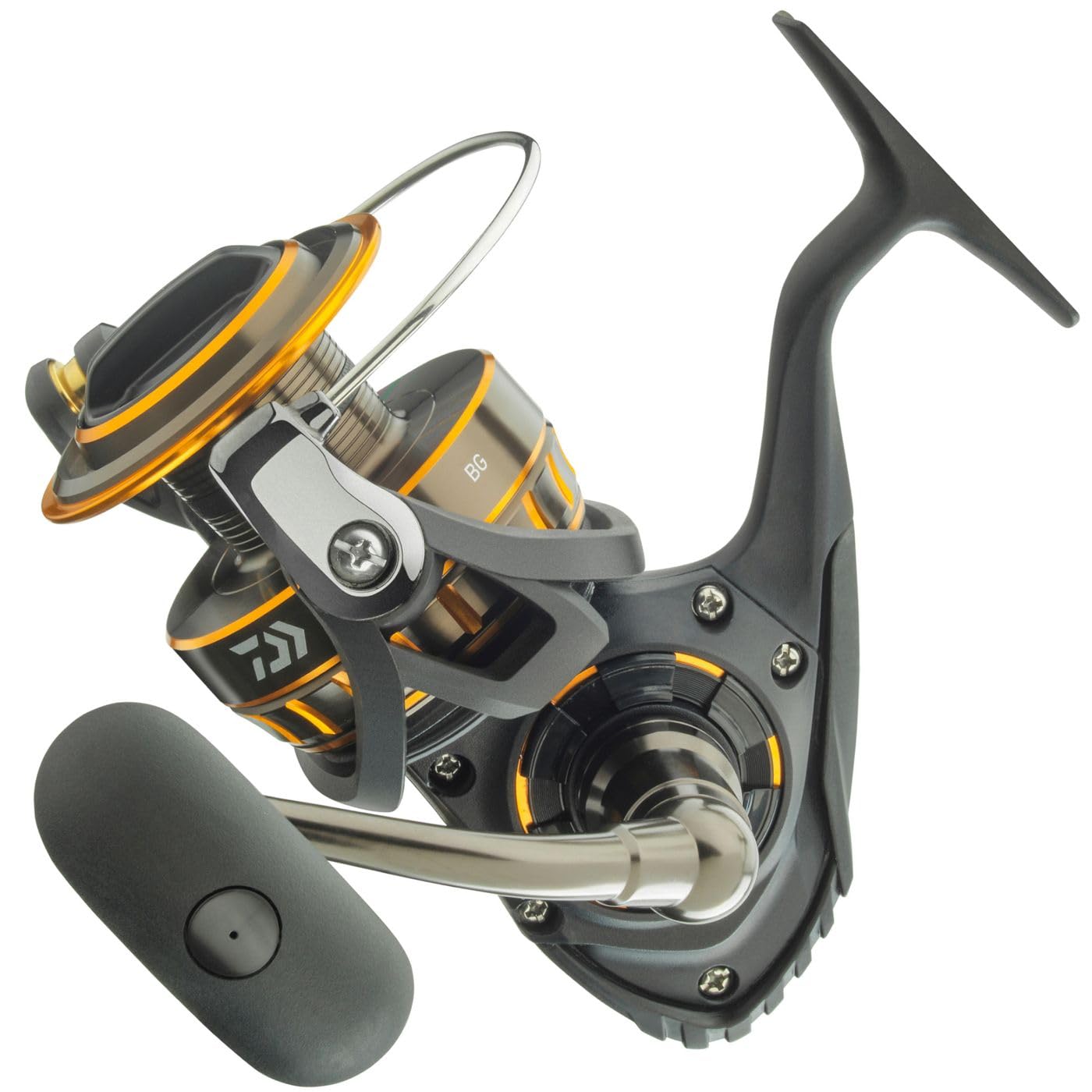
1. Daiwa Spinning Reels BG
Our pick — over 4.5★ from 950+ verified ratings; the strongest balance of quality and price.
The black-and-gold saltwater anchor that has outlasted some anglers’ boats
Start with the number that actually changes your fishing day: 53.3 inches of line retrieve per turn of the crank. That is the fastest of any reel here, and against the Penn Wrath II’s 5.97 inches it is almost nine times the line coming back every revolution. In practice you are covering open water fast, catching up to a fish that bolts toward the beach, and working a jig through a rip without feeling like you are grinding through wet cement.
The spool backs that speed with serious capacity. Daiwa rates the mono side at 25/440 and 30/370, with J-Braid at 65/590 and 80/440 — enough 65lb braid that a long-running fish has a hard time finding the bottom of the spool. That braid figure dwarfs the Penn Wrath II’s 360/15, so if you are spooling heavy braid for surf or boat work, this is the reel that holds it.
Seven bearings sit inside a black anodized, machined aluminum housing — a rigid metal shell that shrugs off knocks and stays stiff under a hard pull. The Digigear system is oversized for its class, which is what keeps the gearing smooth after a season of big fish. The honest trade-off shows up in the aspect feedback: weight is the one point buyers split on, and the aluminum body is the reason. If you cast for hours from a jetty, the extra heft makes itself known.
What Actually Wins Anglers Over
- 53.3 inches of line retrieve per crank — the quickest here, nearly nine times the Penn Wrath II’s 5.97 inches
- Machined aluminum body and side cover with an oversized Digigear for a stiff, planted feel
- Deep 65/590 braid capacity, well beyond the Penn Wrath II’s 360/15
- Seven bearings in the frame, with owners reporting years of service on routine care alone
Where It Asks For Patience
- The aluminum body carries real heft — the split point in the owner feedback
- Not the reel to pick if you cast all afternoon and want the lightest thing on the rod
Buy It If: you fish inshore or from a boat where you want one reel to cover casting speed and big-fish capacity at the same time.
Pass If: a full day of repeated casts on a light rod is your routine, in which case the Piscifun Carbon X II’s carbon body will serve you better.
2. SHIMANO Stradic FL Spinning Fishing Reel
The premium metal frame that turns a hard pull straight into cranking power
The Stradic’s HAGANE body is a metal shell built to resist flexing when you are fighting a fish, which is why the reel feels planted rather than springy under load. That stiffness is the reason your input at the handle goes into moving the fish instead of bending the reel. X-Ship supports the pinion gear on both ends with bearings, which keeps the gear teeth aligned when you are pulling hard and lets the spool spin freely enough that lighter lures cast with less friction.
The 20 pound drag ceiling sits above the Pflueger President’s 12 pounds, and the CrossCarbonDrag washer is built to hold a wider range of settings without grabbing. SA-RB bearings have shields on both sides — the shields are what keep salt and sand out of the bearing races, which is the difference between a reel you rinse and forget and one you take apart in the fall.
Where this reel splits opinion is value: the aspects feedback lists value as its one mixed point. Buyers who appreciate the build call it money well spent; others find it steep. That is a real signal about who this is for. It is also a heavier feel in hand than the ultralight picks, at 12.3 ounces. If you fish often and want a reel that stays smooth for years, the math works. If you cast a few weekends a season, the mid-range options here do the job for a lot less.
The Engineering Read: A metal-body reel built around gear alignment and drag smoothness rather than headline speeds — the kind of spec sheet that pays off over seasons of use, not the first afternoon casting off a pier.
What To Know Before Buying: The G-FreeBody shifts the reel’s center of gravity closer to the rod, which cuts fatigue on long sessions. Owners describe it as an accurate caster — bait goes where you aim it — and the saltwater crowd reports no drama from repeated soakings.
Choose This One For: frequent anglers chasing smoothness and drag control, where the premium build earns its place over the season.
Think Twice If: you want maximum drag per dollar, since the Piscifun NautiX offers a 33 pound ceiling for similar footing.
3. Piscifun NautiX Spinning Reel, Aluminum Body, 33lb Max Drag
A sealed saltwater body with a drag ceiling that outguns reels at twice the ask
The headline here is 33 pounds of maximum drag for the 5000 and 6000 sizes, delivered through a triple disc carbon washer system. The 3000 and 4000 models run up to 26 pounds if you want the same body in a smaller size.
Weight is the surprise. A full aluminum main body and carbon rotor come in at 10.8 ounces, which owners say feels light for a comparable Penn of the same size. The aluminum shell adds rigidity, while the carbon rotor trims the grams. Nine bearings support a CNC-machined aluminum drive gear, and the spool’s spherical structure is designed to keep the carbon drag washer flat so the line comes off and winds on evenly.
The IPX5 rating is the detail that separates this reel from its price class. The aluminum dust cover and four rubber rings minimize water intrusion, and owners who dunked theirs and hosed them down report no water inside afterwards. The honest catch is access: the housing design means getting to the gear chamber requires removing the rotor, so this is not a reel for quick field repairs. One buyer did report a stripped housing screw from the start — though a batch of buyers reported Piscifun replaced faulty units quickly, and the replacement units arrived smooth and creak-free.
Verdict: if you fish salt water hard and want sealed protection plus a 33 pound drag ceiling without paying flagship money, this is the value play in the premium tier.
The Caveat: gear access requires pulling the rotor, so routine maintenance takes longer than on a simple exposed-gear reel.
4. Pflueger President XT Spinning Fishing Reel

Ten bearings and a featherweight frame for anglers who cast until their arm complains
Count the bearings on this one: a 10-bearing system, with the smaller 20 size running a 7-ball setup. That is the most bearings of any reel in this lineup, and more bearings working inside the frame is what keeps rotation silky through a long session. A stainless steel handle and a braid-ready spool round out a reel that weighs 9.12 ounces — noticeably lighter than the 12.3 ounce Stradic, which is what turns a full day of casting from a chore into a routine.
The premium internals are real: an aluminum main shaft and an aluminum pinion gear that resist the wear that shows up in cheaper reels over time. The 10 pound drag ceiling is the most modest number in this lineup, so this is not the reel you grab for a fish that runs into rocks. It is the reel you grab when the fish are around structure and you are making a lot of accurate casts.
Two specs in the aspect data deserve honesty. Smoothness and durability both come out as split points in the feedback — a chunk of owners find it very smooth and long-lived, a smaller group reports it is not as smooth as they hoped and one had durability issues. The anti-reverse also shows a negative flag, meaning a minority found it less crisp than expected. On balance the quality and value scores are the strongest signals here, and owners who pair it with a high-end rod report it performs well above its tier. The build is the pitch; the drag ceiling is the limit.
The Light-Hand Advantage: Pair a sub-10-ounce reel with a good rod and you get the fatigue-free casting that serious anglers pay for. The aluminum shaft and pinion are the parts that wear out in cheap reels, and they are the parts upgraded here.
The Honest Limit: A 10 pound drag ceiling is not built for hard-pulling saltwater fish. This is a freshwater reel with premium spec where it counts for casting comfort.
Pick It For: long casting sessions where arm fatigue is the enemy and the fish are cooperative — trout, panfish, light bass.
Skip It For: anything that runs hard into structure, where you want the drag ceiling of the NautiX or the BG instead.
5. Okuma Avenger ABF B Series Graphite Baitfeeder Saltwater Spinning Reel

The live-bait reel that lets a fish run without ever letting go of the rod
Baitfeeder is the whole point here. Flick the On/Off lever at the rear of the reel and the spool disengages, so a fish can take your bait and run with almost no resistance while you watch. Flip the lever back and the main drag takes over the fight instantly. A quick-set anti-reverse bearing eliminates handle back play, so the moment you crank, the reel engages in one direction for a solid hook-set. Seven bearings sit inside, mixing six ball bearings with one roller bearing.
The Cyclonic Flow Rotor is a corrosion idea worth knowing about. Its ported design increases airflow through the rotor so the reel dries faster after a rinse, and drier metal corrodes less. A computer-balanced weight in the rotor keeps the crank smooth and the alignment true. The maximum drag is 8 pounds — the lowest ceiling in this lineup and the clearest indicator of what this reel is built to do, which is soak bait for surf fish, carp, and redfish rather than win a tug of war.
Owners get a useful lesson out of this one. The graphite body keeps weight down and fights corrosion, and buyers who maintain the handle elbow, line roller bearing, and secondary baitfeeder drag report years of smooth service. One reviewer noted the salt water kills the line roller bearing over time and named a replacement bearing that fits. The same angler flagged that Okuma rates these reels for freshwater light to medium duty even though listings call them saltwater, so a post-trip rinse matters here more than on the machined aluminum bodies.
Why Bait-Fishers Keep Buying It
- The baitfeeder lever lets a fish run free, then hands over to the main drag instantly
- Quick-set anti-reverse kills handle play for a confident hook-set
- Cyclonic Flow Rotor ports push airflow through the rotor for quicker drying and less corrosion
- Balanced rotor keeps the crank smooth with a graphite body that resists rust
The Care It Wants
- 8 pound drag ceiling is the lowest here — not a heavy-fish reel
- Needs a freshwater rinse and attention to three spots after saltwater use
Best Suited To: surf, carp, and live-bait anglers who fish from a rod holder or cast and wait, where the baitfeeder transforms the experience.
Not The One For: boat or jetty work where you need heavy drag and are fighting big, fast fish on the drag system alone.
6. Pflueger President Spinning Fishing Reel

A decade-old standby freshwater anglers still reach for first
Ten bearings and a 12 pound sealed oil felt front drag define this size 35 reel. Line retrieve is the modest part: 28.1 inches per crank against the Daiwa BG’s 53.3 inches. In plain terms, this is the reel that winds a lure in at a comfortable working pace rather than a sprint — the right trade for trout and finesse work where a slow, steady retrieve puts the bait where the fish are.
The features that keep this reel in the conversation are the anti-twist details. Slow oscillation gearing and a Total Line Control system are designed to cut down twists and wind knots, which is the failure mode that ruins a fisher’s afternoon on braid. The line capacity — mono from 230/6 down to 155/10, braid from 250/8 to 160/14 — covers a wide spread of trout and bass lines, and the aluminum braid-ready spool means you can fish mono, fluorocarbon, or braid without a spool swap.
Feedback is overwhelmingly about smoothness and value, with a handful of owners noting line stability and durability as points to watch. The graphite body and rotor keep weight and corrosion off the table; the sealed oil felt drag is the component you want shielded from grit if you fish a weedy lake. For a first serious reel or a dependable mid-tier backup, this covers a lot of ground for the outlay.
The Long-Run Case: Ten bearings and a sealed front drag keep the feel smooth season to season, and the braid-ready spool means you are not locked into one line type. Owners describe the casting and retrieval as smooth and the value as the stand-out.
The One Honest Note: The 28.1 inch retrieve is slow compared to the fast reels above, so pick a quicker model if you need to cover water on every cast.
Great Choice If: you want a dependable, smooth freshwater reel for trout, panfish, and light bass with a spread of line options.
Look Higher If: you need top-end retrieve speed or heavy drag — the faster Daiwa BG and the higher-drag NautiX sit in the tiers above.
7. Piscifun Carbon X II Ultralight Spinning Reel, Light to 5.5oz

A 5.5 ounce size-1000 that turns an ultralight rod into a wand
At 5.5 ounces for the size 1000, this is the lightest reel in the lineup by a wide margin — the kind of weight you just about forget about on a rod. The carbon fiber body, rotor, and side plate are the reason for it. And the power does not disappear with the weight: a reinforced stainless steel main shaft and a carbon fiber resistance system deliver 22 pounds of drag, which is well above the Penn Wrath II’s 15 pounds and the Pflueger President’s 12 pounds. For a reel this small, that is a lot of drag.
Speed and smoothness come from two places. The gear cutting is the latest generation, and a CNC-machined direct-drive screw-in aluminum handle with an EVA grip keeps the connection solid and the feel comfortable in hand. The bearing count is 10+1 double-sealed stainless steel, the highest bearing total here, and that is why owners describe the operation as smooth. Two gear ratios are available — a 6.2:1 high-speed and a 5.2:1 moderate — so you can pick fast retrieve or finesse, depending on your style.
Here is the honest trade-off. The bail mechanism takes the one negative flag in the aspect data: owners describe it closing hard and hesitating at the top of its cycle. The same mechanism is the source of a few reported instances of wind-up grinding, and one buyer notes the winding is not as smooth as a budget Shimano Sienna from the start. The good news is that owner summary also reports the problem is often solved by a replacement unit — the unit that arrives butter smooth. The strong factors in the ratings are quality and weight, and the ultralight crowd clearly loves the low-ounce feel on a panfish rod.
The Featherweight Argument: 10+1 double-sealed bearings and a carbon fiber body give you a reel that disappears on a light rod, with 22 pounds of drag that checks in above much of the field.
The Bail Riddle: The one component that takes criticism is the bail — a hard close and a hitch at the top of the cycle are the notes. If your priority is a silky bail from the start, that is the spec to weigh against the low weight.
Reach For This If: you fish ultralight gear for panfish and light freshwater fish and want minimum weight with above-class drag.
Look Elsewhere If: a flawlessly closing bail fresh from the start is a hard requirement for you.
8. Daiwa BG Spinning Reel
A machined-aluminum sea anchor built for surf and deep jigging
This is the Daiwa BG in a larger frame, and it wears a different set of numbers than the model at the top of the list. Mono capacity runs 25/310 down to 30/260, with J-Braid at 65/440 and 80/330. The 65lb braid figure sits well below the other BG’s 65/590, which simply reflects a different size in the same family — less line, more manoeuvrable for the angler who wants deep-braid capacity without the biggest spool in the range.
The performance story is the one owners repeat: a machined aluminum body with the Digigear system handles hard work and keeps its smoothness. Buyers report five-year-old surf reels that clean up like new and deep jigging sessions that landed tuna after tuna on 80 pound braid. That same heavy-duty construction splits owners on weight — some call it light, others heavy. It is not a wispy reel, but the aluminum frame is the reason it takes a beating.
Two practical notes come from long-term owners. The matte finish scratches easily, so a rinse and a quick dry after a salt session keeps the cosmetics in better shape. And the 33 pound drag on the larger sizes is generous for a mid-premium reel — owners who turned it down for inshore reds and black drum had drag in reserve for bigger fights.
What Earns The Reputation
- Machined aluminum body and Digigear stand up to years of saltwater work
- 65/440 and 80/330 braid capacity covers big fish with plenty of line in reserve
- Owners mention deep jigging sessions landing tuna on 80 pound braid without drama
- 33 pound drag on the larger sizes is plenty for inshore reds and drum
What Long-Term Owners Flag
- Matte finish scuffs and abrades with hard use in sand and rocks
- Heftier than light-frame reels — the split point in owner feedback
- Manual bail flip takes a little getting used to
Worth It For: surf, boat, and deep jigging anglers who want a hard-wearing reel with big line capacity and honest drag.
Consider Lighter If: you cast all day and want to shave ounces — the ultralight picks at the top of the list trade heft for speed of arm.
9. Penn Wrath II Spinning Fishing Reel

A corrosion-resistant graphite body that puts Penn quality on the sand
The 6.2:1 gear ratio recovers 37 inches per turn of the crank, which is a quick retrieve for a budget reel and the spec that keeps up with a running fish on the beach. Line retrieve sits at 5.97 inches on the official spec, the slowest in this lineup, so the honest read is that the gear-speed and the per-crank figure tell different sides of the same number. In practice you are getting a fast-moving reel that keeps line on the spool through a cast.
Capacity is the modest spot. Mono runs 270/8 down to 165/12 and braid 360/15 down to 185/30 — smaller figures than the Daiwa BG’s 65/590, which is the trade for the lighter graphite body and the lower drag ceiling. The 15 pound felt front drag is favored for rapid start-ups, and customers note it adjusting easily for surf work and inshore fishing. A 2+1 stainless steel bearing system, with two shielded ball bearings and one instant anti-reverse bearing, keeps operation smooth and predictable.
The real success story here is the body. A lightweight graphite frame with a machined anodized aluminum spool and line capacity rings resists corrosion, and buyers who rinse after saltwater trips report it taking salt and sand without trouble. The one mixed signal in the feedback is weight — some find it light, some find it heavier than expected — and the 6.2:1 gear ratio works best matched to a medium or medium-heavy rod. Buyers who paired it with a 7ft medium or 12ft surf rod report it as a natural fit.
What Budget Anglers Get
- 6.2:1 gear ratio recovering 37 inches per crank keeps pace on the cast and the retrieve
- Corrosion-resistant graphite body with a machined anodized aluminum spool and capacity rings
- 2+1 stainless steel bearings and a 15 pound felt front drag for rapid start-ups
- Casts smoothly and pairs well with medium-weight rods for surf work
Where It Steps Back
- 360/15 braid capacity sits below the deep-spool Daiwa BG across the aisle
- Weight feedback is split — some buyers find the feel heavier than the category average
Best Value Pick: surf and inshore anglers shopping on a tight budget who want a corrosion-resistant graphite body and an easy-cranking gear ratio.
If You Want More Line: step up to the Daiwa BG if deep braid capacity and heavier drag are on your list.
Understanding the Specs
Maximum Drag
Maximum drag is the highest pull, in pounds or kilograms, the reel can put on a fish before the drag starts to slip by design. A 12 pound ceiling suits light monofilament and trout or panfish gear. A 20 pound ceiling handles schooling fish and medium saltwater. A 33 pound ceiling is built for fish that run into current or structure. Match the drag ceiling to your line’s breaking strength, because the line gives out first if the drag is set far higher than the line can take.
Line Retrieve
Line retrieve is how much line comes back with one full turn of the handle, measured in inches. It is the number you actually feel while fishing, and it is not the same as gear ratio. A 53.3 inch retrieve per crank covers open water fast and lets you catch up to a running fish, while a 5.97 inch retrieve is for slow, deliberate presentations. Always read the retrieve figure when you are comparing reels across different sizes and gear ratios.
Bearings
Bearings are the small rotating interfaces that let the spool, rotor, and handle spin freely. More bearings generally means smoother operation under load, and sealed bearings have shields on both sides so salt and sand cannot work into the race. A reel with 10 or more bearings usually feels smoother from the start on a freshwater setup, while saltwater anglers care more about the sealed side than the total count.
Line Capacity
Line capacity is written as pound-test over yards, so a 65/440 spool holds 440 yards of 65 pound braid. The capacity tells you which size class the reel is built for. A shallow spool suits light lures and ultralight rods, while a deep spool holds the line a running fish needs to take without stripping you to the backing. Capacity is the number that tells you whether a reel belongs on your rod.
FAQ
Will a saltwater-rated spinning reel survive the same abuse as a freshwater one?
What does gear ratio actually mean and how do I pick between 5.2:1 and 6.2:1?
How much drag do I need for saltwater fish?
What is a baitfeeder reel and do I need one?
Do more bearings make a reel better?
Can I swap between monofilament, fluorocarbon, and braid on the same reel?
How often should I service a spinning reel?
Is a 1000-size reel too small for bass or saltwater?
What is the difference between a spinning reel and a casting reel?
Final Thoughts: The Verdict
For most anglers, the casting spinning reel winner is the Daiwa Spinning Reels BG because it brings the fastest line retrieve in this lineup, 53.3 inches per crank, alongside a machined aluminum body and 65/590 braid capacity that together cover everything from fast lure work to big saltwater fish. It holds a 4.7 star score across nearly a thousand owners. If you want the sealed saltwater body with the highest drag ceiling here at 33 pounds, the Piscifun NautiX is the one. And if you fish live bait from a rod holder, the Okuma Avenger ABF B Series baitfeeder does the job that no straight spinning reel can replicate.
How We Picked
We do not accept paid placement. Every pick is matched to a real buyer and a real use-case; we do not hands-on test units.
Sources & Methodology
Specifications: manufacturer listings and product documentation. Review insights: verified customer reviews, as of September 2026. Pricing: not shown on this page (it changes often); check the current price via the retailer link.
As an Amazon Associate, Gadgets Feed earns from qualifying purchases. This does not affect which products we feature.