
Our readers keep the lights on and my morning glass full of iced black tea. As an Amazon Associate, I earn from qualifying purchases.
Specs are compiled from manufacturer listings and verified buyer reviews and can change over time — please confirm the key details on the product page before buying.
If you are tired of dragging a cord across the garage or fighting an extension reel just to vacuum your car mats, a battery operated shop vac is the fix. The trick is picking the right one, because these tools live or die by two things: which battery platform you already own and how long a single charge actually lasts while you work.
I’m Min — the founder and writer behind Gadgets Feed. This guide is built by comparing the manufacturers’ published specifications and the patterns across verified customer reviews, so you get each pick’s real strengths and trade-offs instead of marketing spin.
Some users run these vacuums on batteries they already own from other tools, while others want a self-contained kit with everything in the box. Capacity, airflow, and hose reach decide how fast a job actually goes, so we broke down nine real cordless shop vacs to help you find the best battery operated shop vac for your garage, car, or workshop.
Our Picks at a Glance


How To Choose The Best Battery Operated Shop Vac
Start with the battery you already own, not the vacuum. If you are running DeWALT 20V MAX, Milwaukee M18, Ryobi ONE+, Bosch 18V, EGO 56V, or Worx 20V tools, a bare-tool vac that shares that platform means zero extra spend on power. Everything else — capacity, airflow, and hose reach — is a tuning knob you set based on what you clean most.
Match the tank to the mess
Tank size in gallons decides how long you can go before stopping to empty. A smaller canister around 2.1 to 2.6 gallons is plenty for car interiors, tight garage corners, and around-the-house spills. A larger tank in the 6 to 9 gallon range suits long workshop sessions, flooded basements, and picking up a lot of dry debris in one pass. Larger tanks usually mean a heavier unit, so weigh that against how often you carry the vac up stairs or into a truck bed.
Look at airflow and water lift together
Airflow is measured in CFM (cubic feet per minute — how much air the motor moves). Water lift is measured in inches and tells you how hard the vacuum pulls. A car vac that lists 45 CFM and 43 inches of water lift and a shop vac that lists 110 CFM and 100 inches of lift are solving two different jobs: fine surface dust versus heavy debris and standing water. For drywall dust and sawdust, high airflow plus a tight filter wins. For wet spills and soaked carpet, higher lift wins. Check both numbers, not just one.
Filter choice decides what stays in the air
A HEPA filter traps fine particles, a foam filter handles wet pickup and general debris, and a cartridge filter sits between the two in cost and maintenance. A washable HEPA filter is the right call for drywall dust, sawdust, and allergens because it captures the small stuff instead of blowing it back into the room.
Quick Comparison
| Model | Best For | Capacity | Hose Length | Filter | Amazon |
|---|---|---|---|---|---|
| BOSCH GAS18V-3N 18V★ Best Overall | Serious job site and shop cleanup | 2.6 gallons | 5.25 feet | HEPA | Amazon |
| 20V Cordless Wet/Dry Shop Vac (DeWALT Compatible)Best Value | DeWALT owners and car detailing | 2.65 gallons | 6.56 feet | HEPA | Amazon |
| Seesii Cordless Wet Dry Shop VacTwo-Battery Pick | Two batteries, no downtime | 2.6 gallons | 5.25 feet | HEPA | Amazon |
| Milwaukee MILM18VC20 M18VC2-0 | M18 owners handling HVAC and liquids | 7.5 liters | 2 meters | Foam | Amazon |
| WORX WX031L | Rapid car-to-car detailing on one charge | 2.1 gallons | 6.5 feet | Cartridge | Amazon |
| MILWAUKEE’S Wet/Dry Vacuum 0970-20 | Tight quarters and light daily duty | 2.5 liters | — | Foam | Amazon |
| Milwaukee M18FPOVCL | Contractors moving between homes and jobs | 2.5 gallons | — | HEPA | Amazon |
| Ryobi 18-Volt ONE+ 6 Gal | Big sheds, warehouses, and long sessions | 6 gallons | 2.13 meters | Foam | Amazon |
| EGO Power+ WDV0900 | Whole-garage pickup and chimney work | 9 gallons | 1-7/8 inch | Cartridge | Amazon |
In‑Depth Reviews
1. BOSCH GAS18V-3N 18V Cordless Wet Dry Vacuum, Portable Shop Vac
Our pick — over 4.5★ from 700+ verified ratings; the strongest balance of quality and price.
The job site workhorse that keeps pulling when cheaper vacs choke out.
The BOSCH GAS18V-3N is the one to buy if you clean drywall dust, sawdust, or fine debris and you cannot afford the filter to clog mid-job. Its washable HEPA filter traps 99.97% of fine particles, so drywall dust and sawdust stay in the canister instead of the air. For anyone sanding drywall or running a router, that is the difference between a cleaned room and a dusty one.
Owners rave loudest about raw performance, and the reason is the rotational airflow technology the maker claims keeps suction steady by stopping debris from choking the filter. There is a real trade-off here though: unlike the ReliaRoads 20V above, which reaches further with its 6.56-foot hose, this one ships with a 5.25-foot flexible hose — a 25% shorter reach — so you will move the canister a little more on a long wall.
The Bosch is light enough to carry with one hand at 10.2 pounds and stores its hose and nozzles onboard, which is the whole point of a cordless shop vac. Battery life is the honest caveat — the maker rates it up to 24 minutes with a 6.0Ah battery sold separately, and long-time users report the 8Ah pack as the minimum for any real job. The recurring gripe from heavy users is that smaller batteries drain fast and the canister wants to scoot on smooth floors without casters.
What earns it the top spot
- Washable HEPA filter traps fine drywall and sawdust particles instead of blowing them back into the room
- Rotational airflow tech keeps suction steady instead of fading as the filter loads up
- Light 10.2-pound build with onboard storage for hose and nozzles
- Part of the multi-brand AMPShare System with a five-year limited warranty on tools and batteries
What to plan around
- Battery and charger sold separately — the 6.0Ah pack that delivers the full 24 minutes is an extra cost
- Short 5.25-foot hose means moving the canister more on wide jobs
- No casters — heavy users add their own to stop it scraping the floor
Buy this if: you already own Bosch 18V tools and want a pro-grade HEPA vac for job site dust and garage work.
Look past it if: you need the longest possible hose reach or want the battery included in the box.
2. 20V Cordless Vacuum Cleaner-Wet/Dry Shop Vac, 2.6 Gallon Capacity, Compatible with DeWALT Batteries (Bare Tool) RCSV-20
Snap in the DeWALT batteries you already own and roll into the garage.
If your tool wall is already stacked with DeWALT 20V MAX batteries, this bare-tool ReliaRoads vac turns that investment into a shop vac with no extra power spend. It runs up to 30 minutes of runtime on DeWALT batteries up to 5Ah (amp-hour — a measure of battery capacity), snaps onto the packs you own, and there is a battery life indicator right on top of the unit so you are not guessing mid-job. A mechanical on-off switch means no fiddly electronics to go wrong.
The numbers here are what make the case. The hose reaches 6.56 feet with a 1-1/4 inch diameter, so standard attachments fit and you can get into tight corners without moving the canister. Buyer consensus centers on performance above all else — this is what wins people over on the review pages.
Where it falls short of the Ryobi below is tank size: the Ryobi holds 6 gallons to this vac’s 2.65, so for long warehouse sessions this one empties more often. Owner notes flag that the small floor piece is not fully airtight in blower mode and there is no dedicated storage for all the tools — two accessories sit exposed. Neither is a dealbreaker for home and car use, but they are worth knowing.
The verdict: the smart pick for DeWALT owners who want serious wet/dry suction on batteries they already own.
One caveat to know: the 2.65-gallon tank is tuned for car and home jobs, not for sprawling shop spaces where you would be emptying constantly.
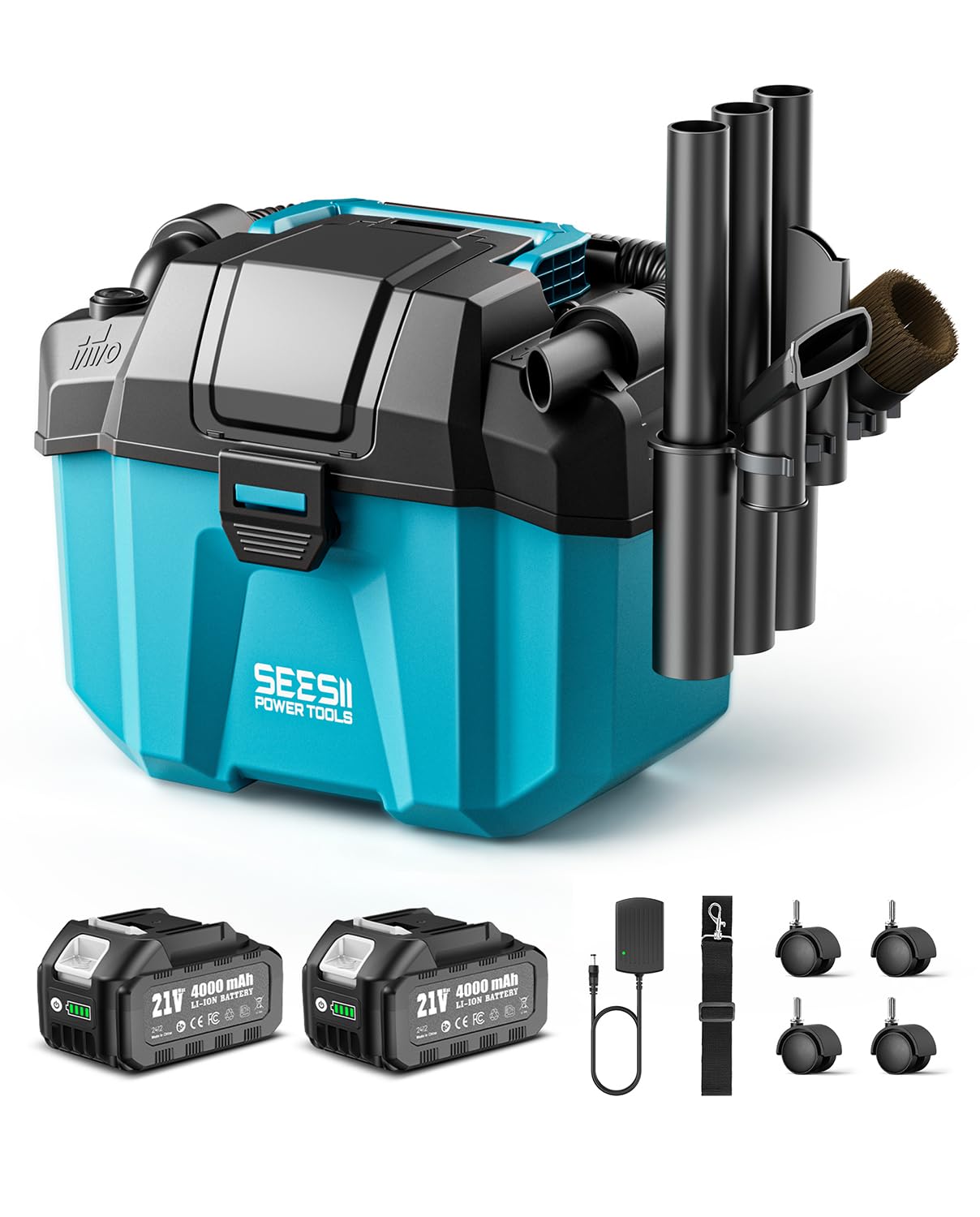
3. Seesii Cordless Wet Dry Shop Vac, 2 x 4.0Ah Rechargeable Batteries
Two batteries in the box means you swap instead of stopping.
Most cordless shop vacs make you feel the pause when the battery dies. The Seesii solves that by shipping with two 4.0Ah batteries — that rated 20 minutes on HIGH and 40 minutes on LOW, plus a 2–2.5 hour charge — so a spare is always ready and you never sit waiting on a charger. It is the pick for anyone doing a full garage clear-out or detailing multiple cars in one session.
The brushless motor runs cooler and lasts longer than brushed designs. It runs cooler and is rated to last longer than older brushed designs, and it gives you two suction modes: 9 kPa for routine spills and 15 kPa when pet hair and caked dirt need more bite. A washable HEPA filter captures fine debris and rinses clean under the tap, extending motor life. Owners consistently rate the sheer performance highest, and light weight is what wins people over on the review pages — at 8 pounds this is one-hand carry territory.
The 2.6-gallon tank and 5.25-foot hose put it in home and vehicle territory rather than job site territory. If you clean sand, leaves, or cat litter off a car carpet, it handles them on the high setting; if you are pulling up soaked carpet in a basement, you want the EGO’s larger tank instead. The hose is on the short side, and the onboard accessory holder is the recurring complaint from owners — one attachment falls off in use, so plan on a zip tie or a dedicated spot.
Why it wins attention
- Two 4.0Ah batteries and a fast 2–2.5 hour charge keep you working instead of waiting
- Dual suction modes: 9 kPa for daily spills, 15 kPa for pet hair and stubborn dirt
- Washable HEPA filter rinses clean under the tap to extend motor life
- 8 pound build with a shoulder strap and four wheels for stairs and tight spots
Honest limits
- 2.6-gallon tank and 5.25-foot hose suit home and vehicle work, not large shop jobs
- The onboard accessory holder is prone to falling off in use
- 20 minutes on HIGH may not cover a full deep-clean session without a battery swap
Reach for this if: you want on-the-go runtime without buying extra batteries and value the two-battery bundle above all.
Think twice if: your main cleanup is a flooded basement or a whole-warehouse floor — you will want a bigger tank.
4. Milwaukee MILM18VC20 M18VC2-0, Wet/Dry Vacuum, Multi-Colour, 7.5 liters
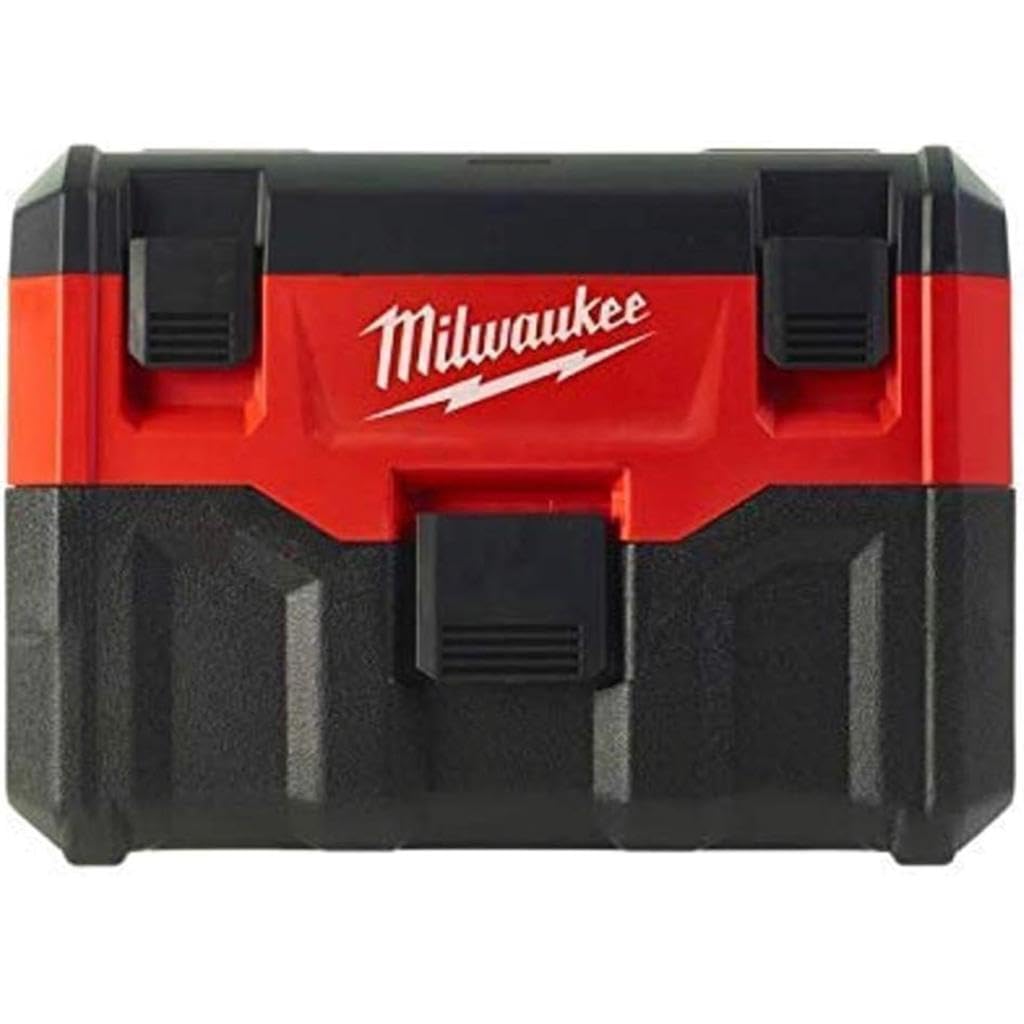
HVAC lines, wet messes, and everything your M18 battery already powers.
If you are deep in the Milwaukee M18 ecosystem, this is the vac that slots into it with zero fuss. Owners who run it specifically for keeping HVAC condensation lines clear call it powerful enough as both a vacuum and a blower, easy to convert, and easy to clean. That drain-line use is the balance — it handles a wet job most handhelds cannot touch, and it runs on the Lithium-Ion packs already in your truck.
The 7.5-litre tank is the biggest among the handheld-style picks here, well above the Seesii’s 2.6 gallons, so you empty it less often on wet pickup. A foam filter handles both wet and dry debris without the fuss of a pleated filter. The 2-metre hose gives you real reach, and the unit converts between vacuum and blower modes quickly, which is why it earns a spot for anyone flushing or clearing lines.
The trade-off is honest and stated plainly: runtime is limited, and owners who expect all-day power will be disappointed. This is a short-burst tool, not a marathon one. It is also a bare tool in most listings, so the M18 battery is assumed. If your jobs are quick and wet, this is the one; if they are long and dry, look at the M18FPOVCL below or a corded option.
The M18 ecosystem payoff: it runs on the packs you already own so you gain a cordless wet vac without buying a new platform.
Positioning note: seven litres of tank and a fast vacuum-to-blower switch make it a genuinely useful wet-cleanup tool, not just a handheld.
Best for: M18 owners who clean HVAC lines, water heaters, and small wet spills and value fast conversion over long runtime.
Not for: buyers who need hours of continuous suction on a single charge.
5. WORX Cordless Wet/Dry Vacuum, 20V 2.1 Gal, WX031L
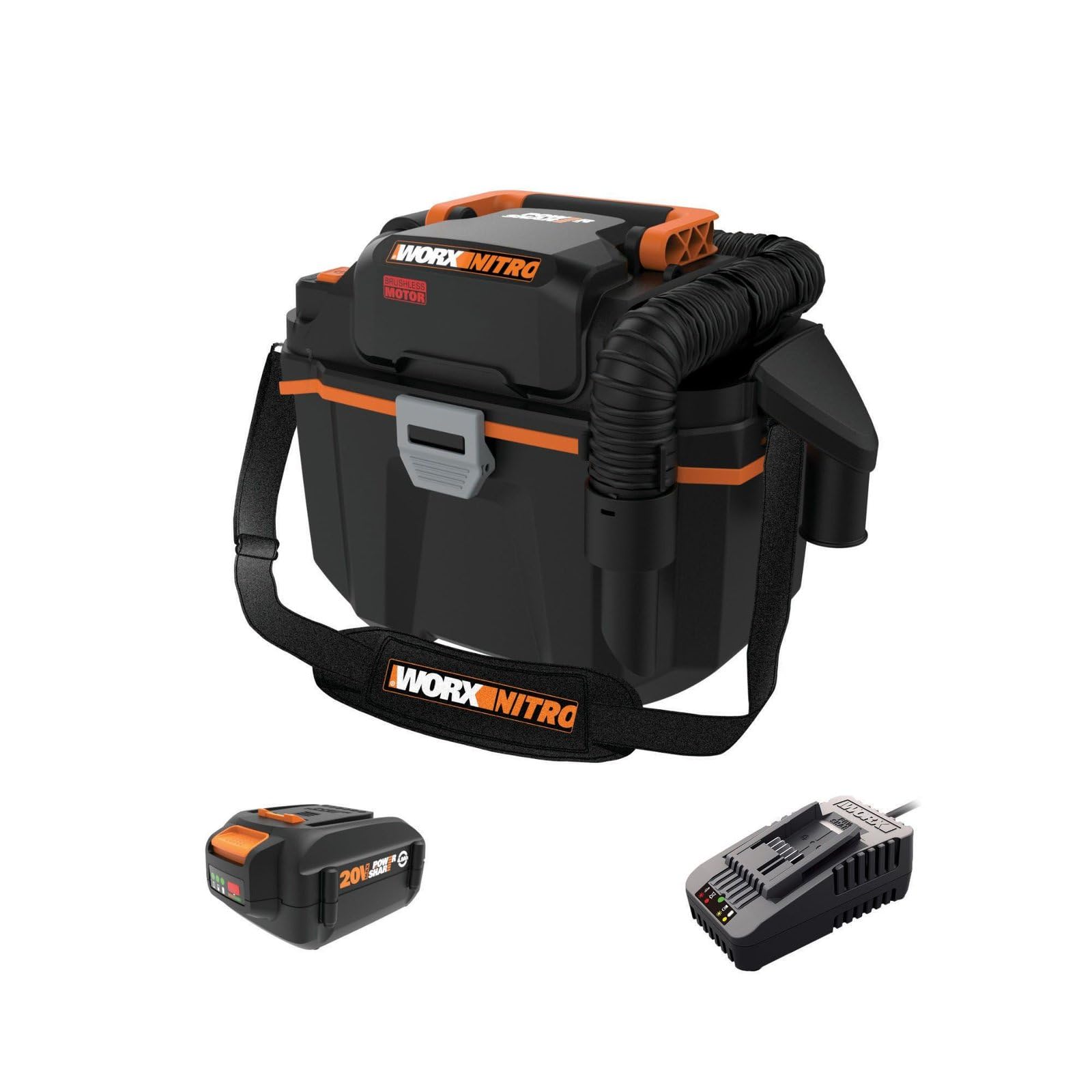
The detailing vacuum that matches plug-in suction without the cord.
Owners describe this Worx as powerful enough to pull dirt, pebbles, and clumps of grass out of a truck floor, and strong enough to go car to car on a single charge. That makes it a serious pick for anyone whose weekly ritual is vacuuming vehicles. It pushes 16 kPa of suction (kilopascals — a measure of pulling force) from a brushless motor, and because the included 4.0Ah Power Share PRO battery is the same pack that runs over 75 other Worx 20V, 40V, and 80V tools, the value is real if you already own Worx gear.
What wins people over most is the performance — this is not a toy by any measure. The 6.5-foot extendable stretch hose reaches into footwells and third rows, high and low speed settings let you dial back for lighter jobs to save charge, and the onboard crevice tool and wide nozzle stay put. It weighs 6.8 pounds with a shoulder strap, so moving around a car or workspace is easy.
The recurring honesty note: value is where opinions split. Some owners feel it was worth every cent for the cordless freedom; others say it sits at the pricier end of what they would pay for a dedicated car vac. Durability also shows up as a smaller point of doubt on the review pages, though the brushless motor is rated for longer service life than brushed designs. It balances on the line between a car tool and a general workshop vac — if you want one that does both, the DeWALT-compatible pick above gives you a longer hose at a lower-tier spend.
Pick it if: you are a Worx owner and want plug-in-level suction for detailing multiple vehicles on one charge.
Leave it if: you are buying it purely on price, or you need to fit a 1-1/4 inch attachment for tight car spots.
6. MILWAUKEE’S Wet/Dry Vacuum, 0970-20
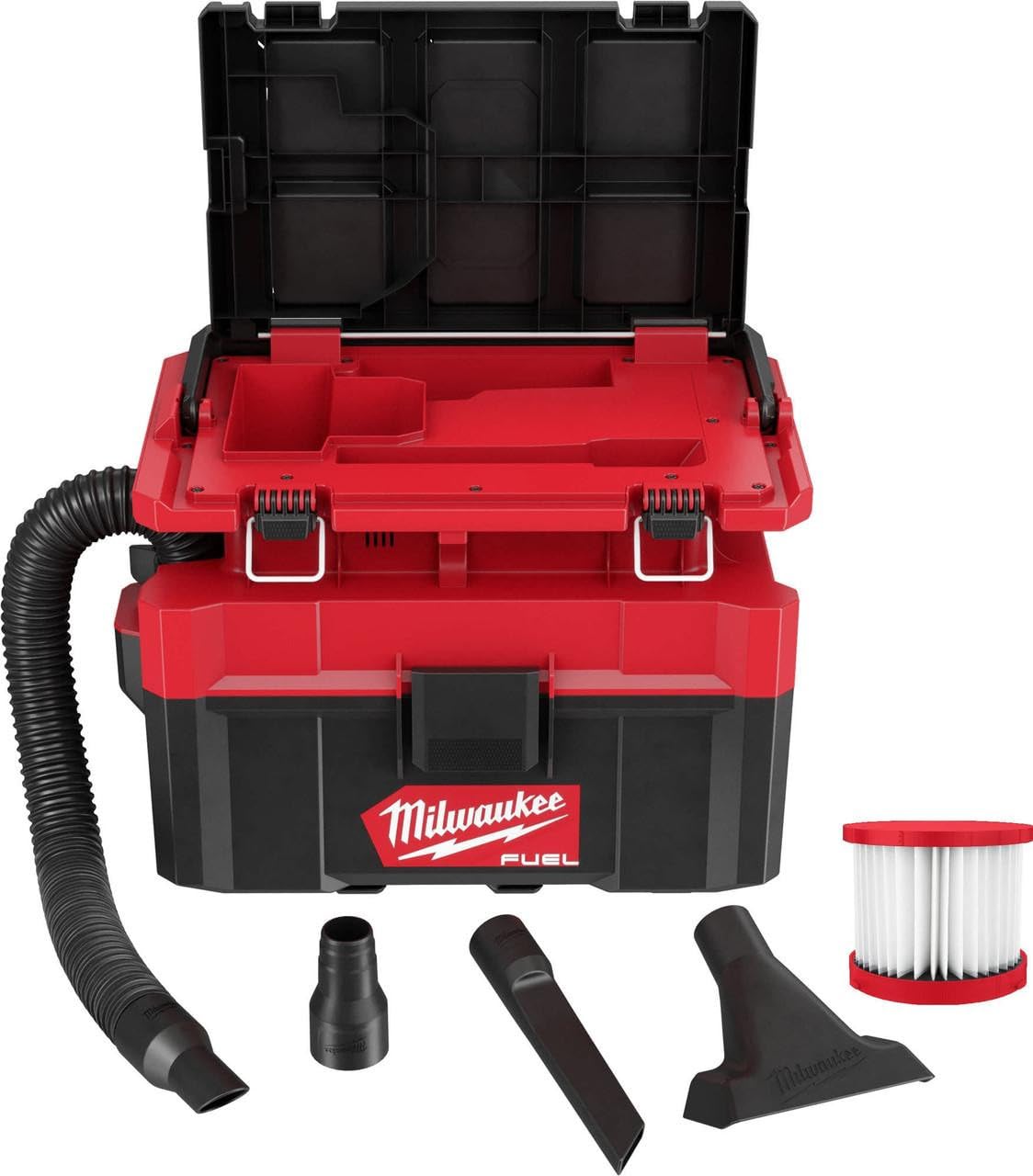
A compact M18 shop vac small enough to live on the shelf and ready to grab.
This is the smaller, handier Milwaukee for tight work and light daily duty — a tool that lives on a shelf and gets pulled down for quick cleanup around the house, garage, or car. The recurring praise from owners is quality: this feels like a Milwaukee tool, with two power levels that let you pick between a soft pass and full suction. It runs on M18 Lithium-Ion packs you already own, and the slot fits the big 12.0 battery, so runtime is on you to size.
The 2.5-litre tank is intentionally small, and that is the point — this is for light duty. It holds less than half the Seesii’s 2.6 gallons, so it is best for crumbs, dust, and small spills rather than long runs. One buyer who used it as a basement flood backup cleared water two gallons at a time, which tells you the tank size in real-life terms. Owners who move it between home and job site like that it is quiet and portable.
Two things to plan around. First, it needs a stack-on system or a steady surface — without one it tips easily on its own. Second, this is a bare platform tool in most listings, so make sure you have M18 batteries in hand. Use the largest mAh pack you have; low power is enough for most vacuuming and blowing and saves charge for when you need it.
Where it fits: light, quiet, and quick — the everyday M18 grab-and-go for spills and small jobs.
Watch-out to note: standing alone it is tippy, and the small tank means frequent emptying on bigger jobs.
Go with this: if you want a small, quiet M18 vac for quick household and car cleanup and already have Milwaukee batteries.
Choose differently if: you need a big tank for a flood or a lengthy workshop pass.
7. Milwaukee M18FPOVCL, Black, 800 W, 2.5 gallons
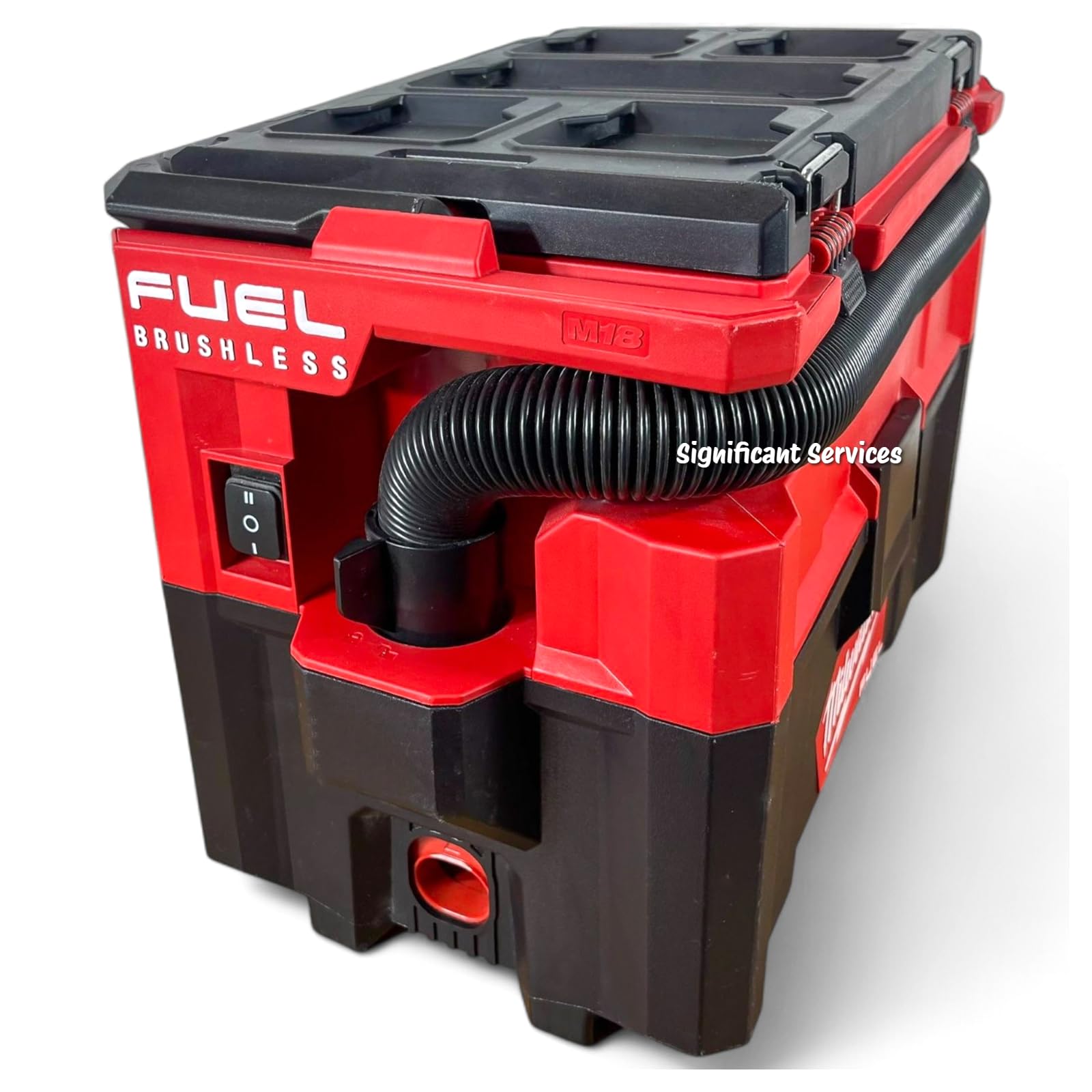
The one crews swap in when they want corded suction without the trip hazard.
Milwaukee rates this M18 vac at up to 70% more suction and up to 2X quieter than the pack, and an aerospace manufacturing floor reportedly swapped its corded shop vacs for these to remove extension-cord trip hazards. That is the use case: clean, quiet, cordless pickup on a finished job site or in a customer’s home. It pulls 50 CFM of airflow and 47 inches of water lift, with a HEPA filter (a high-efficiency filter that traps fine dust) and a bare-tool design that runs on the M18 packs you already trust.
The runtime is rated at 50 minutes per charge with a 30-minute charge time, which is unusual for this class — more than double the M18 VC2-0’s full-day rating on paper, and enough to knock out most home-service calls without a swap. It wins most on performance here, with the compact, lightweight build close behind. Owners who do site work say it is perfect for taking into people’s homes and invaluable for cleaning small work spaces quickly.
The honest limit: this is a small-job machine. A 20-square-foot spill is fine; a whole-carpet job is not. Attachment storage runs a little clunky, and if the mess is genuinely massive, a corded giant shop vac is the right tool. For contractors and DIYers moving between rooms, though, the balance is right.
Suits you if: you do finish work in homes and jobs and want contractor-grade suction and quiet in a cordless package.
Not the one if: your cleanup regularly runs into serious square footage or long continuous sessions.
8. Ryobi 18-Volt ONE+ 6 Gal. Cordless Wet/Dry Vacuum (Bare-Tool)
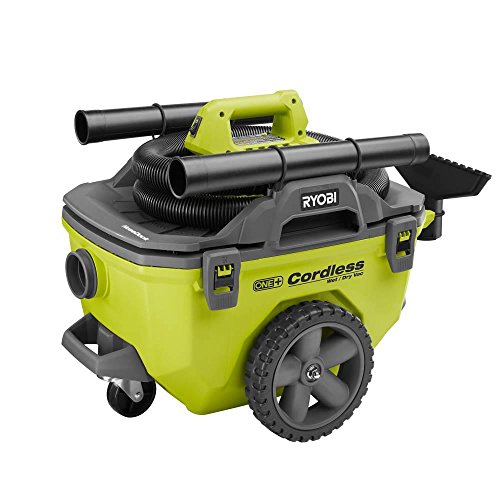
A big-tank ONE+ workhorse built for long sessions on the warehouse floor.
If you clean a large shop, warehouse, or garage bay, tank size and runtime matter more than portability — and this Ryobi delivers both. It packs a 6-gallon tank and 80 CFM of airflow, the maker says corded-level performance, and it runs on the ONE+ 18V battery you already have from your other Ryobi tools. Buyers report it picks up light debris from four to six inches away and maneuvers easily on its wheel design without tipping.
The weight is 16 pounds, which is deliberate — this is a roll-into-place vac, not a carry-around one. Maneuverability and effectiveness both show up as strengths in owner feedback. If you run it with a 9Ah battery you get roughly 45 minutes of runtime; a 4Ah pack drops you to 15–20 minutes, which is not enough for a full session. That means the right battery is not optional — it is the difference between usable and frustrating.
Two caveats owners flag: it ships without a battery or charger, so factor those in if you do not already own ONE+, and the hose is 1-3/4 inches, which means standard 1-1/4 inch car attachments do not fit without an adapter. It is also a set-up job — the screws are hidden in a bag taped to the paper, and they need a T10 Torx driver.
Where it delivers
- 6-gallon tank and 80 CFM airflow suit long, high-volume cleanup in shops and warehouses
- Rolls easily and does not tip; 16 pounds feels sturdy rather than clumsy on the wheel base
- Runs on existing Ryobi ONE+ 18V batteries
Set-up and fit notes
- Battery and charger not included — a 9Ah pack is needed for the full runtime
- 1-3/4 inch hose means standard 1-1/4 inch car attachments need an adapter
- Assembly uses hidden T10 Torx screws, so have the right driver on hand
Pick it up if: you already run Ryobi ONE+ tools and need a big-tank vac for a shop or warehouse floor.
Pass if: you want a light carry-around vac for a truck or car interior — this one wants to roll.
9. EGO Power+ Shop Vacuum Wet Dry, 9 Gallon 110 CFM, WDV0900

Corded-level 110 CFM suction on a 9-gallon tank with a remote on the hose.
EGO built this for the buyer who wants a real shop vac, not a handheld — and the numbers back it. The brushless motor delivers 110 CFM of airflow with a 100-inch lift, roughly matching serious corded models on paper, and the 9-gallon tank with a drain plug handles standing water without you tipping the can. It runs up to 60 minutes on ECO, 30 on high, and 20 on turbo with two 6.0Ah batteries, which sells separately.
What separates it from every pick above is the remote control. Power modes — Low, High, and Turbo — can be changed onboard or from the wireless remote on the hose, so you are not reaching back to the canister to dial it up. Owners call it quiet enough that they checked twice to make sure it was running, and the crevice tool even has a light pipe for under-seat work. It cleans two cars on a 4Ah pack and a whole garage on a 7Ah.
The honest trade-off is cost. Some owners feel it is expensive for what it offers, especially since the batteries are sold separately and EGO 56V ARC Lithium packs are not cheap to add if you are new to the platform. Attachments run oversized for tight car spaces, and the suction bypass collar can open inadvertently — owners tape it shut. For EGO owners with batteries already in the shed, though, this is the whole-garage answer.
The marquee feature: the remote hose control is a genuine convenience most shop vacs simply do not offer.
What it costs: a premium-tier spend, plus the batteries, so it rewards EGO owners who already have packs on hand.
Buy it if: you are an EGO owner and want a large-tank vac with corded-level suction for the whole garage or jobsite.
skip it if: you are starting cold on the EGO platform, since the battery and charger cost lands on top.
Understanding the Specs
Capacity and tank size
Measured in gallons or litres, this is how much debris or liquid the canister holds before you empty it. A 2.1- to 2.65-gallon tank is right for cars, tight corners, and around-the-house spills — you empty it more often but you can carry it one-handed. A 6- to 9-gallon tank suits shop and warehouse floors and wet pickup on long jobs, but those units typically weigh considerably more and want to roll rather than be carried. Match the tank to the size of your worst regular job, not your smallest.
Airflow, water lift, and suction modes
Airflow (CFM) measures how much air moves per minute and drives how fast dry debris disappears. Water lift (inches) measures how hard the motor pulls and matters most for wet pickup. Some units list suction in kPa, which is the metric equivalent of the same pull. Dual- and triple-mode designs let you run low for light jobs to stretch runtime and switch to high or turbo when dirt is stubborn. In practice, low is often enough for routine vacuuming and preserves battery life.
Battery platform and runtime
This is the single biggest ownership cost with any cordless shop vac. A bare-tool unit runs on a battery you already own — DeWALT 20V MAX, Milwaukee M18, Ryobi ONE+, Bosch 18V, EGO 56V, or Worx 20V — so it costs less upfront and shares your tool charging. Runtime is driven by both the amp-hour (Ah) rating of the pack and the suction mode you use; a bigger pack in the same size roughly runs longer on the same setting, and low mode stretches any pack further. Always match the platform, then size the pack to the length of your typical job.
Filters and managing fine dust
A HEPA filter traps the finest particles — the ones from drywall dust, sawdust, and allergens — and is the right choice if you sand, route, or grind. A foam filter handles wet pickup and general debris and does not clog under liquid. A cartridge filter sits in the middle for cost and maintenance. Washable filters, whether HEPA or foam, rinse under a tap and cut the cost of replacement. The moment suction fades, check the filter first: a loaded filter is the most common cause of weak pull in these vacs.
FAQ
Which battery platform should I choose for a cordless shop vac?
How long does a battery operated shop vac actually run on a charge?
Is a HEPA filter worth it on a shop vac?
Can a battery powered shop vac pick up water and wet messes?
Do I need a big battery like a 9Ah for high-suction work?
What is the difference between a shop vac and a car vacuum?
Do these cordless shop vacs come with a battery and charger?
Why is my shop vac losing suction, and how do I fix it?
Will standard 1-1/4 inch attachmentsfit these cordless shop vacs?
Are cordless shop vacs quieter than corded models?
Final Thoughts: The Verdict
For most buyers, the strongest battery operated shop vac is the BOSCH GAS18V-3N 18V Cordless Wet Dry Vacuum because its washable HEPA filter and rotational airflow tech keep suction steady for job site-grade work without a cord. If you already own DeWALT 20V MAX batteries and want real wet/dry power on the packs you have, the ReliaRoads 20V Cordless Shop Vac is the best value in the group. And if a full garage cleanup or a chimney job is your target, the EGO Power+ WDV0900 delivers 110 CFM with a 9-gallon tank and a remote on the hose. Match the platform you own, size the tank to your biggest regular mess, and pick the runtime to fit the job — and the cord stays rolled up for good.
How We Picked
We do not accept paid placement. Every pick is matched to a real buyer and a real use-case; we do not hands-on test units.
Sources & Methodology
Specifications: manufacturer listings and product documentation. Review insights: verified customer reviews, as of September 2026. Pricing: not shown on this page (it changes often); check the current price via the retailer link.
As an Amazon Associate, Gadgets Feed earns from qualifying purchases. This does not affect which products we feature.