
Our readers keep the lights on and my morning glass full of iced black tea. As an Amazon Associate, I earn from qualifying purchases.
Specs are compiled from manufacturer listings and verified buyer reviews and can change over time — please confirm the key details on the product page before buying.
You want real optical zoom, a proper viewfinder, and photos you can actually print — without crossing into serious-camera money. That is the whole game in this bracket. Most phones fake their zoom by cropping and enlarging, which is why a bird at 50 feet turns into a smudge. A dedicated camera with a true optical lens bends light instead, so distant subjects stay sharp, and that single difference is what you are really shopping for here. Below are nine cameras that deliver it, ranged from beginner-friendly compacts to long-zoom bridge models, each one picked for a different kind of shooter.
I’m Min — the founder and writer behind Gadgets Feed. This guide is built by comparing the manufacturers’ published specifications and the patterns across verified customer reviews, so you get each pick’s real strengths and trade-offs instead of marketing spin.
Zoom reach and autofocus speed matter far more than megapixel counts in this range, and the picks here split cleanly by which one you value most — the full breakdown of the camera under 300 field covers reach, sensor size, batteries, and the honest trade-offs.
Our Picks at a Glance

How To Choose The Best Camera Under 300
The single biggest mistake first-time buyers make in this bracket is chasing the biggest megapixel number on the box. Megapixels decide how far you can crop and how large you can print — nothing else. A 16MP sensor paired with a genuinely good lens will beat an 88MP sensor behind a fixed lens almost every time, because the lens is what gathers the light and the detail in the first place. Decide what you shoot, then match the camera to it.
Start With The Lens, Not The Sensor
If you photograph birds, wildlife, or your kid on the far side of a soccer field, the lens length is your deciding spec. A 50x optical zoom reaches subjects most cameras simply cannot touch, and it does so with real glass rather than software. If you shoot mostly people, food, and street scenes, a shorter zoom with a wider aperture — the F-stop number, where a smaller number means more light reaches the sensor — will serve you better in dim rooms and at dusk.
The Autofocus And Stabilization Question
Long zoom magnifies every shake in your hands, so optical image stabilization (a moving element inside the lens that counteracts your movement) is close to essential once you pass about 20x. Autofocus point count works the same way: more points means the camera locks onto a moving subject faster. Cameras with only one or two autofocus points can hunt for a second or two before they commit, which is exactly long enough to miss the shot.
Batteries And Cards: The Hidden Costs
Two battery philosophies live in this price range. Proprietary lithium-ion packs recharge in-camera but tie you to a charger and a wall outlet. Standard AA cells let you buy replacements at any gas station or corner shop, which matters enormously on a road trip or an international holiday. Either way, budget for a memory card — several of these cameras ship without one, and a camera with no card stores almost nothing.
Quick Comparison
| Model | Best For | Optical Zoom | Sensor | Battery | Amazon |
|---|---|---|---|---|---|
| KODAK PIXPRO AZ528★ Best Overall | Long-reach all-rounder | 52x | 16MP BSI CMOS | Rechargeable Li-Ion | Amazon |
| FlyFrost 8K 88MPBest Value | Beginners and vlogging | 16x digital | 88MP (fixed lens) | 2x Li-Polymer | Amazon |
| Monitech 8K 64MPBest for Video | Flip-screen selfie video | 16x digital | 64MP | 2x Li-Ion | Amazon |
| Minolta MND23 | Pocket carry | 16x digital | 13MP Sony CMOS | Rechargeable | Amazon |
| Sony Cyber-shot DSC-H300 | Everyday travel shots | 35x | 20.1MP | Rechargeable | Amazon |
| KODAK PIXPRO AZ255 | AA-battery travel | 25x | 16MP CMOS | 4x AA alkaline | Amazon |
| Canon PowerShot SX400 | Fast autofocus on a budget | 30x | 16.0MP | Rechargeable | Amazon |
| NBDDIGITAL 8K 64MP | Hot-shoe upgraders | 16x digital | 64MP | 2x 2000mAh Li-Polymer | Amazon |
| Canon PowerShot SX530 HS | Wildlife and moon shots | 50x | 16.0MP CMOS | Rechargeable | Amazon |
In‑Depth Reviews
1. KODAK PIXPRO AZ528 16MP Digital Camera, 52x Optical Zoom, Wi-Fi, Black
Our pick — over 4★ from 700+ verified ratings; the strongest balance of quality and price.
The long-reach bridge camera that pulls birds and ballplayers right into the frame.
Fifty-two times optical zoom is the number that defines this camera, and nothing else in this roundup comes close on reach except the Canon SX530 HS at 50x. That means you can fill the frame with a heron across a pond or a grandkid mid-slide from the far sideline without leaving your seat. A 24mm wide-angle lens at the other end of the range handles sweeping landscapes, so you get both extremes from one body. The backside-illuminated 16MP sensor (a design that catches more light than a standard sensor) helps hold detail when the light starts dropping.
Image stabilization runs at every zoom level, which is the quiet hero here — at maximum reach, handheld telephoto shots come out usable without dragging a tripod into the field. Burst shooting at six frames per second lets you fire a rapid sequence at a moving subject, then pick the sharpest frame off the three-inch LCD afterward. A full charge of the rechargeable lithium-ion battery covers a long day of shooting, and the camera takes Class 10 SD, SDHC, or SDXC cards up to 512GB — room for thousands of photos and hours of Full HD video.
What wins people over is the overall quality of the thing — that is the quality owners single out most, with the value-for-money proposition close behind. It makes a genuinely beginner-friendly first camera, and the Wi-Fi handoff to your phone means photos get to social media straight from the field. The catch, and you should plan around this, is that no SD card comes in the box, so as buyers report: “It doesn’t come with an SD card though, so you’re only able to take three pictures when first bought if you don’t have one.” Order a card alongside it. The autofocus also draws the most criticism of any aspect, so half-press to lock focus before you commit on fast subjects.
Where It Pulls Ahead
- 52x optical zoom plus 24mm wide angle covers landscape to long telephoto in one lens
- Optical image stabilization active at every zoom level keeps handheld reach shots sharp
- 6 fps burst mode and a three-inch LCD for picking keepers from action sequences
- Accepts up to 512GB SDXC cards and charges via a rechargeable Li-Ion pack
What Lands Against It
- No SD card included — buy one before your first outing or you get almost nothing
- Autofocus is the most-criticized aspect; focus hunting shows up on fast-moving subjects
- Both picture quality and reliability split opinion, so treat it as a first camera rather than a workhorse
Made for: the traveler or nature shooter who wants maximum zoom reach from one affordable body.
Buy the card too: a spare LB-060 battery and a 32GB-or-larger SD card turn this from a paperweight into a full shooting kit.
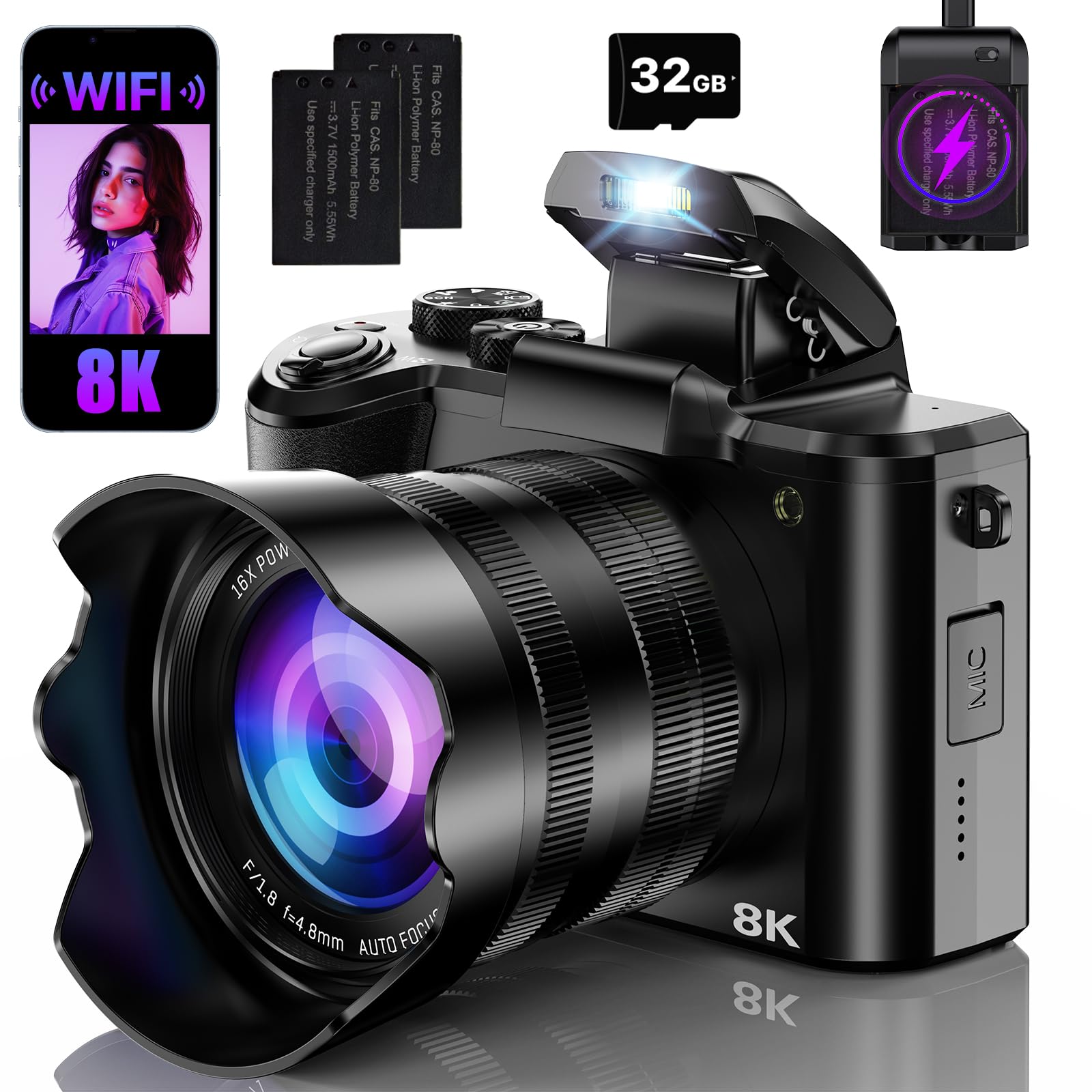
2. 8K Digital Cameras for Photography with WiFi, Autofocus 88MP Vlogging Camera for YouTube with Dual-Lens, 16X Digital Zoom Point and Shoot Camera, 3.2” Touch Screen, Anti-Shake, 2 Batteries & Charging Stand
The high-megapixel vlogging rig that pairs two batteries with a big touchscreen.
The headline figure here is 88MP photo capture alongside 8K video, and it is the biggest megapixel number on this entire list — more than five times the KODAK AZ528’s 16 MP. The catch with that number is that the lens is fixed with 16x digital zoom, which crops and enlarges rather than bending light the way the KODAK’s 52x optical lens does. So it flatters close subjects and bright scenes, and it will not pull a distant bird into frame the way an optical zoom will. Its aperture of F22 (a small opening that lets in relatively little light) sits at the opposite end from the KODAK’s F2.8.
Where this camera earns its place is as a creator’s tool. It carries a 3.2-inch IPS touchscreen (a panel with wide viewing angles and accurate color), dual front and rear lenses you switch with a single touch for selfies, and a 360-degree rotary dial that scrolls through eight shooting modes including slow motion and time-lapse. Autofocus covers contrast, eye, face, and phase detection, so it recognizes faces and locks onto them quickly. Built-in Wi-Fi pairs with the iSmart DV2 app on Android or iOS for instant transfer, and the camera doubles as a webcam for live streaming.
Appearance is what buyers praise above everything else — the vivid colors and lightweight, easy-to-carry body set it apart — with beginner suitability close behind. Two rechargeable lithium-polymer batteries and a 32GB card come in the box, so you can shoot all day without buying extras first. Be honest with yourself about picture quality, though: it is the most-discussed subject in the reviews and opinion splits down the middle, with some owners thrilled and others finding the output flat. As one owner put it: “Does it work, yes. Does it take the best pictures, no.”
Reach reality check: 8K video and 88MP stills look impressive on paper, but the fixed lens means it is a close-range creator, not a zoom shooter.
Focus feel: autofocus detects eyes and faces quickly on several subjects, yet owners describe it taking a beat to settle before it fires.
Best for: vloggers, students, and beginners who want a big screen, dual batteries, and easy phone transfer without spending much.
Step up if: your subjects are usually far away — the optical-zoom models further down this list will serve you far better.
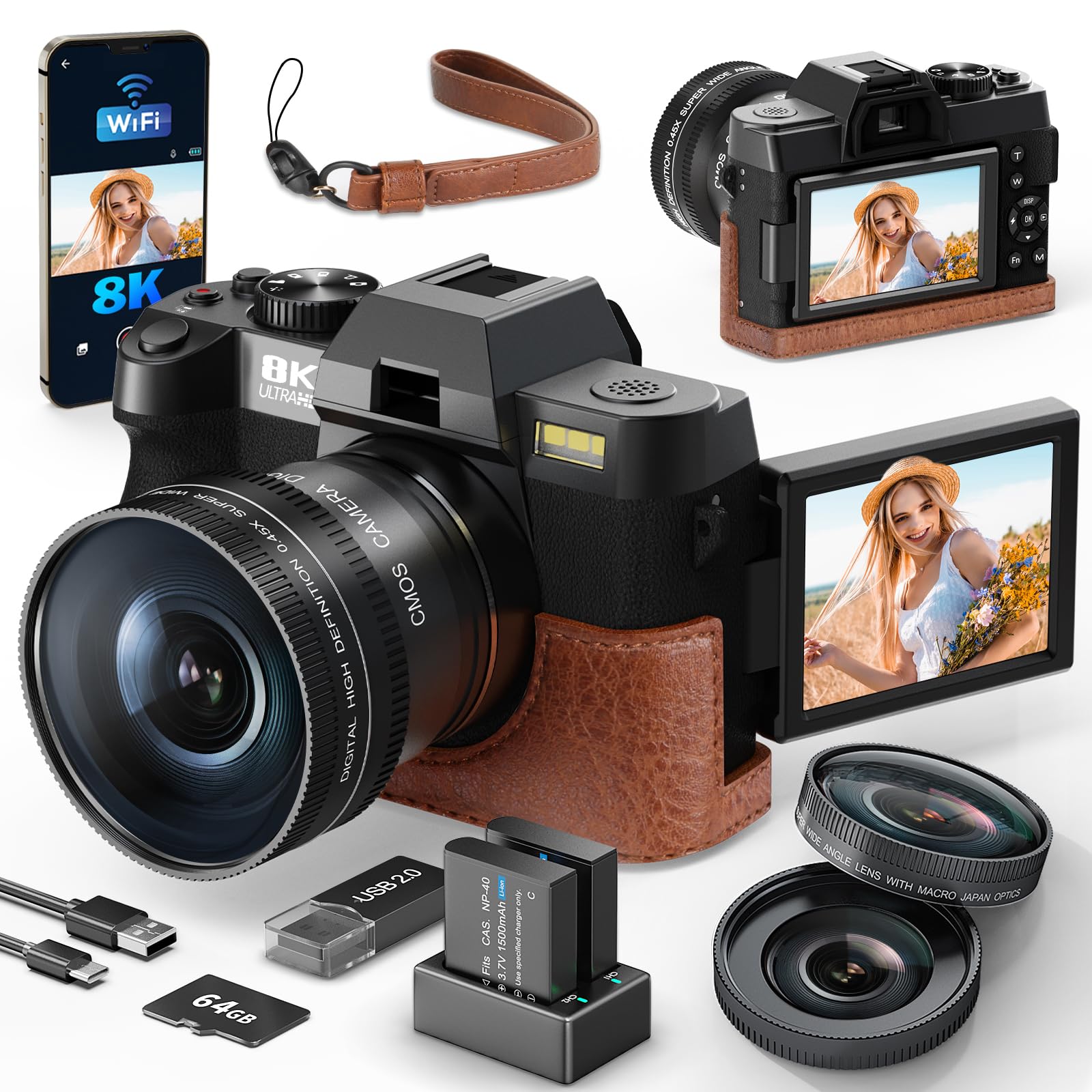
3. 8K&64MP Digital Camera for Photography & Video, 16X Zoom, WiFi, 180° Flip Screen, Autofocus, Anti-Shake, Wide-Angle & Macro Lens, Webcam Mode, PU Leather Case, 32GB Card & 2 Batteries (Black)
A flip-screen kit built for framing yourself and shooting hands-on from any angle.
The 180-degree articulating screen is the feature that earns this camera its spot. It swings forward so you can frame yourself for vlogs and selfies, or tilt for low-angle and overhead shots where a fixed screen leaves you guessing. It shoots 64MP stills and 8K video through a 16x digital zoom lens, and a built-in fill light keeps your face readable when you are filming at night without hauling extra gear. Plug it into a laptop and it works as a webcam for streaming, teaching, or video calls.
The accessory bundle is genuinely complete for a camera at this level: a wide-angle lens and a macro lens for close-up detail, a 64GB TF card, a second battery, a charging dock, a strap, a camera bag, and a PU leather protective case. That means out-of-the-box shooting with no immediate add-on purchases — a real contrast with cameras that ship without a memory card. Time-lapse, scene presets, and filters round out the creative modes to keep things interesting.
The flip-out screen earns real credit for making framing easier when you are in the shot yourself, and buyers use it for stills and video alike. A macro lens plus wide-angle adds flexibility a plain point-and-shoot cannot match. Where it stumbles is clarity at distance — the reviews split on picture quality, and the honest read is that for wide or faraway scenes a modern phone can hold its own. This is a camera for close-up detail, self-framing, and creative play rather than distance pulling.
Self-framing win: the 180-degree flip screen plus fill light and webcam mode make this an easy pick for solo creators.
Closer is sharper: buy it for macro, portraits, and vlogs; lean on the optical-zoom models here if distance is your priority.
Choose this if: you film yourself and want a ready-to-shoot kit with the case, batteries, and card already handled.
Look elsewhere if: you shoot buildings and wildlife across a field — the digital zoom can’t match a true optical lens at range.
4. Minolta MND23 4K Selfie Digital Camera – Blue

The pocket-weight camera for anyone who wants photos without their phone.
At 4.1 oz, this is the lightest camera on this list by a wide margin — light enough to disappear into a jacket pocket or a day bag and stay forgotten until you need it. That is the entire point of the MND23: a dedicated camera you actually carry, so your phone battery stays full and your photos live in one place. It uses a 13MP Sony CMOS sensor and captures 48MP stills, with a 16x digital zoom for reaching subjects like wildlife or a sporting event.
Video options are flexible for the size — 4K at 10FPS, or smoother 2.7K at 30FPS and 1080P at 30FPS if you’d rather have fluid motion than maximum resolution. Face detection and scene modes handle the setup work for you, and the interface is deliberately simple for beginners. It takes USB-C for connecting to phones, tablets, and computers, and accepts Micro SD cards for storage.
Value for money is what people most agree on here — owners feel they got a fair deal for the cash. That said, the shutter speed draws the most negative feedback of any single aspect, and there’s a real delay between pressing the button and the photo actually being taken. You also need to half-press to focus before a full press to fire, which slows down spontaneous shooting. Low-light results get decent marks, but battery life splits opinion and a couple of owners found it drained fast under heavy use.
Why It Travels Well
- 4.1 oz body tucks into a pocket or bag with no effort
- 13MP Sony CMOS sensor captures 48MP photos for a compact
- 4K video at 10FPS plus 2.7K and 1080P at 30FPS for smoother motion
- USB-C connectivity pairs with phones, tablets, and computers
Know Before You Shoot
- Noticeable shutter delay — half-press first, then press to fire
- Battery life draws mixed feedback and can drain quickly under heavy use
- Digital zoom only, so faraway subjects lose quality fast
Good fit for: a student, a daughter’s first real camera, or anyone who wants a tiny carry camera for day trips.
Bear in mind: if you shoot moving subjects often, the slow shutter will test your patience — the 6 fps burst on the KODAK AZ528 handles that job better.
5. Sony Cyber-shot DSC-H300 20.1 MP Digital Camera – Black (Renewed)

A renewed classic with a 20.1MP sensor and a viewfinder old-school shooters still love.
The 35x optical zoom sits comfortably between the Canon SX530’s 50x and the KODAK AZ255’s 25x, giving you solid reach for travel, candid kid shots, and sporting events without leaning on digital tricks.
Two features win hearts here: the eyepiece viewfinder and the Sweep Panorama mode that lets you sweep across a landscape to stitch the whole scene in one shot. Optical SteadyShot reduces blur even in dim light, and in-camera stabilization also smooths HD video. Picture quality is the most-praised thing about this camera across owner reviews, with its value proposition running a close second. The viewfinder especially delights people who came up shooting with one; the screen-framing crowd still warms to it once they get used to it.
Two honest notes. The zoom quality is a little finicky at full extension — as one owner put it, “when you get it working, it works great,” which is a fair description of long-zoom shooting generally. And this is a renewed unit, meaning it arrives in working refurbished condition rather than brand-new packaging. Reliability opinion is genuinely mixed on the renewed supply, so buy from a seller with a solid return policy and check it thoroughly on arrival.
What Earns Its Keep
- 20.1MP sensor gives the most cropping headroom of the zoom cameras here
- 35x optical zoom and Optical SteadyShot handle travel and kid shots at range
- Eyepiece viewfinder appeals strongly to old-school shooters
- Sweep Panorama captures wide scenes in a single motion
Worth Weighing
- Renewed stock — condition and reliability split opinion, so vet the seller
- Zoom quality can be finicky at maximum extension
- Autofocus struggles at very long distances
Pick this if: you want a viewfinder, generous cropping room, and a familiar name at a fair price.
Think twice if: you want a sealed new-in-box camera — this one is renewed, and a few returns have left buyers less than impressed.
6. KODAK PIXPRO AZ255 16MP Digital Camera, 25x Optical Zoom, AA, OIS, Red

The travel camera that runs on batteries you can buy anywhere on earth.
Unlike cameras that tie you to a proprietary charger and a wall outlet, this bridge camera runs on AAs available at any gas station, grocery store, or corner shop worldwide — so a road trip, camping weekend, or international holiday never leaves you stranded with a dead camera. The 25x optical zoom and 24mm wide-angle lens then handle the actual shooting, moving from sweeping landscapes to tight close-ups of wildlife or performers.
A 16MP CMOS sensor captures color and detail well enough to print large and crop deep, and built-in optical image stabilization compensates for hand movement at every zoom level — the difference between a sharp keeper and a blurry miss when you can’t get closer. It records Full HD 1080p video, transfers photos to a computer over USB, and takes Class 10 SD, SDHC, or SDXC cards up to 512GB.
Camera quality is what owners praise most, with value for money right behind it — this is a starter camera people feel good about recommending. Easy controls, a compact non-bulky body, and sharp zoom output without distortion all come up repeatedly in the positives. The trade-off is that it is a budget camera, not a high-end one: a few owners found the zoom output underwhelming and one had a genuinely poor experience, but the overwhelming majority land happy. AA batteries keep you shooting through all of it.
Freedom factor: 25x optical zoom and OIS at every level, paired with AA batteries that remove all charging anxiety.
The honest catch: it is a budget bridge camera, and a handful of owners have found the zoom output flat — buy it for convenience and reach, not for pro-grade image quality.
Ideal for: road-trippers, campers, and travelers who refuse to be tethered to a charger.
Skip if: you want the finest detail at maximum zoom — the AZ528’s 52x reach and larger pixel headroom will serve you better.
7. Canon PowerShot SX400 Digital Camera with 30x Optical Zoom Black (Renewed)

Fifty autofocus points make this the quickest-locking zoom camera in the group.
That 50-point autofocus array is the standout figure — more than four times the Canon SX530’s 9 points and the KODAK AZ255’s 17 — and it directly speeds up how fast the camera locks onto a moving subject. For a camera built around a 30x optical zoom spanning 24-720mm, that matters, because the longer you zoom the harder it is to keep a fast subject in focus. Canon’s High Speed AF works alongside the 16.0MP sensor and DIGIC 4+ image processor to make quick work of it.
The 24mm wide-angle end covers landscapes and group shots, while the 720mm telephoto reaches distant detail, and the 24-720mm range makes this one of the more versatile zoom lenses in the roundup. Video recording runs at 720p HD with a dedicated movie button that lets you keep zooming while you film — a feature not every camera here provides. Smart AUTO reads the shooting situation and selects settings for you, which takes the guesswork out of a beginner’s first outing.
Owners who click with this camera click hard — it depends on the picture quality and a battery that lasts, and it earns steady praise as a first camera for beginners. That said, the review base here is slim, so treat the positive signals as a starting point rather than a settled verdict: fewer than thirty ratings means a couple of unhappy experiences carry outsized weight. One common-enough gripe is that the pixels can’t be adjusted to the shooter’s preference, and another is a battery that drains faster than some owners expected under heavy use.
Sharp pick for beginners: 50 AF points, Smart AUTO, and a 24-720mm zoom built around ease of use — point, frame, shoot.
Small review base: worth the trade if you want Canon glass and speed; recognize that fewer buyers have vetted it than the KODAKs or Sony.
Best for: beginners who want a Canon name, a wide zoom range, and the fastest focus-lock of the bunch.
Consider the AZ255 instead if: you want a bigger pool of owner experience and AA battery flexibility.
8. 8K 64MP Digital Camera for Photography, Professional Camera (Black)
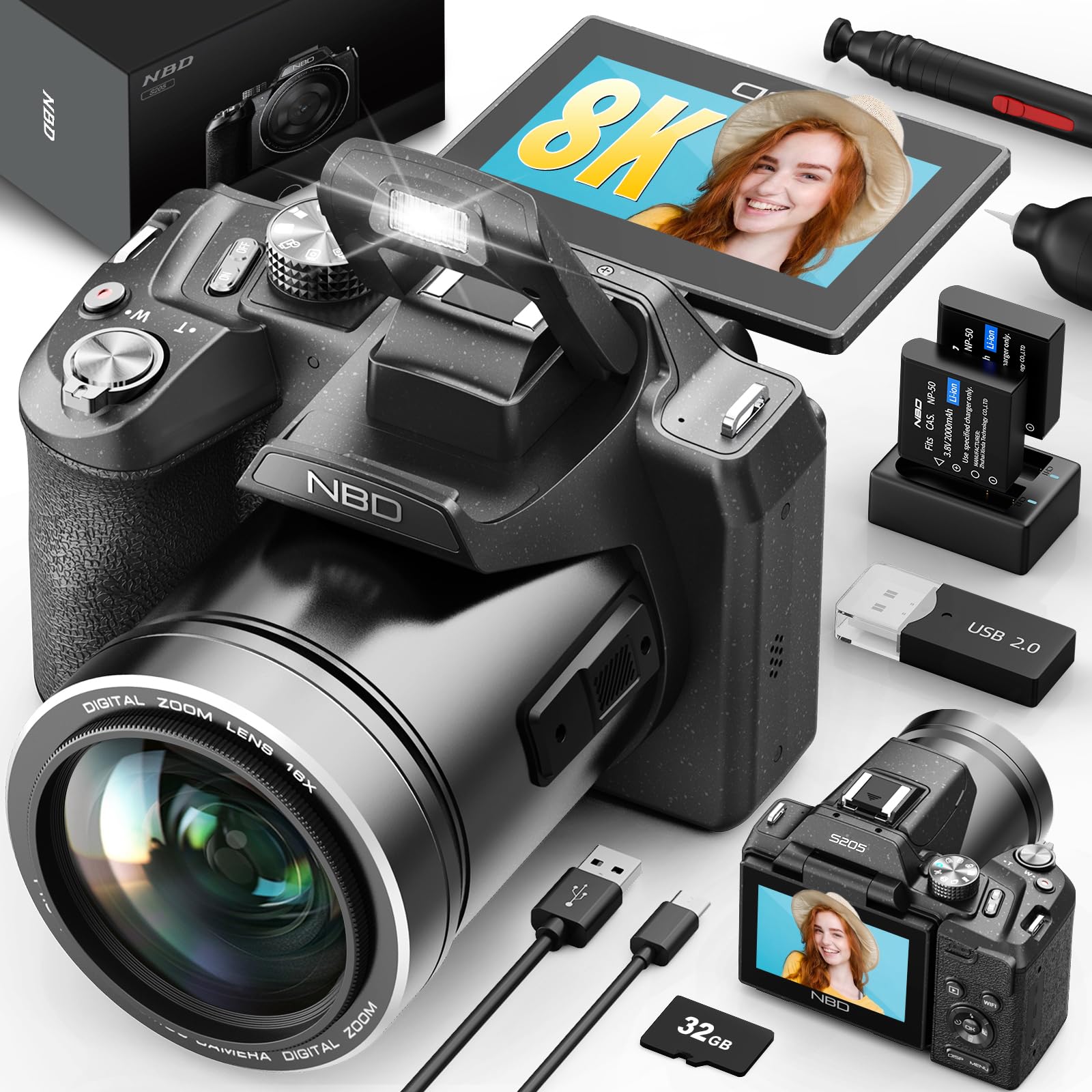
The only camera here with a hot shoe — upgrade the flash without replacing the body.
A hot shoe (the metal mount on top that accepts external accessories) is the difference-maker for a creative upgrade path, and this is the only camera on the list offering one. You can clip on a proper external flash later and grow your lighting setup without buying a new camera. Behind that sits a 64MP CMOS sensor on an 8K-capable video pipeline that also shoots 5K at 30fps or 4K at 60fps — flexibility most point-and-shoots here can’t match. The 16x digital zoom and anti-shake and 2.8-inch 180-degree flip screen cover framing and stability for Vlogs and selfies.
The kit is generous: a 32GB TF memory card, two 2000mAh lithium-polymer batteries, plus Micro HDMI, USB, and Wi-Fi for sharing. Shooting modes include time-lapse, continuous shooting, and slow motion. Connect it over micro HDMI for live streaming as a webcam, which makers of video content and small studios regularly want. Its 64MP output leans soft and natural rather than punchy like a phone’s HDR processing.
Owners describe it as a lightweight travel camera that keeps photos off the phone and pulls solid detail from the included wide-angle and macro lenses. The battery life gets a solid nod after a full day of shooting. That said, you should understand the trade-off clearly — 16x digital zoom will not close the distance the way 50x optical does, and there is far less owner history here than the KODAKs or the Canon SX530 carry.
Why Upgraders Like It
- Hot shoe accepts external flashes — a rare upgrade path in this price range
- 8K video plus 5K/30fps and 4K/60fps choices cover a wide creative palette
- Two 2000mAh batteries and a 32GB card mean no immediate add-ons
- Micro HDMI, USB, and Wi-Fi connection for streaming and transfer
The Trade
- 16x digital zoom can’t match the optical reach of the KODAK or Canon zooms
- Small owner base — less real-world evidence than the higher-volume picks
- Auto exposure only, with no manual control for advanced shooters
Right for: the vlogger who wants a hot shoe, high-resolution capture, and a full accessory kit from day one.
Think twice if: your priority is long-distance reach — the digital zoom is the weak link here next to the optical-zoom models.
9. Canon PowerShot SX530 HS 16.0 MP CMOS Digital Camera with 50x Optical is Zoom (24-1200mm), Built-in WiFi, 3-Inch LCD and 1080P Full HD Video (Black) (Renewed)

A 1200mm reach that turns the moon into a photographable subject.
The 24-1200mm zoom range is the most extreme reach here, and it lives up to the billing — the picture quality stands out most of all, and the ability to pull in close-up images of the moon is the specific ability owners keep returning to. A 16.0MP high-sensitivity CMOS sensor works with Canon’s DIGIC 4+ image processor to make the most of it, and 1080p Full HD video with a dedicated movie button means you’re not choosing between stills and clips. It adds 5x digital zoom on top of the optical reach, plus an ISO range of 100-3200 for low-light flexibility.
At maximum zoom the camera demands steady hands, and the smart approach is a tripod with a two-second delay or shooting off the Canon app on your phone to eliminate shake. Do that and telephoto shots come out rock-solid and clean — one owner shot 4000+ frames in a Lake Superior gale without a single missed frame. Built-in Wi-Fi and NFC move photos to a compatible phone quickly, and the 3.0-inch LCD with a 461,000-dot resolution stays readable even from a wide angle. No SD card is included, and cards top out at 128GB, so buy one first.
Set expectations correctly on this renewed unit — the reliability reports are the least consistent of any camera here, and being renewed, it arrives in refurbished condition rather than new. But the ones that work earn fierce loyalty, and the value proposition is what keeps buyers coming back: as one owner put it, “The picture quality and zoom capability are very good for a camera in the price range of less than.” Buy it for the reach it delivers to wildlife and moon shooters, not for long-haul dependability.
The Reach Edge
- 50x optical zoom spans 24-1200mm — nothing else here reaches as far
- Picture quality earns the strongest owner praise of any camera in this roundup
- 1080p Full HD video with a dedicated movie button that lets you zoom while filming
- Wi-Fi and NFC transfer, plus a readable 461,000-dot 3.0-inch LCD
Plan Around This
- Full zoom requires steady hands — tripod and 2-second delay strongly advised
- No SD card included; cards cap at 128GB
- Renewed stock with the least consistent reliability of the group
Made for: wildlife, bird, and moon photographers who need every inch of reach they can get.
Pair it wisely: a tripod, an SD card under 128GB, and a patient seller check on this renewed unit — then it earns its keep.
Understanding the Specs
Optical Zoom vs. Digital Zoom
Optical zoom uses moving glass elements to physically magnify the scene — this is the good one, because detail comes from real light. Digital zoom crops the image and enlarges it in software, which softens the picture fast. This is why a camera with 50x optical can pull a bird from across a field while a 16x digital zoom cannot: the numbers sound close but they describe entirely different processes. When you compare cameras here, weight optical reach far more heavily than the digital figure.
Megapixels, Sensor Type, and Aperture
Megapixels decide how much you can crop and how large you can print — more is useful but not automatically better. A backside-illuminated sensor (BSI CMOS) collects more light than a standard sensor at the same pixel count, which helps in dim conditions. Aperture is the opening that lets light in, written as an F-number where a smaller value means a wider opening and better low-light performance. Lower-end cameras often use an F22 aperture, while better bridge cameras get closer to F2.8 or F3.0.
Autofocus Points and Image Stabilization
Autofocus points are the zones the camera uses to lock focus. More points means the camera can track a moving subject faster and wider. Image stabilization — optical (OIS) or in-camera — counteracts hand shake, which matters most at long zoom where every twitch is magnified. For handheld long-reach shots without a tripod, stabilization is the difference between sharp and blurry.
Batteries, Storage, and Connectivity
Rechargeable lithium-ion batteries are the standard in this class and recharge in-camera, but they lock you into a charger. AA batteries offer travel freedom because you can buy them anywhere. Storage is a quiet gotcha — several cameras here ship with no memory card, and a card reader or USB cable is how you’ll get photos off. Wi-Fi and app pairing let you move shots straight to your phone, which is the easiest way to share.
FAQ
Is optical zoom or digital zoom more important in a camera under 300?
How far can a 50x optical zoom actually reach?
Do these cameras come with a memory card?
Which is better for beginners, AA batteries or rechargeable lithium-ion?
Are renewedcameras a good choice in this price range?
What does the F-number on a camera lens mean?
Why does a 16MP camera sometimes look better than one with more megapixels?
Do these cameras work as a webcam for streaming or video calls?
Why do long-zoom photos come out blurry at full reach?
How many autofocus points should I look for?
Final Thoughts: The Verdict
For most people shopping the camera under 300 market, the KODAK PIXPRO AZ528 is the pick to beat — its 52x optical zoom out-reaches everything else here while optical stabilization, Wi-Fi transfer, and 6 fps burst shooting make it usable in real conditions. It holds a 4.3 rating across 700+ ratings, earned on 52x reach and versatility rather than hype.
If travel freedom matters most, the KODAK PIXPRO AZ255 runs on AA batteries you can buy anywhere and brings 25x optical zoom with stabilization. For a vlogger who frames themselves, the Monitech 8K 64MP pairs a 180-degree flip screen with a complete accessory kit. And if pulling the moon and wildlife into frame is the whole goal, the Canon PowerShot SX530 HS and its 50x reach are built for exactly that.
How We Picked
We do not accept paid placement. Every pick is matched to a real buyer and a real use-case; we do not hands-on test units.
Sources & Methodology
Specifications: manufacturer listings and product documentation. Review insights: verified customer reviews, as of September 2026. Pricing: not shown on this page (it changes often); check the current price via the retailer link.
As an Amazon Associate, Gadgets Feed earns from qualifying purchases. This does not affect which products we feature.