
Our readers keep the lights on and my morning glass full of iced black tea. As an Amazon Associate, I earn from qualifying purchases.
Specs are compiled from manufacturer listings and verified buyer reviews and can change over time — please confirm the key details on the product page before buying.
If your welder sputters, your winch bogs down, or your inverter trips the moment you push it, the cable between the power source and the load is usually the quiet culprit. A 2-gauge cable is chosen for two jobs at once: carrying high current with almost no voltage lost along the way, and bending easily enough to snake through a frame rail, a golf cart tunnel, or an RV battery bay. Thin insulation or recycled copper-coated aluminum will look fine on the spool and then heat up, corrode, or refuse to flex where you actually need it. This guide breaks down what genuinely separates nine 2 AWG options, from strand count and jacket material to how each one handles real crimping, routing, and long-term outdoor exposure.
I’m Min — the founder and writer behind Gadgets Feed. This guide is built by comparing the manufacturers’ published specifications and the patterns across verified customer reviews, so you get each pick’s real strengths and trade-offs instead of marketing spin.
A lot of the difference between a spool that lasts and one that fights you lives in details most listings bury. Strand count decides whether the cable drapes or kinks, the jacket material decides whether it survives oil and sun, and whether the copper is actually annealed decides how it behaves under a lug. Working through each of these picks side by side is the fastest way to land on the 2-gauge welding cable that fits your specific job without overspending.
Our Picks at a Glance


How To Choose The Best 2-Gauge Welding Cable
Gauge is only the starting point. Two cables can both say “2 AWG” on the jacket and behave completely differently once you start stripping, crimping, and routing them through a vehicle. Here is what actually separates a spool that cooperates from one that fights you.
Strand Count Decides How The Cable Feels In Your Hand
A 2-gauge cable is roughly a third of an inch thick in conductor alone, so how it is built internally changes everything about handling. Cable made from hundreds of fine strands (30 gauge wire twisted together, for example) bends like rope and routes around tight corners without kinking. Cable made from fewer, heavier strands holds its shape and resists bending. Since routing cable is the single hardest part of most welding, battery, and inverter installs, higher strand counts are usually worth seeking out.
Jacket Material And Temperature Range
EPDM rubber jackets resist oil, grease, abrasion, and flame, and typically carry a wide working temperature range. PVC jackets are common on budget battery cable — they work fine indoors but tend to stiffen in cold and are less forgiving against sharp edges. If the cable will live in an engine bay, under a truck frame, or outdoors, check the rated temperature window before you buy.
Lugs, Heat Shrink, And if you need A Crimper
Bundled kits (cable plus lugs plus heat shrink) save you a second order, but they almost never include a crimping tool. A proper 2-gauge crimp requires either a heavy bench crimper, a hammer crimper, or a torch-and-solder method. Factor that into your build plan before choosing between a bare spool and a complete kit.
Quick Comparison
| Model | Best For | Total Length | Strand Count | Jacket / Voltage | Amazon |
|---|---|---|---|---|---|
| WindyNation 2 AWG Kit (10ft Red + 10ft Black)★ Best Overall | Full battery rewiring kit | 20 ft (10 red + 10 black) | Fine-stranded, multiple strands | EPDM / 600V | Amazon |
| Spartan Power 2 AWG Bulk Lead (10 ft Black)Best Single Run | Single-run high-flex replacement | 10 ft (single) | 651 strands | EPDM / 600V | Amazon |
| Kimbluth 2 Gauge Copper Wire (5ft Red + 5ft Black)Best Budget Gauge | Car audio and short battery runs | 10 ft (5 red + 5 black) | Multi-strand, 0.256mm wire | PVC / 600V | Amazon |
| WindyNation 2 AWG Kit (5ft Red + 5ft Black with Lugs) | Winch and welder repair kits | 10 ft (5 red + 5 black) | 10 strands | EPDM / 600V | Amazon |
| Flex-A-Prene #2 AWG Welding Cable (15 ft Black) | Dedicated welding lead | 15 ft (single) | Class K 30 gauge copper | EPDM / 600V | Amazon |
| ACDC 2 AWG Heavy Duty Cable (25 ft Green) | Long-run trunk and golf cart wiring | 25 ft (single) | 624/30 bare copper | EPDM (SAE J1127) / 600V | Amazon |
| WindyNation 2 AWG (15ft Black + 15ft Red) | RV, solar, and battery relocation | 30 ft (15 red + 15 black) | 634 strands | EPDM / 600V | Amazon |
| EWCS 2 Gauge Premium Welding Cable (25 ft Red) | High-current single-color runs | 25 ft (single) | 636 strands | EPDM / 600V | Amazon |
| Crimp Supply Ultra-Flexible Welding Cable (50ft Red + 50ft Black) | Fleet and bulk shop builds | 100 ft (50 red + 50 black) | Not specified | EPDM / 600V | Amazon |
In‑Depth Reviews
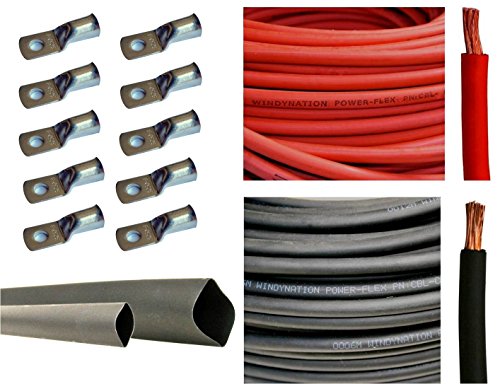
1. WindyNation 2 Gauge 2 AWG 10ft Red + 10ft Black Welding Battery Pure Copper Flexible Cable + 10pc 3/8″ Copper Lug & 3ft Heat Shrink Tubing
Our pick — over 4.5★ from 800+ verified ratings; the strongest balance of quality and price.
The kit that turns a two-trip battery job into a single afternoon of work.
For anyone rewiring a truck harness, adding a winch circuit, or rebuilding a battery bank, the biggest hidden cost is not the cable — it is the second and third order for lugs and heat shrink that always seems to arrive after the weekend you set aside. This kit compresses all of that into one box: 10 feet each of red and black 2 AWG cable, 10 tinned copper lugs sized for a 3/8″ stud, and 3 feet of black polyolefin heat shrink. The listed strand composition is high-count annealed copper under a solvent-resistant EPDM jacket, so the cable bends without kinking while still shrugging off oil and grease. Rated up to 600 volts, with a heat shrink temperature window of -55°C to +125°C, it is spec’d for real engine-bay conditions rather than bench display.
What actually keeps this pick at the top of the pile is the combination of completeness and quality that owners keep circling back to. The cable itself draws the majority of the praise, with buyers describing it as “infinitely better” than the auto-parts-store alternative, and many call out the full-price value of getting lugs and shrink in the same order rather than paying for three separate shipments. The lugs use a closed-end tinned design that resists corrosion in outdoor and marine environments and a flared barrel that makes it easier to feed the cable in before crimping or soldering. Owners running high-draw welding setups report the assembly survived a 2,800-amp, six-second burst before the jacket finally gave up — a real-world ceiling test that carries a warning if you plan to push past it.
Two small trade-offs are worth knowing. The included heat shrink is unsealed (no adhesive liner), which is fine for dry automotive use but not the marine-grade option, and it is a shorter length than the listed measurement — enough for most builds, tight for larger ones. A heavy bench crimper or vice is expected for a clean crimp on 2-gauge cable, so the kit is not a no-tool solution. Otherwise, this is the safest single-spool purchase for a wiring project that needs both colors and the lug hardware on hand.
Where This Kit Pays Off
- Full kit in one order — red and black cable, 10 lugs, and 3 ft of heat shrink
- Fully annealed pure copper under a solvent-resistant EPDM jacket rated to 600 volts
- Closed-end tinned lugs resist corrosion in outdoor and marine use
- High strand count keeps the cable flexible enough for tight engine-bay routing
Small Compromises To Plan Around
- Heat shrink is unsealed and shorter than the length quoted in the listing
- Requires a real crimper or vice — no hand tool will set a 2-gauge lug
- Marine builds needing adhesive-lined shrink will want to buy it separately
Reach for this if: you want to finish a battery, winch, or truck harness job in one order without hunting down lugs two days later.
Look elsewhere if: you are wiring a boat or saltwater environment where every connection needs adhesive-lined marine heat shrink from the start.
2. Spartan Power Welding Lead & Car Battery Cable — 2 AWG, 10 Foot, Black
Built from 651 fine copper strands so it bends through frame rails without a fight.
When you only need one color and one length — a single battery-to-starter run, a ground strap, or a replacement lead — buying a kit means paying for spools you will never open. Spartan Power sells this 10-foot black run on its own, and the headline number is the strand count: 651 individual copper strands packed into a 2 AWG conductor. That construction is what makes the cable drape and turns without kinking, which matters the moment you are fishing it through a vehicle frame or around an EZGO golf cart tunnel. The EPDM jacket resists heat, abrasion, tear, moisture, and oil, and the paper separator inside makes stripping cleaner when you are making your own leads.
The spec sheet lists a 600-volt rating and a -58°F to +221°F working range, so it is rated for engine bays that swing from cold starts to heat-soaked summer idling. Owners installing replacement cables on EZGO carts and F150 battery-to-rear power runs report the copper is genuine oxygen-free — not the copper-coated aluminum that shows up on cheaper spools — and the difference shows up as minimal voltage drop at the far end. The bulk format is a feature too: it ships as a coil you cut to the exact length you need, so a single 10-foot spool can cover multiple short runs instead of one long one.
The honest catch here is sizing: the wire runs slightly small for its gauge, and one owner measured a 4 AWG sample that behaved like 6 AWG, then returned it for a 2 AWG which then fit 4 AWG terminals with a tight crimp. If you already own 2 AWG lugs for a particular terminal, check fit before committing. On the positive side, the flexibility and quality draw the majority of the buyer attention, with a soft bend and no kinking being the most common note. It is a purpose-built single run, and at that job it earns its spot.
The fit-to-check note: the cable is genuinely 2 AWG copper for the conductor, but the outer diameter can match a slightly smaller eyelet — match your existing lugs to the shipped diameter, not the label alone.
Who misses out: anyone who needs red and black in the same order for a mirrored battery rewire — this listing is black only, single run.
The right buy for: a single-cable replacement where flexibility and real oxygen-free copper matter more than a bundled price break.
Pass it by for: two-color battery bank projects that would ultimately cost more here than in a complete kit.
3. Kimbluth 2 Gauge Battery Cable Copper Wire — 5FT Red + 5FT Black
Color-coded short runs for car audio and compact battery jobs without a bundle.
Not every project needs 30 feet of spool. If you are wiring a car audio amplifier, a short aux-power block, or a small solar build, five feet of each color is often exactly the amount you want. Kimbluth’s twin-pack delivers 5 feet of red and 5 feet of black 2-gauge cable made from listed 99% pure oxygen-free copper, twisted from strands of 0.256mm wire, wrapped in a 90mil PVC jacket. The working temperature range runs -40°C to +105°C and the rating tops out at 600 volts, which covers most automotive and light industrial jobs.
The pull here is that both colors arrive on the same order without the extra hardware you might not need. Buyers using it for automotive power and ground blocks consistently describe the insulation as flexible and easy to route, and many call out that it cuts and strips cleanly — a small detail that adds up when you are making multiple short terminations in one afternoon. The PVC jacket is a legitimate step down from a proper EPDM welding jacket: it resists oxidation, corrosion, gasoline, battery acid, and abrasion, but it is a softer jacket material than the rubber compounds on the higher-end spools. In practice, one owner measured the tightest bend radius at around 1.75 inches, which is fine for a battery bay but tighter than some welding leads allow.
The one inconsistency to know about is length verification. Some buyers report both colors arriving exactly as listed, while at least one notes a reel coming in short of the quoted footage. For a buyer needing precise cuts, measure the finished length before you commit to a routing plan that depends on every inch. The quality and functionality notes dominate the reviews overall, and for a budget PCV-jacketed short-run cable, the pricing feels reasonable.
Why It Works For Short Builds
- Both colors in a single 10-foot order — no separate red and black purchases
- Listed 99% OFC copper with fine 0.256mm strands for clean cuts and strips
- 600V rating and -40°C to +105°C window cover most automotive applications
- PVC jacket resists oxidation, gasoline, and battery acid
Limits Worth Noting
- PVC jacket is a step below the EPDM rubber used on premium welding leads
- Listed bend radius around 1.75 inches is tighter than some routing runs allow
- Occasional reports of short footage — verify length before final cuts
Ideal for: a compact two-color job like an amp run or a truck aux-power block where a spool of 30 feet would just collect dust.
Step up if: your routing passes through high heat, oil, or tight corners that demand a rubber jacket and a looser bend radius.
4. WindyNation 2 AWG 5ft Black + 5ft Red + 5pc 5/16″ Lugs + 5pc 3/8″ Lugs + 3ft Heat Shrink Tubing

Twin lug sizes and USA-made cable in one compact kit for welder and winch repairs.
The clever part of this kit is the hardware assortment. Instead of ten lugs in a single stud size, WindyNation ships five 5/16″ and five 3/8″ copper lugs alongside the 5 feet of each color, plus 3 feet of heat shrink. If you are upgrading a welder ground clamp, adding a winch terminal, or replacing a battery cable whose stud size is a guess until you check, having both lug sizes on hand saves a mid-install order. The cable itself matches the brand’s larger kits — USA-made, SAE J1127 approved, fully annealed pure copper under a solvent-resistant EPDM jacket, rated at 600 volts with a -50°C to +105°C working window and a -55°C to +125°C heat shrink range.
The cable weighs in at 2.4 pounds for the pair, which puts it in the same practical category as any decent 2-gauge bundle. Buyers upgrading the ground lead on a small welder report the swap from a thin stock cable to this 2 AWG run was an obvious step up, and owners relocating a battery to a trunk describe routing through a vehicle without issues thanks to the flexibility of the copper under the jacket. The terminal ends and heat shrink are rated good quality, though the shrink is the standard non-adhesive type rather than the sealed marine version.
The one recurring issue is length trim tolerance: the cable can arrive slightly shorter than the listed footage — red measured at 57.7 inches on one order, and a replacement still came up three-quarters of an inch short. If your job depends on hitting an exact measure, verify before you cut. That said, the supplier responded within 24 hours and let the customer keep the short reel, which is a real signal about who you are buying from. For a two-stub-size, one-order build, this kit is hard to argue with.
The hardware angle: two lug sizes in the box — 5/16″ and 3/8″ studs — genuinely covers more builds than most single-size kits.
The measurement watch: occasionally the cut length lands a fraction of an inch short of the listing, so measure your planned run with a little slack before crimping.
Shortlist this for: welder ground upgrades, winch installs, or any job where the stud size is not certain until the parts are in your hand.
Skip the kit route for: builds longer than 5 feet per color — you will need the 15-foot or 30-foot options instead.
5. Flex-A-Prene #2 AWG 100% Copper Welding Cable — Black, 15 Feet

Purpose-built welding lead with a flame rating and printed jacket markings that survive years of use.
A welding lead lives a harsher life than a battery cable — it drags on concrete, gets stepped on, and sits close to spatter — so this Flex-A-Prene spool is built around that abuse. The construction is Class K 30-gauge copper under an EPDM jacket with a paper separator, and the printed markings are ink-ident’d so they do not fade even after years of shop exposure. The spec sheet checks the boxes welding buyers care about: 600V rating, a -50°C to +105°C working window (equivalent to -58°F to +221°F), SAE J1127 and RoHS compliance, VW-1 flame test per UL2556, and suitability for battery cable per UL558 and UL583 under National Electrical Code article 630 for electric welders.
The physical numbers are note because they drive real fit decisions. The outer diameter is 0.413″ with a wall thickness of 0.06″, which lands this lead in the fat-but-manageable category for lug and clamp hardware. The 4-pound spool ships as a single 15-foot black run, so this is a one-color replacement rather than a paired red/black kit. Reviews from actual welders support the spec: the copper is described as solid with no aluminum content, and buyers using it as a dedicated welding lead report the cable handles the amps without drama and stays flexible enough to route around a machine.
Where this one earns its spot is on the welding bench, not in a car audio install. It is a single-color 15-foot spool, so a mirrored battery rewire needs a second purchase. The flame rating and print markings are the two details a serious welder notices first, because they matter when the lead is running hot and near sparks. If you want one purpose-made lead and do not need a matching color second run, this is the one to buy.
Built For Welding Abuse
- Class K 30-gauge copper for high strand count and clean flexibility
- Printed ID markings that resist fading after years of shop use
- VW-1 flame test compliance per UL2556 and SAE J1127 rated
- 15-foot single-color run long enough for most welder ground upgrades
Where It Falls Short Of A Kit
- Ships as a single black spool — no matching red for two-color builds
- 0.413″ outer diameter needs lugs sized for the actual shipping diameter, not the label
- No lugs or heat shrink included in the box
Right lead for: a dedicated ground upgrade or replacement on a stick welder where flame rating and fade-proof markings genuinely matter.
Wrong lead for: a mirrored battery rewire that needs red and black in the same shipment — you will be placing two orders.
6. ACDC 2 AWG Heavy Duty Extra Flexible Welding Lead — 25 FT, Green, Made in the USA

A 25-foot single run built from 624 fine copper strands — long on distance, still soft to route.
Long-distance runs are where undersized cable hurts most, because voltage drop stacks up with every extra foot. This ACDC spool puts 25 continuous feet of 2 AWG in a single color, and the strand count — 624 strands of 30-gauge bare copper — is what keeps a long run from becoming a wrestling match during routing. The listed insulation resists cuts, tears, abrasion, grease, oil, water, and flame, and the cable is SAE J1127 rated at 600 volts and RoHS compliant, with 30 AWG (0.010) stranding called out on the spec sheet.
What owners mention matches the spec in practical ways. The cable holds up being routed through a Jeep Cherokee for a dual-battery install, where the switch from 4-gauge audio wire to 2 AWG produced noticeably improved voltage, charging, and startup behavior. Buyers upgrading golf carts from undersized 6-gauge to this 2 AWG describe the change as an obvious fix that many cart owners never get around to researching. The 4-pound spool is light enough to handle in one hand while laying a run, which is a small but real advantage over thicker cable.
The honest limits: it ships as a single green spool, so a matched red run needs a second order, and 25 feet is a lot of cable for a short battery-bay job. One owner using it for high-current accessory wiring notes the insulation feels solid and the conductor passes basic torch testing for real copper — no copper-coated aluminum surprises. If you are wiring a long truck run, an inverter in a semi, or a golf cart bank, the single-color 25-foot format fits the job.
Best fit scenario: long one-direction runs — trunk batteries, semi-truck inverters, golf cart upgrades — where distance is the whole point of buying a single spool.
The color caveat: green only. Anyone wiring a mirrored positive/negative pair has to plan for the second order upfront.
The smart pick for: anyone running power across more than ten feet of vehicle, where the strand count and single-color spool fit the routing plan.
Better served elsewhere if: you need two colors on one order or you are doing short 3-5 foot runs that would waste most of the spool.
7. WindyNation 2 AWG 15ft Black + 15ft Red — Car, Inverter, RV, Solar Cable
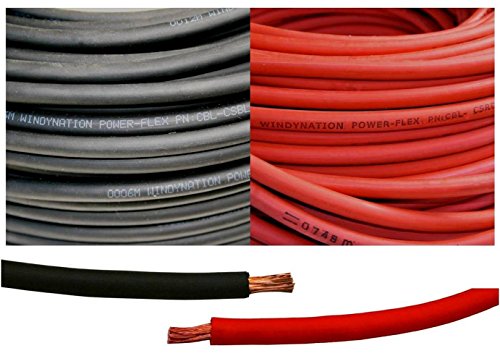
A 30-foot matched pair that fits RV battery banks and solar charge runs without waste.
Anyone wiring an RV house bank or a solar array knows the frustration of buying two mismatched spools and ending up a few feet short on one color. This WindyNation pair ships 15 feet of black and 15 feet of red — 30 total — in the same order, cutting a common headache out of the buying step. The cable itself is fully annealed pure copper with a 634-strand count under an EPDM jacket, SAE J1127 compliant, IEC and RoHS listed, made in the United States, and rated at 600 volts with a -50°C to +105°C working window. The 7.1-pound combined weight speaks to the copper content rather than a thin jacket hiding a light core.
Where this one shines is battery-bank work. Owners using it to connect RV battery banks with crimped lugs report enough flexibility to bend into tight compartments and a correct size for the lug terminations, with no warming at the connection under real load. Solar-system users describe a clean install from the array through to the inverter. Anyone replacing old truck harness wiring or adding a second battery will find the matched pair genuinely useful because they are not left with a spare spool of the wrong color.
Two things to be aware of: the 15-foot runs are thick enough that a very tight routing may force a different cable choice — one RV owner wanting battery-to-distribution-box leads found the 2 AWG too stiff for that specific run and repurposed the cable for battery-to-battery instead. And there is an initial odor from the insulation on unboxing that fades over time. The flexible copper and correctly-sized jacket make up for both in most installs. For long two-color runs across an RV or solar system, this is the ready-to-go option.
Why RV And Solar Builders Like It
- Matched 15ft red and black pair in one order — no color re-order
- 634-strand annealed copper under an EPDM jacket rated 600V
- -50°C to +105°C working range handles engine bays and RV compartments
- Confirmed to fit crimped lugs cleanly for battery-bank connections
Before You Buy
- Initial insulation odor on unboxing, which fades with use
- 2 AWG thickness may be too stiff for very tight distribution-box routing
- No lugs or heat shrink in the box — hardware is a separate purchase
Do buy this if: you are matching colors across an RV bank or a solar array and want both spools in one shipment.
Think twice if: your target routing bends sharper than a 2-gauge cable comfortably allows — a longer flex lead may fit that job better.
8. EWCS 2 Gauge Premium Extra Flexible Welding Cable — Red, 25 Feet, USA Made
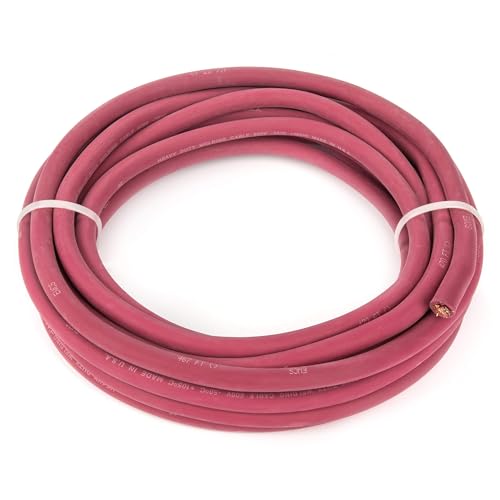
A 25-foot single-color spool with 636 strands — the flex-first pick when routing is the hard part.
The best-known argument for EWCS welding cable is how it behaves before you ever cut it: 636 strands of fine 30-gauge copper make a 25-foot run flex like a rope, which is exactly what a golf-cart or trunk-battery install demands. The listed features are sunlight and water resistant, and it ships as a coil so you can unroll and cut without fighting a tight spool. This is a red-only, 25-foot single run, so the choice is really about flexibility and length rather than matched colors.
Owners putting this to work describe very pliable cable that routes into tight spaces and handles heavy starting loads without complaint. Electric golf cart rewires using soldered or crimped ends are the most common large upgrades, and the general consensus is that the flexibility, durability, and current delivery together make this a solid choice for high-current jobs. Trunk-mount battery installs using it with soldered and hammered copper tubing terminals also come up frequently, with the cable described as abrasion-resistant and cheaper than official battery-relocation wire kits.
Two honest notes. First, the marketed gauge can run a little larger than strict 2 AWG in the eyelet fit, so one owner reported needing 4-gauge eyelets on an actual 2-gauge run and being unhappy with the discrepancy. Match your existing lugs to the shipping diameter rather than the label. Second, this is a single-color red spool, so a mirrored negative-side build needs a second purchase. For a long, high-flex cable for golf carts, welders, or trunk batteries, the flexibility and the sunlight-resistant jacket make it a very practical pick.
What It Does Best
- 636-strand copper gives the highest strand count on this list at 2 AWG
- 25-foot single-coil format for long single-direction runs
- Sunlight and water resistant jacket suits outdoor and exposed routing
- Handles soldered and crimped terminations and heavy starting loads in real use
Consider Before Buying
- Shipping diameter may occasionally run near 4-gauge eyelet fit, despite the label
- Single red color only — a mirrored black run needs a second order
- Thick cable, so a very tight routing still needs care
Reach for this if: you are upgrading a golf cart, welder, or trunk-mounted battery and want the most flexible single-color run money can buy.
Look elsewhere if: you need both colors in the same shipment or you plan to crimp with an existing 2 AWG eyelet set without confirming fit.
9. Crimp Supply Ultra-Flexible Car Battery / Welding Cable — 2 Gauge, 50ft Red + 50ft Black + 5 Copper Lugs

A 100-foot bulk spool pair for shops and multi-run builds where one job never uses the whole reel.
For fleet maintenance, workshop stock, and multi-battery installs, buying a spool that gets used across many jobs beats buying a short kit every time — and this Crimp Supply pair is the largest on this list at 50 feet of red and 50 feet of black. The cable is USA-made pure copper under a highly flexible EPDM jacket rated to resist abrasion, cut, tear, flame, grease, oil, and water, and listed for 600 volts. Five smooth copper lugs with 3/8″ studs are included to get you started on the first build.
What owners actually use it for is a telling clue. RV solar builders wiring an eight-battery dual-system bank choose it deliberately over cannibalizing jumper cables, because 100% stranded copper is the safer call than copper-coated alternatives. One owner specifically rates it better than PVC-cased high-gauge wire and notes it solders cleanly with lead solder and a torch. Aux battery connections, remote winch plugs, trailer gensets, amplifiers, and ground runs all show up in the same review stream — the kind of variety you only see with a bulk spool.
The obvious trade-off is the 24.8-pound, 100-foot commitment. That is a lot of cable for a single-vehicle install, and the included five lugs only cover the first few terminations, so most buyers will still need to buy lugs separately. This is the pick for someone who will keep reaching for the spool across multiple projects, not the person doing one battery replacement. For that repeat-use buyer, it is the most cost-efficient way to keep good 2-gauge flexible cable on the shelf.
Shop-stock strategy: a single 100-foot purchase replaces what would normally be two or three separate 30-foot orders across a season of builds.
The shelf-versus-spool call: on a one-car job, the leftover copper sits idle — this is a pick for repeat users, not weekend one-offs.
For the buyer who: maintains a fleet, runs a shop, or wires multiple batteries and wants a spool that stays useful across jobs.
Not for the buyer who: needs just one short run, since a 100-foot, 24.8-pound pair is far more cable than a single replacement demands.
Understanding the Specs
Strand Count And Why It Governs Flexibility
A 2 AWG conductor is built from many smaller copper wires twisted together. Higher strand counts (above 600 at this gauge) mean the cable drapes over its own weight and bends through tight vehicle corners without kinking, which is the difference between a routing job that takes ten minutes and one that takes an hour. Lower strand counts save on copper cost but hold their shape, so they resist bending. For welding leads, winch wiring, and any run through a frame rail, higher strand count is usually worth the upgrade.
Jacket Material, Temperature Window, And Ratings
EPDM jackets resist oil, grease, abrasion, and flame, and hold up in a wide temperature window — several options here rate from -50°C to +105°C. PVC jackets are common on lower-cost cable: they resist oxidation, gasoline, and battery acid, but feel stiffer and take less abuse near sharp edges. The 600-volt rating shared by every pick here is standard for the category and covers most automotive, welding, golf cart, and inverter applications. If your build pushes high amps regularly, jacket quality and strand count both matter more than the headline gauge number.
FAQ
Will 2-gauge cable handle a welding ground upgrade on a small stick welder?
Can I crimp 2-gauge cable with a standard hand crimper?
How do I know if 2 gauge is enough for my winch or inverter run?
Will 2-gauge cable fit inside standard battery lugs and terminals?
Is EPDM or PVC a better jacket for welding cable?
Do I need the same color for positive and negative runs?
How should I store unused bulk welding cable?
Will 2-gauge cable work for a golf cart upgrade from 6 gauge?
Is copper-coated aluminum cable ever okay for a 2-gauge application?
What length should I buy for a typical battery relocation?
Final Thoughts: The Verdict
For most people hunting a 2-gauge welding cable, the WindyNation 10ft Red + 10ft Black kit is the one to buy first, because it gets the cable, lugs, and heat shrink into your hands in a single order — saving the mid-project scramble for hardware. If you are replacing just one lead and want maximum flexibility for a tight route, the Spartan Power 651-strand single run is the pull; if you are running power across a vehicle longer than ten feet, the ACDC 25-foot green lead is the smart length; and if you are stocking a shop or fleet, the Crimp Supply 100-foot bulk pair earns its shelf space. Pick by the job, not the label.
How We Picked
We do not accept paid placement. Every pick is matched to a real buyer and a real use-case; we do not hands-on test units.
Sources & Methodology
Specifications: manufacturer listings and product documentation. Review insights: verified customer reviews, as of September 2026. Pricing: not shown on this page (it changes often); check the current price via the retailer link.
As an Amazon Associate, Gadgets Feed earns from qualifying purchases. This does not affect which products we feature.