
Desktop gaming audio doesn’t need a sprawling 5.1 setup or a bulky subwoofer under the desk. A well-chosen pair of 2.0 speakers delivers the stereo imaging, vocal clarity, and punchy bass most players actually hear in competitive shooters and immersive RPGs — without the cable clutter or the space commitment.
I’m Min — the co-founder and writer behind Gadgets Feed. I’ve spent hundreds of hours cross-referencing driver materials, amplifier wattages, and DSP tuning across dozens of speaker pairs to separate the genuinely good from the merely loud.
This guide ranks the models that actually hold up under desktop gaming loads — from budget-friendly nearfield monitors to premium wood-enclosure bookshelf pairs — so you can confidently choose among the finalists for the best 2.0 pc gaming speakers.
How To Choose The Best 2.0 PC Gaming Speakers
A great pair of 2.0 PC gaming speakers hinges on three things: driver composition for clear mids and highs, amplifier power to fill a nearfield desk space without distortion, and the connectivity options that match your gaming setup. Passive bookshelf speakers demand an external amplifier, while powered (active) models include everything in the box, which is usually the smarter path for a desktop.
Driver Materials and Frequency Response
The woofer and tweeter materials directly shape what you hear. Carbon-fiber woofers are stiffer and lighter than standard paper or polypropylene cones, which means faster transient response for footsteps and gunshots. Silk-dome tweeters handle high frequencies without the metallic harshness of titanium or aluminum domes — important for hours of competitive play where ear fatigue matters. Look for a frequency response that extends to at least 55 Hz on the low end for passable bass presence.
Amplifier Power and DSP Tuning
Desktop nearfield speakers don’t need massive wattage; 20 W to 60 W RMS per pair is sufficient for clean audio at typical sitting distances. More important is whether the speakers include a DSP (Digital Signal Processing) chip that actively corrects distortion and balances the frequency curve. DSP-tuned speakers maintain clarity when you turn them up, while non-DSP models often break up or sound boxy at higher volumes.
Connectivity Options for Low Latency
For gaming, wired connections beat wireless every time. USB-C and Optical inputs offer lossless digital audio with near-zero latency, while standard 3.5 mm AUX is fine for casual use. Bluetooth 5.3 or 5.4 is a nice convenience for music streaming, but avoid relying on it for competitive gaming where audio delay matters. Balanced TRS inputs are a bonus for content creators who also use studio gear.
Quick Comparison
On smaller screens, swipe sideways to see the full table.
| Model | Category | Best For | Key Spec | Amazon |
|---|---|---|---|---|
| Edifier R1700BT | Premium | Rich stereo with Bluetooth | 66W RMS, MDF wood enclosure | Amazon |
| Sony SS-CS5M2 | Premium | Hi-Res passive bookshelf | 3-way drivers, 53 Hz – 50 kHz | Amazon |
| Creative T60 | Mid-Range | Compact desk upgrade | USB + Bluetooth, dialogue mode | Amazon |
| IBALL·BOX 60W | Mid-Range | Balanced EQ controls | 60W DSP, carbon-fiber woofer | Amazon |
| Ortizan C7 Studio Monitors | Mid-Range | Nearfield music production | TRS balanced, USB-C DAC | Amazon |
| Bluedee RGB Speakers | Budget | RGB aesthetic + USB-C | 20W peak, Bluetooth 5.4 | Amazon |
| Electrohome Huntley EB10B | Budget | Versatile retro setup | 3-inch drivers, wood cabinets | Amazon |
In‑Depth Reviews
1. Edifier R1700BT Bluetooth Bookshelf Speaker

The Edifier R1700BT delivers the most balanced stereo experience among powered 2.0 desktop speakers at this tier. Its 66W RMS amplifier drives a 19mm silk-dome tweeter and a custom mid-bass driver inside a rigid MDF wood cabinet, producing a warm, distortion-free soundstage that outclasses plastic-bodied competitors. The front-ported design means you can push the pair flush against a wall monitor without bass bloom — a practical advantage for tight desks.
Bluetooth connectivity works reliably with PC, Mac, and mobile devices, and the included remote control adds convenient volume and input switching. Side-panel bass and treble knobs allow real-time EQ tuning without diving into software. The 19mm silk tweeter handles high frequencies with smoothness that prevents ear fatigue during long gaming sessions, while the wooden cabinet resonance control keeps the low end tight.
Bass extension below 50 Hz is limited, so EDM and explosion-heavy titles won’t shake the room. The rear power switch is slightly awkward to reach on a crowded desk. Despite these trade-offs, the R1700BT remains the most well-rounded powered 2.0 option for gamers who value clarity over raw volume.
Why it’s great
- Silk-dome tweeters deliver smooth, non-fatiguing highs
- Front-ported design fits wall-adjacent desk placement
- Remote control included for easy input switching
Good to know
- Limited sub-bass extension below 50 Hz
- Rear power switch is inconvenient to reach
2. Sony SS-CS5M2 3-Way 3-Driver Bookshelf Speakers

The Sony SS-CS5M2 brings a true 3-way, 3-driver configuration to the desktop passive speaker market — a rarity at this level. A 5.12-inch reinforced cellular cone woofer handles low frequencies, while a separate high-precision tweeter and wide-dispersion super tweeter cover the mids and highs up to 50 kHz. This three-driver architecture creates an expansive soundstage with exceptional detail retrieval, revealing subtle audio cues in games that single-driver speakers mask.
These are passive speakers, so you’ll need a separate amplifier or AV receiver — the Sony CS series pairs well with their own STR-DH series receivers. The bass reflex enclosure keeps low-end distortion minimal, though the rear port requires at least a few inches of breathing room from the wall. The 6-ohm impedance is relatively easy to drive, making it compatible with most budget desktop amps.
Bass below 50 Hz is lean without a subwoofer, and the speakers can sound slightly bright on certain recordings. Isolation feet are recommended to decouple them from desk surfaces. For gamers building a dedicated desktop audio chain, the SS-CS5M2 offers Hi-Res Audio certification and build quality that easily exceeds typical PC speaker sets.
Why it’s great
- 3-way driver design for superior detail and soundstage
- Reinforced cellular cone woofer for clean low-end
- Hi-Res Audio rated up to 50 kHz
Good to know
- Requires external amplifier — not powered
- Rear port needs wall clearance
3. Creative Labs T60 Compact 2.0 Desktop Speaker System

Creative’s T60 offers the smallest footprint among mid-range powered 2.0 speakers while still delivering impressively loud output. The dual-driver per channel setup (a full-range driver plus a tweeter) produces clear mids and highs that easily fill a desk area, and the dedicated Dialogue mode boosts vocal frequencies for better voice clarity in chat-heavy games or cutscenes. USB connectivity makes it a true plug-and-play option for PC and Switch.
The built-in Bluetooth receiver streams from mobile devices without wired tethering, and the front-mounted volume knob doubles as an input selector. Sound quality holds up well at moderate volumes, though pushing them near maximum reveals some compression in the low end. The compact plastic enclosure lacks the cabinet mass of wood speakers, so bass stays polite rather than impactful.
The included AUX cable quality has been noted as a weak point, and the digital USB volume control sometimes requires third-party EQ apps for precise leveling. However, for gamers who prioritize desk space and a straightforward, high-volume 2.0 setup, the T60 delivers reliable performance without the footprint of larger bookshelf speakers.
Why it’s great
- Very compact footprint fits tight desk setups
- Dialogue mode boosts vocal clarity for gaming
- USB plug-and-play with PC and Switch
Good to know
- Bass is polite due to plastic enclosure
- USB digital volume control may need EQ app workaround
4. IBALL·BOX 60W Computer Speakers with DSP
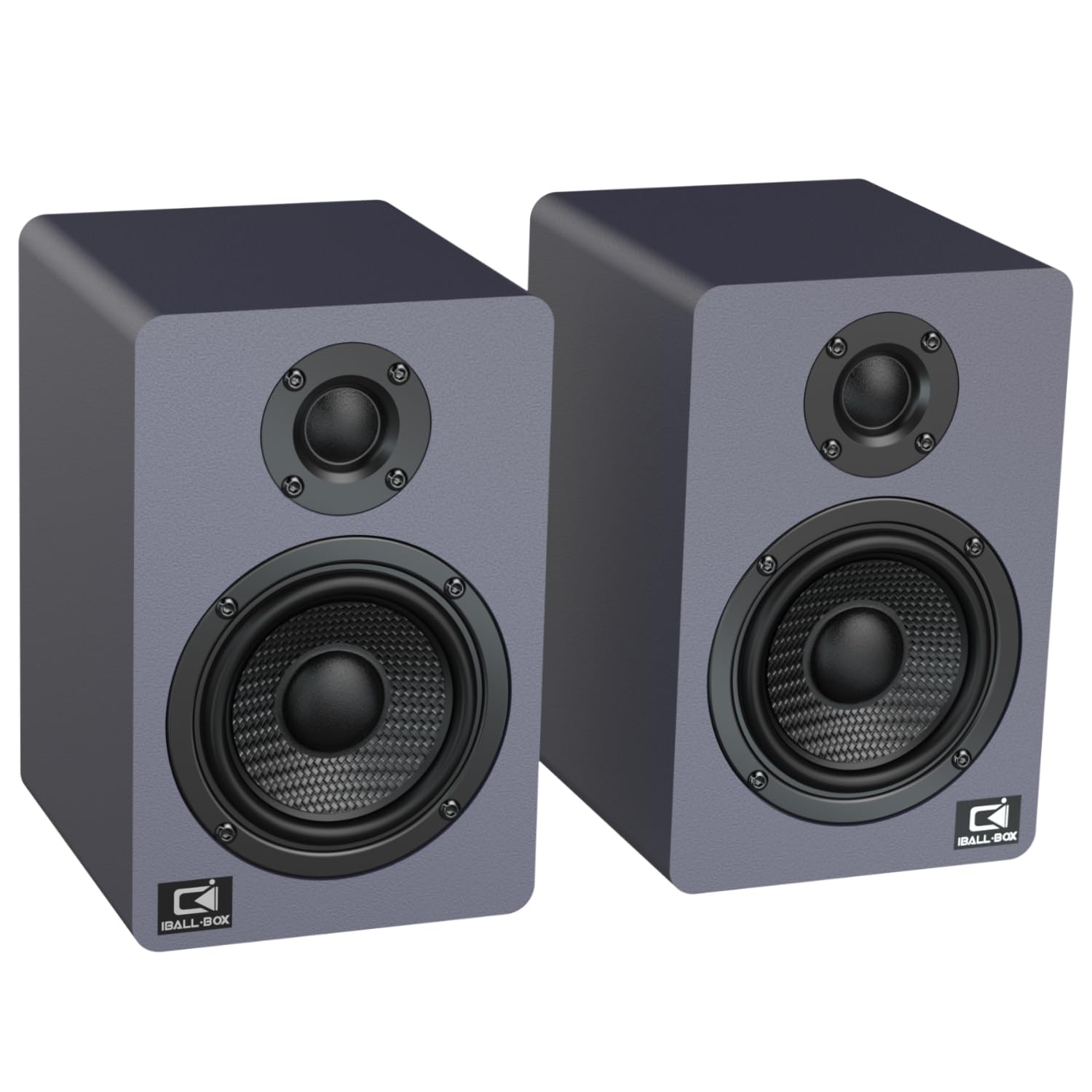
The IBALL·BOX 60W DSP speakers bring a powerful combination of hardware and connectivity at a mid-range price point. A 3.5-inch carbon-fiber woofer paired with a silk-dome tweeter delivers a frequency response that digs down to 55 Hz, providing fuller bass than most desktop 2.0 systems. The built-in DSP chip actively corrects distortion and balances the frequency curve, keeping audio clean even when you push the volume.
Connectivity is impressively versatile for the tier: Bluetooth 5.3 for wireless, 24-bit USB-C DAC for direct digital audio from a PC, Optical input for console or TV, and 3.5 mm AUX for legacy devices. The MDF wood cabinet with rear port reduces cabinet resonance, far outperforming the plastic enclosures of budget alternatives. Onboard volume, bass, and treble knobs give you immediate EQ control without software.
Clarity degrades slightly at maximum volume in larger rooms, and the rear port requires a few inches of clearance from the wall. The slate blue finish is a nice aesthetic twist. For gamers who want a DSP-tuned powered 2.0 set with multiple digital inputs and physical EQ knobs, this is the best value proposition on the list.
Why it’s great
- 60W DSP actively corrects distortion
- Carbon-fiber woofer reaches 55 Hz low end
- 4 input options including USB-C and Optical
Good to know
- Rear port needs wall clearance
- Clarity drops slightly at max volume in large rooms
5. Ortizan C7 Dual-Mode Studio Monitors
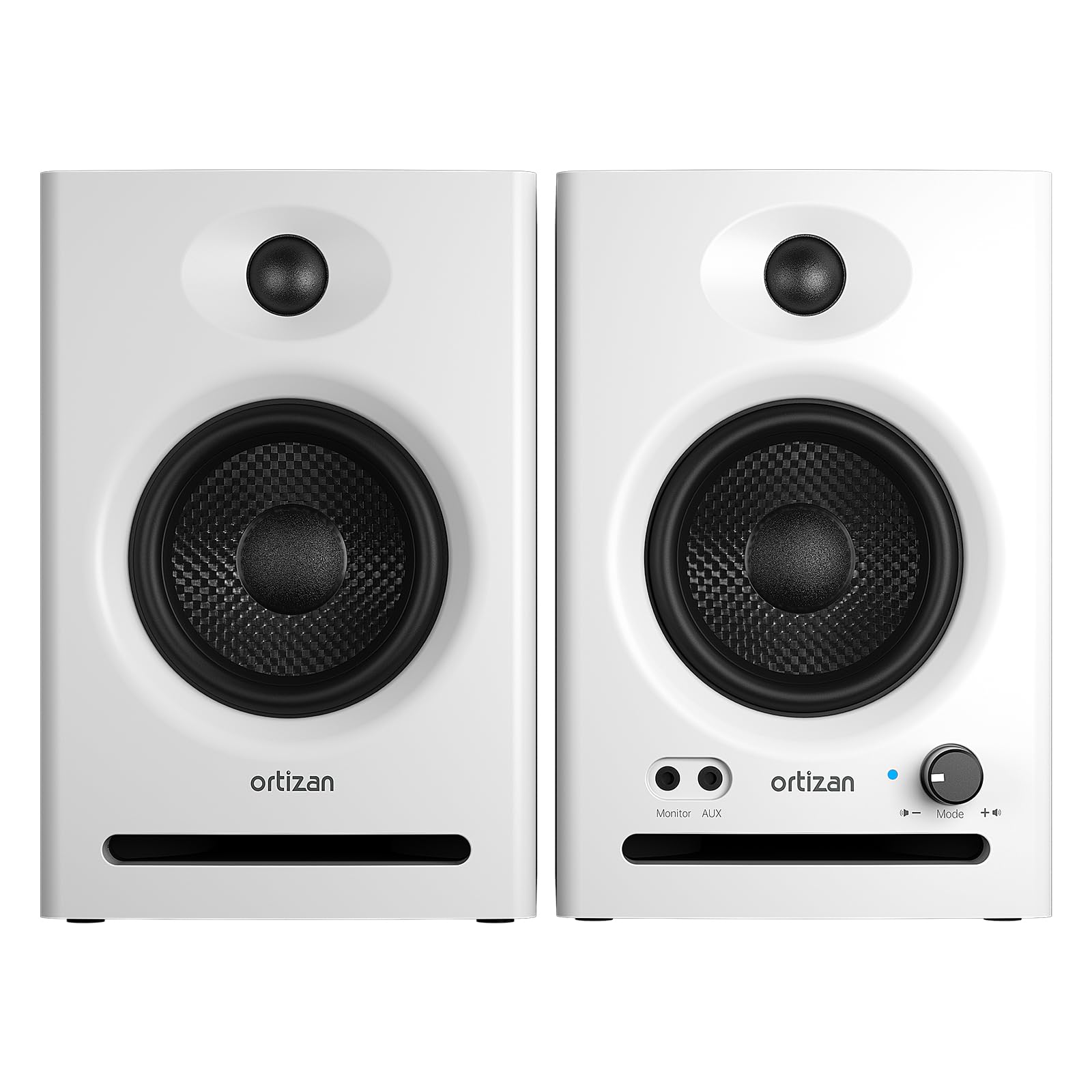
The Ortizan C7 targets the gap between casual PC speakers and professional studio monitors. A 3.5-inch carbon-fiber mid-bass driver with a 0.75-inch silk-dome tweeter, paired with an electronic 2-way crossover, produces a near-flat frequency response ideal for content creation and critical listening. The built-in 24-bit DAC over USB-C minimizes signal loss, making this pair suitable for music production and audio monitoring on a desktop.
Input versatility sets the C7 apart at this price: 6.35 mm TRS balanced inputs connect to mixing consoles or audio interfaces, while two AUX unbalanced inputs and a front-panel headphone output handle additional sources. Bluetooth 5.3 with an 18-meter range offers wireless flexibility for secondary device streaming. The Monitor/Music mode switch lets you toggle between flat response for production and slightly enhanced tuning for casual listening.
Bass extension is limited below 60 Hz, and a faint idle hiss is noticeable in silent rooms. The volume knob has slightly choppy increments rather than a smooth sweep. For gamers who also record or produce audio, the C7’s balanced connections and USB-C DAC make it a versatile tool that out-classes typical multimedia speakers.
Why it’s great
- TRS balanced input for studio gear integration
- 24-bit USB-C DAC for lossless digital audio
- Near-flat response with Monitor/Music mode
Good to know
- Limited bass extension below 60 Hz
- Faint idle hiss in silent environments
6. Bluedee Computer Speakers with RGB Lighting
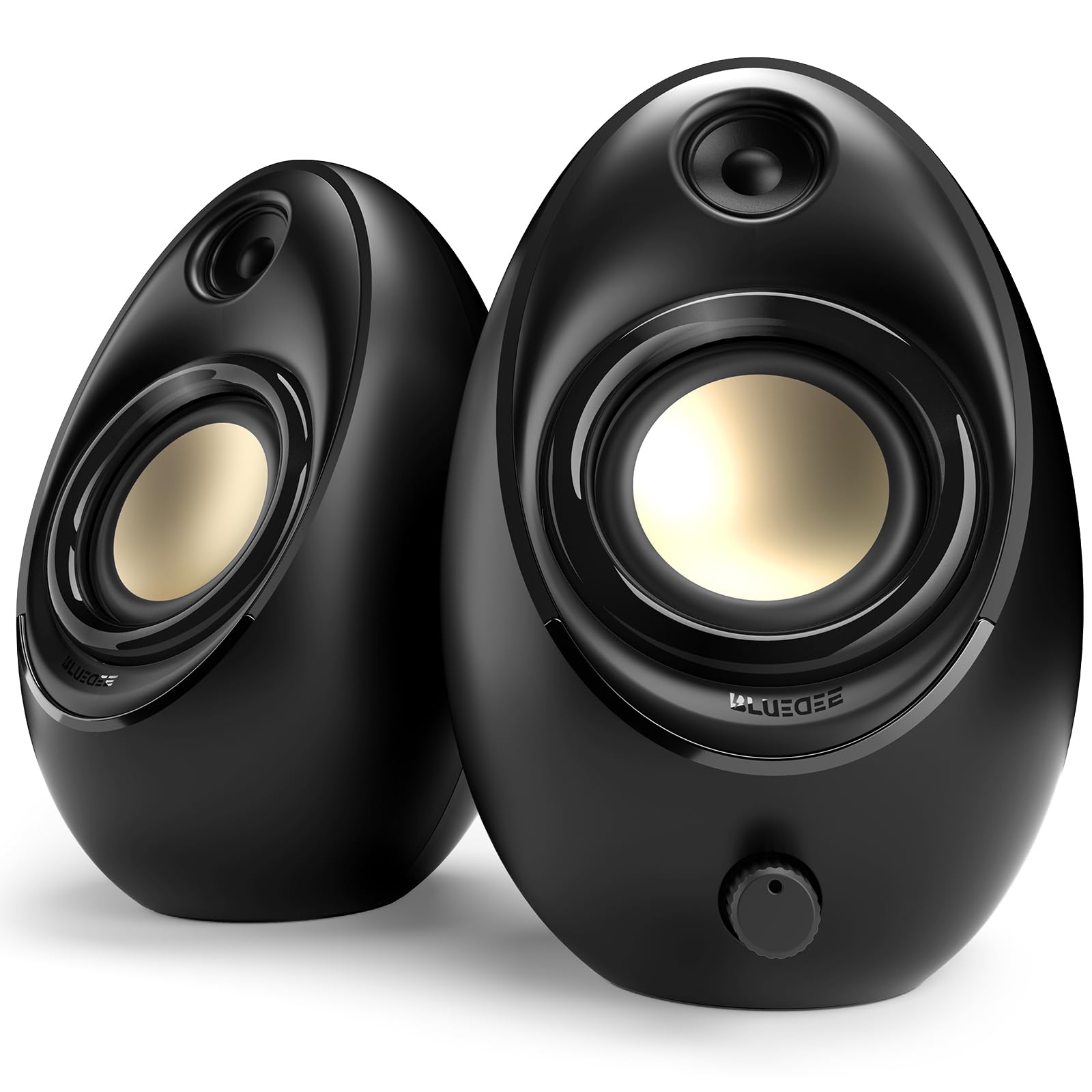
The Bluedee RGB computer speakers are a strong entry-level option for gamers who want aesthetic lighting without sacrificing audio fundamentals. The driver array includes two tweeters, two full-range drivers, and two passive radiators, producing clearer sound and more bass presence than typical single-driver budget speakers. The built-in DSP tuning smooths harsh highs and minimizes distortion, keeping the sound listenable at medium volumes.
The all-in-one control knob handles volume, play/pause, lighting effects, and input switching with intuitive feedback. Bluetooth 5.4 provides fast wireless pairing, while USB or USB-C connection offers true plug-and-play operation with PC, laptop, and Mac — no drivers needed. Eight RGB lighting effects plus an off option let you match the desk aesthetic without being stuck on a single pattern.
The inter-speaker cable length of about 50 inches may be too short for dual-monitor setups where the speakers sit at the outer edges. Bass, while improved over basic desktop speakers, still lacks the depth of larger woofer designs. For budget-conscious gamers who prioritize RGB customization and clean stereo sound, the Bluedee delivers solid value.
Why it’s great
- Dual tweeters and passive radiators for enhanced sound
- 8 selectable RGB lighting effects
- USB-C plug-and-play with no drivers
Good to know
- Inter-speaker cable short for wide monitor setups
- Bass lacks depth of larger woofer systems
7. Electrohome Huntley Powered Bookshelf Speakers EB10B

The Electrohome Huntley EB10B pairs a retro wood-cabinet aesthetic with surprising versatility for its entry-level price. Handcrafted MDF cabinets with a rear-ported design produce a warm, resonance-free sound profile that outperforms plastic budget speakers. The 3-inch dynamic drivers deliver balanced stereo audio suitable for casual gaming, music, and video streaming without the harshness common in ultra-cheap desktop speakers.
Connectivity options include RCA, AUX, and Bluetooth 5, allowing the Huntley to serve as a hub for PC, turntable, TV, or mobile devices — a rare degree of input flexibility at this tier. The touch controls on the front panel are responsive and clean-looking, while the included 8-foot speaker wire and 6-foot power cord give some flexibility in placement. The wood cabinets also reduce the hollow echo typical of budget speakers.
The 3-inch drivers lack the low-end punch to reproduce deep bass, and the touch controls can be slightly finicky without tactile feedback. High-volume playback reveals some compression in the upper frequencies. For buyers seeking an affordable 2.0 powered speaker with a classic look and multiple inputs, the Huntley EB10B offers a solid entry point.
Why it’s great
- MDF wood cabinets reduce resonance for warm sound
- Multiple inputs: RCA, AUX, and Bluetooth 5
- Aesthetic retro design suits various desk setups
Good to know
- Limited bass extension from 3-inch drivers
- Touch controls can feel unresponsive at times
FAQ
Is 2.0 better than 2.1 for desktop gaming?
Do I need an amplifier for passive 2.0 PC speakers?
What connectivity works best for low-latency gaming audio?
Can I use studio monitors as 2.0 PC gaming speakers?
What size woofer do I need for a 2.0 desktop setup?
Final Thoughts: The Verdict
For most users, the best 2.0 pc gaming speakers winner is the Edifier R1700BT because it pairs 66W RMS of clean power, silk-dome tweeters, and a wood cabinet into a package that outperforms everything in its price range without requiring an external amplifier. If you want smooth highs with adjustable EQ for fine-tuning your desktop sound, grab the IBALL·BOX 60W. And for content creators who need balanced TRS inputs and a flat frequency response, the Ortizan C7 Studio Monitors deliver the best value.