
Our readers keep the lights on and my morning glass full of iced black tea. As an Amazon Associate, I earn from qualifying purchases.
Specs are compiled from manufacturer listings and verified buyer reviews and can change over time — please confirm the key details on the product page before buying.
If your shoulders ache by mid-afternoon, the chair is usually the culprit — not your posture willpower. A fixed backrest forces your arms to float or your neck to crane, and both put strain on the shoulder girdle hour after hour. The fix is a chair that lets you move the headrest, the lumbar pad, and the armrests to match your actual body, so your shoulders can drop and stay there through a full workday.
I’m Min — the founder and writer behind Gadgets Feed. This guide is built by comparing the manufacturers’ published specifications and the patterns across verified customer reviews, so you get each pick’s real strengths and trade-offs instead of marketing spin.
Every model below pairs an adjustable headrest or shoulder-friendly arm support with a reclining backrest and breathable mesh. If you want the short answer, the Solviva Mesh Office Chair with Headrest is the strongest all-around pick, and it is the one I would point a shoulder-pain buyer to first. The rest of this guide breaks down exactly which chair for shoulder pain fits your body, your desk, and your budget.
Our Picks at a Glance
How To Choose The Best Chair For Shoulder Pain
Shoulder strain at a desk rarely starts at the shoulder. It usually starts lower — in a backrest that pushes you forward, a headrest set too low so you crane your neck, or armrests positioned where your elbows can’t rest at a right angle. Fix those three contact points and your shoulders relax on their own.
Start with the headrest, not the back height
A headrest that moves up, down, and rotates lets you rest your head without tipping your chin up or pushing your neck forward. On the Solviva chair, the headrest moves up, down, and rotates; on the CYKOV, the 4.72-inch headrest swivels 60 degrees so it follows your head through a recline. Skip a fixed headrest entirely if your neck is the source of your shoulder tension.
Check the seat depth against your leg length
If the seat pan is too long, the front edge digs into the back of your thighs and you slide forward, which rolls your shoulders in. A sliding seat fixes this: the ProtoArc EC200 offers 5 positions with 1.97 inches of travel, and the Branch Ergonomic Chair Pro builds seat position into its 14 points of adjustment. Short-statured buyers should treat seat depth as make-or-break.
Match armrests to your shoulder width
Armrests set too wide pull your shoulders outward all day. Look for armrests that move in and out as well as up and down — 3D arms move in three directions, 5D arms add more axes. The amseatec chair uses 5D flip-up arms, and the Branch Pro uses 5D arms that also pivot and reposition the pad. If you can’t narrow the arm gap, your shoulders pay for it.
Confirm the weight and height fit
Every chair here lists a supported body range. The nosaluro fits a 5.5 to 6.5 foot frame with a 350 LBS capacity, while the ProtoArc EC200 is calibrated for users 5’4″ to 6’0″ and under 220 lbs. Order outside your range and no amount of adjustment will rescue the fit.
Quick Comparison
| Model | Best For | Weight Capacity | Headrest Type | Recline Range | Amazon |
|---|---|---|---|---|---|
| Mesh Office Chair with Headrest (Solviva)★ Best Overall | All-around shoulder comfort | 300 lbs | Adjustable, rotating | 120° | Amazon |
| Humergo Ergonomic Chair with FootrestBest for Big and Tall | Big and tall users who recline | 365 lbs | 45° rotating, height-adjustable | 90°-145° | Amazon |
| amseatec Ergonomic Mesh ChairBest for Small Spaces | Small offices, flip-up arms | 350 lbs | 3D headrest | 4-level lock | Amazon |
| ProtoArc EC200 | Sliding-seat fit precision | Under 220 lbs (fit range) | 3D headrest | 4-stage, 90°-130° | Amazon |
| CYKOV Ergonomic Chair with Footrest | Long gaming sessions | 350 lbs | 4.72″ adjustable, 60° swivel | Up to 135° | Amazon |
| marrap Ergonomic Office Chair | Roomier seating | — | Adjustable | 90°-120° rocking | Amazon |
| MOLENTS Ergonomic Office Chair (Dawn Grey) | Shoulder-friendly 3D arms | 300 lbs | — | 90°-120° | Amazon |
| GABRYLLY Ergonomic Chair with Footrest | Tall users needing foot support | 300 lbs | 3-way adjustable | 90°-135° | Amazon |
| naspaluro High Back Chair | Big and tall recline comfort | 350 lbs | 3D headrest | Reclining high back | Amazon |
| GABRYLLY Big and Tall 215° Rotate | Flexible arm positioning | 350 lbs | 3D headrest, 3 modes | 90°-120°, 3-level lock | Amazon |
| Branch Ergonomic Chair Pro | Full-body fine-tuning | — | Sold separately | Smooth tilt & forward tilt | Amazon |
In‑Depth Reviews
1. Mesh Office Chair with Headrest, Lumbar Support, 3D Arms, Wide Seat (Solviva)
Our pick — over 4.5★ from 350+ verified ratings; the strongest balance of quality and price.
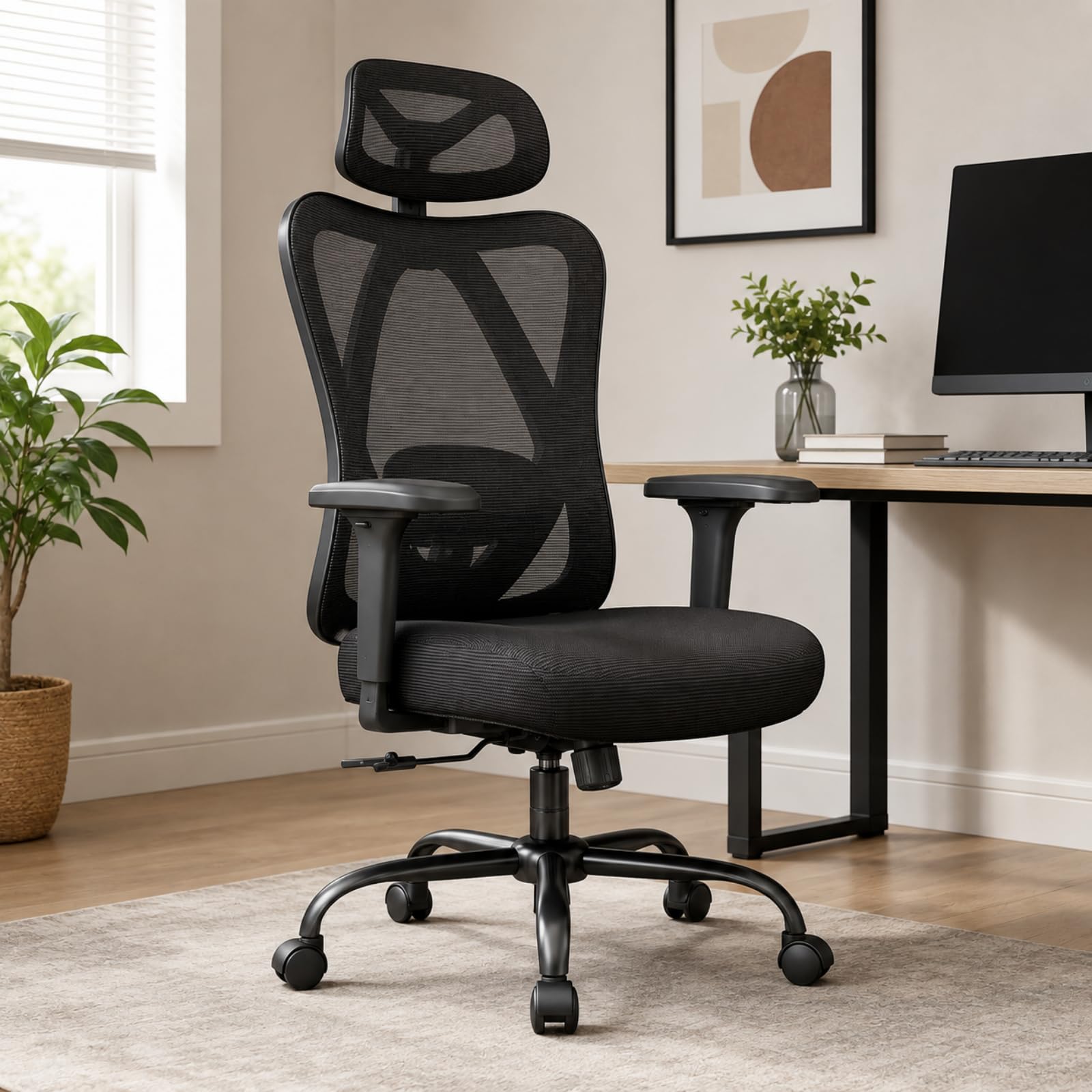
The Solviva Mesh Office Chair with Headrest and 3D arms is the pick that treats shoulder strain as a fit problem first.
Solviva’s chair sits at the top of this list because it solves the two things that quietly wreck your shoulders across a long desk day. Its headrest moves up, down, and rotates, so you can rest your head without tipping your chin or straining your neck — the posture that pulls your shoulder up toward your ear. The 3D armrests then move up, down, forward, backward, and side to side, letting you pull your elbows in and support them at a relaxed angle instead of letting your arms float all afternoon.
Beneath the support is a genuinely roomy build. A 20.67-inch backrest width gives your upper back somewhere to spread out, and the wide padded seat adds breathing room at the hips so you settle back instead of perching forward. The seat height also adjusts across a 2.96-inch range, enough to line your feet up flat and take the tension off your lower back.
What keeps you cool matters too. The breathable mesh back drives air through the panel so heat doesn’t build up behind your shoulders during long sessions — the same reason it holds up as a study or work chair.
what separates it
- Adjustable headrest moves up, down, and rotates
- 3D armrests adjust up, down, forward, backward, and side to side
- 20.67-inch backrest width for upper-back room
- 300 lbs capacity with SGS-certified gas lift and reinforced five-star metal base
- 120° reclining backrest with rocking function, tilt-tension control, and 360° swivel
Know this before buying
- Padding runs on the firmer side, so buyers who love a plush seat should sit in one first
- The 2.96-inch height range won’t suit every desk, especially for shorter users at a tall workstation
Reach for it if: you want one chair that gets the headrest, the lumbar, and the armrests right without stepping into premium territory.
Look elsewhere if: you need a deep recline angle — this one caps at 120°, and the footrest models below stretch further.
2. Ergonomic Office Chair with Footrest, 90-145° Reclining Mesh Desk Chair (Humergo)
The Humergo pairs a 365 lbs frame with linkage armrests that adjust themselves as you lean back.
If you’re taller or heavier than average, this is the build to look at first. Humergo rates it at 365 lbs on a reinforced heavy-duty nylon base with an SGS and BIFMA certified Class 4 gas lift, and it holds the widest weight ceiling on this list. That headroom matters for shoulders specifically — a chair that flexes under weight forces you to brace your upper body, and bracing is what tightens the shoulder line.
Your arms stay supported even when you lean back, thanks to synchronous linkage armrests (armrests that move with your body as you recline). As you lean back, they follow your arms up and change angle on their own, so your elbows, wrists, and shoulders stay on the pads instead of slipping off. Add a headrest that adjusts up and down and rotates 45 degrees, plus a movable crossbar that gives 2cm of depth adjustment on the lumbar pad (the lower-back cushion), and you can shape the fit to your spine instead of forcing your spine to fit the chair.
The reclining range runs from 90 to 145 degrees with a retractable padded footrest, so you can stretch out flat between tasks. Breathable racing mesh keeps air moving across your back, and the high-density polyurethane foam seat is built to hold its shape.
Where the money goes: the certified Class 4 gas lift and reinforced nylon base explain why this chair carries a bigger number than its neighbors — the safety certification and weight ceiling are the value.
The honest limit: the lumbar pad pushes you forward by 3 to 4 inches, and at 6 feet tall that leaves roughly 5 inches of leg unsupported even at the lowest setting. So if you’re tall and want your thighs fully cradled, measure carefully or size up.
The build for heftier frames: it carries the top weight rating here and self-adjusting arms keep your shoulders supported through a recline.
Not the fit for: taller users who need deep thigh support — the forward lumbar offset eats into leg room.
3. amseatec Ergonomic Mesh Office Chair, 5D Flip-Up Arms, 3D Lumbar Support
Flip-up 5D arms let this amseatec tuck away under a tight desk and free your shoulders when you want them free.
The amseatec earns its spot with the most adjustable armrest system here — 5D flip-up arms (armrests that adjust in five directions and fold fully upright). That flip matters for shoulder pain in two ways. Angled right, they support your elbows. Folded up, they get completely out of the way so you can pull straight to the desk and keep your shoulders square instead of rounding them around a fixed arm.
Support runs deep: 4D lumbar support, a 3D headrest, and a 4-level recline lock give you tailored support across your head, back, hips, and arms. It’s BIFMA certified with a 350 lbs load capacity, and the build stays stable with no wobble or noise. The frame uses a plastic base, and the chair’s compact dimensions suit a smaller office or a bedroom corner workstation.
The seat is thick high-density foam over three-dimensional breathable mesh, which keeps air circulating and cuts heat buildup across long sessions. High-resilience silent casters roll quietly on floors, and the whole thing assembles with included tools in about 20 to 30 minutes. It carries a 1-year warranty with customer support for repairs.
Why it earns its spot
- 5D flip-up arms fully fold away under the desk
- 4D lumbar support plus 3D headrest for full upper-body support
- BIFMA certified, 350 lbs capacity, stable with no wobble or noise
- Compact footprint for small offices and tight corners
Gripes worth knowing
- Recline tops out at a mild angle — one buyer wished it leaned back further
- Assembly manual uses diagrams only, so some steps take reading between the lines
Nicely done for tight rooms: the flip-up arms and compact body make it the friendliest fit where floor space is scarce.
Look past it if: you want a deep recline for napping — the angle stays modest.
4. ProtoArc EC200 Ergonomic Office Chair with Adjustable Seat Depth
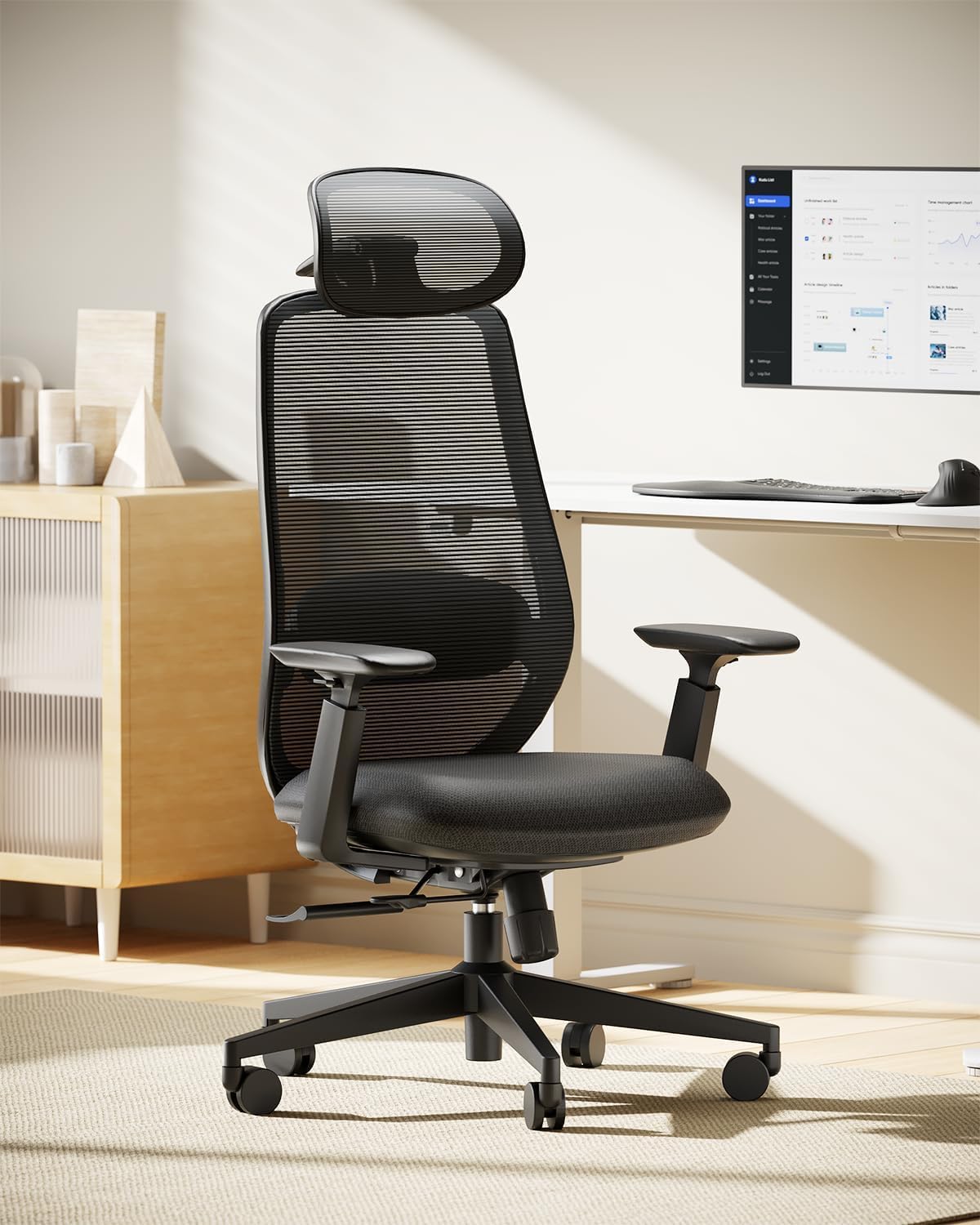
The ProtoArc EC200 slides its seat forward and back so your back stays against the lumbar pad and your shoulders stay relaxed.
Seat depth is the most overlooked shoulder-pain lever, and ProtoArc is built around it. The EC200 offers 5 positions with 1.97 inches of travel on the seat pan (the part you sit on), so you can extend it for long thighs or pull it in for a shorter frame while your back stays glued to the lumbar support. That stops you sliding forward and rounding your shoulders, the drift that builds neck and shoulder tension over eight hours.
The support is a genuine three-point system: adjustable lumbar, a high-tension mesh back, and a 3D headrest, all tuned for the natural curve of your spine. The lumbar block adjusts 2.36 inches in height and 0.8 inches in depth so it fills your lower back whether you’re upright or reclined.
The chair is calibrated for users from 5’4″ to 6’0″ and under 220 lbs, so the fit is more targeted than most here. The 55D foam cushion is built to resist collapse, and the reclining back locks at 90, 105, 120, and 130 degrees with a tension knob to fine-tune resistance. Assembly takes about 20 minutes with the included tools.
Where it shines: the sliding seat is rare at this level and the calibration for a specific height and weight range means the fit is deliberate rather than one-size-fits-all.
The catch: that targeted 5’4″–6’0″ fit is a hard ceiling — taller buyers report it running small, so measure before you commit.
Made for the 5’4″–6’0″ desk worker: sliding seat depth plus a 3D headrest and 4-stage recline put fit in your hands.
skip it if: you’re taller — the calibrated range tops out at 6 feet.
5. CYKOV Ergonomic Office Chair with Footrest, Reclining Mesh Back, 350 Lbs
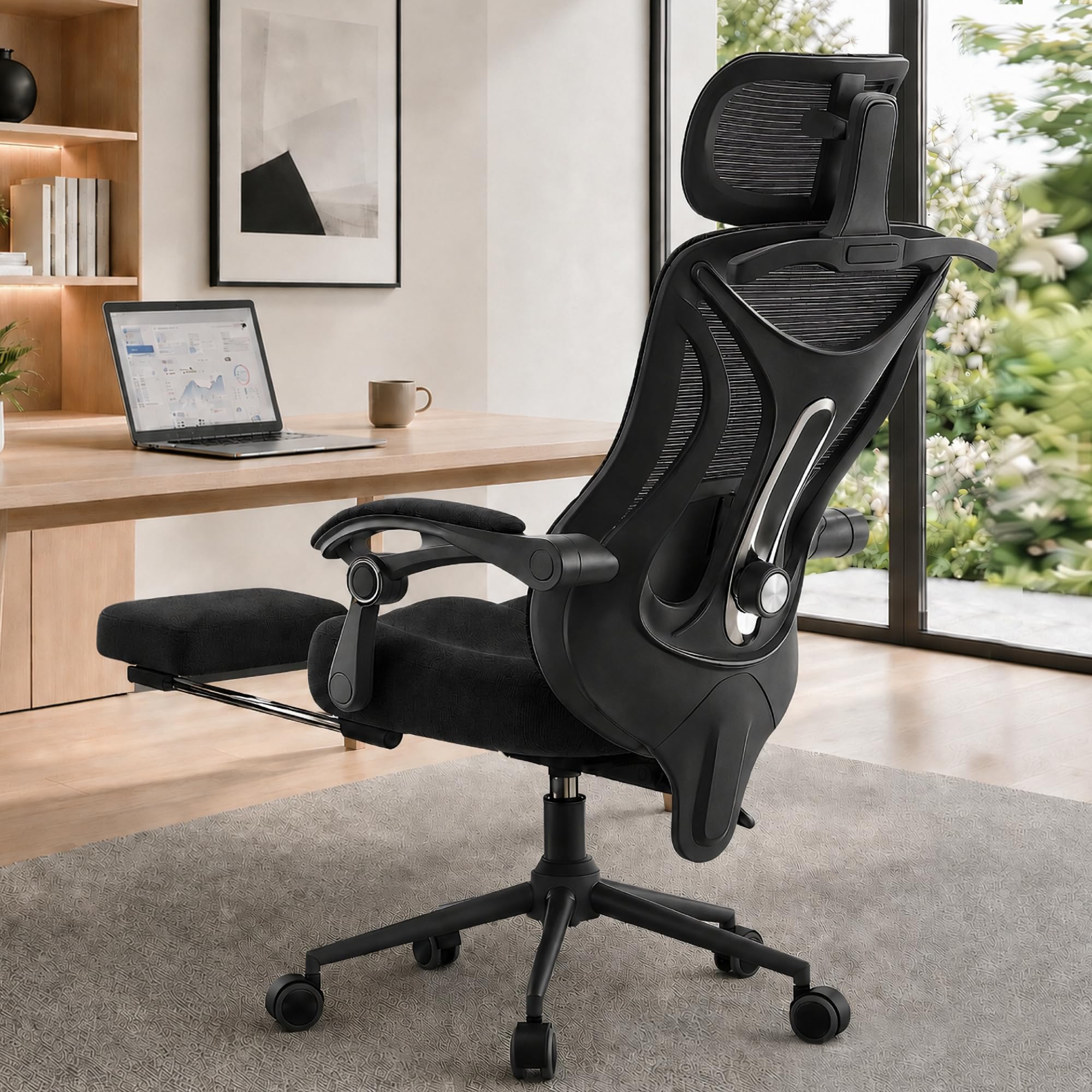
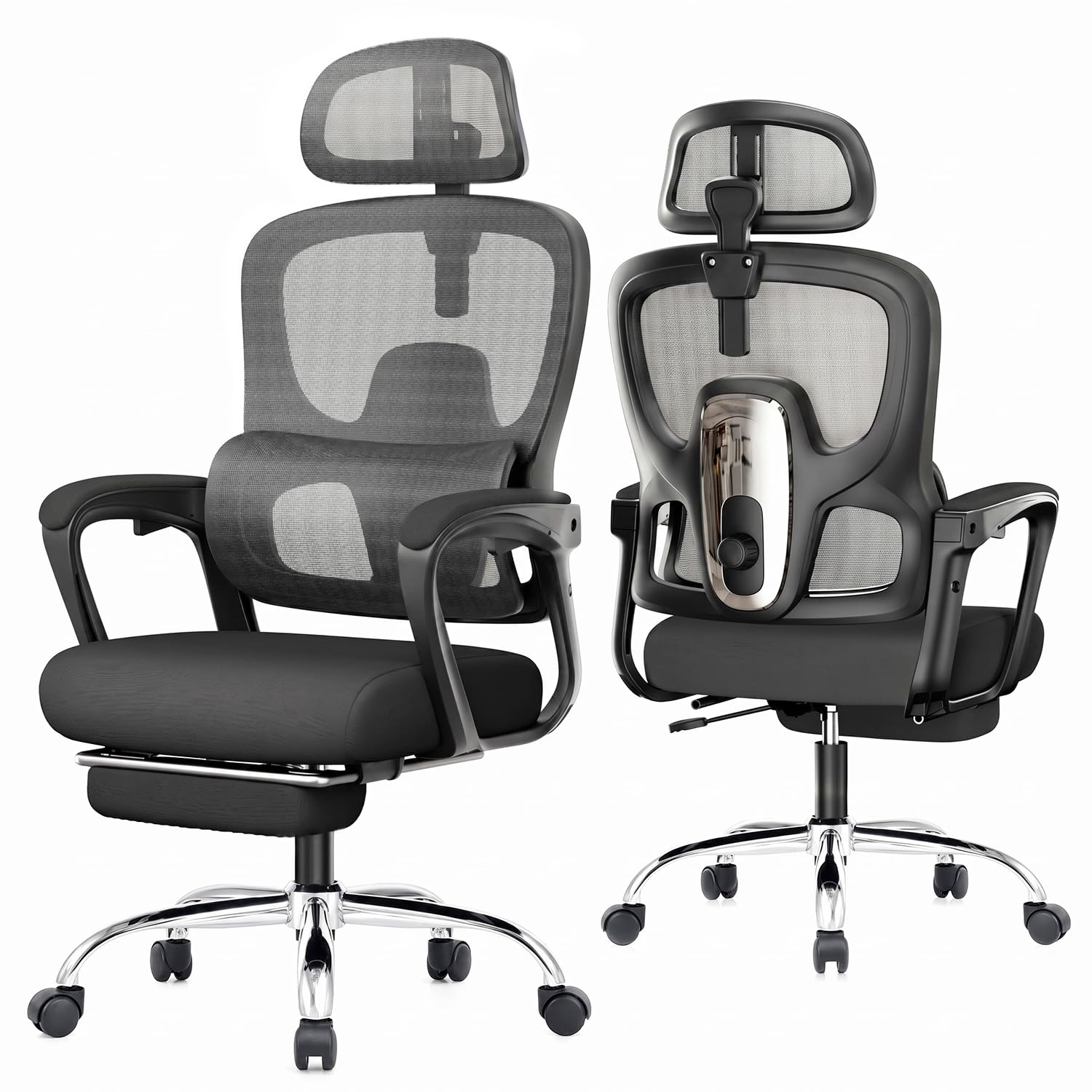
The CYKOV’s 4.72-inch headrest swivels 60 degrees to follow your neck at any recline angle.
For marathon desk days and gaming nights, CYKOV’s headrest does the heavy lifting on shoulder comfort. It’s a 4.72-inch adjustable headrest with 60 degrees of swivel, so it tracks your head as you lean back instead of leaving your neck to crane for support. The 2-way lumbar support adds 2 inches of height and 1.18 inches of depth adjustment so your lower back stays hugged.
The chair fits users from 5’1″ to 6’2″, a wider range than the ProtoArc, and carries a reinforced nylon base rated to 350 lbs. Pull out the retractable footrest, recline up to 135 degrees, and the chair shifts from focus work to a full stretch without an ottoman. The breathable mesh back keeps air moving where leather gaming chairs trap heat.
There’s a small extra that earns its keep: a built-in clothes hanger for your jacket or hoodie. Assembly uses pre-sorted hardware with illustrated instructions and a T-handle Allen wrench, and it’s backed by a 5-year structural warranty with replacement support.
The standout: the swiveling headrest moving with you at every angle is the most neck-friendly design on this list, and the 5-year structural warranty is the longest coverage here.
One thing to check: shorter users may find the seat hard to sit comfortably, so if you’re on the smaller side, confirm the fit before you buy.
Tuned for the 5’1″–6’2″ recline-and-relax set: a tracking headrest, 135-degree recline, and a long warranty.
Think twice if: you’re on the petite end of the height range — the seat runs deep for smaller frames.
6. marrap Ergonomic Office Chair, Adjustable Lumbar Support
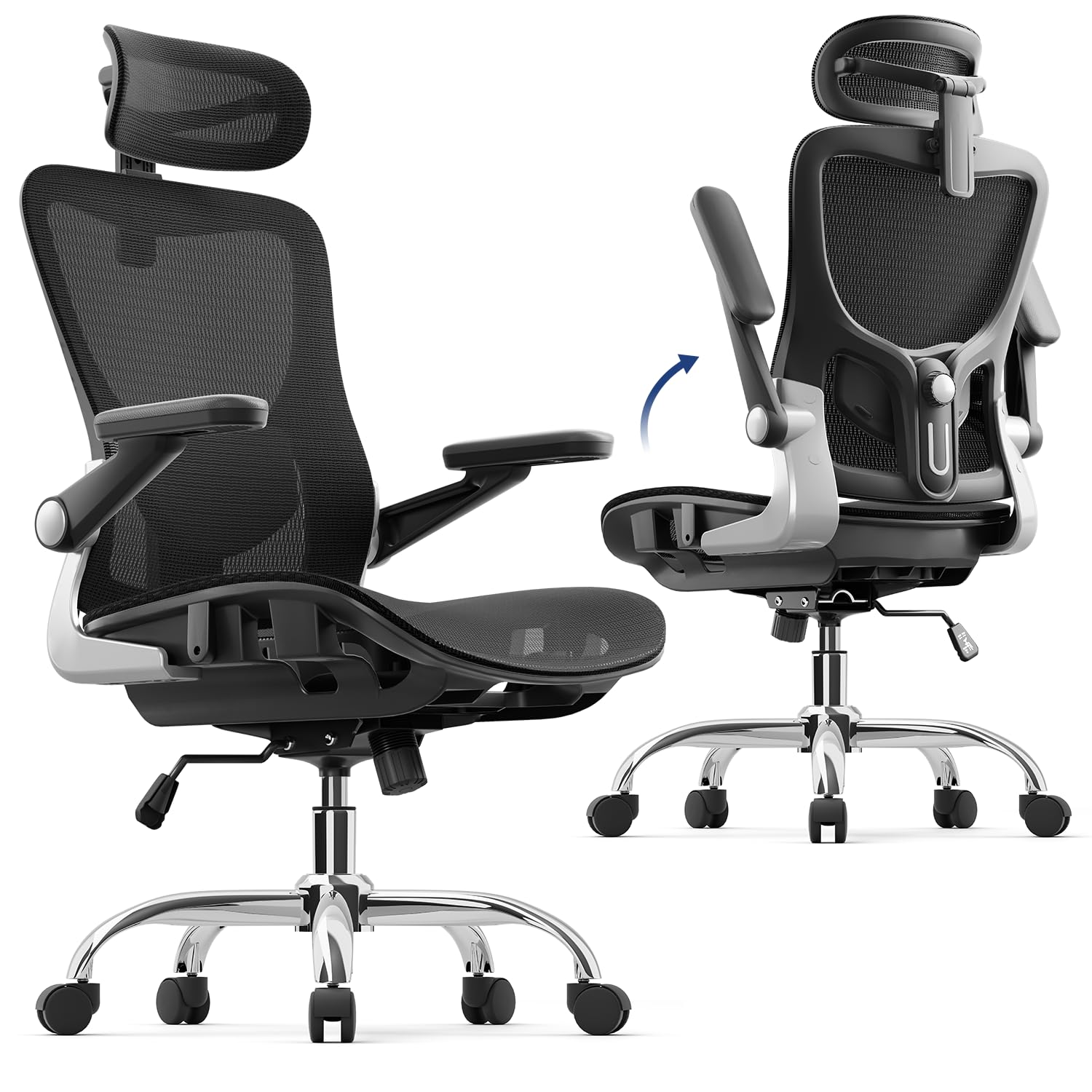
The marrap gives you more seat and back to spread into, with a rocking function, 3D armrests, and a headrest.
The marrap’s pitch is space. Its 20-inch depth and 22.03-inch width give your upper body somewhere to settle so you’re not scrunched into your shoulders, and the 39-inch height means the headrest sits where it should on a taller frame. Adjustable lumbar, adjustable headrest, and 3D armrests let you line up the three contact points that keep your shoulders down.
The backrest and headrest use high-breathability mesh to keep air circulating during long sits, and the blue cushion against the grey mesh gives it a look that stands out from the usual all-black chairs. It rolls on smooth wheels that move easily, and the 90 to 120 degree rocking function lets you shift position without standing up.
Assembly takes some time but the instructions are easy to follow. One caution worth flagging for households with small children: the small silver screw-hole pegs come loose during setup and are a choking hazard, so keep them away from little ones while you work.
What buyers like
- Wide 22.03-inch build with room to spread out
- Adjustable lumbar and headrest plus 3D armrests
- 90°-120° rocking function for quick position changes
- Breathable mesh back with a distinctive blue-and-grey look
Worth weighing
- It sits large — size down if your space or frame is small
- The armrest pads rotate a touch too freely on some units
A fit for the broad-shouldered sitter: extra seat and back width keep the upper body loose.
Not your chair if: you need a smaller footprint or tight, locked armrest pads.
7. MOLENTS Ergonomic Office Chair (Dawn Grey)
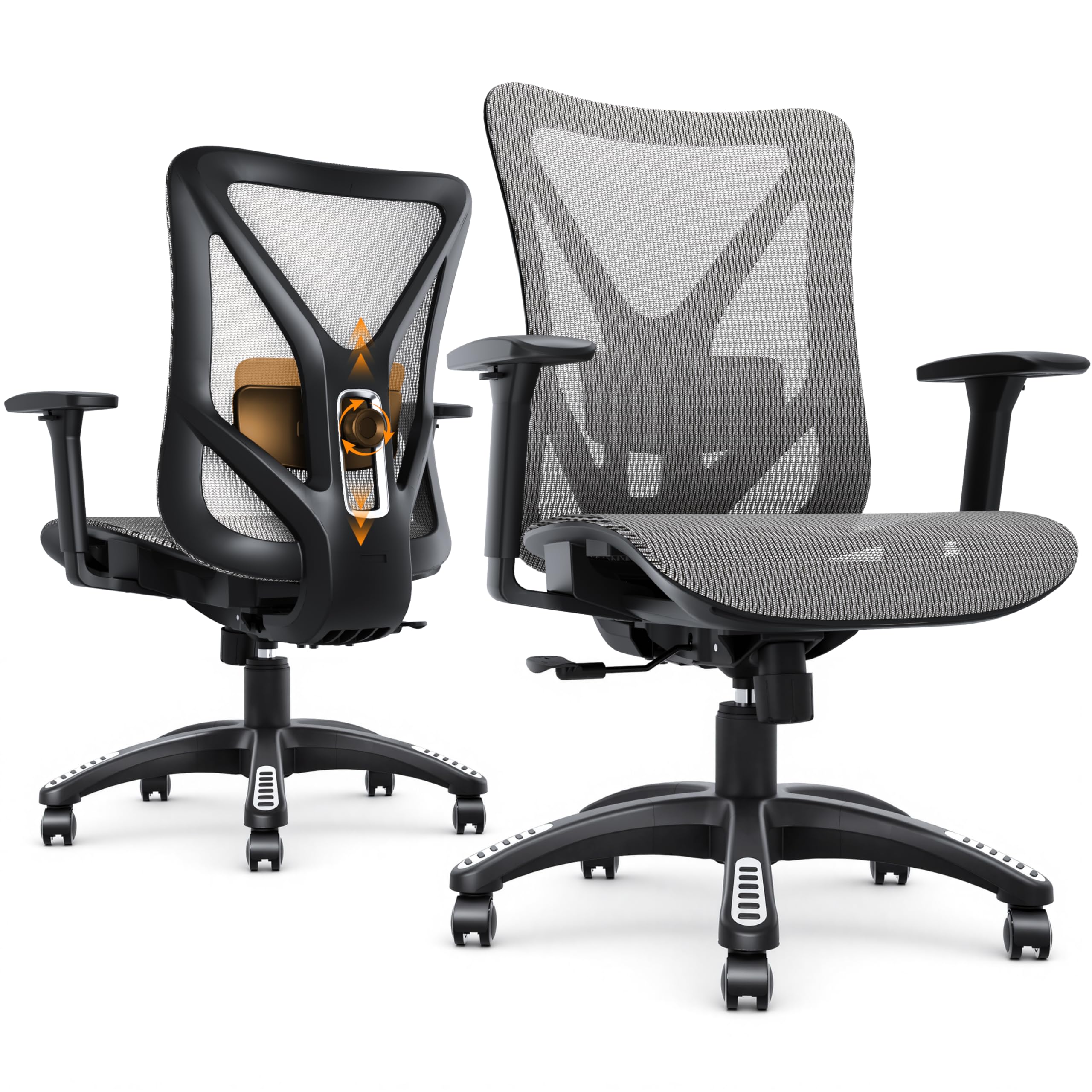
MOLENTS builds this chair around 3D armrests explicitly designed to take strain off your arms and shoulders.
MOLENTS names shoulders in the spec sheet itself: its 3D adjustable armrests are built to support your arms and shoulders and reduce strain through the workday. That’s the direct answer to shoulder pain — armrests that move in and narrow the gap to your body so your shoulders stop hanging. The lumbar support adjusts both up and down and forward and backward for tailored lower-back placement, and the tilt-back runs through three reclining positions from 90 to 120 degrees.
The mesh is high-elastic and breathable, which keeps you cool through long stretches, and the whole chair is BIFMA X5.1 certified for commercial-grade build quality. It’s rated to 300 lbs and designed for company offices and home studies alike, with a seated height range of 19.5 to 23.3 inches and a 19.8-inch seat width.
Heavier users get a bonus here: the chair rises higher than most — buyers standing 6 feet and beyond with a larger frame report it fits well with a roomy seat and no creaks. Assembly takes about 15 minutes with the included tools and manual.
The shoulder-first design: these are the only armrests in this guide the maker markets specifically for shoulder strain, and the BIFMA X5.1 certification (an industry durability and safety standard) backs the build.
What to know: the armrests slide when you pull the chair, and the lumbar adjustability is modest — if you want a deeply tunable lumbar pad, look at the ProtoArc or GABRYLLY instead.
The one made for shoulder strain: 3D shoulder-supportive armrests plus certified durability for heavy users.
Heads-up if: you want a lumbar pad you can fine-tune across a wide range — this one adjusts less.
8. GABRYLLY Ergonomic Office Chair with Footrest, 135° Reclining
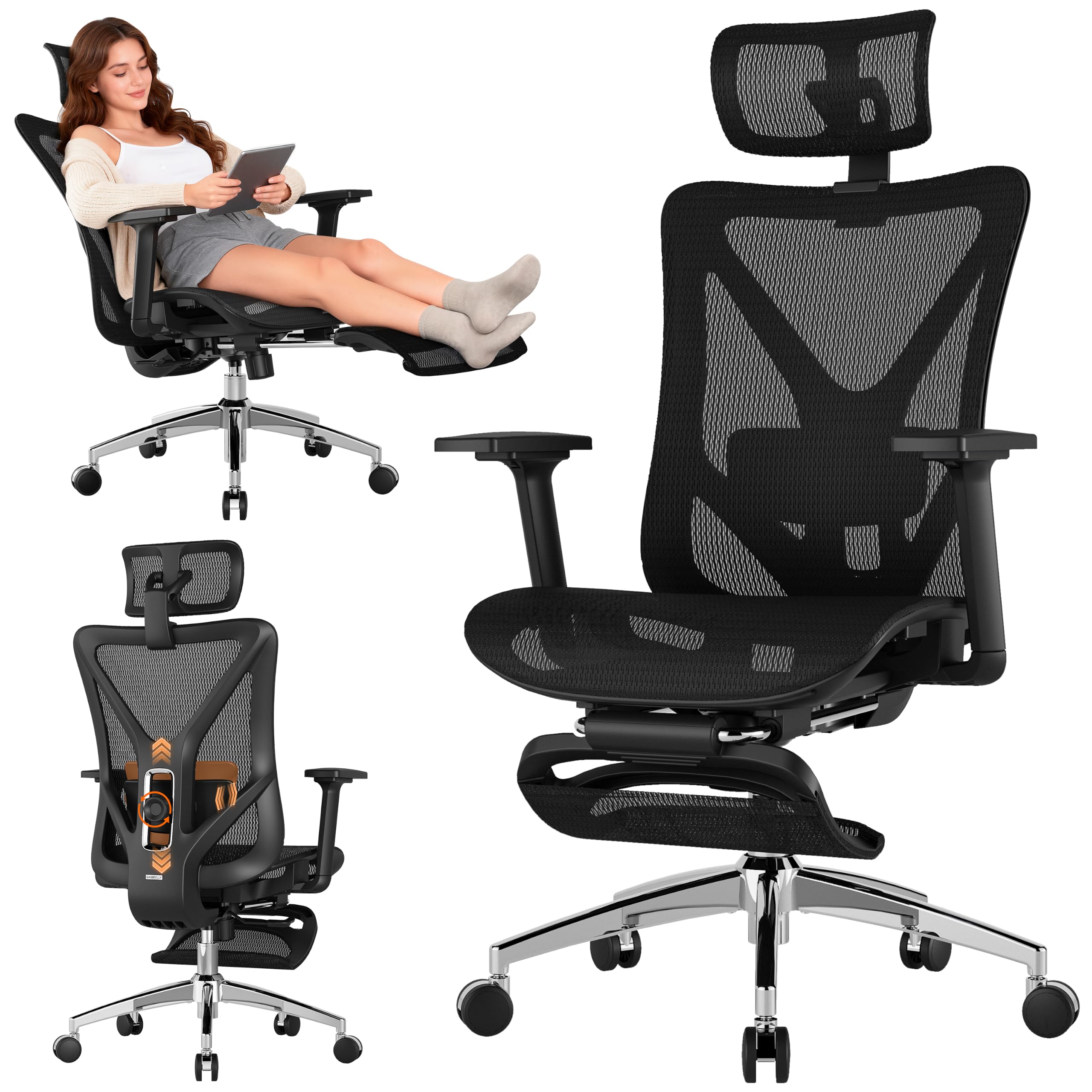
GABRYLLY’s 30-inch steel base and 3D arms give 5’3″–6′ users rock-solid support with a pull-out footrest.
GABRYLLY answers the tall-user question with size and stability. The chair fits users between 5’3″ and 6′ tall and rests on a large 27.5-inch steel base with silent wheels, which keeps it steady even when you recline fully or pull out the footrest. For shoulders, the key feature is a 3-way adjustable armrest that moves up and down, front and back, and in and out — supporting your arms so you’re not holding them suspended while you type.
Support runs through a 2-way adjustable lumbar pad with 3 inches of vertical and 1.6 inches of horizontal travel that conforms to your lower back, plus a large mesh headrest with three adjustments for height, angle, and bracket. The reclining back locks at 90, 110, and 135 degrees, and the retractable steel footrest extends up to 18.1 inches for napping or a stretch between tasks.
It’s rated to 300 lbs, professionally tested by SGS and BIFMA, and backed by a 3-year parts warranty. Assembly takes 15 to 25 minutes with the included Allen wrench and screw kit.
What stands out
- Large 27.5-inch steel base for stability through a full recline
- 3-way adjustable armrests plus a 3-adjustment mesh headrest
- Footrest extends up to 18.1 inches for full-leg support
- 3-year parts warranty, longer than most here
Worth flagging
- Wheels don’t roll as smoothly as owners expect on some floors
- The mesh seat runs scratchy for a few buyers, who add a cover
Fits the 5’3″–6′ tall desk sitter: a wide steel base, deep recline, and a footrest that turns a break into a rest.
Lean away if: smooth flooring glide matters most to you — the casters can drag.
9. naspaluro Ergonomic Office Chair High Back, Grey
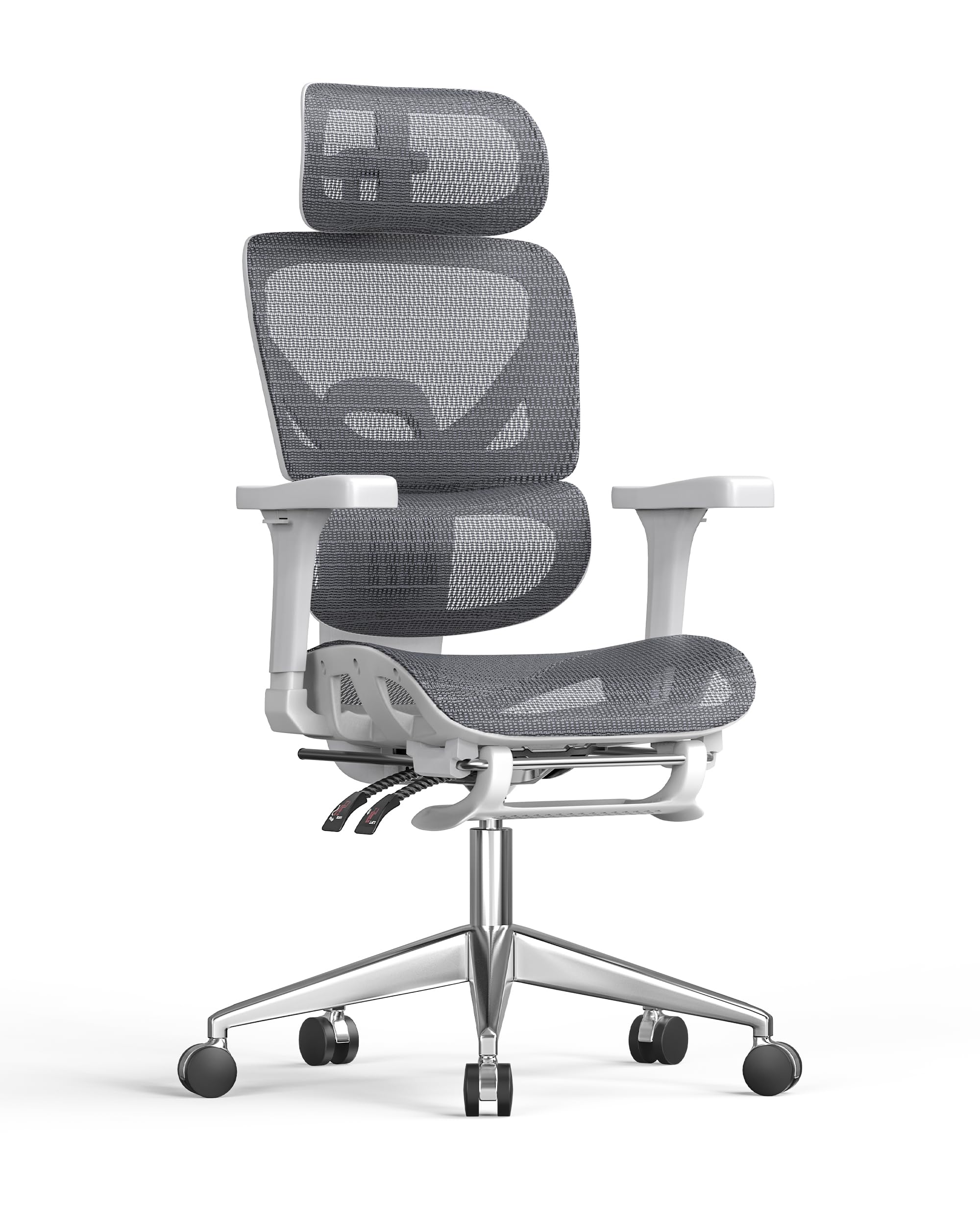
The naspaluro engineers a 3D headrest and 3D armrests specifically to relieve neck and shoulder tension.
naspaluro’s selling point is tailored neck and shoulder relief. Its 3D headrest (adjustable in three directions) tilts, raises, and lowers to cradle your neck, while the 3D armrests adjust in height, width, and angle to align with your shoulders and arms — the two contact points that decide whether your upper body stays relaxed. Adjustable lumbar and customizable seat height round out the fit so your feet rest flat and your lower back stays supported.
For larger bodies, the chair carries a 350 lbs weight capacity with a 5.5 to 6.5 foot height fit, making it a genuine big-and-tall option. The high back wraps around your upper body when you recline, supporting shoulders and spine together.
A hidden footrest lets it switch from a work chair to a relaxation spot, and the pull-out rest improve your legs for a stretch. It rolls on wheels and comes with a swivel base for easy movement.
The fit range: a 5.5–6.5 foot height window and 350 lbs capacity is one of the broadest big-and-tall spans in this guide.
The one thing to know: the lumbar support is fixed rather than adjustable, and for some body types it presses without repositioning — so if you want a moving lumbar pad, this isn’t your chair.
Suits the larger frame: 3D headrest and 3D arms align to broad shoulders across a wide height and weight range.
Pass on it if: you need a lumbar pad that slides and adjusts — this one is set in place.
10. GABRYLLY Big and Tall Mesh Chair, 215° Rotate 3D Armrest

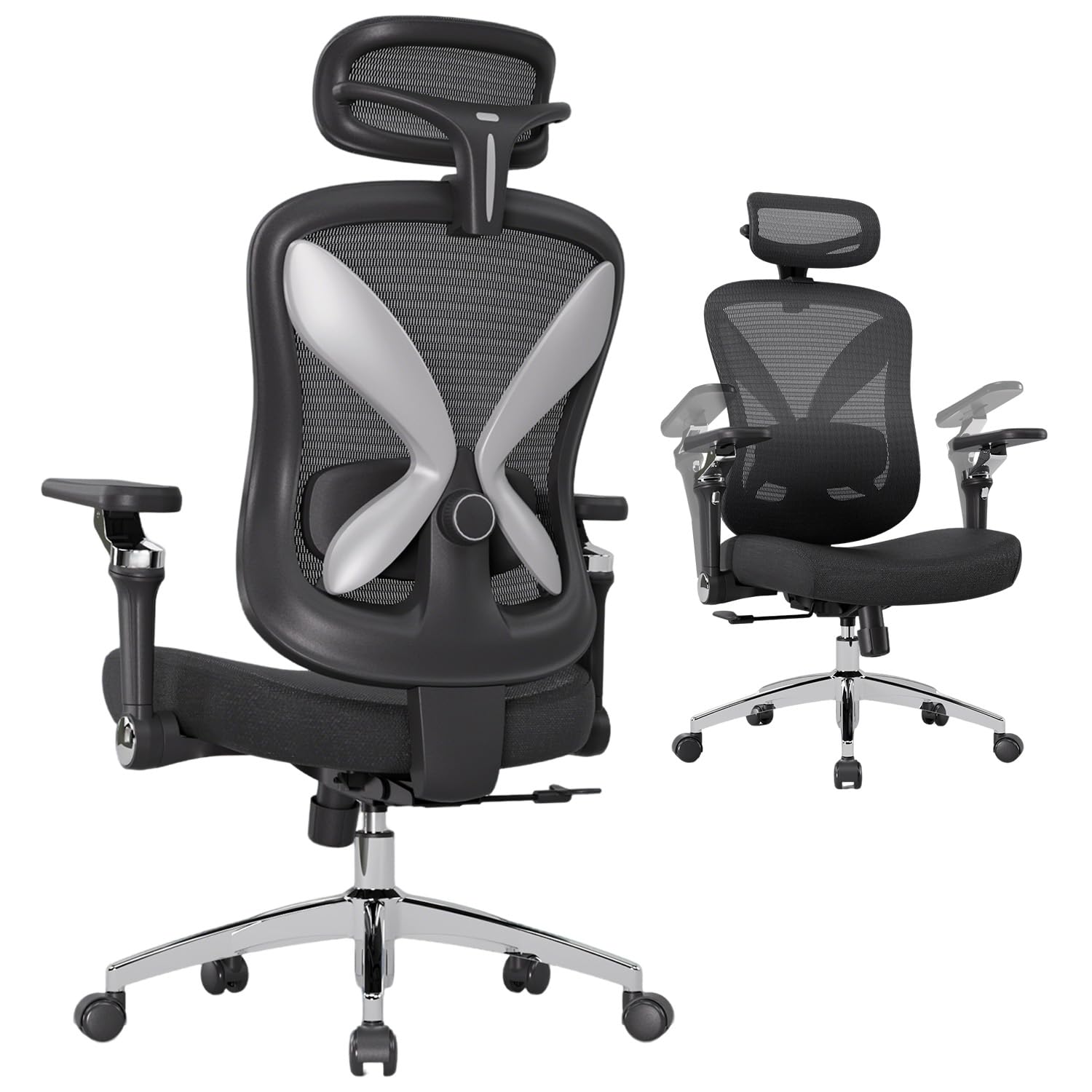
This GABRYLLY’s armrests rotate a full 215 degrees so your elbows never fight the desk.
Arm geometry is this GABRYLLY’s calling card. Its 3D armrests rotate through 215 degrees and adjust up and down, front and back, and inward, so you can fit them to your desk height and support your elbows, arms, and wrists while typing or gaming. For shoulder pain, that wide rotation range is the difference between arms propped in support and arms hanging off the edge all day. The double-back design adds lumbar support that follows your body’s curve.
This is a generously sized chair — the backrest runs 29.5 inches wide, and the seat measures 20.5 inches wide by 20.5 inches deep. It’s recommended for users from 5’5″ to 6’3″, rated to 350 lbs, and rides on an upgraded steel base tested to BIFMA standards. A 3D headrest adjusts across three modes for height and angle, and the backrest tilts and locks in three positions between 90 and 120 degrees.
The high-quality double-layer mesh resists wear and deformation and is easy to wipe clean. Assembly takes about 25 minutes with all tools included, and it carries a 2-year warranty with manufacturer support for parts.
Why it’s here: a 215-degree armrest rotation is the widest arm range in this guide, which matters when you want your shoulders square rather than rotated forward.
The trade-off: at 29.5 inches wide it’s a big chair that wants space, and a few buyers find it heavier to move across carpet.
Built for the 5’5″–6’3″ heavy user: 215-degree rotating arms and a 350 lbs steel base make it sturdy and shoulder-friendly.
Think again if: your desk corner is tight — this chair needs room around it.
11. Branch Ergonomic Chair Pro, Mesh Office Chair with 14 Points of Adjustment
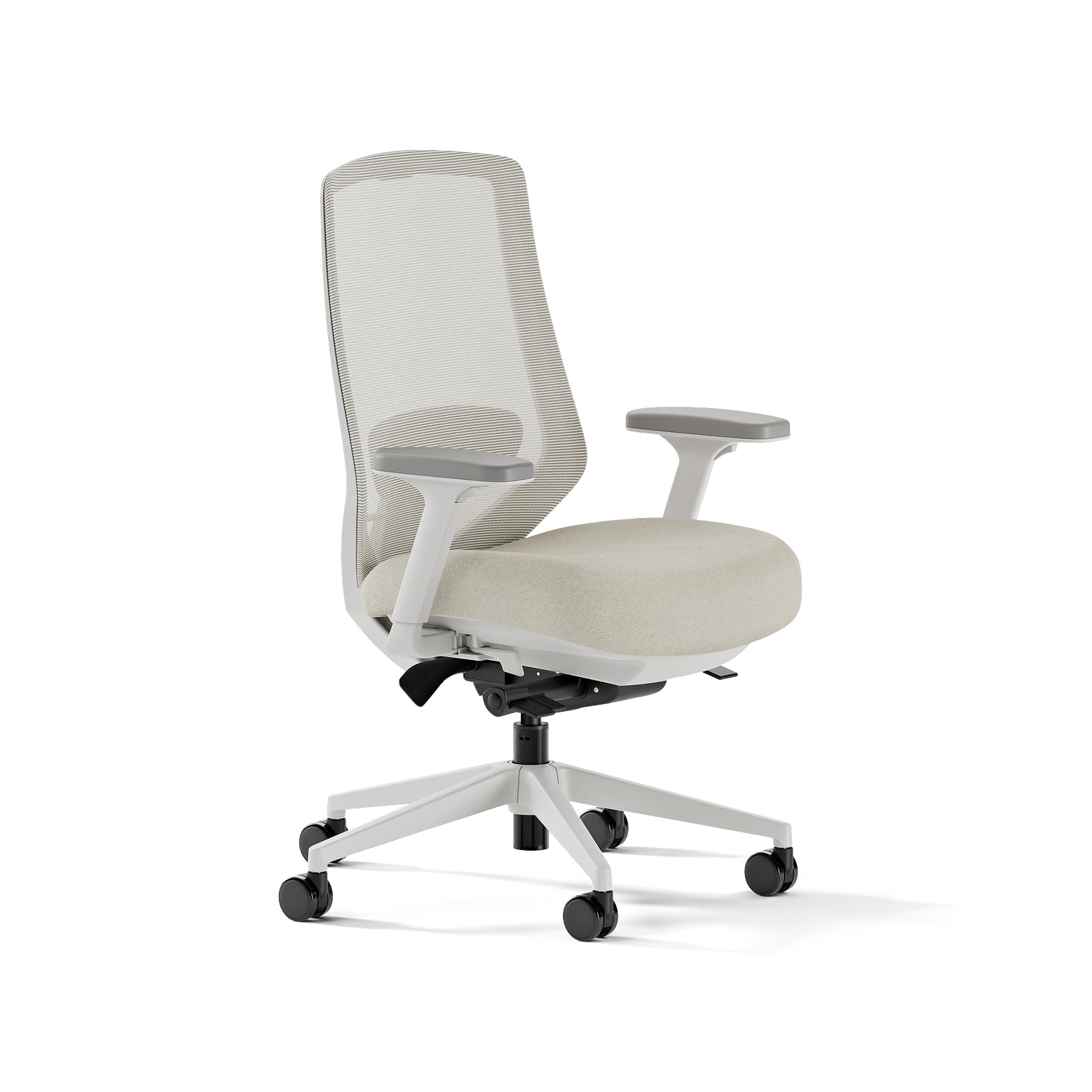
The Branch Pro spreads customization across 14 points so you can dial in your body inch by inch.
Branch takes a different approach from every chair above: instead of one hero feature, it gives you 14 points of adjustment. That breadth is the shoulder story — you can tune the armrests, the lumbar, the seat, and the tilt until your upper body sits exactly where it should. The lumbar cushion is padded and two-way adjustable, moving vertically to fill your spine’s curve, and the 5D armrests move in height, width, depth, pivot, and pad position for genuinely personalized arm support.
The seat uses molded high-density foam built to hold its shape through the workday, and the tilt system is smooth with tension control plus a forward tilt setting that supports active sitting and posture shifts. The frame is aluminum for a durable, light-feeling build.
It’s the only pick here that sells the headrest separately, so factor that into your decision if you want neck support. Assembling it takes about an hour, and the included instructions and tools make it manageable for one person.
What justifies the tier
- 14 points of adjustment for a truly personalized fit
- 5D armrests move in five ways including pad position
- Two-way lumbar cushion plus forward-tilt seat
- Aluminum frame with molded high-density foam
Before you commit
- No headrest included — it’s sold separately
- Cushion and lumbar padding run firm, which some prefer and others don’t
The top-tier tuner: 14 adjustment points and 5D arms make it the most customizable chair here for chasing an exact fit.
Hold off if: you want a headrest from the start — this one sells it as an add-on.
Understanding the Specs
Headrest adjustability
A headrest you can raise, lower, and tilt is the single most useful feature for shoulder pain. It lets you rest your head without pushing your neck forward, which is what keeps your shoulders from creeping up. Models here range from a simple height-adjustable headrest to the CYKOV’s 4.72-inch, 60-degree swivel unit and the ProtoArc’s 3D headrest. If a chair lists a fixed headrest, treat neck support as the weak link — the Branch Pro avoids the issue by selling its headrest separately.
Armrest dimensions
Armrests that move in only one or two directions force your shoulders into a fixed angle all day. The more axes an armrest moves on, the closer you can bring the pads to your body and the more you can unload your shoulders. The scale rises from standard arms to 3D arms that move in three directions, then 5D arms that add pivot and pad repositioning. At the top end, this GABRYLLY’s 3D arms rotate 215 degrees.
Seat depth and sliding seats
Seat depth decides whether you can sit back against the lumbar pad or get pushed forward into a hunch. If the pan is too long, the front edge digs into your thighs; too short, and your back leaves the support. A sliding seat solves it — the ProtoArc EC200 offers 5 positions with 1.97 inches of travel. Buyers at either end of the height range should check seat depth first.
Weight capacity and height fit
Every chair lists a supported body range, and stepping outside it undoes the best engineering. Weight capacity tells you how much the base, gas lift, and frame are built to hold; height fit tells you whether the headrest will land on your neck and your feet will touch the floor. The Humergo tops out at 365 lbs, the MOLENTS supports 300 lbs, and the naspaluro fits a 5.5 to 6.5 foot frame at 350 lbs. Match both numbers to your body before anything else.
FAQ
Will an adjustable headrest actually help my shoulder pain?
How do I know a chair’s weight capacity fits me?
Does seat depth matter for shoulder tension?
What is the difference between 3D and 5D armrests?
How much recline is useful for shoulder relief?
Can a chair that fits big and tall users still suit smaller buyers?
Is a mesh back better than a padded back for long sitting?
Should I buy a footrest chair if I want shoulder support?
How long does assembly usually take on these chairs?
Do armrests really affect shoulder pain or is posture the whole story?
Final Thoughts: The Verdict
For most desk workers fighting upper-body tension, the chair for shoulder pain to buy is the Solviva Mesh Office Chair with Headrest, because it gets all three shoulder contact points right — a headrest that rotates, 3D armrests that move five ways, and adjustable lumbar support — behind a 120-degree recline and breathable mesh. If you carry more weight and want the widest weight ceiling here, reach for the Humergo Ergonomic Chair with Footrest and its self-adjusting linkage arms. And if your shoulders need the most arm control money can buy, the Branch Ergonomic Chair Pro and its 14 points of adjustment put every contact point in your hands.
How We Picked
We do not accept paid placement. Every pick is matched to a real buyer and a real use-case; we do not hands-on test units.
Sources & Methodology
Specifications: manufacturer listings and product documentation. Review insights: verified customer reviews, as of September 2026. Pricing: not shown on this page (it changes often); check the current price via the retailer link.
As an Amazon Associate, Gadgets Feed earns from qualifying purchases. This does not affect which products we feature.