
Our readers keep the lights on and my morning glass full of iced black tea. As an Amazon Associate, I earn from qualifying purchases.
Specs are compiled from manufacturer listings and verified buyer reviews and can change over time — please confirm the key details on the product page before buying.
Soundproofing almost never fails because your walls are too thin — it fails because of the gaps you cannot see. Sound leaks through the seams where drywall meets the floor, around electrical outlets, along window and door frames, and through the holes cut for pipes and cables. Acoustic caulk is the product that plugs those leaks, and it is the cheapest step in any soundproofing project. Get the sealant right and a modest wall build can go quiet. Get it wrong and you have spent a weekend sealing nothing.
I’m Min — the founder and writer behind Gadgets Feed. This guide is built by comparing the manufacturers’ published specifications and the patterns across verified customer reviews, so you get each pick’s real strengths and trade-offs instead of marketing spin.
Not every tube sold as a sound sealant is actually rated for acoustical work, and the difference shows up in how the cured bead behaves years later. Below you will find a clear, plain-English breakdown of the best acoustic caulk for soundproofing, covering what each tube really seals, how much ground it covers, and where the honest trade-offs sit. Every pick here is a genuine acoustical sealant, ranked so you can match one to your wall, your gaps, and your caulk gun.
Our Picks at a Glance
How To Choose The Best Acoustic Caulk For Soundproofing
Buying acoustic caulk is mostly about matching three things to your project: the size of the gaps you are sealing, the tool you already own, and how much wall you have to cover. Everything else — colour, odour, cleanup — is secondary. Here is what actually changes your result.
Decibel Ratings And What They Mean In A Room
Some tubes publish an average noise reduction figure in decibels, written as dB. A decibel is simply a unit for measuring how loud a sound is. A tube rated for sound deadening within a stated frequency band is telling you how much it reduces noise once cured, not how quiet your room becomes — the wall assembly does the rest. Treat a dB number as one input, not a promise. Your drywall layers, insulation, and how well you seal the seams together decide the final result.
Tube Size, Coverage, And The Gun You Will Need
Acoustical sealant comes in small cartridges and in large tubes. Small cartridges in the 9-to-10 fluid ounce range fit a standard handheld gun and suit outlet boxes, baseboard gaps, and small touch-ups. Large tubes in the 28-to-29 ounce range hold far more sealant and are the practical choice for perimeter seams on a full room — but they need a bigger, higher-capacity caulk gun. One large tube can cover a substantial run of seam, so check the stated coverage before you buy six of them.
Why Flexibility After Curing Is The Real Test
A wall moves. Wood framing swells with humidity and shrinks in winter, and a sealant that dries hard can crack right at the joint it was meant to close. That is why acoustical sealants are formulated to stay permanently flexible and to keep stretching with the substrate. A bead that goes brittle is a bead that opens a new sound leak, which is the opposite of what you paid for.
Sealing Is A System, Not A Single Tube
Sealant works alongside other materials, not instead of them. Owners who report the biggest gains describe combining a sound-rated sealant with added drywall layers, insulation, and putty pads behind electrical boxes. If you seal every gap and still hear your neighbour, the leak is usually in the assembly above or below the sealant, not the sealant itself.
Quick Comparison
| Model | Best For | Volume Per Unit | Units Included | Cure Time | Amazon |
|---|---|---|---|---|---|
| Green Glue Noiseproofing Sealant Caulk★ Best Overall | Whole-room perimeter sealing | 28 oz tubes | 6 tubes | 7 days | Amazon |
| Donseal GA777-AC 2-PackBest Value | Small gaps and detail work | 9.5 fl. oz. | 2 cartridges | 24 hours | Amazon |
| TMS Acoustical Soundproofing Caulk | A single room on a budget | 28 fluid ounces | 1 tube | — | Amazon |
| Sika SikaSeal Fire Guard | Pipe and cable penetrations | 295 ml | 1 cartridge | — | Amazon |
| St. Gobain Green Glue Noiseproof Compound | Between drywall layers | 28 Ounce | 1 tube | 30 days | Amazon |
| OSI SC-175 Draft and Acoustical Sealant | Large multi-room builds | 28 oz | 12 tubes | — | Amazon |
In‑Depth Reviews
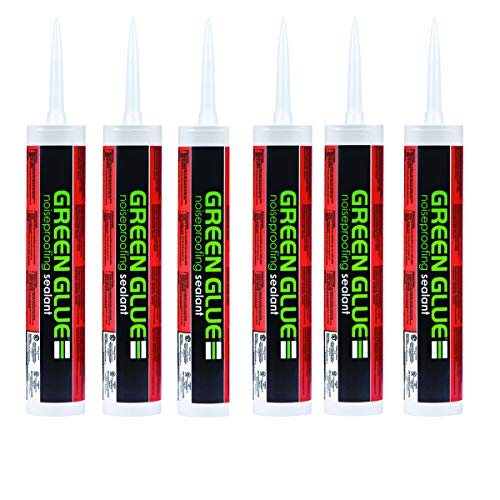
1. Green Glue Noiseproofing Sealant Caulk – Pack of 6 Tubes (28 oz Each) – with Cleanup Wipes
Our pick — over 4★ from 300+ verified ratings; the strongest balance of quality and price.
Six large tubes of paint-ready sealant — enough to run a whole room’s perimeter without stopping to reorder.
If your project is a full room rather than a couple of outlet boxes, this is the pack that keeps you working. You get six 28 oz tubes, each one carrying a nozzle, plus cleanup wipes and an installation guide in the box. The six-tube count alone puts this well ahead of single-tube options: the TMS Acoustical Soundproofing Caulk ships as one tube against this six, and the Donseal 2-pack gives you two cartridges. For a room with a continuous perimeter seam, having six tubes on the shelf is the difference between finishing this weekend and waiting on a delivery.
The sealant is white and paintable, so it disappears under a coat of wall paint once it is dry. It is built to close the spots where sound actually escapes: the perimeter and corners where wall meets ceiling, and the gaps around outlets. Full cure runs seven days, which is standard for a sound-rated sealant and slower than the 24-hour cure on the Donseal cartridges. Plan your project around that week rather than expecting an overnight result.
What wins people over is simple — it works. Buyers report that neighbours’ voices stop being intelligible and a TV through the wall becomes unrecognisable. The most repeated caveat is honest and worth repeating: this is not a soundproofing magic wand. A hardwood floor still transmits footfall, and one buyer chasing a full acoustic result found that a 0.16 kg tube weight and a proper bead only help as part of a bigger build.
Where It Earns Its Keep
- Six 28 oz tubes with nozzles means one order covers a full room perimeter
- Paintable white finish blends into any wall once fully cured
- Seals the high-value leak points: perimeter seams, corners, and outlet gaps
- Cleanup wipes and an installation guide come included
What The Owners Warn About
- Seven-day full cure is patient work — the Donseal 2-pack sets in 24 hours by comparison
- You will need a large caulk gun rated for these bigger tubes
- Durability is the weak spot here, with tubes not always arriving in usable condition
- It reduces intelligible neighbours; it will not silence a hardwood floor
Go with it if: you are sealing a whole room and want enough sealant in one order to finish the job without a second shipment.
Check the gun first: these large tubes need a heavy-capacity caulk gun, and a standard handheld one will not push them.
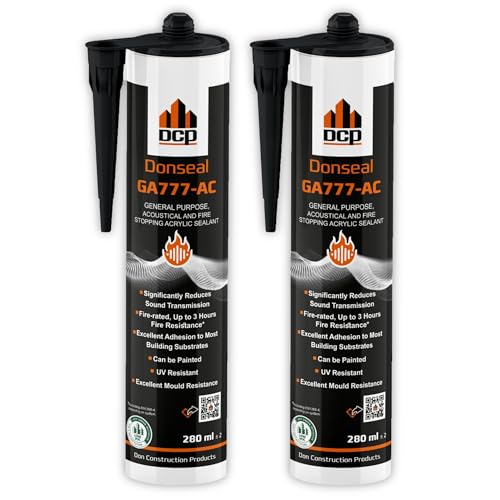
2. Donseal GA777-AC 2-Pack Acoustic Caulk 9.5 fl. oz. for Soundproofing
The detail-work tube: small enough to fit a standard gun, fast enough to cure while you move on.
Smaller gaps are where most of the sound leaks happen, and this two-pack is aimed straight at them. Each cartridge holds 9.5 fluid ounces, and the pair arrives with nozzles attached. The lightest volume here by a wide margin — the TMS Acoustical Soundproofing Caulk holds 28 fluid ounces in a single tube, three times what one of these cartridges carries — these are for baseboard lines, window and door frames, and the seams around plumbing. They flow through a handheld gun, which is the tool most people already own.
The material side is genuinely practical. It is a water-based acrylic that sticks to concrete, masonry, aluminium, stone, and wood without pulling out a primer first. Full cure is 24 hours, quick enough to apply in an evening and keep working the next day. The acrylic formula is low-VOC and LEED-compliant, and it paints over like a normal wall filler. It stays flexible once cured, which is the property that keeps your seal closed when the wall moves.
Quality control is the honest weak point, and buyers have run into it directly: the recurring report here is tubes arriving dried out or hardened before the first use. When a tube does arrive fresh, the feedback flips positive fast — it flows well, tools smoothly with water and a sponge, and holds a bead. As owners put it after sealing a baseboard run, the caulk “flowed easily though stickier/denser than silicone.” Treat every carton as worth a quick squeeze test the day it lands.
Where this tube shines: it is the fastest-curing option of the small-format picks at 24 hours, and the acrylic formula needs no primer on the concrete and masonry surfaces where most penetration leaks sit.
The consistency gamble: drying out in storage is the one complaint that keeps showing up, so it pays to check every cartridge the moment it arrives rather than weeks later when you finally open the box.
Pick it if: you want a low-VOC sealant for detail gaps around frames and services, and you value a fast cure over sheer tube volume.
Not for whole rooms: with 9.5 fluid ounces per cartridge, you would burn through the two-pack fast covering a full perimeter.
3. TMS Acoustical Soundproofing Caulk – Premium Sound Proofing Acoustic Sealant – 1 Tube (29oz)

A half-tube-one-room tube: 28 fluid ounces that owners say stretches across a surprising amount of wall.
The TMS tube is a one-can project in a single purchase. It carries 28 fluid ounces of latex-based sealant, and it is made in the USA. It adheres to drywall, wood, concrete, metal studs, and plaster, and it is designed to hold STC ratings — a rating system for how well a wall blocks sound — under the IBC and ASTM standards referenced in the listing. If you are sealing a bedroom or a single partition and do not want to buy six tubes, this is the volume that fits the job.
Coverage is where it surprises people. Owners mention substantial reach from a single tube, with one builder covering the walls of a small isolation cabinet and still having two tubes to spare. The sealant is thicker and more rubbery than silicone, which is what you want when the bead has to bridge a framing gap. Full cure is roughly a day, and the low odour means you do not have to clear the room after applying it.
The caveat is the tube, not the sealant. The recurring complaint about this product is that the tubes do not always dispense properly, and a few arrive without nozzles in the box — an easy fix to spot on arrival, but one that stops work if you find it mid-project. Pair that with the price sitting at the higher end for a single tube, and it starts to feel like a one-room pick rather than a whole-house one.
Why It Stands Out
- A full 28 fluid ounces of latex-based sealant in one tube — a whole small room for a single purchase
- Made to hold STC ratings under the IBC and ASTM standards named in the spec sheet
- Bonds to drywall, wood, concrete, metal studs, and plaster without special prep
- Low-odour formula so you can stay in the room while it cures
Where It Falls Short
- Dispensing is hit-or-miss — some tubes do not flow cleanly out of the nozzle
- Nozzles are occasionally left out of the packaging entirely
- Pricing runs high for a single tube compared to value-tier cartridges
Best fit: a single room, a partition wall, or a studio build where one large tube of latex sealant covers the whole job.
Buy with a nozzle check: open the box and confirm the tube and nozzle are sound before you commit to a weekend of sealing.
4. Sika SikaSeal Fire Guard Intumescent Acrylic Sealant, Grey, 295ml
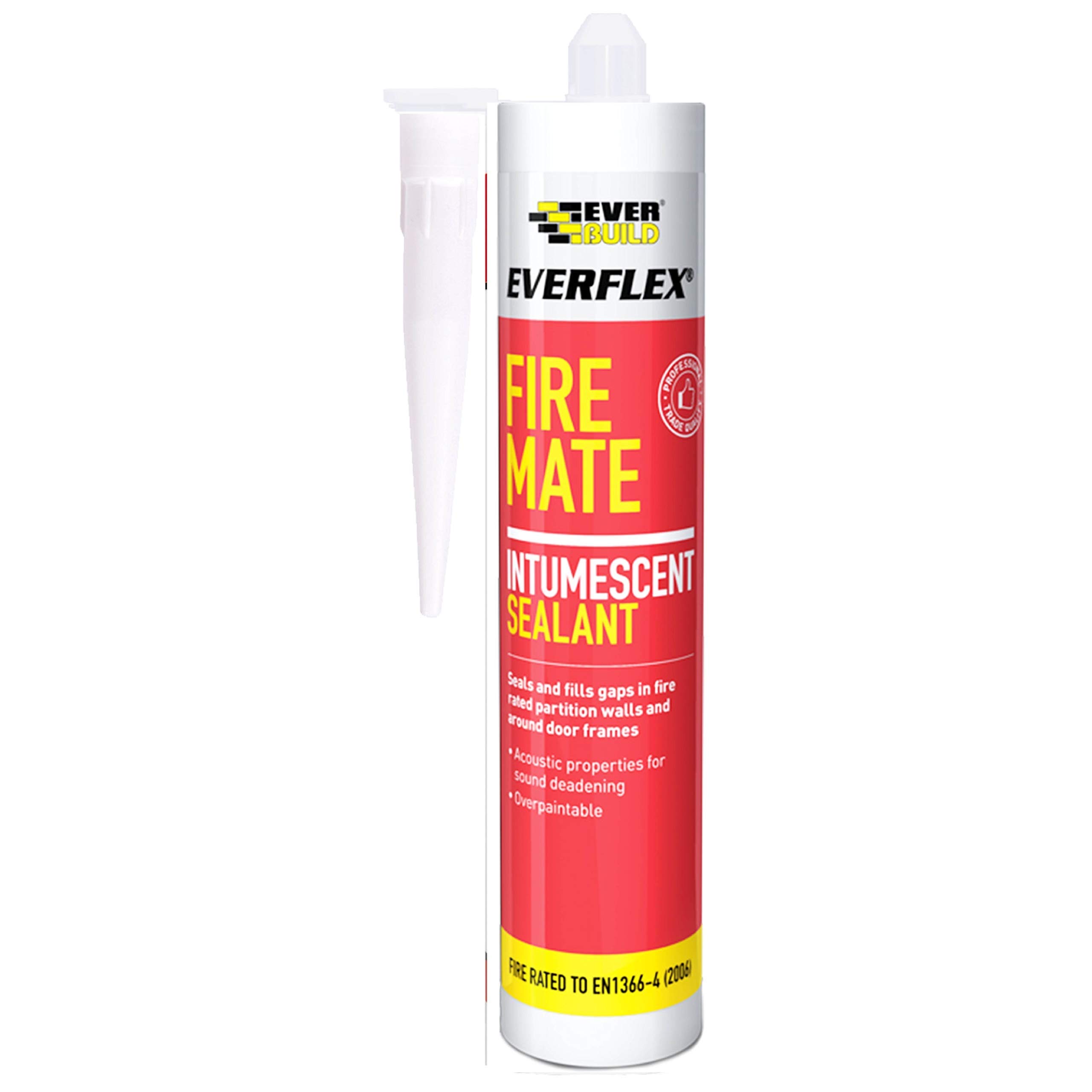
Two jobs in one tube: it slows fire and it deadens sound around the pipes and cables you seal.
Most acoustic sealants handle sound and nothing else. This one is intumescent, which means it swells when it meets heat — the listing states it expands beyond 150% of its original size and forms a char that resists fire for up to five hours. That makes it a natural fit for the penetrations where pipes and cables pass through a wall or ceiling, because those are both a fire path and a sound leak. It is a single 295 ml cartridge in grey, and it needs no primer on most construction substrates.
The listing states an average noise reduction of 24dB across the 100–3150 Hz band, which covers speech and most household noise. For reference, that band covers speech and most household noise, so the sealant is aimed at the sounds you actually hear through a wall. It cures fast — tack-free in 15 minutes — and it stays permanently flexible, with the listing quoting more than 100% elongation to ISO8341. On surfaces where silicone is too slick and too firm, that stretch is the property that keeps the joint closed.
The practical catch is the tube size and the pressure it takes to push this material out. It is thicker than silicone, so it needs more force, and cold weather makes it stiffer still — bring it to room temperature before you start. It is also a 295 ml cartridge in grey, so it is not the choice when you want a paintable white finish across a visible wall seam. Its natural home is behind fittings, not on open hallway trim.
Built for hard-to-reach penetrations: a single cartridge suited to sealing pipes, cables, and irregular gaps in one pass, with an intumescent formulation that swells against heat.
Be ready to work at it: the material is stiffness-first, so a good gun and warm room temperature matter more here than with a thin acrylic.
Reach for this if: you are sealing the penetrations around pipes and cables and want one product that addresses both fire and sound at the same joint.
Look elsewhere if: you want a paintable white bead along visible trim — this is grey, and its strength is in hidden gaps, not finished seams.
5. St. Gobain GGCOMPOUND-28OZ Green Glue Noiseproof Compound, 28 Ounce (Pack of 1)

Not a seam sealer at all — this is the compound that goes between two sheets of drywall.
Before you buy, get the role straight: this is a noiseproofing compound, not a caulk. It goes between layers of wallboard, where it converts the second sheet of drywall into a damping layer that works against low-frequency noise. The listing states that independent lab tests measured it dissipating up to 90% of noise, and it targets the low-frequency bass from home theatre systems and subwoofers that pushes straight through a normal wall. It is a 28 Ounce tube with a full cure time of 30 days.
Cure time is the part to plan around. The listing gives a seven-day cure for best results, with peak performance reaching 30 days after application. The material stays very sticky for days after it goes on, so any drip that reaches carpet or trim needs wiping immediately rather than the next morning. It comes in a cartridge, and the guidance from the listing is that removing the screw-on applicator leaves product stranded inside — a small waste that adds up across a whole wall of sheets.
The results are real but hard to isolate. Owners who built out an entire party wall alongside special drywall and sealant report the neighbour noise simply going away. Others who used it between drywall layers in a studio found it impossible to separate its effect from the rest of the build, which is the honest reality of a layered product: it works inside a system, not on its own.
What Makes It Different
- Damping compound, not a caulk — it targets low-frequency bass that ordinary sealant cannot address
- Rated to dissipate up to 90% of noise in the manufacturer’s stated lab tests
- Bonds to brick, concrete, metal, and wood as well as drywall
- A 28 Ounce cartridge applies quickly once your sheets are ready
The Honest Limits
- 30-day full cure is the longest wait of any pick here, with the listing quoting seven days for best use
- Extremely sticky for days after application — drips must be cleaned immediately
- It does nothing on its own; it only works inside a full wall assembly
Suits the deep build: anyone ready to add a second layer of drywall and wants to attack bass, not just the seams along a wall.
Wrong tool for seams: if your problem is gaps around trim and outlets, this is not the product — that job belongs to a proper acoustic caulk.
6. 12-Pack of 28 oz OSI SC-175 White OSI Draft and Acoustical Sound Sealant
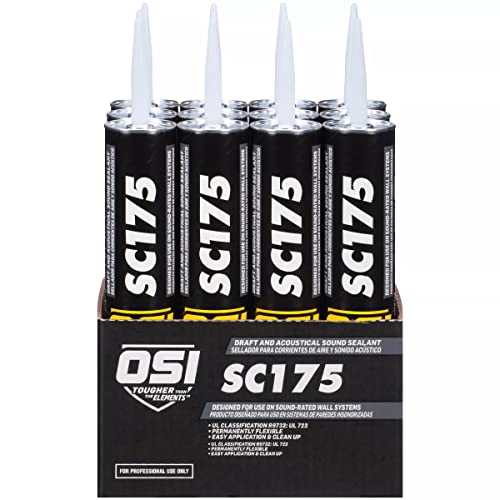
A contractor-sized case of twelve acoustic tubes — for the build that runs wall after wall.
This is the biggest case in the lineup, and it is priced accordingly. Twelve 28 oz tubes in one order adds up to 40 pounds of sealant on your doorstep, twin the six-tube Green Glue pack at the top of the list. That volume is aimed at multi-room builds, basements, and workshop partitions where you are sealing seams across an entire floor rather than a single room. Each tube is a standard 28 oz format, so one good caulk gun sees you through the whole case.
On paper the specification list is solid. It is a latex acoustical draft sealant designed for both fire-rated and non-fire-rated wall systems, with permanent flexibility and strong adhesion. The low-VOC content and GREENGUARD Indoor Air Quality certification speak to using it in occupied spaces. It sticks to concrete, metal, and wood, and it cleans up with soap and water while still wet, which keeps the trim edges tidy on a large job.
The recurring problem is packaging, not the formula. The case arrives from the seller and the pattern in the reviews is boxes showing up damaged, with tubes bent at the tips or leaking around the nozzles — a defect of shipping rather than the sealant itself. The other consistent note is how thick this material is: it needs a strong, low-ratio caulk gun, going slowly rather than squeezing hard, since too much pressure can rupture a tube. Owners who hit both conditions report it working well and holding its shape without shrinking as it dries.
What you are buying: twelve 28 oz tubes of latex sealant in one case, suited to a job that spans several rooms and does not want to stop for a reorder.
The delivery risk: inspect the case the day it arrives — bent tips and leaking nozzles from rough handling are the recurring complaint, and once the return window closes, those tubes are yours.
Understanding the Specs
Noise Reduction in Decibels (dB)
A decibel is a unit that measures how loud a sound is. When a sealant lists an average noise reduction — like the 24dB across the 100–3150 Hz band on the Sika SikaSeal Fire Guard — that figure describes how much the cured sealant reduces sound within a stated frequency range. It is not a promise that your room goes silent. The wall itself, its insulation, and the drywall layers all contribute, and the sealant’s job is to close the gaps those materials leave behind.
Cure Time and Full Strength
Cure time is how long a sealant takes to go from wet to fully set. The Donseal GA777-AC reaches full cure in 24 hours, the Green Glue Noiseproofing Sealant takes 7 days, and the St. Gobain Green Glue Noiseproof Compound hits peak performance 30 days after application. A faster cure lets you keep working, while a longer one asks for patience. Either way, resist the urge to test your sound result on day one — the sealant has not finished its job yet.
Tube Volume and Coverage
Tube volume, measured in fluid ounces or millilitres, tells you how far a single tube stretches. Small cartridges around 9.5 fluid ounces fit a standard handheld gun and suit detail gaps around frames and outlets. Large tubes at 28 to 29 ounces hold far more, run a longer seam in a single pass, and need a bigger gun. Match the volume to the job: detail work wants a small cartridge, and perimeter work wants the large format.
Flexibility and Elongation
Permanently flexible is the phrase to look for, and it is often backed by an elongation figure — how far the sealant can stretch before it tears. The Sika SikaSeal Fire Guard lists more than 100% elongation to ISO8341, so the bead stretches with the wall instead of cracking. That matters because walls move with humidity and temperature. A bead that dries hard can crack at the joint and open a fresh sound leak, while one that keeps stretching holds the seal through the seasons.
FAQ
Is acoustic caulk the same as regular painter’s caulk?
Will a 28 oz tube fit my caulk gun?
How much wall does one tube of acoustic caulk cover?
Can acoustic caulk stop bass coming through a wall?
Do I need to remove old paint or primer before applying acoustic sealant?
What should I seal around a wall outlet or switch box?
Is acoustic caulk paintable once it has cured?
How long does acoustic caulk take to fully cure?
Can I use acoustic caulk in a fire-rated wall assembly?
Why did my acoustic caulk crack after it dried?
Final Thoughts: The Verdict
For most people sealing a room, the smart, quiet-money pick among the best acoustic caulk for soundproofing is the Green Glue Noiseproofing Sealant Caulk 6-Tube Pack, because six large tubes carry you through a full perimeter without stopping to reorder. If you want one tube for a single room, the TMS Acoustical Soundproofing Caulk is the volume that fits that job. For detail gaps around frames and outlets, the Donseal GA777-AC 2-Pack fits a standard gun and cures in 24 hours. Whichever your project, buy with the knowledge that a sealant rewards a proper bead and a patient week — and skip the tube if the tip is already bent and leaking.
How We Picked
We do not accept paid placement. Every pick is matched to a real buyer and a real use-case; we do not hands-on test units.
Sources & Methodology
Specifications: manufacturer listings and product documentation. Review insights: verified customer reviews, as of September 2026. Pricing: not shown on this page (it changes often); check the current price via the retailer link.
As an Amazon Associate, Gadgets Feed earns from qualifying purchases. This does not affect which products we feature.