
Our readers keep the lights on and my morning glass full of iced black tea. As an Amazon Associate, I earn from qualifying purchases.
Specs are compiled from manufacturer listings and verified buyer reviews and can change over time — please confirm the key details on the product page before buying.
Here is the short answer before you scroll: the SVS PB-1000 Pro is the one most people should buy, because it pairs a proven 12-inch driver with an app that lets you tune the bass to your actual room instead of guessing. Around this power level — roughly 700 to 1000 watts of peak or RMS output — the subwoofer itself matters less than whether it fits your space and your vehicle.
I’m Min — the founder and writer behind Gadgets Feed. This guide is built by comparing the manufacturers’ published specifications and the patterns across verified customer reviews, so you get each pick’s real strengths and trade-offs instead of marketing spin.
From small apartments to full trucks, this breakdown separates the cabinet you actually need from the spec sheet you don’t, so you can pick the right 800 watt subwoofer without guessing.
Our Picks at a Glance


How To Choose The Best 800 Watt Subwoofer
The 800-watt number on the box is a rough ceiling, not a promise of volume. What actually decides how a sub sounds in your space is the driver size, the cabinet design, and whether you are powering it in a car or a living room.
Start with RMS, not peak
RMS (root mean square) is the continuous power a sub can handle all day without strain, while peak is a short burst the amp can hit on a hard kick drum or explosion. A sub rated 400W RMS and 800W peak is honest about both numbers, so check the RMS figure first when comparing boxes.
Ported vs sealed cabinets
A ported cabinet has a tuned opening, often called a slot port, that pushes more air for deeper boom at movie volume, while a sealed box trades some of that low-end output for tighter, faster bass that suits music. Neither is better overall — ported tends to win for home theater impact and sealed tends to win for accuracy.
Match the driver to the space, then the wattage
A 12-inch driver moves more air than an 8-inch, which matters in a big room and matters less in a car cabin. Once the size and box type fit your space, the wattage ranking tells you how much headroom you have before the amp runs out of steam.
Quick Comparison
| Model | Best For | Peak Power | RMS Power | Driver Size | Amazon |
|---|---|---|---|---|---|
| SVS PB-1000 Pro★ Best Overall | Home theater tuning | 820+ W | 325 W | 12 in | Amazon |
| BOSS Audio BAB8Budget Champion | Under-seat car bass | 800 W | — | 8 in | Amazon |
| Kicker 43CVR122Best for Deep Bass Builds | Loud car sub builds | 800 W | 400 W | 12 in | Amazon |
| Rockville SS10P | Complete car install | 800 W | — | 10 in | Amazon |
| CT Sounds TROPO-1X8D2 | Tangled-free trunk installs | 800 W | 400 W | 8 in | Amazon |
| Rockville Rock Shaker 12 | Budget home theater | 800 W | — | 12 in | Amazon |
| Rockville Rock Shaker 15 | Big-room loud playback | 1000 W | 500 W | 15 in | Amazon |
| Sound Town CARPO-12DSPW | PA and DJ rigs | 800 W | 400 W | 12 in | Amazon |
| SVS 3000 Micro | Small-room audiophile bass | 2,500+ W | 800 W | 8 in | Amazon |
| SVS 3000 Micro R|Evolution | Apartments and compact rooms | 4,000+ W | 1,200 W | 9 in | Amazon |
| Klipsch RP-1200SW | Large home theaters | 800 W | 400 W | 12 in | Amazon |
In‑Depth Reviews
1. SVS PB-1000 Pro Subwoofer (Black Ash)
Our pick — over 4.5★ from 250+ verified ratings; the strongest balance of quality and price.
The tunable floor-shaker that turns a problem room into clean, deep bass.
If your living room has always sounded muddy no matter what you plugged in, this is the pick that fixes it. The SVS PB-1000 Pro pairs a long-throw 12-inch driver with an 820+ watt peak Sledge STA-325D amplifier, and the peak figure is the burst of power the amp can deliver on a hard hit — the sustained figure, 325 watts RMS, is what it holds continuously. That split matters because it is exactly the combo buyers report using to tame rooms with severe bass problems.
The real weapon is the smartphone app. It runs on a 50MHz Analog Devices Audio DSP — a dedicated audio chip that shapes the sound before it reaches your ears — so you can adjust volume, phase, and parametric EQ from your seat instead of crawling behind the cabinet. Owners with a 46Hz hump and cancellation dips at 87-95Hz report the app’s parametric EQ flattens the response to ±3dB down to 20Hz. You also get two foam port plugs, so you can seal the ported cabinet down for tighter music response any time you want.
What wins people over most is the sound itself — the split between bass notes is clean, and the sub fills a room without turning into one-note mud. It holds 4.8 stars across 280+ ratings, and owners keep returning to the value. The honest caveat is size: this is a substantial cabinet, so verify your space before ordering, and an occasional owner still catches faint port noise on the heaviest action scenes.
Where It Wins
- 12-inch driver with an 820+ watt peak amp and 325W RMS of sustained power
- App equalizer that flattens bad room response down to 20Hz
- Dual ported cabinet with two included foam plugs for sealed-mode flexibility
- Trigger input for auto power-on and front ports that ease wall spacing
What To Weigh
- It is a large cabinet — measure your spot before buying
- App tuning is manual; there is no full auto-calibration
- Faint port noise can appear on the heaviest low-frequency hits
Best fit for: anyone who wants app-guided control over a big, ported home theater sub without jumping to a flagship.
Look elsewhere if: your space is tight or you want a set-and-forget sealed cube.
2. BOSS Audio Systems BAB8 8 Inch 800 Output Amplified Boxed Car Subwoofer
The slim all-in-one box that slots under a seat and wakes up a factory stereo.
If your truck or aging car stereo sounds thin but you do not want to rebuild the whole audio system, this is the practical starting point. The BOSS BAB8 packs an 8-inch driver and a built-in amplifier into one low-profile box, so you skip buying an amp separately. That 800-watt figure is peak, not continuous, which is the number the amp can flash on a hard hit rather than hold all day.
Installation is the part owners talk about most warmly — it fits cleanly under a seat and runs off either RCA low-level inputs or high-level speaker inputs tapped straight off a factory radio. That means no line-output converter is needed when you tap existing speaker wires. It also includes a remote subwoofer control, a variable low-pass filter to keep high notes out of the driver, and a variable bass boost you set to taste.
What it does well is add warmth and low-end presence without rattling mirrors apart. As one owner described it, it is a good supplement for “Cruise and Blast Bass” rather than a full-size enclosure replacement — the buyers expecting 12-inch-style slam from an 8-inch box at this price are setting the wrong bar. The recurring gripe to know about is longevity: a handful of units fail after a few months, and an occasional leaky amp draws power even when parked, so disconnect it if the car sits for days.
Space-saver payoff: the slim single-box format solves the biggest problem with car bass — a full enclosure eating your cargo space. It powers up from your factory radio with no separate amplifier to mount.
Set your expectations: it delivers bass support, not concert-level output, and its peak rating is not a continuous number. Buyers who want a mirror-rattling system should look at a dedicated 12-inch enclosure build instead.
Grab this one when: you want hidden under-seat bass and easy factory-radio hookup in a truck, Jeep, or older sedan.
Skip it when: you are chasing wall-shaking output or need a marine-rated box.
3. Kicker 43CVR122 COMPVR 12″ 800 Watt DVC 2-Ohm Car Audio Subwoofer
The raw driver for builders who already have an amp and a box picked out.
This is the one for the person tuning a system, not plugging in a box. The Kicker 43CVR122 handles 800 watts peak and 400 watts RMS — 400 being the continuous power it can take without stress. Its dual 2-ohm voice coils can be wired for different impedance loads, which is what lets you match a mono amp for maximum output. Compared with the BOSS BAB8 above, its 12-inch driver is 50% larger than that 8-inch unit, and that size difference is exactly what buys you deeper, rounder low end instead of a tight upper-bass punch.
Owners running it near max output with the right amplifier describe hits that land like a pair of 12s. At full power, 16-gauge speaker wire can burn through in about ten days, so use 10-12 gauge instead. Pairing it with a ported MDF box and a matching mono amp gets the most out of the driver, and a common upgrade path is adding a second driver once the first one is dialed in.
The honest limit is the flip side of its strength: because it is a bare driver, you supply your own enclosure, amplifier, and wiring kit, and it will sound ordinary until that supporting gear is right. Buyers chasing deep sub-bass pressure rather than punchy mid-bass note that it leans toward solid hits instead of pure SPL rumble.
Builders will want it: 400W RMS of continuous handling and dual 2-ohm voice coils give you real headroom and flexible amp matching. The result, set up correctly, is a big, chesty low end from a driver at this level.
Know the trade: it is a component, not a finished box, so factor in a proper ported enclosure, a capable mono amp, and heavier speaker wire before you hear it at its best.
Reach for this if: you are assembling a serious car system and want a driver with real continuous power handling.
Look past it if: you want a box that works the moment it arrives.
4. Rockville SS10P 10″ Powered Under-Seat Subwoofer with RWK81 Wiring Kit

A whole car-bass kit in one box — sub, amp, and wiring, no guesswork.
The slowest part of any car audio install is hunting down the right cable, fuse, and connectors. This Rockville bundle removes that step by shipping the SS10P sub alongside the RWK81 8-gauge amp wiring kit with a 100% copper RCA cable. That 8-gauge rating refers to how thick the power wire is — thicker wire carries more current without heating up, which is what a powered sub needs. The sub itself is an 800-watt peak, 10-inch driver in a slim 3-inch enclosure that drops under most car and truck seats.
The setup is designed for people who are not installers. High-level inputs and auto turn-on let it read your factory radio signal and power up on its own, and the 100% copper RCA in the kit keeps the signal clean. From there, adjustable gain, bass boost, and a low-pass filter let you dial it in, helped by a remote bass knob you mount near the dash for quick tweaks. The cast aluminum enclosure is built to stay cool and hold up across extreme temperatures.
Owners describe it as a big step up for a stock stereo — enough to gently vibrate mirrors and fill out a convertible or a pickup without rattling the whole block. The recurring caution is placement: it sounds noticeably stronger under the driver’s seat than tucked under a rear bench, and the casing runs hot during long sessions. Note that it matches the Kicker 51HS10 closely in performance and build among compact options, per owners who compared both, and its peak wattage figure is the burst number, not a continuous rating.
Why It Earns A Spot
- Comes with a complete 8-gauge amp wiring kit and 100% copper RCA
- Auto turn-on and high-level inputs suit factory head units
- Slim 3-inch enclosure fits under most car and truck seats
- Remote bass knob for on-the-fly adjustment from the dash
Worth Knowing
- Runs hot during extended use — some owners add vents or fans
- Sounds weaker mounted under a rear seat than under the front
- Its peak rating is a burst figure, not continuous output
Ideal for the driveway DIYer: everything the install needs arrives in the box, so a factory-radio car gains real bass fast.
Think twice if: you need marine-rated gear or plan to mount it under a rear bench.
5. CT Sounds TROPO-1X8D2 Single 8″ Loaded Ported Car Subwoofer Box

An 8-inch box that thumps far above its size in a tight trunk.
Trunk space is the reason most people avoid a subwoofer, and this box is built to answer that. The TROPO-1X8D2 arrives pre-loaded with a TROPO-8 dual 2-ohm subwoofer already wired to a 1-ohm final impedance, so you bolt it in and connect an amp without re-wiring coils yourself. It handles 800 watts peak and 400 watts RMS of continuous power.
The cabinet is the quiet hero here. It uses MDF wood with dado, miter, and rabbet joinery — a class of interlocking wood joints, rather than staples, that gives the box rigidity and holds its tuning. That construction is why an 8-inch driver in this enclosure can surprise people. As one owner put it, “To be only 8″ subs the bass really bangs!” The 1-ohm final impedance also lets a suitable amp deliver more of its rated power to the driver.
Size is where it wins: it drops into a Mustang trunk with room to spare and keeps your spare tire accessible. Compared with the 12-inch Kicker above, you give up some deep low-end extension in exchange for a box that vanishes into a trunk. The durability note is worth hearing — most examples hold up well, though a few owners mention shorter lifespans than expected, so match it with a clean amp and avoid over-driving it.
Big sound, small footprint: the pre-wired 1-ohm load and rigorously jointed MDF box let an 8-inch driver hit hard in a trunk that has no room for anything larger.
How to get the most: a quality amplifier in the 800-1000W RMS range pairs best — above that it stops being efficient. Treat it gently and it rewards with tight, responsive bass.
Made for tight trunks: drivers who want real thump but cannot hand over their cargo space or spare-tire access.
Not the pick if: you want gut-punching sub-20Hz extension or plan to push it far past its RMS rating.
6. Rockville Rock Shaker 12″ Black Powered Home Theater Subwoofer

Plug-and-play 12-inch thunder for a movie room, wired up in minutes.
For a first home theater sub, the priority is simple: something that fills the room without needing an installer. This Rockville Rock Shaker runs a 12-inch driver on a built-in Class D amplifier rated 800 watts peak, and the crossover can be tuned from 50Hz to 150Hz to blend with your speakers. That crossover range is the band where the sub takes over from your main speakers, so it is the dial that keeps bass from bleeding into dialogue.
Setup is a two-cable job — plug it in, run an RCA cable to your receiver, and use the phase switch and volume control to balance it. It fits any home audio setup thanks to RCA and speaker-level inputs. Buyers describe deep, clean bass that can rattle windows and make the house shake, with one noting it as a “” bargain that exceeded expectations — a rare glimpse of just how much sub you get at that level.
The honest catches: a small number of customers note a buzzing cabinet or a loose internal wire, most of which is fixed with a few zip ties, and one describes the laminate finish as basic. Owners of a broken-in example praise the sound for years of use, but a couple of units arrived with a small shipping dent. If you want flawless furniture-grade cabinet finish, this is not it — it is the value option, and at its peak rating it delivers serious low end for the money.
Value you can hear: a 12-inch driver, a built-in 800W peak Class D amplifier, and a 50Hz-to-150Hz crossover deliver room-filling bass for a first-time home theater buyer.
Minor cosmetics, minor fixes: interior wiring can arrive loose and the vinyl wrap is basic, so expect to spend a few minutes tidying it up for best results.
Great first sub: movie and music fans who want deep, plug-and-play bass without a separate amp.
Keep hunting if: you want a refined cabinet finish or a music-first sub with tight, DSP-controlled accuracy.
7. Rockville Rock Shaker 15″ Dark Wood Powered Subwoofer Home Theater
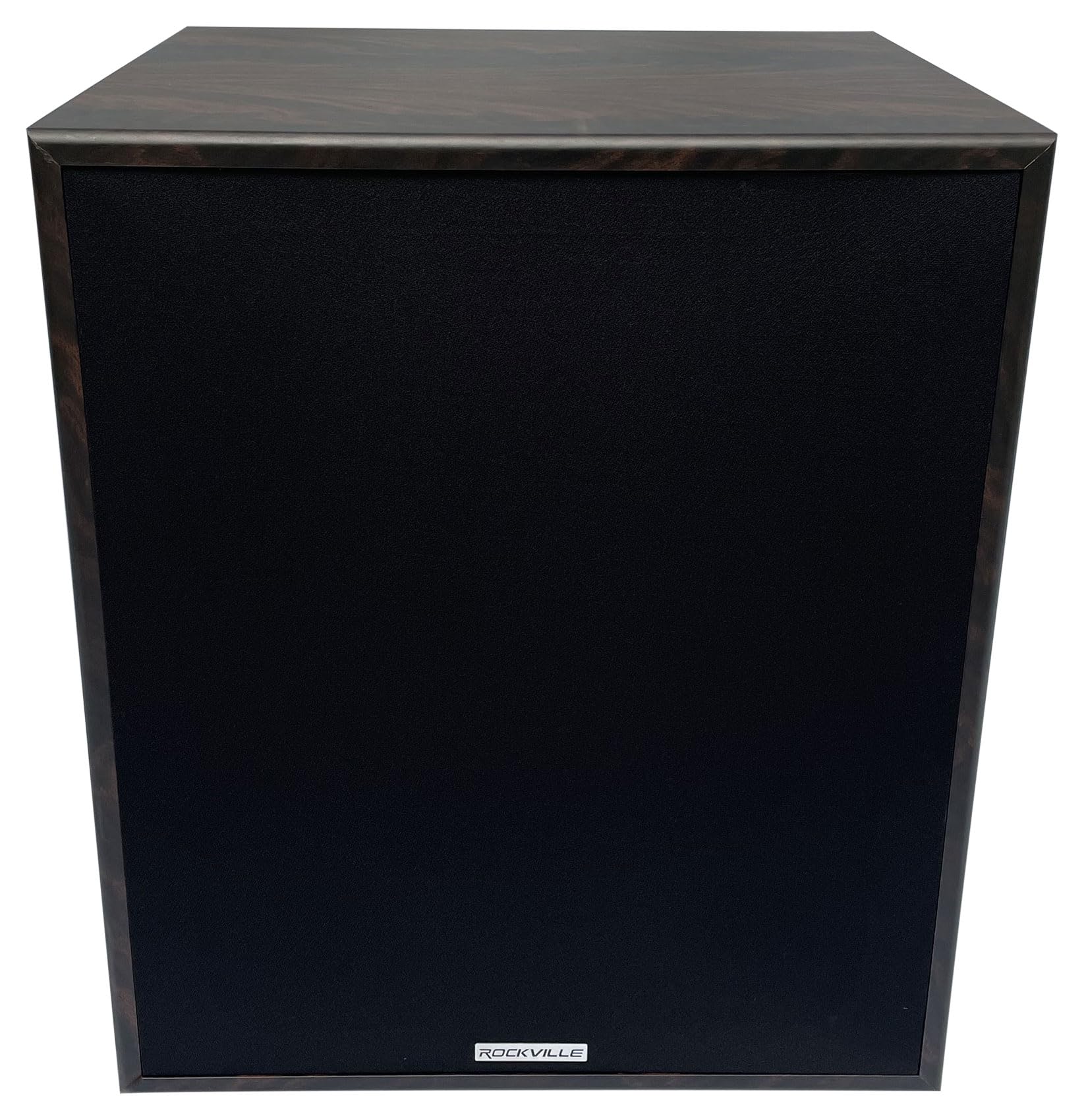
15 inches of air-moving cabinet for anyone who wants the room to move back.
When the goal is sheer output per dollar, this is the biggest driver on the list. The Rock Shaker 15 runs a 15-inch woofer with a foam surround, a Y30 magnet, and a 4-layer voice coil, powered to 1000 watts peak and 500 watts RMS — the 500 being the continuous figure. That jump from the 12-inch model’s 800W peak and 400W RMS to this one’s 1000W peak and 500W RMS is the clearest reason to size up: more driver area plus more sustained power equals more physical air moved.
Connected via Tiffany RCA inputs and outputs or high-level speaker inputs, it slots into a receiver or an amp-based setup. Owners describe it as loud enough to shake windows, and one reports pairing two of them in a theater rig where both ran at half volume. The MDF cabinet with its vinyl finish is built to resist the resonance that thinner board would allow.
Two things to plan for. First, placement and receiver tuning matter more than usual at this output level — get the crossover and room position wrong and you can hear port noise, so budget time to dial it in. Second, this cabinet has a mixed reputation on noise: a hum when idle and shaken windows are both reported, and a couple of units have failed well within a year. It is not the most refined sub for music, but for turning a large room into a cinema it delivers thump for the money.
Where It Delivers
- 15-inch driver, 1000W peak and 500W RMS for room-filling output
- MDF cabinet with vinyl finish resists the resonance of thin-board boxes
- Tiffany RCA and high-level speaker inputs for flexible hookups
- Adjustable crossover, volume, and phase controls tailor it to the room
Plan Around These
- Needs careful placement and receiver tuning to avoid port noise
- Some units hum when powered but idle
- Not the most refined option for music-first listening
Built for big rooms: home theater fans who want maximum low-end impact from a large driver.
skip it if: music accuracy tops your list or your room cannot take a cabinet this large.
8. Sound Town 800 Watts 12″ Powered Subwoofer with 2 Speaker Outputs (CARPO-12DSPW)

The box that powers your whole PA, not just the low end.
Most subs on this list do one job. This one is different: the CARPO-12DSPW carries a built-in 3-channel amplifier rated 400W plus 2 x 250W continuous, or 800W plus 2 x 500W peak, and it feeds a 12-inch driver with a 3-inch voice coil while also driving two passive satellite speakers. That means you can hang your tops off this box and run a whole small PA from one unit. It handles 400W continuous and 800W peak of its own.
The connection set is built for gig life — two 1/4-inch and XLR combo inputs, two XLR line outputs, and two Speakon power outputs, all housed in a plywood enclosure with a metal grille and two recessed handles. A 35mm mounting socket lets you pole-mount a speaker on top. Reviewers point out it running parties and events with clean, hiss-free output, and the manufacturer support gets called out as responsive.
There is a real caveat here that a home listener would never hit: it is heavy, the amp is clip-light sensitive, and you have to run it within its limits rather than crank everything. One mixed review flags that the onboard filtering can muddy the mid-bass on a boomy backline. For weddings, house parties, and small DJ sets, though, the all-in-one amp makes it a genuine workhorse.
One box, a whole rig: the 3-channel amp, Speakon outputs, and XLR I/O mean this sub can power your mains and your low end together — huge for a mobile setup.
Mind the headroom: it is clip-light sensitive and must be run within its limits, so treat it as a system component you tune, not a set-and-forget box.
For gigging DJs: mobile performers who need bass plus mains drive in a single portable unit.
Not for the living room: home listeners want a simpler, lighter box without the balanced-input and Speakon complexity.
9. SVS 3000 Micro Subwoofer (Piano Gloss White) | Dual 8-in Drivers, 800 Watt RMS

A cube the size of a shoebox that punches like a full tower.
Small rooms are where big ported subs go wrong — they either overwhelm the space or sit out of place. The SVS 3000 Micro takes the opposite approach: two 8-inch drivers mounted opposite each other in a sealed 10-inch cabinet, powered by an 800-watt RMS amplifier that peaks at 2,500+ watts. The dual-opposing design matters because the two cones cancel each other’s vibration, so the cabinet stays almost motionless even when it is working hardest.
The sealed box plus acoustic bracing is why it stays so clean and musical rather than boomy, and buyers consistently point to how easily it disappears into a room. That small footprint is the thing owners praise most, letting it tuck into a corner or under furniture without dominating the space.
What surprises people is the output-to-size ratio. It energizes rooms with tall ceilings and rattles wall clocks, and it handles both music and movies with equal poise — one owner notes it handles a huge open theater with sound that seems to come from everywhere. Owners also rate the SVS app highly for tuning, with precise EQ and presets. The one honest boundary is size as a limitation: in a large home theater, it will not match a big ported tower’s sheer output, so this is a small-to-medium room specialist.
The app earns the price: SVS’s control app is widely called the best in its class, with precise parametric EQ, presets for music and movies, and 12V trigger support — tuning this sub is easy.
Match it to your room: it holds its own in nearly any small or medium room, but it is not a substitute for a large ported cabinet in a very big space.
Perfect for compact spaces: apartment and small-room listeners who want audiophile-grade bass that hides in plain sight.
Size up if: you run a large dedicated theater and need maximum output over accuracy.
10. SVS 3000 Micro R|Evolution Gloss Black Powered Subwoofer
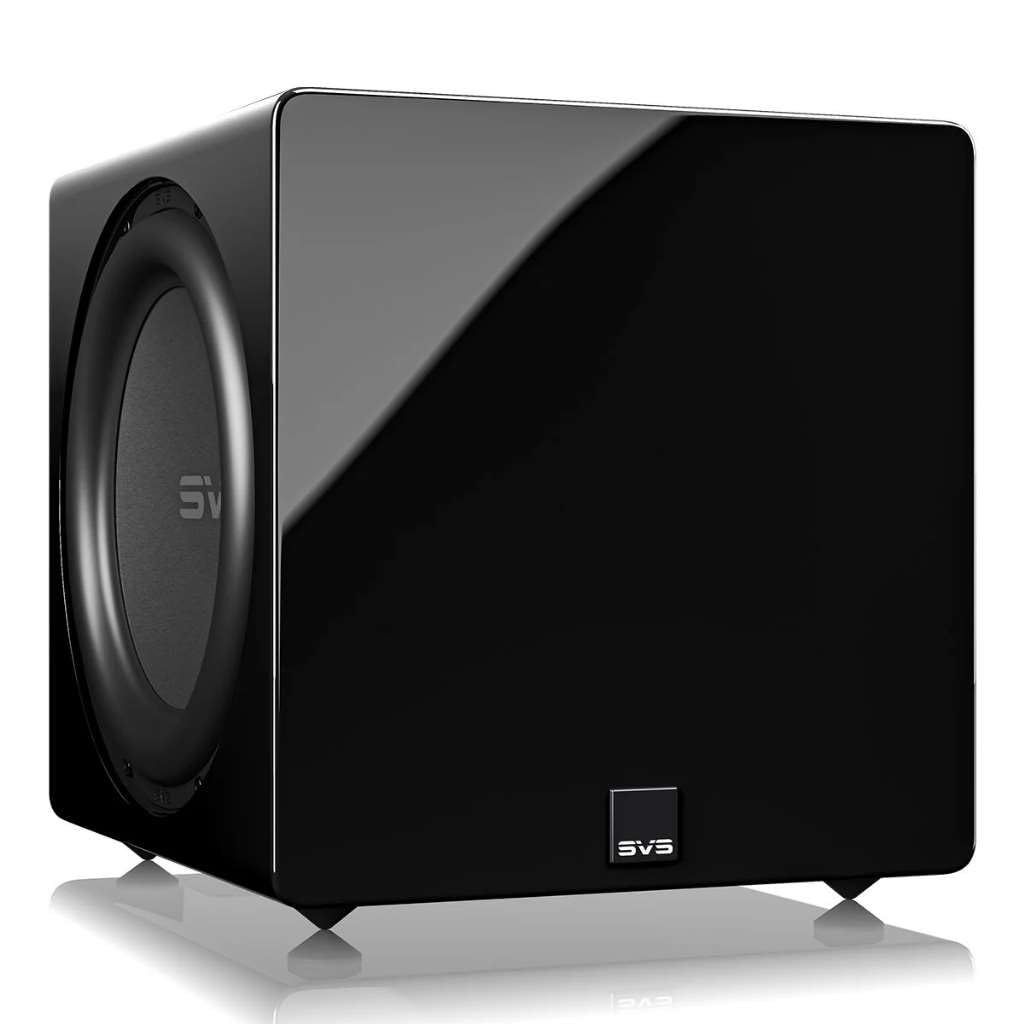
The Micro is rebuilt with bigger drivers and roughly half again the power.
The original 3000 Micro is a benchmark, and this R|Evolution version is a direct step up from it. The dual opposing drivers grow from 8 inches to 9, and the Class-D amplifier jumps to 1,200 watts continuous with 4,000+ watts peak — the peak figure being the transient burst, while the 1,200 continuous is what it can hold. A 295MHz Analog Devices DSP handles the signal processing. It all fits in a compact 11-inch cabinet, only an inch wider than the standard model.
That extra power and driver area translate into noticeably better low-bass output at lower volumes, which is the whole point in a small space. Buyers upgrading from the original describe the old version running out of steam in open-concept rooms where this one now delivers real impact. The app adds Auto EQ — automatic room correction — so tuning a small, awkwardly shaped room takes less guesswork than ever.
Two caveats to hold onto. First, the lower harmonic distortion claim is a real, measured improvement over the original, but the published frequency response is optimistic — the graph shows less deep output than the header number suggests, so do not expect the deepest sub-20Hz rumble. Second, at launch the Auto EQ feature was labeled “coming soon,” so buyers wanting it immediately should confirm it is live before ordering.
Why It Steps Up
- Dual 9-inch opposing drivers in an 11-inch cabinet
- 1,200W continuous and 4,000+W peak Class-D power
- App-based Auto EQ for automatic room correction
- Very clean output with lower distortion than the original
Before You Order
- Published frequency response reads better than the measured curve
- Auto EQ was not fully live at launch on some units
- Premium tier — the smaller 3000 Micro costs less
For the space-limited audiophile: apartment and open-concept owners who want maximum bass from a hidden cabinet.
Only if you have the budget: the standard 3000 Micro delivers most of this experience for less.
11. Klipsch RP-1200SW 800W Subwoofer with 12″ Cerametallic Driver and WA-2 Wireless Kit
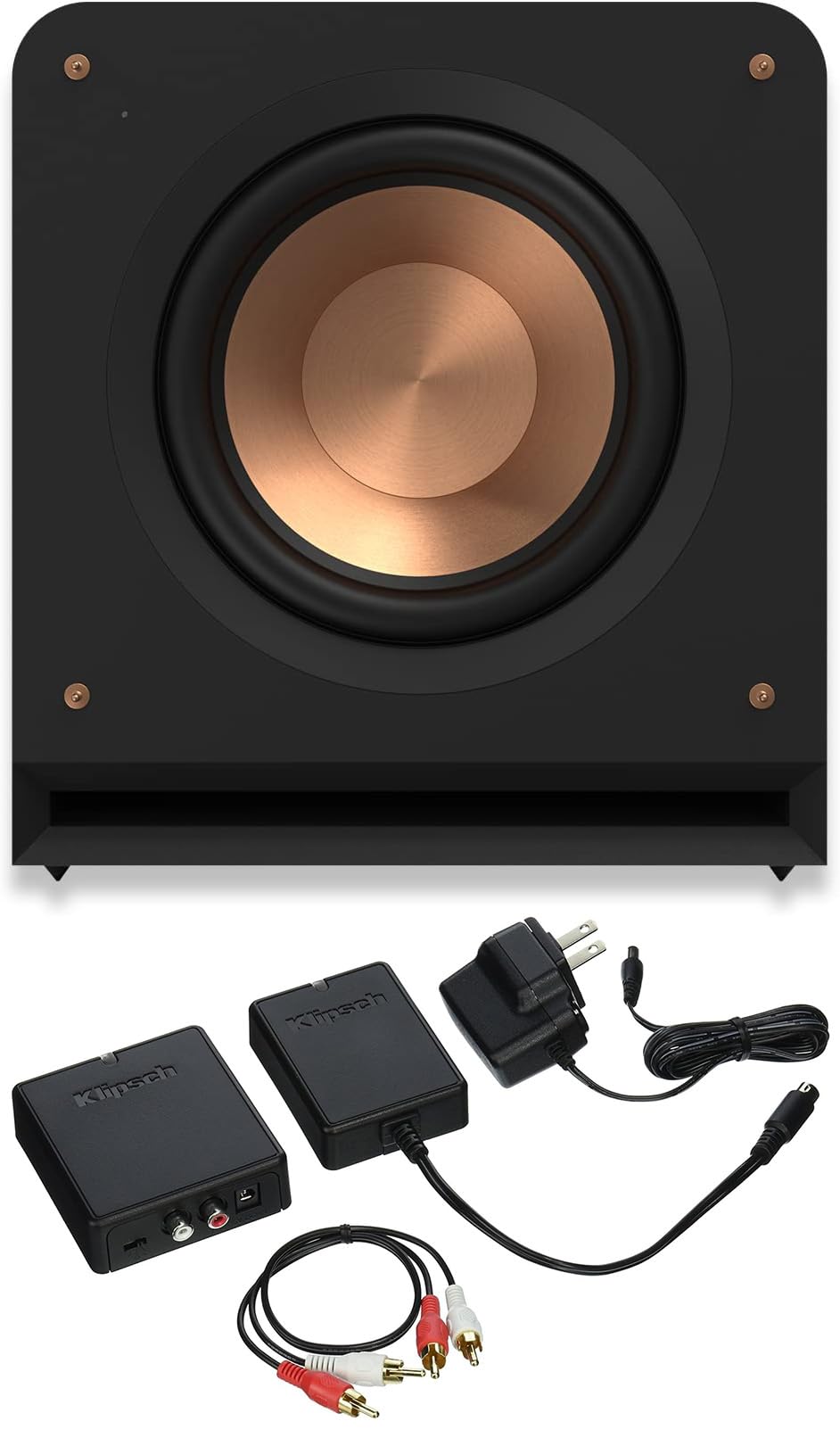
Klipsch’s reference-grade tower with a matching wireless kit for flexible placement.
If you already run a Reference Premiere or similar home theater system, this is the sub built to sit at the bottom of it. The RP-1200SW pairs a 12-inch Cerametallic woofer — a spun-metal cone that stays rigid and light so it distorts less — with a Class D amplifier rated 400W RMS and 800W peak. Klipsch rates the frequency response from 16.5Hz to 138Hz, with up to 121dB of maximum acoustic output. It is a front-firing driver with an Aerofoil slot port that is designed to cut port noise.
The bundle is what makes this pick special: the Klipsch WA-2 wireless subwoofer kit is included, letting you place the sub where it sounds and looks best without running a speaker cable across the room. The transmitter finds the receiver automatically on first power-up, so no manual pairing is needed, and up to four WA-2 links can run in one home.
Build quality is what owners rave about, and the cabinet is genuinely serious — shoppers say it weighs around 70 pounds and carries rounded edges and a well-engineered grille. The bass is loud enough to be heard throughout a house. The main thing to weigh is its size and weight — it demands real floor space — and one unit arrived dead on arrival, so test yours immediately.
The wireless kit seals it: the bundled WA-2 lets you place this heavy sub anywhere without a cable run, and auto-pairing means you plug in and go.
Bring your space plan: at roughly 70 pounds with a large cabinet, this is a sub you commit floor space to — measure before it ships.
The system-matching pick: Klipsch and Reference Premiere owners who want a big, powerful sub with flexible wireless placement.
Overkill for: small rooms or tight spaces where its size and weight would dominate.
Understanding the Specs
RMS vs Peak Power
Peak power is the short burst an amplifier can deliver on a hard hit, while RMS (root mean square) is the continuous power it holds steadily — the number that tells you how hard you can push the sub without strain. A box rated 400W RMS and 800W peak, like the CT Sounds TROPO-1X8D2, is honest about both. When comparing options, look at the RMS figure first and treat the peak as headroom.
Driver Size and Cabinet Type
Driver size sets how much air the sub can move — larger cones typically produce deeper, louder bass in a big room but demand more space, which is why a 15-inch cabinet and an 8-inch under-seat box serve entirely different buyers. Cabinet type then shapes the character: a ported design tends todeliver more boom at movie volume, while a sealed design like the SVS 3000 Micro trades some of that output for tighter, faster bass that suits music.
FAQ
What is the difference between an 800 watt peak and 800 watt RMS subwoofer?
Will an 800 watt subwoofer work with my factory car stereo?
Is a 12 inch subwoofer better than an 8 inch for deep bass?
Do I need a ported or sealed subwoofer cabinet?
How do I stop my subwoofer from rattling windows or the house?
Can I use a home theater subwoofer in my car?
What size amplifier do I need for the Kicker 43CVR122 subwoofer?
How much space does an 800 watt subwoofer take up?
Why does my powered subwoofer hum when it is not playing?
Does the SVS subwoofer app replace a receiver’s bass settings?
Final Thoughts: The Verdict
For most buyers, the 800 watt subwoofer winner is the SVS PB-1000 Pro because its 12-inch driver, 820+ watt peak amp, and sound-shaping app fix the room problems that make most subs sound muddy. If your priority is bass that hides completely out of sight, grab the SVS 3000 Micro — its dual opposing 8-inch drivers cancel cabinet vibration so a sealed cube delivers clean, tunable bass in a small room. And for turning a whole car stereo around with one box and one install step, the Rockville SS10P is the one to reach for.
The single nudge worth making: the PB-1000 Pro tops this list at 4.8 stars across hundreds of owners, and that rare consensus makes it the one worth stretching your budget for. Whichever you choose, match the cabinet to your space and the driver to your room size, and the 800-watt number stops being a mystery and starts being useful.
How We Picked
We do not accept paid placement. Every pick is matched to a real buyer and a real use-case; we do not hands-on test units.
Sources & Methodology
Specifications: manufacturer listings and product documentation. Review insights: verified customer reviews, as of September 2026. Pricing: not shown on this page (it changes often); check the current price via the retailer link.
As an Amazon Associate, Gadgets Feed earns from qualifying purchases. This does not affect which products we feature.