
The term “autonomous driving kit” covers a vast landscape, from a simple dash cam with lane-keeping alerts to a full-stack developer platform running SLAM and neural networks on a dedicated GPU. The core challenge isn’t just picking hardware—it’s matching the system’s intended use, whether that is retrofitting a postal route vehicle with right-hand drive controls, building a ROS-based research rover, or deploying a production-grade drone surveyor, to its actual processing capability and sensor suite.
I’m Min — the co-founder and writer behind Gadgets Feed. I’ve spent hundreds of hours dissecting the technical specifications, compatibility requirements, and real-world performance data of the autonomous driving kits and robotics platforms currently on the market to separate genuine developer tools from simple toys.
This guide breaks down eleven very different approaches to vehicle autonomy, from steering stabilizers for Class A motorhomes to a 275-TOPS AI supercomputer on a module. Whether you need a reliable collision-avoidance dash cam or a complete NVIDIA Jetson development rig, this analysis of the best autonomous driving kit will help you match the right system to your project or vehicle.
How To Choose The Best Autonomous Driving Kit
An autonomous driving kit is not a monolithic product. Depending on whether you are developing for a full-sized passenger car, a research drone, a mail delivery vehicle, or a hobbyist robot car, the required hardware—and its cost—varies by orders of magnitude. Before buying, you must define your environment, level of autonomy, and development skill set.
Define the Target Platform: Car, Drone, or Research Rover
A kit designed to add right-hand drive controls to a postal Jeep is a mechanical retrofit—no cameras, no AI. A kit like the XiaoR GEEK ROS SLAM Tank Car targets ground rovers and academic research, relying on a LiDAR, an HD camera, and a Raspberry Pi 4B to execute SLAM (Simultaneous Localization and Mapping). Meanwhile, the Autel EVO 2 Pro V3 is a complete UAV (Unmanned Aerial Vehicle) with its own flight controller and obstacle avoidance. Choose a kit whose form factor and environment match your actual project: ground, air, or retrofitted road vehicle.
Compute and Sensor Payload
The heart of any modern autonomy kit is its on-board computer. A simple ADAS dash cam uses a proprietary chipset for lane-departure warnings. A research rover runs on a Raspberry Pi 4B or 5, handling basic OpenCV and ROS Melodic. A professional developer rig, however, needs the horsepower of an NVIDIA Jetson AGX Orin or Thor, delivering 275 to 2070 TFLOPS for real-time deep learning inference. Sensor suite matters equally: does the kit include a 360° LiDAR, a 2-DOF HD camera with pan/tilt, a GPS module, and a 10 Hz multi-GNSS receiver? The gap between a camera-only system and a multi-sensor fused rig is the gap between basic lane keeping and true autonomous navigation.
Software Stack and Open Source Ecosystem
Open-source software is the difference between a locked appliance and an extensible development platform. Kits running ROS (Robot Operating System) on Ubuntu—like the XiaoR GEEK and Hiwonder TurboPi—allow you to modify Python source code, swap out navigation algorithms, and integrate custom peripherals. Proprietary kits (like the SAFEDRIVE mechanical conversion) are purpose-built and require no coding but offer zero programmability. If your goal is research or secondary development, always choose a kit with published Python source code, OpenCV examples, and community documentation.
Quick Comparison
On smaller screens, swipe sideways to see the full table.
| Model | Category | Best For | Key Spec | Amazon |
|---|---|---|---|---|
| NVIDIA Jetson AGX Orin 64GB | Developer Kit | High-end AI prototyping | 275 TOPS, 64 GB RAM | Amazon |
| Garmin Catalyst | Track Optimizer | Motorsports lap-time coaching | 10 Hz GNSS, True Track | Amazon |
| 70mai 4K T800 3-Channel | Dash Cam | ADAS & 24/7 parking guard | Dual Sony IMX678 STARVIS 2 | Amazon |
| Autel EVO 2 Pro V3 | UAV | Aerial autonomy & mapping | 6K HDR, 40 min flight | Amazon |
| SAFEDRIVE Pro Plus | RHD Retrofit | Postal & rural delivery | Universal fit, security pin | Amazon |
| Raspberry Pi Smart AI Car (XiaoR GEEK) | Research Rover | Education & SLAM research | LiDAR, RPi 4B 4GB | Amazon |
| MasterPi 5DOF Arm | Robot Arm Rover | AI vision & object sorting | 5DOF arm, RPi 5 8GB | Amazon |
| TurboPi Robot Car | AI Robot Car | ChatGPT & voice interaction | Mecanum wheels, RPi 5 | Amazon |
| HAWK’S WORK F450 Kit | DIY Drone | Custom quadcopter building | 450mm wheelbase, Pixhawk | Amazon |
| Safe-T-Plus Steering Control | Steering Stabilizer | Motorhome & RV safety | 19.6 lbs, Class A fit | Amazon |
| NVIDIA Jetson Thor | AI Supercomputer | Humanoid robotics & Gen AI | 2070 TOPS, 128 GB RAM | Amazon |
In‑Depth Reviews
1. NVIDIA Jetson AGX Orin 64GB Developer Kit

The NVIDIA Jetson AGX Orin 64GB Developer Kit is the gold standard for advanced AI-powered robotics and autonomous machine prototyping. Its 275 TOPS of AI performance, driven by the NVIDIA Ampere GPU architecture and 64 GB of unified memory, allows it to handle multiple concurrent AI pipelines—natural language understanding, 3D perception, and multi-sensor fusion—without breaking a sweat. This kit includes the Jetson AGX Orin 64GB module, a 90W power adapter, and standard connectivity via Ethernet, USB, and DisplayPort, making it ready to emulate all Jetson Orin modules.
Real-world reviews confirm its ease of setup for CUDA-optimized workloads, with unified memory working well for both headless and UI-driven development. Users have successfully run LLMs (Large Language Models), ComfyUI, and Framepack on the platform, though they note that the developer kit ships with the 2023 firmware and requires an iGPU update and a rebuild of Jetson Linux before running the latest AI toolchains.
This is not a plug-and-play consumer device. You need a solid grasp of Linux, the NVIDIA software stack, and possibly a dedicated NVMe drive, as the onboard storage fills quickly. For serious researchers, university labs, and start-ups building autonomy solutions, the Jetson AGX Orin delivers unmatched compute flexibility and ecosystem support for the money.
Why it’s great
- 275 TOPS for real-time deep learning.
- 64 GB unified memory handles large AI models.
- Full NVIDIA AI stack (Isaac, DeepStream, Riva).
Good to know
- Requires firmware update out of the box.
- Not a consumer kit; developer skill required.
- Onboard 64GB storage fills fast; needs NVMe.
2. NVIDIA Jetson Thor Developer Kit
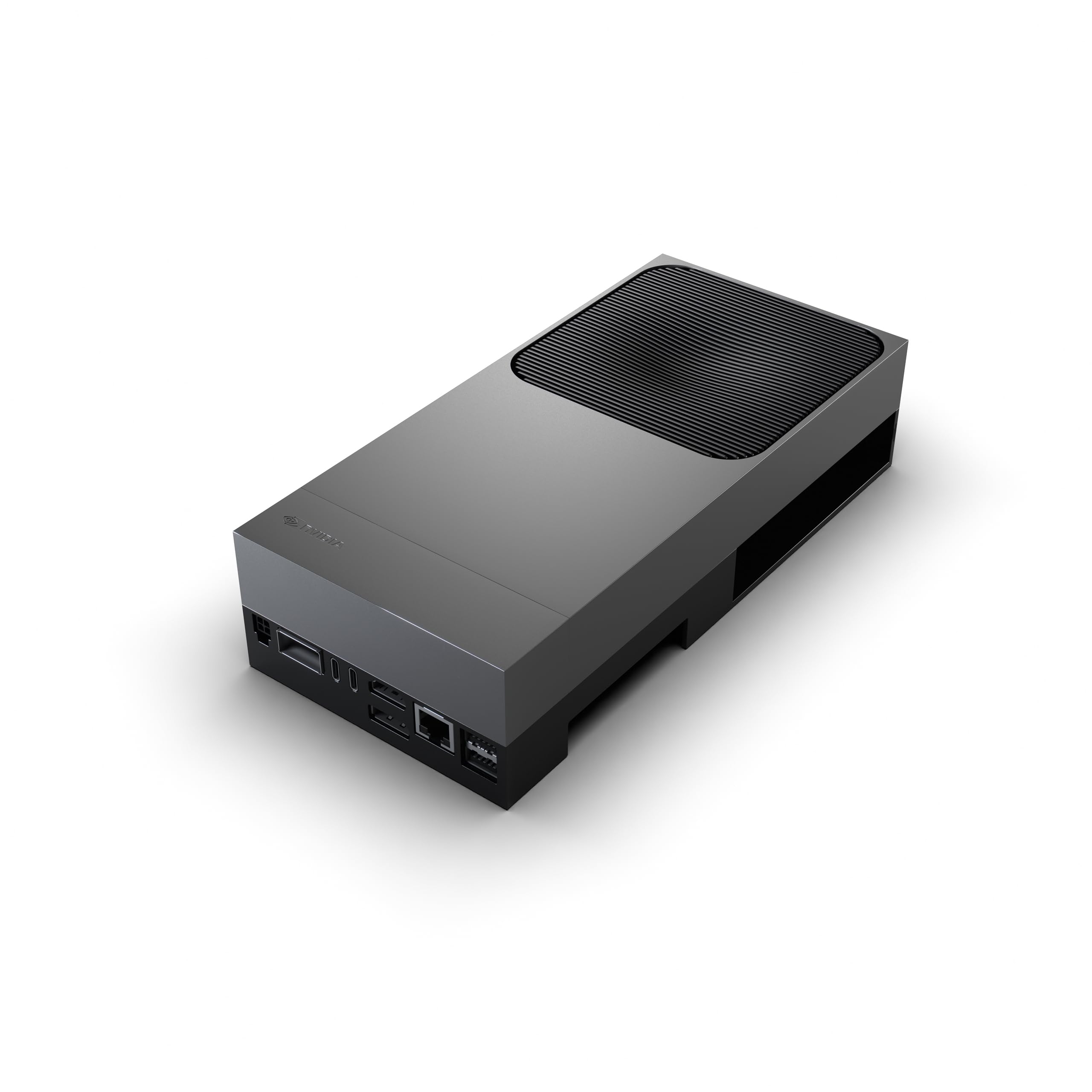
The NVIDIA Jetson Thor Developer Kit represents a massive leap in edge AI capability, packing a 2560-core NVIDIA Blackwell architecture GPU with 96 fifth-gen Tensor Cores and 128 GB of GDDR6X graphics memory. At 2070 TFLOPS of AI performance, this developer kit is designed exclusively for the most demanding autonomy workloads—humanoid robotics, physical AI, industrial automation, and generative AI that must run at the edge rather than in the cloud.
Early reviews from early adopters are enthusiastic but candid: the hardware is exceptional, but the software stack is still maturing. Users report that some demos are currently non-functional due to incomplete NVIDIA driver support for the Thor architecture, and building from source (vllm, custom kernels) is required for the best performance. The device is taken by those who already know why they need it—it is not for casual exploration.
Jetson Thor is the right choice for teams building next-generation autonomous systems that demand maximum on-device inference throughput. If your project involves real-time multi-modal sensor fusion or running large transformer models on a robot platform, this is the compute engine that can deliver, provided you are comfortable compiling from source and debugging an evolving software ecosystem.
Why it’s great
- Unmatched 2070 TFLOPS for edge AI.
- 128 GB GDDR6X for huge model sizes.
- Blackwell architecture with 96 Tensor Cores.
Good to know
- Software stack currently incomplete for some demos.
- Not consumer-friendly; expert-level knowledge needed.
- Very high entry cost for the ecosystem.
3. Garmin Catalyst

While technically a driver-performance optimizer rather than a full autonomy kit, the Garmin Catalyst deserves a spot on this list for its groundbreaking True Track Positioning technology. Using built-in accelerometers, image processing, and a 10 Hz multi-GNSS receiver, the Catalyst automatically generates your car’s racing line on track and delivers real-time audio coaching cues—braking points, speed management, and line optimization—streamed via Bluetooth to your headset or car stereo.
Its 6.95″ IPS touchscreen displays a clear adaptive delta time and the True Optimal Lap, which calculates your best achievable time based exclusively on segments you have actually driven and can repeat. Post-session analysis shows your biggest areas of gain without requiring a laptop. Pre-loaded track database includes road courses from around the world.
Track-day enthusiasts consistently report significant lap-time improvement after just a few sessions. The main downsides are occasional satellite lock issues on overcast days and a mount that can fail under severe off-track impact. For anyone serious about motorsports data acquisition, the Catalyst is a smarter, simpler alternative to a full data-acquisition system.
Why it’s great
- True Optimal Lap calculation is unique.
- Real-time audio coaching works great.
- No external computer needed for analysis.
Good to know
- GPS lock can be flaky in cloudy weather.
- Mount may fail under severe impact.
- Camera mount restricted to windshield view.
4. 70mai 4K T800 3 Channel Dash Cam
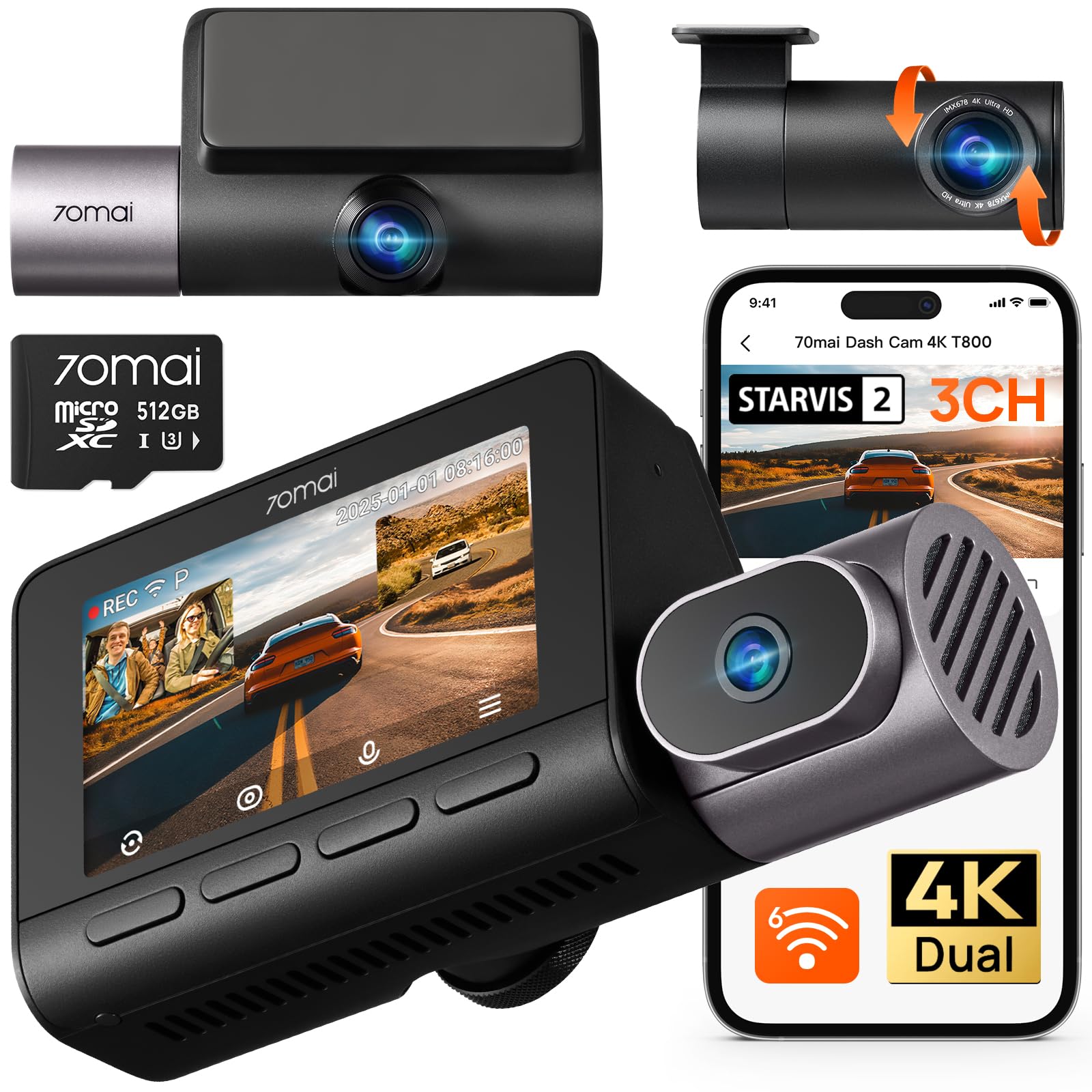
Its built-in ADAS features include lane departure warnings, forward collision warnings, and pedestrian detection, while the optional 4G LTE hardwire kit unlocks live view, theft tracking, and real-time route monitoring via the 70mai app.
Users consistently praise the exceptional low-light performance—the proprietary Night Owl Vision and four 940nm infrared LEDs for the interior cam deliver usable footage even in pitch-black parking garages. The included 512 GB memory card is a welcome bonus, and the 5 GHz Wi-Fi 6 connection enables transfer speeds up to 40 MB/s, allowing a 200 MB clip to download in roughly 5 seconds.
The super capacitor design handles extreme heat better than lithium batteries, and the 24/7 parking guard with AI motion detection offers genuine peace of mind. For rideshare drivers and commuters who want ADAS-level safety without a full autonomy retrofit, the 70mai T800 is the most capable camera-based option available.
Why it’s great
- Dual 4K Sony STARVIS 2 sensors for night clarity.
- ADAS with lane/collision/pedestrian warnings.
- 512 GB card included, no extra purchase.
Good to know
- 4G LTE kit purchased separately.
- Some units arrive dead on arrival (rare).
- Hardwire installation recommended.
5. Autel Robotics EVO 2 Pro V3
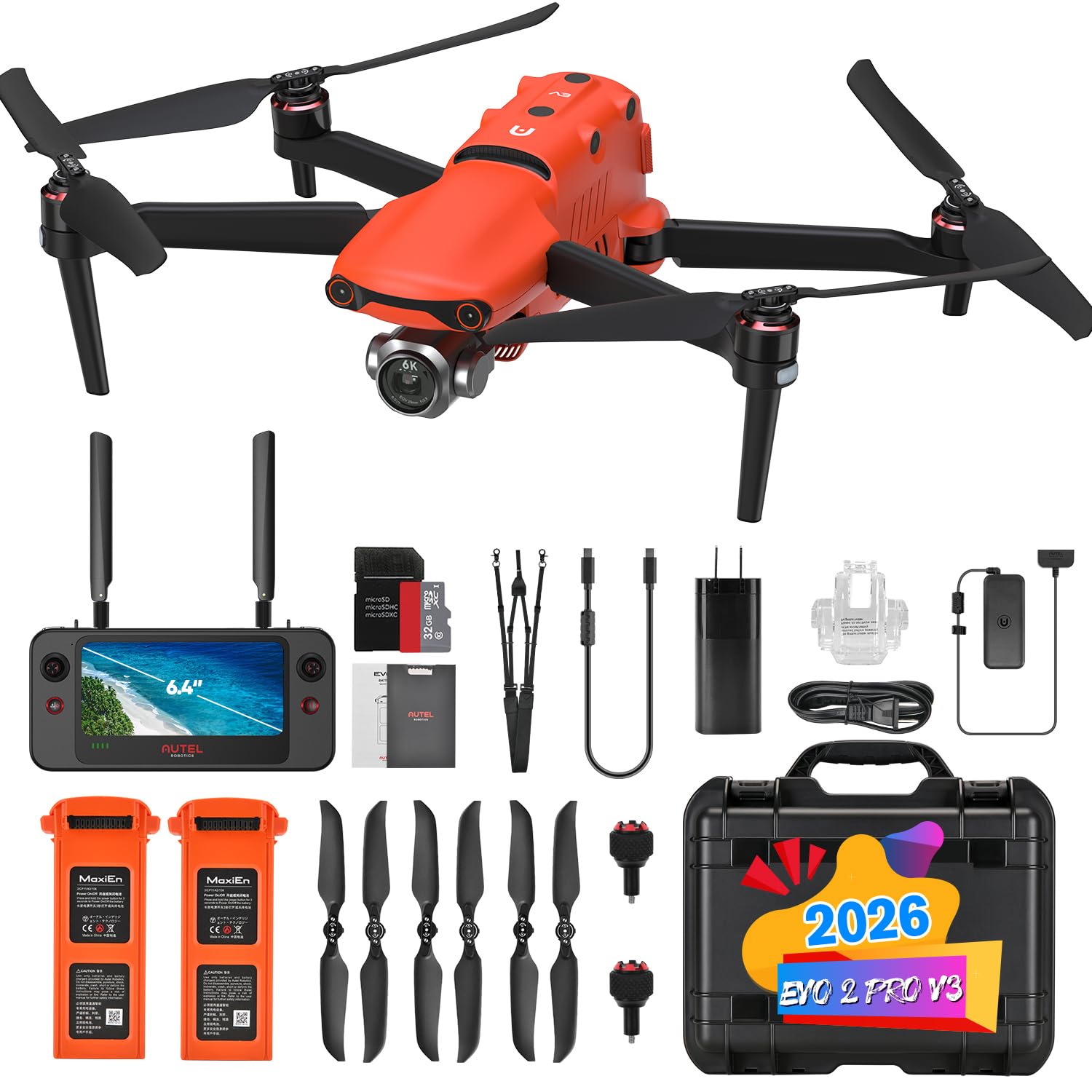
The Autel Robotics EVO 2 Pro V3 is a professional-grade UAV that functions as its own autonomous driving airframe. Its 1-inch CMOS sensor captures 6K HDR video at up to 120 fps, and the new Moonlight Algorithm 2.0 pushes the ISO to 44,000 for exceptional night photography. The SkyLink 2.0 transmission system provides 15 km of range across tri-band communication (2.4/5.8/900 MHz), with automatic frequency hopping for maximum anti-interference capability.
Omnidirectional obstacle avoidance is handled by 12 visual sensors across 19 groups, providing 360° real-time pathing through complex terrain. The 40-minute flight time and 27 mph maximum wind resistance ensure reliable operation in challenging environments. The included Smart Controller SE features a 6.4-inch OLED screen and an IP43 weather rating.
Commercial operators and surveyors have used the EVO 2 Pro V3 for railroad and river surveying, with optical 3D mapping showing just 1–3 tenths of variation. The open gimbal and lack of geofencing (compared to some competitors) make it a favorite for mapping and inspection work. For anyone needing an autonomous aerial platform with professional camera output and reliable collision avoidance, this bundle is excellent.
Why it’s great
- 1-inch CMOS, 6K HDR, ISO 44,000.
- 12-sensor 360° obstacle avoidance.
- 40-min flight time, SkyLink 2.0, 15 km range.
Good to know
- Battery charging may need multiple restarts.
- Obstacle avoidance fails on wires.
- Controller interface differs from phone app.
6. SAFEDRIVE Pro Plus

The SAFEDRIVE Pro Plus is a mechanical right-hand drive (RHD) conversion system designed for rural mail carriers and delivery drivers who need to operate the brake and gas pedals from the passenger seat. It offers a universal fit for all vehicles, with a security pin that disables the system so a passenger cannot accidentally apply the pedals. The unit replaces the need for a dedicated postal vehicle, preserving the original driver-side functionality.
Installation typically takes under an hour for mechanically inclined users, though some reviewers have reported that the included mounting screws are too short and recommend using longer self-tapping hardware. The brake pedal feel is not a 1:1 replica of the stock pedal—it requires more force—but it provides sufficient pressure for push-to-start vehicles and mailbox-stop-and-go driving.
Customer support is based in Illinois and widely praised for offering live phone and text assistance. For rural carriers who need to deliver from the right side without buying a purpose-built postal vehicle, the SAFEDRIVE Pro Plus is a well-engineered, much cheaper alternative.
Why it’s great
- Universal fit for most vehicles.
- Security pin disables passenger pedal access.
- Live US-based technical support.
Good to know
- Requires mechanical skill to install.
- Brake pedal feel is not 1:1 with stock.
- Hardware may need replacing with better screws.
7. Raspberry Pi Smart AI Robot Car (XiaoR GEEK)

The XiaoR GEEK ROS SLAM Tank Car is a purpose-built autonomous navigation research platform. It comes with a Raspberry Pi 4B (4 GB), an XR-Lidar S1 for accurate scanning and mapping, an HD camera, a 3.5-inch touch display, and a durable aluminum alloy chassis with encoded motors. This is a complete kit for performing SLAM (Simultaneous Localization and Mapping), fixed-point navigation, autonomous driving, obstacle avoidance, and visual patrol.
Users confirm that this is not a toy—it requires genuine knowledge of ROS, Linux, and Python to operate. The included tutorial booklet provides a starting point for learning ROS Melodic, and the Android app (sideloaded) provides basic remote control. The 2200 mAh battery offers limited run time, and the kit ships with a blank SD card, so you will need to flash the OS yourself. For university labs, advanced hobbyists, and anyone serious about learning ROS-based autonomy, this is the best value entry point.
The tank-style tracks handle complex terrain well, and the manufacturer’s customer support is consistently described as responsive and knowledgeable.
Why it’s great
- Complete ROS-based SLAM platform.
- LiDAR, HD camera, and touch display included.
- Aluminum alloy chassis, encoded motors.
Good to know
- Requires ROS, Linux, and Python knowledge.
- SD card is blank; OS must be flashed.
- Android-only app, sideloaded.
8. MasterPi 5DOF Robotic Arm (LewanSoul)

The MasterPi from LewanSoul combines a high-quality 5DOF robotic arm with a Mecanum-wheel omnidirectional chassis and an HD camera mounted at the end of the arm for first-person-view perspective. Powered by a Raspberry Pi 5 (8 GB), it leverages OpenCV for AI vision tasks such as color sorting, target tracking, and line following. The metal gear servos provide precise movement for object transport and sorting.
Reviews highlight the well-machined parts and open-source ecosystem, making it suitable for both beginners and experts. The app and PC software are functional, and YouTube tutorials support the learning curve. However, some users report that the aluminum frame can block the RPi’s WiFi signal, and the supplied servo wiring is not clearly labeled in the manual. The FOV of the HD camera is limited to 90°, and the unit cannot charge and run simultaneously without a separate battery failsafe.
For STEM education and AI vision learning, the MasterPi offers a very complete package—a real robotic arm and autonomous car in one kit. The prompt customer support resolved a defective servo issue for one reviewer by sending replacement parts quickly.
Why it’s great
- 5DOF arm with end-mounted HD camera.
- Mecanum wheels for 360° movement.
- RPi 5 8GB, Python, OpenCV tutorials.
Good to know
- Aluminum frame may block WiFi.
- Manual is sparse on servo wiring.
- Cannot charge and run simultaneously.
9. TurboPi Robot Car (LewanSoul)
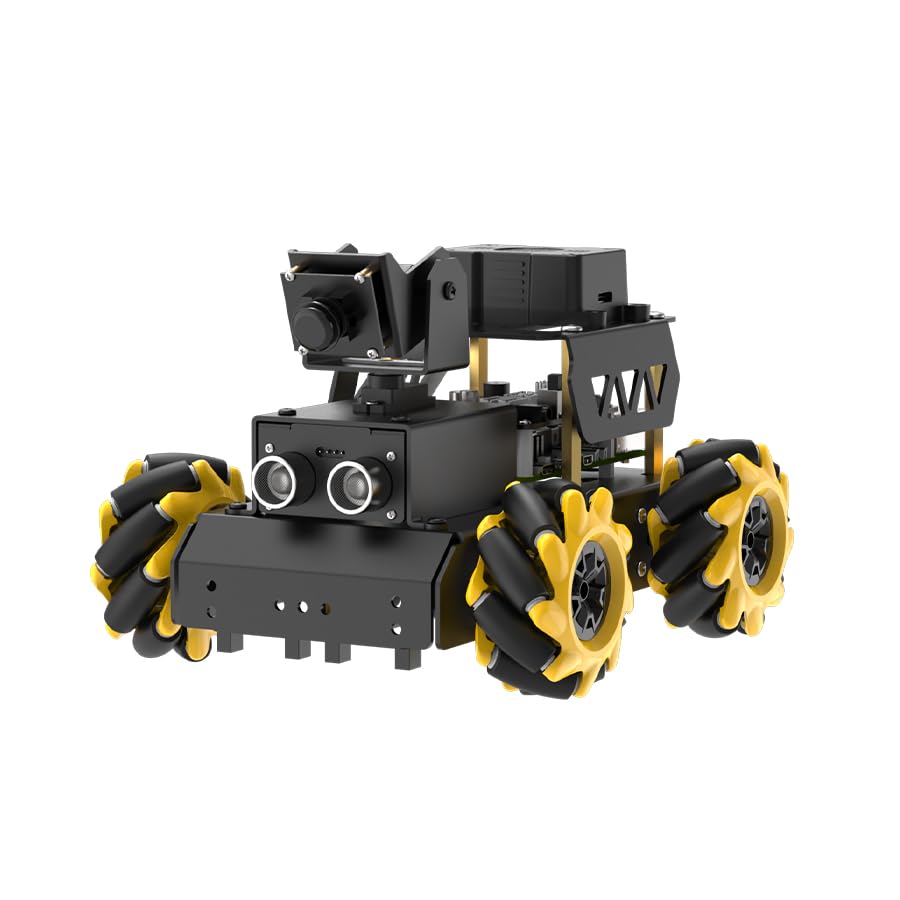
The TurboPi from LewanSoul runs on the ROS2 operating system and integrates a multimodal large AI model (ChatGPT) for vision and voice interaction. The 2-DOF HD camera supports FPV feedback and enables AI applications like gesture recognition, face detection, target tracking, and color sorting. The Mecanum wheel chassis provides truly omnidirectional 360° movement, allowing the car to navigate complex routes with precise translation and rotation.
Reviewers praise the clear build instructions and the fun, hands-on Python learning experience. The starter kit restricts coding to the Wonder Pi app, which limits simultaneous feature execution. One user reported a defective expansion board that blocked WiFi, and another found the provided learning resources insufficient for modification and improvement beyond the pre-set scripts.
The TurboPi is a compelling package for educators and advanced hobbyists wanting to teach AI interaction concepts, provided they are comfortable troubleshooting potential hardware defects and working within the app ecosystem.
Why it’s great
- Integrated multimodal ChatGPT AI.
- 2-DOF camera for FPV and vision tasks.
- 360° Mecanum wheel omnidirectional movement.
Good to know
- Starter kit limits coding to the Wonder Pi app.
- Some units have defective WiFi/expansion boards.
- Limited resources for advanced modifications.
10. HAWK’S WORK F450 Drone Kit
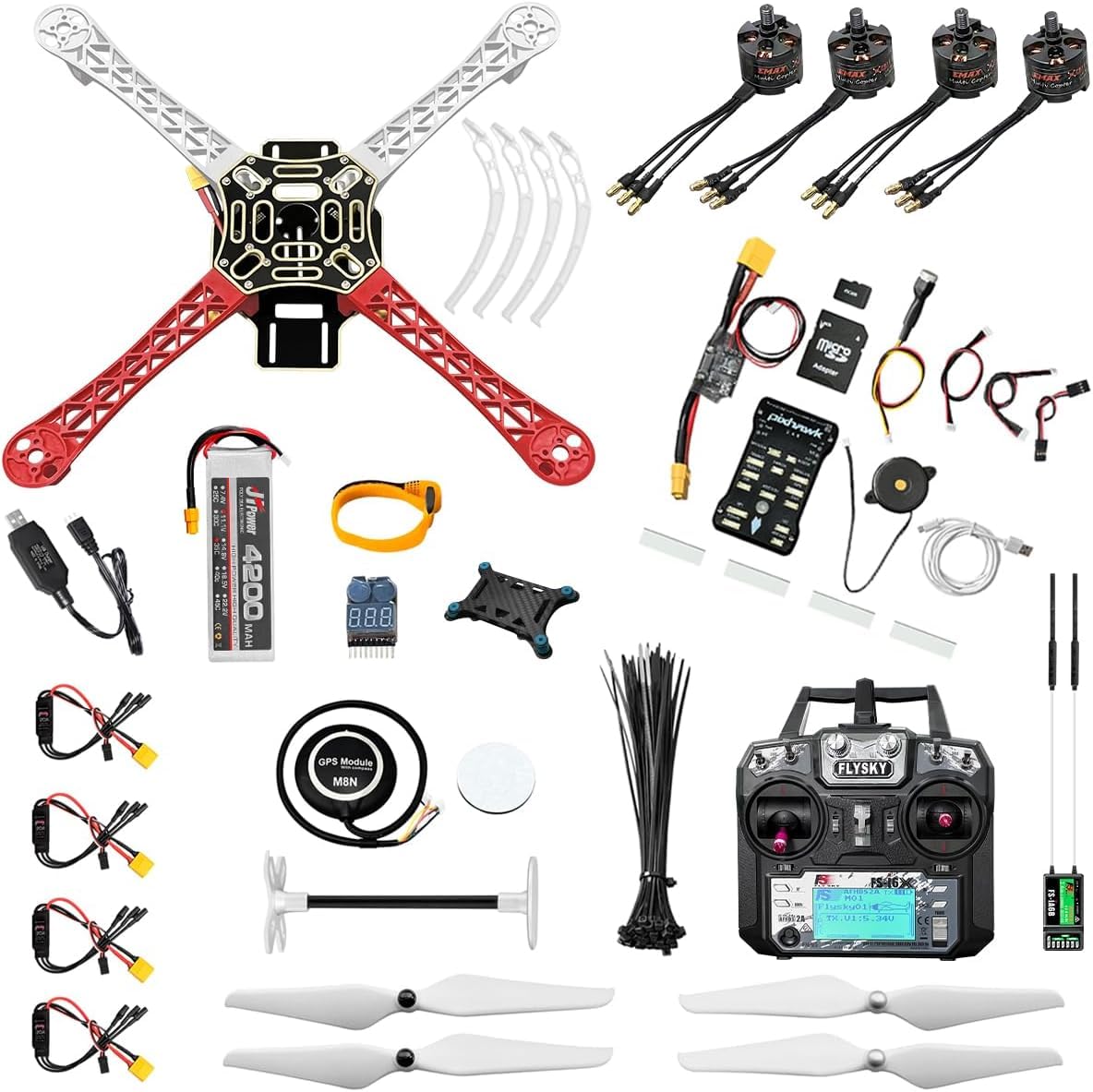
The HAWK’S WORK F450 Kit is a complete DIY quadcopter set based on a 450mm wheelbase frame with a maximum take-off weight of roughly 1.8 kg. It includes a Pixhawk flight controller and GPS module, making it suitable for both beginners learning drone assembly and researchers conducting secondary development. The nylon and plastic frame provides enough space for a Raspberry Pi, a dedicated camera, and various sensors.
A critical note: the flight control (Pixhawk) and GPS are included in the kit, but users must obtain the actual flight controller firmware and compatible battery/transmitter separately. Reviews confirm it is a great platform for self-learners—the crash-recoverable design means you can repair it with replacement parts—but the flight controller programming is challenging, requiring online resources. The kit also lacks a camera or telemetry module by default.
For anyone wanting to understand every component of a quadcopter from the ground up, this kit is unbeatable at the price. Just be prepared to spend significant time on programming and calibration before your first flight.
Why it’s great
- Teaches full drone assembly and repair skills.
- Crash-recoverable with available spare parts.
- Includes Pixhawk and GPS module.
Good to know
- Flight controller programming is difficult.
- No camera or telemetry included.
- Requires battery, transmitter, and firmware setup.
11. United Safety Safe-T-Plus Steering Control

The Safe-T-Plus Blue Steering Control (Model 41-230) is a hydraulic steering stabilizer designed specifically for large Class A motorhomes—fitting Freightliner, Spartan, Workhorse W-Series, Ford F-53, and other chassis. It helps improve driving safety during a front tire blowout, road shoulder drop-off, potholes, pavement drops, and passing traffic by resisting sudden steering inputs. This is a pure mechanical ADAS system: no cameras, no computers, just physics-based stability.
Owners of 30-foot to 40-foot RVs report that the Safe-T-Plus converted dangerously uncontrollable steering into a comfortable one-handed driving experience. Installation is feasible for a DIY mechanic but requires careful measurement of the drag link and clamp diameter per the fitment guide. Adjusting the stabilizer after installation can be awkward, often requiring two people and multiple attempts.
If you own a heavy RV and want a passive safety system that reduces the risk of loss-of-control incidents, this steering stabilizer is a proven, life-saving investment. It is a category-specific component that serious RV buyers consider essential.
Why it’s great
- Dramatically improves heavy RV steering stability.
- Effective in blowout and drop-off scenarios.
- Proven life-saving safety upgrade.
Good to know
- Hard to adjust after installation.
- Mounting kit not included.
- Vehicle-specific fitment requires careful checking.
FAQ
Can I turn my regular car into a fully self-driving vehicle with one of these kits?
What is the difference between ROS and ROS2 in these robot car kits?
How many TOPS do I need for a college-level autonomous car research project?
Final Thoughts: The Verdict
For most users, the best autonomous driving kit winner is the NVIDIA Jetson AGX Orin 64GB Developer Kit because it offers the best balance of compute power (275 TOPS), developer ecosystem, and price for real-world AI development. If you want a purpose-built ADAS system for your daily driver, grab the 70mai 4K T800 3 Channel Dash Cam. And for entry-level SLAM and ROS education, nothing beats the XiaoR GEEK ROS SLAM Tank Car.