
Our readers keep the lights on and my morning glass full of iced black tea. As an Amazon Associate, I earn from qualifying purchases.
Specs are compiled from manufacturer listings and verified buyer reviews and can change over time — please confirm the key details on the product page before buying.
If you want the short answer: the Professional 4200PSI 4GPM 212CC Gas Pressure Washer is the pick most people should buy. It pairs a 4200 PSI punch (pounds per square inch — the force of the water) with a 33-foot hose and a 77-pound frame, so you get reach without a monster machine. 4.6 stars across 40+ ratings backs that up. The rest of this list covers the heavier commercial machines, the value gas units, and the models built for wide-open coverage.
I’m Min — the founder and writer behind Gadgets Feed. This guide is built by comparing the manufacturers’ published specifications and the patterns across verified customer reviews, so you get each pick’s real strengths and trade-offs instead of marketing spin.
One thing to know before you scroll: this list uses flexible matching for pressure class. Every pick here sits in the 4000 PSI range — roughly 3800 to 4200 PSI — not every unit hits the exact number you searched. The picks below answer which 4000 psi pressure washer actually fits your driveway, your fence, and your storage space.
Our Picks at a Glance
How To Choose The Best 4000 PSI Pressure Washer
Buying a gas pressure washer is not like buying a phone — the specs you ignore on day one are the ones that make you regret the purchase on day thirty. Here is what actually matters.
PSI and GPM work as a team, not solo
PSI (pounds per square inch) is the force of the water stream — it is what strips paint and blasts moss off brick. GPM (gallons per minute) is how much water moves per minute — it is what decides how fast you finish a driveway. A machine rated 4200 PSI and 4.0 GPM cleans faster than a 4200 PSI unit pushing 2.6 GPM, because you cover more surface with each pass. Buyers shopping this class should look at both numbers, never just the bigger one.
The pump decides how long the machine lives
Two pump types dominate this category. An axial cam pump is the common, lighter design — cheaper to make and fine for moderate use. A triplex plunger pump is the heavier commercial design, built for steady daily work. The listed specs tell you which one you are getting, so check before you commit.
Engine size and fuel tank tie to how you work
The engine size in CC (cubic centimeters — a measure of the engine’s displacement, so a bigger number means more raw muscle) determines starting effort and how hard the unit pulls the pump. Fuel tank size in liters or gallons tells you how long you can run before refilling. A 3.6-liter tank on a 212CC engine suits a few hours of yard work. A 1.7-gallon tank on a larger engine suits longer commercial sessions.
Quick Comparison
| Model | Best For | Max Pressure | Max Flow | Hose Length | Amazon |
|---|---|---|---|---|---|
| Professional 4200PSI 4GPM 212CC★ Best Overall | Best overall for home and driveway work | 4200 PSI | 4 GPM | 33 feet | Amazon |
| 4200PSI Gas Pressure Washer 4.0GPM 212CCBest Value | Highest-rated value pick | 4200 PSI | 4 GPM | 25 feet | Amazon |
| 4200PSI 4.0GPM 212CC Gas Power WasherCompact Pick | Compact all-rounder | 4200 PSI | 4 GPM | 32 feet | Amazon |
| Gas Powered Pressure Washer 4200 PSI 209CC | Copper pump on a mid-tier budget | 4200 PSI | 4 GPM | 25 feet | Amazon |
| 4200 PSI Gas Pressure Washer 4.0 Max GPM 212CC | Fence, deck, and car cleaning | 4200 PSI | 4 GPM | 25 feet | Amazon |
| Commercial 4000PSI 4GPM 212CC 7.0HP | Long-reach driveway jobs | 4000 PSI | 4 GPM | 25 feet | Amazon |
| Professional 4000PSI Gas Pressure Washer 212CC | Heavy-frame coverage | 4200 PSI | 4 GPM | 33 feet | Amazon |
| Simpson PowerShot 4400 PSI CRX 420cc | Contractor entry machine | 4400 PSI | 4 GPM | 50 feet | Amazon |
| Westinghouse WPX4400 | Fastest coverage on big surfaces | 4400 PSI | 4.2 GPM | 50 feet | Amazon |
| VEVOR Gas Pressure Washer 4400 PSI | DIY enthusiasts on a budget | 4400 PSI | 2.6 GPM | 50 feet | Amazon |
| Simpson Aluminum Series 4200 PSI GX390 | Professional contractor use | 4200 PSI | 4 GPM | 50 inches | Amazon |
In‑Depth Reviews
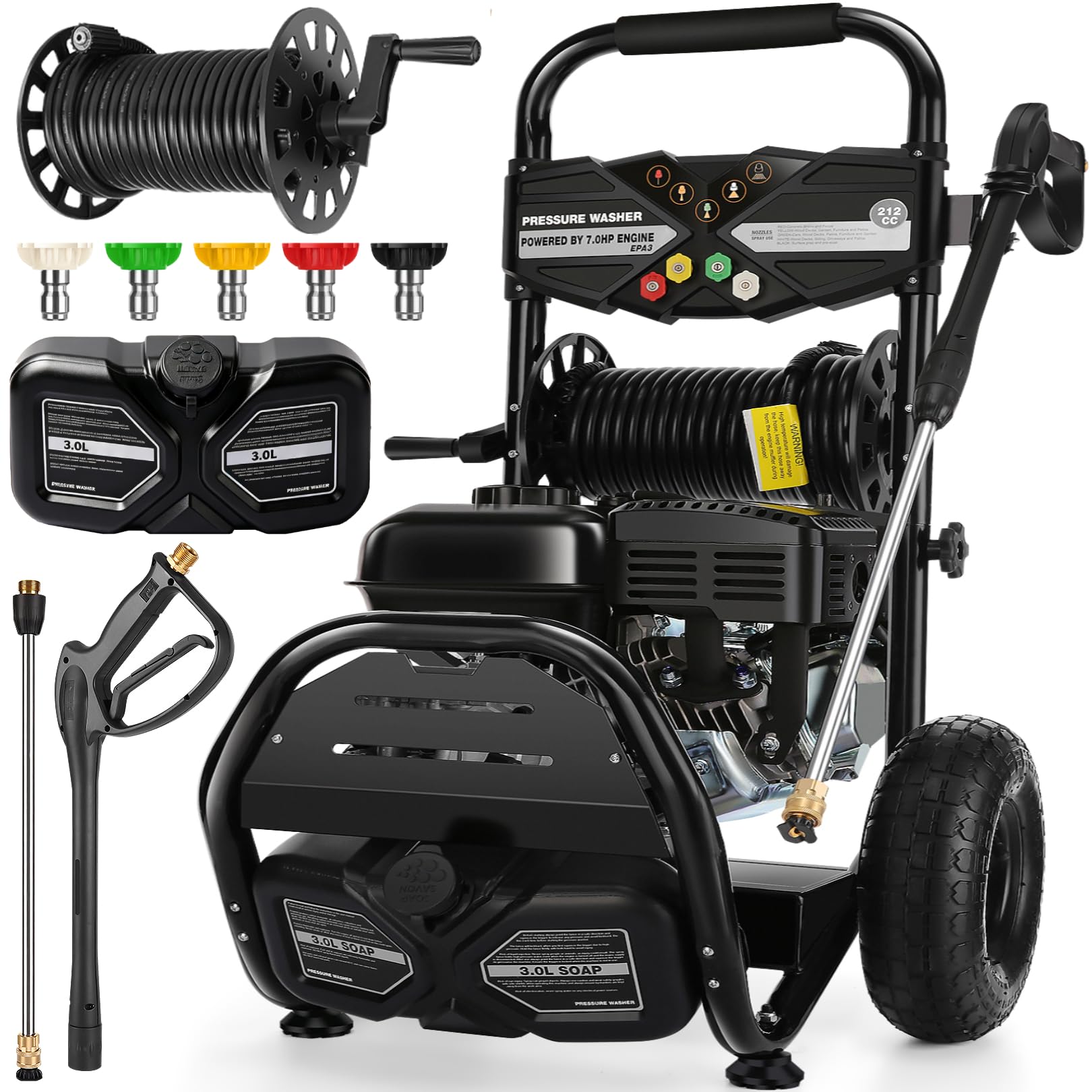
1. Professional 4200PSI 4GPM 212CC Gas Pressure Washer, 7.0HP Heavy-Duty 3600RPM, GBlack
Our pick — over 4.5★ from 40+ verified ratings; the strongest balance of quality and price.
A 33-foot reel-mounted hose and 4200 PSI that cover a whole driveway from one parking spot.
Start with the number that changes your afternoon: the hose runs 33 feet, and it sits on a reel, so it winds up without fighting you at the end of the job. That is 33 feet versus 25 feet on the 4200PSI Gas Pressure Washer 4.0GPM 212CC — a 32% more gap that means you leave the machine parked at the garage door and still reach the back fence. The quick-connect nozzle set covers 0°, 15°, 25°, 40°, and soap, so you step down in aggression without digging through a bag.
The 212CC gasoline engine (212 cubic centimeters — the size of the engine’s combustion chamber) pushes a maximum 4 GPM (gallons per minute — how much water flows through), which is the number that really finishes jobs. What wins people over here is the effectiveness in practice — the water stream carries tree roots and moss off the patio. One owner who measured “Have it for three weeks so far it’s pretty good” is exactly the early read of a machine that does not need convincing arguments. Setup stays short: hose on, quick-connect on, recoil pull, done. The safety lock on the trigger is a small thing you notice every time — it stops you firing the wand when it is not pointed at a project. The 77-pound frame is on the heavier side for this class — this is the top end of what most people want to lift onto a trailer, not a featherweight you carry up a flight of stairs.
Where it pulls ahead
- 33-foot hose with integrated reel — the most workable reach in this class
- 212CC engine with 4200 PSI max and 4 GPM max for real driveway coverage
- 5 nozzles (0°, 15°, 25°, 40°, soap) plus 3000ML foam bottle cover stripping to suds
- EPA/CARB/ETL compliant, safety lock on trigger
- 10-inch wheels roll over grass and gravel without dragging
What to know before you buy
- 77 pounds — you feel the weight when loading it alone
- Takes a strong, deliberate recoil pull to start cold
- You will want to store it somewhere with ventilation because of the fuel smell
Buy this if: your driveway, fence, and patio need coverage from one machine, and you want the hose to reach without dragging the unit.
Choose a lighter unit if: you need to lift the washer up stairs or pack it into a car trunk regularly.
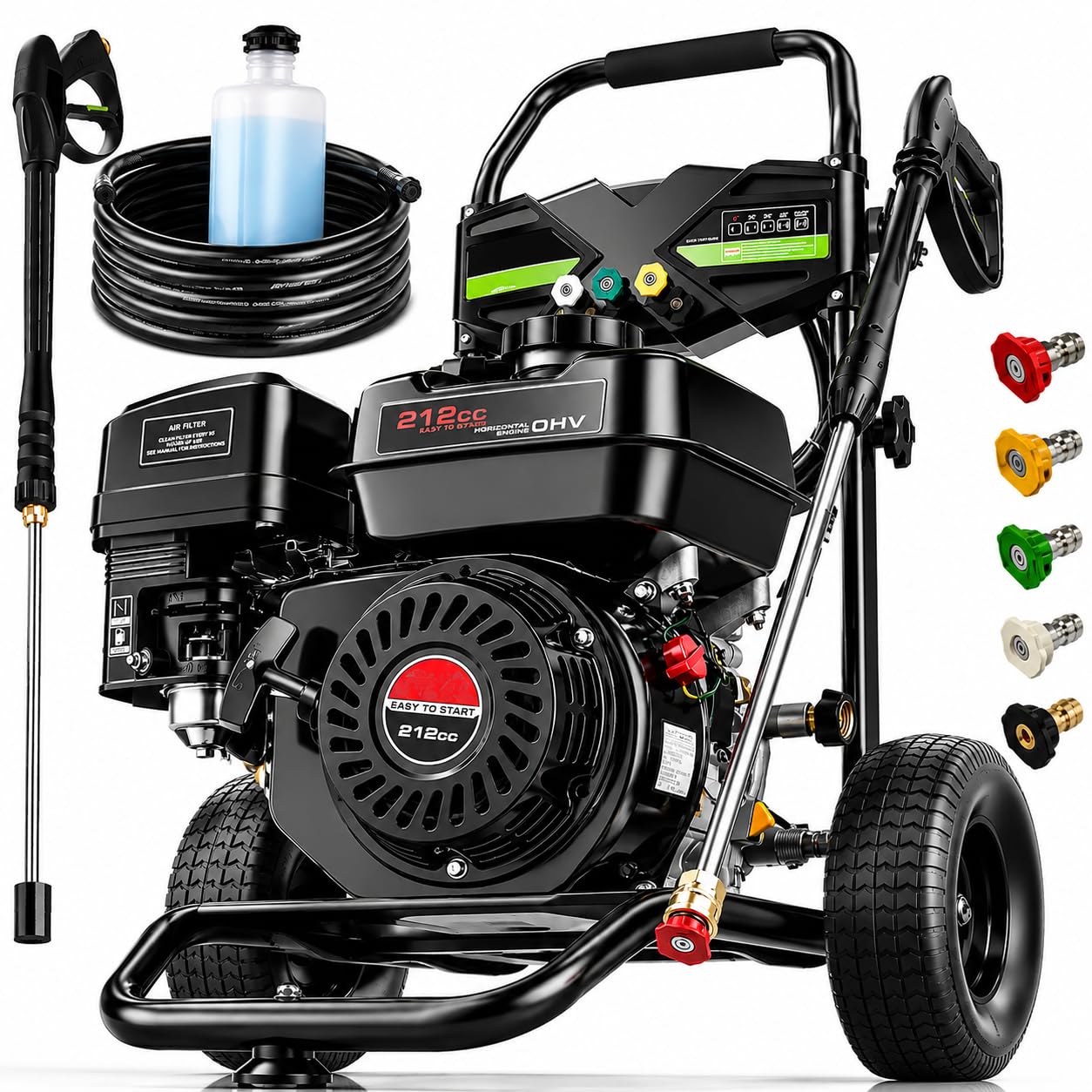
2. 4200PSI Gas Pressure Washer 4.0GPM Gas Power Washer 212CC, Commercial Grade
A 66-pound gas unit with 4 GPM that strips stubborn deck stains without a second pass.
Compared with the 4200PSI 4GPM machine at the top of this list, this one runs a shorter 25-foot hose and skips the reel — that is the honest split, because you trade some reach for a smaller footprint and 66 pounds versus 77. The 212CC 4-stroke OHV engine (overhead valve — a design that lets the engine breathe better) with a 7HP rating pulls a premium axial cam pump (a pump type that uses a wobbling plate to push water), and the whole setup sits on 10-inch pneumatic wheels (air-filled tires) that roll over lawns and mud without digging in. Starting is a pull-start with a choke (a valve that richens the fuel mix for cold starts) — fuel valve open, choke on, one firm tug, then you are running.
What separates this from cheaper gas washers is the fuel tank and the runtime. A 3.6-liter tank keeps you at the wand for longer stretches without walking back to the can, and the dual soap tank with an adjustable switch feeds detergent while you work. The nozzle set runs 0°, 15°, 25°, 40°, 60°, and soap, which covers concrete stripping down to delicate car paint. Buyers describe the pressure as exceptionally sturdy — enough to strip years of buildup with no pretreatment — and the machine assembles in about ten minutes from the box.
The one honest note: the 1/4-inch quick-connect wand and pump are built to standard specs, so if you already own proprietary tooling you may need an adapter. Most people will not hit that snag.
Where it slots: the runtime, the 4 GPM flow, and the lightweight frame make this the pick for a homeowner who works a big yard in one session without upgrading to a commercial rig.
The trade: 25-foot hose versus 33 feet means you move the machine more on long driveways — nothing that a wheel roll does not cover.
Best fit: homeowners running multi-hour jobs who want gas power with less bulk than the top pick.
Not for you if: you are cleaning a half-acre property in one sitting — the extra reach on the 33-foot units will save your back.
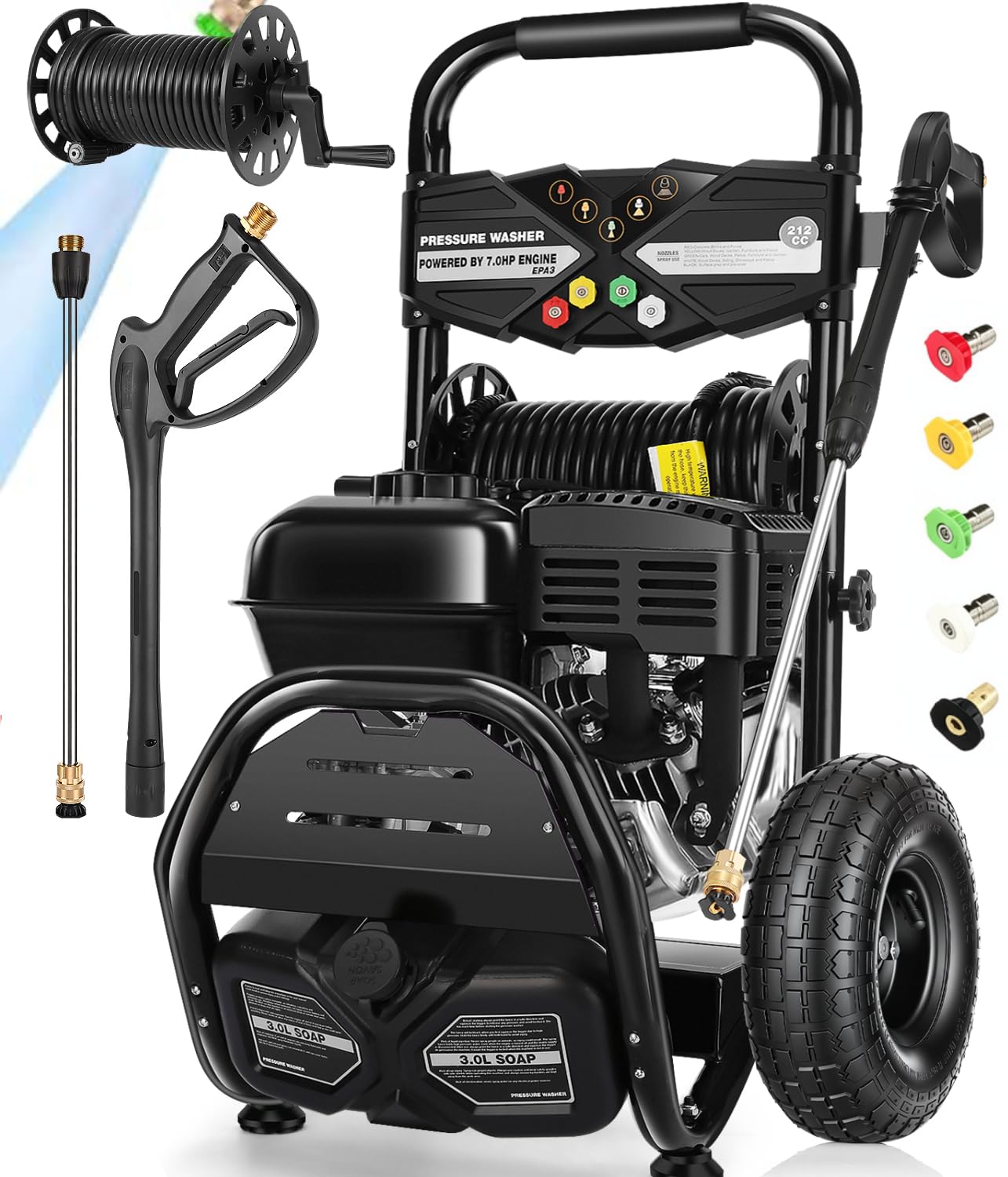
3. 4200PSI Pressure Washer 4.0GPM Gas Power Washer 212CC, 32FT Hose Reel
A 32-foot reel-mounted hose on a 212CC engine that rolls up tangle-free after the job.
Here is a rare thing in this category: a 32-foot hose that lives on a reel, so you roll up without a tangle. That sits right between the 33-foot leader and the shorter 25-foot units, and it is paired with a 212CC 7HP engine pushing 4 GPM — plenty for a multi-car driveway or a long fence line. The 3.6-liter tank supports a full afternoon session without a refill stop.
The nozzle set covers 0°, 15°, 25°, 40°, 60°, and soap, and the 3L dual soap tank lets you mix detergent in independently. The steel frame has an anti-rust coating, and the 10-inch pneumatic wheels roll smoothly over lawns and rough ground. Owners describe the storage layout as the win — hose on the reel, gun on the hook, no tangled coil to fight next season. The EPA/CARB/ETL certifications mean it meets emissions and safety standards you likely care about if you are buying for a residential area.
The trade-off to know about: the choke needs to be set right on a cold start, and if you skip that step the engine just will not catch. Follow the start sequence exactly once and you will not think about it again.
Why it earns a spot
- 32-foot reel hose — nearly the top of the class on reach, self-storing
- 212CC OHV engine with 7HP rating for heavy-duty cleaning power
- 3.6-liter fuel tank extends your working window
- 10-inch pneumatic wheels roll on grass and mud without digging
Where it needs work
- Pull-start sequence matters — cold starts require the choke set correctly
- Steel frame adds weight versus aluminum models
- Takes a firm fuel priming routine on first fill
The right pick if: you have a long fence or wide driveway and want reach without moving the machine every few feet.
Look elsewhere if: you want a lighter aluminum frame for frequent transport.
4. Gas Powered Pressure Washer 4200 PSI 209CC Commercial, Copper Pump
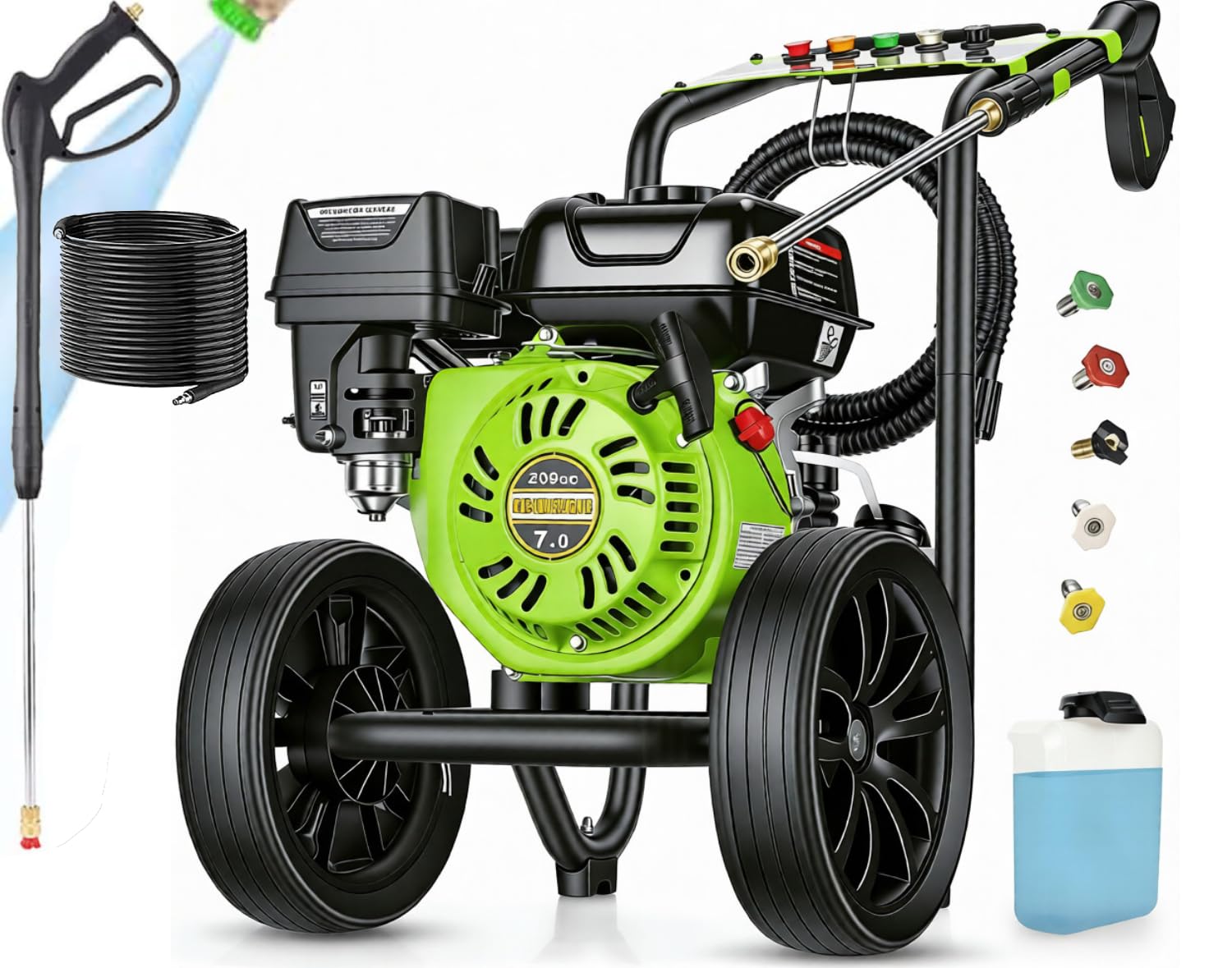
A 209CC rig with a copper pump and 32-foot steel-braided hose that owners rate as powerful enough for the whole job.
This is the only pick in this guide that lists a copper pump in the parts spec — the pump is the piece that sees heated, high-pressure water every second it runs, and a copper-built pump is the kind of detail you want if you plan to live with the machine for years. The 7HP 4-stroke 212cc gasoline engine with recoil start (a pull cord, like a lawnmower) drives the pump, and the whole rig produces a 4200 PSI max and 4.0 GPM flow at the nozzle. Assembly is quick from the box — engine oil, tools, and a start guide are all in there.
The 32-foot steel-braided hose is a real day-one win. Braiding stops the kinking that shortens cheaper hoses, and the non-marring, abrasion-resistant jacket means you can drag it across a concrete driveway without tearing the liner. The 10-inch pneumatic tires roll across uneven ground, and the storage hook catches the gun when you pause. The 3.6-liter gas bottle gives extended runtime, and the adjustable soap switch on the tank mixes detergent right at the wand.
What to expect on day one: the machine ships with a 1L soap tank, not a larger one, so on heavy detergent jobs you will top up mid-session. Otherwise the flow numbers and the copper pump put this in the value tier without cutting corners on the parts that matter.
The strong case: copper pump, 212cc engine, 4200 PSI max, and 32 feet of steel-braided hose at a price that sits mid-list — that combination is why this is worth a hard look.
The single catch is the small 1L soap reservoir. Budget for a separate foam bottle if you plan to soap-wash a fleet.
Reach for this if: the pump build quality is what keeps you awake at night, and you want copper rather than a lighter alloy alternative.
Step past it if: you soap-wash large surfaces frequently — the 1L tank will need a bigger partner bottle.
5. 4200 PSI Gas Pressure Washer, 4.0 Max GPM 212CC 7HP Commercial
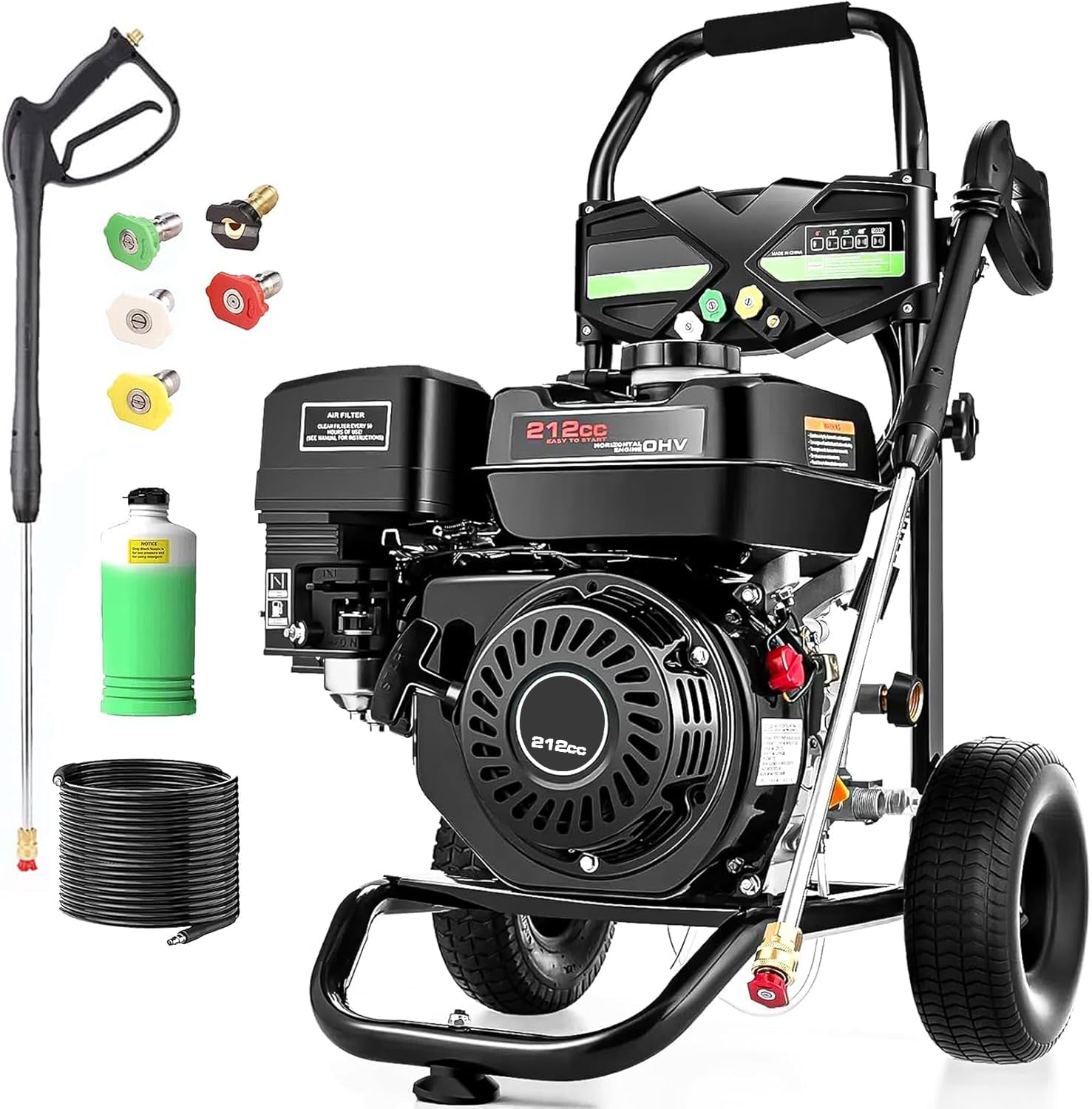
A CARB-certified 212CC rig with never-flat tires and a 25-foot hose for porches, patios, and cars.
You get a 7HP 212cc gas engine with easy-start technology and a commercial-grade axial cam pump on a CARB-certified chassis. That combination covers the raw specs most buyers scan for: 4200 PSI max, 4.0 GPM max, 5 quick-connect nozzles on the 0°/15°/25°/40°/60°/soap ladder, and a 1L soap tank with an adjustable switch. The 10-inch never-flat tires are note — flat tires on a gas washer are a genuine pain, and these are rated to not puncture or leak on you.
Where this earns trust is what owners actually do with it. The machine powers through porches, driveways, patios, and even cars with the 25-foot hose radius. The universal 1/4-inch quick-connect fitting accepts most pressure washer accessories — surface cleaners, extension wands, foam cannons — so you are not locked into brand-specific add-ons. The paint on the frame is holding up, and the recoil pull is easy with a warm engine.
The one buyer worth flagging: if you only clean a small patio a couple of times a year, this is more machine than you need. It is sized for a serious yard list, not a corner of concrete.
The core strength
- 5 quick-connect nozzles cover stripping to gentle car sprays
- Never-flat tires eliminate the flat-tire nuisance
- CARB certified and tested for durability
- 1/4-inch universal quick-connect accepts most add-ons
Fit check
- 1L soap tank is small for extended detergent jobs
- Axial cam pump is the standard (not commercial triplex) design
- 25-foot hose is fine for most driveways but shorter than the reel-mounted alternatives
Good for you if: you want a serious gas machine with never-flat tires and universal accessory compatibility.
Overkill if: you clean a small patio twice a year — you can get away with a smaller pressure class.
6. Commercial 4000PSI 4GPM 212CC 7.0HP Gas Pressure Washer, 9″ Wheels
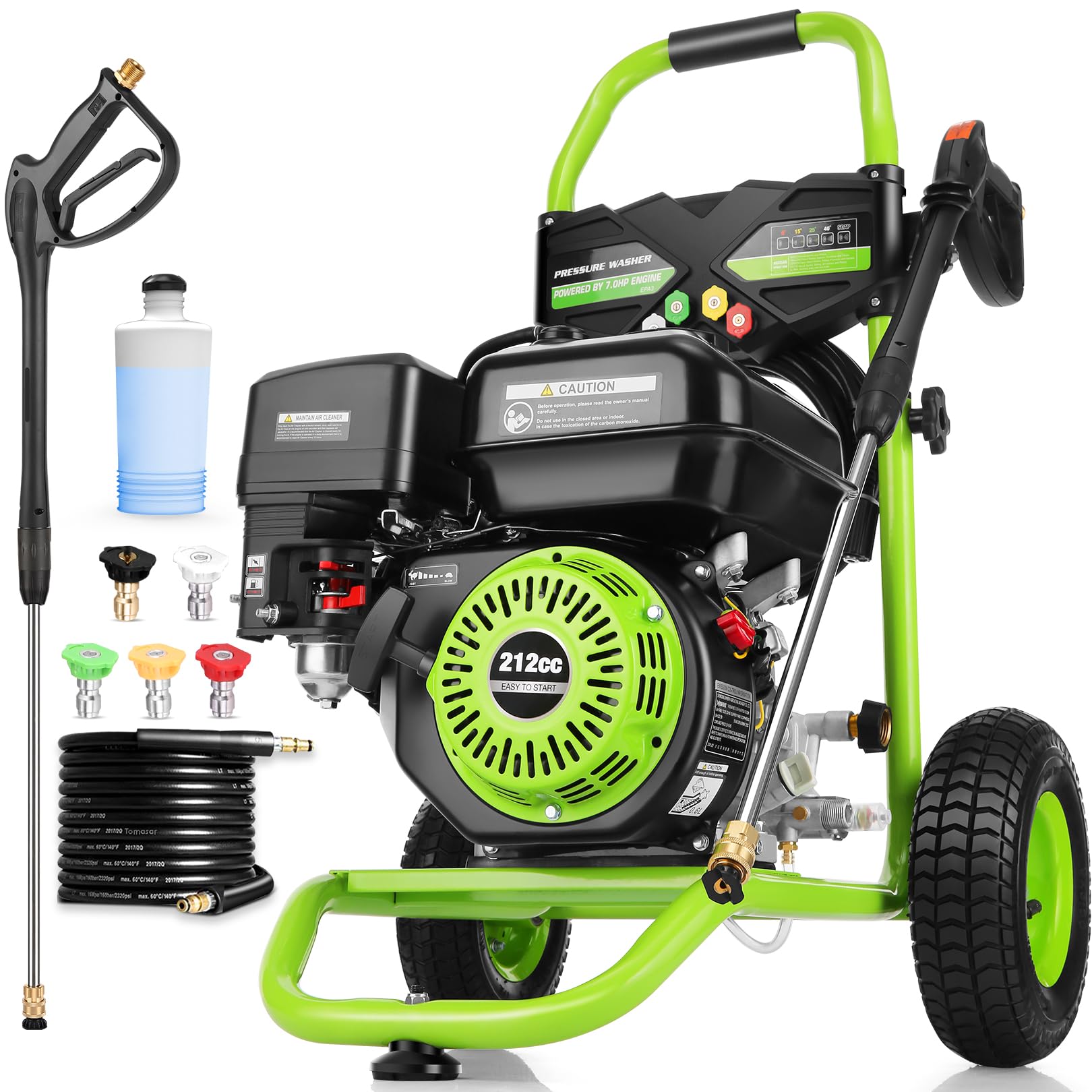
The only pick rated at exactly 4000 PSI, with a 212CC 7.0HP engine and a two-year warranty.
Most of this list says 4200 PSI on the label — this one honestly states 4000 PSI max, and 4 GPM flow. That is still deep in the range you searched for. The 212CC 7.0HP gas engine runs the pump, the frame has a metal build for durability, and the two-handed handle supports the 66-pound machine when you need to lift it over a curb. The five replaceable nozzles (0°, 15°, 25°, 40°, soap) let you go from stripping paint off a driveway to gently cleaning car paint in one machine.
Owners consistently describe the cleaning performance as equal to heavier machines. The frame setup hits a real balance for large-lot cleaning — driveways, patios, siding, wood decks, and rental properties. The gas powered design removes the extension cord from the equation entirely, and the 9-inch wheels roll across grass and asphalt fine. Two-year warranty coverage is included on the unit, and the EPA/CARB compliance (meets federal and California emissions rules) means it is legal for use in states that check.
One thing buyers should plan for: this machine ships with a factory fuel smell from testing, and it needs a specific start sequence — fuel valve open, choke closed, then recoil pull. Follow the steps once and it becomes reflex.
Where it shines: the sweep from a 4000 PSI deck strip down to a car rinse, without changing machines, is what makes this one land for mixed-use yards.
The catch to expect: the hose is 25 feet rather than the 33 feet you get on the reel-mounted top pick — plan your layout around that.
The one to choose if: you want an honest 4000 PSI class machine with a two-year warranty and 4 GPM flow at the value tier.
skip it if: you need to strip stubborn paint off a large surface in one pass — you may want the 4400 PSI commercial machines below.
7. Professional 4000PSI Gas Pressure Washer 4GPM 212CC, 32FT Hose
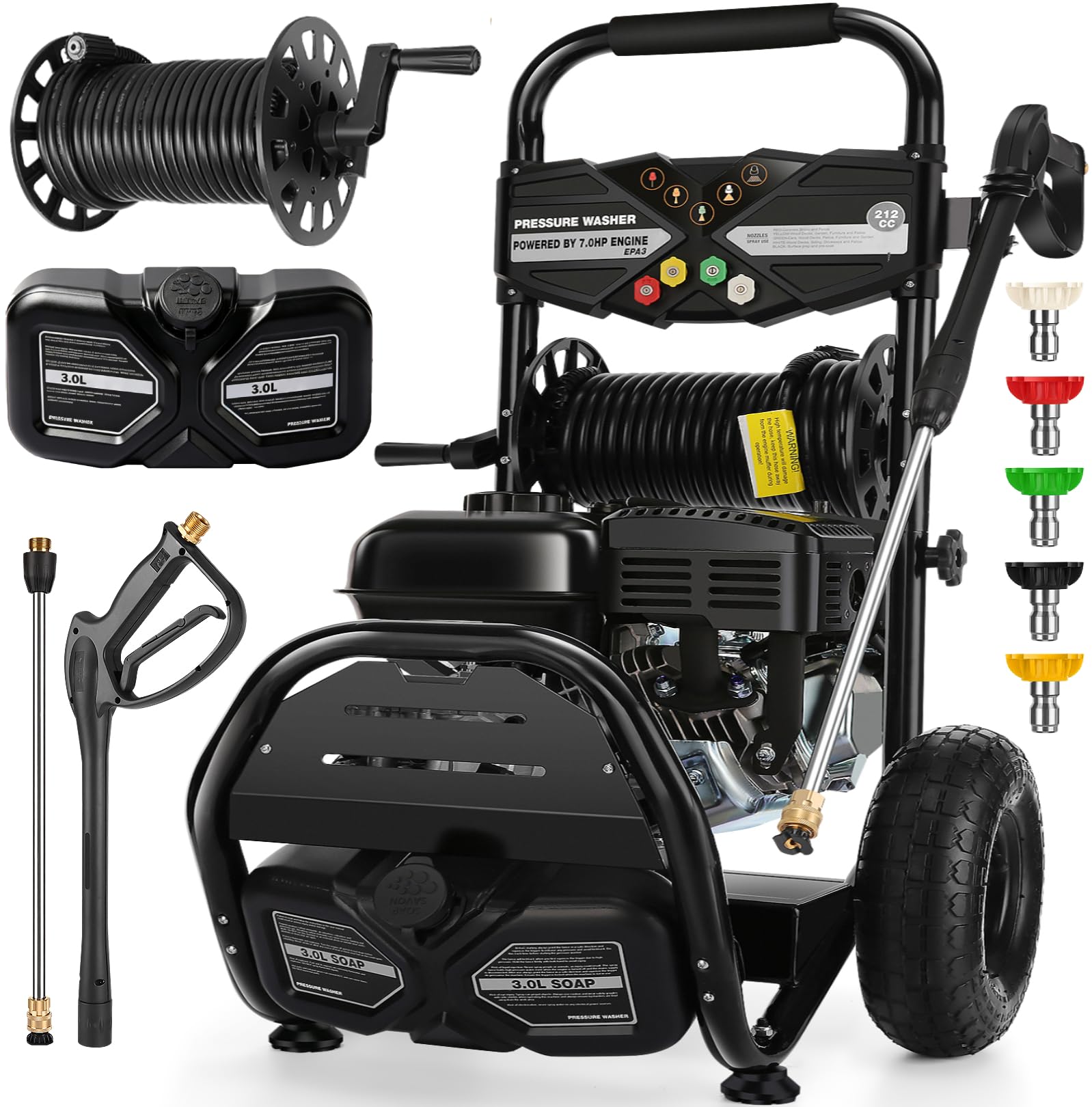
A 33-foot hose on a 77-pound frame that trades portability for reach and stability on large lots.
This machine matches the top pick on hose length — 33 feet — and on weight, 77 pounds. Both sit heavy in the class, and both are worth it if your property rewards reach over portability. The 212CC engine with 7HP rating and the 4 GPM max flow deliver real surface coverage, and the 3L foam bottle plus five quick-connect nozzles (0°, 15°, 25°, 40°, soap) cover everything from fence stripping to car washing. The unit is rated 4000 PSI max — right in the class you searched for, and honest about it.
The safety lock on the trigger is one of those details you appreciate every session, and EPA/CARB/ETL compliance keeps it street-legal in most markets. The 10-inch wheels roll over grass and gravel with reasonable effort given the weight. Buyers cooking up their second or third pressure-washer project describe the frame build as solid and the reach as the reason they chose it over shorter-hose units.
The catch: the 77-pound frame is heavy for one person to lift solo, and the machine needs a ventilated storage spot between uses because of the fuel smell. Both are the normal cost of a machine this size.
The wins here
- 33-foot hose gives the same reach as the top pick
- 3L foam bottle covers longer soap-wash sessions
- EPA/CARB/ETL compliant, safety lock included
- 10-inch wheels make the 77-pound rig manageable
What to plan around
- 77 pounds demands two people for lifting onto a truck bed
- Fuel smell means ventilated storage
- Pull-start needs a firm, deliberate tug cold
Best suited for: larger residential properties where reach matters more than the machine’s weight.
Look past it if: you unload the washer from a car trunk every weekend — the 77-pound frame will get old fast.
8. Simpson PowerShot 4400 PSI Gas Pressure Washer, 4.0 GPM, CRX 420cc
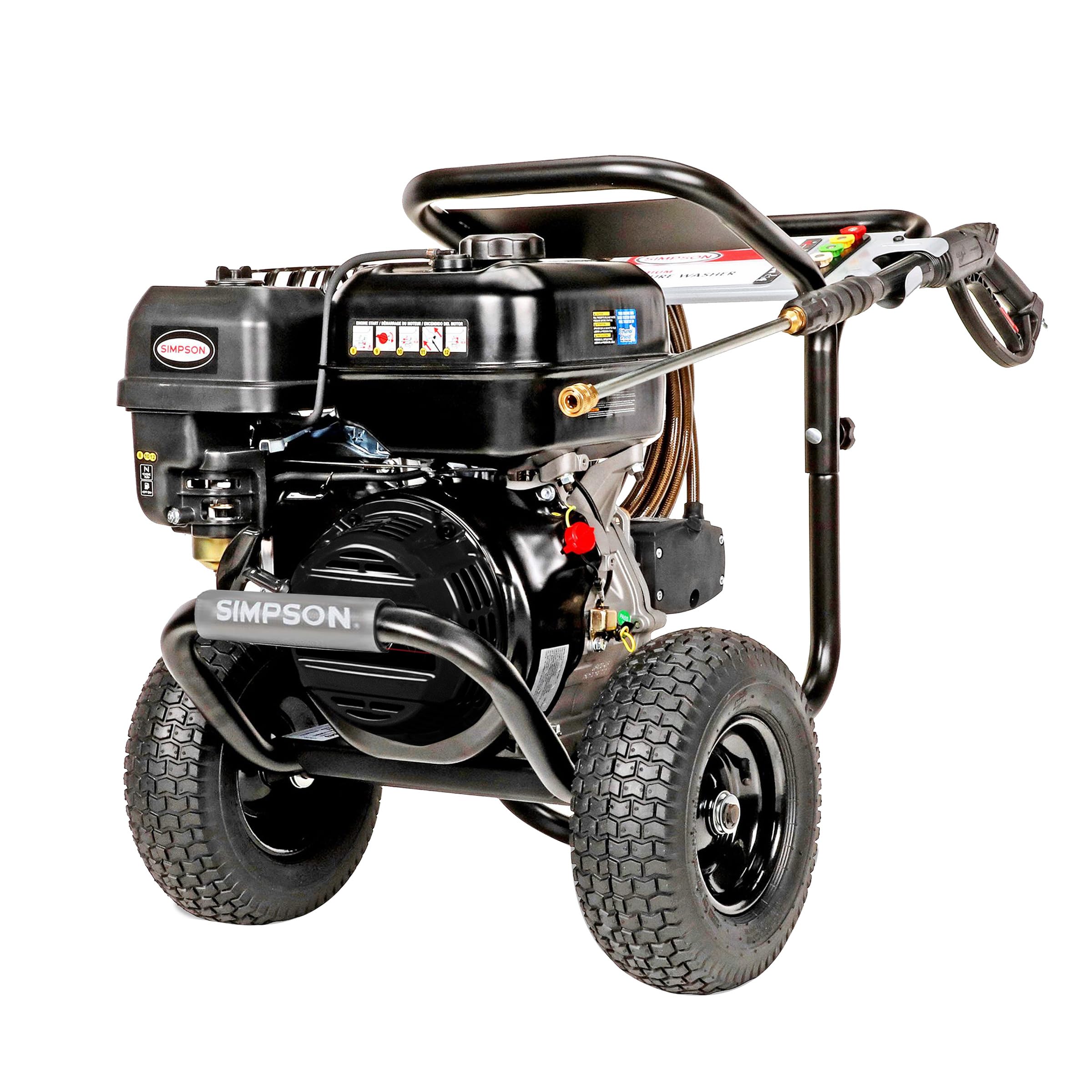
A 420cc engine and AAA triplex pump pushing 4400 PSI through a 50-foot hose — the commercial starter.
The stats tell the story before you pull the recoil: a CRX 420cc premium engine, 4400 PSI, 4.0 GPM, an AAA industrial triplex plunger pump, and PowerBoost Technology that raises pressure at the nozzle. That is a genuine step up from the 212CC axial-cam machines above, and it is aimed at people doing deck cleaning, wood restoration, and paint prep professionally or at a serious DIY level. The 50-foot Monster hose with polyurethane outer jacket resists kinks and abrasion, and covers a lot of ground before you move the frame.
The triplex pump is the key difference — plunger pumps are built for sustained use, and Simpson adds thermal relief to prevent overheating. Thirteen-inch pneumatic tires and a welded steel frame with powder-coat finish round out the durability story. The five quick-connect tips (0°, 15°, 25°, 40°, soap) and the 31-inch steel wand cover everything from fence stripping to paint prep. Contractors who run these for a living prioritize GPM for speed and coverage — this machine delivers the 4.0 GPM consistently.
The honest catch: this rig ships 49-state compliant and cannot ship to California. And it is a 135-pound machine — real weight, real footprint, real fuel consumption. This is not the pick for someone who just wants to hose the sidewalk once a month.
The reason it is here: the commercial triplex pump and CRX 420cc engine combo is a real upgrade for anyone whose washer gets used as a tool rather than a toy.
The real consideration: California buyers are locked out — this unit is 49-state compliant only.
Built for you if: you clean decks, prep paint, or restore wood as a side business or serious hobby.
Overkill if: you only run a pressure washer a couple of weekends a year — the smaller 212CC picks cost less and do the same job at home.
9. Westinghouse WPX4400 Gas Pressure Washer, 4400 PSI and 4.2 GPM

The highest GPM rig here at 4.2 GPM — the one to grab when surface area is the enemy.
The 420cc 4-stroke OHV horizontal shaft engine with recoil start drives a commercial-grade triplex brass head pump. That pump combination is the kind that owners describe as building a workhorse reputation over years of use, and the powder-coated steel frame with 12-inch pneumatic tires rolls over uneven yard terrain.
The kit covers the practicals: a 50-foot Super-Flex hose, high-pressure spray gun, and 5 quick-connect nozzles (0°, 15°, 25°, 40°, soap) that accept M22-fitting accessories like surface cleaners and foam cannons. The 1.7-gallon fuel tank supports long sessions without a refill stop. Owners describe the machine as reliable with high flow rate performance and easy to walk through a job. Assembly guides you through in minutes, and Westinghouse includes engine oil and tools in the box.
The buying caveats: 142 pounds is real weight, and the machine needs care around cold weather. Recoil starting is the routine — a firm pull with the choke set correctly. And like any 4-stroke gas machine, you need to store it with ventilation to avoid fuel vapor buildup.
Where it dominates
- 4.2 GPM is the highest flow rate in this guide
- Commercial triplex brass head pump
- 50-foot Super-Flex hose plus 5 quick-connect nozzles
- 3-year limited manufacturer warranty covers service, labor, and parts
What to plan for
- 142 pounds — heavy for solo loading and unloading
- Recoil start requires correct choke placement for cold cranking
- 1.7-gallon tank refills more often than larger tank models
Reach for this if: raw coverage speed is your priority — big driveways, parking pads, or commercial walkways.
Not your pick if: you want something light enough to carry and store easily.
10. VEVOR Gas Pressure Washer, 4400 PSI, 4.0 GPM, Gas Powered

A 4400 PSI branded rig with 50 feet of hose and a copper pump for DIY enthusiasts.
VEVOR positions this as the DIY enthusiast’s choice, and the bare specs back that up: 4400 PSI max pressure, a 390 ml 4-spoke engine, a 15 HP copper pump, and a 1.7-gallon gasoline tank. The 50-foot hose is the second-longest in this guide, and the abrasion-resistant design plus the on-machine storage keep it manageable. The 10-inch never-flat wheels and steel frame round out the practicals.
Owners describe the machine as great for a starter build with commercial cleaning — the kind of tool you buy to run a business test or tackle a one-time big job before deciding to upgrade. The 5 quick-connect metal nozzles cover 0°, 15°, 25°, 40°, and soap. The recoil starter has a kickback risk, so plan a firm, deliberate pull with both hands. Adding an aftermarket full-finger recoil handle is a common upgrade we see echoed in reviews.
The honest note: at 137 pounds this machine does not move around the yard easily, and the motor base is reported as a weak point by owners running heavy sessions. The pump and hose are the strong parts — so as long as you are not abusing the frame with daily commercial hours, this holds up as a value-first first gas washer.
The reason to consider it: 4400 PSI at a mid-tier price with a copper pump and 50-foot hose is genuinely hard to find in one package.
The reality check: expected durability leans on the pump and hose; owners do flag the motor base as the fragile piece over time.
Try this if: you are building a first gas washer setup and want impressive specs without paying commercial-tier prices.
Pass if: you plan to run it five days a week — you want the triplex pump and heavier frame of the Westinghouse or Simpson rigs.
11. Simpson Aluminum Series 4200 PSI Gas Pressure Washer, Honda GX390

The aluminum-frame Simpson with Honda and CAT internals — a permanent-tool pick for pros.
Two names do the heavy lifting here: Honda GX390 engine and CAT triplex plunger pump. Both are known quantities in contractor circles, and both are why this machine costs what it does. The 4200 PSI max and 4.0 GPM flow are exactly what you want from a commercial rig, and the CAT pump includes thermal relief to prevent overheating plus advanced oil seal technology and ceramic-coated pistons. The 50-foot dual-braided Monster hose resists kinks and abrasion with a non-marring polyurethane jacket so it protects finished surfaces.
Where this earns its keep: the aircraft-grade aluminum frame with powder-coated finish resists corrosion and cuts weight versus steel equivalents — 124 pounds for a machine with this power class is impressive. Thirteen-inch pneumatic tires roll smoothly over gravel, grass, and curbs. Assembly is straightforward: handle, oil, fuel, then pull. Owners describe starting on the first pull with the low-oil shutdown watching for the engine, and reach that lets them cover walls, driveways, and sidewalks without repositioning the machine frequently.
The catch to size honestly: the aluminum frame demands careful bolt tightening — over-torque it and you risk stripping the threads. And like any commercial rig this weighs over 120 pounds, so it is not a machine you stash on a shelf between uses. The 49-state compliant designation means California buyers are locked out. For contractors and serious property managers, though, the Honda-plus-CAT combination is the whole reason this ends up on a pro shortlist.
Why it is on the pro list
- Honda GX390 engine with low-oil shutdown — among the most serviced engines in the category
- CAT triplex plunger pump with thermal relief and ceramic-coated pistons
- Aluminum frame cuts weight to 124 pounds versus steel equivalents
- 50 feet of Monster dual-braided hose resists kink and abrasion
- Five quick-connect tips cover stripping to car cleaning
What to know before you commit
- Not for sale in California — 49-state compliant only
- Aluminum frame bolts need careful tightening (no over-torquing)
- 124 pounds is a two-person lift onto a truck bed
- Coolant and fuel top-off routine required for long-running sessions
The pick for you if: you run a pressure-washing business or manage multiple properties and want a machine built to survive years of use.
Not for you if: you are buying for the occasional weekend deck clean — the Honda-plus-CAT internals are worth it only when you use them, and the 124 pounds is real.
Understanding the Specs
PSI and GPM — the two numbers that matter most
PSI (pounds per square inch) is the force of the water stream — how hard it hits the surface. GPM (gallons per minute) is the flow — how much water moves each minute. A driveway full of moss needs both: PSI to break the moss loose, GPM to wash the debris off. A machine rated 4200 PSI and 4.0 GPM cleans faster than one rated 4200 PSI and 2.6 GPM because each pass covers more surface. Both specs must appear on the label to be meaningful — if only one shows, be cautious.
Axial cam pump versus triplex plunger pump
The pump is the part that pressurizes the water, and it usually outlasts or out-fails the engine. An axial cam pump is a lighter, less expensive design that handles occasional and moderate use fine. A triplex plunger pump is the heavier commercial design — it is what you find on machines built for daily work, and it typically comes with thermal relief to prevent overheating on long sessions. Entry-level gas washers use axial cam pumps. Commercial rigs use triplex plunger pumps with names like CAT and AAA.
Engine size in CC and what it controls
CC stands for cubic centimeters — the size of the engine’s combustion chamber. A 209CC engine is smaller than a 212CC engine, which is smaller than a 420CC. A larger engine spins the pump harder and holds pressure better on long runs, and it usually requires more fuel. A 212CC gas engine with a 7HP rating is the balance for residential work. A 420CC engine belongs on machines built to run hard all day.
Hose length and wheel size — the daily-use specs
Hose length decides how often you move the machine. A 25-foot hose covers a small driveway. A 32 or 33-foot hose covers a long fence line from one position. A 50-foot hose is what commercial users want for reaching distant corners. Wheel size matters for rolling over grass and gravel: 9 or 10-inch pneumatic tires handle lawns, and 12 or 13-inch pneumatic tires handle rougher ground. Solid never-flat tires are an option on a few models — you trade some cushioning for zero risk of a flat.
FAQ
Can I use a 4000 PSI pressure washer on a wood deck?
What is the difference between an axial cam pump and a triplex pump?
How long can I run a gas pressure washer on one tank of fuel?
Do I need an EPA or CARB compliant gas pressure washer?
Will a 4200 PSI pressure washer strip car paint?
What type of oil and fuel does a 212CC gas pressure washer need?
How much hose length do I need on a gas pressure washer?
Which nozzle should I use for cleaning a concrete driveway?
Is a gas pressure washer better than an electric one for home use?
How do I store a gas pressure washer between uses?
Final Thoughts: The Verdict
For most people shopping for the 4000 psi pressure washer, the winner is the Professional 4200PSI 4GPM 212CC because the 33-foot reel-mounted hose and 77-pound frame land in the balance for residential work — reach without a monster footprint. If raw coverage speed is your goal, grab the Westinghouse WPX4400 with its 4.2 GPM flow, the highest in this guide. And if you run a pressure-washing business or manage multiple properties, the Simpson Aluminum Series is the one to reach for — Honda GX390 engine plus CAT triplex pump is a combination built for years of use.
How We Picked
We do not accept paid placement. Every pick is matched to a real buyer and a real use-case; we do not hands-on test units.
Sources & Methodology
Specifications: manufacturer listings and product documentation. Review insights: verified customer reviews, as of September 2026. Pricing: not shown on this page (it changes often); check the current price via the retailer link.
As an Amazon Associate, Gadgets Feed earns from qualifying purchases. This does not affect which products we feature.