
Our readers keep the lights on and my morning glass full of iced black tea. As an Amazon Associate, I earn from qualifying purchases.
Specs are compiled from manufacturer listings and verified buyer reviews and can change over time — please confirm the key details on the product page before buying.
Buying copper tubing sounds simple until the coil shows up flattened in the middle, the ends are crushed from a pair of wire snips, or the outer diameter runs fat and your fittings won’t grab. Those are the three things that ruin a job, and they are exactly what separates a good coil of 3/4″ copper tubing from a bad one. This guide sorts the real options by what actually matters on the job: whether the tube stays round, whether it bends without kinking, and whether the wall thickness is honest.
I’m Min — the founder and writer behind Gadgets Feed. This guide is built by comparing the manufacturers’ published specifications and the patterns across verified customer reviews, so you get each pick’s real strengths and trade-offs instead of marketing spin.
You need tubing that fits your existing fittings and flare tools without leaks. Every pick here shares the same 3/4-inch outer diameter, so your tools line up. They cover refrigeration and HVAC grade coils, soft-annealed tube for hand bending, and shorter lengths for small repairs. If you want the short answer: the crowd favorite for all-round HVAC work is a 99.9% C12200 smooth coil with 4.7 stars across 500+ ratings. It earns that spot on roundness and clean bends as much as on purity. This breakdown covers the best 3/4 copper tubing for refrigerant lines, water lines, and DIY repair work.
Our Picks at a Glance
How To Choose The Best 3/4 Copper Tubing
The biggest beginner mistake with copper tubing is assuming all 3/4″ tube is the same 3/4″. It isn’t. On ACR (air conditioning and refrigeration) tube, the 3/4″ figure refers to the outside diameter — the measurement across the outside of the pipe. On plumbing tube sold by nominal size, the labeling works differently, and fittings are matched to that system. Buy the wrong one and your flare nut will not seat, no matter how carefully you work.
Match the outer diameter to your fittings first
Every product on this list is measured by outside diameter, and each listing states that number directly. A 3/4″ OD coil is the common size for larger line sets and higher-flow runs. The inner diameter differs from product to product, because it depends on wall thickness — one coil here runs 0.687″ ID, another 0.677″ ID, and the 25 ft coil lists 11/16″ ID. That gap is the wall, and the wall is what decides how the tube behaves when you bend it.
Thickness decides how forgiving the bend is
A thicker wall resists collapsing when you pull a tight radius by hand. A thinner wall bends with less effort but demands more care — many owners of thin-wall tube report reaching for a bender to stop the tube from flattening. If your run has tight corners, favor the heavier wall and plan your bends. If you are making sweeping curves, the softer tube is easier on your hands.
Length: repair patch or full line set
Short coils suit repairs — a capillary tube fix, a fuel line, a short patch — while longer coils suit a complete install without inline joints. Continuous tube without a splice is the goal on any refrigerant run, because every joint is a potential leak point. Know your run length before you buy, then add margin for the bends you will cut off and redo.
What “soft” and “smooth” really mean
Soft-annealed copper has been heated and cooled so it stays pliable and can be hand-bent. smooth means the tube was drawn as one piece with no welded seam running down its length, which matters for pressure holding. Both appear across these listings, and both are worth confirming before you buy.
Quick Comparison
| Model | Best For | Length | Wall Thickness | Material Grade | Amazon |
|---|---|---|---|---|---|
| BELLA BAYS Copper Tubing 3/4″ OD x 10 ft★ Best Overall | All-round HVAC and DIY work | 10 ft | — | C12200 T2, ASTM B280 | Amazon |
| Pure Copper Tubing smooth T2 3/4″ OD x 5 FTBest for Repairs | Capillary and small refrigeration repair | 5 ft | 0.9 mm | Copper | Amazon |
| YuJingKey 3/4″ OD x 5 Ft Copper Tubing | Small DIY and craft projects | 5 ft | 0.375 in | C12200, ASTM B280 | Amazon |
| GOORY Copper Tubing 3/4″ OD x 10 FT | HVAC installs and custom runs | 10 ft | 0.031 in / 0.8 mm | C12200, ASTM B280 | Amazon |
| ELECTRAPICK Copper Tubing 3/4″ OD x 25 Ft | Longer runs without joints | 25 ft | 0.8 mm / 0.031 in | C12200 | Amazon |
| TAUROX 50 Ft 3/4 OD Copper Tubes | Full line sets with cutter included | 50 ft | 0.8 mm | C12200, ASTM B280 | Amazon |
| ICS Industries 3/4″ OD ACR Tubing | Pro-grade line sets and HVAC piping | 50 ft | .035 | Copper, ACR grade | Amazon |
In‑Depth Reviews
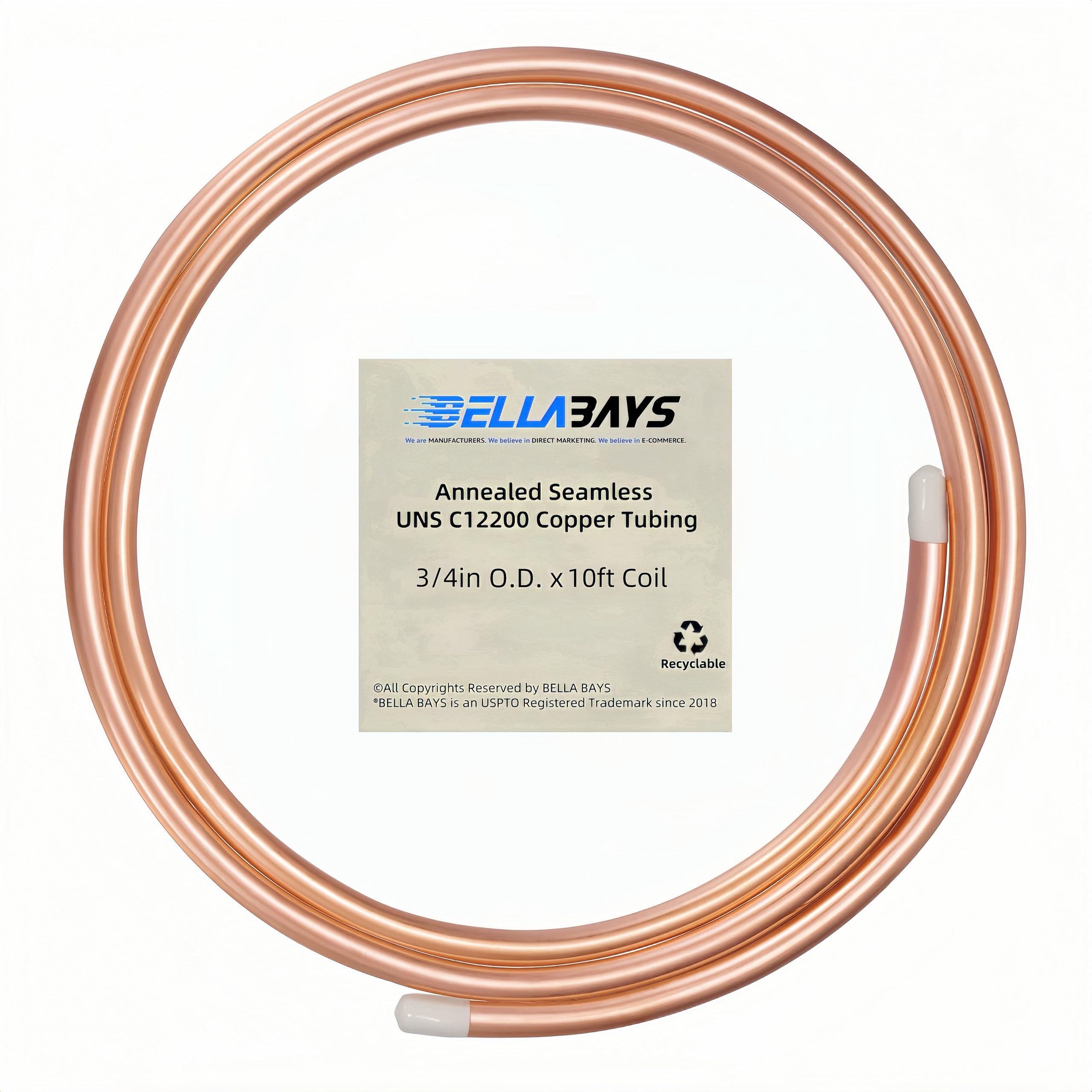
1. BELLA BAYS Copper Tubing 3/4″ OD x 0.687″ x 10 ft
Our pick — over 4.5★ from 500+ verified ratings; the strongest balance of quality and price.
Ten feet of nitrogen-charged smooth coil that stays round, bends clean, and fits the flare the first time.
This coil is drawn from UNS C12200 copper — that is the standard refrigeration-grade copper, 99.9% pure — and it conforms to the ASTM-B280 specification, the industry benchmark for this type of tube. The coil measures 3/4″ outside diameter by 0.687″ inside diameter over 10 ft, so the wall sits right in the balance for hand bending without collapsing. It arrives as a tidy 120-inch coil weighing 1.38 kg.
The nitrogen-charged treatment is the detail worth pausing on. Nitrogen is pumped inside during manufacturing to push out moisture and oxygen, which keeps the interior from oxidizing before you ever open it. That matters on a refrigerant run, because an oxidized interior is what breaks your vacuum hold and forces you to pull a second vacuum. The tube ships pressure tested, and the smooth surface supports a tight seal at flared and sweated fittings. Copper’s thermal conductivity (how readily it moves heat) is the reason it dominates refrigeration work in the first place, and this tube delivers that in a flexible form.
What wins people over is that it flat-out works — the reviews consistently lead with successful installs, from swamp cooler repairs to hydraulic line fixes, and the value-for-money comments show up right behind. Buyers report: “The tubing fit the fender and bent well. Installed the tubing with no leaks and no problems.” The tube bends to whatever angle your run needs and assembles with flared or sweated fittings. The practical warning is roundness — a few owners open the box to find minor dents, and the durability reports are genuinely mixed on that point. Thin walls also demand patience: use a bender on tight radii or the tube will collapse. The upside is that the majority of these coils arrive straight and true, which is exactly why this one holds the top spot here.
What earns the ranking
- UNS C12200 copper at 99.9% purity conforming to ASTM-B280, the grade refrigeration work calls for
- Nitrogen-charged interior keeps oxidation and impurities out before installation
- 0.687″ ID over a 10 ft coil gives a wall that bends by hand without folding
- The reviews back it up — functionality is what buyers bring up most, with value and material quality close behind
Where it asks for care
- Durability draws mixed reports, with some coils arriving with minor dents
- Thin walls mean a tubing bender is close to mandatory on tight corners
- 10 ft limits longer line sets — measure your run before ordering
Reach for this if: your job is a refrigerant repair, a swamp cooler rebuild, or a DIY line where you need one reliable 10 ft coil that bends and seals clean.
Look elsewhere if: your run exceeds 10 ft, or you’re buying for a pro install where a continuous 25 ft or 50 ft coil avoids inline joints entirely.
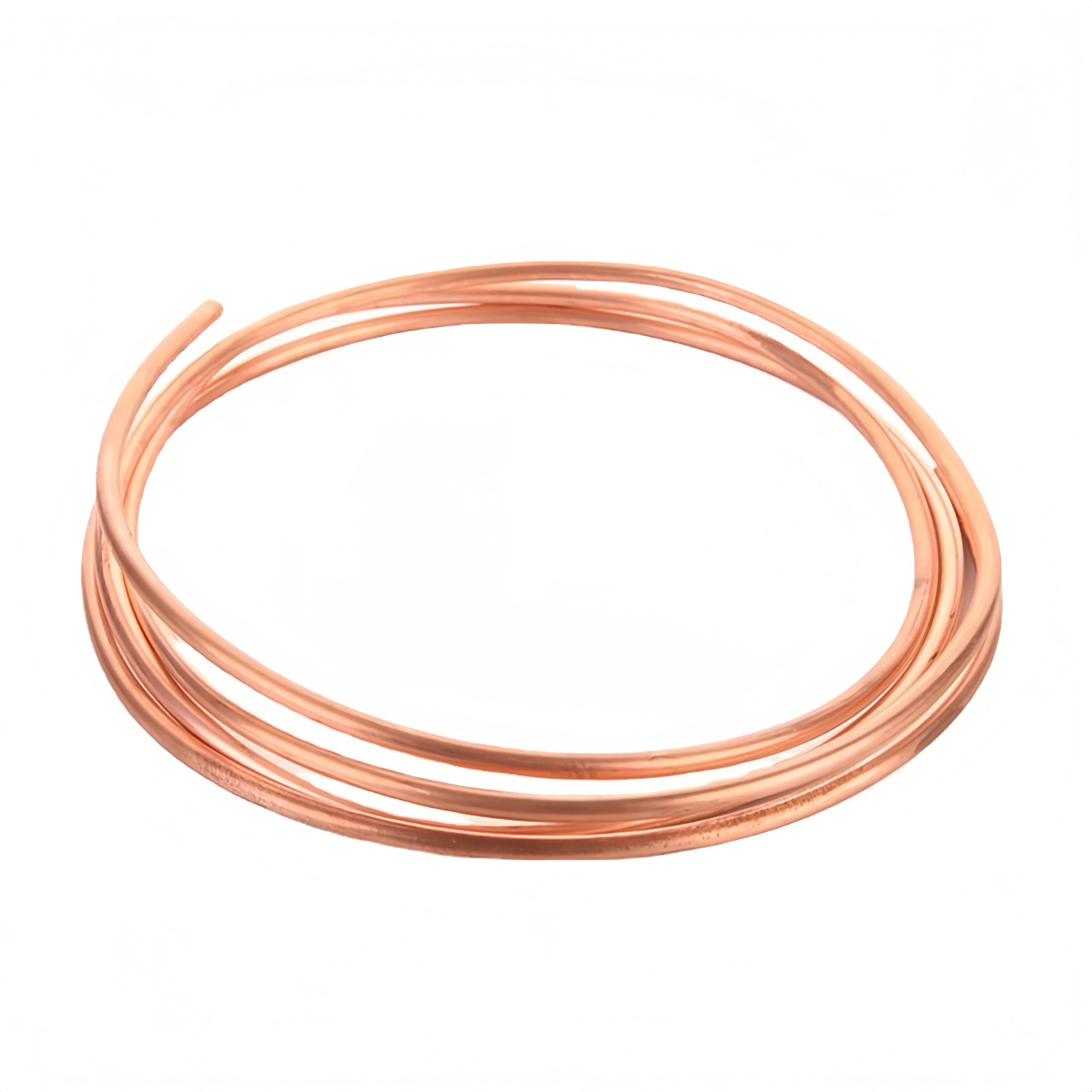
2. Pure Copper Tubing smooth Hollow T2 3/4″ OD x 5 FT
The short-coil specialist — five feet of soft T2 copper sized for a capillary repair, not a full line set.
A leaking refrigerator capillary tube is the exact job this coil is built for, and the sizing tells you why. It runs 3/4″ outside diameter with a 0.677″ inside diameter — a 0.9 mm wall — over a 5 ft length. That wall is on the thicker side, which means the tube resists collapsing better than the thinner coils here even though the softer anneal keeps it workable by hand. The surface is smooth and smooth, and the copper is chosen for extensibility and conductivity, which is precisely what a refrigeration repair demands.
The repair pattern runs like this: cut out the failed section, slide in a length of new tube with a small gap at each end, pinch the ends, then braze with a torch and silver rods. Owners mention exactly that sequence working on a decades-old fridge — cut, insert, braze, and the system holds. Five feet gives you more than enough for several capillary patches, and the soft temper lets you shape it around the tight spaces behind a fridge or inside an appliance cabinet. Beyond refrigeration, it suits any small craft or model project that needs genuine copper tube.
The honest catch here is packaging. It arrives in a bag, not a rigid box, and one buyer’s experience is worth repeating because it’s the specific risk: their tube showed up round and undamaged, but they noted it “could have been crushed easily.” Fit is the other recurring note — several owners found the outside diameter ran larger than their fittings expected. Check your fitting spec against 0.75″ OD before you commit. When it lands round, it does the job cleanly, and the quality comments carry the listing.
The repair-ready read: a 0.9 mm wall over 5 ft is the combination you want for brazing small repairs — enough meat to resist collapsing, soft enough to shape by hand behind an appliance.
Check your fittings first: the outside-diameter complaints are real enough that you should confirm your flare nuts and couplings are matched to 0.75″ OD before ordering, and plan to inspect the bag on arrival.
Ideal when: you’re patching a capillary tube, a small chiller line, or a repair job where five feet is plenty and you want a thicker wall.
Skip if: your run is longer than five feet, or you need a coil that ships in a rigid container to survive rough handling.
3. YuJingKey 3/4″ OD x 5 Ft Copper Tubing
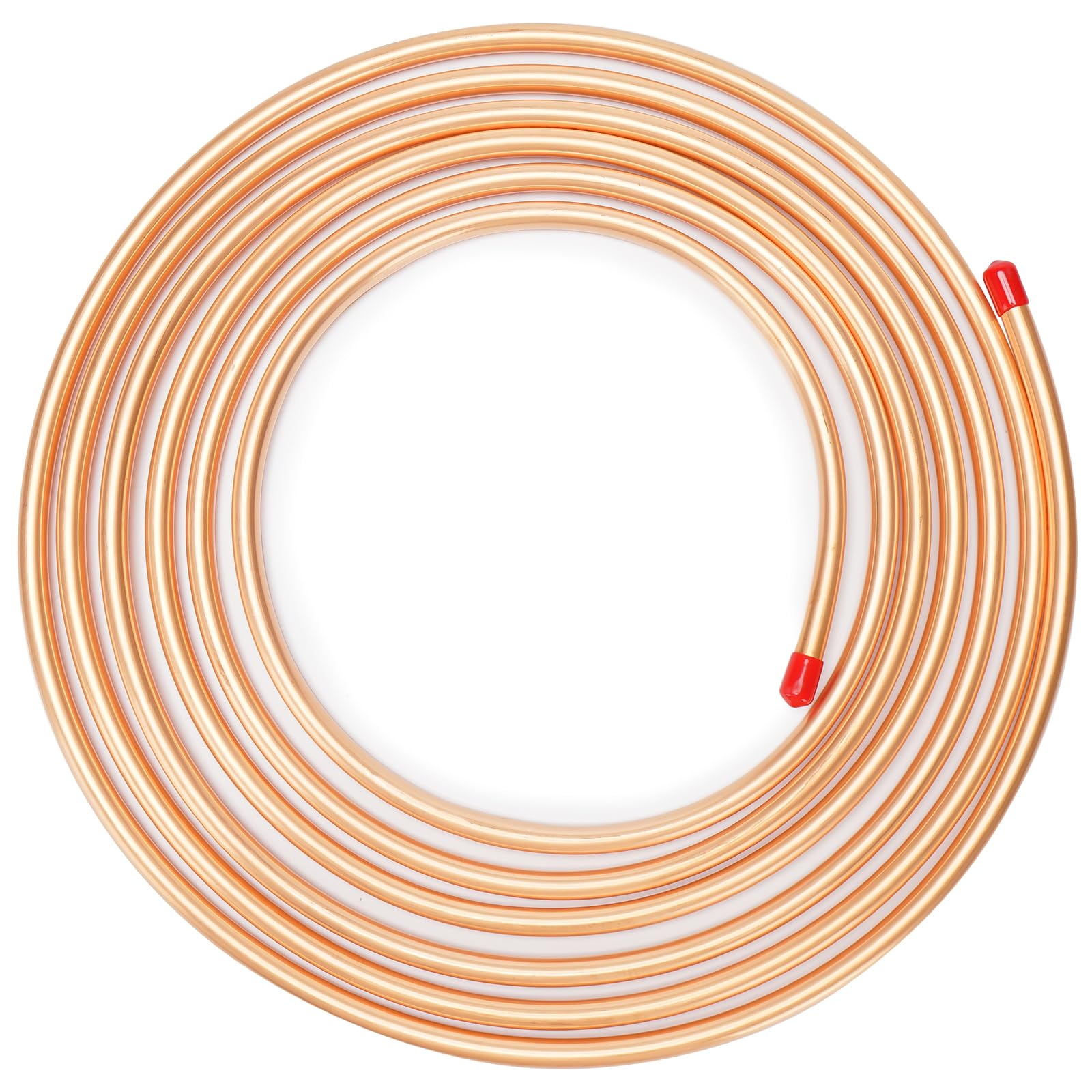
Craft-project copper with real HVAC pedigree — the same C12200 grade, cut down to five feet.
This is the listing that surprises you, because the tube itself is the serious material. YuJingKey draws it from C12200 grade copper meeting the ASTM-B280 specification, and the tube carries strong corrosion and scaling resistance plus high-temperature strength. The flexibility is the working characteristic: the inherent hardness and temper let it follow contours and corners at almost any angle with smooth bends. Five feet of it, packaged as a single piece.
What’s genuinely interesting is the range of jobs buyers put it to. One owner soldered it to a brass hose end and snaked it between board gaps to blast water upward and dislodge paper wasp nests under an enclosed deck — flexible enough to position, rigid enough to aim. Another uses it as indoor plant support, bending it to hold heavy monstera leaves because it’s sturdier than plastic forms. That’s the same tube doing pest control and houseplant duty, which tells you how workable the bend really is.
The one thing to guard against is the middle of the coil. Most arrive clean with a bright finish and no seam or corrosion, and the dimensions check out. But a bent-flat tube is the failure that ruins the whole purchase, because once the cross-section goes oval, your fittings won’t seal. Inspect the center of the coil before you cut, and refuse a coil that arrives crushed. Two buyers also flagged the cut ends arriving poorly finished, needing a fresh cut before use — a minor fix with a proper tubing cutter. For craft and small-project work at this size, it’s a straightforward buy.
Why crafters and fixers like it
- Genuine C12200 copper to ASTM-B280 — the same grade spec as full HVAC coils
- Bends smoothly at nearly any angle, so it follows contours and tight corners
- Sturdy enough for structural hobby use like plant supports, not just decorative work
- Corrosion and scaling resistant, so it holds up indoors and out
What to watch at unboxing
- A crushed or bent-flat middle section is possible and unusable once the tube goes oval
- Some ends arrive poorly cut and need re-cutting before you fit them
- 5 ft won’t cover a line set — this is a project-length coil
Buy it for: hands-on projects that need real copper tube — plant supports, small fabrications, and short utility runs where five feet is the right amount.
Pass it over if: you’re running refrigerant line and need a longer continuous coil with factory-finished ends.
4. GOORY Copper Tubing 3/4″ OD x 0.687″ ID x 10 FT

A 10 ft nitrogen-charged coil with the same purity grade as the top pick, built for HVAC line work.
Here’s the direct comparison that matters: this coil and the BELLA BAYS above share the same core recipe — UNS C12200 copper at 99.9% purity, ASTM-B280 compliance, 3/4″ OD by 0.687″ ID, 10 ft length, nitrogen-charged interior. The measurable difference is wall thickness. GOORY lists 0.031 inch (0.8 mm), while the top pick doesn’t publish its wall — so if you’re the type who wants the number written down before you buy, GOORY gives you that, and the thinner wall cuts through tight radii with less hand strength.
The nitrogen-charged treatment gets the same emphasis here as it should anywhere on this list. Impurities are pulled out during manufacturing, pressure testing is done, and the result resists oxidation and condensation inside the tube. On a cooling system, that clean interior is what holds a deep vacuum and keeps refrigerant flowing without restriction. The tube cuts and bends with hand tools or a ratchet bender, assembles with sweated or flared fittings, and stretches across both cooling gear and electrical or craft projects.
For the price tier, this is a solid balance — the review sentiment backs it as a “works” tube with strong suitability for custom runs and repairs, and it ships in a strong box that survives transit. Customers note: “exactly what was needed for my hvac install. shipped well, in a strong box that was not damaged during transit.” The trade-off to know is kink behavior. The thinner wall asks for a bender on tight turns, and some coils arrive wound tightly enough that you have to be careful straightening them. Occasional dents show up too. Use a bender, inspect on arrival, and this coil does exactly what it promises.
Why installers reach for it: the wall is published at 0.031 inch, so you know exactly what you’re bending before you open the box — a real advantage over coils that leave you guessing at thickness.
Your pick when: you want the 10 ft nitrogen-charged spec with a stated wall thickness and strong shipping protection for an HVAC install.
Think twice if: your run needs more than ten feet, or your bends are tight enough that a thin wall demands a tool you don’t own.
5. ELECTRAPICK Copper Tubing 3/4″ OD x 11/16″ ID x 25 Ft
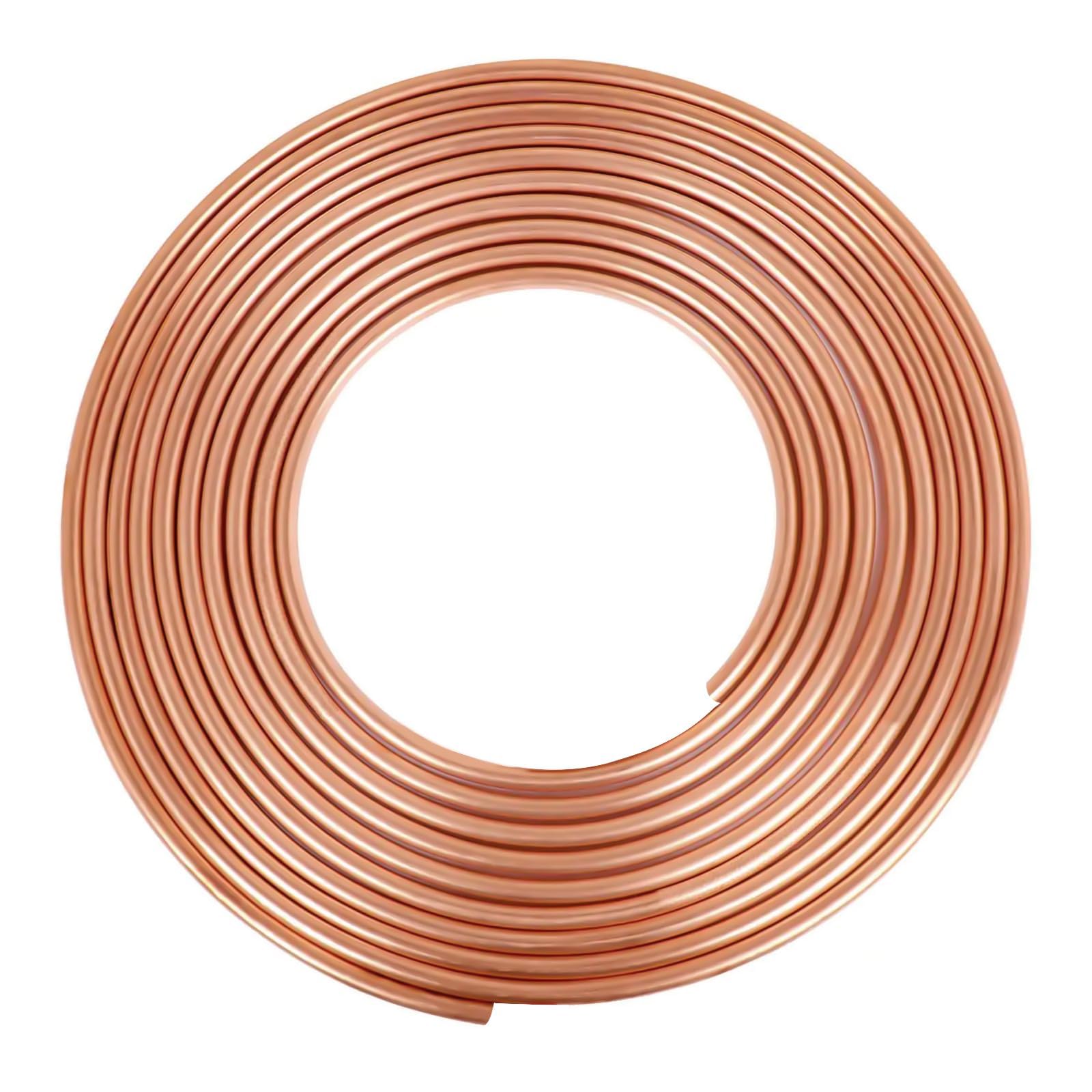
Twenty-five continuous feet of C12200 coil — the middle ground between a repair patch and a full fifty-foot run.
Length is the whole point of this coil, and the number is 25 ft (7.62 m) in a single continuous piece. It measures 3/4″ outside diameter by 11/16″ inside diameter, which works out to a 0.8 mm wall — thin enough to bend by hand, and the kind of tube you’d use for a mid-length run where ten feet falls short but fifty is more than you need. It’s drawn from C12200 copper with smooth, smooth surfaces, so the interior stays clean for refrigerant flow.
What copper delivers on a cooling system is heat transfer, and this tube leans into that. It carries refrigerant well, dissipates heat effectively, and stays stable under hot and cold conditions because the metal itself isn’t bothered by temperature swings or corrosion the way other materials are. That resilience is what keeps a 25 ft run of refrigerant line holding up over years of hot and cold cycling. The soft temper makes elbows and joints straightforward, and the same tube serves craft and model work when you have leftover length.
Straightforward is the right word for the feedback on this one — it does the job, holds up, and the value lands right. Fuel line work, general installation, small projects: the applications vary but the outcome repeats. The wall is thinner than some coils here, so if your run has sharp bends, work over a mandrel or bender rather than forcing the tube by hand, which is true of any 0.8 mm wall. At 25 ft, you’ve got room to make a mistake and still finish, which is worth a lot on a job where a splice is the last thing you want.
Where the length pays off
- 25 ft continuous coil covers a full mid-length run with margin to spare
- 0.8 mm wall bends by hand without excessive effort
- C12200 copper with smooth smooth interior for clean refrigerant flow
- Stable under both hot and cold conditions, with strong heat-transfer ability
The trade-offs to plan around
- 0.8 mm wall needs a bender or careful mandrel work on tight radii
- 25 ft is more than a small repair needs, so there’s leftover with no short option
This suits you when: your run is too long for a 10 ft coil but doesn’t justify a 50 ft one, and you want a single continuous piece with no joints.
Not for you if: you’re making a short capillary repair — a 5 ft coil covers that far more sensibly.
6. TAUROX 50 Ft 3/4 OD Copper Tubes ACR Refrigeration Tubing
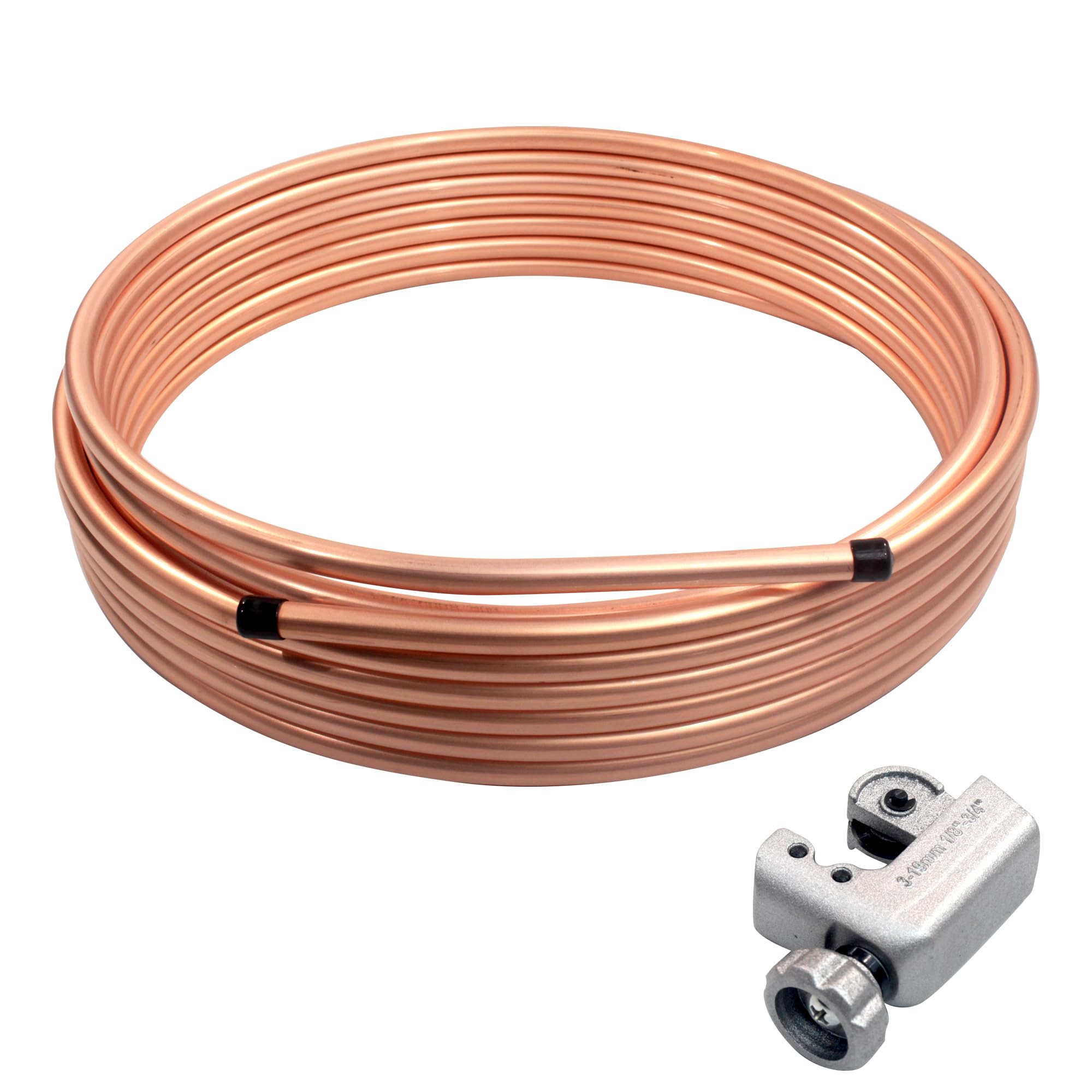
Fifty feet, a cutting knife in the box, and a crack-resistant bend that goes to any angle by hand.
Two things set this coil apart from the other long coils here: it’s 50 ft of C12200 copper at 99.9% purity to ASTM-B280, and it ships with a copper-pipe cutting knife included. That matters if you’re starting a job and don’t want to add a separate tool to the order. The 3/4″ OD with a 0.8 mm wall gives you a forgiving tube that bends to any angle without cracking, and the uniform wall thickness holds up to expansion and hard bending without springing a leak.
The claim the listing leans on is sealing. A flawlessly smooth interior surface is the reason a brazed or flared joint seals without weeping, and a uniform wall is what keeps refrigerant flowing at full efficiency. Together, they’re the difference between a line set that holds its charge and one that weeps refrigerant at every brazed joint. The soft temper and easy cutting simplify the install, and the same 50 ft coil handles electrical conduit, thermal runs, and horticulture projects beyond HVAC.
What buyers notice most is the flex. The tube bends smoothly, the wall feels solid in the hand, and it works just as well on a refrigerator water line as it does on art pieces — one owner even connected a new kitchen’s water line with it and called it “very easy to use.” The included cutter gets used and appreciated on the first job. Fifty feet won’t run short the way a smaller coil can, and when you’re brazing a line set, having margin means fewer splices. For a do-it-yourselfer or a pro who wants a full run and the tool to cut it, this is the kit to grab.
The value read: fifty feet of certified C12200 with a pipe cutter in the same box is a complete install kit, not just a coil — you unbox and you’re ready to cut, bend, and set the line.
Get this if: you’re building a full line set and want the copper and the cutting tool together, with enough length to work without splicing.
Not the one if: you only need to patch a short section — 50 ft is far more tube than a small repair calls for.
7. ICS Industries 3/4″ OD smooth Copper ACR Tubing, 50 Ft

The one the refrigeration trade keeps coming back to — 50 ft of pro-grade ACR copper with a heavier wall.
If you want the trade-standard pick, this is it. ICS Industries manufactures this tube for air conditioning and refrigeration work to meet stringent ASTM standards, and the spec sheet backs the reputation: 3/4″ outside diameter, 50 ft continuous coil, smooth construction. It’s built to handle continuous refrigerant flow and systemic pressures, with clean interior surfaces and thermal conductivity that no substitute matches. The nominal wall thickness reads.035 — a heavier wall than most of the coils here, and that’s the reason it holds up under real job conditions.
The heavier wall shows up in how it handles solder and flare. It takes reliable soldering and brazing, flares precisely, and bends by hand without kinking as easily as the thin stuff does. That extra material is also what lets it hold pressure on a high side or liquid line install where a thin coil would be risky. Owners running it in real systems report the ends arrive plugged, the tube isn’t oxidized, and there’s no contamination inside — the details that decide whether a vacuum holds on the first try.
The reputation in the trade is earned, and buyers treat it as their standing supplier for good reason. The honest note is thickness. This is still a soft-annealed coil, and a thinner-walled tube demands care — but owners of the heavier variety bend in larger radius arcs over a cylinder or use a tubing bender, going slowly, to keep the tube from kinking. Do that, and it holds up. For anyone running a serious refrigeration or HVAC line set, the extra wall thickness is worth working with.
The pro-grade case: a.035 nominal wall over 50 ft is heavier than the field of thinner coils here, and that’s what lets it hold brazed pressure joints on a liquid or suction line without flinching.
Bend it with intention: soft copper still wants a large-radius form or a bender and a slow hand on tight turns — force it and the tube will kink regardless of wall weight.
Choose it when: you’re doing a genuine HVAC or refrigeration line set and want the heavier wall and certification the trade trusts.
Steer clear if: your job is a five-foot patch — this is a full-run coil, and a shorter piece is the sensible buy for a small repair.
Understanding the Specs
Outer Diameter (OD) vs. Inner Diameter (ID)
The outer diameter is the measurement across the outside of the tube, and it’s the number your fittings are matched to. A 3/4″ OD tube seats in a 3/4″ flare nut or coupling. The inner diameter is the bore — the open space inside — and it’s always smaller than the OD by twice the wall thickness. On these listings, a 3/4″ OD coil runs 0.687″ ID or 0.677″ ID or 11/16″ ID depending on how thick the wall is. A thicker wall narrows the bore slightly but resists collapse when you bend. When you’re matching fittings, match the OD. When you’re judging bend behavior, look at the wall.
Wall Thickness and Kink Resistance
The wall is the metal between the bore and the outside surface, given here in millimeters or inches — 0.8 mm, 0.9 mm, 0.031 inch,.035. A heavier wall keeps the tube’s round cross-section when you pull a tight radius, which is why thicker tube is more forgiving on sharp corners. A thinner wall bends with less hand effort but folds more easily if you force it. The practical rule regardless of thickness: bend over a form or use a tubing bender for any radius tighter than a gentle curve, and work slowly. C12200 and ASTM B280 are the grade and specification to look for — both appear across the coils above and both signal refrigeration-grade copper.
FAQ
Will 3/4 inch copper tubing fit my existing flare fittings?
What does 3/4 inch actually measure on ACR copper tubing?
Do I need a tubing bender for 3/4 inch soft copper?
What is the difference between soft copper and rigid copper tubing?
What does nitrogen charged mean and why does it matter?
Can I use 3/4 copper tubing for a refrigerator water line?
Why does my copper tubing arrive bent or crushed in the middle?
Is 3/4 inch copper tubing good for HVAC line sets?
How do I cut copper tubing without crushing the ends?
What is ASTM B280 and why does it matter for copper tubing?
Final Thoughts: The Verdict
If you’re buying one coil and just want it to work, the BELLA BAYS 3/4″ OD x 10 ft is the pick — 99.9% C12200 copper to ASTM B280, nitrogen charged, and a 10 ft coil that bends and seals on real jobs, which is why it holds the top spot here. If you’re running a full line set and want the copper and the cutter together, reach for the TAUROX 50 ft coil. And if the job is pro-grade refrigeration work where wall thickness matters, the ICS Industries 50 ft ACR coil is the trade-trusted choice. For a short capillary repair, the 5 ft Pure Copper Tubing coil is the right size — grab that one instead of cutting down a long coil.
How We Picked
We do not accept paid placement. Every pick is matched to a real buyer and a real use-case; we do not hands-on test units.
Sources & Methodology
Specifications: manufacturer listings and product documentation. Review insights: verified customer reviews, as of September 2026. Pricing: not shown on this page (it changes often); check the current price via the retailer link.
As an Amazon Associate, Gadgets Feed earns from qualifying purchases. This does not affect which products we feature.