
A surround sound system is the difference between merely watching a movie and being dropped into the middle of the action. The wrong setup leaves dialogue buried, effects sounding tinny, and the subwoofer either rattling the walls or barely breathing. The right one, even at a sensible budget, locks every channel into a coherent soundstage where helicopters fly overhead without phase distortion and whispers stay intelligible at low volumes.
I’m Min — the co-founder and writer behind Gadgets Feed. I’ve spent hundreds of hours cross-referencing driver sizes, amplifier topologies, DSP room-correction algorithms, and real-world impedance curves to separate the signal from the noise in this crowded category.
Whether you are upgrading from TV speakers or retiring a decade-old plastic 2.1 set, this guide pinpoints the best affordable surround sound speakers that deliver genuine channel separation, usable bass extension, and voice clarity without forcing you to audition receivers and decode THX ratings alone.
How To Choose The Best Affordable Surround Sound Speakers
Every buyer in this category faces a tension between channel count and driver quality. A 5.1 system with cheap satellite speakers will never sound as cohesive as a well-matched 3.1 with a competent center channel and subwoofer. Before you count speakers, you need to understand what each channel actually does and where the amplifier’s power budget is being spent.
The Center Channel Is The Anchor
In a home theater, roughly 70 to 80 percent of all audio content — dialogue, vocals, on-screen effects — routes through the center speaker. A weak or mismatched center channel destroys intelligibility regardless of how capable your front left and right speakers are. Look for a dedicated center with at least a 1-inch soft-dome tweeter and dual woofers sized 4 inches or larger. The Polk Monitor XT30 and the slim Polk ES35 both prioritize this channel, and the difference in vocal clarity compared to a soundbar’s virtual center is immediate and repeatable.
Passive vs. Active Systems and Amplifier Requirements
An active system (like the Bobtot or ULTIMEA soundbar-based kits) includes the amplifier inside the subwoofer or soundbar — you plug in speakers and they work. A passive system (like the Monoprice 5.1.2 kit) requires an external A/V receiver, which adds cost but gives you upgradeability, room correction software (Audyssey, Dirac), and far greater control over crossover points and speaker levels. If you already own a receiver, passive satellite kits deliver better sound per dollar. If you are starting from zero, an active bundle simplifies setup dramatically.
Surround Channel Implementation: Wired vs. Wireless
True surround separation requires speakers physically behind the listening position. Systems that call themselves wireless often still require a power cable to each rear speaker; only the audio signal is transmitted wirelessly. Wired rear speakers, while a hassle to route, eliminate latency and compression artifacts. The LG S40TR and Fire TV Soundbar Plus use wireless rear speakers with separate power cords — a fair compromise for renters or cable-averse setups. The Bobtot and Rockville systems rely entirely on wired satellites, which forces you to plan cable runs but guarantees no dropouts.
Quick Comparison
On smaller screens, swipe sideways to see the full table.
| Model | Category | Best For | Key Spec | Amazon |
|---|---|---|---|---|
| ULTIMEA Skywave F40 | Soundbar + 2 Rears | Dolby Atmos height effects | 5.1.2ch with up-firing drivers | Amazon |
| Polk XT30 Center | Center Channel | Dialogue clarity in a 3.1 setup | 1″ Terylene tweeter, dual 5.25″ woofers | Amazon |
| LG S40TR | Soundbar + Sub + Rears | Wireless rear convenience | 4.1ch with wireless satellite speakers | Amazon |
| Rockville HTS820 | Full 5.1 System | High SPL in large rooms | 8″ subwoofer, 1500W peak power | Amazon |
| Monoprice 5.1.2 | Passive Satellite Kit | Receiver-based Atmos upgrades | Upward-firing driver, 8″ subwoofer | Amazon |
| ULTIMEA Poseidon D70 | Soundbar + 4 Rears | Multi-speaker immersion for small rooms | 7.1ch virtual, 4 wired surrounds | Amazon |
| Amazon Fire TV Soundbar Plus | Soundbar + Sub + Rears | Ecosystem integration with Fire TV | 5.1ch Dolby Atmos, wireless surrounds | Amazon |
| Polk ES35 Center | Slim Center Channel | Ultra-slim design under a wall-mounted TV | 1″ tweeter, six 3″ woofers, Power Port | Amazon |
| Bobtot HTS | Full 5.1 System | All-in-one bundle with karaoke mics | 6.5″ sub, 800W peak, dual mic inputs | Amazon |
In‑Depth Reviews
1. ULTIMEA Skywave F40
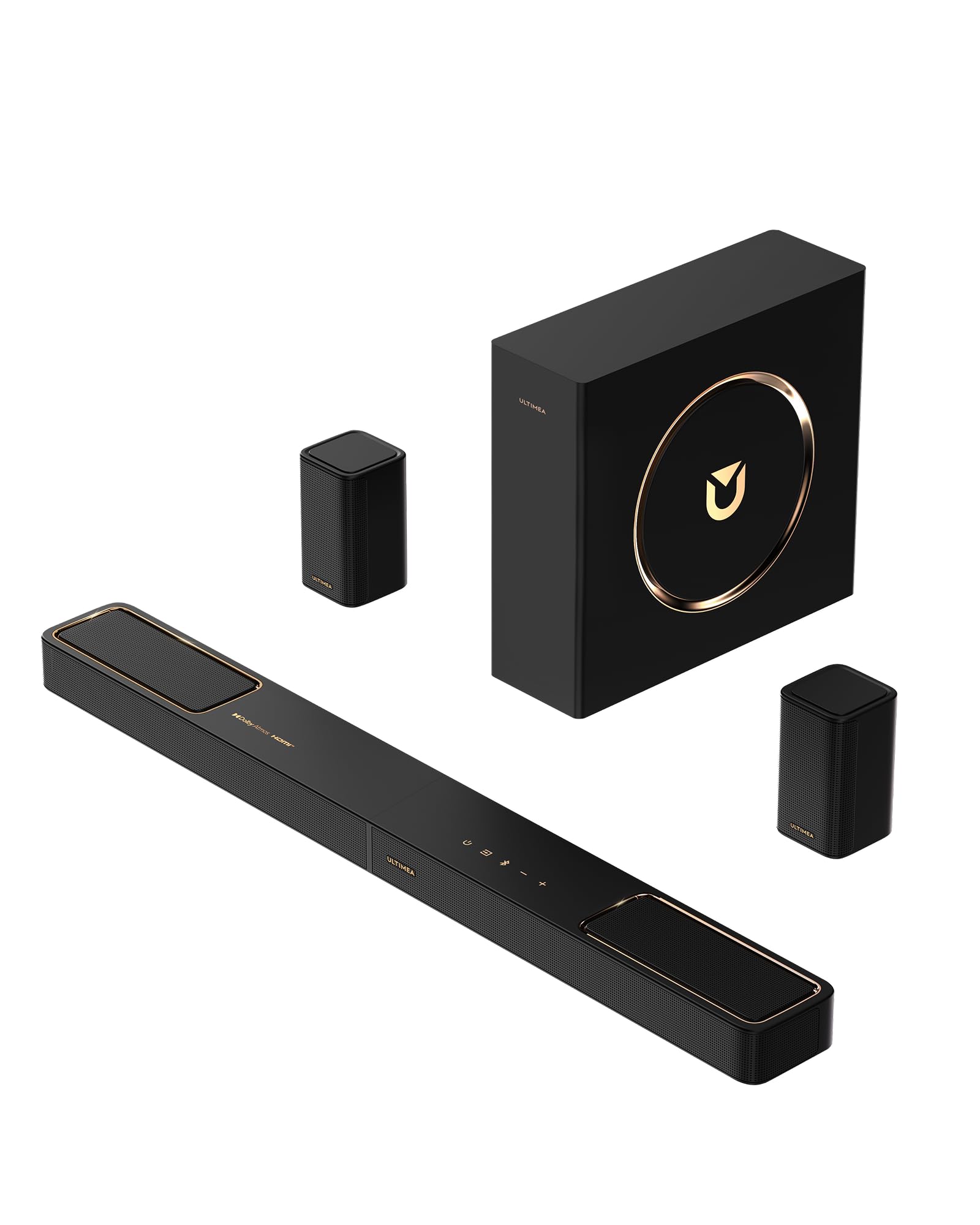
This system packs Dolby Atmos height virtualization into a affordable form factor that genuinely works. The up-firing drivers use neodymium internal magnets and an 18-core voice coil assembly to project overhead effects — rain and helicopter pans — without needing ceiling-mounted speakers. The 5.25-inch wired subwoofer hits a 40 Hz lower limit with usable extension, and the SurroundX spatial algorithm keeps the rear satellites locked into a cohesive 360-degree bubble. HDMI eARC carries uncompressed lossless audio at up to 37 Mbps, so there is no bandwidth bottleneck even with TrueHD tracks.
The Ultimea Home app provides a 10-band graphic EQ and 121 preset matrices, letting you dial in everything from voice-forward mode for dialogue-heavy scenes to a bass-boosted curve for action sequences. The 13-step surround level adjustment (-6 to +6) is granular enough to compensate for asymmetrical room layouts. Bluetooth 5.4 adds a 15-meter range with AAC support for music streaming.
At roughly 25 percent volume, the system fills a 400-square-foot living room with clean, uncompressed output. The only limitation is codec compatibility — DTS:X is not supported, so older Blu-ray collections will downmix to PCM. For pure Atmos content on streaming platforms and consoles, this is the most coherent spatial audio package available at this budget tier.
Why it’s great
- Genuine Dolby Atmos height channel with zero ceiling modification
- Lossless HDMI eARC eliminates compression artifacts
- App-based EQ and surround leveling is unusually precise
Good to know
- Does not support DTS:X; requires PCM output for DTS content
- Rear speakers need a power outlet despite being “wireless”
2. Polk Monitor XT30 Compact Center Channel

If you already own a 2.0 or 2.1 setup with decent front towers, adding the Monitor XT30 is the single most cost-effective upgrade you can make. The 1-inch Terylene tweeter and dual 5.25-inch Dynamic Balance woofers are timbre-matched to Polk’s Monitor XT series, so they blend seamlessly with the MXT60 towers and MXT12 subwoofer. The 4-ohm and 8-ohm compatibility means it works with virtually any receiver class A/B or digital amp, from budget Denons to mid-tier Marantz units.
Dialogue clarity is the XT30’s standout trait. Without it, sibilant consonants and low-register voices get smeared across the front soundstage. With it, British period dramas and Nolan films become intelligible at low listening levels — you stop needing closed captions. The cabinet dimensions are wider than a typical compact center (roughly 22 inches), so measure your media console before buying.
Reviewers consistently note that the XT30 sounds better than speakers in twice its price bracket. The bass extension from the dual woofers and rear porting is surprisingly deep, crossing over cleanly at 80 Hz with most standard subwoofers. The only real complaint is size — it may lift your TV above the ideal eye line unless you have a low-profile mount or a taller stand.
Why it’s great
- Timbre-matched to the full Polk Monitor XT ecosystem
- Crystal-clear dialogue without sibilance or chestiness
- Wide impedance tolerance supports nearly any AVR
Good to know
- Cabinet width is larger than many compact center channels
- Grille cover is gray, not black, which may clash with other gear
3. LG S40TR 4.1ch Soundbar

LG’s S40TR is a 4.1-channel system that ditches the center channel soundbar driver in favor of a dedicated subwoofer and wireless rear satellites. The rear speakers connect to the soundbar wirelessly for audio, but each needs a standard wall outlet for power — this makes the placement flexible within the reach of a power cord. The WOW Orchestra feature lets the LG TV’s built-in speakers play simultaneously with the soundbar, effectively adding phantom height and width to the soundstage without separate overhead drivers.
The AI Sound Pro mode dynamically levels volume across content types — commercials, streaming movies, and music — so you are not constantly reaching for the remote. Clear Voice Plus applies center-channel DSP to boost dialogue even in stereo-only sources. Smart Up-Mixer expands 2-channel audio into a multi-channel field, though purists may prefer to leave it off for music.
For a bedroom or a small den under 250 square feet, the S40TR delivers convincing surround immersion without the overhead of a receiver. The subwoofer is punchy enough for action movies at moderate volume, but the 4.1 layout means you lose discrete center-channel dialogue separation — the soundbar handles all front imaging. If you sit directly in the sweet spot, the effect is satisfying; off-axis listeners will notice the virtual center collapsing.
Why it’s great
- No separate AVR required; plug-and-play wireless rears
- WOW Orchestra leverages TV speakers for expanded sound
- AI Sound Pro smooths volume jumps between content
Good to know
- 4.1 layout lacks a dedicated center channel driver
- Rear speakers require power cords; not fully wireless
4. Rockville HTS820 5.1 System

The Rockville HTS820 is designed for buyers who need to pressurize a large room — 600 square feet or more — without jumping into the four-figure hi-fi tier. The 8-inch subwoofer with a built-in 375-watt RMS amplifier hits a frequency response from 20 Hz to 20 kHz with a maximum SPL of 108 dB. That translates to genuine couch-shaking bass at moderate volume levels, not just vibro-tactile buzz. The satellite speakers each contain a 3-inch midrange driver and a 0.75-inch dome tweeter, producing 4-ohm impedance for efficient power draw from the integrated amplifier.
Input flexibility is comprehensive: Bluetooth, HDMI, optical, coaxial, RCA, USB, and SD card slot. The dual 1/4-inch microphone inputs with independent echo control turn the system into a karaoke rig instantly, while the 5-band EQ lets you tune the subwoofer crossover and satellite balance independently. The 30-foot rear speaker cables allow satellite placement at the back of most living rooms without extension cords.
Reviewers consistently note the system outperforms expectations at this price tier, especially for music playback and movie bass. The main caveat is that true 5.1 surround playback depends on your source device — some older TVs with optical output only pass stereo, so the rear speakers may stay silent during 5.1 content unless you feed the system via HDMI ARC. The 30-pound shipping weight also means wall-mounting requires solid anchors.
Why it’s great
- 8-inch subwoofer delivers genuine sub-30 Hz extension
- Dual mic inputs with echo control for karaoke use
- Extensive input options, including USB and SD card
Good to know
- 5.1 playback requires HDMI ARC; optical may output stereo only
- Heavy system at 32 pounds shipping weight
5. Monoprice Premium 5.1.2 System

The Monoprice Premium 5.1.2 is a passive satellite-and-subwoofer kit designed for buyers who already own an A/V receiver with Dolby Atmos decoding. The immersive satellite speakers feature an upward-firing driver angled at 45 degrees, reflecting sound off the ceiling to create a height layer. The 8-inch front-firing subwoofer has a 200-watt amplifier and a rear port, delivering tight, controlled bass that integrates cleanly with the satellites at an 80 Hz crossover.
When paired with a receiver that supports Audyssey or Dirac room correction — such as a Denon AVR-S760H or Onkyo TX-SR494 — this system punches well above its price. Reviewers using it with a Yamaha Atmos receiver report crisp, clear sound and deep bass that outperforms older Sony and Klipsch satellites that cost twice as much. The center channel speaker reproduces vocals without the boxy reverb that plagues many budget centers.
The primary limitation is the subwoofer’s excursion at high volume. At reference-level playback in rooms larger than 350 square feet, the 8-inch driver can bottom out on deep bass tracks below 35 Hz. Some users replace the sub and center with Klipsch or SVS units while keeping the satellite pair, which still represents a net savings over buying those components individually. For a first Atmos setup with room to grow, this kit is the most flexible entry point.
Why it’s great
- Upward-firing drivers create overhead effects without ceiling speakers
- Passive design allows receiver-based room correction upgrades
- Outperforms many speaker sets with proper calibration
Good to know
- 8-inch subwoofer bottoms out at high volume in large rooms
- Requires an external A/V receiver; not a standalone system
6. ULTIMEA Poseidon D70

The Poseidon D70 is a 7.1-channel soundbar system that uses four wired satellite speakers — two front and two rear — to create a true multi-directional soundfield without requiring a receiver. The soundbar itself houses three main channels for dialogue and front effects, while the 6.5-inch wireless subwoofer handles bass. The 20-foot rear speaker cables provide enough length for spacious living room layouts, and the 13-step adjustable surround level lets you fine-tune the rear channel output independently from the front.
The 410-watt peak power rating translates to clean, distortion-free output at moderate-to-high volumes in rooms up to 400 square feet. The 121 preset EQ matrices in the app and the 10-band graphic equalizer give you granular control over the sound signature — useful for compensating for room acoustics without buying acoustic panels. Voice MX technology applies DSP to center-channel dialogue, making it intelligible even during loud action sequences.
It is important to note that the D70 is not compatible with Dolby Atmos or DTS:X — the 7.1 is a virtualized configuration using PCM 2.0 as the base codec. For buyers who prioritize discrete height channels, the Skywave F40 is a better fit. But for those who want the widest possible horizontal surround spread from a single soundbar platform, the D70’s four physical satellites deliver a coherent 360-degree bubble.
Why it’s great
- Four wired satellites create true physical surround separation
- Extensive app control with 121 EQ presets and 10-band EQ
- Voice MX DSP keeps dialogue clear during loud effects
Good to know
- No Dolby Atmos or DTS:X decoding support
- Aux input quality is noticeably lower than Bluetooth output
7. Amazon Fire TV Soundbar Plus

Amazon’s Fire TV Soundbar Plus bundle includes a 5.1-channel soundbar, a wireless subwoofer, and two wireless surround speakers. The system pairs automatically via HDMI ARC — no manual pairing sequence or receiver configuration required. The dedicated center dialogue channel applies a five-level boost that makes voices cut through effects without sounding artificially sibilant. Dolby Atmos and DTS:X are both supported, though the soundbar lacks up-firing drivers and relies on virtual height processing.
The surround speakers are wireless for audio but require AC power, making placement flexible as long as a wall outlet is nearby. The subwoofer produces crisp, controlled bass with minimal port noise, and the system as a whole can output reference-level volume in a 300-square-foot room without audible distortion. Fire TV integration means volume, power, and input can all be controlled from a single Fire TV remote without HDMI-CEC conflicts.
The main limitation is feature depth — there is no app-based EQ, no adjustable crossover frequency, no night mode toggle beyond the preset modes. The remote is minimalistic, offering only volume, bass, and dialogue boost controls. For buyers deeply embedded in the Amazon ecosystem who want a no-fuss upgrade from TV audio, this is the most friction-free option. Audiophiles who need parametric EQ and crossover fine-tuning should look at the ULTIMEA or Monoprice kits.
Why it’s great
- Zero-pairing setup; speakers recognize each other instantly
- Five-level dialogue boost works across all content types
- Single remote controls TV and soundbar via Fire TV integration
Good to know
- No app-based EQ or advanced audio customization available
- Virtual height processing, not physical up-firing drivers
8. Polk Signature Elite ES35 Center Channel

The Polk Signature Elite ES35 solves a specific pain point: how to get a high-performance center channel that fits under a wall-mounted TV without blocking the IR sensor or requiring a console riser. At only 4.5 inches tall, the ES35 packs a 1-inch Terylene tweeter and six 3-inch woofers in a cascading crossover array, producing a frequency response from 40 Hz to 40 kHz. The Power Port technology reduces port noise and extends low-frequency output by channeling rear-wave energy through a flared port that can sit flush against a wall.
Dialogue clarity is exceptional, even compared to larger centers. The six 3-inch drivers handle vocal frequencies with minimal distortion, and the metal grille covers the entire front baffle while resisting denting. The included wall-mount template and magnetic grille make installation straightforward. Rear porting with a wire management cage allows the speaker to sit flat against the wall without cord interference, which is rare in ported center-channel designs.
At this price point, the ES35 is a significant investment for a single speaker, but it replaces the need for a full soundbar in space-constrained setups. It pairs naturally with Polk’s Signature Elite tower and bookshelf speakers — the S60 towers and S30 bookshelves are timbre-matched. The only trade-off is that the 3-inch woofers cannot produce the same mid-bass impact as the 5.25-inch drivers in the XT30, so a subwoofer crossover at 80 Hz is recommended.
Why it’s great
- Ultra-slim 4.5-inch profile fits under TV without blocking sensor
- Six-driver array delivers clean, box-free dialogue
- Power Port allows flush-to-wall placement
Good to know
- 3-inch woofers require subwoofer crossover for bass extension
- Premium pricing for a single center channel speaker
9. Bobtot Surround Sound System
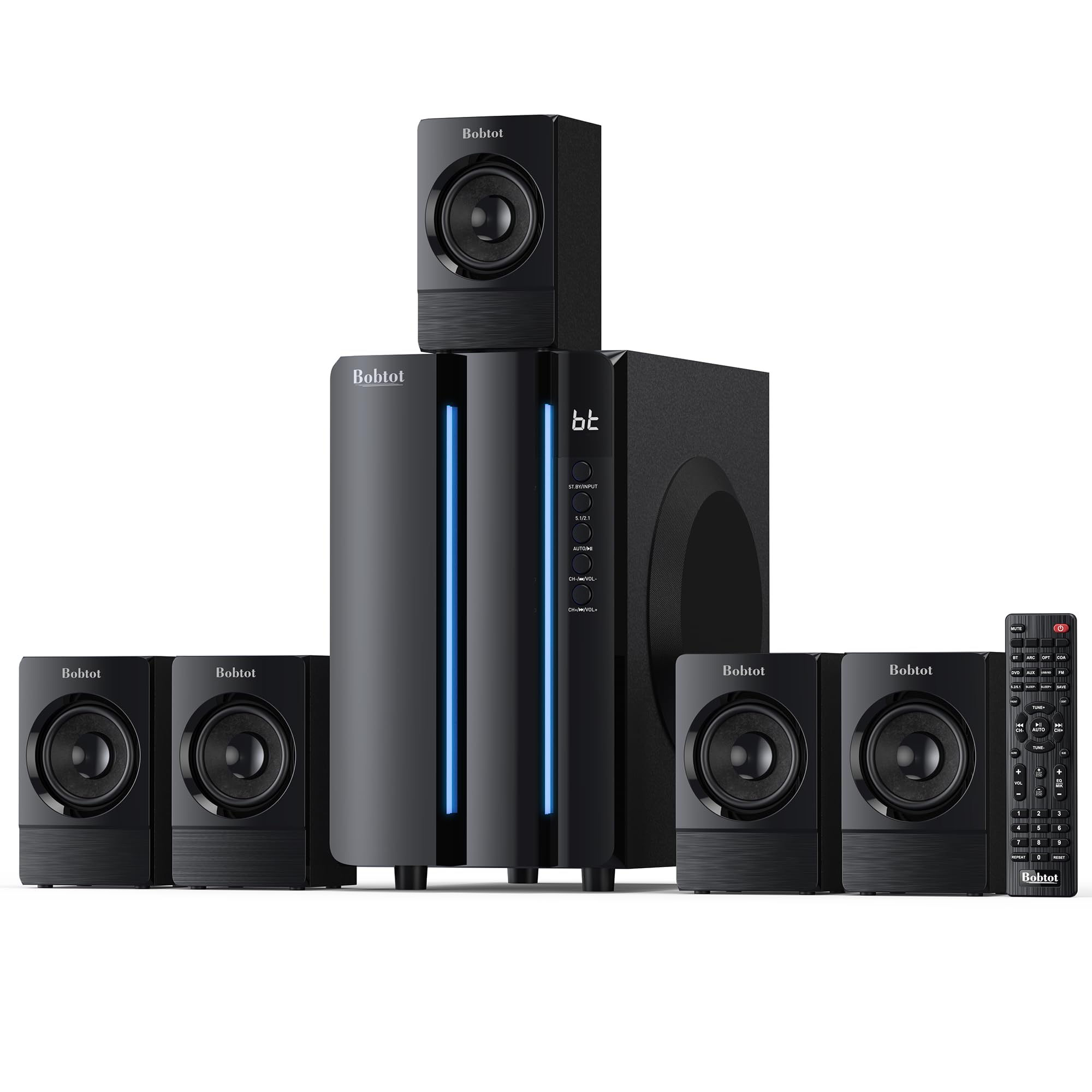
The Bobtot system is the quintessential entry-level 5.1 bundle: a 6.5-inch subwoofer with a built-in receiver, five wired satellite speakers (two front, two rear, one center), and a full-function remote. The 800-watt peak power rating translates to surprisingly loud output for the price, and the 6.5-inch subwoofer produces usable bass down to roughly 40 Hz. The sound quality is good enough to reveal surround effects and channel separation that TV speakers simply cannot produce — gunfire pans from front to rear, and environmental ambience spreads across the room.
The connectivity suite is unusually generous for the price: Bluetooth 5.3 with minimal lag, ARC and optical inputs, coaxial, AUX, USB, and a built-in FM tuner. The dual microphone inputs with independent echo control turn the system into a karaoke machine, and the five listening modes — jazz, country, classic, pop, rock — provide quick tonal adjustments. Setup is genuinely plug-and-play: speakers are color-coded and labeled, and the subwoofer connects to the TV via a single ARC cable.
Reliability is the main concern here. Multiple users report the system shutting off or failing after several months of use, which aligns with the “you get what you pay for” adage. The sound quality for the price is excellent, but long-term durability is not guaranteed. For a first surround system in a bedroom or temporary living space, the Bobtot delivers an immediate experience upgrade. If you need a system that will survive cross-country moves or daily high-volume use, a mid-range passive kit is a better long-term investment.
Why it’s great
- Complete 5.1 system with no receiver or extra purchases needed
- Bluetooth 5.3 with low latency for music and gaming
- Dual microphone inputs with echo for karaoke
Good to know
- Long-term reliability is questionable based on user reports
- 5.1 playback may not work via optical on older TVs
FAQ
Can I use a center channel speaker without a subwoofer?
Do all 5.1 systems work with a standard TV remote via HDMI ARC?
What is the ideal rear speaker placement for a 5.1 system?
How do I fix a center speaker that sounds too quiet or boomy?
Are active soundbar systems better than passive satellite speakers for music?
Final Thoughts: The Verdict
For most users, the best affordable surround sound speakers winner is the ULTIMEA Skywave F40 because it delivers true Dolby Atmos height effects with up-firing drivers, a 5.1.2 channel layout, and app-based EQ control without requiring an external receiver or ceiling modifications. If you want the best dialogue clarity for a receiver-based system, grab the Polk Monitor XT30 — it is the most cost-effective upgrade you can make to an existing 2.0 setup. And for a fully wireless layout that eliminates cable runs to rear speakers, nothing beats the LG S40TR.