
Our readers keep the lights on and my morning glass full of iced black tea. As an Amazon Associate, I earn from qualifying purchases.
Specs are compiled from manufacturer listings and verified buyer reviews and can change over time — please confirm the key details on the product page before buying.
The single biggest mistake with a bathroom sink supply line is ordering the wrong length. Too short and the hose kinks against the cabinet wall; too long and you are looping excess braid behind a pedestal you can barely reach. Get the length and both thread sizes right and the swap takes five minutes with a small wrench. Get either wrong and you are back at the store with the water shut off.
I’m Min — the founder and writer behind Gadgets Feed. This guide is built by comparing the manufacturers’ published specifications and the patterns across verified customer reviews, so you get each pick’s real strengths and trade-offs instead of marketing spin.
Most of these hoses use the same 3/8-inch compression and 1/2-inch FIP threads (FIP stands for Female Iron Pipe, a standard threaded connection), so your real choice depends on length, certification, and how the fittings seal under pressure. The list below ranks the strongest bathroom sink supply lines by what buyers actually report.
Our Picks at a Glance

How To Choose The Best Bathroom Sink Supply Lines
A supply line is the flexible hose that carries water from the shutoff valve under your sink up to the faucet inlet. It is a small, unglamorous part, and the one most likely to fail quietly behind a cabinet door. Three things decide whether yours lasts: the length you order, the thread size at each end, and the seal inside the nut.
Measure before you order, then add slack
Run a tape from the stub-out — the pipe sticking out of the wall or cabinet floor — to the water inlet on the faucet. A 30-inch hose reaches a comfortable run in a standard vanity. Add a couple of inches to whatever you measure, because a hose pulled tight will kink and a kinked braid stresses the inner tube. One buyer put it simply on the 30-inch ARCORA listing: “It’s a good idea to order them 2 inches longer.”
Match both ends of the thread
Most US faucets take a 3/8-inch compression fitting at the wall valve and a 1/2-inch FIP (female iron pipe) nut at the faucet tailpiece — sometimes written as 1/2-inch FIP x 1/2-inch FIP on some faucets. Check your own fixture before ordering; a 3/8-inch x 1/2-inch hose will not thread onto a 1/2-inch x 1/2-inch faucet, and forcing it strips brass. Hand-tighten first, then finish with a wrench.
Look for the certification stamp
cUPC and NSF are third-party certifications that confirm a product meets US and Canadian plumbing standards for potable water and lead content. If the hose you buy carries no certification mark, you have no independent confirmation of what is inside the tube or the brass. For a part your family drinks from, that is worth checking.
Quick Comparison
| Model | Best For | Length | Thread Size | Certification | Amazon |
|---|---|---|---|---|---|
| ARCORA 30 Inch Faucet Hose 1/2” to 1/2”★ Best Overall | Standard vanity, both ends 1/2-inch FIP faucets | 30 inches | 1/2″ FIP x 1/2″ FIP | cUPC | Amazon |
| KAINGA 30″ Faucet Supply LineTop Performer | Best all-round for bathroom and kitchen sinks | 30 inches | 3/8″ Comp x 1/2″ FIP | cUPC | Amazon |
| PLUMBINGMASTER 16″ Faucet Hose Connector | Tight under-sink spaces and short runs | 16 inches | 3/8″ Comp x 1/2″ | NSF & cUPC | Amazon |
| Homevacious 40-Inch Faucet Connector Hose | Tall vanities and long runs | 40 inches | 3/8″ Comp x M10 | — | Amazon |
| IVIGA 12Inch Faucet Supply Lines | Tight spaces where only 12 inches fits | 12 inches | 3/8″ Comp x 1/2″ FIP | cUPC | Amazon |
In‑Depth Reviews
1. ARCORA 30 Inch Length Faucet Hose 1/2” to 1/2”, Braided Stainless Steel cUPC Supply Lines, 1 Pair
Our pick — over 4.5★ from 500+ verified ratings; the strongest balance of quality and price.
The pair that does the boring job perfectly — braided steel, sealed threads, zero drama.
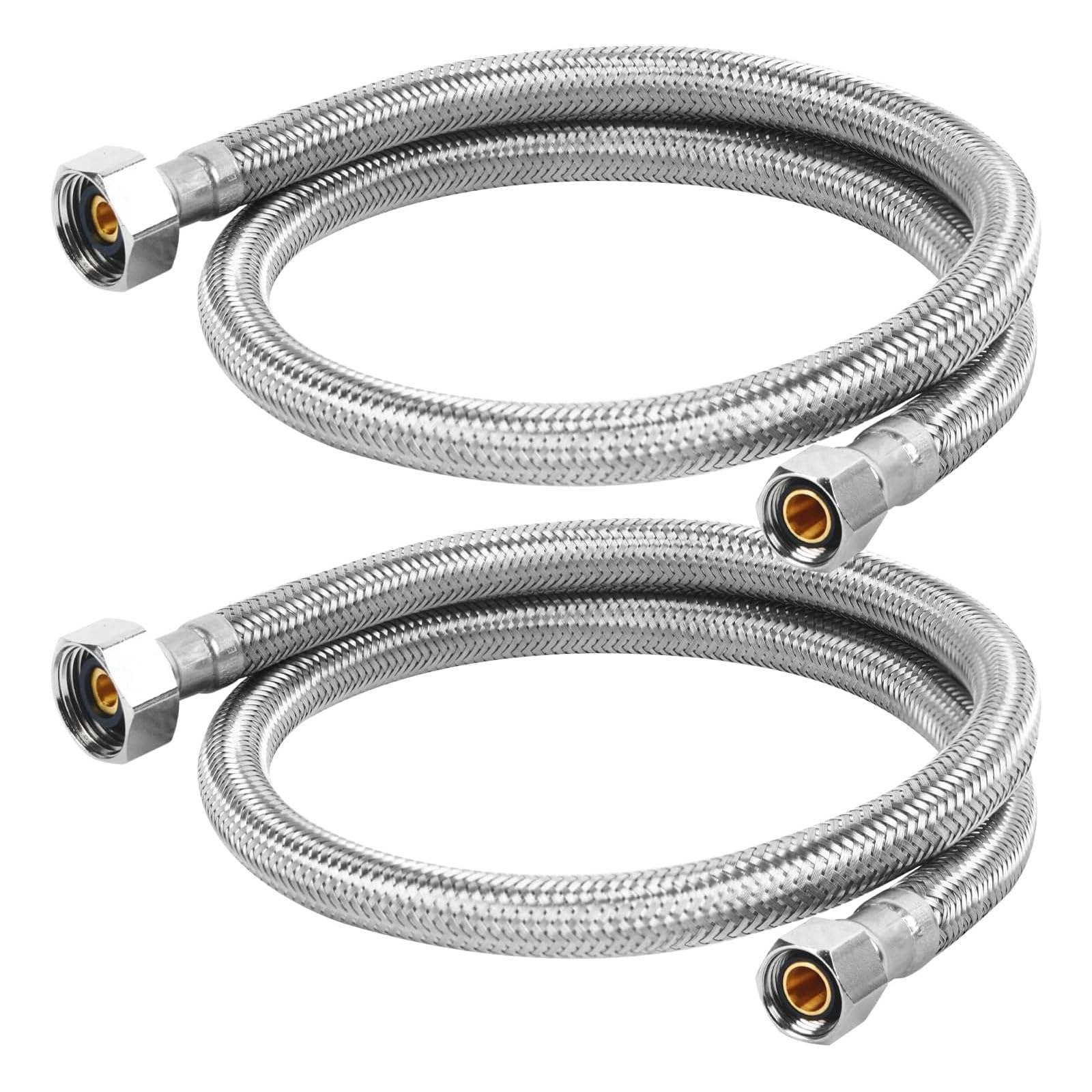
If your faucet takes a 1/2-inch female thread at both ends, this is the pair to grab. You get two 30-inch hoses in one box, the length that covers most single-vanity bathrooms without a loop of spare braid coiling up behind the cabinet. Each hose is 0.5 inches in outside diameter (the thickness of the braided sleeve), and the pair weighs 0.3 kg in total — light enough that they arrive curled and straighten out as soon as you screw them on.
What wins people over here is the quality of the build — it dominates the feedback on this listing by a wide margin, and the praise keeps landing on the same details: the braided stainless steel sleeve over the inner tube, the solid brass connector, and the rubber sealing washer that sits inside the fitting. That washer is what does the actual work. It compresses against the faucet tailpiece and forms the watertight face, which is why buyers report “Put them in and tightened and no leaks, as requested!” after a straightforward hand-tighten plus a wrench turn. The red and blue markings for hot and cold are a small touch that a lot of people call out, because it removes the guesswork when you are crouched under a sink with a flashlight.
Two things to know before you order. First, this is specifically a 1/2-inch to 1/2-inch hose — if your shutoff valve stub-out uses a 3/8-inch compression fitting, this is not the right part and you need a 3/8-inch x 1/2-inch hose instead. Second, the braid is flexible rather than stiff, and a few buyers mention it takes a moment of gentle adjusting to route smoothly around a trap. Measure your stub-out to the faucet inlet, add a couple of inches, and order the length that lands closest to that number.
What sets it above the rest
- Solid brass connectors with a sealing washer that buyers consistently describe as leak-free
- cUPC certified for potable water use
- 30-inch length suits most standard vanities
- Red and blue markers make hot/cold ID instant
- Two hoses per pack covers both supply feeds in one order
Right fit, wrong fixture?
- 1/2-inch FIP on both ends — will not fit a 3/8-inch compression valve without an adapter
- Braided sleeve needs a little coaxing around tight trap runs
- Silver finish is plain; no decorative option
The straightforward call: Buy this pair if your faucet and shutoff both take 1/2-inch female threads and you want a certified, sealed hose you can fit in minutes.
Check your valve first: If the stub-out under your sink is a 3/8-inch compression fitting, this is the wrong thread size and you want one of the 3/8-inch x 1/2-inch options below.
2. KAINGA 30″ Faucet Supply Line, 3/8 inch Comp x 1/2 inch FIP Faucet Connector, Braided Stainless Steel, 2 Pack
The standard thread combination, done with a nickel-plated nut and a torque-tuned seal.
This is the 3/8-inch compression by 1/2-inch FIP pairing that fits the majority of US bathroom faucets — the compression end threads onto the wall shutoff, the FIP nut goes to the faucet tailpiece. At 30 inches, it is the same length as the ARCORA pair above, which means for a standard vanity the two are directly comparable on reach. Where the KAINGA separates itself is the fitting: a nickel-plated brass nut with an integrated elastomeric sealing gasket, sized so the nut torques down properly without crushing the washer. That is the detail that keeps a joint dry through the vibration of a running tap.
Owners point to build quality more than anything else on this listing, and the second most-discussed point is simply that it works every day without fuss. A recurring theme in the feedback is the local-store problem — one buyer’s condensed note describes a hardware run that lacked a long hose length and offered only coupled hoses instead, before finding this online. The install note that keeps coming up: it takes about five minutes with basic tools and no plumber. The double-crimp ferrules on each end are what hold the braided sleeve to the fitting, so the hose resists the pull and vibration that eventually loosens a cheap crimp.
One caveat worth holding onto: because this is a 3/8-inch compression fitting, it will not thread onto a 1/2-inch male stub-out straight from the start, so match it to your own valve before ordering. The wrong thread size on any supply line means a return trip regardless of construction quality. Order the 30-inch if your run measures around 26 to 28 inches from valve to faucet.
Where it earns its place: A 3/8-inch x 1/2-inch hose built around the sealing joint rather than the braid — a nickel-plated nut, integrated gasket, and double-crimp ferrules that keep the fitting tight through daily use.
What to watch: Confirm your shutoff is a 3/8-inch compression valve before you buy, and allow 2 to 3 inches of slack so the hose does not pull taut behind the cabinet.
Best for the standard swap: A 3/8-inch compression valve feeding a 1/2-inch faucet inlet, in a normal-depth vanity.
Not the one if: Your shutoff is a 1/2-inch thread — grab the ARCORA pair instead, because the thread has to match before anything else matters.
3. PLUMBINGMASTER 16” Faucet Hose Connector, 3/8″ Comp x 1/2″ FIP Braided Stainless Steel, 2Pcs

The short-run specialist with the shortest distance between valve and faucet.
Sixteen inches is the shortest hose on this list, and that is exactly why some buyers need it. In a compact vanity, a bar sink, or a tight under-cabinet run, a 30-inch hose has to loop and fold on itself, and a folded braid is where kinks start. Cut the length to the actual run and the hose routes straight, which is what makes this pair the sensible pick when your measurement comes in short. It carries the same 3/8-inch compression by 1/2-inch FIP threads that fit most faucets, and it holds both NSF and cUPC certification with lead content listed at less than 0.25%.
Note the count while you are at it: the product page describes a 2-pack, and the listing unit count reads one — so confirm what is shipping before your order if you need both hot and cold lines at once. Where this hose wins is at the connection. Reviewers describe well-made fittings, clean burr-free threads, and a straightforward bite onto stopcocks and faucet inlets without cross-threading. Owners mention the install takes only a few minutes with a spanner, and the manufacturer offers an installation video plus free guidance by message if a fitting gives you trouble.
The honest trade-off is length itself. Several customers note the 16-inch reach is the limiting factor — one review specifically calls it out from a buyer who “needed longer ones for the new sink,” which is a sizing mismatch and not a defect. Measure first: if your run from valve to faucet inlet is longer than about 14 inches, buy the 30-inch KAINGA instead. If it is short, this is the cleanest fit of the bunch.
Why tight vanities like it
- 16-inch length routes straight in compact cabinets without a fold
- NSF and cUPC certified, lead content stated under 0.25%
- Clean, burr-free threads that bite without cross-threading
- Fits the common 3/8-inch compression x 1/2-inch FIP pairing
Confirm before you click
- Short reach — measure first, because 16 inches will not cover a deep cabinet run
- Listing shows a unit count of one against a two-piece product description, so verify the count
Reach for this if: Your valve sits close to the faucet inlet and a longer hose would have to loop, crinkle, and risk a kink behind the cabinet.
Look elsewhere if: Your measurement from stub-out to faucet runs past roughly 14 inches — step up to a 30-inch pair and save yourself the return.
4. Homevacious 40-Inch Long Bathroom Kitchen Faucet Connector Braided Supply Hose

For tall vanities where a standard hose simply will not reach — and a thread pattern you have to check.
Forty inches is the longest hose here — more than three times the reach of the 12-inch IVIGA pair further down — and for a vessel sink on a tall vanity or a faucet set far from the wall valve, that extra length is the difference between a straight run and a kinked one. What you need to check before ordering is the thread: this hose uses a 3/8-inch female compression fitting at the wall end and an M10 male connector at the faucet end. That M10 (a 10-millimeter metric thread) is common on imported faucets but not universal, so match it to your fixture rather than assuming. If your faucet takes a 1/2-inch FIP nut instead, this is the wrong hose.
The braided steel sleeve carries the same corrosion resistance as the others, and the fitting has a tight seal designed to keep water where it belongs. Buyers specifically praise this hose for taller vanities, where the extra reach finally ends the fight with a hose that is two inches too short. The brass connector is solid, and the install is a hand-tighten followed by a quarter to a half turn with a wrench — no more. Over-torquing is the one thing this listing warns you about directly, because too much force crushes the sealing gasket and creates the leak it was meant to prevent.
A real caution to note: this is the highest-volume hose on the list, and it is also the one with the widest spread of results on sealing. Most buyers get a dry fit, but the leak reports that exist are real, and most of them trace back to a fitting that was over-tightened or seated off-angle on first install. Go gently on the wrench, check the gasket is sitting flat before you torque, and hand-tighten first to feel the seal seat before you add force.
Pick it for the reach: 40 inches of braided steel solves tall-vanity and long-run installs that a 30-inch hose cannot cover, with solid brass at the connection.
Tighten it gently: The listing warns that excess wrench force crushes the sealing gasket — hand-tighten, then only a quarter to a half turn more.
Who this suits: Tall vanities, vessel sinks, and long runs where the extra 10 inches over a standard hose is the whole point, provided your faucet uses the M10 male end.
Think twice if: Your faucet inlet takes a 1/2-inch FIP nut, or if you are the type to crank a fitting down hard — this hose responds badly to force at the seal.
5. IVIGA 12Inch Faucet Supply Lines, 3/8″ COMP x 1/2″ FIP Toilet Supply Line, 2Pcs

Twelve inches of ultra-flexible braid for the tightest, shortest runs under a sink.
This is the shortest hose on the list and the most flexible, built for the cramped corner where a longer line has nowhere to go but into a knot. The construction is a stainless steel braided exterior over a PEX inner hose, with brass nuts for the fittings and a rust-proof finish — that PEX core is the same cross-linked polyethylene used in modern supply plumbing, chosen for pressure tolerance rather than pure flexibility. The 3/8-inch compression by 1/2-inch FIP threads fit the standard US pairing, and the hose carries cUPC certification through IAPMO for lead-free, potable-water use.
The standout feature is how freely the braid bends. It is designed to route behind sinks and appliances without kinking or cracking, which matters more the shorter the hose gets, because a 12-inch line has less room to make a gentle curve. In practice, reviewers point out the fit lands exactly where the manufacturer says it should — measure the run, allow 2 to 3 inches of slack, and order the length that matches. The install kit includes both flat washers for the compression side and cone washers for the threaded side, so you have the right seal for each end of the connection.
Look at the fine print, because it is the deciding factor here. The product description highlights a 20-inch hose and a 12-inch model in different lines, so verify the exact length on the variant you add to cart before you buy. If your measured run is short — a compact bathroom, a toilet feed, or a tight vanity — this pair makes the cleanest connection of the short options. If you need more reach, you are better served by the longer lines above than by a hose that arrives two inches shy.
Built for the tight corner
- Ultra-flexible braid bends behind sinks without kinking
- PEX inner core with brass nuts for the fittings
- cUPC certified by IAPMO for lead-free potable-water use
- Ship kit includes both flat and cone washers for each end
Size it right or send it back
- 12 inches is a short reach — measure first, because it will not bridge a deep cabinet
- The product description references a 20-inch model in places, so double-check which length you are ordering
Ideal for the shortest run: Compact bathrooms, toilet feeds, and tight vanities where a straight, unkinked route matters more than extra reach.
Skip the guesswork: Confirm the cart variant says 12 inches before checking out, and measure your run first — this line is built for short, not for long.
Understanding the Specs
Length — how far the hose has to travel
Supply line lengths run from 12 inches up to 40 inches, and the one you need is decided by the distance from your shutoff stub-out to the faucet inlet, plus a little slack. A 12-inch hose solves a tight toilet feed; a standard vanity usually lands at 30 inches; a tall or vessel-sink setup may need 40 inches. Add a couple of inches to whatever you measure so the hose can curve gently instead of pulling tight, because a taut braid kinks and a kink stresses the inner tube over time. Order the length closest to your measurement, not the longest one on the shelf.
Thread size and certification — the fit and the safety stamp
The two thread labels you will see are 3/8-inch compression and 1/2-inch FIP, sometimes written 1/2-inch FIP x 1/2-inch FIP or 3/8-inch Comp x 1/2-inch FIP. Match both ends to your fixture before ordering. Certification is the other spec worth your time: cUPC and NSF are third-party marks confirming a hose meets US and Canadian plumbing standards for potable water and lead content. Lead-free brass and a sealing washer complete the picture, and hand-tightening followed by a small wrench turn is how the seal seats without crushing the gasket.
FAQ
How do I know what length bathroom sink supply line to buy?
What does 3/8-inch comp x 1/2-inch FIP mean on a faucet supply line?
Can I use a bathroom sink supply line on a toilet or kitchen faucet?
Do I need cUPC or NSF certification on a supply line?
Why does my supply line leak at the fitting after installation?
Should I use a braided stainless steel supply line or a plastic one?
How long should a bathroom sink supply line last?
Can I install a supply line without a plumber?
What is the difference between the M10 and FIP faucet connections?
Final Thoughts: The Verdict
For most bathrooms, the winner is the ARCORA 30 Inch Faucet Hose — two certified hoses, braided stainless over the inner tube, a sealing washer that keeps the joint dry, and at 30 inches the length that suits a standard vanity without a spare loop of braid behind the cabinet. The one thing that made it the top pick over the equally good KAINGA pair is the 1/2-inch to 1/2-inch fitting that matches a huge share of US faucets straight from the start. If your shutoff instead takes a 3/8-inch compression fitting, the KAINGA 30″ Faucet Supply Line is the direct answer, with a nickel-plated nut and an integrated gasket built for the standard 3/8-inch x 1/2-inch pairing. And if your run is short, reach for the PLUMBINGMASTER 16-Inch Pair, because a shorter hose routes straight where a longer one would have to fold. Measure first, match the thread, and tighten gently — that is the whole job.
How We Picked
We do not accept paid placement. Every pick is matched to a real buyer and a real use-case; we do not hands-on test units.
Sources & Methodology
Specifications: manufacturer listings and product documentation. Review insights: verified customer reviews, as of September 2026. Pricing: not shown on this page (it changes often); check the current price via the retailer link.
As an Amazon Associate, Gadgets Feed earns from qualifying purchases. This does not affect which products we feature.