
Our readers keep the lights on and my morning glass full of iced black tea. As an Amazon Associate, I earn from qualifying purchases.
Specs are compiled from manufacturer listings and verified buyer reviews and can change over time — please confirm the key details on the product page before buying.
If a flying toy, a thrown cup, or an excited cat is the reason you are shopping, the short answer is this: you want a sheet of acrylic that hangs over the screen, not a film you stick to it. Acrylic is the hard, clear plastic used for the panel itself, and it is the part that actually takes the hit. The picks below cover the two jobs buyers come here for — keeping a screen alive around kids and pets, and cutting the harsh blue light that keeps you wired at night.
I’m Min — the founder and writer behind Gadgets Feed. This guide is built by comparing the manufacturers’ published specifications and the patterns across verified customer reviews, so you get each pick’s real strengths and trade-offs instead of marketing spin.
Screen size is the first thing to get right, because a protector sold for a 27-inch display will not fit a 43-inch TV. Fit, thickness, and how the panel hangs decide whether this works. Here is how the leading acrylic tv protector options actually shake out.
Our Picks at a Glance

How To Choose The Best Acrylic TV Protector
The single mistake that ruins these purchases is buying for the TV’s advertised size instead of the screen you can actually see. A “55-inch TV” has a picture area smaller than 55 inches once you subtract the frame. Nearly every return and frustration in this category traces back to that gap. Read the protector’s own listed dimensions, then hold a tape against your display.
Measure the picture, not the frame
Run a tape diagonally across the lit part of your screen only — corner to corner, over the pixels, not over the plastic trim. That number is what has to match the protector’s range. If you land between two sizes, size up and expect a slight overhang rather than clamping a panel that is too small. The panel’s own length and width in the listing tells you the true footprint. A 27-28 inch protector here measures 24.8 inches long by 14.6 inches wide, so it suits a widescreen display in that diagonal range — not a 24-inch one.
How the panel stays on the screen
Rigid acrylic cannot cling like a phone film, so makers use one of three methods: a lip or ledge the sheet rests on, peel-and-stick strips, or hook-on brackets. Ledge and hook styles mean no adhesive touches your screen at all, which keeps the glass clean and lets you lift the panel off in seconds. Stick-on styles hold tight but are fiddlier to place, and getting the panel level matters more. If your TV stands on two legs and has a very thin bezel, budget for a little foam weatherstrip or a Velcro dot to brace the bottom — it is a common fix and costs almost nothing.
Hardness, clarity, and the glare trade-off
Look for the hardness rating first, listed as 9H or 7H. That is a scratch-resistance scale where a higher number means the surface shrugs off keys, fingernails, and cat claws better. A 9H panel resists everyday scuffs more than a 7H one. Then check clarity, given as a percentage of light that passes through: higher means the picture looks closer to bare glass. The catch is glare. A glossy acrylic sheet can bounce room light and lamps back at you, so a protector facing a window or a bright overhead light will show reflections when the screen is off or on a dark scene. That is physics, not a defect — plan your room lighting around it.
Blue light, in plain terms
Blue light here means the short-wavelength part of the visible spectrum, and these filters are marketed by how much they block. What you will notice day to day is a slight tint and a calmer, less piercing picture, which many buyers report makes long evening viewing easier on tired eyes. Think of it as taking the edge off, not switching the screen off.
Quick Comparison
| Model | Best For | Screen Range | Panel Size (L x W) | Hardness | Amazon |
|---|---|---|---|---|---|
| TV-Protector 23-24 inch★ Best Overall | Family TVs and kids’ rooms | 23–24 inch | 21.5″ x 13″ | 9H | Amazon |
| BSPROTE 27-28 Inch Blue Light Filter | Desk workers fighting eye strain | 27–28 inch | 24.8″ x 14.6″ | 9H | Amazon |
| Vizomax 27-28 inch Anti-blue Light | Monitors and TVs needing a clear blue filter | 27–28 inch | 24.8″ x 14.6″ | 9H | Amazon |
| VizoBlueStop 42-43 inch | Big-screen TVs in the living room | 42–43 inch | 38.2″ x 22.4″ | 7H | Amazon |
In‑Depth Reviews
1. TV-Protector 23-24 inch TV Screen Protector for LCD, LED and Plasma TVs
Our pick — over 4★ from 850+ verified ratings; the strongest balance of quality and price.
The panel that quietly outlasts the kids throwing things at it.
If your TV lives in a room with a toddler, a ball, a Wii remote, or a cat with a habit of batting the screen, this is the pick to start with. It is the crowd favorite here at 4.4 stars across 888 ratings, and the reason it sits at the top is simple: the thing earns its keep as a physical shield first and a viewing upgrade second. What wins people over most is that it does its job without ruining the picture — the sheet is clear enough that you stop noticing it is there within a few minutes of turning the TV on.
The material is the story. This is optical-grade acrylic rated 9H on the scratch-resistance scale, which is the top of that scale and roughly how hard a panel can get before it stops being safely shatter-resistant. It measures 21.5 inches by 13 inches and weighs 2 pounds, so it suits a 23-24 inch screen and rests lightly enough not to stress a wall mount. The maker rates the acrylic at 10 times the strength of 1/4-inch glass. In everyday terms, that means it takes the impact of a toy or a falling book instead of the screen taking it, and the finger-width film peels off clean for a sharp, clear view.
Owners mention it surviving the exact punishment you are worried about — repeated hits from light projectiles, cups, books, shoes, and one very determined set of toys. The recurring gripe is not fragility but installation: on thin-bezel TVs that stand on legs, the included attachments do not always reach, and owners end up adding foam spacers or a Velcro dot to brace the bottom edge. One buyer in a 58-inch setup called it “pricey, screen reflects when off, install tricky on thin-bezel/leg-stand TVs.” The 21.5-inch by 13-inch panel also runs a bit smaller in footprint than the 27-28 inch BSPROTE further down the list, so check that your screen really lands in the 23-24 inch band before ordering. And peel both layers of film — the inner one is easy to miss and leaves the panel looking cloudy until you catch it.
What buyers keep coming back to
- 9H acrylic takes hits that would crack a bare screen
- Clear enough that you forget it is mounted
- Handles kids, pets, and the occasional flying toy
- Peel-and-clean film leaves the picture sharp
Where it asks for patience
- Installation on thin-bezel, leg-stand TVs needs extra foam or Velcro
- Glossy surface reflects room light when the screen is off
- Some attachments do not reach every TV layout
Grab this one if: your screen shares a room with kids, pets, or controllers and you want the strongest everyday shield with a clear view.
Pass if: your TV stands on legs with a very thin frame — you will want a brace kit on hand before it feels fully secure.
2. BSPROTE 27-28 Inch Blue Light Filter for Computer Monitor
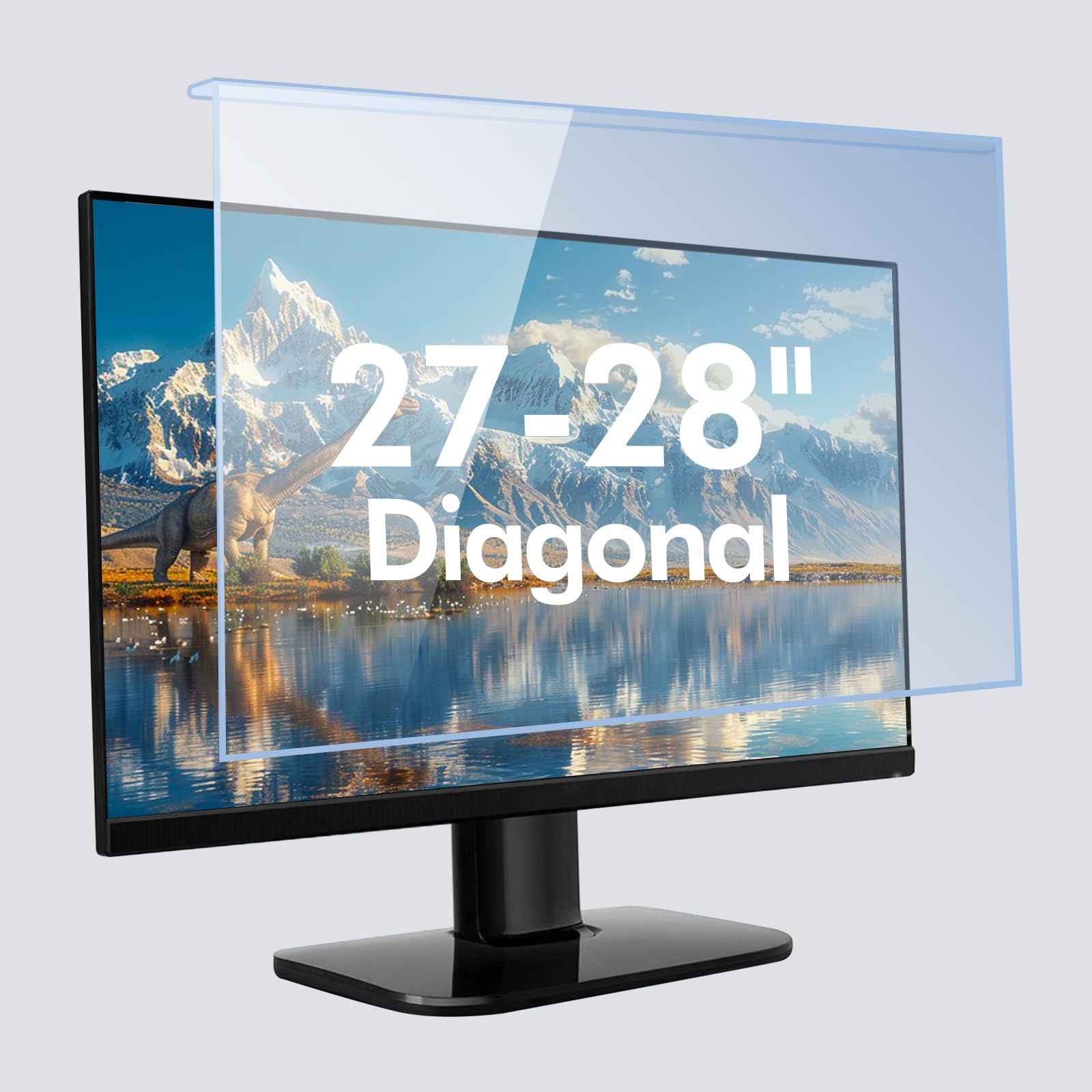
The desk-monitor panel that fights blue light and takes the sneezes.
Long days in front of a monitor are the whole reason this one exists. It is built for desktop screens — 27-28 inch panels specifically — and it hangs rather than sticks, so nothing touches your display. The standout number is the light transmittance: 98% of the screen’s light passes straight through, so the picture keeps its original color instead of washing out. For a filter, that is a high figure, and it means you are not trading brightness for eye comfort.
The maker rates it at up to 99% UV and 75% blue-light blocking across 380nm-495nm. Those are the wavelengths tied to the tiring part of screen time, and the goal is to cut the edge off long evening sessions without dimming the view. The panel itself is 24.8 inches by 14.6 inches and rated 9H, so it also doubles as a shield against scratches and light impacts — cat owners in particular like it. One buyer who added it to a monitor against cat claws noted it beats draping a blanket over the screen and keeps dust out. One sneeze-prone owner says it catches spray reliably and seems to ease eye strain.
Here is the honest catch, and the maker says it up front: this is not anti-glare. It is glossy, so it reflects background light, and a few buyers find the tint shifts colors slightly. It also will not play well with a curved monitor from the start — the hook-on design assumes a flat panel, though at least one resourceful owner rigged it onto a curved screen with clamps. The upside is that flat, unhurried desk setups fit perfectly with no tools and no adhesive. If you share a wall with a bright window, angle the monitor or the reflections will get in the way.
The value math: with 98% transmittance you keep almost all of the brightness you paid for, while the extra UV and blue-light filtering comes along at no cost to the image.
Set it up right: measure diagonally across the visible screen only, and remember it hangs on the top edge with an anti-slip strip, so a thin frame holds it best.
Reach for this if: you park in front of a flat 27-28 inch monitor for work or gaming and want a clear, affordable blue-light cut with a scratch shield thrown in.
Look elsewhere if: your monitor is curved or you need a matte, reflection-free finish.
3. Vizomax 27-28 inch Anti-blue Light Monitor/TV Screen Protector

A nearly invisible blue-filter panel that works the evening shift.
This pick is for the viewer who wants the screen to look essentially unchanged while still softening the harsh light after dark. It is a multi-layer acrylic filter measuring 24.8 inches by 14.6 inches with a polished finish and 9H hardness, sized for 27-28 inch displays across the common monitor and TV brands. Clarity is the headline gift: buyers describe it as almost invisible, with no distortion and no change in brightness you would notice during the day.
What owners value most is how easy it is to live with. It goes on without fuss, it stays put, and the slight tint actually makes a bright monitor more comfortable to look at over a long session. Its headline spec is blue-light filtering across 390nm-480nm, including the HEV range, which reads as a calmer night picture rather than a color shift. Compared with the BSPROTE above, this one leans harder into the blue-light number and a polished, near-invisible look, while the BSPROTE brags up its 98% transmittance instead. Both are 9H panels in the same 24.8 by 14.6 size, so the tiebreaker is finish and price feel.
The trade-off to know before you buy is reflection. Several owners find the panel more reflective than a bare screen, and on a dark scene it can behave a bit like a mirror, so a lamp or window behind you will show up. There is also a split on value — some buyers feel the clarity and durability justify the spend, others grumble that it is on the pricier side for what is, at heart, a sheet of acrylic. If you can control the light in the room and want the cleanest possible look, this is the one; if glare is unavoidable, plan around it.
Why it earns its place
- Clear to the point of near-invisibility
- 9H multi-layer acrylic takes scratches and light knocks
- No fussy mounting — often holds without the extra velcro
- Slight tint eases long evening viewing
What to weigh first
- More reflective than a bare screen; glare in a bright room is a real factor
- Buyers are split on whether the clarity justifies the price
Best used by: the night-shift viewer with a controllable room who wants a filter that all but disappears against the screen.
Think twice if: your screen faces a window or overhead light — the polished surface will catch it.
4. VizoBlueStop 42-43 inch Anti-Blue Light TV Filter

The living-room-sized filter that takes the night bite out of a big screen.
When the TV in question is a full 42-43 inches, you need a panel cut for that size, and this is the one here that goes big — a 38.2 inch by 22.4 inch sheet of multi-layer acrylic. It is a 7H panel, one step below the 9H picks, which is still a tough surface for a screen this size but softer than the smaller options if you are chasing maximum scratch resistance. The finish is glossy and the maker lists anti-fingerprint and blue-light blocking as its special features. It is designed to fit the full spread of big-screen brands, so most name-brand TVs in that range are covered.
Owners describe the change as calming rather than dramatic: the bright, glaring punch of an evening TV gets dialed back, and the room feels easier to wind down in. The maker rates it at 100% UV blocking and reduced high-energy blue light across 380nm-480nm, with full visible color retained. Customers note less eye strain over long binge sessions, and one owner with cataracts found it eased watering and strain even after lowering the TV brightness. Attachment is done by straps or a lip, so it holds without adhesive on the glass.
The thing to size your expectations against is brightness in a pitch-dark room. A filter takes the sharpest edge off the light, but if you like a very bright picture late at night, expect it to still feel punchy rather than fully mellow. Setup is guided and quick, and the panel itself is nicely packaged, though the strap attachment can feel a touch awkward at first on some TV shapes. It is the largest and most premium pick on this list, so it makes most sense when a big screen is the daily centerpiece rather than a secondary set.
What stands out: a 38.2 by 22.4 inch surface is big enough to cover a true 42-43 inch TV, not just a monitor, and the blue-light range runs the full 380nm-480nm band.
Who it is built for: households with a large living-room screen and a shared evening wind-down routine.
Made for you if: you watch a 42-43 inch TV most nights and want a large acrylic panel that softens the glare and blue light without washing out the color.
Less ideal if: you demand the hardest possible 9H surface or you keep the picture turned up bright in a dark room at night.
Understanding the Specs
Screen size and panel dimensions
Screen size is measured diagonally across the visible picture, and it is the number you match to the protector’s stated range. The protector’s own length and width — such as 24.8 inches by 14.6 inches for a 27-28 inch model, or 38.2 inches by 22.4 inches for a 42-43 inch one — tells you the true footprint that must cover your display. Measure your lit area, ignore the plastic frame, and size up rather than down if you land between two ranges. A 42-43 inch panel will overwhelm a 27-inch monitor, and a 23-24 inch panel simply will not reach across a large TV.
Hardness rating (9H vs 7H)
Hardness here is a scratch-resistance scale, where a higher number means the surface holds up better against keys, rings, and claws. A 9H panel resists everyday scuffs more than a 7H one, which is why most smaller protectors in this category land at 9H. Bigger sheets sometimes run 7H, which is still a tough acrylic surface but a touch softer. The practical takeaway: if scratch resistance is your priority, aim higher; if coverage and size matter more, a 7H panel on a large screen is a reasonable trade.
Blue-light blocking
Blue light is the short-wavelength visible light these filters target, and makers advertise how much they block across a range like 380nm-495nm. A filter at a higher blocking percentage will tint the picture a little more and feel calmer on the eyes at night. It will not fix eye health or single-handedly dim a bright screen in a dark room. Treat the blocking figure as a comfort dial, not a cure, and expect a slight color shift on any high-blocking panel.
Clarity and glare
Clarity is the percentage of light that passes through the panel — a high figure like 98% or 100 keeps the picture close to bare-screen brightness. Glare is the flip side: a glossy acrylic sheet reflects room light, so a screen facing a window or lamp will show reflections, especially on dark scenes. A higher clarity number is almost always paired with a glossier finish, so you cannot fully have both. Control your room lighting and you keep the clear view; ignore it and you get a mirror on dark scenes.
FAQ
Will these acrylic protectors fit my exact TV size?
Is acrylic better than tempered glass for a TV screen protector?
Do these protectors really block blue light and is that safe?
Will an acrylic panel make my screen look dimmer or change the colors?
How do these panels attach without damaging my screen?
Is a glossy acrylic protector going to cause reflections?
Can I use a monitor protector on a curved screen?
Does a screen protector work on a touchscreen or stop the remote from reaching the TV?
How do I clean an acrylic TV protector without scratching it?
Should I remove the film on both sides before using the protector?
Final Thoughts: The Verdict
For most households, the acrylic tv protector to grab is the TV-Protector 23-24 inch, because it pairs a 9H optical-grade acrylic shield with the clear, near-invisible view that parents, pet owners, and controller-waving kids actually want. If you are protecting a desk monitor and fighting evening eye strain, the BSPROTE 27-28 Inch Blue Light Filter keeps 98% of your brightness while cutting the harsh wavelengths. For the cleanest, most invisible look around a 27-28 inch screen, reach for the Vizomax. And when the TV itself is a 42-43 inch centerpiece, the VizoBlueStop is the one sized to cover it.
How We Picked
We do not accept paid placement. Every pick is matched to a real buyer and a real use-case; we do not hands-on test units.
Sources & Methodology
Specifications: manufacturer listings and product documentation. Review insights: verified customer reviews, as of September 2026. Pricing: not shown on this page (it changes often); check the current price via the retailer link.
As an Amazon Associate, Gadgets Feed earns from qualifying purchases. This does not affect which products we feature.