
Our readers keep the lights on and my morning glass full of iced black tea. As an Amazon Associate, I earn from qualifying purchases.
Specs are compiled from manufacturer listings and verified buyer reviews and can change over time — please confirm the key details on the product page before buying.
You want a cinema-sized picture without a cinema-sized room, and that is exactly what an ultra short throw projector solves. It sits inches from your wall and throws a massive image upward, so nobody casts a shadow while walking past. The catch is that “affordable” here is relative — these are multi-year purchases, and the wrong pick means a projector that washes out in daylight or fights you on placement. This guide sorts the real current models by who each one actually suits.
I’m Min — the founder and writer behind Gadgets Feed. This guide is built by comparing the manufacturers’ published specifications and the patterns across verified customer reviews, so you get each pick’s real strengths and trade-offs instead of marketing spin.
You will get straight answers on brightness, laser life, and throw distance so you can pick with confidence. My goal is to make the search for the best affordable ultra short throw projector faster and less confusing than reading spec sheets alone.
Our Picks at a Glance

How To Choose The Best Affordable Ultra Short Throw Projector
The first thing to understand is that “ultra short throw” is a geometry, not a marketing word. These projectors sit close to the wall and fire the image upward at a steep angle, which is why placement and throw ratio matter more than almost anything else.
Throw ratio decides your room layout
The throw ratio is the number that tells you how far from the wall the unit must sit to fill a screen. A ratio like 0.25:1 means roughly a quarter unit of distance for every unit of screen width. Lower numbers let you place the projector even closer. Get this wrong and you either can’t fill your screen or the unit is too far forward for your cabinet.
Brightness and ambient light
To watch with the lights on, you need enough brightness. Brightness is measured in lumens (a unit of light output). Sunlight from windows washes out a dim picture fast. If your room gets a lot of daytime sun, check the lumen number closely and plan to add an ALR screen (a screen that blocks light from the side to keep the picture bright and clear).
Laser lifespan and the light engine
Most of the picks here use laser light sources, which means no bulb to replace. Laser life is measured in hours, and the picks here run 25,000 to 30,000 hours. At 30,000 hours, that’s roughly a decade of nightly movie watching before the laser dims noticeably. Contrast ratio, meanwhile, shapes how deep the blacks look in a dark room.
Quick Comparison
| Model | Best For | Brightness | Contrast Ratio | Resolution | Amazon |
|---|---|---|---|---|---|
| AWOL VISION LTV-3000 Pro★ Best Overall | All-round home theater | 2000 lm | 2500:1 | 3840 x 2160 | Amazon |
| Optoma GT3500HDRBrightest Pick | Bright-room gaming | 3800 lm | 500000:1 | 1080p Full HD | Amazon |
| WEMAX Nova ProBest Value | Big screen on a budget | 2100 ISO lumens | 3000:1 | 3840 x 2160 | Amazon |
| XGIMI AURA | Art-minded living rooms | 2300 ISO lumens | 1000000:1 | 3840 x 2160 | Amazon |
| Hisense PL2 | Balanced value | 2700 lumens | 3000:1 | 3840 x 2160 | Amazon |
| Epson EpiqVision Ultra LS800 | Daylight viewing | 4000 lm | Over 2,500,000:1 | 3840 x 2160 | Amazon |
| Epson Lifestudio Grand | Bright rooms with Bose audio | 3600 lm | 5,000,000:1 | 3840 x 2160 | Amazon |
| Hisense PX3-PRO | Console gaming | 3000 lumens | 3000:1 | 3840 x 2160 | Amazon |
| LG HU85LA CineBeam | Tight placement | 2700 lumens | 2,000,000:1 | 4K UHD (3840×2160) | Amazon |
In‑Depth Reviews
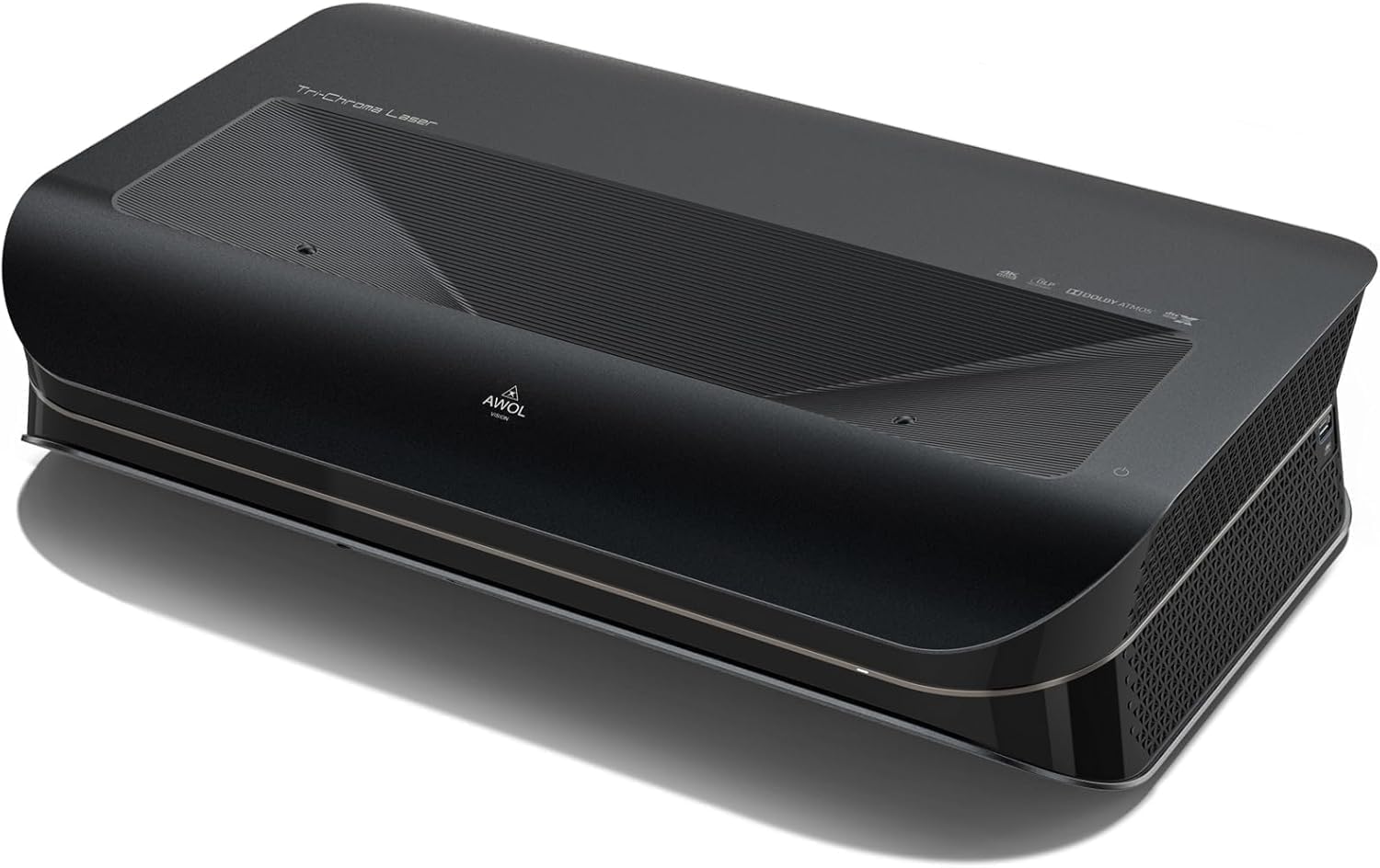
1. AWOL VISION LTV-3000 Pro 4K 3D Ultra Short Throw Triple Laser Projector
Our pick — 4.5★ from 200+ verified ratings; the strongest balance of quality and price.
The triple-laser all-rounder that turns a living room into a 150-inch home theater.
The AWOL LTV-3000 Pro is the pick if you want the most complete home cinema in one box. It uses a triple laser light source (three separate lasers instead of a color wheel) with 4K UHD, Dolby Vision and HDR10+. That means sharper color with no spinning-wheel artifacts. The built-in center channel speaker fires dialogue straight from the screen, so voices sound like they are coming from the actors rather than a soundbar on the floor.
Brightness sits at 2000 lm and the native contrast ratio is 2500:1, which is modest on paper but reads far punchier in a dark room. Where it genuinely shines is the day-to-night range — owners consistently describe the picture as bright and vibrant even with room light on, and sharp enough to rival a television at night. The throw ratio is a fixed 0.25:1, so you need roughly 8.54 inches for a 100-inch screen and 12.84 inches for 150 inches. If your cabinet is too shallow, AWOL sells a motorized slider to dial in placement.
Here is the honest trade-off. Refresh tops out at 60Hz, so serious console gamers will notice motion blur and a little input lag. The menus feel basic, and a rainbow effect can show up on white backgrounds during fast motion. Setup also rewards patience — aligning the image is flawless once done, but it takes a careful hand. Buyers report the Dolby Vision performance is excellent except in vivid mode, and one buyer flagged chromatic aberration (color fringing on text) that support called “just how it is.”
What earns its keep
- Triple laser with Dolby Vision and HDR10+ at 4K UHD
- 107% BT.2020 and 147% DCI-P3 color coverage
- Built-in center channel plus ThunderBeat 4.2.2 sound upgrades to 5.2.2
- Fixed 0.25:1 throw ratio — 8.54″ for 100″, 12.84″ for 150″
Caveats to weigh
- 60Hz max refresh means motion blur and some gaming lag
- Menus feel primitive compared to smart TV rivals
- Setup rewards patience — UST alignment takes a careful hand
Pick it when: you want a single-box cinema with triple-laser color, Dolby Vision and Atmos audio.
Think twice if: you game seriously at high refresh rates — the 60Hz ceiling is the real limit.
2. Optoma GT3500HDR 1080p Full HD Home Laser Projector
The dim-room-slayer for gamers who want raw brightness and near-instant response.
If your room has stubborn daylight and you play fast games, this Optoma is the value play. It pushes 3800 lm, which is nearly double the AWOL’s 2000 lm, so it holds its own in a lit room where dimmer rivals wash out. The contrast ratio is a staggering 500,000:1 — roughly 200x the AWOL’s 2500:1 on paper — which explains why owners describe deep blacks and bright whites. Better yet, it hits 8ms input lag at 1080p 120Hz, so shooters feel snappy.
The DuraCore laser is rated for up to 30,000 hours, and the 1-minute cooldown keeps your movie nights brisk. Connectivity is generous with 2x HDMI 2.0, USB-A power, 3.5mm audio out, RS232 and RJ45. The built-in 15W speaker is fine for casual viewing, though sound is described as just okay.
The catch is that this is a projector only — no operating system, no streaming apps. Focus also maxes out at a 144-inch screen, and one owner hit the limit of the focus range at that size. A textured wall won’t work — you need a proper screen for clean edges. A handful of units have arrived feeling repackaged or damaged, so check the seal on delivery.
The gaming math: 8ms lag at 1080p 120Hz plus 3800 lm brightness is a combo the dimmer competition can’t match under -class pricing.
Where it stumbles: no smart OS and no USB media playback — you will need a streaming stick and a wall or screen that plays nice with ultra short throw geometry.
Worth it for: gamers and bright-room watchers who already own a streaming device and a good screen.
Not the one if: you expect built-in apps or USB movie playback from the start.
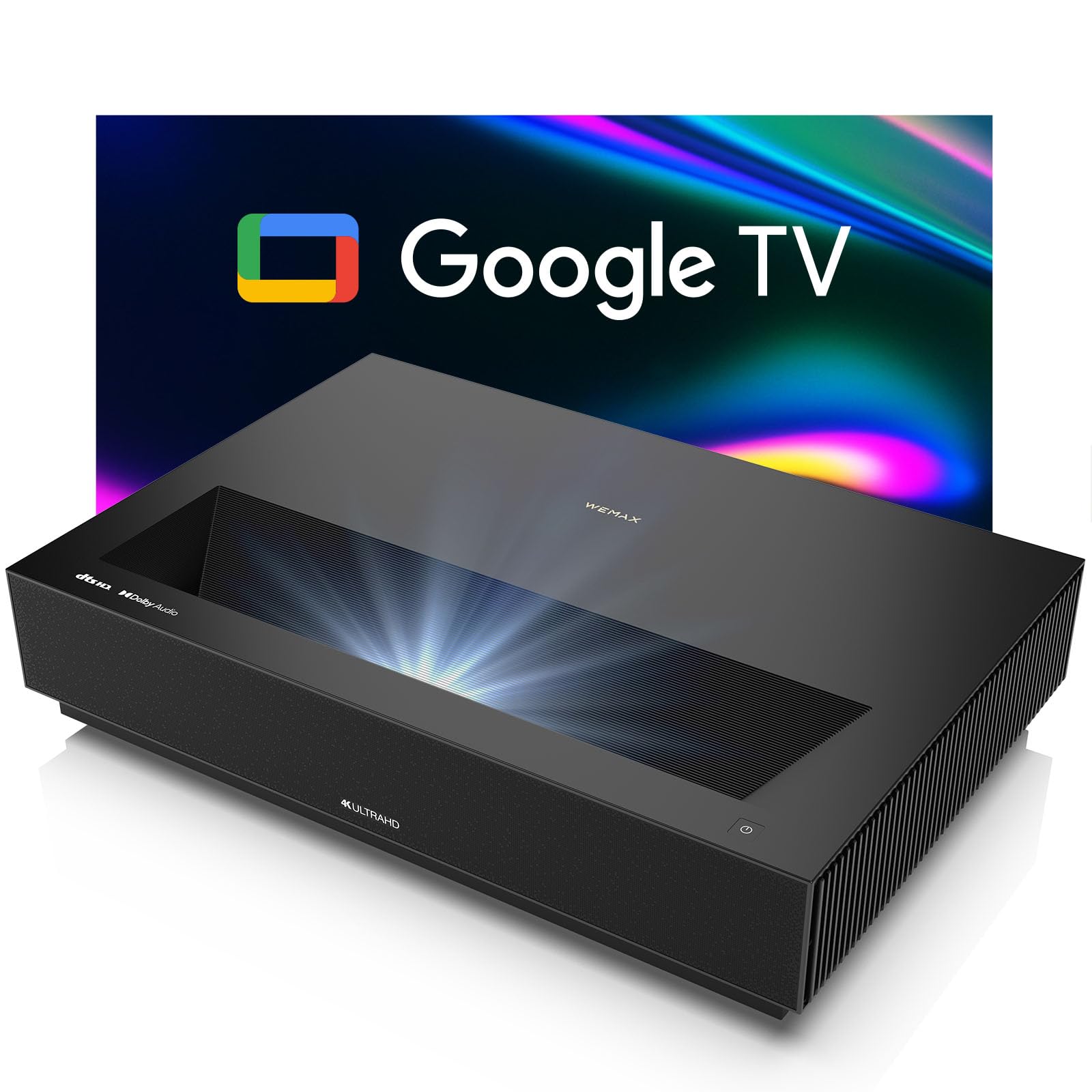
3. WEMAX Nova Pro 4K Ultra Short Throw Projector, Google TV, 2100 ISO Lumens
A 150-inch 4K laser cinema that punches well above its price bracket.
The Nova Pro is the projector that keeps coming up when people ask which ultra short throw delivers the most screen for the money. It runs ALPD laser technology (a speckle-free laser light engine) with true 4K UHD, 110% Rec.709 coverage and 1.07 billion colors, plus HDR10 and HLG. The throw ratio is a very short 0.23:1, so you get a 150-inch image from just 49cm (19 inches) away. WEMAX’s 0.23:1 even edges out the AWOL’s 0.25:1 for tighter placement in small rooms.
Brightness lands at 2100 ISO lumens with a 3000:1 contrast ratio, which is enough for moderate ambient light and shines at night. Google TV is built in with native Netflix, over 700,000 movies and shows across 10,000+ apps, and Google Assistant voice search. Dual 15W speakers with DTS-HD and Dolby Audio mean you can skip the soundbar for casual watching. Around 396 owners have weighed in, and the thing they praise most is the build quality and picture.
Two honest wrinkles. First, reliability splits the room — most report zero issues, but a minority hit a unit that stopped working or developed dead pixels over time, so an extended warranty is worth considering. Second, the software has quirks: apps sometimes close on first load, and input memory can reset on power off. This projector also lacks a built-in tuner, and owners mention you may need a streaming stick for some services.
The value read: you get a 4K laser UST (ultra short throw, meaning it sits close to the wall) with Google TV and a 150-inch picture from under two feet away. That makes it among the most affordable true-4K choices here.
Buyer tip: grab the extended warranty if you plan years of daily use, and pair it with an ALR screen for daylight rooms.
Choose it for: a big-screen cinephile on a value budget who wants 4K and smart apps in one box.
Consider another if: you want bulletproof long-term reliability out of the gate — add a warranty here.
4. XGIMI AURA Ultra Short Throw 4K Laser Projector

The furniture-grade projector that doubles as decor and supports Netflix out of the gate.
XGIMI built the AURA to blend into a room rather than shout at it. There’s an exclusive Art Mode that turns the unit into a piece of decor when it’s off, and the styling reads more like a piece of kit than a box. Under the hood it’s serious: 2300 ISO lumens, a 1,000,000:1 contrast ratio, and IMAX Enhanced certification with Dolby Vision and Dolby Atmos. Harman/kardon speakers are built in, so the audio package is tuned rather than aftermarket.
Google TV with licensed Netflix is baked in, so you power on and stream — no workarounds or third-party stick needed. The throw ratio is an ultra-tight 0.177:1, which is among the shortest here, and it supports screens up to 150 inches. Intelligent Screen Adaption 5.0 handles auto-focus and alignment. For gamers there’s 20ms latency and MEMC (motion smoothing that reduces judder). Connections run to 3 HDMI (one with eARC), 3 USB, optical audio and Ethernet.
The honest downside is software maturity. A recurring frustration is that the hardware is genuinely excellent while the software occasionally stumbles — such as needing an unplug when a remote command doesn’t register, or brightness randomly resetting. A few owners hit speaker crackling on two units in a row. On picture alone it’s a standout: “Quality is insanely good it justifies the price.”
Reasons it stands out
- 1,000,000:1 contrast ratio with Dolby Vision and IMAX Enhanced
- 2300 ISO lumens plus 0.177:1 throw — among the shortest here
- Licensed Netflix inside Google TV — no extra streaming device needed
- 20ms latency and MEMC for responsive gaming
Where it asks patience
- Software bugs like needing an unplug, or brightness resetting
- Occasional speaker crackling reported on some units
- Support response can be slower than the hardware deserves
Best matched to: design-conscious buyers who want Netflix built in and a projector that looks good when it’s off.
skip it if: you want a rock-solid software experience from the start without occasional quirks.
5. Hisense PL2 Ultra Short Throw Home Theater Laser Projector

Hisense’s value pick — bright, colorful, and easier on your eyes than most.
The PL2 is the balanced middle of the Hisense line. It runs on X-Fusion laser tech with 2700 lumens and a 3000:1 contrast ratio, plus Dolby Vision and Dolby Atmos. It projects from 80 inches up to a giant 150 inches, and a 4K AI Upscaler (software that sharpens low-resolution content to near-4K detail) keeps older sources looking clean. The 1.07 billion color palette is the kind that makes skin tones look natural rather than flat.
Buyers consistently say the PL2 gives TV-like quality, stays sharp even on a plain light gray wall, and runs quieter than expected. The built-in speakers get steady praise and work well for most watching. Sports fans in particular like the big, rich wall picture. The X-Fusion laser is rated for 25,000+ hours, so you won’t be buying bulbs.
Two things to know. First, some customers note a rainbow effect (brief red-green-blue flashes from the color wheel-free engine), and for a small number of people this causes discomfort — it’s worth a demo if you have never used a DLP projector before. Second, setup can be complex if you’re wiring it into a receiver and speaker system, and autofocus can be finicky. The built-in Google TV handles streaming cleanly once you find your way around.
What buyers love: crisp images on ordinary walls and sound that outperforms what most expect from built-in speakers.
Who should test first: anyone sensitive to rainbow effects — try to see a DLP projector in person before committing.
A strong fit for: movie and sports nights in a mixed-light room where you want big-screen quality without a projector screen yet.
Look elsewhere if: you need a simple receiver-and-speaker chain and impatient autofocus drives you up the wall.
6. Epson EpiqVision Ultra LS800 Ultra Short Throw Laser Projector (Renewed)

Daylight-abuse projector that beats most rivals for sheer raw brightness.
If your room is permanently bright, the Epson EpiqVision Ultra LS800 is the one to beat. It fires 4000 lumens — more than any other pick here except the Lifestudio Grand — and the contrast ratio runs at over 2,500,000:1. That pairing is why owners describe the picture as extremely vivid and bright in full daylight. The 3-chip 3LCD engine handles color differently from single-chip DLP designs, which means no rainbow effect at all. It supports 4K 120Hz, so console gaming at high refresh is on the table.
Being a renewed unit, it often lands at a friendlier tier than brand-new. The tradeoff is that rebuilt stock can be hit-or-miss — some reviewers point out units dying within months or arriving with dead HDMI ports, so buy from a seller that honors returns. When it works, though, it works beautifully: sharp, vivid pictures, an easy setup, and praise for the clean UST geometry. Android TV is built in, though many owners add a Roku Ultra to sidestep the laggy interface.
The catch is physical. This is a large, heavy unit — a couple of owners note it’s roughly triple the size of earlier Epson models. It won’t work on a textured wall, since UST beams cast shadows off bumps, and the built-in Android TV interface feels slow. You’ll want a screen and a streaming device to round it out.
The size reality: plan for cabinet space and a dedicated screen — this is a big appliance, not a set-top gizmo.
On buying renewed: the savings are real, but so is buyer variance — purchase somewhere with easy returns.
Ideal for: bright living rooms where daylight viewing and 4K 120Hz gaming both matter.
Skip if: you want a brand-new sealed unit or a compact footprint — this one is neither.
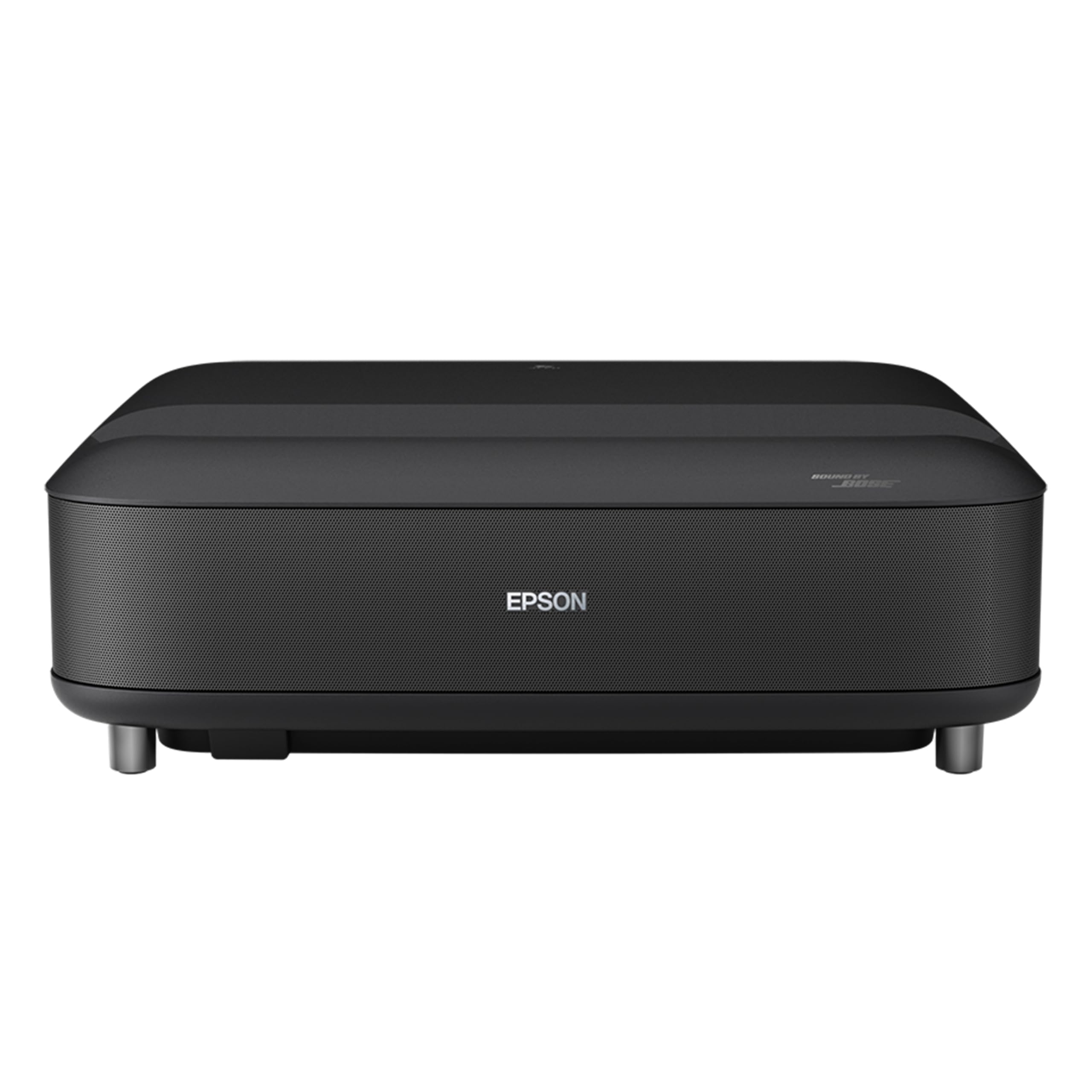
7. Epson Lifestudio Grand Ultra Short Throw 4K PRO-UHD Laser Projector
Epson’s sound-first projector — Bose audio and a picture that shrugs off room light.
The Lifestudio Grand is Epson’s premium answer to home entertainment, and its calling card is audio. Stereo speakers tuned with Bose technology deliver deep bass, room-filling sound that buyers describe as genuine theater quality without any soundbar. The picture matches the sound: 3-chip 3LCD delivers 3,600 lumens of color and white brightness, so it stays vivid in bright rooms. 4K PRO-UHD processing handles clarity and HDR10 color without sacrificing brightness. There’s a 5,000,000:1 contrast ratio — among the highest here — for deep blacks in dark scenes.
Google TV is built in, with over 10,000 streaming apps including Netflix, Disney+ and Hulu, plus YouTube TV. Throw is ultra short, so you can sit it against the wall for a theater-like image up to 120 inches. The unit itself is a chunky tower, roughly 15.7″ x 18.4″ x 6.2″, so plan for floor or low-cabinet placement. Audio and picture together feel genuinely room-filling, which is exactly what “Grand” implies.
That said, the honest gripe here is connectivity. Multiple shoppers say Wi-Fi dropping or reconnecting slowly, and wireless projection from phones (airplay-style casting) has been flaky for some, requiring factory resets or workarounds. The built-in Google TV interface also isn’t as responsive as some rivals. If you plan to stream over Wi-Fi primarily, plan for an Ethernet cable or a streaming stick to sidestep it.
Where it wins
- Bose-tuned 2-channel audio that owners describe as theater-grade
- 3,600 lumens of both white and color brightness from 3-chip 3LCD
- 5,000,000:1 contrast ratio for deep blacks
- Google TV with 10,000+ apps and Netflix built in
Watch out for
- Wi-Fi can drop or reconnect slowly
- Phone mirroring and casting have been unreliable for some
- Large, heavy form factor — plan cabinet or floor space
The right call if: audio matters as much as picture, and you want a big-screen experience without a separate sound system.
Look elsewhere if: you need rock-solid wireless casting and lightweight placement flexibility.
8. Hisense PX3-PRO Laser Cinema Triple Laser Ultra Short Throw Projector

A triple-laser UST built specifically for Xbox — the console gaming projector.
The PX3-PRO is billed as the world’s first UST projector designed for Xbox, and the specs back it up. It runs LPU technology (Hisense’s precision color engine) covering 110% BT.2020 and about 151% DCI-P3, so colors are rich and lifelike. It pairs that with 3000 lumens, a 3000:1 native contrast ratio, plus Dolby Vision, HDR10+ and IMAX Enhanced. Throw is ultra short, so a 150-inch screen sits just inches from the wall. A 4K AI Upscaler cleans up older content.
For Xbox and PC gamers, the standout is support for 240Hz refresh via HSR (high refresh rate) with auto-low-latency mode, which smooths out screen tearing and lag. Google TV handles apps and voice control, and the Google TV OS runs quick enough that buyers compare it favorably to smart TVs. Streaming and movies look detailed, and the 150-inch screen provides a full THX viewing angle for genuine cinema immersion. Multiple owners describe setup as genuinely easy.
The honest caveat is service and QA. A few buyers have hit picture defects like a rainbow band across the bottom after a short runtime, or units that stopped working entirely — and Hisense’s customer service complaints recur in the reviews. It’s worth buying from a seller with a strong return window, and taking a photo of your setup once installed. The unit itself also projects upward from a low position, so you’ll need floor or low-cabinet placement.
The gamer read: 240Hz HSR plus auto-low-latency is a spec sheet most home projectors can’t touch.
Worth noting: check the return policy closely — Hisense support gets mixed marks on faults.
Tuned for: Xbox and high-refresh PC gamers who want a cinema-scale 150-inch screen with smooth motion.
Not ideal if: you want low-maintenance long-term support — the service experience is inconsistent.
9. LG HU85LA CineBeam 4K UHD Ultra Short Throw Projector

The classic triple-laser LG — 7.2 inches from the wall for a 120-inch picture.
The LG HU85LA is the veteran of this list, and it still earns its place. It pushes 2700 lumens and has a 2,000,000:1 contrast ratio, and it delivers a 120-inch screen from just 7.2 inches away — among the shortest throw distances here. Under the hood is LG’s webOS smart system accessed via the included Magic Remote, plus Alexa built-in and LG ThinQ AI. Triple-laser construction means real color richness rather than the single-laser layouts found on budget-tier options. LG even touts a 2019 CES Innovation Award.
Owners who have lived with it for years still rave: one long-term buyer called it “Magical, absolutely love it.” Some early buyers noticed a blue/purple hue, and that note has stuck around, but many describe the picture as vivid and rich, especially at night. It runs quiet — rated down to 26dB(A) (a low noise level). There’s an ATSC tuner (a built-in over-the-air TV receiver), so you get free broadcast channels without an external box.
The honest caveat is that this is an older-generation unit, and it shows. Refresh and gaming features lag behind newer rivals, there’s no HLG or HomeKit support, and edge-focus softness can appear at the full 120-inch size. Some units have developed dead pixels after a couple of years. Placement is genuinely fiddly to dial in, and some buyers report HDMI port failures over time. But if you need a tiny footprint and mature smart-TV software, this remains a strong option.
The placement story: 7.2 inches from the wall for a 120-inch picture is the tightest fit here — great for narrow media walls.
Think about this: the triple-laser color is beautiful, but the platform is aged relative to newer 4K HDR rivals.
Choose for: anyone with a narrow wall or side-table setup who wants mature smart-TV software and 4K HDR.
Consider newer: if gaming refresh and cutting-edge HDR formats top your checklist.
Understanding the Specs
Brightness in lumens
Lumens are the raw light output measure — more lumens hold up better against daylight. If your room sees strong daylight, aim for a higher figure. If you mostly watch at night, 2000 to 2700 lumens is plenty and often gives deeper blacks.
Contrast ratio
Contrast ratio describes the gap between whites and blacks. Higher numbers mean stronger depth in dark scenes. It matters most in a dark room, where a 2500:1 panel shows greyer blacks than a 1,000,000:1 one.
Throw ratio
The throw ratio tells you how far from the wall the projector must sit. Lower numbers (0.2:1, 0.25:1) let you place it closer. Check this before buying — an ultra short throw lives or dies by placement.
Laser life and light source
Laser projectors list lifespan in hours. Most picks here are rated for 25,000 to 30,000 hours, so you never replace a bulb. Triple-laser engines cover more color without a spinning color wheel, which helps avoid rainbow effects.
FAQ
How far from the wall does an ultra short throw projector need to sit?
Can I watch an ultra short throw projector in a bright room?
Do ultra short throw projectors have the rainbow effect?
Do these projectors need a screen, or will any wall work?
How long does the laser light source actually last?
What refresh rate do these projectors support for gaming?
Do I need a separate soundbar with these projectors?
Should I buy a renewed or open-box UST projector to save money?
Do these projectors include streaming apps built in?
Which UST projector is easiest to set up in a small room?
Final Thoughts: The Verdict
For most buyers, the affordable ultra short throw projector winner is the AWOL VISION LTV-3000 Pro because it delivers true 4K UHD, triple-laser color, Dolby Vision and Atmos audio in a single box that owners describe as TV-beating at night. If you want raw daylight brightness and instant gaming response, grab the Optoma GT3500HDR. And for the brightest 3-chip 3LCD picture with 4K 120Hz gaming support, the Epson EpiqVision Ultra LS800 is the one to reach for.
How We Picked
We do not accept paid placement. Every pick is matched to a real buyer and a real use-case; we do not hands-on test units.
Sources & Methodology
Specifications: manufacturer listings and product documentation. Review insights: verified customer reviews, as of September 2026. Pricing: not shown on this page (it changes often); check the current price via the retailer link.
As an Amazon Associate, Gadgets Feed earns from qualifying purchases. This does not affect which products we feature.