
Our readers keep the lights on and my morning glass full of iced black tea. As an Amazon Associate, I earn from qualifying purchases.
Specs are compiled from manufacturer listings and verified buyer reviews and can change over time — please confirm the key details on the product page before buying.
If you are still raking a big yard by hand, you already know the pain: weekends gone, blisters, and a leaf pile that laughs at you. A backpack leaf blower fixes that by putting the engine and the airflow on your back instead of in your hands. The picks below range from budget-friendly two-strokes to premium commercial-grade machines, each rated on how it handles wet leaves and gravel.
I’m Min — the founder and writer behind Gadgets Feed. This guide is built by comparing the manufacturers’ published specifications and the patterns across verified customer reviews, so you get each pick’s real strengths and trade-offs instead of marketing spin.
Buyers care most about raw blowing power and how comfortable a unit feels after an hour on their back. To help you compare airflow, engine size, and weight side by side, here is a plain-English look at the best backpack leaf vacuum options for serious yard cleanup.
Our Picks at a Glance

How To Choose The Best Backpack Leaf Blower
Choosing a backpack leaf blower is really about matching three numbers to your yard: airflow (CFM), air speed (MPH), and the unit’s weight on your back. Get those right and a full weekend of raking drops to a couple of hours. Get them wrong and you end up with a blower that stalls on wet leaves or wears your shoulders out before you finish.
Airflow (CFM) vs Air Speed (MPH)
CFM (cubic feet per minute) measures how much air the blower moves, and it is the number that matters most for pushing big piles of leaves. MPH (miles per hour) measures how fast that air travels, which helps break debris loose from grass and pavement. For heavy wet leaves, a higher CFM does more work than a higher MPH, so look at CFM first.
Engine Type: 2-Stroke vs 4-Stroke vs Battery
A 2-stroke engine needs oil mixed into the gas, runs loud, and delivers strong power for its size. A 4-stroke engine uses straight gas with no mixing, runs quieter and smoother, but typically makes less raw power. A cordless battery model skips fuel entirely, runs quietly with no exhaust, and trades runtime for convenience. Match the engine to your yard size and how long you need to run per session.
Weight and Harness Comfort
These machines sit on your back for an hour or more, so weight and harness design matter as much as power. Padded straps, a ventilated back panel, and an even weight distribution keep you going longer. A 23-lb unit with a padded harness can be more comfortable than an 18-lb one with thin straps.
Quick Comparison
| Model | Best For | Airflow (CFM) | Air Speed (MPH) | Weight | Amazon |
|---|---|---|---|---|---|
| Echo PB-9010T★ Best Overall | Maximum power for large properties | 1110 | 220 | 23 lbs | Amazon |
| HTK 63CCBest Value | Budget-friendly gas power | 665 | 205 | 21 lbs | Amazon |
| PROYAMA 72CCMost Versatile | Versatile seasonal cleanup | 880 | 275 | 21 lbs | Amazon |
| SENIX 49CC | Quiet 4-cycle operation | 425 | 195 | 18.2 lbs | Amazon |
| PRORUN PBB2884 | High airflow on a mid-range budget | 1020 | 240 | 32.8 lbs | Amazon |
| Greenworks 80V | Cordless convenience for smaller yards | 750 | — | 9.5 lbs | Amazon |
| Echo PB-580T | Reliable mid-range gas performance | 510 | 215 | 22.6 lbs | Amazon |
| PRORUN PBB3000 | Commercial-grade blow force | 1125 | 250 | 33 lbs | Amazon |
| Husqvarna 560BTS | Pro-level power and comfort | 632 | 232 | 23.2 lbs | Amazon |
| EGO POWER+ LB6003 | Long-runtime cordless cleanup | 600 | 160 | — | Amazon |
| Husqvarna 580BTS | Heavy-duty commercial clearing | 1000 | 220 | 34 lbs | Amazon |
In‑Depth Reviews
1. Echo 220 MPH 1110 CFM 79.9 cc Gas 2-Stroke X Series Backpack Blower with Tube-Mounted Throttle PB-9010T
Our pick — over 4.5★ from 900+ verified ratings; the strongest balance of quality and price.
The 79.9cc monster that turns a full weekend of raking into a two-hour job
Its 79.9 cc 2-stroke engine pushes 1110 CFM (cubic feet per minute, the volume of air it moves) and 220 MPH (miles per hour, how fast that air travels). That airflow is what lets buyers report clearing a 6″ wet snow off a 300’x10′ gravel drive in 90 minutes. Against the HTK 63CC below, it moves 445 more CFM and reaches 15 MPH higher — the gap in raw clearing power is real.
What wins people over is the sheer performance on tap. Owners describe it blowing bricks around and moving 3/4″ crushed gravel with ease, and one senior user halved his job time on a large New Hampshire wooded property. A homeowner on an acre cut his clearing from roughly 10 hours down to 2. The 28″L x 20″W x 24″H frame is bulky, and it is a thirsty machine — figure on roughly a gallon every 90 minutes at work. At 23 lbs, it is easier to don from a tailgate than off the ground, and a waist belt plus chest strap make long sessions far kinder to your shoulders.
The catch is the noise and the fueling ritual. It runs on a 50:1 gas-oil mix and many owners compare the sound to a 2-stroke motorcycle, so ear and eye protection are non-negotiable. Assembly instructions are widely panned as poor, and the cruise control is easy to bump off. If you want commercial-grade muscle without a commercial-grade learning curve, that is the trade you accept.
Where it wins
- 1110 CFM and 220 MPH deliver class-leading clearing for big wet piles
- Starts second pull cold, single pull warm once primed
- Tube-mounted throttle with lock keeps control at your fingertips
- Halved or better cleanup time for owners on wooded acreage
What to weigh
- Loud enough to demand ear and eye protection every session
- Burns about a gallon of 50:1 mix per 90 minutes
- Assembly directions are notoriously unhelpful
- Bulky 23-lb frame needs a belt and chest strap for comfort
Buy it if: you own acreage with heavy leaf drop and want the strongest all-around backpack blower here.
Pass if: you need whisper-quiet operation or an easy-starter for a small suburban lot.
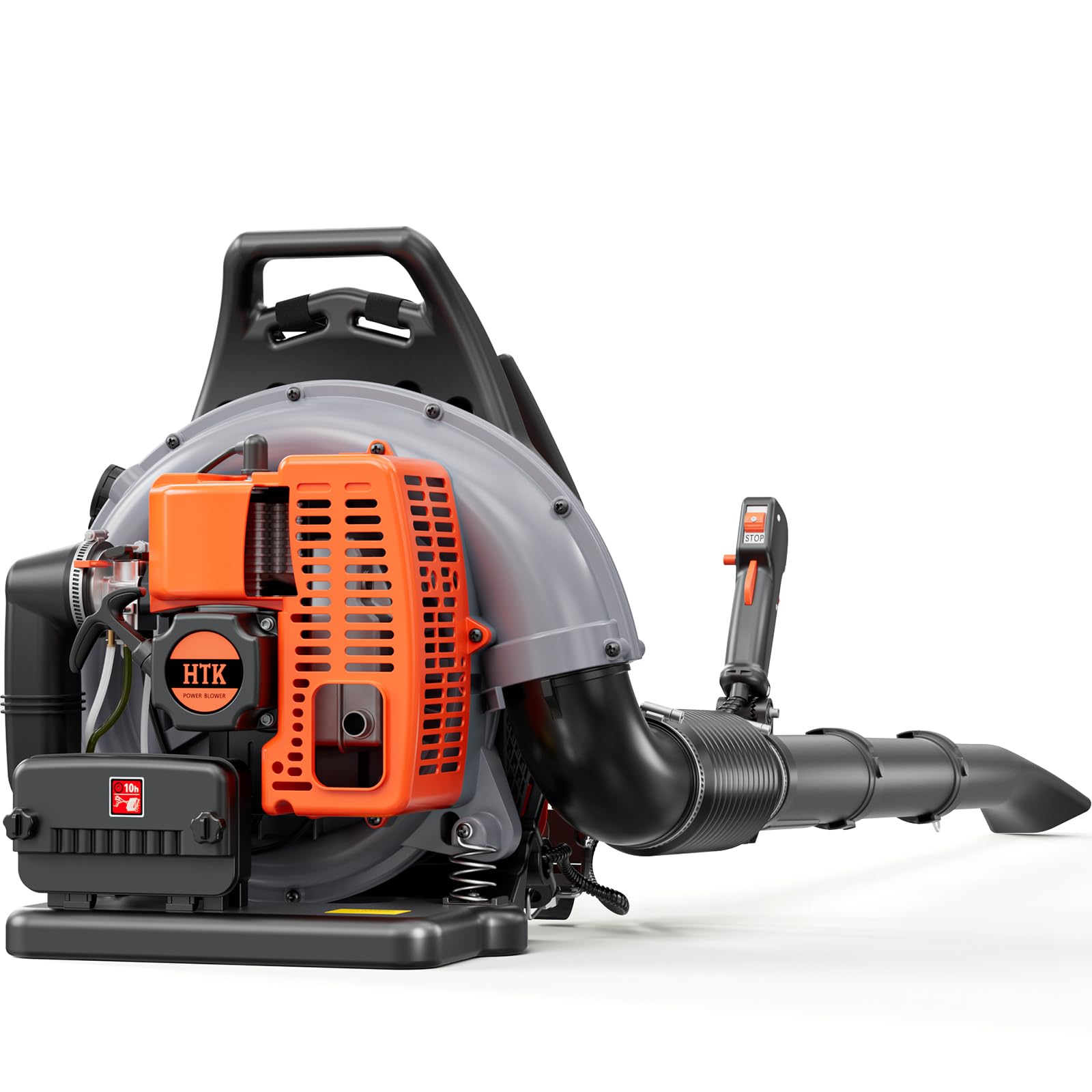
2. HTK Gas Backpack Leaf Blower, 63CC 2-Stroke, 665 CFM, Max 205 MPH, Orange
Entry-level gas power that still moves wet leaves without emptying your wallet
If you are buying your first gas backpack leaf vacuum, the HTK is the one to start with: its 63 cc 2-stroke engine (a two-stroke engine burns a gas-and-oil mix) moves 665 CFM (cubic feet per minute — the volume of air it pushes) at up to 205 MPH, enough to clear wet leaves and grass clippings from a large yard. The air-purge system (a primer that pushes fresh fuel into the engine before you pull) makes cold starts easier, and the oversized controls are easy to grab with gloves on. It gives up raw power to the Echo PB-9010T above, but costs far less and still handles the same kind of cleanup.
The comfortable part is the fully padded ergonomic harness, which spreads the load and keeps vibration low across longer sessions. Owners run it through hours of landscaping without back pain, and the variable-speed throttle plus cruise control let you hold a steady setting without squeezing a trigger the whole time. The 1.7 L tank is sized for demanding, large-property work, and the 2-year warranty backs the purchase. The stated 71 dB sound level keeps it from being the loudest machine on the block.
Where it gives ground is durability at the margins. The plastics feel shop-grade rather than premium, thin tubes and strap hardware draw some grumbling, and the manual’s assembly illustrations for the handle and cable guides are skimpy. It also hits a break-in oil ratio that trips up a few buyers who do not read carefully. Treat the plastics kindly and it holds up; manhandle it and you will notice.
Real-world read: owners mention this is a strong value for homeowners and lawn-care work. One owner weighed it at 18.25 lb with fuel in it and got about 2 hours of runtime from the 0.45 gal tank — honest numbers for a machine this size. skip it if you need the extra power of the Echo PB-9010T for the biggest jobs.
Honest caveat: the plastic components and strap assembly are the weak spots, so plan on a little care with the harness hardware.
Worth grabbing: if you want your first gas backpack blower and value easy starting over premium materials.
Look elsewhere: if you expect commercial-grade build quality from every panel and fitting.
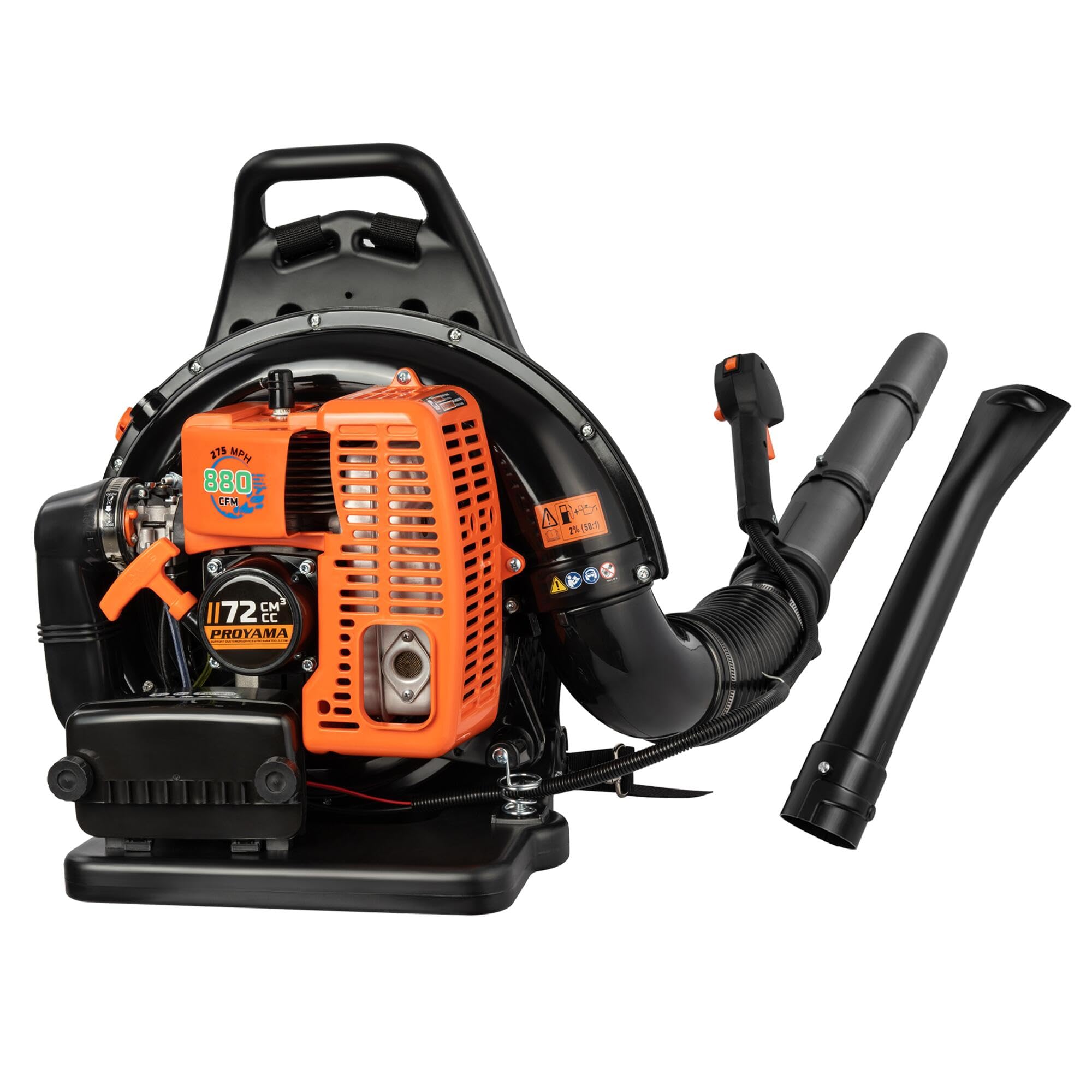
3. PROYAMA 72CC Gas Backpack Leaf Blower, Garden Yard Cleaning, Snow Removal
One machine for autumn leaves and winter snow, thanks to a dual-nozzle setup
Here is the pick for a buyer who wants a single tool to handle two seasons. The PROYAMA runs a 72 cc 2-cycle engine rated at 3.7 HP, pushing 880 CFM and 275 MPH. That airflow sits between the HTK 63CC above and the top-tier Echo, and it is enough for leaves, debris, and light snow. The dual-tube design (a flat nozzle plus a round one) is the standout: the flat tip gets into tight borders, the round one opens up for driveways and wide terrain.
Comfort here is deliberate. Shock-absorbing straps and balanced weight distribution keep the 21-lb unit settled, and the thickened backrest isolates the engine’s running heat from your back — a real difference on a hot afternoon. A self-throttle lock maintains consistent RPM to cut fatigue, and the high-efficiency air filter traps dust to protect the engine. Verified owners have cleared 2.5 acres of oak leaves and debris over a week of use without issue and praised the build quality for the money.
The honest caveat is durability on hard use. A small handful of long-term customers note premature failures, and one notes the fuel tank level is hard to see, so you risk overfilling. The long attachment arm also takes some practice to wrangle. For the overwhelming majority it runs smoothly and starts easily at full throttle, but if you want maximum long-haul reliability you are paying more elsewhere.
Best fit: a homeowner with a large yard who wants one blower for both leaves and light snow.
Plan around: the fuel-level visibility issue and give the long arm a few practice passes.
Pick this one: if dual-season usefulness and a heat-shielding backrest top your list.
Skip it: if you are buying for daily commercial abuse and want proven longevity first.
4. SENIX 49CC 4-Cycle Gas Powered Backpack Leaf Blower, 425 CFM & 195 MPH

The no-fuel-mixing option: a 4-cycle backpack that sips straight gas and runs calm
If mixing oil into gas every fill-up drives you up a wall, the SENIX 49CC is your answer. Its 49 cc 4-cycle engine runs on plain gasoline — no premix — produces lower emissions than a 2-cycle, and delivers 425 CFM and 195 MPH. That output sits below the bigger 2-strokes on this list, so it suits homeowners with 1/2- to 1-acre yards who want steady, clean clearing over brute force.
Owners like the low-key character: the 4-stroke sound is quieter and smoother, vibration is low, and it starts easily with a choke-to-auto transition. The variable-speed throttle plus cruise control keeps a steady setting, and the 18.2-lb frame is light enough for most users to shoulder without strain. The engine matches a handheld Stihl on power in owner reports while saving the arm fatigue a handheld causes. On the flip side, long-term reliability draws mixed owner feedback, so plan on regular oil changes and use ethanol-free fuel with a stabilizer to protect the engine.
The gas cap and warm-up time come up as annoyances, and a few owners found the airflow underwhelming compared to a 2-stroke. The wider chest strap would help comfort on long sessions. Buy this for the convenience of a 4-cycle, not for the strongest blow on the block — and the trade is worth it if no-mix fueling matters to you.
Who it suits: homeowners on modest acreage who want the ease of a 4-cycle engine and quieter running.
What to plan for: regular oil changes and ethanol-free fuel, since long-term reliability feedback is mixed.
Reach for this: if avoiding oil-mix fuel is a priority and your yard tops out around an acre.
Think twice: if you need maximum airflow and commercial-grade durability.
5. PRORUN 75.6cc 1020 CFM 240 MPH Gas-Powered 2-Cycle Backpack Leaf Blower, PBB2884

1020 CFM of commercial-style airflow, and a pull cord that mostly holds up
The PRORUN PBB2884 gives you the most airflow for your money here: its 75.6 cc 2-cycle engine (a two-stroke engine that runs on a gas-and-oil mix) pushes 1020 CFM and 240 MPH, matching the Echo above on air volume while costing less. An anti-vibration system (dampers that cut the shake reaching your hands) and instant-start assist (a spring-loaded starter that needs less pull effort) make it a real step up from the entry 2-strokes. It is built for people moving huge piles — reviewers point out it shifting three-foot-high, ten-foot-thick rows of leaves without slowing down.
The padded backpack harness distributes the 32.8-lb frame reasonably well for a heavy machine, though the initial lift may challenge smaller users. It fires on the second or third pull with the spring-assist recoil, and a full tank can turn in about two hours of use at full throttle. A 3-year residential warranty backs it, which matters at this power level.
The recurring gripe is durable hardware at the margins — a small fraction of shoppers say the pull cord or a carb going early, and tube connections could be snugger. Box packing has arrived battered for some, so check the contents on delivery. The harness is workable but not luxurious.
The strong points
- 1020 CFM and 240 MPH rival far pricier machines
- Spring-assist start fires within a couple of pulls
- Anti-vibration system eases fatigue on long jobs
- 3-year residential warranty
The trade-offs
- At 32.8 lbs the initial lift is heavy for smaller users
- A minority report the pull cord or carb failing early
- Tube fittings and harness could be sturdier
- Packaging can arrive rough — inspect on delivery
Go for it: if you want near-premium airflow without the premium price tag.
Reconsider: if you have a smaller build or want flawless out-of-box packaging.
6. Greenworks 80V Backpack Leaf Blower, 750 CFM, 4.0 Ah Battery and Charger
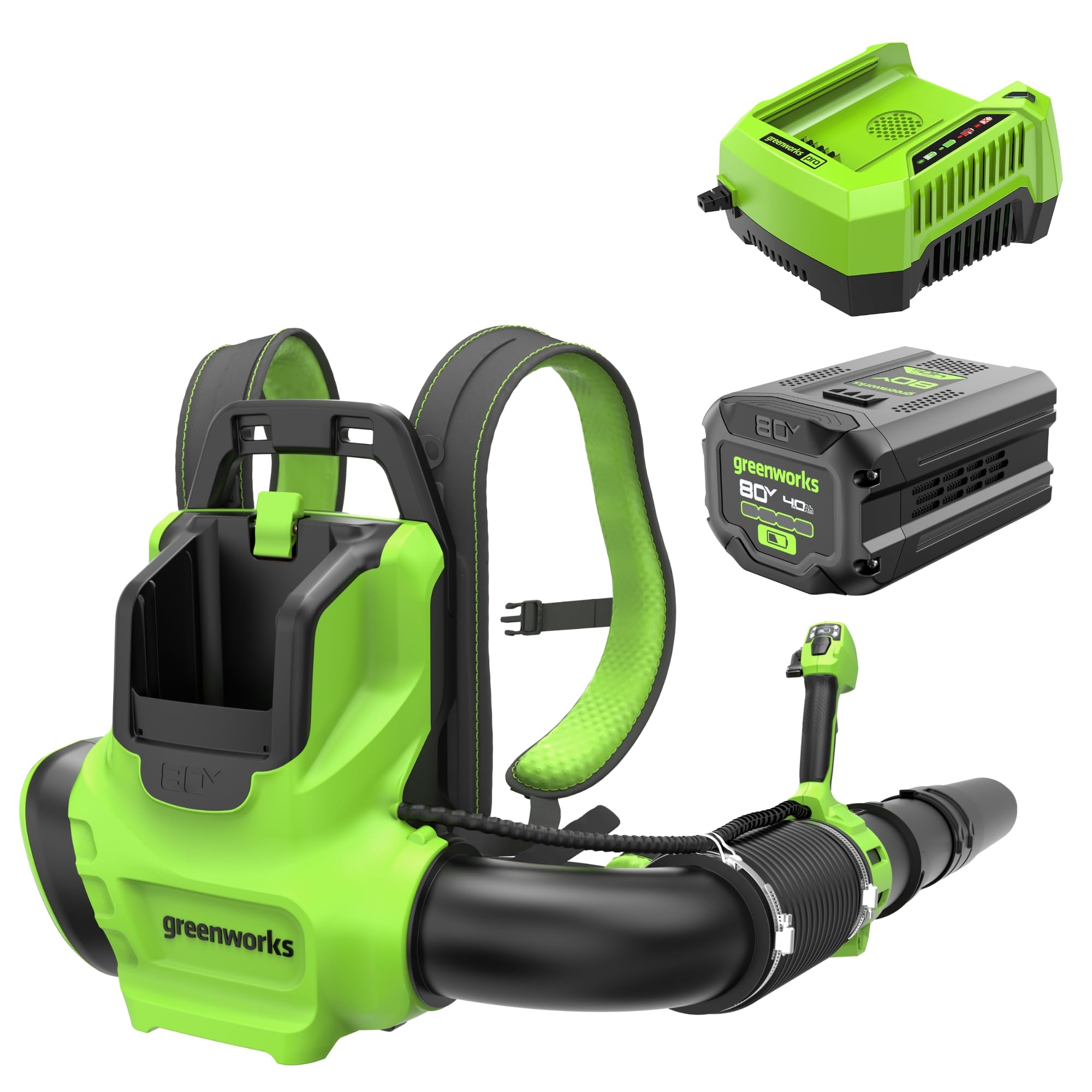
The gas-free shoulder-saver: 9.5 lbs, 80 volts, and no exhaust in your face
Weighing just 9.5 lbs, the Greenworks 80V is the lightest backpack blower here by a wide margin — even the SENIX above is nearly twice as heavy. That matters if you want to keep working without a gas engine thrumming against your spine or exhaust in your lungs. Its 80V brushless motor produces up to 750 CFM, and the eco-friendly design runs quieter and cleaner than any gas model on this list. For clearing pavement, driveways, and looser leaf cover on a smaller lot, it holds its own against a comparable gas blower on power in owner reports.
The convenience upside is real: variable-speed control lets you dial the airflow up or down, the turbo setting handles the stubborn spots, and a brushless motor means low maintenance and long motor life. There is no oil, no gas, no choke, and no pull cord — just squeeze and go. Owners appreciate the light weight and the ease of getting it on and off.
Now the honest part: runtime. The 4.0 Ah battery delivers only around 15 to 20 minutes at full power, so a large yard will have you swapping or recharging constantly. That is the single biggest realism check for this pick. It works best as a lighter-duty, no-fuss blower for smaller properties, not as a replacement for a commercial gas machine churning through acreage all afternoon.
Why it earns a spot: the brushless 80V motor, 750 CFM output, and 9.5-lb frame make it an easy carry for those who tire quickly under a heavy gas unit.
The reality check: battery life at full power runs short, so keep a spare charged if your yard is big.
Ideal for you: if you want light, quiet, exhaust-free clearing on a small to mid-size lot.
Not for you: if you need to run continuously for over half an hour on a single charge.
7. Echo PB-580T 58.2 CC Back Pack Blower with Tube Mounted Throttle

The dependable middle child — plenty of ready power without the flagship price
For buyers who want proven Echo reliability without stepping up to the flagship, the PB-580T is the sensible middle ground. Its 58.2 cc 2-stroke engine delivers 510 CFM and 215 MPH from a 22.6-lb backpack frame. That airflow trails the PB-9010T above by a wide margin, but it handles the leaves, sticks, and general yard debris that most homeowners actually deal with, and it starts by the second or third pull consistently.
What makes it a keeper is the power-to-effort ratio. Owners routinely say it does more in two hours than they used to do in two days with a rake or a corded blower, and the tube-mounted throttle keeps control in hand without reaching. It is comfortable to carry, and this one has a storied reputation for running for years with nothing but normal maintenance — one long-term owner leans on Echo machines daily for work and calls this one a beast. The 510 CFM is modest by today’s numbers, but reliability tends to beat bragging rights for the long haul.
Two honest notes: assembly instructions are confusing for some, and there is a recurring report of a leaky fuel tank on a small number of units. Neither is common, and most owners simply run it and forget it. Expect to spend a little time with the manual on setup, and check the tank on arrival.
The thing everyone raves about: reliability — this blower has the kind of track record where owners say it just keeps going year after year with routine upkeep.
Watch for: a small chance of a leaky fuel tank and a fiddly assembly, so inspect on delivery.
Land on this: if you want a dependable Echo for everyday yard work at a fair price.
Look up: if you need top-end airflow for acreage or commercial siding.
8. PRORUN PBB3000 Gas Backpack Leaf Blower, 79.9cc Commercial-Grade, 250 MPH, 1125 CFM
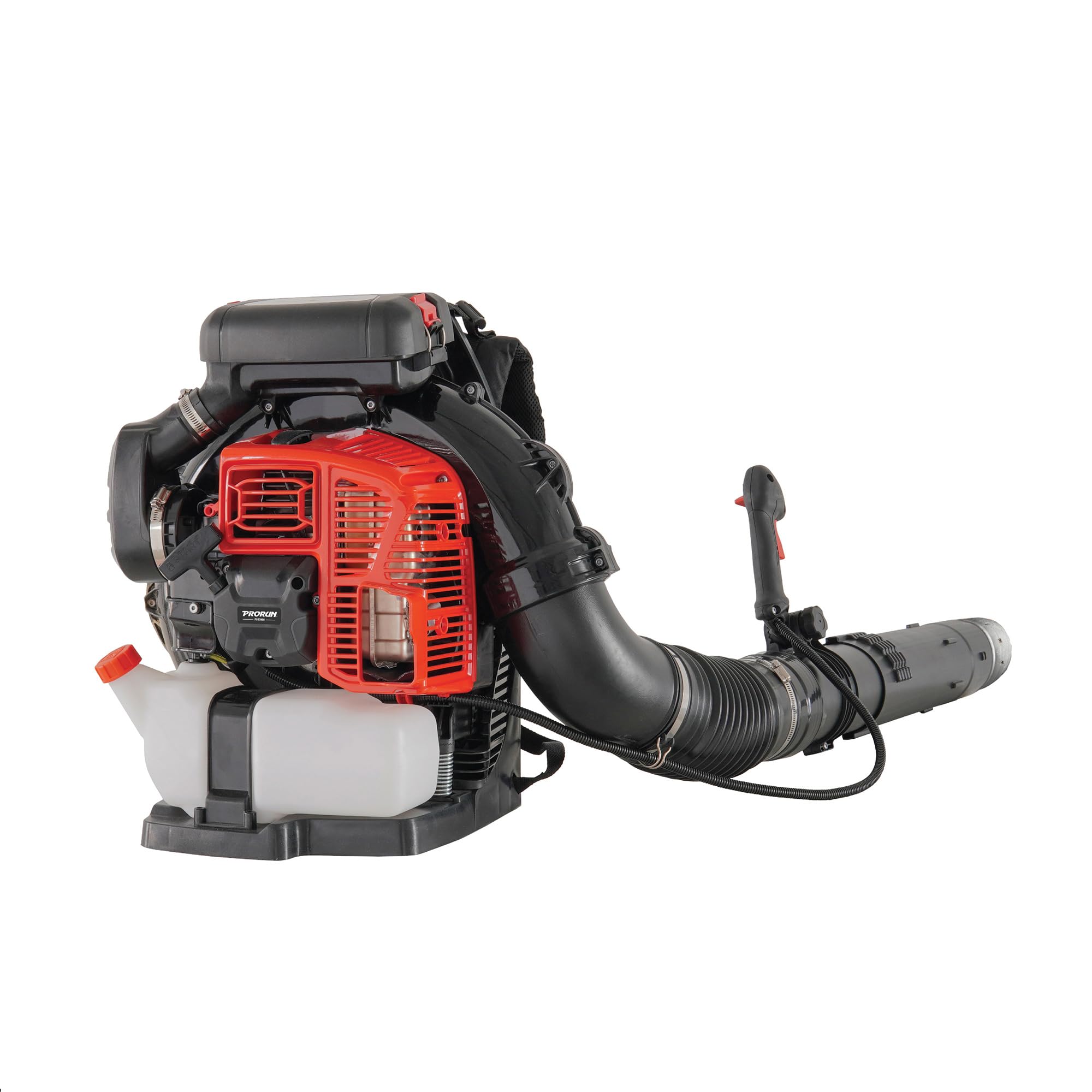
1125 CFM and 50 Newtons of blow force — the peak of this whole lineup
If you want the highest raw numbers on this page, the PRORUN PBB3000 delivers. Its commercial-grade 79.9 cc, 5.0 HP 2-cycle engine produces 1125 CFM, 250 MPH, and 50.0 Newtons of blow force — the most airflow of anything here. Owners describe it handling 3 acres of ash, maple, and oak leaves in under a day, moving branches, rocks, and walnuts, and repeatedly comparing it favorably to premium-name machines. The spring-assisted handle reduces pulling effort by 40%, and it offers up to 90 minutes of operation at full throttle.
The comfort engineering is deliberate. CoolFlow tech provides fan-powered back ventilation, the ScuffGuard nozzle uses heavy-duty metal rings to cut pipe wear, and a tool-less dual-stage filtration system handles dusty conditions. Anti-vibration dampeners and padded wide-grip straps ease fatigue on long jobs. It comes with a 3-year residential or 1-year commercial limited warranty. One owner put it against a Stihl 700/800 and preferred this, praising the rear air intake that keeps the back cool.
Two honest gripes surface: it takes a while to warm up, and the recoil starter can feel weak after a season. A small number of units arrive with carb or coil issues, though buyers report the company resolves problems quickly. At 33 lbs with a full tank it is heavy, so don’t plan on one-arm handling. The blow force is worth the weight if you have serious acreage.
Big-league strengths
- 1125 CFM and 250 MPH — the most airflow here
- Spring-assist handle cuts pull effort by 40%
- CoolFlow back ventilation keeps you cooler on hot days
- Up to 90 minutes at full throttle per fill
Know before you buy
- Takes longer to warm up than most
- Recoil starter can weaken after a season of use
- Heavy at 33 lbs with a full tank
- Small share of units need a fix from the start
The right call: if maximum blow force for big acreage is the whole reason you are shopping.
Not the right call: if you want a featherweight or a low-effort recoil that never strains.
9. Husqvarna 560BTS Gas Backpack Leaf Blower
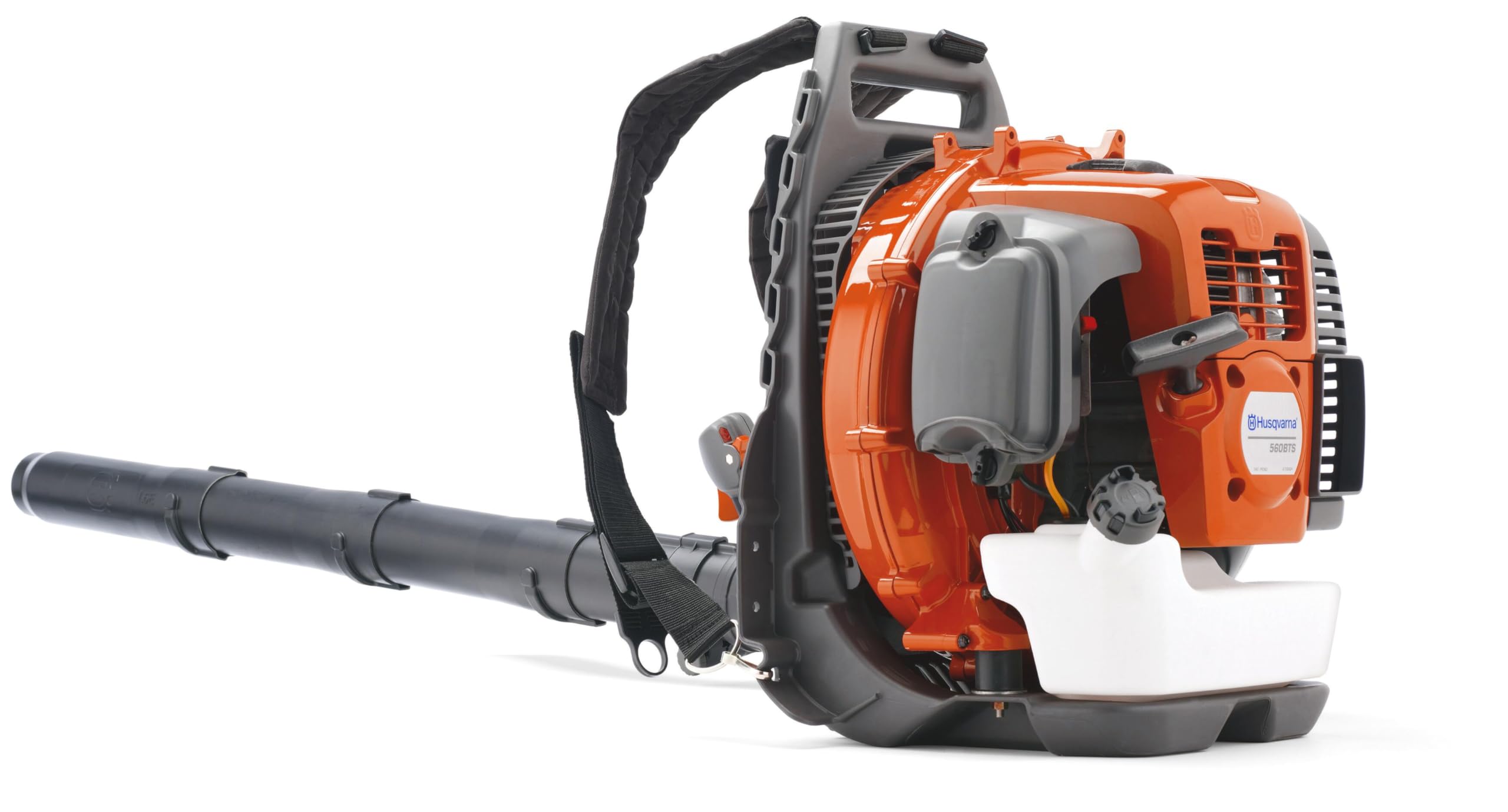
A pro-grade workhorse that some owners wear all day without a second thought
The 560BTS is the machine for a serious property. Its 65.6 cc X-TORQ engine delivers 30 N of blow force with 632 CFM and 232 MPH, and it comfortably handles leaves, sticks, small rocks, and even gutters. An adjustable offset handle with a comfort grip gives you fine control, and the 2-stage load-reducing harness distributes the 23.2-lb weight so evenly that one buyer says they could wear it all day. It also uses a 2-stage air filter for protection in dusty conditions.
Durability is what separates it. Owners mention cutting cleanup time by half to two-thirds compared with handheld blowers, and one ran it a full season with only an air filter change. A 10-year owner on 5.5 acres calls it one of the best purchases he has made, and says it starts on the first or second pull after a few primer pumps. The throttle mounted on the tube (a trigger on the blower tube itself) keeps control right at your hand. If you run a big property every week, this is built to take it.
Two things to hold against it: it is heavy, and it is loud enough that hearing protection is wise. It also burns fuel fast on long jobs — one owner measured about a quart every 40 minutes — and there is no chest or waist strap in the box, so you may want to buy one for long sessions. Those are the honest costs of running a machine this capable.
Where it earns its keep: commercial-grade build and a harness comfortable enough to wear for entire workdays.
The honest costs: heavy, loud, thirsty, and there is no chest strap included.
Your pick: if you want a professional-grade blower you can wear comfortably for full-day jobs.
Keep looking: if weight and fuel consumption are your biggest concerns.
10. EGO POWER+ Backpack Leaf Blower, Cordless Electric 600 CFM, Includes 56V 7.5Ah Battery and Charger – LB6003

Hour after hour on a single charge — the cordless pick for marathon quiet cleanup
Runtime is where the EGO LB6003 separates itself from every other cordless machine here. With the included 56V 7.5Ah ARC Lithium battery, it delivers up to 180 minutes on a single charge. That dwarfs the roughly 15 to 20 minutes a smaller 4.0 Ah battery turns in, so if long, uninterrupted sessions matter, this is the cordless pick to beat. The high-efficiency brushless motor produces up to 600 CFM with turbo mode and air speeds up to 145 MPH.
The quiet factor is a genuine draw. It runs at 64 dB, which the maker frames as up to 30 times quieter than gas leaf blowers — quiet enough to use without waking the neighborhood or shouting over an engine. Variable-speed control runs from 260 to 600 CFM right from the handgrip, the tube length adjusts for control, and the battery is compatible with the rest of the EGO 56V platform, so owned batteries stretch across tools. Owners in their 70s praise being able to work without their arms tiring. A 5-year tool warranty and 3-year battery warranty back it.
The honesty note: it sits at the top of the cordless price range, and some owners find the battery drains fast when running turbo on a bigger yard. Air speed tops out lower than the gas machines, so heavy wet leaf cleanup takes more passes. It is a superb quiet, fume-free choice for a mid-size lot — just size it to the yard you actually have.
Standout spec: up to 180 minutes of runtime from the included 7.5Ah battery — the longest cordless runtime here by far.
Honest limit: 145 MPH air speed trails the gas machines, so plan extra passes on wet, matted leaves.
Made for you: if you want a quiet, fume-free blower that runs for hours on a single charge.
Overkill or underpowered: if you only need ten quiet minutes, or if you face dense wet leaves on acreage.
11. Husqvarna 580BTS Gas Backpack Leaf Blower, 75.6-cc 4.59-HP 2-Cycle, 1000-CFM, 47-N

Commercial muscle with a padded hip belt made for multi-acre days
Built for people who clear land for a living, the 580BTS pairs a 75.6 cc X-TORQ engine (rated 4.59 HP) with 1000 CFM and 47 N of blow force at 220 MPH. That places it among the strongest machines here, just behind the PRORUN PBB3000 above on airflow but with Husqvarna’s commercial lineage behind it. It uses a 2-stage commercial-grade air filter to protect the engine in dusty conditions, and a ventilated harness with even weight distribution keeps the 34-lb frame manageable.
The comfort details are the selling point. A padded hip belt spreads the load evenly, which is the difference between wearing it for two hours and wearing it all day. The tube-mounted throttle keeps control close, and the 2-stage intake filtration extends service life. Owners who run it on acreage describe it cutting yard clearing from about 30 minutes to 10 on a manageable lot, and one says it dislodges years-old dusty gravel on contact. It starts reliably on the second or third pull, even after extended storage.
Two things to plan around: it is a fuel-thirsty commercial machine, and a rare report mentions a wrong-sized handle mount arriving in the box. It is also loud, so protect your hearing. This is not a casual suburban blower — it is heavy-duty gear for people with serious ground to cover, and it rewards that workload.
Why pros reach for it
- 1000 CFM and 47 N of blow force for heavy-duty clearing
- Ventilated harness with a padded hip belt for all-day wear
- 2-stage commercial air filter protects the engine
- Starts reliably even after long storage
What it asks of you
- Burns fuel quickly during extended use
- Heavy at 34 lbs with a full tank
- Loud enough to need hearing protection
- Occasional shipping report of a wrong part included
The one to beat: if you run a landscaping operation or own serious acreage that needs daily clearing.
Too much machine: if you have a small suburban yard or want something light enough for casual use.
Understanding the Specs
CFM (Cubic Feet Per Minute)
CFM tells you how much air the blower moves each minute, and it is the number to check first for pushing big piles. A higher CFM means more volume, which is what clears wet, heavy leaves and gravel. In this lineup, the airflow runs from 425 CFM on the SENIX up to 1125 CFM on the PRORUN PBB3000, so the spread is wide enough to match any yard size.
MPH (Miles Per Hour)
MPH measures how fast the air exits the nozzle, which helps knock debris loose from grass and pavement. A high MPH is useful for stuck-on leaves and gravel, but for raw leaf pile movement, CFM does more of the work. Most gas machines here run between 195 and 275 MPH, and the cordless EGO tops out at 145 MPH, which is why it takes more passes on wet mats.
2-Stroke vs 4-Stroke Engines
A 2-stroke engine mixes oil into the gas, runs loud, and delivers strong power for its size — most of the gas picks here are 2-stroke. A 4-stroke engine like the SENIX 49CC runs on straight gas with no mixing, runs quieter and smoother, and needs regular oil changes but typically makes less raw power. Choose 4-stroke for no-mix fueling and lower noise, or 2-stroke for maximum output.
Engine Displacement (CC)
Displacement in cubic centimeters (cc) tells you the size of the engine, and it is a rough guide to power. Bigger engines generally move more air but weigh and drink more fuel. This lineup spans 49 cc on the SENIX up to 79.9 cc on both the Echo PB-9010T and the PRORUN PBB3000. Match displacement to your workload: 49 cc for suburban lots, 79.9 cc for acreage.
FAQ
What is the difference between CFM and MPH on a backpack leaf blower?
Should I choose a 2-stroke or 4-stroke backpack leaf blower?
How long can I run a backpack leaf blower on a full tank?
How long does a cordless backpack leaf blower run per charge?
Do I need hearing protection when using a gas backpack leaf blower?
Can a backpack leaf blower move wet leaves and light snow?
How much does a backpack leaf blower weigh and does weight matter?
What fuel mixture do 2-stroke backpack leaf blowers require?
Is a backpack leaf blower better than a handheld for large yards?
Do backpack leaf blowers come with a warranty?
Final Thoughts: The Verdict
For most large-property owners, the backpack leaf vacuum winner is the Echo PB-9010T because its 1110 CFM and 220 MPH handle even wet snow and gravel in a single pass. If raw blow force is the priority, grab the PRORUN PBB3000 with its 1125 CFM and 50 Newtons. And for quiet, fume-free work that runs for hours on one charge, the EGO POWER+ LB6003 is the one to reach for — just size it to your yard before you commit.
How We Picked
We do not accept paid placement. Every pick is matched to a real buyer and a real use-case; we do not hands-on test units.
Sources & Methodology
Specifications: manufacturer listings and product documentation. Review insights: verified customer reviews, as of September 2026. Pricing: not shown on this page (it changes often); check the current price via the retailer link.
As an Amazon Associate, Gadgets Feed earns from qualifying purchases. This does not affect which products we feature.