
Our readers keep the lights on and my morning glass full of iced black tea. As an Amazon Associate, I earn from qualifying purchases.
Specs are compiled from manufacturer listings and verified buyer reviews and can change over time — please confirm the key details on the product page before buying.
A generator battery sits idle for months, then has to crank a cold engine on the first try. If your pull-start rope snaps, your unit has sat in the garage for months, or the last battery arrived with the terminals on the wrong side, this guide solves that. Below are nine 12-volt batteries that actually fit common champion-style and dual-fuel generators, sorted by how they perform in real cold-start and standby use.
I’m Min — the founder and writer behind Gadgets Feed. This guide is built by comparing the manufacturers’ published specifications and the patterns across verified customer reviews, so you get each pick’s real strengths and trade-offs instead of marketing spin.
A standby generator gets one chance to start when the grid drops, and a weak 12V battery is the most common reason it doesn’t. Replacement batteries for generators come in sealed lead-acid and lithium types, and each has a real advantage you should match to how you actually use your machine. For most buyers, the Interstate AGM below is the pick: 18Ah, 4.5 stars across 400+ ratings, and reliable starts when kept on a trickle charger.
Our Picks at a Glance


How To Choose The Best Battery For Generator
The wrong generator battery almost always fails on one of three fronts: it does not fit the tray, the terminals are reversed, or the amp-hour rating is too low for the starter motor. Getting all three right is the whole game.
Match the amp-hour (Ah) rating to your engine size
Amp-hours measure how much total energy the battery can store and deliver, like the size of a fuel tank for electricity. A small portable generator typically needs 6.5Ah to 15Ah, while a larger 8000W or 12000W unit often wants an 18Ah battery. Going much below your original spec risks a slow crank or a no-start on the first cold morning.
Verify terminal placement and case dimensions first
Getting the physical fit right is the single most common mistake. Measure your battery tray and note which side the positive post sits on before you buy. The MFQ-6.5 further down this list is a textbook example — several buyers discovered its positive post sits on the opposite side from their original, which makes reconnecting the cables awkward or impossible without rewiring.
Sealed lead-acid vs lithium LiFePO4
Sealed lead-acid AGM batteries are the standard replacement and are spill-proof because the electrolyte (the acid that carries the charge) is held in glass mats rather than free liquid. Lithium LiFePO4 (a lithium chemistry that is lighter and more powerful for its size) batteries weigh dramatically less and can crank harder for their size, but they behave differently — one DKL14 owner noted the battery shuts down permanently if left to drop below 12.9V (volts) from disuse, so they suit riders who use their equipment weekly, not seasonal standby generators.
Quick Comparison
| Model | Best For | Capacity | Chemistry | Weight | Amazon |
|---|---|---|---|---|---|
| Interstate SLA1116★ Best Overall | All-around generator standby power | 18 Ah | Sealed Lead Acid / AGM | 1.2 lb | Amazon |
| Casil 12V 18Ah Deep CycleDeep-Cycle Pick | Deep-cycle generators and inverters | 18 Ah | Lead Acid / AGM | 10.8 lb | Amazon |
| PowerStar PS12-15TTop Performer | Briggs & Stratton direct replacement | 15 Ah | Lead-Acid / AGM | 13.7 lb | Amazon |
| Energizer EN18-12 | Low self-discharge storage | 18 Ah | Lead Acid / AGM | 14.5 lb | Amazon |
| AJC Champion 9000 | Champion 9000 exact swap | 18 Ah | Sealed Lead Acid | 12.1 lb | Amazon |
| UPSBatteryCenter XP12000EH | DuroMax XP12000EH specific | 14 Ah | Sealed Lead Acid | 10 lb | Amazon |
| PowerStar PS12-18 | Briggs 8000/10000W Elite fit | 18 Ah | Lead Acid / AGM | 11.4 lb | Amazon |
| MFQ-6.5 12V 6.5AH | Small generators and powersports | 6.5 Ah | AGM | 4.36 lb | Amazon |
| DOUKAS DKL14 | Weight-saving powersports use | 4 Ah | LiFePO4 Lithium | 2.16 lb | Amazon |
In-Depth Reviews
1. Interstate Batteries SLA Battery 12V 18Ah AGM VRLA SLA1116
Our pick — 4.5★ from 400+ verified ratings; the strongest balance of quality and price.
An 18Ah AGM that holds its charge through months of standby and cranks a mid-size generator on the first try.
The Interstate SLA1116 packs 18 amp-hours (Ah, a measure of stored energy) at 12 volts — enough stored energy for a mid-to-large portable generator to spin its starter without asking you to pull a rope. The case measures 7.13 by 2.99 by 6.57 inches, so it drops into the standard tray used by many Champion and Generac models. What really separates it is that it weighs just 1.2 pounds, making it one of the lightest full-capacity 18Ah batteries here. That gap is dramatic against the Casil 12V 18Ah further down the list, which weighs 10.8 pounds — a 9.0x difference for the same rated capacity.
Interstate backs this with a 12-month performance warranty and their 7-Point Quality Protocol. The brand has been in the power business for over 70 years, and their tech is used widely in auto stores. Buyers report it handled a real hurricane test well — one wrote: “I needed to replace my generator battery with something reliable before hurricane season and this is perfect. I connected a Battery Tender to it and it performed perfectly after a hurricane.” That reviewer rhythm of topping it up on a float charger (a charger that keeps the battery topped off without overcharging) is exactly how you get the longest service life out of any AGM battery.
The catch is the negative reviews Amazon groups under battery life — a handful of buyers reported melted terminals or ground-wire insulation when a bad connection created heat. Clean your posts, tighten the nut-and-bolt terminals firmly, and keep it on a maintainer between outages; the vast majority of owners mention clean starts for the life of the warranty.
What stands out
- 18Ah at 12V — the capacity most mid-size generators need to crank reliably
- Weighs just 1.2 pounds, dramatically lighter than the Casil 18Ah at 10.8 pounds
- Spill-proof AGM construction means no water topping and no acid leaks
- Fits the standard 7.13 x 2.99 x 6.57-inch tray found on many Champion and Generac units
What to keep in mind
- Terminals need a firm torque to prevent the heat damage some buyers reported
- AGM chemistry prefers a float charger during long idle periods
Best for: anyone replacing a standard 18Ah generator battery who wants the proven brand, lightest build, and broadest fit.
Look elsewhere if: you need deep-cycle discharge capability for inverter or solar use — the Casil further down is built for that.
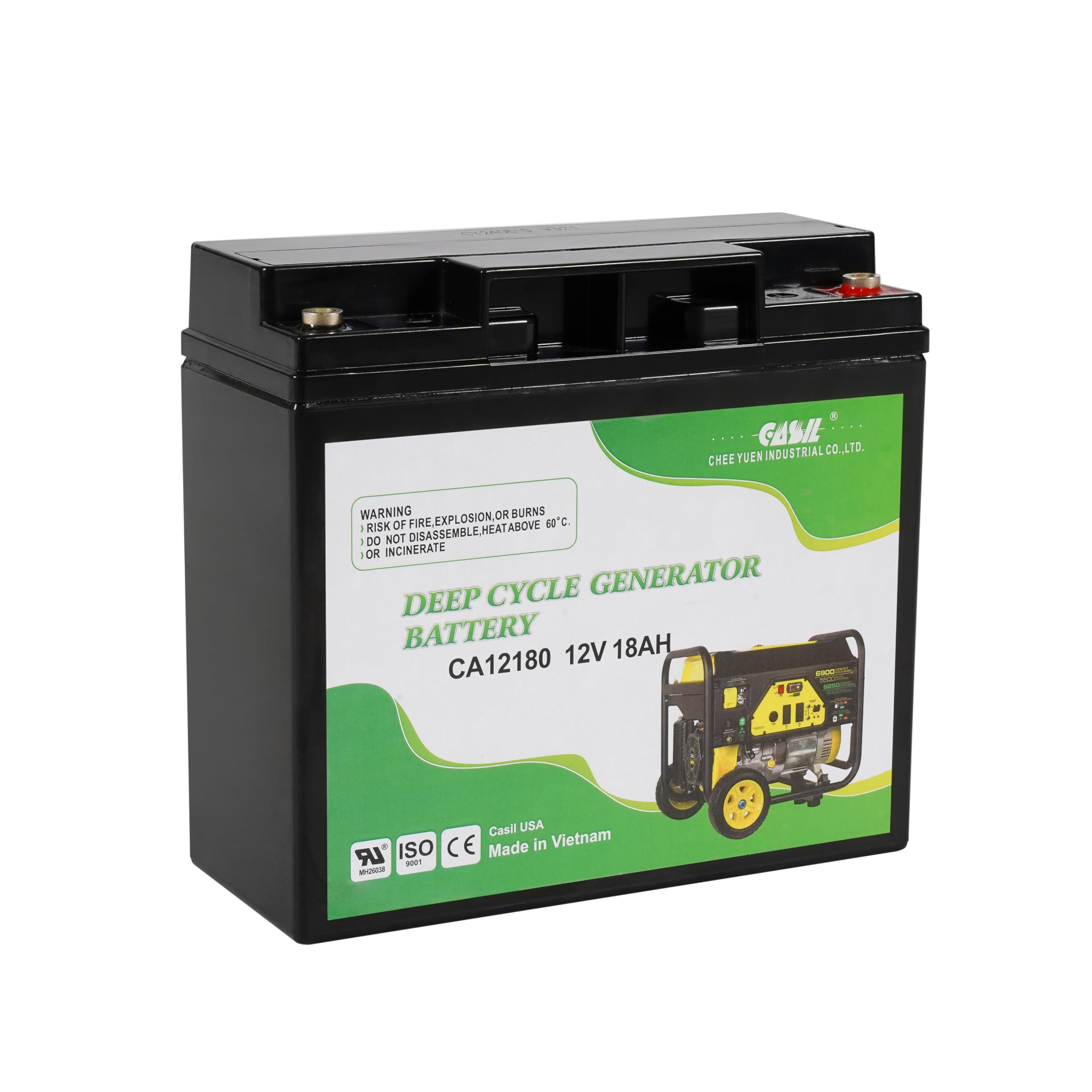
2. Casil 12V 18Ah Deep Cycle Generator Battery
A deep-cycle AGM built to survive repeated discharge and recharge without fading.
If your generator runs standby duty week after week, the Casil 18Ah deep-cycle design is worth the look. It is rated to handle frequent charge and discharge cycles without the performance loss that wears out a standard starting battery, which makes it the right pick for backup power and continuous use. The case runs 7.13 x 2.99 x 6.57 inches — the same footprint as the Interstate above — and it arrives with the terminal extension hardware tucked inside the case for a clean drop-in.
The cross-compatibility list is genuinely useful. Casil lists it as a direct replacement for Champion, Generac, Duromax, and Briggs & Stratton models, and for part numbers like UB12180, FM12180, CP12180, and 6FM18. Buyers had good things to say: “Excellent battery so far. It’s been about 6 months and I keep it on a trickle charger for my generator. It fits perfect and has plenty of juice.” The maintenance-free AGM build is spill-proof and vibration-resistant, and Casil covers it with a one-year prorated warranty.
The trade-off is straightforward — this one weighs 10.8 pounds, so it is heavier to lift and install than the featherweight Interstate. That heft is typical of deep-cycle builds, since thicker plates are what let it bounce back from deep discharge. One buyer also found the size did not fit their particular generator, so measure your tray and check your terminals before ordering.
The deep-cycle difference: rated for frequent charge and discharge without performance loss is exactly what a standby generator needs — it is the design distinction between this and a standard starting battery.
One honest caveat: at 10.8 pounds it is a genuine heft to install, and the fit is generous but not universal — measure first.
Reach for this if: you run a backup power setup that cycles often and want the deep-cycle resilience to match.
Better to skip it if: you own a specific generator model not on Casil’s compatibility list and want zero fit risk.
3. PowerStar PS12-15T 12V 15Ah Briggs and Stratton Generator Battery
The plug-and-play replacement that starts a seven-kilowatt Champion like it came from the factory.
This is the pick for the owner who just wants the battery to fit and crank without a fitment gamble. The PowerStar PS12-15T is a 15Ah, 12-volt sealed AGM with T3 nut-and-bolt terminals, and it comes ready to install with hardware included. The dimensions run 7.14 x 3.03 x 6.59 inches, and at 13.7 pounds it is a substantial, solid unit.
What buyers consistently praise is performance — the thing everyone raves about is how reliably it cranks the engine. One owner wrote: “I bought this to replace a generator battery that we accidentally killed by overcharging it. It fit perfectly and connected easily. We charge it monthly and it always starts the generator on the test run.” The monthly maintenance charge is the pattern to copy, since it keeps the battery topped up between outages. Another noted: “Plug and play replacement for my Champion 7kw generator. Same specs, dimensions and polarity.”
The honest caveat is that 15Ah is a step below the 18Ah models on this list, so if your generator’s starter draws a heavy cold crank, the larger capacity here may serve better. It also ships sometimes needing a freshen-up charge from the start, which was the case for at least one buyer. That is a small thing — a trickle charge the night before you install handles it. PowerStar backs this with a two-year warranty, among the longest here.
Why owners keep this one
- Plug-and-play fit with identical specs and polarity to the original on many Champion units
- Two-year warranty — one of the longest coverage windows in this lineup
- Maintenance-free AGM sealed design resists vibration in a generator frame
Where it falls short
- 15Ah capacity sits below the 18Ah models, so very large starters may prefer more reserve
- Occasionally arrives needing a top-up charge before first use
The confident verdict: if you own a Briggs & Stratton or Champion generator and want a no-guess fit with a two-year warranty, this is the quiet winner.
One thing to check: confirm your generator does not need the extra 3Ah of an 18Ah battery before you commit.
4. Energizer EN18-12 12V 18Ah Sealed Lead Acid AGM Battery

An 18Ah AGM with a low monthly self-discharge rate, so it still has cranking power after months in storage.
Standby generator batteries spend most of their life doing nothing, and that idle time is where cheap batteries lose their charge. The Energizer EN18-12 addresses that head-on with a low monthly discharge rate — meaning it holds its stored energy far longer between top-ups, so it is ready even after extended storage. It is an 18Ah, 12-volt sealed AGM rated to resist shocks and vibrations, and it installs in any position except upside down.
The construction details are honest and specific. Energizer uses 99.994% LME certified quality lead with cast calcium-tin alloy grids, and the battery meets UL safety standards and is CE certified. Their two-year limited warranty is one of the longest on this list. Customers note it as a reliable replacement for starting generators — one wrote: “Perfect replacement battery. Finally found one that fits my Duramax generator. A lot of replacements didn’t.” It recharges easily on a standard 12V charger, so you can top it up with the same equipment you use on a car battery.
The mixed feedback centers on fit, not function. A couple of owners found it slightly too large for their particular tray cavity — not a defect, but a reminder to measure your compartment and terminals before ordering. Get the fit right and the performance side holds up well.
The standout feature: a low self-discharge rate is genuinely valuable for a battery that sits idle between outages — it is the difference between a ready generator and a dead one in an emergency.
Confirm before you buy: double-check the dimensions against your generator’s battery compartment, since the case runs slightly on the larger side.
Pick this if: your generator sits for weeks at a time between uses and you want the lowest idle drain available.
pass on it if: your battery compartment is tight — the case runs slightly larger than some OEM units.
5. AJC Battery Compatible with Champion 9000 12V 18Ah Sealed Lead Acid Battery

A 12V 18Ah sealed lead-acid battery sized to the Champion 9000’s original tray and terminals for a no-rewire swap.
When you want the battery that reads “same as original,” this is it. The AJC is a 12-volt, 18Ah sealed lead-acid replacement built specifically to match the Champion 9000 generator setup. It weighs 12.1 pounds and uses six internal cells with NB-style terminals (a common nut-and-bolt connector). Reviewers point out it simply works — one wrote: “It’s a replacement for my Generator and it works perfectly. I bought a second one for an inverter and have yet to stress test but it also fit and came mostly charged.” The fact that it arrived mostly charged means you can often install it and get a start without waiting on a full top-up.
The straight-swap design is the whole appeal here. If your existing battery is a Champion OEM unit and you want to keep the exact fit, this is a low-friction replacement — no rewiring, no bracketry to fight. The 12.1-pound build is solid for a maintenance-free sealed unit, and the 18Ah capacity matches the standard for this generator class.
Two real caveats stand out. One buyer received a unit with visible arrival damage and reported it anyway since the generator was needed — worth inspecting the box before install. Another buyer could not find the height, width, and length upfront on the listing, so if you want to verify dimensions before ordering, confirm against your tray. Both are logistics issues, not design flaws, and the strong buyer satisfaction with the fit and function supports that read.
Why it earns the exact-swap label: the 12V 18Ah sealed lead-acid build matches the Champion 9000 original, arrives mostly charged, and installs without modification.
Two things to note: inspect the unit for shipping damage on arrival, and confirm the dimensions against your tray since the listing does not surface them clearly.
Best for: Champion 9000 owners who want a faithful match and a no-thought replacement.
Not the pick if: you need dimension details listed upfront or you’re replacing a battery in a different generator brand.
6. UPSBatteryCenter Replacement 12V for DuroMax XP12000EH Generator Battery

A 12V 14Ah sealed lead-acid battery built to the DuroMax XP12000EH’s 5.91 x 3.35 x 5.71-inch tray and shipped charged.
If you own the DuroMax 12,000-watt dual-fuel unit, the fitment question mostly answers itself with this battery. It is a 12V 14Ah sealed lead-acid unit built to the DuroMax XP12000EH’s original dimensions — 5.91 x 3.35 x 5.71 inches — and it uses F3 nut-and-bolt terminals. It arrives fully assembled, charged, and ready to install, which saves the top-up step on most other picks on this list.
The performance praise is consistent. One owner wrote: “Awesome Quick delivery and got my generator back on track 100%.” Another: “The battery fit perfectly and was charged.” The 14Ah capacity and 10-pound build are sized for the generator’s starter draw, and the sealed lead-acid chemistry is maintenance-free. For owners who want to install in minutes and turn the key, the pre-charged delivery is a real convenience point worth noting.
The genuine caveat is form factor detail. The battery is slightly taller than some original units, and at least one reviewer noted being unable to fully lock it into the tray because of the height. Another observed the terminals are side-mount screw/nut type rather than the OEM top-mount single-screw — a tight space makes connecting slightly fiddlier, and vibration could theoretically loosen a screw over time. Neither is a dealbreaker on a correctly snugged install, but pay attention to terminal style and tray clearance on your specific unit.
Where it shines
- Arrives fully charged — install and go without a pre-charge step
- Built to the XP12000EH’s exact footprint for a drop-in installation
- Maintenance-free sealed lead-acid design resists generator vibration
Good to plan around
- Slightly taller than some OEM units — may not fully lock into every tray
- Side-mount screw/nut terminals rather than the OEM top-mount style, tighter to connect in a crowded bay
Clear match for: DuroMax XP12000EH owners who want a pre-charged, drop-in replacement for this specific model.
Think twice if: your battery bay has tight vertical clearance — the slightly taller case could interfere with the tray lock.
7. PowerStar PS12-18 12V 18Ah Sealed Lead Acid Battery

A Briggs & Stratton fit so exact that buyers call it non-OEM but perfect.
The PowerStar PS12-18 is the pick for the Briggs & Stratton owner who wants factory fit without the factory markup. It is a 12V 18Ah sealed lead-acid AGM unit measuring 7.17 x 3.03 x 6.57 inches, with nut-and-bolt terminals. It is rated for a high discharge rate, a wide operating temperature range, and deep discharge recovery — the specs that matter when the battery has to bounce back after sitting partially drained.
What wins people over here is the fit and the reliability together. One owner wrote: “Arrived in fine shape, installed then trickle charge for 24 hours. (Installed in 8000-10000 Briggs Stratton generator.) Fired it up w/no problems.” Another called it a “Perfect fit” for a Briggs & Stratton 8000/10000W Elite generator, noting it installs in roughly 15 minutes with the included nuts, bolts, and washers. The thing everyone raves about is that it is not OEM (original equipment manufacturer, meaning it is not the brand that built your generator) but fits and works like it should, backed by a two-year full warranty — one of the strongest coverage terms in this lineup.
The honest note is that long-term life is, as with all standby batteries, a function of how you treat it. One owner said plainly, “Only time will tell as to longevity,” and recommended keeping it on a trickle charge — the same advice that applies to every AGM battery here. Do that and the reliability these shoppers say tends to hold.
The fit is the feature: an exact match for Briggs & Stratton 8000 and 10000W Elite generators, installed in about 15 minutes with included hardware, at a fraction of the OEM cost.
Treat it right: keep it on a trickle charge between outages to protect the long-term reliability buyers report.
Hands-down the one for: Briggs & Stratton 8000/10000W Elite owners who want OEM-grade fit with a two-year warranty.
Not aimed at: anyone with a different generator brand whose tray dimensions differ from the 7.17-inch case.
8. MFQ-6.5 12V 6.5AH AGM Battery for Powersports and Generator

A 12V 6.5Ah AGM for small generators, ATVs, and mowers — check that the positive post matches your cable side first.
This is the small-capacity option for a different job. The MFQ-6.5 is a 12V 6.5Ah sealed AGM battery sized at 5.5 x 2.6 x 4 inches and weighing 4.36 pounds, which suits small generators, ATVs, mowers, and scooters. The sealed maintenance-free design means no water checks and no corrosion worries, and the AGM construction holds up to vibration in an engine bay.
Here is the one thing to get right before you buy: terminal polarity. The most-discussed issue with this battery is that the positive and negative posts sit opposite to what many buyers expect. One owner put it plainly: “Notice location of + & – poles. Replacement battery for generator But it doesn’t work because the poles are reversed.” Several others found their unit simply would not fit their Predator generator without rewiring. This is not a defect in the battery — it is a fitment mismatch you can avoid in thirty seconds by checking which side your cables need the positive post on.
Get the polarity right and the feedback on function is fine — some call it a great product for the price, others a good deal that was “perfect for my generator.” The quality rating is mixed overall, which reflects that split between buyers who got a clean fit and those who did not. At 6.5Ah this is built for smaller engine starters, so confirm your generator’s draw before choosing it over one of the 18Ah models above.
Do this first: confirm the post orientation matches your cables. Polarity is the make-or-break issue with this battery, and it is stated upfront by the sellers who know their product.
Size check: at 6.5Ah this suits smaller generators and powersports — larger units want the 18Ah capacity found higher up this list.
Reach for this if: you have a small generator or powersports engine and you verify the positive post sits where your cables need it.
Look elsewhere if: you have a large generator that needs 18Ah of crank capacity, or you cannot confirm the polarity before ordering.
9. DOUKAS DKL14 12V LiFePO4 Powersports and Generator Battery

A featherweight lithium that cranks hard — if you use your machine regularly.
This is a different animal from every lead-acid battery on the list. The DOUKAS DKL14 is a lithium LiFePO4 battery rated for over 550 amps of starting power and weighing just 2.16 pounds — roughly a third the weight of a comparable lead-acid unit. It packs a built-in Battery Management System (an internal circuit that watches voltage and protects the cells) with an easy-to-read status indicator, and the maker rates it for faster charging and a longer service life than lead-acid. It fits a long list of powersports machines and generators and replaces sizes including YTX14-BS and YTZ14S.
The lightweight advantage is real and buyers feel it. It is a strong fit for motorcycles and smaller engines where dropping several pounds actually matters — one owner moved from a 12Ah, 10-pound AGM to this 4Ah, 2.1-pound unit and reported the starter still cranks strongly on an older Suzuki Intruder. The weight savings for a given cranking rating is the whole reason to choose lithium here, and it delivers.
The important caveat is how it behaves in disuse. Lithium batteries shut down permanently if they are allowed to drop below a low-voltage threshold, and dry storage drains them. One owner reported the battery arriving dead and warning that it cannot be restarted once it drops low, calling it unsuitable for occasional use. Another reported failure within a season with a trickle charge that would not revive it. If your generator runs monthly or you ride regularly, this is not a concern. If your machine sits idle for months, choose a lead-acid battery instead and save yourself the disappointment.
Why lithium earns its place
- 2.16 pounds — roughly a third the weight of a comparable lead-acid battery
- Rated for over 550 amps of cranking power in a tiny package
- Built-in BMS with a status indicator protects and reports on the cells
Where it asks more of you
- Shuts down permanently if left to drain below its voltage floor in storage
- Best suited to machines used weekly, not seasonal standby equipment
balance: riders who use their machine every week and want to drop pounds without sacrificing cranking power.
Wrong tool for: anyone storing equipment for months at a time — a lithium battery that drains in storage is far less forgiving than the lead-acid picks above.
Understanding the Specs
Amp-Hour (Ah) Capacity
Amp-hours describe how much total energy the battery can store and release — think of it as the size of the fuel tank for electricity. A generator’s starter motor needs a big enough gulp of current to turn the engine over, and a larger Ah rating gives it more reserve to do that. Small portable units run fine on 6.5Ah to 15Ah batteries, while larger 8000W-plus generators typically want an 18Ah battery to crank with authority. Under-sizing the capacity is the most common reason a new battery feels weak.
Sealed Lead-Acid vs LiFePO4
Sealed lead-acid AGM batteries hold their electrolyte in absorbent glass mats, so they are spill-proof and maintenance-free. Lithium LiFePO4 batteries weigh dramatically less and can deliver high cranking amps for their size, but they have different habits — they self-drain in storage and can shut down permanently if they drop below a low-voltage floor. Lead-acid tolerates neglect and recharges readily; lithium rewards regular use. Match the chemistry to how often you actually use your machine.
Terminal Style and Fit
Terminals are how the battery connects to your generator’s cables, and getting the wrong style or polarity (which side is positive and which is negative) is the number-one return reason. Nut-and-bolt terminals are common and secure; some units use top-mount versus side-mount posts that change how easily the cables reach. Always note which side the positive post sits on and measure your battery tray — a battery that is a half-inch too tall may not lock in, and reversed posts can require rewiring or may not fit at all.
Warranty and Maintenance
Sealed batteries are maintenance-free, but they still last longest when kept topped up. A trickle or float charger connected between outages keeps an AGM battery from sulfating and a lithium battery from draining too far. Warranty terms range widely across this lineup — some batteries carry a one-year prorated warranty, others a two-year full warranty. Longer coverage is worth weighing for a battery that may sit unused for months before you actually need it.
FAQ
How do I know which amp-hour battery my generator needs?
Why did my replacement battery not fit even though it was the right voltage?
Are sealed lead-acid and AGM batteries the same thing?
How long does a generator battery last before it needs replacing?
Can I use a lithium battery in place of my generator’s lead-acid battery?
Why are the positive and negative posts reversed on some replacement batteries?
Do I need to charge a new generator battery before installing it?
How do I keep a generator battery topped off between outages?
Will a lighter battery have less cranking power?
Is a taller replacement battery a problem for my generator?
Final Thoughts: The Verdict
For most buyers, the battery for generator winner is the Interstate SLA1116 because it pairs the 18Ah capacity most mid-size generators need with a spill-proof AGM build and a 1.2-pound frame, and it has the track record and the brand backing to trust it season after season. If a deep-cycle battery matters more for your backup setup, grab the Casil 12V 18Ah Deep Cycle. And for a Briggs & Stratton or Champion generator that needs an exact fit with a two-year warranty, the PowerStar PS12-15T is the one to reach for. Just remember that the highest-scoring pick on the whole list is the PowerStar PS12-18 at 4.9 stars — but with only 35 ratings, it covers far fewer models than the Interstate, so match it to a Briggs 8000/10000W Elite before you buy.
How We Picked
We do not accept paid placement. Every pick is matched to a real buyer and a real use-case; we do not hands-on test units.
Sources & Methodology
Specifications: manufacturer listings and product documentation. Review insights: verified customer reviews, as of September 2026. Pricing: not shown on this page (it changes often); check the current price via the retailer link.
As an Amazon Associate, Gadgets Feed earns from qualifying purchases. This does not affect which products we feature.