
Our readers keep the lights on and my morning glass full of iced black tea. As an Amazon Associate, I earn from qualifying purchases.
Specs are compiled from manufacturer listings and verified buyer reviews and can change over time — please confirm the key details on the product page before buying.
Swapping your cart from a rack of heavy lead-acid batteries to one 48V lithium pack is the single biggest upgrade you can make — you drop hundreds of pounds, kill the watering routine, and often gain speed and range on the same cart. The trick is matching the BMS (the built-in brain that manages current and protects the cells) to your controller’s draw, and the amp-hours to your real driving distance. This guide walks you through nine 48V lithium packs that fit real carts, from budget-friendly conversions to premium UL-listed builds.
I’m Min — the founder and writer behind Gadgets Feed. This guide is built by comparing the manufacturers’ published specifications and the patterns across verified customer reviews, so you get each pick’s real strengths and trade-offs instead of marketing spin.
Every pick below has the same core job — replace your lead-acid bank with one lighter pack that fits a standard 48V controller. The crowd favorite here is the Cloudenergy 105Ah kit, sitting at 4.8 stars across 300+ ratings, and it earns the top spot on capacity and BMS headroom. If you want the smartest way to compare these packs, the real sorting question is always the same: how many amp-hours you get, how many amps the BMS can push, and how many deep cycles the cells are rated for. Nail those three, and picking the best 48v lithium battery for golf cart becomes easy.
Our Picks at a Glance
How To Choose The Best 48V Lithium Battery For Golf Cart
The wrong pack won’t damage your cart — it just strands you on the back nine or shuts down mid-hill. A pack that’s too small in amp-hours strands you on the back nine, and a BMS that’s too weak shuts down mid-hill. Here’s what actually matters when you’re comparing.
Match the BMS to your controller, not the other way around
Your controller draws short bursts of high current when you hit the throttle or climb. The BMS (the battery’s internal manager) has to allow that burst without tripping. A 200A continuous rating with a 1000A peak handles most stock carts, while a 250A continuous unit gives extra headroom for modified controllers and bigger motors.
Amp-hours decide range, not speed
Amp-hours (Ah) is how much energy the pack stores, roughly how far you go between charges. A 100Ah pack typically covers a full 18 holes with margin; a 105Ah pack adds a little more buffer for hills and accessories. Extra amp-hours buy range, not speed, and add cost and weight.
Check your tray before you commit
Lithium packs are boxy and often taller than the lead-acid cells they replace. Measure your battery compartment’s length, width, and height, and check for a level mounting surface. Many installs need a small tray trim or a shim to sit flat.
Confirm your cart doesn’t already run lithium communication
Some newer carts ship with factory lithium packs that talk to the cart over a CAN bus (a digital handshake). A standard aftermarket pack like these won’t speak that language, so check your cart’s original setup before buying.
Quick Comparison
| Model | Best For | Capacity | BMS Rating | Weight | Amazon |
|---|---|---|---|---|---|
| Cloudenergy 48V 105Ah Kit★ Best Overall | Overall power and range | 105Ah | 250A | 82.7 lb | Amazon |
| CHINS 48V 100AHBudget Champion | Budget conversion | 100Ah | 200A | 87 lb | Amazon |
| OGRPHY Conversion KitMost Complete Kit | Complete kit buyers | 100Ah | 200A | 88.1 lb | Amazon |
| LOSSIGY 48V Kit | Reliable daily driving | 102Ah | 200A | 83.8 lb | Amazon |
| OGRPHY 105Ah | Compact installs | 105Ah | 200A | 99.2 lb | Amazon |
| TEMGO 48V 100Ah | Lightweight builds | 100Ah | 200A | 61.7 lb | Amazon |
| DC HOUSE Metal Case | Rugged metal housing | 100Ah | 200A | 99 lb | Amazon |
| Cloudenergy 250A 105Ah | High-current controllers | 105Ah | 250A | 92.5 lb | Amazon |
| VATRER POWER 105Ah | UL-listed safety focus | 105Ah | 200A | 102.5 lb | Amazon |
In-Depth Reviews
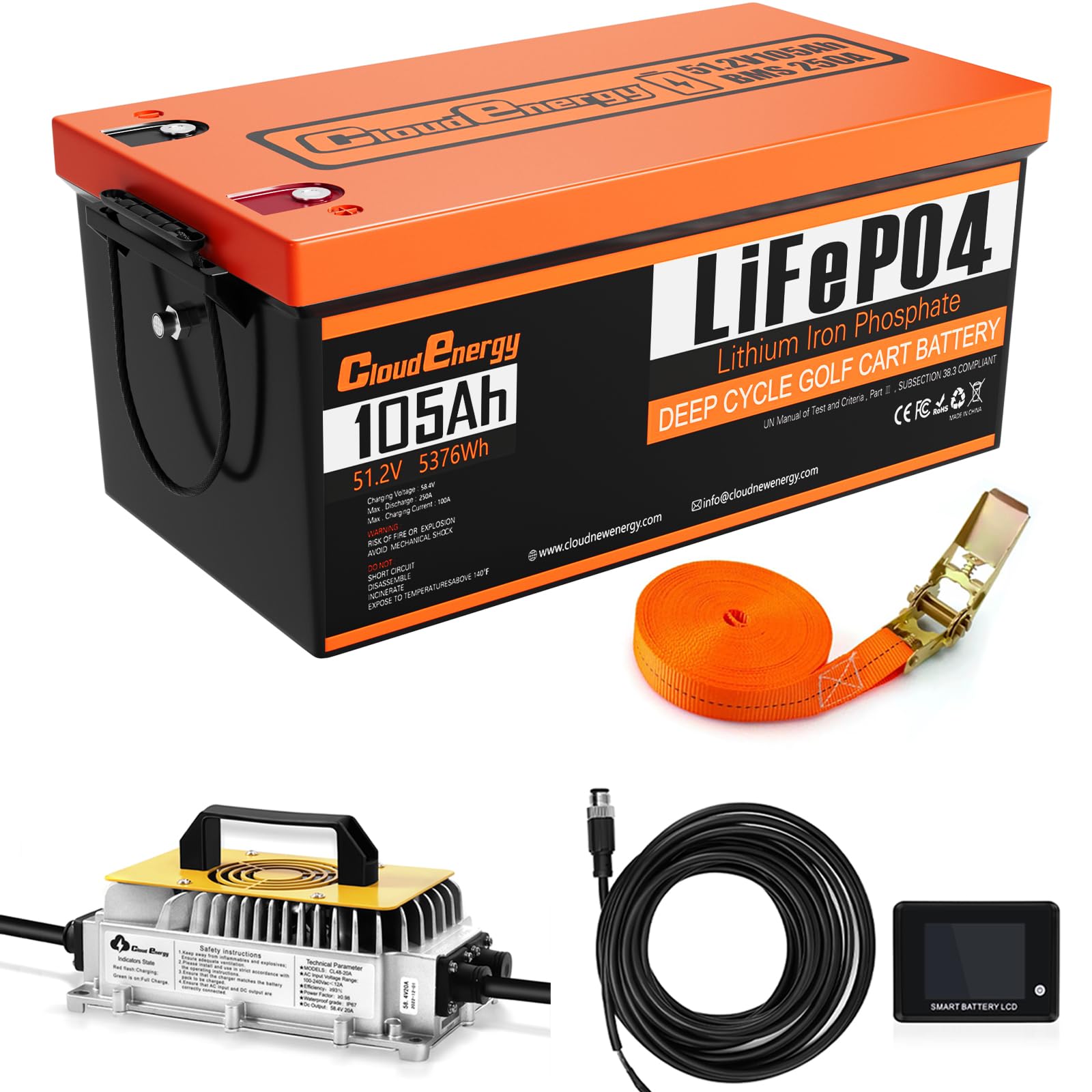
1. Cloudenergy 48V 105Ah LiFePO4 Lithium Golf Cart Battery With Charger Kit
Our pick — over 4.5★ from 350+ verified ratings; the strongest balance of quality and price.
The biggest amp-hours here, with a BMS built to swallow hill-climb spikes without quitting.
Start with the number that separates this pack from the rest: 105 amp-hours. That’s a touch more capacity than the 100Ah packs most of its rivals use, and it’s why buyers here talk about range first. Owners of Yamaha G29 and Club Car DS carts report 40 to 45 miles of real driving, and the customers-say summary credits up to 30 miles on a single charge in everyday mixed use. For scale, it holds 105 amp-hours against the 100 amp-hours in the CHINS 48V 100AH.
Under the lid sits a 250A continuous BMS (the internal brain that manages current and protects the cells), and that’s the highest continuous rating in this lineup outside its own sibling. It peaks at 400A for 35 seconds and 600A for 3 seconds. One Yamaha G29 owner wrote a full report: “Yamaha G29 48V conversion: 2hr install, frees space, +3mph, better hills, regen works, no extra parts. Pulls 60-70A cruising, 120A hills; 40-45mi range.” That 250A ceiling against a controller’s 235A max is exactly the headroom that avoids mid-hill shutdowns.
The kit comes complete — a 20A fast charger, a 2.8-inch LCD touch screen, a 78.74-inch mounting strap, and 16 lithium cells. It weighs 82.7 pounds, which is light for a 105Ah pack; the CHINS below weighs 87 pounds at a smaller 100Ah rating. The catch on early units: some owners saw the BMS misread the state of charge, and a few had to chase a fix. The thing buyers praise most is the battery quality and the sheer cycle life — over 6000 deep cycles at 80% depth of discharge. Treat the display bracket gently, mount the screen securely, and this is the pack to beat.
Where it pulls ahead
- 105Ah capacity — a step above the 100Ah conversion crowd
- 250A continuous BMS clears most stock controller ceilings
- 6000+ deep cycles at 80% depth of discharge
- Complete kit: 20A charger, LCD screen, mounting strap
Worth knowing first
- Some early units had the BMS misread the charge level
- The display bracket and pins are delicate — mount it firmly
- Heavier than lighter 100Ah packs, so check tray clearance
Top pick for riders who want maximum range and BMS headroom from a single charge, especially with upgraded controllers.
Think twice if you drive a cart measuring its battery tray tightly — some heavier packs squeeze harder.
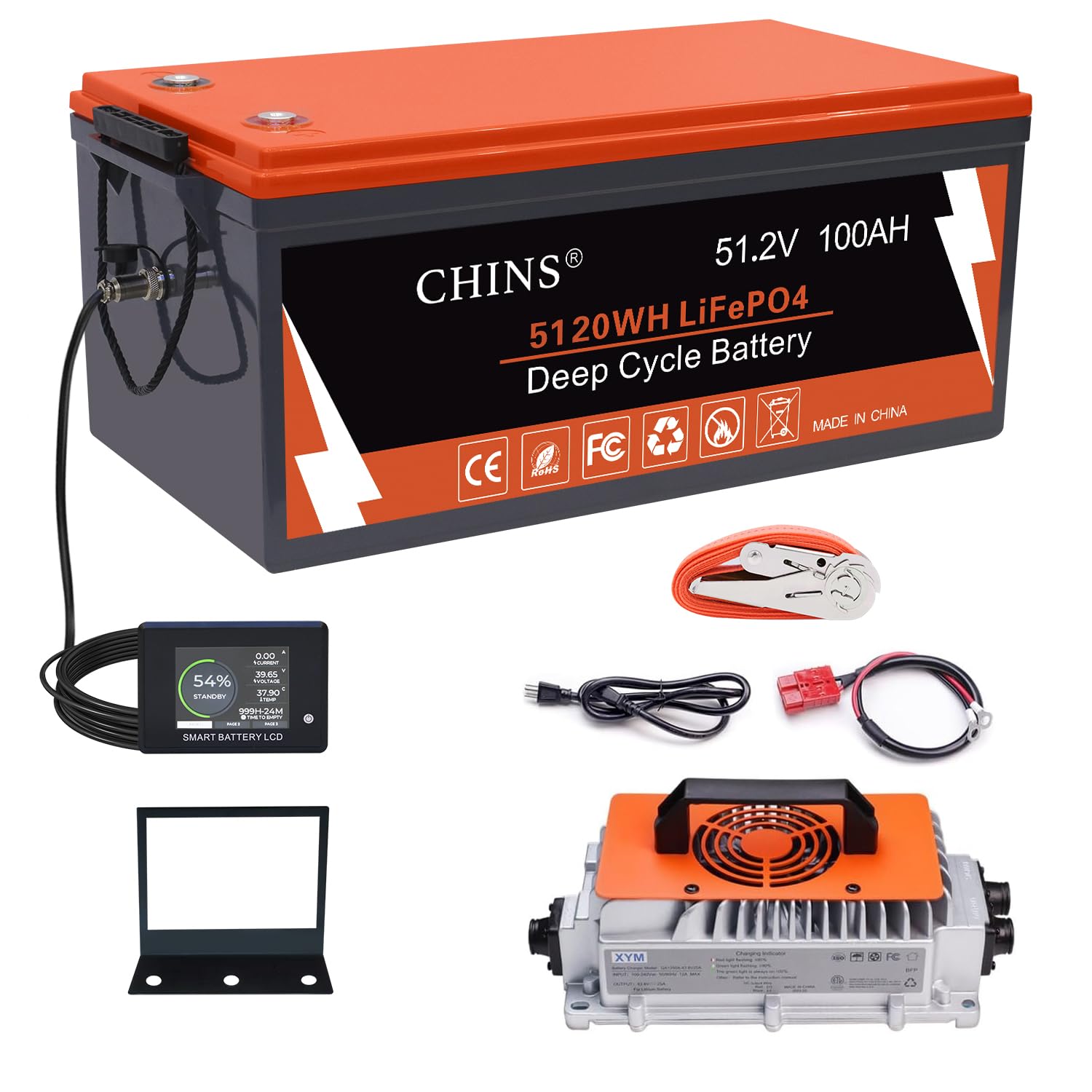
2. CHINS 48V Lithium Battery Golf Cart 100AH, Includes 18A Charger, Monitor
The budget entry that turns a tired lead-acid rack into a pack you can check from the kitchen.
The defining spec here is a 100Ah LiFePO4 pack wearing a 200A BMS, wired to a 58.4V 18A charger. That combination gets you a full charge in about 7 hours and 30 miles of range on a 3kW motor under test. Bluetooth is built in, so you can watch the charge state from your phone without walking to the cart. The one number buyers here keep returning to is range — a full day across 4 acres on one charge is the pattern.
Installation is a straightforward afternoon job. A Club Car DS conversion with this pack shed roughly 500 pounds, and you can expect around 20 miles of driving with more than half the charge still showing. Cycle life is rated at 5000+, and the BMS guards against overcharge, over-discharge, over-current, and short circuits with a high-temperature cutoff above 122°F.
Two things to weigh. The first is the warranty: CHINS backs this pack with a 1-year manufacturer term, shorter than the 5 years you get on several packs above. The second is fit — the “Fit” and “App” aspects both show mixed feedback, with some carts needing a small tray modification to seat it properly. It is heavier than the CHINS spec sheet implies at 87 pounds, but for the price it clears the bar most budget shoppers set.
What it nails: 5000+ rated cycles, a 30-mile tested range, and a 7-hour charge from the included 58.4V 18A charger — the core loop a budget rider wants.
The honest caveat: Some carts need small tray adjustments to seat it, and the 1-year warranty is the shortest in this lineup.
Reach for it if you want a proven 100Ah pack that does the daily loop without a premium price.
Look elsewhere if a longer warranty or a tighter tray fit matters most.
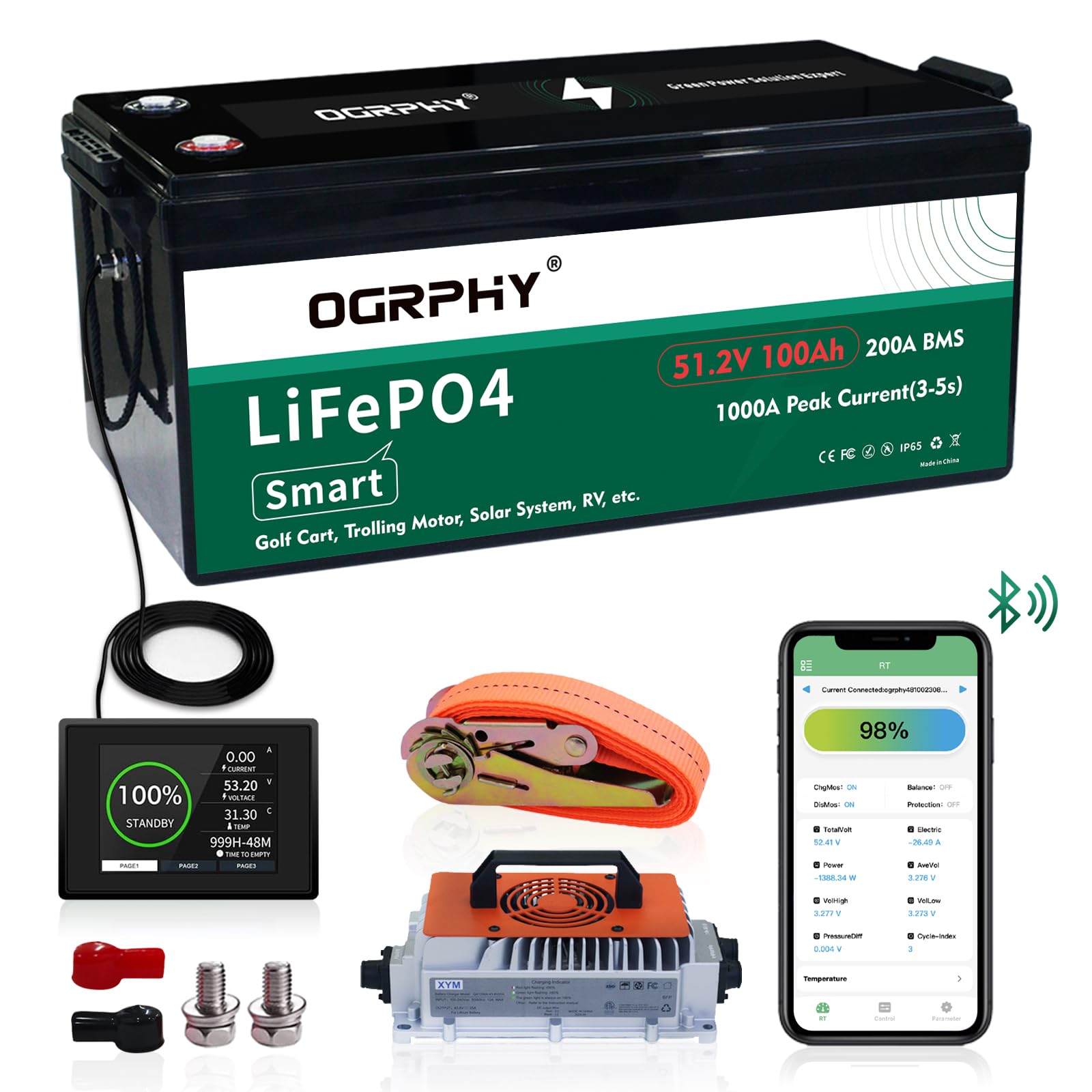
3. 48V Lithium Golf Cart Battery Conversion Kit with Touch Monitor and Charger
A UL-certified kit with an onboard charger you can mount right on the cart frame.
The package is the pitch: 48V 100Ah LiFePO4 pack, a 58.4V 18A charger designed for in-vehicle installation, a touch monitor with screen stand, and a retention strap. That onboard charger plugs into your cart’s original charging port, so you drill no new holes. Certified by Intertek to UL 1973 (a third-party safety standard for stationary batteries), the cells carry a grade-A rating. Cycle life is rated 4000+ with an 80% depth of discharge.
The BMS runs 200A continuous with a 1000A peak for 3 to 5 seconds, 300A for 32 seconds, and 600A for 32 seconds — enough for a 70lb-thrust trolling motor or an 8kW golf motor. One owner in an EZGO TXT took the time to note the “875W smart charger” and praised the app’s Bluetooth range and detailed stats. What wins people over on this one is value; the recurring complaints land on the instruction quality, which some found thin, and the charger — a few report it failing.
Buyers who paired it with a YouTube walkthrough were happy, but the useful move is to read the safety notes carefully: always shut the battery switch off before connecting or disconnecting cables.
Fit gets mixed marks. It drops into a 48V EZGO TXT with tray cutting, and Club Car owners have moved the control board to seat it. It weighs 88.1 pounds and measures over 20 inches wide, so verify your tray first.
Pick this one for buyers who want the onboard charger and touch monitor already in the box, plus a certified cell build.
skip it if thick instructions matter to you — plan to lean on YouTube for the walkthrough.
4. LOSSIGY 48 Volt Lithium Battery Golf Cart Conversion Kit with 18A Charger
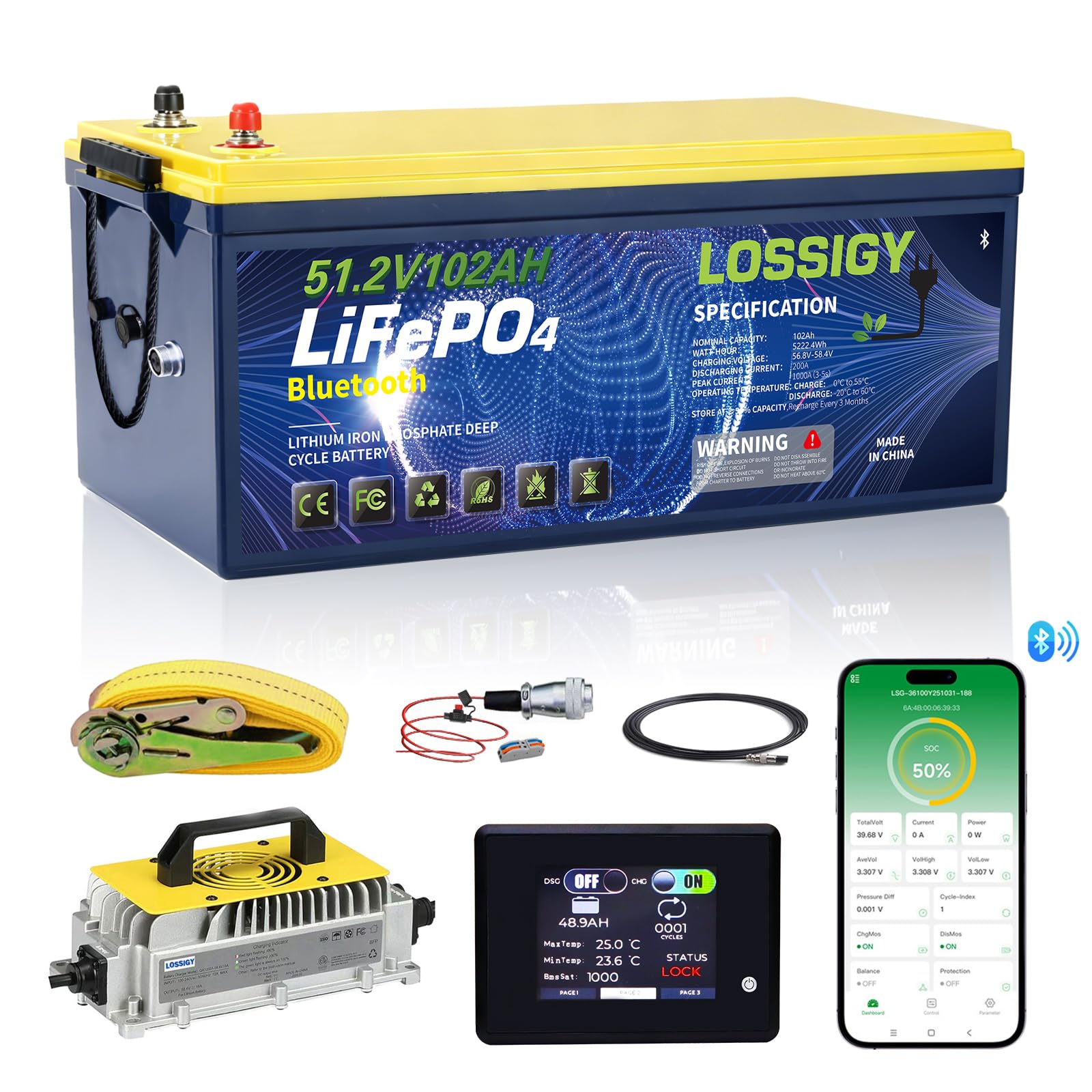
A 102Ah pack with a built-in 48-to-12V converter, so your lights and accessories keep working.
Most packs here leave you to add a separate 12V reducer for your lights and stereo. This one builds a 36/48V-to-12V step-down converter right in, alongside a 200A Bluetooth BMS that peaks at 1000A for 3 to 5 seconds. Capacity is 102 amp-hours, and the pack stores 5.22kWh. The BMS’s 1000A peak covers the startup draw on almost any golf cart controller.
Installation reports are largely a one-hour DIY job with all parts in the box; the battery arrives about half-charged. One owner shed roughly 400 pounds going from eight 6V lead-acid cells to this single pack and gained about 3 mph. Another in an Icon i60L saw 30+ mph downhill and 25+ mph uphill after dropping around 400 pounds of lead. Reliability is the thing buyers mention most after battery quality, and it holds up — a failure inside the first year, an internal temperature sensor, was covered under the 5-year warranty with a free replacement.
The catch is fit on some older angled frames — one 2003 Club Car needed a fabricated mount and a small seat raise. This is a US-market model (Model LAF48102) so you are not waiting on overseas shipping.
what separates it: The built-in 48-to-12V converter saves you a separate reducer purchase and one more wiring task.
What to plan for: Angled or shallow trays may need a custom mount and a slight seat raise to seat the 83.8-pound pack.
Best for riders running lights, a stereo, or other 12V accessories who want that converter handled from the start.
Consider another pack if your cart frame is angled and you would rather not fabricate a mount.
5. OGRPHY 48V Lithium Golf Cart Battery, 105AH with Touch Monitor & Mobile APP
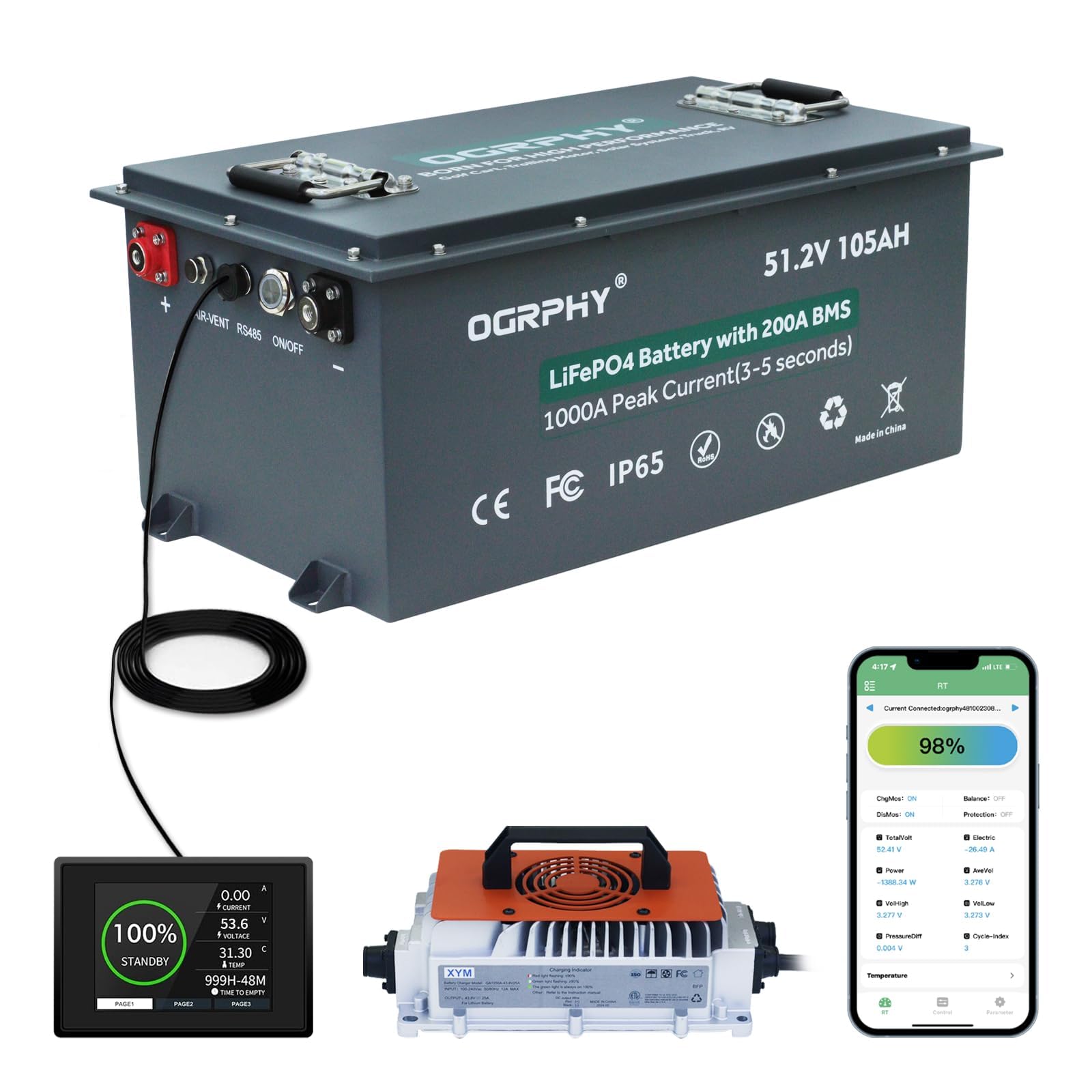
The range king: a compact 105Ah pack claiming more than 50 miles on a 3kW motor.
Where the other OGRPHY kit lists a 30-mile test figure, this 105Ah model claims more than 50 miles on the same 3kW motor, backed by 5.37kWh of stored energy. That 50-mile claim is the longest range figure in this lineup. The pack holds a 200A BMS with a 1000A peak for 3 to 5 seconds, 600A for 30 seconds, 300A for 32 seconds, and 200A continuous for the whole run.
The build is deliberately compact — the maker shrank the footprint to 19.7L x 11.6W x 8.66H inches to fit a wider range of carts. Weighing 99.2 pounds, it is heavier than the Cloudenergy 105Ah kit but more compact. Owners here run real numbers: one reported 60 miles at wide-open throttle with 30% left on the gauge. Another logged 36 holes on hilly terrain with more than 70% still showing. The one big-motor setup reported 105Ah draining in about 4 days behind a 600A controller — a sign that a bigger pack serves a 13hp motor better. The screen button is stiff and most owners just use the phone app instead. The 5-year warranty and a support team that issues prepaid return labels back it up.
Why it earns its spot
- 50-mile claim, the longest range figure in this lineup
- Compact footprint fits more cart trays
- 200A BMS with 1000A peak handles demanding startup draws
Before you commit
- Heavier than the lighter 105Ah packs at 99.2 pounds
- Screen button is stiff — most owners default to the app
Go with this if maximum distance per charge is the whole point of your upgrade.
Then again, if you run a big controller and a 13hp motor, an even larger pack may suit you better.
6. TEMGO 48V (51.2V) 100Ah LiFePO4 Lithium Golf Cart Battery
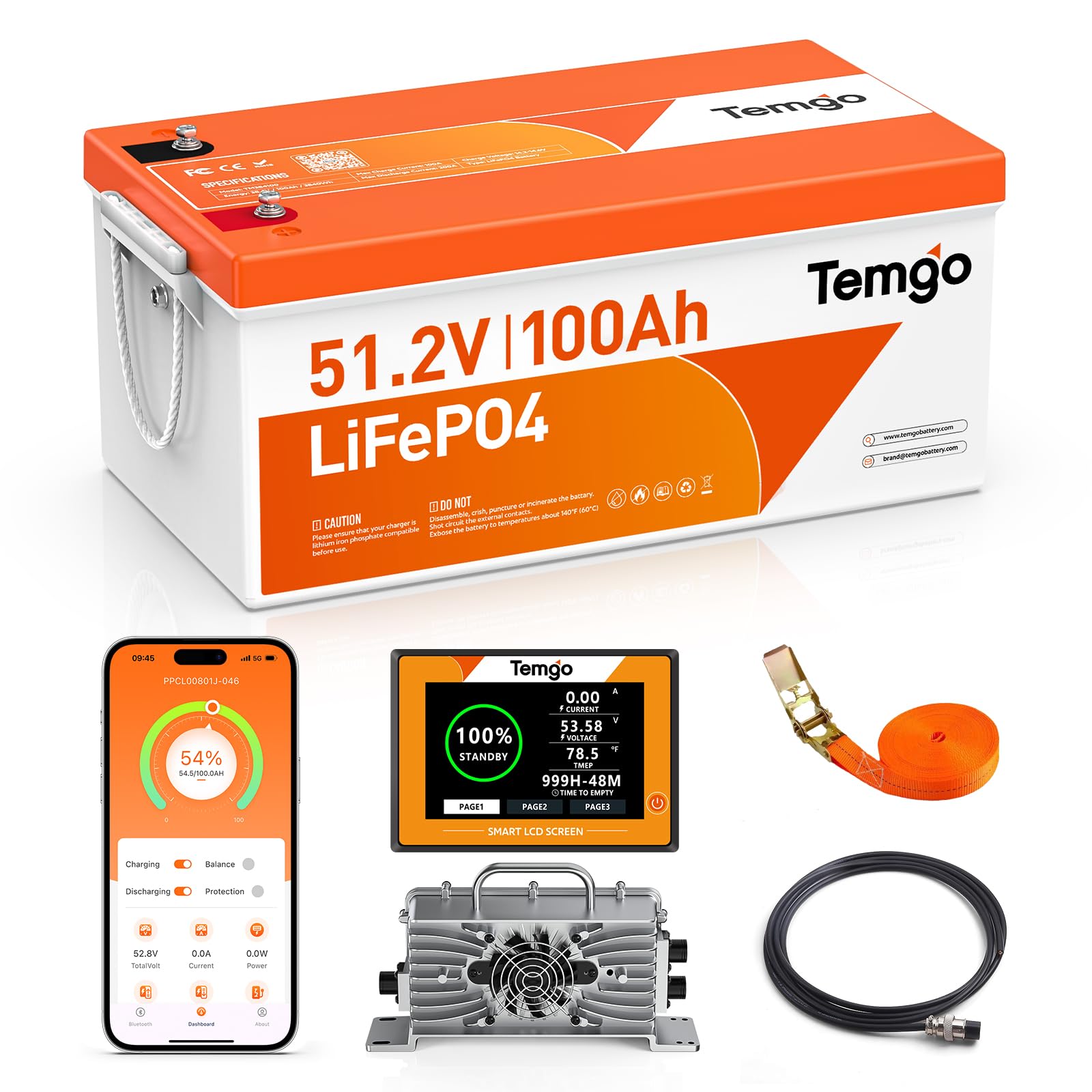
The featherweight of the bunch at 61.7 pounds — a full 20 pounds under the next lightest.
At 61.7 pounds, this pack undercuts every other 100Ah option here by a wide margin. At 61.7 pounds, it drops into the tray without a second set of hands. Capacity is 100Ah, and the draw is a 200A continuous BMS peaking at 600A for 3 seconds with a max output of 10.24kW. In real conversions, owners have cut more than 250 pounds of old battery weight, gained about 4 mph, and trimmed incline time from about 20 seconds down to 15.
It supports parallel connection (linking packs together for more total capacity) up to 4 units, expanding capacity to 20.48kWh, so it scales for solar or off-grid use as well as carts. The included kit brings a 58.4V 18A charger, an LCD touch display, and a retention strap, and a simple tray trim can seat it quickly. What wins people over is the painless conversion; the trade-off showing up in feedback is the gauge — on some carts, the reading drops below about 40% right before the pack cuts out. Just recharge earlier than the meter suggests.
If you drive an older cart that already used lithium with a communication system, this pack will not speak that language — it is built for standard 48V controller carts.
Made for solo installers and anyone who wants the lightest pack that still delivers 100Ah of range.
Heads up if you rely on the gauge alone — recharge before the reading gets low.
7. DC HOUSE Metal Case 48V 100Ah Lithium Golf Cart Battery Kit w/ 18A Charger

A sheet-metal case instead of plastic, built to shrug off the bumps a golf cart dishes out.
Most packs here wear an ABS plastic shell. This one wraps its grade-A cells in a fireproof, anti-collision sheet-metal case with a vent and a one-key safety switch that trims standby power draw. The metal fixtures secure the internal cells and reduce swelling risk. That construction matters when the pack lives under a seat and rattles over rough ground all season. The case weighs 99 pounds.
The power side is a 200A BMS with 2C discharge at 250A for 30 seconds and a 670A peak for half a second. It ships with an 18A charger good for 900W fast charging, taking the pack to full in about 5.5 hours, and the charger stops itself when the pack fills. The kit includes a wireless Bluetooth LCD monitor; if you want a wired display, the battery has a reserved port for one. Range and weight claims run big — 74% weight reduction, 60% smaller size, and a 56-mile figure the maker advertises.
The recurring buyer note is the gauge reading and the fit — some carts need tray trimming, and DC HOUSE flags that fit varies across battery compartments. Cycle life is rated 4000+ with a 3-year warranty.
Build angle: Metal case, metal cell fixtures, a vent, and a safety switch — a sturdier shell than the plastic-cased packs around it.
Plan around this: Tray sizing varies by cart, so measure your compartment before ordering to avoid a trim job.
Suits riders who want the durability of a metal-cased pack and a fast 900W charger in one kit.
Not the first choice if the maker’s advertised 56-mile range is your deciding factor — real notes land lower.
8. Cloudenergy 48V (51.2V) 105AH Lithium Golf Cart Battery 250A BMS
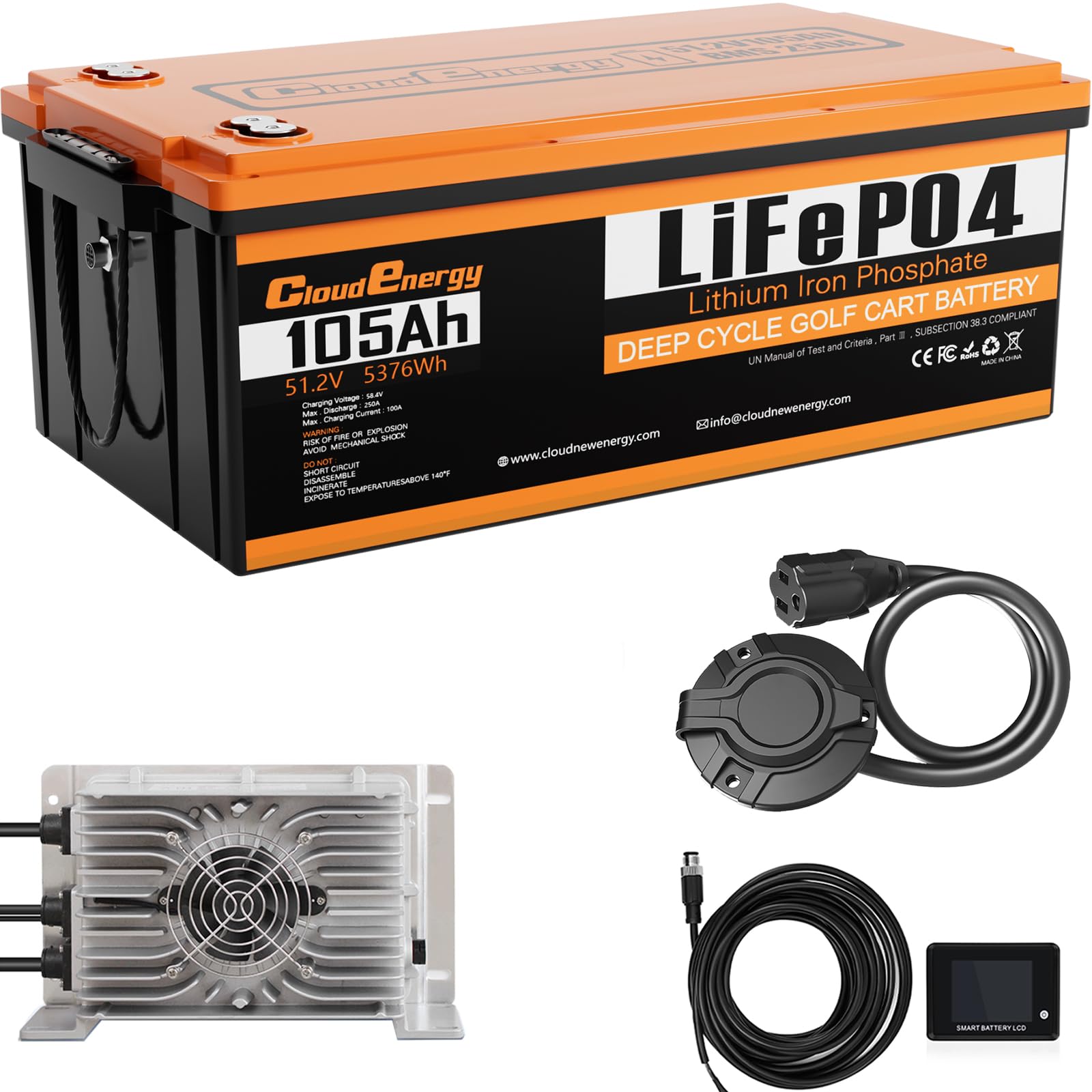
Same 105Ah cell count as the top pick, but upgraded to dual M8 terminals and a 4-in-1 kit.
This is the newer sibling of the Best Overall pack, and it shares the core numbers: 105 amp-hours, a 250A Bluetooth BMS peaking at 400A for 35 seconds and 600A for 3 seconds, and over 6000 deep cycles at 80% depth of discharge. The difference is in the extras — a 4-in-1 bundle with a 58.4V 20A charger, a 2.8-inch LCD touch screen with a holder, a charger extension cable, and the same 78.74-inch mounting strap. Dual positive and negative M8 screw terminals make the wiring hookup easier to manage.
Installation is the strong suit here, and it is what buyers talk about most. The cart-side work is a clean no-special-wiring swap for a Yamaha G29 replacing six Trojan cells, and one Stаr EV owner logged the old six batteries at 360 pounds against 90 for the new pack — genuinely plug-and-play. Speed and power stay smooth, with one owner holding 16 mph consistently and another clearing steep grades without a stutter. It weighs 92.5 pounds.
The one gripe that recurs is the monitor: the LCD touch screen has been called cheap and unresponsive on some units, and a few reported it quitting within days. The good news is you do not need it — the phone app shows the same data. If you want the heaviest kit of the two Cloudenergy packs with the most bundled accessories, this is it.
Choose it for the bundled 4-in-1 kit and the dual M8 terminals that make wiring simpler.
Compare against the top pick if the included LCD screen matters to you — that is where owners flag the weakest point.
9. VATRER POWER 48V 105Ah Lithium Golf Cart Battery, UL2271 Listed

The only pack here carrying UL2271 certification — the recognized safety standard for lithium light-electric-vehicle packs.
UL2271 is the certification body Intertek issues for light electric vehicle lithium batteries, and it is the one spec that puts this pack apart. It means the battery has been independently tested against overcharge, short circuit, thermal runaway, vibration, and impact. Capacity is 105Ah with a 5.37kWh energy rating, and the built-in 200A BMS peaks at 400A for 35 seconds and 600A for 3 seconds with a continuous discharge up to 200A. The case is cold-rolled sheet metal, fireproof and shockproof, and rated IP67 (sealed against dust and water immersion).
Real conversions back up the range claim — one owner reports 60 miles at wide-open throttle with 30% left, and the range picture here is the kind you stop worrying about. Charging runs about 55 minutes to full capacity on the included 5.5-hour charger. Weight is 102.5 pounds, which is heavier than most 100Ah options, but it still shaves a couple hundred pounds off the lead-acid it replaces. The 105Ah pack balances within 0.003V across 16 cells — that’s matched, healthy cell behavior. As owners put it, “So far so good. Installed on my golf cart. Run good. Lots of power.” The 5-year warranty and a US-and-China support team round it out.
Where it counts
- UL2271 listed — third-party safety certification no other pick here has
- IP67 metal case and 200A BMS with 400A/600A peaks
- 105Ah with a 5-year warranty and 24-hour support
Worth noting
- Heaviest pack here at 102.5 pounds
- Some Club Car trays need trimming to seat it
The one to pick if independent safety certification is the deciding factor for you.
Also consider the top pick if you want the same 105Ah capacity in a lighter, cheaper-for-the-power package.
Understanding the Specs
Amp-Hours (Ah) and Watt-Hours (Wh)
Amp-hours tell you how much charge the pack stores; watt-hours convert that to usable energy. A 100Ah pack at 48 volts holds roughly 5.12kWh, and a 105Ah pack holds about 5.37kWh — a small bump that buys a few extra miles. If your round trips run long, this is the number to check first.
BMS Continuous vs Peak Current
The BMS continuous rating is how many amps the pack pushes all day; the peak is the short burst it allows for acceleration and hills. A 200A continuous pack handles most stock carts; a 250A unit gives headroom for modified controllers. Too low a continuous rating and the pack cuts out mid-climb.
Depth of Discharge (DOD) and Cycle Life
Depth of discharge is how far down you drain the pack before recharging, and cycle life is how many charge-drain rounds it survives at that depth. Packs here are rated 4000+ to 6000+ deep cycles at 80% DOD, far beyond the few hundred cycles a lead-acid bank sees.
Voltage Match and Charger Compatibility
These packs are built for 48V systems (a 51.2V nominal LiFePO4 pack is the standard 48V replacement). They need a LiFePO4 charger, not a lead-acid one. Check your cart’s controller voltage and confirm it is a standard 48V setup before ordering.
FAQ
Will a 48V lithium battery fit my golf cart tray?
Can I use my existing lead-acid charger on a lithium pack?
How long does a 48V lithium golf cart battery last?
Do I need a bigger BMS for a lifted cart or bigger motor?
How much range will I really get per charge?
Is a 48V lithium battery safe to install myself?
Why does my gauge read low and then the cart cuts off?
Can I use one 48V pack for a trolling motor or solar setup too?
Will a lithium pack speed up my cart?
What should I do before buying a lithium pack?
Final Thoughts: The Verdict
For most riders, the 48v lithium battery for golf cart worth buying is the Cloudenergy 48V 105Ah Kit, because it pairs the highest capacity in this lineup with the 250A BMS headroom that clears most cart controllers cleanly. If longest possible range matters most, grab the OGRPHY 105Ah with its 50-mile claim. And if independent safety certification is your deciding factor, the VATRER POWER 105Ah is the only pack here carrying UL2271. Whichever you pick, measure your tray and confirm your controller voltage before ordering.
How We Picked
We do not accept paid placement. Every pick is matched to a real buyer and a real use-case; we do not hands-on test units.
Sources & Methodology
Specifications: manufacturer listings and product documentation. Review insights: verified customer reviews, as of September 2026. Pricing: not shown on this page (it changes often); check the current price via the retailer link.
As an Amazon Associate, Gadgets Feed earns from qualifying purchases. This does not affect which products we feature.