
Our readers keep the lights on and my morning glass full of iced black tea. As an Amazon Associate, I earn from qualifying purchases.
Specs are compiled from manufacturer listings and verified buyer reviews and can change over time — please confirm the key details on the product page before buying.
You want one box that powers your garage, shed, or workshop without tripping every time the compressor starts. The short answer: match the box to your amperage (the total electrical load it can handle), count the spaces you’ll actually fill, and check whether a ground bar is included — because most of these don’t ship with one. The picks below cover small 4-space boxes up to a 48-circuit panel, all indoor-rated.
I’m Min — the founder and writer behind Gadgets Feed. This guide is built by comparing the manufacturers’ published specifications and the patterns across verified customer reviews, so you get each pick’s real strengths and trade-offs instead of marketing spin.
Most buyers buy too many spaces and too little breaker brand compatibility, then find the two don’t match at the counter. If you’re wiring a subpanel for a welder or replacing an old fuse box in a shed, the right breaker box depends on matching amps, spaces, and breaker type to your actual load before you drill a single hole.
Our Picks at a Glance


How To Choose The Best Breaker Box
A breaker box — also called a load center — is the metal enclosure where your main power splits into individual circuits, each protected by its own breaker. Buying the wrong one means a return trip, a mismatched breaker, or a box that runs out of spaces before your project is finished. Here’s what actually decides the purchase.
Spaces versus circuits
A “space” is a physical slot on the bus bar (the metal strip that carries power to each breaker). A “circuit” is how many breakers you can ultimately run. An 8-space, 16-circuit box accepts tandem breakers (two slim breakers sharing one space), so it holds twice as many circuits as it has slots. If you plan to add an EV charger or a hot tub later, count circuits, not just spaces.
Main lug versus main breaker
Main lug panels have no main breaker inside — power comes in through lugs (the connection terminals) and you shut it off upstream. A convertible panel ships as main lug but accepts a main breaker you add later. If your inspector or utility wants a local shutoff inside the box, a convertible model gives you that option without buying a second enclosure.
Ground bars and neutral bonding
Nearly every panel here ships without a ground bar, and reviewers consistently flag it. For a subpanel (a panel fed from your main panel), the ground and neutral must stay separate, so you’ll add a ground bar and skip the green bonding screw. Some boxes list the included neutral/ground bars, some don’t — check before you buy.
Quick Comparison
| Model | Best For | Amps | Spaces / Circuits | Mount & Feed | Amazon |
|---|---|---|---|---|---|
| Siemens E0408ML1125SU★ Best Overall | Small sheds & one-stall garages | 125 A | 4 spaces / 8 circuits | Indoor, main lug, surface | Amazon |
| Square D QO612L100DSBest for Future Loads | Future-proof subpanels | 100 A | 6 spaces / 12 circuits | Indoor, main lug, surface | Amazon |
| ABB TLM812SCUDPMost Workshop-Ready | Garage shops with welders | 125 A | 8 spaces / 16 circuits | Indoor, main lug, 3-wire | Amazon |
| ABB TLM612FCUDP | Convertible small workshops | 125 A | 6 spaces / 12 circuits | Indoor, top or bottom feed | Amazon |
| Square D HOM1224L125PC | Whole-home subpanels | 125 A | 12 spaces / 24 circuits | Indoor, main lug, plug-on neutral | Amazon |
| Siemens E0816ML1125S | Tight stud-bay installs | 125 A | 8 spaces / 16 circuits | Indoor, main lug, surface | Amazon |
| Siemens SN2448L1125 | Large homes & future loads | 125 A | 24 spaces / 48 circuits | Indoor, main lug, plug-on neutral | Amazon |
| Leviton LP210-BPD | New construction & smart breakers | 100 A | 20 spaces / 20 circuits | Indoor, main breaker included | Amazon |
In‑Depth Reviews
1. Siemens E0408ML1125SU 4 Space, 8 Circuit, 125-Amp, Main Lug, Surface Mount, Indoor Load Center
Our pick — over 4.5★ from 500+ verified ratings; the strongest balance of quality and price.
Small, cheap, and rated for twice the circuits its size suggests
If all you’re feeding is a shed, a one-stall garage, or a couple of outlets and lights, this is the sensible starting point. It’s a 4-space panel, but with the main cutoff installed those slots hold 4 circuits, and without it you get 6. That’s real flexibility in a box that fits between framing without a fight. It carries a 125-Amp maximum current rating (the ceiling on how much power it can pass through), which is more headroom than most sheds will ever use.
The knockouts (the pre-scored punch-out holes for running cable) are the easy part — they pop out cleanly but stay sturdy enough for pinch rings to lock in place, so your cable connectors don’t wobble after you torque them down. There’s plenty of room for large gauge wire, and the panel accepts Siemens breakers that clip in tight and flush. Buyers who run this as a subfeed report needing to add a ground bar, since the neutral bar isn’t intended for grounds — factor that into your parts list.
The catch is the size itself. It’s genuinely small, and that cuts two ways: it’s perfect for a tight wall cavity or the cabinet of a food-truck-style build, but if your list of future circuits is longer than a few, you’ll outgrow it fast. Siemens sells much larger main lug boxes in the same mount style if that worry nags at you.
Owners keep repeating
- Clean knockouts that pop out easily yet hold pinch rings firmly
- 125-Amp rating gives real headroom for a small outbuilding
- Breakers seat tight and flush with no wobble
- Skinny enough for tight framing and small cabinets
Budget for these add-ons
- No ground bar included for subpanel use
- Very small footprint limits future circuits
- Plastic housing rather than a steel enclosure
Reach for this one if: your load is a handful of outlets, lights, and small tools in a shed or single-bay garage.
Look past it when: you’re already sketching a future EV charger or a second subfeed — the 4 spaces will run out.
2. Square D – QO612L100DS QO 100-Amp 6-Space 12-Circuit Indoor Main Lugs Load Center with Surface Mount Cover, Gray
A 100-Amp box built for the circuits you haven’t added yet
This is the pick if your head is already at next year’s loads. It’s a 100-Amp panel rated 120/240 VAC (standard home voltage) with a 10,000 AIR short circuit current rating — the number that says how much fault current the box can safely withstand before it’s damaged. Six spaces become 12 circuits with tandems, and buyers report wiring it as a subpanel for dryers, HVAC, water heaters, ranges, and solar. That’s a lot of headroom crammed into a surface-mount enclosure.
The cover is included and the layout is generous — the pull-tab door and top-feed lug arrangement mean you can bring feeders in from any direction without rotating the box. It holds 8 pounds, and unlike the ABB TLM812SCUDP above with its 16 circuits, this one trades circuit count for a broader spread of future load types. What it does not include is a ground bus bar, so budget for that separately. Buyers who pair it with large-gauge wire suggest picking a ground buss with oversized lugs to match.
The honest friction is breaker fit. This box takes Square D QO breakers, not Homeline, and QO breakers are a smaller family. Some owners find the breakers sit loosely on the busbar until the faceplate is screwed down, and there are no separate main lugs on this model. Check your breaker brand before ordering.
What owners confirm: a resilient indoor panel that earns praise for build quality and value, and one that handles a broad book of future 208V loads without fuss.
Where the friction sits: breaker fit is fussy, and there’s no ground buss in the box — plan for a parts run before you start roughing in.
Solid choice for: anyone building a subpanel for a future dryer, HVAC, or solar circuit who wants spare capacity now.
Pick something else if: you already own Homeline breakers — they won’t seat in this panel.
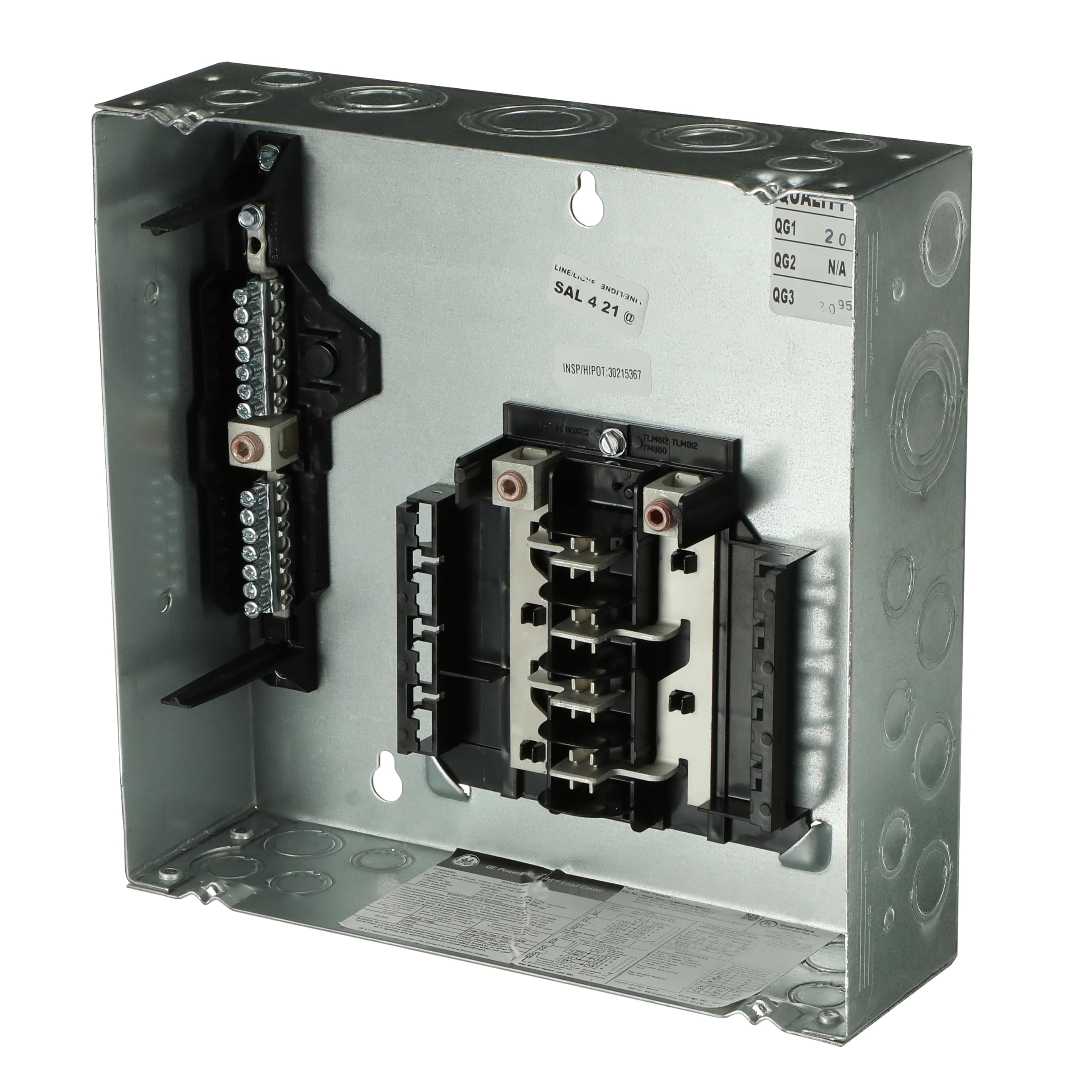
3. ABB TLM812SCUDP Low Voltage Load Center 125A
Eight spaces of copper for welders, compressors, and heavier shop loads
Buyers who use this box tend to describe one scene: a dedicated garage shop where a welder, an air compressor, and lighting all hang off the same panel. That’s what the 8 spaces and 16 circuits are for — a big step up from the 4-space box above, and enough slots to run multiple heavy 240V circuits alongside everyday lighting. It’s rated 125 Amp, 3-wire, single phase, and main lug, and the interior sits in a 3.4″L x 11.6″W x 11.4″H enclosure.
The material choice matters here. This panel uses a copper bus bar, which is what owners point to when they call it a quality electrical product — copper is the preferred conductor for reliability over time. It’s a heavy enclosure at 8.2 pounds, and the flush cover, well-placed knockouts, and secure breaker seating get consistent praise. It comes with a neutral bus bar but no ground bar, which multiple owners mention — for subpanel use you’ll add the ground bar separately, but the included neutral bar is a modest head start.
One caution buyers raise: the listing can be confusing about which breakers fit. This panel takes ABB breakers (the ABB brand absorbed GE’s residential line), and the product data shows very few compatible model numbers called out. Check the ABB or GE breaker family before you buy, and don’t assume a standard GE breaker from the big box store will work here.
Why shop buyers keep it in the cart
- Copper bus bar — the conductor owners credit for reliability
- 8 spaces / 16 circuits covers welders, compressors, and lights
- Sturdy 8.2-pound enclosure with clean knockout placement
- Includes neutral bus bar (ground bar added separately)
Before you commit
- No ground bar included — required for subpanel grounding
- Compatible breaker model numbers aren’t clearly listed
- The 125 Amp rating limits you if your shop grows beyond that
Suits: a working garage or small shop running a welder and compressor off dedicated circuits.
Not for: buyers who want a box with the compatible breakers spelled out — you’ll need to confirm the ABB breaker family yourself.
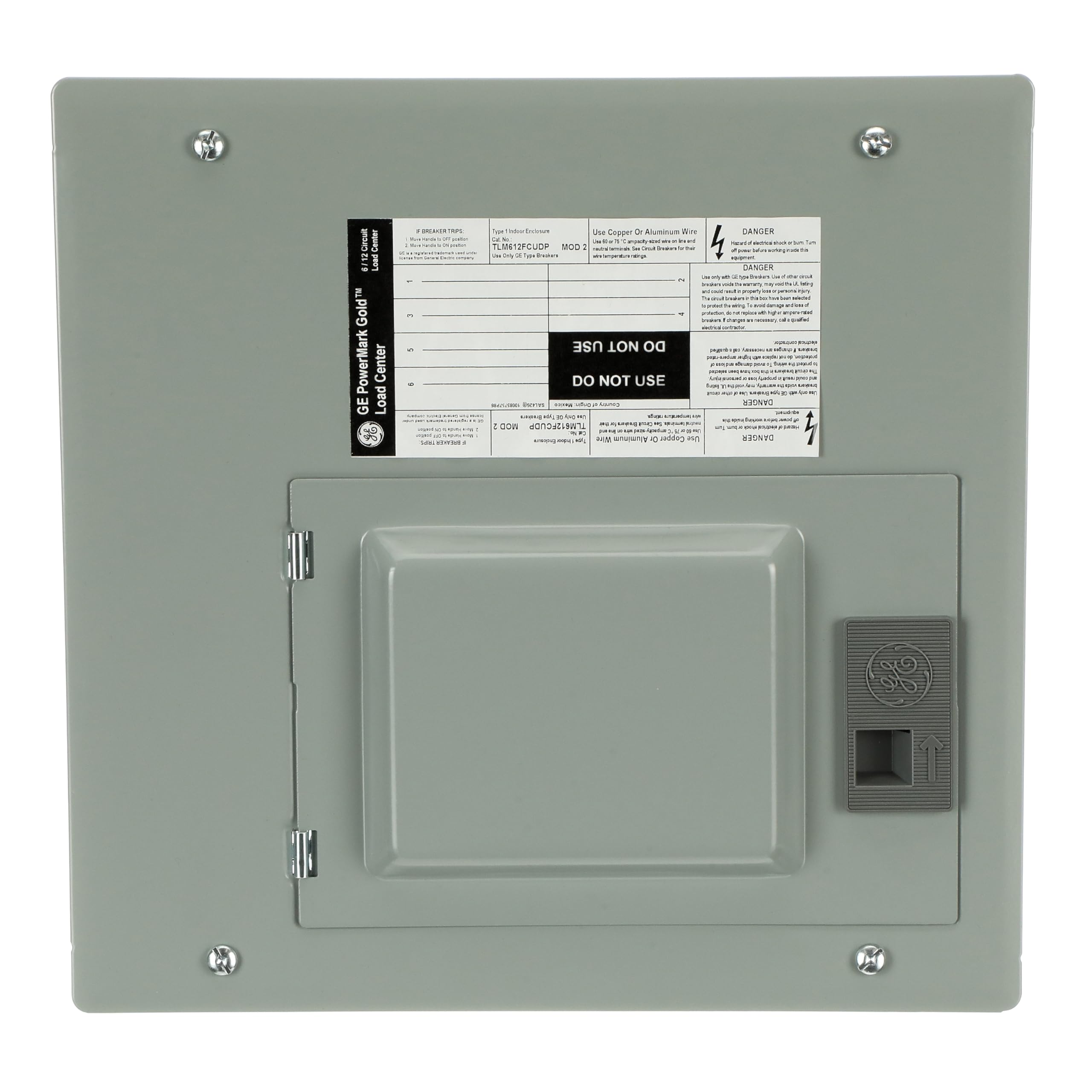
4. ABB TLM612FCUDP 125A Main Lug Convertible Load Center
The one you can wire from either end and upgrade to a main breaker later
Two things make this panel stand out. First, it’s convertible — it ships as main lug but accepts a main breaker if you decide you want a local shutoff inside the box. Second, it feeds from the top or the bottom, which means you don’t have to fight your existing conduit run to make it fit. That combination saves a return trip when your inspector or your own plans change mid-project. It’s rated 125 Amp, 6 spaces, 12 circuits, 3-wire, single phase, and it lives in a NEMA 1 galvanized steel enclosure rated for indoor use only.
The galvanized steel resists rust, and the full-length neutral bars simplify wiring on longer runs. Owners who use it as a small workshop panel appreciate that the grounding bar is included here — a rarity across this category, where most boxes leave it out. It accepts GE Q Line breakers: THQL, THQP, and the GFCI and AFCI families. The trade-off versus the ABB TLM812SCUDP above is circuit count — 6 spaces here against 8 spaces there, and this box weighs 3.72 kg.
The one gripe worth planning for: the compatible breaker types aren’t clearly spelled out on the listing. Buyers want the exact breaker model numbers listed so they don’t have to guess at the store. Knowing it takes GE Q Line breakers closes most of that gap before you order.
Best feature for a first-timer: top or bottom feed means the wiring routes to wherever your panel actually sits, not the other way around.
The caveat: the listing doesn’t name the breaker model numbers, so confirm you’re buying GE Q Line before checkout.
Great pick for: installs where conduit runs from above or below and you might want a main breaker later.
Instead choose: the 8-space ABB above if you need more circuits, or the Siemens 4-space if you need fewer.
5. Square D – HOM1224L125PC Homeline Load Center with Cover

Twelve spaces of plug-on neutral capacity for a whole-home subpanel
When a shed box isn’t enough and you’re feeding a large subpanel, this is the step up. It’s a 125-Amp, 12-space, 24-circuit main lug panel, and it’s plug-on neutral ready — meaning the arc-fault breakers snap directly onto the neutral rail without a separate pigtail wire. That’s a real convenience if you’re installing a full row of AFCI (arc-fault) or GFCI (ground-fault) breakers, which otherwise each need a hand-wired neutral connection. The distributed neutral bar lets you place a Plug-on Neutral combination arc fault breaker on any single space.
Each pole space accepts full-size, tandem, or quad breakers, so the panel bends to your circuit plan rather than forcing it. It’s a substantial unit — 17.1 pounds — and the spring-loaded faceplate seats snugly. The cover is included, and customers note using it as a subpanel in a garage or shed with ample knockouts and workspace. It also accepts a plug-on secondary surge arrestor, sold separately.
The consistent catch is the ground bar. Multiple owners note it isn’t included and add one themselves, and the documentation around breaker types is described as unclear. If you’re using this as a subpanel, plan to buy a ground bar and to leave the green bonding screw alone — or, as some owners note, remove the bus jumper screws, which voids the UL listing and warranty. Order early too; delivery is reported as slow.
What earns the most praise
- Plug-on neutral saves wiring time on AFCI and GFCI breakers
- Spaces take full-size, tandem, or quad breakers
- Cover included; spring-loaded faceplate sits tight
- Room for plug-on surge arrestor and 125-Amp capacity
Plan for these gaps
- No ground bar included — add one for subpanel use
- Breaker compatibility isn’t clearly documented
- Slow shipping reported by buyers who needed it fast
- At 17.1 pounds, it’s a heavy unit to hang
Best fit: bigger subpanel jobs feeding a garage, workshop, or whole-home branch circuit plan.
Skip if: you want a box that ships with the ground bar — you’ll be sourcing one plus a compatible breaker set.
6. Siemens E0816ML1125S EQ 125 Amp, 8-Space, 16-Circuit, Indoor Main Lug Surface Mount Load Center

A mid-size panel that slips between wall studs without trimming
This is the box for a workshop subpanel where you want eight spaces but don’t have a lot of wall to work with. It’s 125 Amp, 8 spaces, 16 circuits, single phase, 120/240 volt, with an aluminum bus bar in a NEMA 1 indoor enclosure. Owners repeatedly flag the fit — one describes it as skinny enough to fit between wall studs, which is the kind of detail that saves a framing headache when you’re mounting a box in a finished shop. It’s got a galvanized carbon steel enclosure for corrosion resistance and meets UL and ANSI safety requirements.
It’s a substantial 12 pounds and comes with a mix of uses in mind — buyers install it in garages, outdoor shops, and even a food truck cabinet where space is tight. It fits ITE breakers, has plenty of knockouts for easy routing, and the bus bars hold wires securely. Compared to the Square D HOM1224L125PC above with 24 circuits, this one trades circuit count for a narrower profile that fits into framing gaps.
Two honest limits. The ground bar is not included — reviewers point out you’ll buy it separately — and the cover is not reversible, so you need to plan the mounting orientation up front. Buyers also flag that breakers aren’t interchangeable between brands, so confirm your breaker matches the Siemens family before you buy.
Why workshop builders like it: fit is the recurring theme — a narrow panel that slips into a stud bay without modifications, with no shortage of knockouts for routing.
The trade-off to weigh: a non-reversible cover means the mounting direction is locked the moment you set it, so check your feeder entry before you fasten it down.
Made for: a shop or garage subpanel where wall space is slim and you want 8 spaces anyway.
Think twice if: you need a reversible cover or a box that ships with its ground bar.
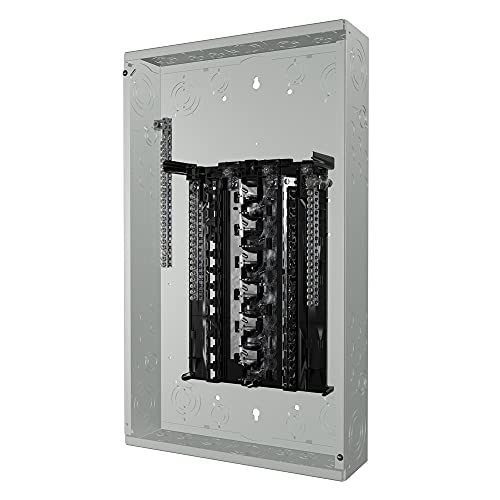
7. SN Series 125 Amp 24-Space 48-Circuit Main Lug Plug-on Neutral Load Center Indoor
24 spaces and 48 circuits for a whole home’s worth of branch circuits
If you’re laying out a panel that will eventually feed most of a house — and you’d rather not swap it out later — this is where you land. It’s a 125-Amp panel with 24 spaces and 48 circuits, single phase, 3-wire, 120/240 volt, in a NEMA 1 indoor enclosure. It carries a 100,000 AIC interrupt rating, which is the maximum fault current the box can interrupt safely, and it’s plug-on neutral, so arc-fault breakers mount directly to the neutral rail for quick installation. Over 4 inches of wire bending space means you’re not cramming conductors to close the cover.
Siemens factories install the ground bar here — one comes pre-installed, which puts this panel ahead of most of the field. It’s built from alloy steel and buyers repeatedly call it the sturdiest they’ve used, with plenty of room for wiring and enough breakers to fill it out over time. Against the Square D HOM1224L125PC above with its 12 spaces, this panel doubles the capacity.
The one complaint that comes up is ground terminals: shoppers say wanting more of them, distributed better across the bar. It’s a minor gripe on an otherwise solid panel, but if you’re planning a lot of equipment grounds, plan accordingly.
What buyers rave about
- 24 spaces / 48 circuits — room for a full branch-circuit plan
- Factory-installed ground bar, unlike most panels here
- 100,000 AIC interrupt rating for higher-fault environments
- Over 4 inches of wire bending space simplifies wiring
The one honest gripe
- Ground terminals are skimpy and could be better distributed
- At 24 spaces it’s a large box — plan the wall space
- 125 Amp main lug only, no main breaker included
Ideal for: a new whole-home panel or a large subpanel where future expansion is the whole point.
Consider a smaller box: if you’re feeding one outbuilding and won’t touch 24 spaces.
8. Leviton 20 Space, 20 Circuit Indoor Load Center with 100 Amp Main Circuit Breaker, LP210-BPD

The panel you can wire before any breaker goes in, with a 100-Amp main already included
This one works differently from everything else here. The whole load center can be wired at rough-in before any circuit breakers are present, which means you can close up walls and finish the rough stages without waiting on the electrical trim. It comes with a 100-Amp main circuit breaker already installed, so unlike the main-lug panels above, you get a local shutoff in the box without buying a convertible model. It’s a 20-space, 20-circuit indoor panel with tin-plated copper bus bars and a 10-Year Limited warranty.
The design details are thoughtful. Notches stamped into the enclosure hold cable ties for neat wiring, and the white powder-coated finish is a genuine visual difference — owners describe it as sleek and clean, and it matches an existing Leviton main panel. The heavy 25.8-pound build and copper bus bars are what buyers point to when they call it well made and innovative, and it pairs with Leviton’s smart WiFi GFCI and AFCI breakers for a safer way to install and swap breakers with minimal effort.
Plan for three real caveats. The door is sold separately — this ships as enclosure and interior only. It’s on the pricey side compared to the main-lug picks, and the proprietary breakers carry a premium. And the cover screws aren’t included, so you’ll source those before final assembly.
The headline design win: wiring can be completed at rough-in before breakers are present, and copper bus bars back a 10-Year Limited warranty.
Budget for it: the door, the cover screws, and the Leviton breakers are all separate purchases — price the full package, not just the enclosure.
Perfect for: new construction and smart-home builds where you want pre-wiring flexibility and smart breakers.
skip it if: you want a complete panel from the start — the door and screws are on you.
Understanding the Specs
Amperage and Interrupt Rating
The amperage rating (like 100 A or 125 A) is the ceiling on how much current the panel is designed to carry — it needs to match the size of the feeder breaker protecting it upstream. Don’t buy a 125-Amp panel and feed it from a 60-Amp breaker; size them to match. The interrupt rating (10,000 AIR or 100,000 AIC) is entirely different: it’s the fault current, in amps, that the panel can safely withstand if a short occurs, and higher values suit larger service installations.
Spaces, Circuits, and Copper vs. Aluminum
A space is a physical breaker slot; a circuit is a breaker you can ultimately run, counting tandems. An 8-space panel that accepts tandems can hold 16 circuits. Bus bar material matters too — copper (used in the ABB TLM812SCUDP and the Leviton LP210-BPD) is generally preferred by electricians for long-term reliability, while aluminum bus bars (used in the Siemens E0816ML1125S) remain common and cost less. Finally, confirm the panel’s mount type: surface mount, flush, or convertible, and check whether it’s rated for indoor use (NEMA 1), since that rating sets where it can legally be installed.
FAQ
What is the difference between a main lug and a main breaker panel?
How many circuits can a breaker box hold?
Do I need a ground bar for a subpanel?
Will Homeline breakers fit in a QO panel?
What breakers fit an ABB load center?
Can I use a 125-Amp panel on a 100-Amp feed?
Do breaker boxes include a cover or door?
Can a breaker box be mounted outdoors?
What is a plug-on neutral load center?
How much wire bending space should a load center have?
Final Thoughts: The Verdict
For most small-project buyers, the breaker box winner is the Siemens E0408ML1125SU because its 4 spaces and 125-Amp rating are more than enough for a shed or single-bay garage, and its knockouts and tight breaker fit make install straightforward. If you’re feeding dryers, HVAC, or solar, grab the Square D QO612L100DS for its 10,000 AIR rating and future-load capacity. And for a whole-home subpanel with smart breaker options, the Leviton LP210-BPD is the one to reach for. For the largest capacity with a factory-installed ground bar, choose the SN Series 24-space panel.
How We Picked
We do not accept paid placement. Every pick is matched to a real buyer and a real use-case; we do not hands-on test units.
Sources & Methodology
Specifications: manufacturer listings and product documentation. Review insights: verified customer reviews, as of September 2026. Pricing: not shown on this page (it changes often); check the current price via the retailer link.
As an Amazon Associate, Gadgets Feed earns from qualifying purchases. This does not affect which products we feature.