
Finding a camera that delivers genuine photographic quality without draining your wallet is the central challenge of modern image making. The market is flooded with options that promise pro-level results but deliver smartphone-level disappointment, leaving you stuck with soft details, sluggish autofocus, and poor low-light performance. A truly capable camera for photography needs to balance sensor size, lens options, and image processing—all while staying accessible.
I’m Min — the co-founder and writer behind Gadgets Feed. I’ve spent countless hours analyzing the technical specifications, real-world sample images, and user feedback from over a thousand verification sources to separate the genuine budget-friendly performers from the overpriced also-rans.
This guide is built around the best budget camera for photography, meticulously comparing sensor resolution, autofocus systems, stabilization, and lens ecosystem value to help you make a confident, informed purchase.
How To Choose The Best Budget Camera For Photography
Selecting a budget camera for photography requires a careful evaluation of core specifications that directly affect image quality and usability. The right choice balances sensor performance, autofocus capability, stabilization, and system expandability within your spending tier.
Sensor Size and Megapixels
In the budget tier, sensor size—not megapixel count—is the single most important determinant of image quality. An APS-C sensor (roughly 23.5 x 15.6 mm) captures significantly more light than the smaller 1-inch or Micro Four Thirds sensors found in some compact cameras. A 24.2-megapixel APS-C sensor will consistently outperform a 20-megapixel Micro Four Thirds sensor in low light and dynamic range. Look for cameras with at least an APS-C sensor for the best balance of resolution and noise control.
Autofocus System
A camera’s autofocus system determines how many of your shots are sharp, especially when photographing moving subjects like children, pets, or street scenes. Phase-detection autofocus (PDAF) is far faster and more accurate than contrast-detection alone, particularly in low light. Budget-friendly cameras with 143 phase-detection points or more, like those in Canon’s Dual Pixel CMOS AF system, provide reliable eye and face tracking that rivals higher-tier models.
Image Stabilization
In-body image stabilization (IBIS) compensates for camera shake during handheld shooting, allowing you to use slower shutter speeds without blur. A camera with 5-axis IBIS can provide 4 to 5 stops of stabilization, meaning you can shoot at 1/15th of a second instead of 1/125th and still get sharp images. This is critical for low-light photography without a tripod and is a feature more commonly found in mid-range Micro Four Thirds models than in entry-level APS-C DSLRs.
Quick Comparison
On smaller screens, swipe sideways to see the full table.
| Model | Category | Best For | Key Spec | Amazon |
|---|---|---|---|---|
| Canon EOS R100 | Mirrorless | Entry-level travel | 24.1MP APS-C, 143 AF points | Amazon |
| Panasonic LUMIX G85 | Mirrorless | Handheld low-light | 16MP MFT, 5-axis IBIS | Amazon |
| Panasonic LUMIX G100 | Mirrorless | Vlogging + photo | 4K 24p/30p, tracking mic | Amazon |
| Canon EOS Rebel T7 | DSLR | Value bundle starter | 24.1MP APS-C, 9 AF points | Amazon |
| OM SYSTEM E-M10 Mark IV | Mirrorless | Compact retro style | 20MP MFT, 5-axis IBIS | Amazon |
| Sony Alpha ZV-E10 | Mirrorless | Vlog + photo hybrid | 24.2MP APS-C, 425 AF points | Amazon |
| Canon EOS RP | Mirrorless | Entry full-frame | 26.2MP full-frame, 4K UHD | Amazon |
| Nikon Z50 II | Mirrorless | Versatile two-lens kit | 20.9MP APS-C, 231 AF points | Amazon |
| Sony a7 III | Mirrorless | Full-frame all-rounder | 24.2MP full-frame, 693 AF | Amazon |
| Canon EOS R6 Mark II | Mirrorless | Action + low-light | 24.2MP full-frame, 40 fps | Amazon |
| DJI Osmo Pocket 3 | Compact | Pocketable video | 1-inch CMOS, 3-axis stab | Amazon |
In‑Depth Reviews
1. Canon EOS R100

The Canon EOS R100 is the lightest and smallest body in the EOS R series, weighing just 356 grams with a 24.1-megapixel CMOS APS-C sensor that delivers natural bokeh and excellent detail. The DIGIC 8 image processor provides responsive performance, including 4K video at up to 24 fps and Full HD at 60 fps, making this a capable hybrid shooter despite its entry-level positioning.
The Dual Pixel CMOS AF system covers a wide 143-zone area with human face and eye detection, plus animal and vehicle detection—autofocus that punches well above its budget-friendly status. Continuous shooting tops out at 6.5 fps in One-Shot AF, sufficient for capturing fast-moving subjects like sports or pets without breaking the bank.
Users consistently praise its compact form factor, intuitive GUI, and reliable autofocus as standout qualities for beginners. Some note the lack of a bundled charger (the LP-E17 battery requires a separate charger) and the kit lens’s moderate aperture, but the core image quality and RF lens compatibility make it a strong starting point for any photographer.
Why it’s great
- Ultra-light RF mount body for easy carrying
- Reliable Dual Pixel CMOS AF with eye detection
- Good 4K/24p video capability for the price
Good to know
- No in-body image stabilization
- Battery life about 300 shots per charge
- Kit lens maximum aperture is F4.5–6.3
2. Panasonic LUMIX G85

The Panasonic LUMIX G85 is a Micro Four Thirds mirrorless camera that punches above its weight with class-leading 5-axis dual image stabilization—both in-body and in-lens—that works seamlessly for stills and 4K video. The 16-megapixel sensor lacks a low-pass filter, which results in noticeably sharper fine detail than typical 16MP sensors, giving it near 10% better resolving power for landscape and macro work.
Its 4K video recording at 3840 x 2160 resolution is paired with 4K Photo and Post Focus modes, letting you extract 8-megapixel stills at 30 fps and adjust focus after capture. The 3-inch tilt-and-touch LCD and OLED live viewfinder with 2360K dots offer excellent visibility in bright conditions, while the magnesium alloy body and weather sealing ensure durability in challenging environments.
Owners praise the G85 as the price-to-performance king of entry-to-mid-level mirrorless cameras, with intuitive ergonomics and reliable low-light autofocus. The main trade-offs are a smaller Micro Four Thirds sensor compared to APS-C and average battery life, but the superb stabilization and rugged build make it a top contender for handheld photography.
Why it’s great
- Excellent 5-axis in-body image stabilization
- Weather-sealed magnesium alloy body
- 4K Photo mode with post-focus adjustment
Good to know
- 16MP sensor is outmatched by modern APS-C in low light
- No headphone jack for video monitoring
- Battery life around 330 shots
3. OM SYSTEM E-M10 Mark IV

The OM SYSTEM E-M10 Mark IV (formerly Olympus) packs a 20-megapixel Live MOS Micro Four Thirds sensor with a powerful 5-axis in-body image stabilization system rated for up to 4.5 stops of correction. This stabilization allows handheld exposures of up to one second without blur, making it exceptional for low-light street photography and indoor shots where a tripod isn’t practical.
The flip-down monitor and dedicated selfie mode make it a strong choice for vloggers and self-portrait enthusiasts, while the 121-point contrast-detection autofocus is snappy for still subjects and provides 16 Art Filters including Instant Film for creative shots straight out of camera. The 4K video recording is standard for the class, and the compact body with the 14-42mm pancake lens fits into a jacket pocket.
Users highlight the camera’s excellent build quality, lightweight form factor (383g), and intuitive controls as major advantages. Criticisms include the lack of a USB-C port for charging (uses micro-USB) and a slightly slower burst rate compared to contemporary DSLRs, but the combination of IBIS, image quality, and portability is hard to beat in its segment.
Why it’s great
- Highly effective 5-axis IBIS for low-light handheld shots
- Very compact and lightweight body
- Flip-down screen with dedicated selfie mode
Good to know
- Micro-USB charging instead of USB-C
- Contrast-detect AF lags in continuous tracking
- Kit lens pancake design limits maximum aperture
4. Canon EOS Rebel T7 Bundle
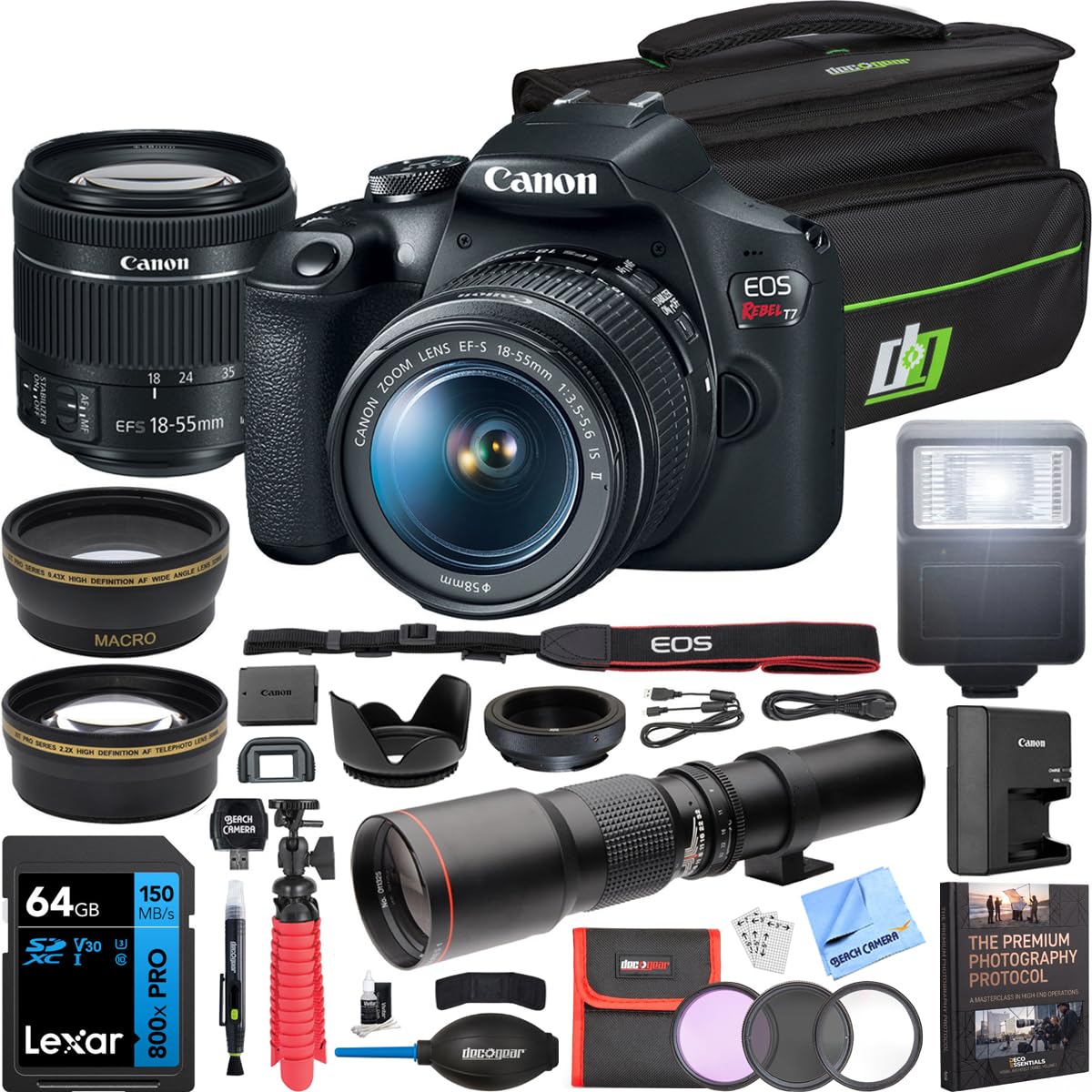
The Canon EOS Rebel T7 is a traditional DSLR with a 24.1-megapixel APS-C CMOS sensor and DIGIC 4+ image processor, providing a solid foundation for learning photography. This bundled version adds a 500mm preset telephoto lens, wide-angle and macro adapter lenses, a camera bag, 64GB SDXC memory card, tripod, flash, and filter kit, making it a comprehensive starter package for newcomers who want everything in one box.
The 9-point autofocus system is basic by modern standards but functional for general photography, and the optical viewfinder offers 95% coverage for framing. Built-in Wi-Fi and NFC enable easy image transfer to a smartphone, and Full HD 1080p video recording at 30 fps covers casual video needs. The EF-S 18-55mm IS II kit lens provides optical stabilization to reduce camera shake in good light.
Buyers appreciate the exceptional value of the bundle and the ease of use for beginners, though many note that the battery drains quickly (some report dead batteries after 8 photos) and the included bag is too small for all accessories. The 500mm telephoto lens adds super-telephoto reach but requires significant light due to its fixed f/8 aperture, making it a daytime-only tool.
Why it’s great
- Comprehensive 13-piece bundle for new photographers
- 24.1MP APS-C sensor for clean images
- Canon EF/EF-S lens system is huge and affordable
Good to know
- 9-point AF is limited for moving subjects
- Battery life is below average in this class
- Bundle accessories may include lower-quality items
5. Sony a7 III

The Sony a7 III remains a benchmark in the full-frame mirrorless market thanks to its 24.2-megapixel back-illuminated Exmor R CMOS sensor and 15-stop dynamic range. The 693-point phase-detection AF system covers 93% of the image area, providing fast and accurate tracking for everything from portraits to wildlife, while the 10 fps continuous shooting with AE/AF tracking handles action sequences smoothly.
The NP-FZ100 battery delivers approximately 710 shots per charge—easily the best battery life in this comparison—making the a7 III a reliable companion for long shoots. The 5-axis in-body image stabilization allows handheld shooting at much slower shutter speeds, and the 4K HDR video recording with full pixel readout provides excellent video quality for the premium tier. The included 28-70mm f/3.5-5.6 lens is a decent all-around starter, though many users upgrade to prime lenses for better low-light performance.
Users overwhelmingly praise its best-in-class autofocus, incredible battery life, and low-light performance that rivals much more expensive cameras. The menu system is complex and the kit lens doesn’t fully exploit the sensor’s potential, but the a7 III’s combination of full-frame quality, durability, and value makes it a top choice for serious photographers stretching their budget.
Why it’s great
- Outstanding 710-shot battery life
- Full-frame sensor with wide 693-point AF
- 15-stop dynamic range for high-contrast scenes
Good to know
- Menu system is complex and cluttered
- Kit lens is soft in corners and slow aperture
- Weather sealing is limited compared to competitors
6. Canon EOS R6 Mark II

The Canon EOS R6 Mark II provides 24.2 effective megapixels on a full-frame CMOS sensor paired with the DIGIC X image processor, delivering exceptional performance for both photography and videography. Its electronic shutter offers up to 40 fps continuous shooting, making it one of the fastest cameras in its class for capturing split-second action like sports or wildlife, while the mechanical shutter provides 12 fps for general use.
The Dual Pixel CMOS AF II system detects and tracks people, animals (including dogs, cats, birds), and vehicles (cars, motorcycles, trains, aircraft, horses), with advanced head, face, and eye detection that maintains focus even during erratic movement. The 8-stop in-body image stabilization is among the best available, allowing sharp handheld exposures at shutter speeds that would cause blur on less stable systems. The 6K oversampled uncropped 4K at up to 60 fps delivers cinema-quality video, and the vari-angle touchscreen LCD with 1.62 million dots makes composition effortless from any angle.
Reviewers consistently rank the R6 Mark II as a dream hybrid camera that grows with the user, offering robust build quality, intuitive controls, and weather sealing. The lack of an integrated flash and the body-only purchase (no lens) are its main drawbacks, but the autofocus speed, low-light performance, and stabilization justify its position as a premium investment for serious photography.
Why it’s great
- 40 fps electronic shutter for action shots
- Excellent 8-stop IBIS and subject tracking
- 6K oversampled 4K60p video with C-Log 3
Good to know
- No built-in flash
- Body-only – lens sold separately adds cost
- Higher tier price point
7. Canon EOS RP

The Canon EOS RP is the lightest and most compact full-frame mirrorless camera in Canon’s lineup, weighing just 440g with a 26.2-megapixel full-frame CMOS sensor. The RF24-105mm F4-7.1 IS STM kit lens provides up to 5 stops of optical image stabilization and a versatile zoom range from wide-angle to short telephoto, making it a fantastic travel companion that still delivers full-frame image quality.
The Dual Pixel CMOS AF system delivers fast and accurate autofocus with face and eye detection, a huge step up from older DSLRs like the Canon T7 or Nikon D3500. The 3-inch vari-angle touchscreen is bright and responsive, and the electronic viewfinder ensures accurate preview of exposure and depth of field. Video recording reaches 4K UHD at 24 fps, and the camera can be used as a high-quality webcam via the EOS Utility Webcam Beta software or through a clean HDMI output.
Owners upgrading from crop-sensor cameras appreciate the immediate improvement in depth of field control, low-light performance, and fine detail. The RP’s 24-105mm kit lens is considered good value but shows softness at wide apertures, and the 4K video is limited to 24 fps with a significant crop factor. Nevertheless, its full-frame sensor, compact design, and accessible price point make it a compelling entry into full-frame photography.
Why it’s great
- Lightest full-frame mirrorless body at 440g
- Full-frame sensor for shallow depth of field
- Versatile RF lens mount with future-proof upgrades
Good to know
- 4K video has heavy crop factor
- Kit lens soft in corners at wide apertures
- Battery life is average for full-frame
8. Sony Alpha ZV-E10
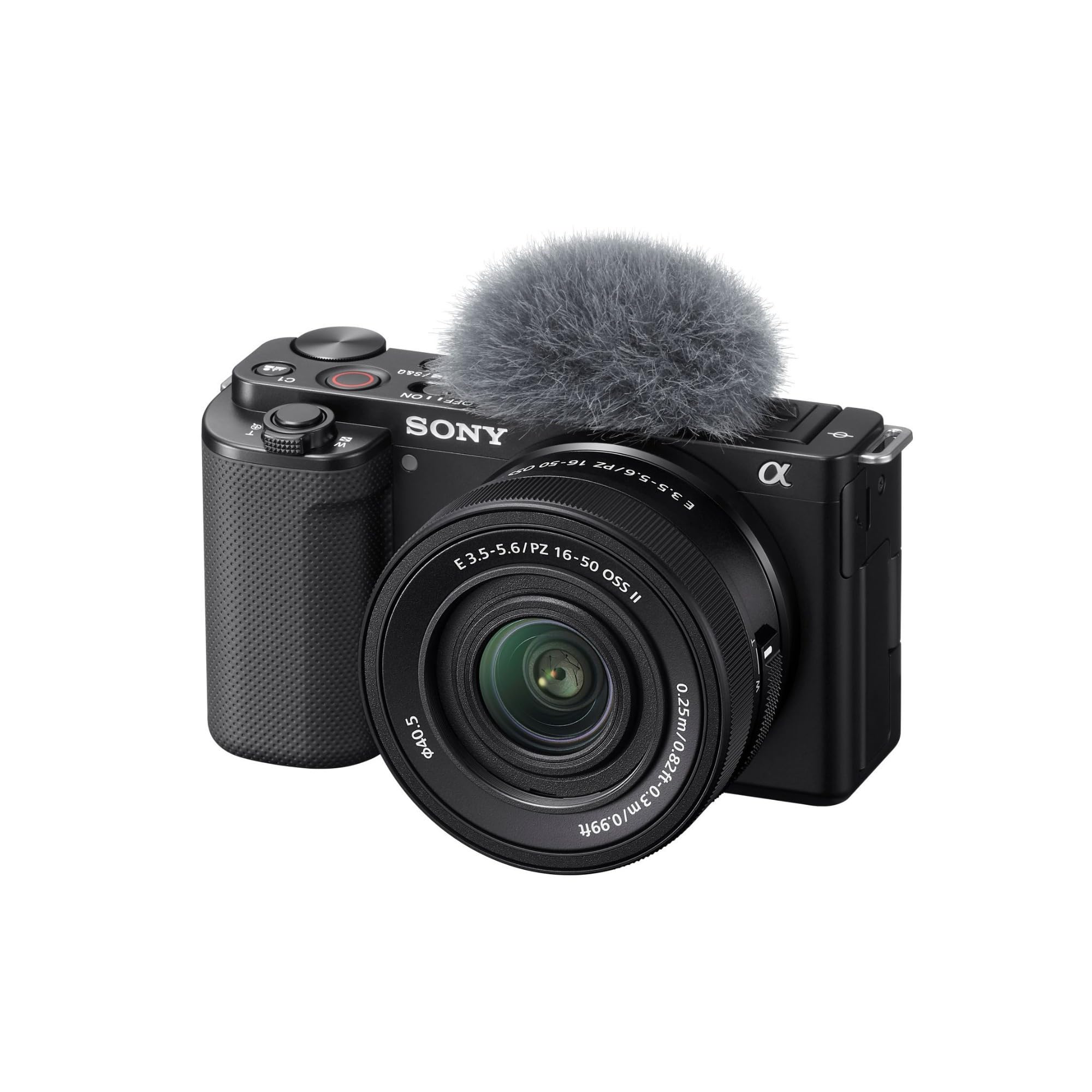
The Sony Alpha ZV-E10 pairs a 24.2-megapixel APS-C Exmor CMOS sensor with the fast BIONZ X processor, designed specifically for content creators who need both photo and video performance. The 425-point hybrid autofocus system combines phase-detection and contrast-detection for reliable tracking, and the Product Showcase Setting instantly transitions focus from face to an object held up to the lens—a killer feature for review and demonstration videos.
The camera records 4K video oversampled from 6K with full pixel readout and no pixel binning, producing sharp and detailed footage. The Background Defocus button instantly toggles between a blurred background and a sharp one, and the built-in directional 3-capsule microphone captures clean audio. The ZV-E10’s lightweight body and E-mount lens compatibility give it room to grow as your skills advance, with access to Sony’s extensive lens lineup.
Youthful creators and vloggers love the ZV-E10 for its ease of use, fast autofocus, and built-in cinematic features. Some users find the lack of in-body image stabilization limiting for handheld walking shots, and the menu system is less intuitive than Canon’s offerings. However, the video-first features and sensor quality make it a hybrid powerhouse for its price range.
Why it’s great
- 425-point hybrid AF with real-time tracking
- 6K oversampled 4K video for sharp footage
- Product Showcase mode for review content
Good to know
- No in-body image stabilization
- Battery life is moderate (440 shots)
- Menu navigation can be complex for beginners
9. Nikon Z50 II

The Nikon Z50 II offers a 20.9-megapixel DX-format (APS-C) sensor that is several times larger than a typical smartphone sensor, delivering lifelike colors and fine details from dawn to dusk. The camera comes with two zoom lenses: the 16-50mm f/3.5-6.3 VR for everyday shooting and the 50-250mm f/4.5-6.3 VR for telephoto reach, together covering a 35mm equivalent range from 24mm to 375mm—making it incredibly versatile out of the box.
The 231-point hybrid autofocus system automatically detects and tracks nine subject types, including people, dogs, cats, birds, and vehicles, plus dedicated bird and airplane modes for enhanced accuracy. The 31 built-in Picture Control presets allow you to find your aesthetic instantly, and you can download additional Cloud Picture Controls directly from Nikon Imaging Cloud to develop a unique look without post-processing.
Users upgrading from older Nikon DSLRs like the D3400 report excellent improvements in image quality, autofocus speed, and color accuracy. The Z50 II’s flip-out screen drains battery faster than expected, and only one battery is included, but the camera’s compact size, weight, and two-lens kit make it a strong candidate for everyday family photography and travel.
Why it’s great
- Two-lens kit covers wide to telephoto range
- 31 built-in presets for quick creative looks
- Reliable subject detection with dedicated modes
Good to know
- Flip-out screen drains battery quickly
- Only one battery included in kit
- Kit lenses are variable aperture and slower in low light
10. Panasonic LUMIX G100

The Panasonic LUMIX G100 is a Micro Four Thirds mirrorless camera that prioritizes video and audio quality, featuring a high-performance microphone with tracking audio that auto-adjusts to capture clear sound whether you’re indoors, outdoors, in a crowd, or recording one-on-one interviews. The camera shoots 4K video at 24p and 30p, and its iA (intelligent auto) mode makes it easy for beginners to get perfect shots without manual adjustment.
The G100 includes a frame marker for social media aspect ratios and facial recognition to keep subjects sharp. The 5-axis Hybrid I.S. reduces blur for both photos and video, and the camera supports V-Log L recording for color grading in post-production. It can also be used as a high-quality webcam via USB, making it suitable for streaming and remote work.
Users praise the G100’s compact size and straightforward menu logic, with many noting that it produces beautiful colors straight out of camera. The main limitation reported is a strict 4K video recording time cap, which can be frustrating for long events. The Micro Four Thirds sensor is smaller than APS-C, but the lens ecosystem and body features deliver strong value for hybrid shooters.
Why it’s great
- Built-in tracking microphone with 360-degree sound
- Compact, lightweight design for one-handed use
- Webcam functionality via USB
Good to know
- 4K video recording time is capped
- Micro Four Thirds sensor smaller than APS-C
- No phase-detection autofocus
11. DJI Osmo Pocket 3

The DJI Osmo Pocket 3 is a pocket-sized gimbal camera with a 1-inch CMOS sensor that records 4K video at up to 120fps, providing cinematic slow-motion capability. Its 2-inch rotatable touchscreen allows seamless switching between horizontal and vertical framing, and the 3-axis mechanical stabilization delivers ultra-steady footage without the bulk of a separate gimbal, making it ideal for action-packed vlogs, hiking, or chasing pets.
The ActiveTrack 6.0 system keeps subjects centered while the camera is mounted on a tripod or held, and the D-Log M and 10-bit color depth recording captures up to one billion colors for professional-grade color grading in post. The Creator Combo includes a DJI Mic 2 transmitter, wide-angle lens, battery handle, mini tripod, and carrying bag—significantly expanding its usability for interviews and multi-scene shoots.
Reviewers consistently call the Pocket 3 a game-changer for content creation, praising its excellent low-light performance, smooth gimbal stabilization, and ability to replace a phone for video entirely. The downsides are the fragile gimbal mechanism (needs a protective case), the 9.4MP still resolution, and the premium price for the Creator Combo. For pure video creativity in a truly portable form factor, it’s unmatched.
Why it’s great
- Pocket-sized with integrated 3-axis gimbal
- 1-inch sensor for excellent low-light video
- 4K/120fps slow-motion capability
Good to know
- Gimbal is fragile without protective case
- Still resolution limited to 9.4MP
- Creator Combo is a significant additional cost
FAQ
Is a full-frame camera worth the extra cost for photography?
How many autofocus points do I need for photography?
What is the difference between optical stabilization vs in-body stabilization for photography?
Final Thoughts: The Verdict
For most users, the best budget camera for photography winner is the Canon EOS R100 because its 24.1MP APS-C sensor, Dual Pixel CMOS AF, and compact RF mount body deliver the best balance of image quality, autofocus performance, and future upgrade potential at an accessible price. If you want superior in-body stabilization for handheld low-light shots, grab the Panasonic LUMIX G85. And for a pocketable video-first companion that replaces a gimbal, nothing beats the DJI Osmo Pocket 3.