
Our readers keep the lights on and my morning glass full of iced black tea. As an Amazon Associate, I earn from qualifying purchases.
Specs are compiled from manufacturer listings and verified buyer reviews and can change over time — please confirm the key details on the product page before buying.
If you want deep, room-filling bass without guessing which amp actually feeds a subwoofer, the short answer is simple: match a receiver that has a real subwoofer output to a powered sub that fits your room size. Get that one pairing right and everything else — the crossover, the gain, the app — falls into place. Get it wrong and you end up with thin movie explosions and boomy music no amount of knob-twisting can fix.
I’m Min — the founder and writer behind Gadgets Feed. This guide is built by comparing the manufacturers’ published specifications and the patterns across verified customer reviews, so you get each pick’s real strengths and trade-offs instead of marketing spin.
Every pick below is judged on the specs that actually change how a system sounds: honest wattage per channel, a true subwoofer output, driver size, and how low the bass reaches. Whether you are building a compact desktop rig or a full theater, this breakdown covers the Best Amplifier And Subwoofer matches worth your money.
Our Picks at a Glance


How To Choose The Best Amplifier And Subwoofer
You are not really shopping for two boxes — you are shopping for a partnership. The amp has to send a clean, controllable bass signal out, and the sub has to turn that signal into pressure you can feel in your chest without turning music into mush. Here is what actually decides whether that partnership works.
Start with the subwoofer output, not the wattage
A subwoofer output (often shortened to “sub out”) is the dedicated connection that feeds low bass to a powered sub. Without it, your bass has nowhere clean to go. Check for a single RCA sub-out or a set of sub-out jacks before you look at anything else on the spec sheet.
Match the sub to your room, not the marketing
A bigger driver (the cone that actually moves air) usually means deeper bass, but a large ported cabinet needs floor space. A sealed cabinet is typically smaller and tighter, which suits music, while ported designs push more output for movies.
Understand what amp wattage really means
Wattage ratings are often quoted for two channels only. When you drive five or nine channels at once, the real number drops. Read the RMS figure (continuous power) rather than the peak figure, and match it to your speakers’ impedance in ohms.
Leave room for tuning
Crossover, phase, and gain controls let you blend the sub into your main speakers so bass notes arrive together instead of smearing. An app that tunes the sub from your seat saves you crawling behind the cabinet.
Quick Comparison
| Model | Best For | Type | Power / Driver | Key Feature | Amazon |
|---|---|---|---|---|---|
| SVS PB-1000 Pro★ Best Overall | Serious movie bass in medium rooms | Powered ported sub | 325W RMS / 12-inch | DSP app with parametric EQ | Amazon |
| Pyle PTA62BTBudget Champion | Karaoke and PA on a budget | 6-channel amplifier | 750W peak | 2 mic inputs with echo | Amazon |
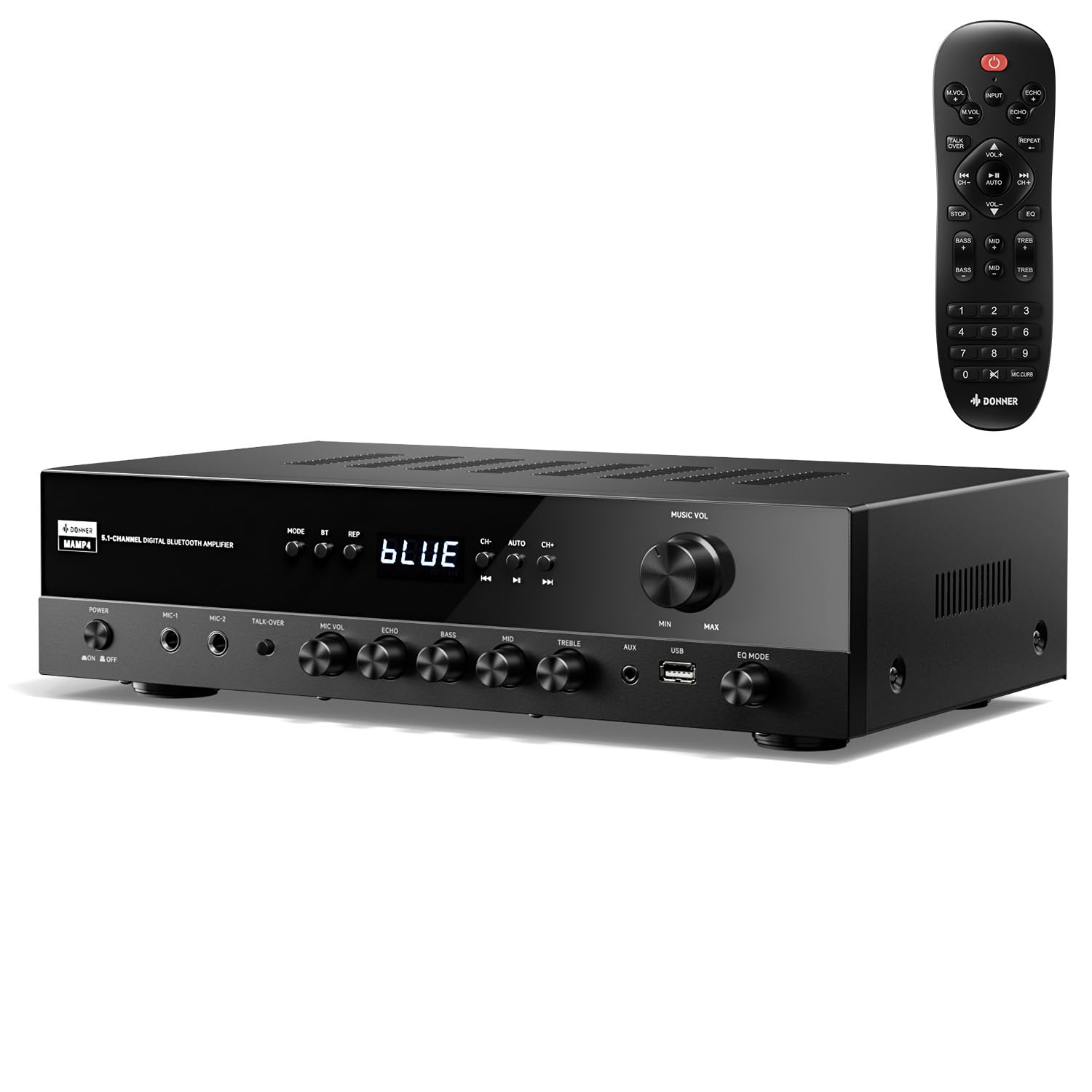
| Donner MAMP4Best for Home Theater | Budget 5.1 home theater | 5.1-channel receiver | 60W/4R + 25W×3 RMS | Bluetooth 5.3, Optical/Coax | Amazon |
| Edifier T5s | Desktop and bookshelf systems | Powered sealed sub | 70W RMS / 8-inch | 35Hz low-end, slim cabinet | Amazon |
| Fosi Audio MC351 | Compact desktop hi-fi | 2.1-channel integrated amp | 165W×2 + 350W | Vintage VU meter, built-in DAC | Amazon |
| AIYIMA A80 | Modern hi-res desktop rigs | 2.0/2.1 DAC amplifier | Max 300W×2 | ESS9038Q2M DAC, TRS inputs | Amazon |
| Sony STRDH590 | Plug-and-play TV surround | 5.2-channel AV receiver | 725W, 6 ohm, 1kHz | 4K HDR pass-through, S-Force PRO | Amazon |
| SVS SB-1000 Pro | Music-first compact bass | Powered sealed sub | 325W RMS / 12-inch | DSP app, sealed cabinet | Amazon |
| Cambridge Audio AXR100 | Stereo music and vinyl | Stereo receiver | 100W per channel | Phono stage + sub out | Amazon |
| REL T/7x | HiFi stereo in large spaces | Powered sealed sub | 200W Class A/B / 8-inch | Down-firing 10-inch passive radiator | Amazon |
| Denon AVR-X4800H | Large multi-channel theaters | 9.4-channel AV receiver | 125W × 9 | 4 RCA/XLR subwoofer outputs | Amazon |
In‑Depth Reviews
1. SVS PB-1000 Pro Subwoofer (Black Ash)
Our pick — over 4.5★ from 250+ verified ratings; the strongest balance of quality and price.
The ported monster that turns a home theater into an event you feel in your ribs.
This is the pick for the buyer who wants a first serious sub and does not want to buy twice. The 12-inch driver (the cone that actually moves air) sits in a ported cabinet, and a 325-watt RMS Sledge amplifier (RMS means continuous, honest power) drives it. That combination is aimed squarely at medium and large rooms, where a small sub simply runs out of steam.
What wins people over is how clean the low end stays. Buyers report kick drums and bass guitars stay distinct instead of blurring into one muddy note. Reviewers upgrading from 10-inch subs report the PB-1000 Pro pressurizes medium and large rooms. The SVS smartphone app is the other headline act — it lets you tune the sub from your seat instead of crouching behind the cabinet, with custom presets and parametric EQ. If you pair it with a receiver that has a proper sub-out, like the Sony STRDH590 above with its 5.2 channels, dialing in the blend is a few minutes of app work.
The honest catch is footprint. A ported 12-inch cabinet is a large box, the kind that eats a corner of the room, and this is the recurring trade-off buyers flag. It also rewards setup patience: nudging the gain and using the app’s room compensation matters more than raw volume. This is not a sub you tuck behind the couch and forget.
What Earns Its Keep
- 325W RMS (820+W peak) continuous power for serious output
- 12-inch driver in a ported cabinet for deep, abundant bass
- DSP app handles volume, presets, and parametric EQ tuning
- Clean, distortion-free sound at high volume, per the owner consensus
The Trade-Offs
- Physically large cabinet that needs real floor space
- Rewards careful setup and placement to sound its best
Top pick if: you want one sub that anchors a movie system and you have the floor space for a proper cabinet.
Think twice if: you are working with a tight corner or a small apartment where a sealed, compact sub fits better.
2. Pyle Wireless Bluetooth Karaoke Amplifier
A 6-channel amp built for karaoke nights and patio speakers, where fun beats finesse.
If your vision of a stereo includes a microphone in one hand, this is the one. The Pyle PTA62BT is a 6-channel Bluetooth amplifier rated at 750 watts peak power — “peak” means a brief maximum, not the continuous figure — and it runs speakers in 4 to 8 ohms. The 7 inputs cover USB, micro SD, AUX, and FM radio, and there are two ¼-inch microphone jacks with echo. Sub out connector is on the back, so you can add a powered sub to a party setup.
The talk-over button is the sleeper feature: trigger it and the music ducks so your announcement or page goes through clear. That single function is why this amp turns up in PA and karaoke builds. It is also compact, at 9.59 pounds, so it disappears into a shelf. Compared with the Donner MAMP4 down the list, this model trades home-theater decoding for microphone features and sheer input count, which is the right call if singing is the point.
Be honest about its ceiling, though. Run it hard and it gets warm and starts to show its limits — the documented pattern is that it wants efficient speakers and does not stay clean at the very top of its volume range. Treat it as a great value party amp rather than a critical-listening amplifier and it does its job.
Where it shines: the microphone setup and talk-over button, the wide input list, and the sub out make it a complete one-box karaoke center.
The honest limit: it is noisy and runs hot at high volume, so efficient speakers and moderate loudness keep it in its comfort zone.
Reach for this if: karaoke, parties, or a garage/patio system is the plan and you want microphones plus a sub out in one budget box.
Look elsewhere if: you need a quiet, analytical amplifier for critical music listening.
3. Donner MAMP4 5.1 Channel Audio Amplifier
A five-speaker-plus-sub receiver for people building their first surround setup on a budget.
Here is the upgrade path for the buyer moving from a soundbar to real speakers. The Donner MAMP4 handles five speakers and one subwoofer, with left/right channels rated at 60W into 4 ohms and the surround and center channels at 25W each. That is enough power for a modest living-room array, and the sub out means bass has a clean home.
The connection list is unusually complete at this level: Bluetooth 5.3 (the newer wireless standard, which means steadier pairing), Optical and Coaxial digital inputs for smart TVs, USB up to 64 GB, one RCA, one AC-3, and two ¼-inch mic jacks for karaoke. There is no HDMI input, so you route TV audio over optical or coaxial instead — worth knowing before you buy. The remote reaches the treble, midrange, bass, echo, and talk-over settings from any input, which is more than most budget receivers offer.
Two things to weigh. First, this is a PCM-only decoder — Dolby and DTS surround formats are not supported, so it plays stereo and standard digital audio rather than decoding every cinema codec. Second, reviews split on the little things: some find the interface menu fiddly to move through and the cooling fan noisier than they would like. The deep lows and clean highs are the strong suit, provided your source is feeding it correctly.
The value read: five channels of amplification plus a sub out, digital optical and coaxial inputs, and karaoke-friendly mic jacks for an entry-level price.
Know before you buy: no HDMI and no Dolby or DTS decoding, so pair it with a PCM-capable TV source.
Best fit for: a first 5.1 speaker build where you want optical TV audio and a sub out without paying for decoding you do not need.
Skip this one if: your setup depends on HDMI switching or Dolby and DTS decoding.
4. Edifier T5s Powered Subwoofer
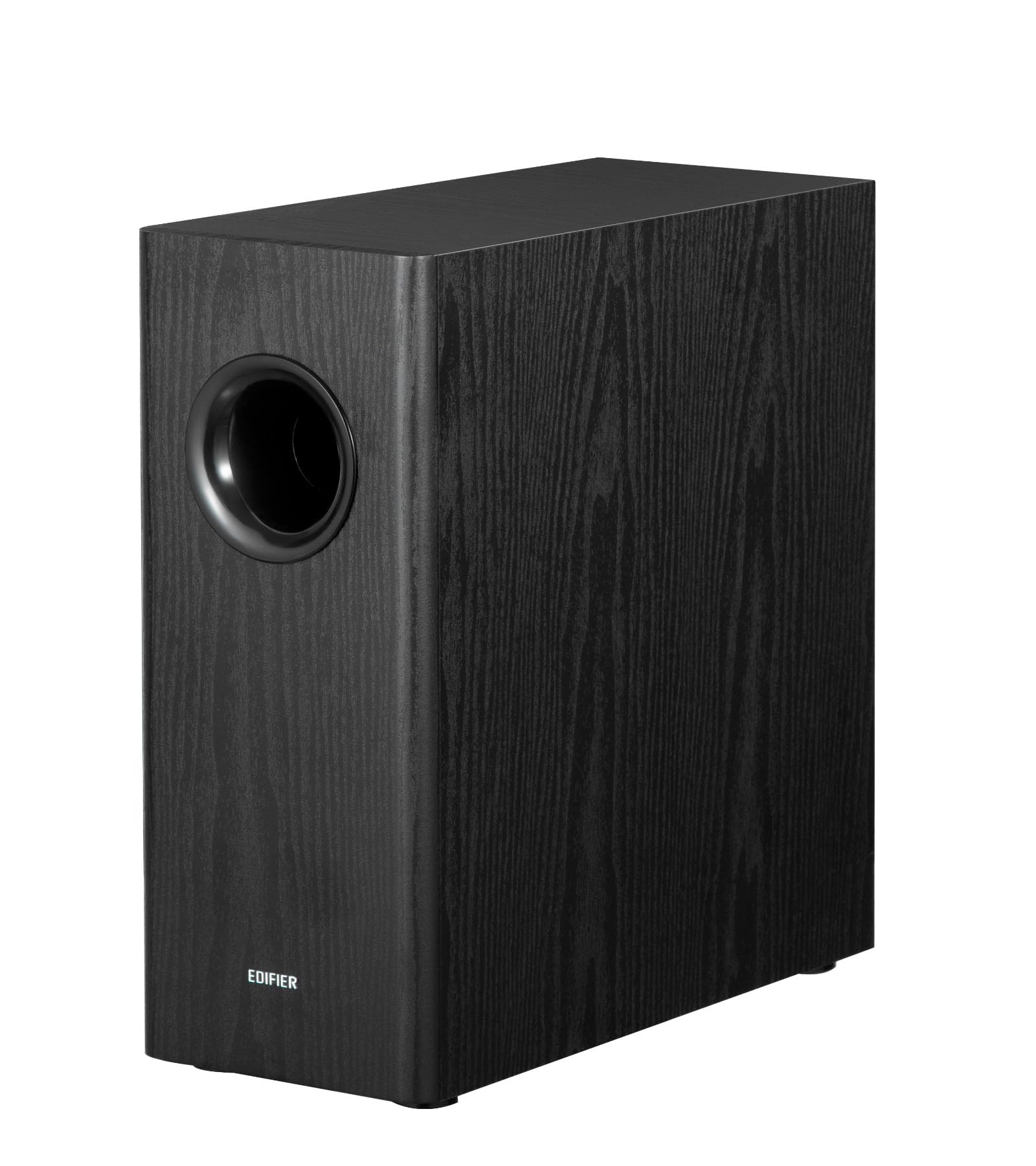
The slim under-desk sub that rescues small speakers without rattling the whole building.
Desktop and bookshelf owners, this one is aimed at you. The Edifier T5s packs an 8-inch long-throw woofer (a cone designed to travel further for more punch) and a 70W RMS Class-D amplifier into a slim 18mm MDF cabinet. It reaches down to 35Hz, so it adds genuine low-end weight rather than a thin bump. A front-firing driver and right-firing port help it sit tight against a wall without booming.
Setup is genuinely plug-and-play, and that matters if wiring intimidates you. It ships with 3.5mm-to-RCA and RCA cables, and there is a low-pass filter you can set from 30Hz to 160Hz plus a 0°/180° phase selector to match your main speakers. Two connection paths cover most rigs: if your speakers or amp have a sub out, run RCA into the T5s’ Signal In; if they do not, daisy-chain source → T5s → main speaker. It is officially matched to a long list of Edifier models and fits other desktop and bookshelf gear with RCA ports.
What gives it a clear edge in a small room is the tight, blended bass rather than raw violence. The size is the giveaway — this is a sub for a desk, office, or bedroom, not a home theater. Push it for cinema-style LFE and it will feel out of its depth, since it is designed to augment small speakers, not pressurize a big room.
Why Desktop Builds Love It
- 35Hz low-end from an 8-inch driver in a slim cabinet
- 70W RMS Class-D amp with plug-and-play RCA and 3.5mm-to-RCA cables included
- Adjustable low-pass filter (30Hz–160Hz) and 0°/180° phase control
- Small footprint that tucks under a desk or beside a shelf
Where It Stops
- Bass is refined and tight rather than chest-thumping
- Small-room tool, not a large-theater subwoofer
The smart buy if: you run small powered speakers or bookshelf monitors and want deeper bass in a desk or office setup.
Wrong tool if: you want cinema-shattering output for a large living room.
5. Fosi Audio MC351 2.1 Channel Integrated Amplifier

A little black box with dancing needles that drives real speakers and a sub from your phone.
The spec that earns the MC351 its spot is its dual TPA3255 arrangement (a TPA3255 is a high-efficiency Class-D amplifier chip) rated to output up to 165W x 2 plus 350W in a 2.1 setup. In plain terms, it has the muscle for passive bookshelf or tower speakers and a powered sub at the same time. Its all-aluminum CNC body has no visible screws, and the round mini VU meter dances to your music.
This is a true all-in-one for a compact hi-fi system. Digital decoding covers Bluetooth, USB, Optical, and Coaxial, plus five switchable inputs and bass and treble controls with center detents for tone-defeating. Owners drive Wharfedale towers and inefficient vintage speakers with it and report clean, composed sound. It stays cool through hours of use, an automatic standby kicks in after 2 minutes of silence, and it comes with a 24-month warranty.
The honest caveat is headroom and a couple of quirks. At high volume with bass-heavy tracks it can run out of clean power and start distorting, so it suits realistic listening levels rather than stadium loudness. Turntable fans should note a record player by RCA can sound inconsistent without an external preamp, there is no remote included, and the VU meter is decorative rather than functional.
The appeal: one compact box that drives true speakers and a sub with a sub out, plus four digital inputs and that retro VU meter for personality.
The catch: limited headroom at high volume and no remote, so it is best for a small-to-medium room at sensible levels.
Go for it if: you want a stylish, slim integrated amp to power passive speakers and a sub in a compact hi-fi or desktop system.
Look past it if: you push high-volume bass-heavy tracks or want a remote in the box.
6. AIYIMA A80 Bluetooth Stereo DAC Amplifier
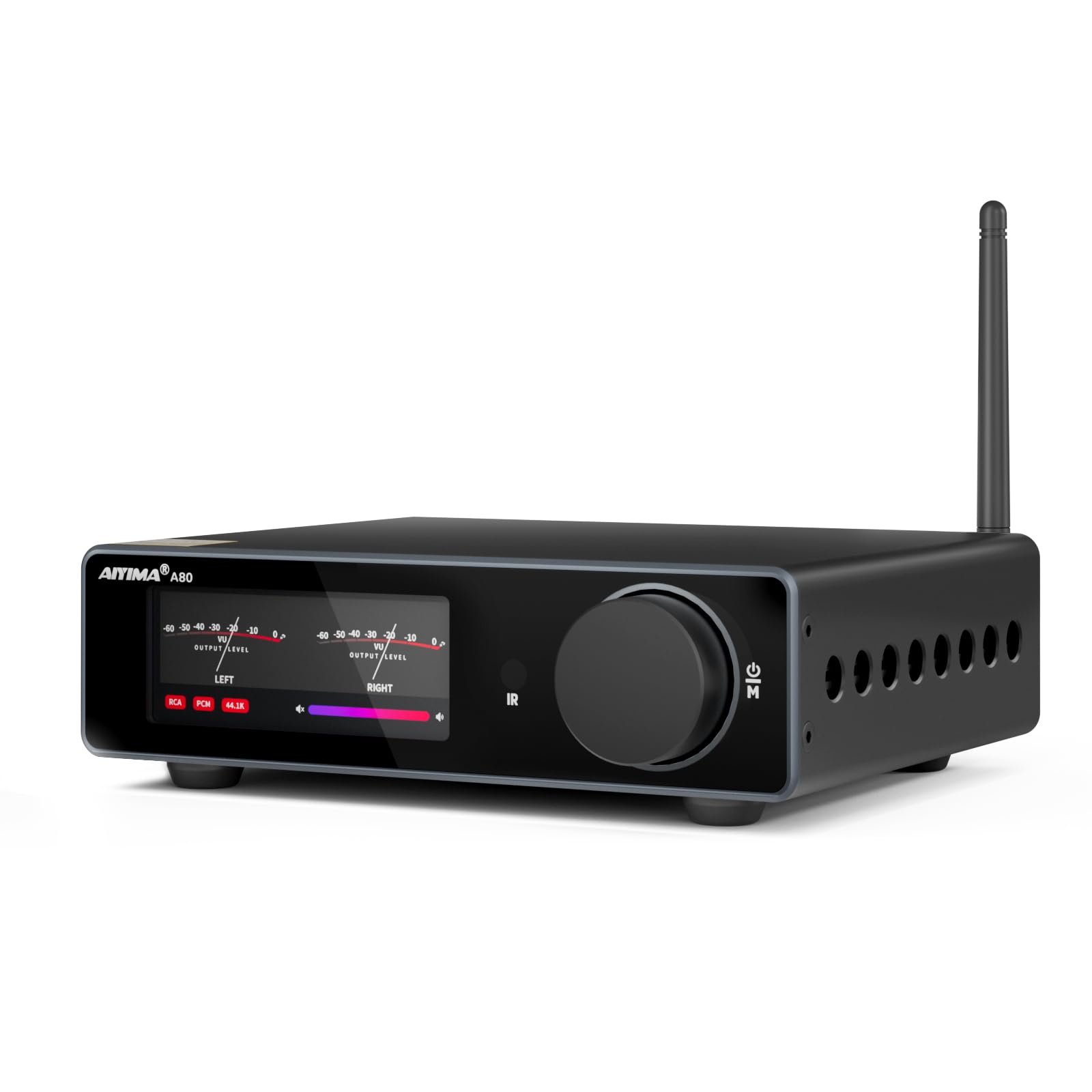
A hi-res desktop amp that pairs audiophile-grade chips with a spectrum display and a sub out.
For the buyer who wants a modern integrated amp that will not look out of place on a desk, the AIYIMA A80 is the stand-out. It combines an ESS9038Q2M DAC (a digital-to-analog converter, the chip that turns your digital files into sound) with a TPA3255 amplifier rated to a max output of 300W x 2. It supports DSD256 and high-resolution PCM, and it includes a 3.5mm subwoofer pre-out plus TRS balanced inputs — a connection type that blocks outside electrical noise for a dead-silent floor.
The features are where it pulls ahead of simpler desktop amps. Digital VU display modes show input status and volume, a remote switches sources, and there is tone control, an RCA output, and 12V trigger input for linking with other gear. Owners pair it with budget speakers and JBL 100s and report a silent noise floor even at full volume. Compared with the Fosi MC351 below it, this one adds balanced inputs and a fuller display, in a compact 1.66kg body.
Settle your expectations on two points. The display is small if you sit across the room, and it lacks auto power-on, so you press a button rather than sink into the couch and let it wake. It also runs warm after a while at average volume, which the wide vents handle but heat-wary buyers should know about.
Why It Wins the Desk
- ESS9038Q2M DAC with high-resolution DSD256 and PCM support
- TRS balanced inputs shut out noise for a silent noise floor
- 3.5mm sub out for adding a powered sub to a 2.1 system
- Digital VU display, remote, and 12V trigger input
Room to Know About
- Small display is hard to read from across the room
- No auto power-on, and it runs warm at average volume
Pick this if: you want a hi-res desktop amp with balanced inputs, a sub-out, and a display that shows you what is playing.
Weigh the details if: you value auto power-on or read your gear from across the room.
7. Sony STRDH590 5.2 Channel Surround Receiver
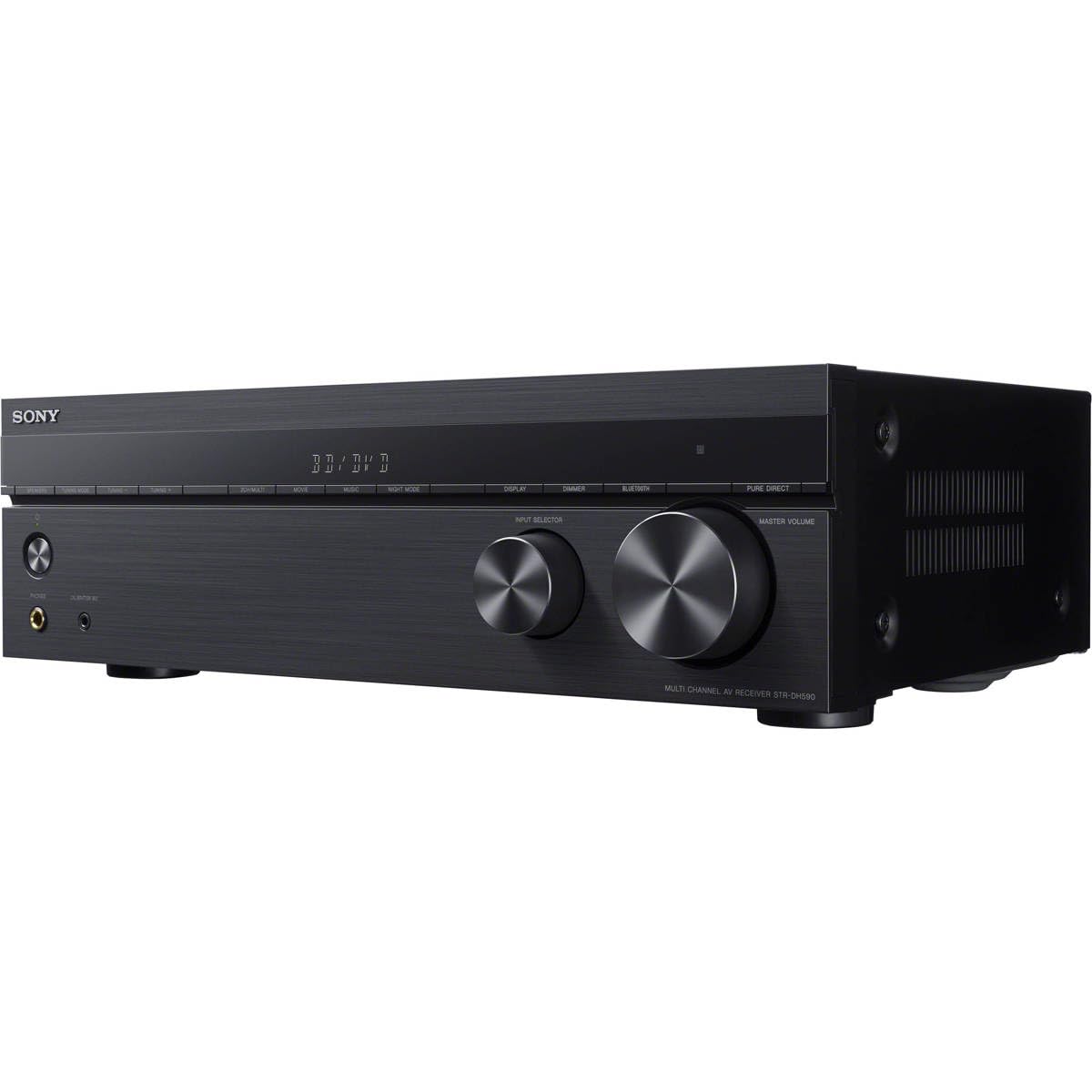
The plug-and-play 5.2 receiver that makes a TV surround build painless for a first-timer.
This is the safe, sensible center of a living-room system. The STRDH590 is a 5.2-channel AV receiver rated at 725W, 6 ohms, at 1kHz with 0.9 percent THD, and the 5.2 figure means it can drive two subwoofers at once. It passes 4K HDR video through with HDCP 2.2 support, so your TV picture stays sharp while the receiver handles the sound. It offers 4 HDMI in and 1 out with Audio Return Channel, plus a stereo RCA set and an optical and a coaxial digital output.
What makes it the beginner-friendly choice is the setup experience. Owners call it plug-and-play, citing the auto room tuner and on-screen calibration walkthrough. Bluetooth reaches across the house and supports Bluetooth Standby, so your phone can wake the receiver. S-Force PRO builds a virtual surround effect from just two speakers if you do not want a full array. Pair it with the big SVS PB-1000 Pro above and its 5.2 sub channels give you two sub outputs to run dual subs.
There are real limits to note. This model has no tone controls, no AM tuner, and no B-speaker outputs — adding a second speaker pair needs an external switch. It also has a mixed reliability history, with some units reportedly failing after a couple of years and a few throwing a “protect” error. Buy it expecting a dependable plug-and-play receiver for a few great years rather than a forever component.
What Buyers Praise
- 5.2 channels with two sub outputs for dual-subwoofer setups
- Auto room tuner and on-screen setup make calibration simple
- 4K HDR pass-through with HDCP 2.2 keeps your picture sharp
- Bluetooth Standby lets your phone turn the receiver on
Set Your Expectations
- No tone controls and no B-speaker outputs
- Mixed reliability history, with some units failing in a few years
Ideal for: a first surround build where easy setup and 4K video pass-through matter more than deep tweaking.
Consider elsewhere if: you want tone controls, dedicated B-speaker outputs, or the longest expected service life.
8. SVS SB-1000 Pro Subwoofer (Black Ash)
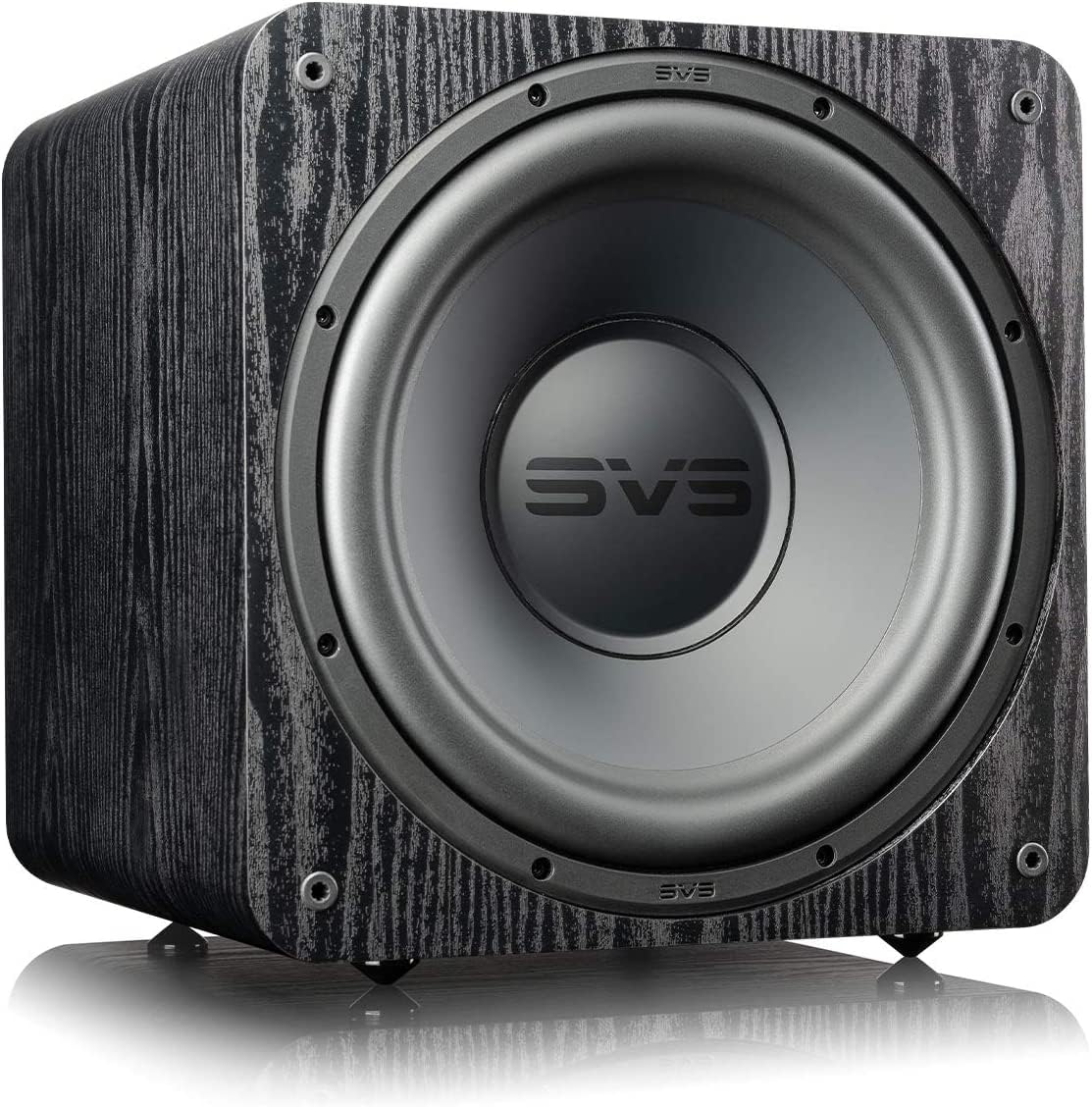
Sealed-cabinet bass that stays tight and articulate when music purity matters most.
Same power plant as its ported sibling, different philosophy. The SB-1000 Pro runs the identical 325W RMS Sledge amplifier and 12-inch driver found in the PB-1000 Pro, but houses them in a sealed cabinet instead of a ported one. That sealed design trades some raw low-end output for tighter, faster bass — the kind that makes drums sound like drums instead of a muddy thud. It is compact enough to fit in nearly any room or system, thanks to an inert, rigidly braced MDF cabinet.
The DSP app is again the star, and it is what sets SVS apart from the Edifier T5s and other budget subs: real-time tuning from your listening position, custom presets, and multiple parameters you can adjust from your phone. Owners run a single RCA to their amp, tune from the couch, and report deep bass that never overwhelms music. The sealed box also means less floor space than the ported model — a genuinely practical win for apartments.
The compromise is straightforward: closed-cabinet subs produce less output below the deepest octaves than a ported design, so for a large room dedicated to blockbuster movies the PB-1000 Pro is the stronger tool. This one is the music lover’s sub, and it rewards you with accuracy rather than sheer volume.
Why it earns its spot: 325W RMS and a 12-inch driver in a sealed cabinet tuned for tight, musical low-end that fills big rooms without boom.
The trade-off to accept: a sealed box gives up some deep-movie rumble compared with a ported sub, so it favors music over cinema.
Right for you if: music accuracy and a compact footprint top your list, especially in a smaller room.
Not the one if: you want maximum movie-shaking output in a large dedicated theater.
9. Cambridge Audio AXR100 FM/AM Stereo Receiver

A warm, powerful stereo receiver with a turntable stage and a dedicated subwoofer output.
This is the two-channel purist’s receiver, and it is built for the buyer who wants music first. The AXR100 delivers 100 watts per channel and includes a dedicated subwoofer speaker output, a built-in phono stage for a turntable, plus analogue and digital inputs. It is a straightforward stereo receiver rather than a multi-channel cinema box, which is exactly the point if movies are not your priority.
The sound is the strong suit — owners describe it as clean, clear, and warm, with a wide soundstage that reveals detail in recordings. The phono stage stays quiet with no hum, which makes vinyl sing. Bluetooth is onboard via a 3.5mm jack connection, and the remote handles the basics. Compared with the Sony STRDH590, this gives up surround channels and HDMI but adds a genuine phono stage and a two-channel topology built purely for stereo music.
The friction points are real and worth knowing. Bluetooth range is limited — a few owners found it breaks up easily — so treat it as a convenience feature rather than the main input. The fixed crossover at 200Hz is higher than some would like, the buttons on the remote are dim and hard to read in low light, and one mixed reliability report has surfaced. None of it changes how good it sounds with wired sources.
The Draw
- 100 watts per channel for easy stereo power
- Built-in phono stage for turntables plus a dedicated subwoofer output
- Warm, detailed, wide-soundstage sound with no fan noise reported
- Analogue and digital inputs cover vinyl, CD, TV, and streaming
Adjust Your Expectations
- Limited Bluetooth range, best treated as a secondary input
- Fixed 200Hz crossover and dim, hard-to-read remote buttons
Choose it if: vinyl and two-channel music are the heart of your system and you want a warm, powerful stereo receiver with a sub out.
Pass if: surround sound and reliable Bluetooth streaming are must-haves.
10. REL T/7x 8-Inch Powered Subwoofer

An audiophile subwoofer that slots into high-end stereo systems for bass you feel in your chest.
This is the connoisseur’s choice, and it is honest about what that means. The REL T/7x pairs a front-firing 8-inch driver with a down-firing 10-inch passive radiator (a driver that moves with the air pressure rather than powered directly) and a 200-watt Class A/B amplifier. It is a sealed design tuned to reach 30Hz at -6dB and is meant for rooms up to 800 square feet. Pair two for spaces over 800 square feet and the effect scales.
Its flexibility is the reason it earns premium status. It connects two ways at once — the included high-level speaker wire bridges itself to almost any amplifier for music, while a single RCA cable (not included) can feed the subwoofer output for movies. That means you can run stereo music and cinema bass from one unit. Owners pair it with high-end bookshelf and tower speakers and report tight, transparent bass on both music and movies.
Understand the intent before spending here. This sub is tuned for music and integrates beautifully into a stereo system; it is not the pick for movie-only, wall-shaking duty. It also rewards setup — a little balancing with your main speakers is what open up its best, so plan for a tuning session rather than a plug-in-and-done approach.
The premium case: an 8-inch front driver, a 10-inch down-firing passive radiator, and a 200W Class A/B amp in a sealed cabinet reaching 30Hz.
Right tool, right job: it shines blending into stereo music systems, not for movie-only rooms in the mood to rattle windows.
Built for you if: you have a quality stereo system, want musical bass you can feel, and value speaker-level and line-level flexibility.
Shop on if: blockbuster cinema rumble is your only goal.
11. Denon AVR-X4800H 9.4 Channel AV Receiver

The flagship brain for a big theater, with four subwoofer outs and room for nine channels.
If you are building a serious multi-channel room, this is the piece everything else plugs into. The Denon AVR-X4800H is a 9.4-channel receiver rated at 125W x 9, with 8K/60Hz pass-through and support for Dolby Atmos, DTS:X Pro, IMAX Enhanced, and Auro 3D. The headline for sub lovers is that it carries four RCA/XLR subwoofer outputs, which is how you run up to four subs and tame the dead spots that plague big rooms.
The connection set is genuinely comprehensive: 10 HDMI ports (7 in, 3 out) with 8K and 4K/120 support, analog and digital inputs, a phono input for a turntable, and built-in HEOS Wi-Fi for multi-room streaming. Owners running 5.2.4 and 5.1.2 arrays report all nine channels driven with clarity and depth. Audyssey room correction is included with the mic, and it can even catch wiring and phase errors during calibration. Dirac Live is available as an add-on for buyers who want to go deeper.
One honest note on the power rating: the advertised 125W is measured across two channels, and the real per-channel figure drops below that when all nine channels are driven. That is true of nearly every AV receiver, and it only matters if you run hard-to-drive 4-ohm speakers at high volume. There is also mixed feedback on the user interface being less intuitive than some rivals. Neither undercuts what this receiver does for a large theater.
What Makes It a Flagship
- 9.4 channels at 125W x 9 for full Atmos, DTS:X Pro, IMAX Enhanced, and Auro 3D
- Four RCA/XLR subwoofer outputs for multi-sub bass management
- 10 HDMI ports (7 in/3 out) with 8K and 4K/120 support and eARC
- Built-in HEOS Wi-Fi multi-room streaming plus a phono input
Worth Knowing
- The 125W rating is two-channel; real per-channel power drops when all nine channels drive together
- The user interface gets mixed feedback in reviews
Made for this buyer: someone building a full multi-channel theater with multiple subs and 8K video who wants room to grow.
Overkill if: you run a simple stereo or 5.1 setup where four sub outs and nine channels go unused.
Understanding the Specs
Subwoofer Output (Sub Out)
This is the dedicated connection that carries bass from your amplifier to apowered subwoofer. Without it, bass has nowhere clean to go, and you are stuck sending full-range signal to speakers that cannot reproduce it. A single RCA sub-out handles one sub; a receiver with multiple sub-outs (like the four on the Denon AVR-X4800H) lets you run several subs to even out bass across a big room. Always match your amp’s sub-out to a powered sub — a passive sub needs its own amplification and will not work on a line-level output.
RMS vs Peak Wattage
RMS wattage is the continuous power a unit can deliver without strain, while peak is only a brief maximum. A 325W RMS sub plays steady, clean bass for a whole movie; a “750W peak” amp only touches that figure for an instant. When comparing gear, put the RMS numbers side by side — that is the figure that predicts how loud and how cleanly it plays, not the bigger peak number.
Driver Size and Cabinet Type
The driver is the cone that moves air, and its size (measured in inches) heavily shapes how deep and how loud bass goes. A ported cabinet uses a tuned opening to boost output for movies, while a sealed cabinet trades some raw output for tighter, faster bass that suits music. Neither is universally better — match the cabinet type to whether you watch more films or listen to more songs.
Channels and Impedance
Channel count tells you how many speakers an amp can drive at once — a 2.1 setup runs two speakers plus a sub, while a 5.2 or 9.4 receiver drives multiple surround speakers and several subs. Impedance, measured in ohms, is the electrical load your speakers present; most home speakers sit at 4 to 8 ohms, and lower-impedance speakers demand more current from the amp. Match the two so the receiver is not straining to drive a load it was not built for.
FAQ
Do I need a subwoofer output on my amplifier to add a sub?
Will a 5.1 receiver like the Donner MAMP4 work with my smart TV?
What is the difference between RMS and peak wattage?
Is a ported subwoofer better than a sealed one for movies?
How many subwoofer outputs do I need on a receiver?
Can I run two subwoofers off one amplifier?
What does the crossover and phase control on a subwoofer actually do?
Why do AV receivers list power for two channels only?
Do I need 4K or 8K pass-through on a home theater receiver?
Can I use a stereo receiver instead of an AV receiver for movies?
Final Thoughts: The Verdict
For most people building a system around deep, controllable bass, the amplifier and subwoofer winner is the SVS PB-1000 Pro, because its 325W RMS amplifier and 12-inch ported driver deliver the clean, room-filling low-end that the crowd favorite — 4.8 stars across nearly 300 owners — keeps praising, and its app tuning makes blending it into a system genuinely simple. If you want compact, music-first bass that slips into smaller spaces, reach for the SVS SB-1000 Pro with its sealed cabinet. And if you are starting a surround build on a budget, the Donner MAMP4 gives you five amplified channels, a sub out, and optical TV audio for an entry-level outlay. Match the amp to the sub, give the bass a clean signal to follow, and the results speak for themselves.
How We Picked
We do not accept paid placement. Every pick is matched to a real buyer and a real use-case; we do not hands-on test units.
Sources & Methodology
Specifications: manufacturer listings and product documentation. Review insights: verified customer reviews, as of September 2026. Pricing: not shown on this page (it changes often); check the current price via the retailer link.
As an Amazon Associate, Gadgets Feed earns from qualifying purchases. This does not affect which products we feature.