
Our readers keep the lights on and my morning glass full of iced black tea. As an Amazon Associate, I earn from qualifying purchases.
Specs are compiled from manufacturer listings and verified buyer reviews and can change over time — please confirm the key details on the product page before buying.
Buying a PC case and then shopping for fans separately is the mistake almost every first build makes. You pay twice, you guess at airflow direction, and you end up with mismatched cables snaking across a glass panel. Every case in this guide already has fans screwed in and wired from the factory — you open the box, drop in your motherboard, and close it up. Before the reviews, one honest note on how these picks were chosen: this list uses flexible, human-like matching for ATX motherboard support. That means every case here genuinely fits a full-size ATX board and ships with preinstalled fans, but not every pick is the exact number or size you typed into the search bar. The nearest same-type match serves the same purpose, and we flag any size caveat in the review itself so you are never surprised at the door.
I’m Min — the founder and writer behind Gadgets Feed. This guide is built by comparing the manufacturers’ published specifications and the patterns across verified customer reviews, so you get each pick’s real strengths and trade-offs instead of marketing spin.
Airflow, GPU clearance, and fan count decide whether a build runs cool or throttles under load — and the picks below cover every budget tier. If you only remember one thing, make it this: the atx pc case with fans that ships preinstalled is the one you will actually finish in a weekend.
Our Picks at a Glance

How To Choose The Best ATX PC Case With Fans
The case is the one part you keep when you upgrade your CPU, GPU, and motherboard three years from now. Get the three numbers below right and the case outlives two GPU upgrades. Get them wrong and you are back on Amazon returning a box the size of a filing cabinet.
Check Your GPU Length Before Anything Else
Your graphics card is the longest part inside the case, so its length sets your minimum clearance. Measure your card, then compare it against the case’s listed GPU support — you want a visible gap for the power cables and airflow. The Lian Li V100RX and the FOIFKIN F1 both stretch to 420mm and 400mm respectively, which swallows three-fan flagship cards with room to spare. If you are building around a compact two-fan GPU, a case with 330mm support is plenty and you can shop the value tier.
Count The Fans, Then Check How They Are Wired
A case advertising “4 fans” can mean four daisy-chained ARGB PWM fans on a single hub, or four bare fans each needing its own motherboard header. Daisy-chain wiring (where fans plug into each other in a chain) is the easier route — you connect one lead and all four spin and light together. Bare individual leads mean you may run out of fan headers on a budget board. Preinstalled PWM fans are also the better pick over DC fans, because PWM lets the motherboard slow them down when your PC is idle instead of keeping them at a fixed speed.
The Airflow Panel Question
A glass front looks brilliant and traps heat. A mesh or perforated metal front lets air through and shows less of your build. For an air-cooled CPU and GPU, mesh in front moving air across the graphics card is what actually lowers temperatures. For a liquid-cooled loop venting through a radiator, a solid glass front with side intakes works fine. Match the panel to your cooling plan, not to the photo on the listing.
Quick Comparison
| Model | Best For | Preinstalled Fans | Max GPU Length | Top Radiator | Amazon |
|---|---|---|---|---|---|
| Lian Li V100-ATX Mid-Tower (V100RX)★ Best Overall | All-round flagship build | 4x 120mm ARGB PWM | 420mm | 360mm | Amazon |
| Zalman S3 TGBudget Champion | Budget starter builds | 3x 120mm | 330mm | — | Amazon |
| MUSETEX Y6Best Display | Showcase 270° glass builds | 4x 120mm non-LED | 410mm | 360mm | Amazon |
| MONTECH XR Panoramic | Mid-range value seekers | 3x 120mm ARGB PWM | 420mm | 360mm | Amazon |
| FOIFKIN F1 | Maximum fan count on a budget | 6x 120mm ARGB PWM | 400mm | 360mm | Amazon |
| MONTECH AIR 903 MAX | Airflow-first gaming rigs | 4x 140mm PWM | 400mm | 360mm | Amazon |
| Thermaltake View 380 TG ARGB | Back-connect motherboard builds | 4x 120mm ARGB | 415mm | 360mm | Amazon |
| Antec C5 ARGB | Liquid-cooled showcase builds | 7x 120mm ARGB PWM | — | 360mm | Amazon |
| NZXT H9 Flow | Large, quiet premium builds | 3x 140mm + 1x 120mm | — | 420mm | Amazon |
In‑Depth Reviews
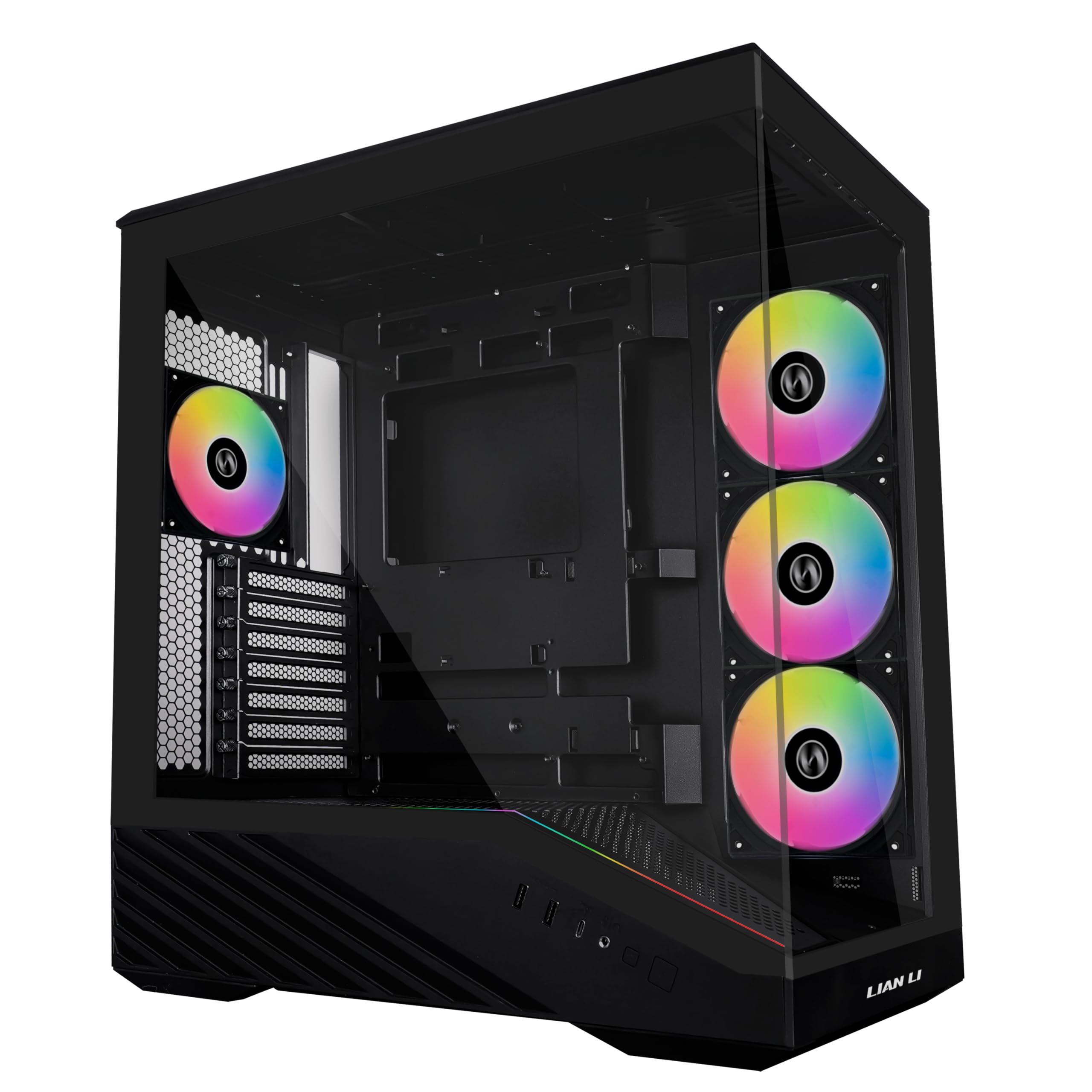
1. Lian Li V100-ATX Mid-Tower PC Case-Black-V100RX
Our pick — over 4.5★ from 550+ verified ratings; the strongest balance of quality and price.
Four PWM fans, a pillarless glass front, and room for a 420mm card — the build that finishes itself.
If you are building one PC this year and you want it to look like a display piece instead of a beige box, start here. The Lian Li V100RX arrives with four 120mm PWM-controlled ARGB fans already installed — that is PWM (pulse-width modulation, which lets your motherboard dial fan speed up and down automatically) plus ARGB (addressable RGB, meaning each individual light on the fan can glow a different color). The fans spin up to 1800 RPM, push 61.47–60.4 CFM of air, and sit at a noise level of 26.5–30.8 dBA, which is quiet enough that you will hear your GPU before you hear the case. An integrated 26-LED ARGB strip runs along the side and syncs with your motherboard software, so the whole interior lights as one system instead of four separate glowing circles.
Clearance is where this case separates itself from cheaper picks. It swallows graphics cards up to 420mm, CPU coolers up to 178mm tall, and a 360mm radiator across the top — three numbers that cover basically every current flagship part. That 178mm cooler figure is the one that matters if you run a big air tower: it beats the MUSETEX Y6’s 160mm figure, and it means the tallest Noctua-style coolers slide in without touching the glass. Both side panels detach tool-lessly, and the interior supports back-connect ATX and Micro-ATX boards, which route all your cables behind the motherboard tray for a cleaner visible build.
The build experience is the reason this crowds out the competition. Owners describe labeled parts, well-placed cable channels, and room at the bottom for a bulky non-modular PSU; buyers report “very quiet stock fans (no whine/rattle)” and GPU temps in the mid-to-high 60s under heavy 1440p load, with one noting the case holds two 360mm radiator setups. Two honest notes: the glass-and-mesh design trades some sound isolation for airflow, and the storage bay count is basic at four internal bays. This is the highest-rated pick in the lineup and it has the review history to back it up.
What Owners Keep Coming Back To
- 420mm GPU and 178mm cooler clearance — flagship parts fit without guesswork
- Four preinstalled PWM ARGB fans plus a 26-LED strip, all syncable to your motherboard
- Quiet at 26.5–30.8 dBA despite moving up to 61.47 CFM per fan
- Tool-less side panels and back-connect motherboard support for clean routing
Where It Asks A Little Patience
- Open glass-and-mesh design lets more component noise escape than a sealed case
- Four internal bays is modest if you keep a stack of spinning drives
- The rear cable channel is workable but not generous — plan your routing before you zip-tie
Reach for it if: you want one case that fits a full-size ATX board, a 420mm card, and a big air cooler with zero measuring.
Pass if: you need a drive farm inside the box or you want a near-silent sealed build.
2. Zalman S3 TG ATX Mid-Tower Desktop PC Case
Three Zalman quiet fans, a full tempered glass side, and enough room for a starter ATX rig.
Some builders want the cheapest case that still looks like a proper gaming tower, and this is that case. Zalman ships three 120mm quiet fans preinstalled — two at the front and one at the rear — behind a full tempered glass side panel that shows off your components. The front design is built for airflow rather than looks alone, the power supply gets its own dedicated space for cooler running, and there are seven PCI expansion slots with magnetic dust filters on the top and bottom. For a first gaming PC on a tight budget, this covers the essentials with nothing to assemble.
Where it slips against the higher-tier picks is internal room. It supports graphics cards up to 330mm, and it holds five internal bays — that bay count beats the Lian Li V100RX’s four, so if you are stacking hard drives this is the roomier storage case of the pair. But 330mm means a long three-fan flagship card will not fit; you are limited to two-fan or shorter triple-fan GPUs, and one reviewer specifically flagged that 240mm AIO coolers are a squeeze. The frame is also compact for an ATX case, which makes routing the CPU power cable at the top a genuinely fiddly job.
The build quality is the honest caveat here. Some owners describe the metal as flimsy and note there is not much room behind the motherboard tray, and a couple of units arrived with shipping damage. Set against that, it is one of the longest-serving picks here, with buyers reporting “Reliable after 2 years” as a quiet, low-fuss box. Treat it as an entry-level case you build once and leave alone, not one you rebuild in every year.
Where the value sits: three included fans, five bays, magnetic filters on every vent, and a tempered glass panel — the feature list reads like a case that costs noticeably more.
The trade you make: the frame is small for full ATX, so cable routing behind the board takes patience and long GPUs simply will not fit.
Ideal match: a first-time builder pairing a mid-length two-fan GPU with a stock or modest air cooler.
Not the right frame: anyone planning a 240mm AIO up top or a 340mm-plus graphics card.
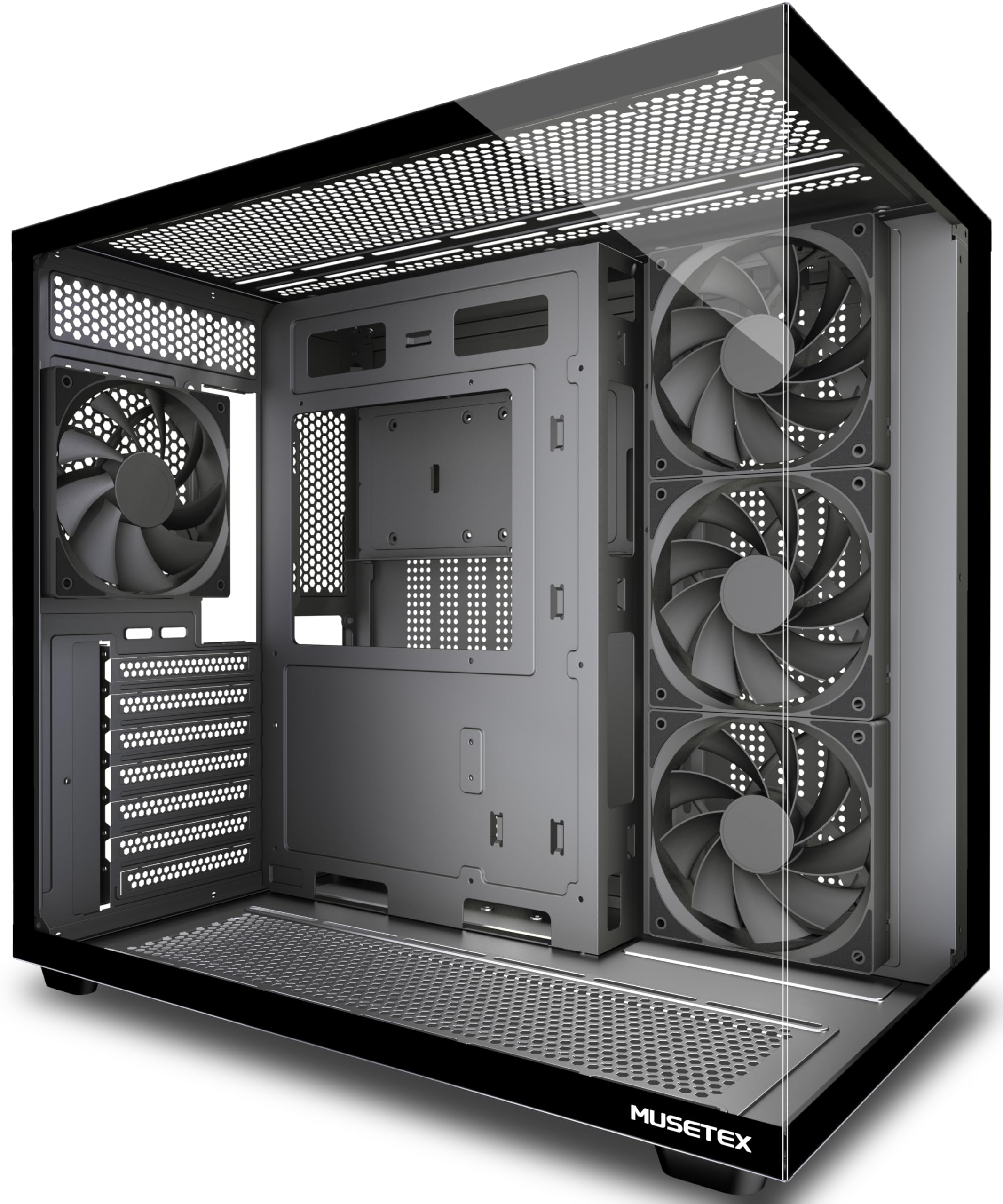
3. MUSETEX Y6 PC Case, Pre-Installed 4 Non-LED Fans, ATX Mid Tower
Two tempered glass panels wrap 270° of your build, with four fans already moving air behind them.
This is the case you buy because your finished build is the point — not the wattage, not the overclock, just the sight of a glowing GPU through dual tempered glass panels. MUSETEX uses black matte detailing and two glass panels angled to give a wider field of view than a standard single-side-window tower. Four 120mm non-LED fans come preinstalled (three reverse-blade fans on the side, one forward fan at the rear), and a front Type-C port plus USB 3.0 and USB 2.0 cover your peripherals. The dual-chamber layout keeps the power supply in its own ventilated tunnel, and magnetic dust filters on the top and bottom pull out for quick cleaning.
What owners mention again and again is how much hardware it accepts for the size. Graphics cards up to 410mm fit, CPU coolers up to 160mm, liquid cooling up to 360mm across the top, and the power supply up to 230mm. That 410mm GPU figure puts it just behind the Lian Li V100RX’s 420mm, which is a difference you will only feel if you are running the very longest flagship card. Tower coolers, meanwhile, top out at 160mm, and that is the same figure the MONTECH AIR 903 MAX beats comfortably with its 180mm clearance — so if your cooler is a tall dual-tower block, measure it before you commit.
The recurring gripe is case handling rather than cooling. Owners repeatedly flag sharp edges on the interior sheet metal during the build, and a few note that a full-size ATX board sits flush against the bottom plate, cutting into the cable channel behind it. A couple of builds ran into a misaligned standoff that left one screw unused. None of that touches the airflow or the display quality — this is a striking, cool-running showcase for a mid-range to high-end build as long as you wear gloves and plan your cable run.
The standout: 270° of tempered glass and four included fans make this the most visually dramatic case in its price tier.
Handle with care: interior edges are sharp and the cable channel gets tight once a full ATX board is in — budget extra build time.
Built for you if: the finished look is the whole point and you are running a mid-length three-fan GPU with a stock-height cooler.
Think again if: you need a 160mm-plus air tower or you want slack in the rear cable channel.
4. MONTECH XR Panoramic High Airflow ATX PC Case

A wood-grain I/O strip, three ARGB fans, and dual glass panels that make a mid-range build look deliberate.
MONTECH’s XR is aimed at the builder who wants the fish-tank look without the flagship price. Three ARGB PWM fans come preinstalled at a maximum 1500 RPM — two reverse-blade fans on the side and one regular fan at the rear — and the case accepts up to nine fans in total if you want to fill every mount later. The I/O interface uses a mature wood-grain design that separates it from the usual black plastic strip. Dual tempered glass panels cover the front and side, and magnetic dust filters cover the top, bottom, and side, so cleaning does not mean a full teardown.
Compatibility is quietly impressive for the size. It also fits 3.5-inch hard drives plus 2.5-inch SSDs and uses tool-free GPU mounts, so you can drop in a three-fan card, a 360mm AIO, and storage without hunting for a screwdriver. Its three internal bays trail the Lian Li V100RX’s four, though the gap is small in practice.
The strongest warning in the owner feedback is fan noise at full tilt. A number of buyers describe the stock fans as audible across the room at high RPM, and one returned the case for a quieter model because of it. If your PC sits on the desk next to your monitor and you work in silence, plan on a custom fan curve in BIOS or swapping the ARGB fans for quieter ones. For everyone else, this is a genuinely well-rounded mid-range case that looks far more expensive than its tier.
Why It Earns the Slot
- 420mm GPU and 360mm top radiator support in a compact mid-tower footprint
- Three ARGB PWM fans preinstalled, with room to expand to nine total
- Magnetic dust filters on top, bottom, and side for easy upkeep
- Tool-free GPU mounts and a wood-grain I/O strip that reads as premium
The Recurring Caveat
- Stock fans get loud at full RPM — a BIOS fan curve is close to mandatory on a desk
- Fingerprints land on the glass panels fast and need regular wiping
- No 140mm fan support, so your upgrade path tops out at 120mm units
Worth your money if: you want panoramic glass, plenty of fan expansion, and a 420mm-capable frame without flagship-tier outlay.
Look elsewhere if: silence at high RPM is non-negotiable or you plan to run 140mm fans.
5. FOIFKIN F1 PC Case, 6 PWM ARGB Fans, ATX Mid-Tower
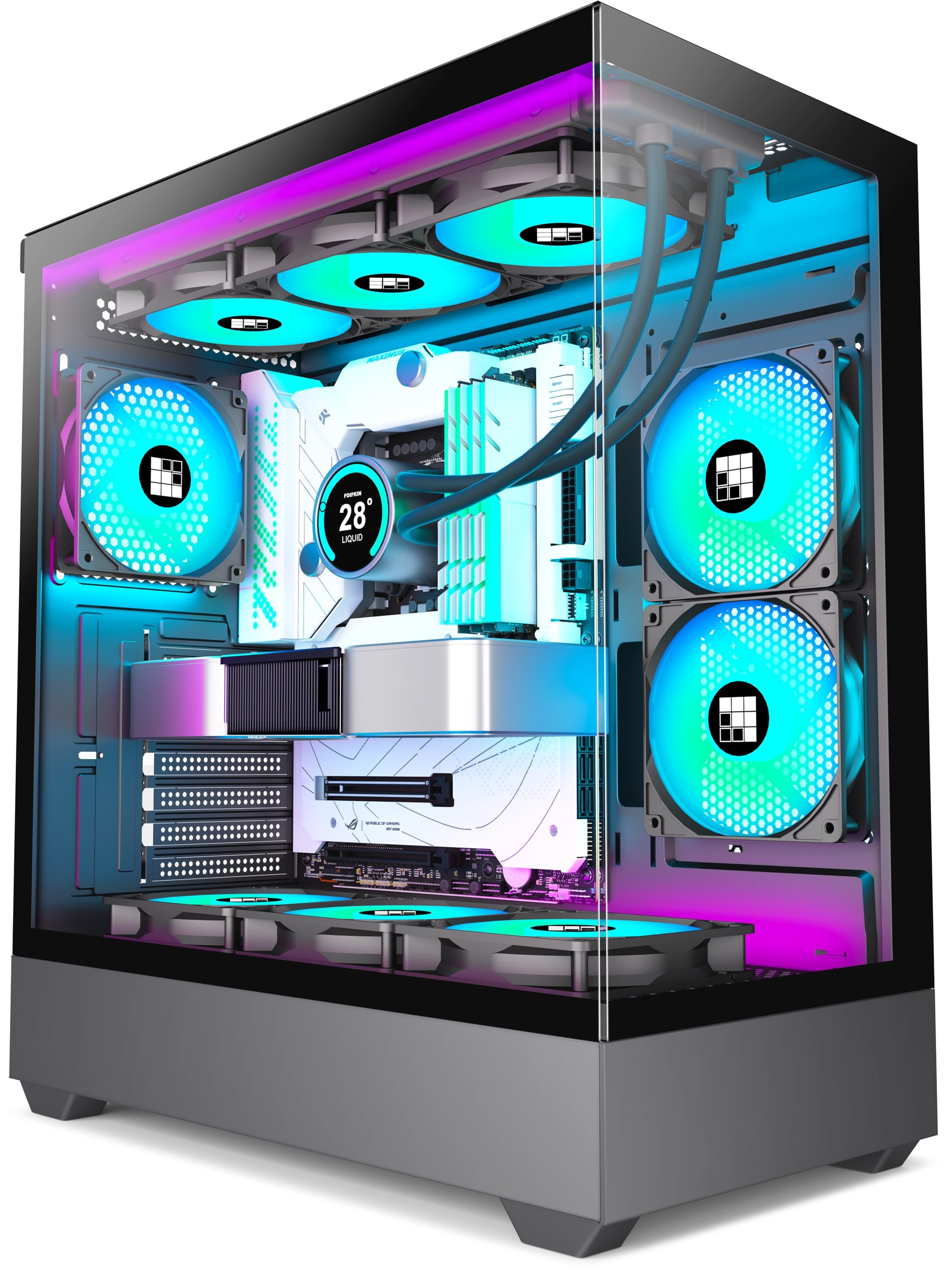
Six ARGB PWM fans from the start — the most airflow per dollar in this lineup.
If your build priority list is “how many fans do I get for my money,” this is the case that answers it most loudly. FOIFKIN packs six 120mm ARGB PWM fans into the F1 — five reverse-blade fans and one forward fan — all preinstalled and daisy-chained so they light and spin as one group. The dual-chamber layout separates your motherboard and GPU from the power supply, which improves both thermals and the cable routing behind the tray, and full tempered glass wraps the whole build for display. The front panel carries one Type-C, one USB 3.0, two USB 2.0 ports, plus mic and audio jacks.
The fit figures are generous for a mid-tower. Graphics cards up to 400mm drop in, the top accepts a 360mm radiator, and air coolers go up to a stated 170mm in height. Storage runs to one HDD plus three SSDs across four internal bays. Before you buy a 3.5-inch drive, note the listing supports a single hard drive — if you keep a RAID of spinning disks, this is not the frame for it. The power supply bay, meanwhile, accommodates units up to 200mm, and the case itself is a standard 430 by 123 by 490mm mid-tower footprint.
The fan wiring is the one thing to plan around. Owners note the six fans use a newer ARGB 5V harness, so an older RGB motherboard will need a converter to sync them, and a couple of builds had to reposition fans to daisy-chain all six on the available leads. There are also scattered reports of a few fans arriving faulty — a shipping risk, not a design flaw. Get past that and the near-fully-assembled build, real glass, and quiet strong airflow make this the budget crowd-pleaser of the set.
The headline: six preinstalled ARGB PWM fans daisy-chained and ready is more included airflow than any other case in this lineup.
Worth knowing: the 5V ARGB harness needs a converter on older RGB boards, and one HDD bay keeps you on SSDs for most storage.
Made for you if: you want maximum included fans, a dual-chamber build, and a Type-C front panel on a mid-range budget.
Skip if: you run multiple 3.5-inch drives or you are on pre-ARGB motherboard lighting.
6. MONTECH AIR 903 MAX High Airflow E-ATX PC Case

A 51% ventilation-rate metal front panel and four 140mm fans — built for builds that run hot.
Airflow is the entire design brief on the AIR 903 MAX, and MONTECH states it plainly: a metal front panel with a 51% ventilation rate (a measure of how much of the panel is open air rather than solid metal). It ships with four 140mm PWM fans — three HP140 ARGB units and one plain HP140 — wired through a bundled LED and PWM controller that drives 21 lighting effects. The larger 140mm fan size moves more air at lower RPM than a 120mm fan, which is why the four-fan count here does more thermal work than a six-fan array of smaller units. It also supports E-ATX boards, so it accommodates larger motherboards than the ATX-only picks deeper down this list.
Clearance climbs with the size. CPU coolers go up to 180mm in height — the tallest ceiling in this roundup, beating the 160mm MUSETEX Y6 by a clear 20mm — and graphics cards up to 400mm long and 190mm wide, which covers the big triple-slot flagship cards. Two 360mm AIO positions at the front and top give liquid coolers plenty of room. The mesh front panel doubles as a removable dust filter, so clearing it out takes seconds rather than a teardown.
The honest trade-off is noise at the top end and sheer bulk. The stock 140mm fans push serious air but get loud at high RPM — owners recommend setting a custom fan curve in BIOS to tame them, and the ones who do describe the resulting build as very quiet. It is also a genuinely large mid-tower, and one build noted roughly five inches of unused space at the front. If you want a compact case, this one will surprise you on the desk; if you want cool and quiet with the ability to tune it, the fan controller makes that easy.
Why Airflow Fans Pick This One
- 51% ventilation rate metal front panel is the most open face in this lineup
- Four 140mm PWM fans move more air than smaller 120mm units at the same RPM
- 180mm cooler clearance and 400mm GPU support clear flagship parts
- E-ATX support and dual 360mm radiator positions for water-cooled builds
Watch Before You Buy
- Stock 140mm fans are loud at high RPM until you set a custom fan curve
- Physically large for a mid-tower — measure your desk or shelf first
- Two internal bays keeps spinning-drive storage minimal
The right pick if: your build runs hot, your parts are large, and you will spend five minutes on a BIOS fan curve.
Wrong pick if: you want a small footprint or you never want to open the fan settings.
7. Thermaltake View 380 TG ARGB Black ATX Case

A dual-chamber pillarless glass case with four fans and room for a 415mm card behind the glass.
Thermaltake designed this for the builder who hates cables crossing the front of the motherboard. The View 380 is a dual-chamber case with a pillarless front and side tempered glass panel, and it is built to work with hidden-connector motherboards — the kind where power and front-panel wiring plug into the back of the board so nothing shows through the glass. Four 120mm hydraulic-bearing ARGB Lite fans come preinstalled, and the I/O carries one Gen.2 USB 3.2 Type-C port, two USB 3.0 ports, and HD audio. A hidden-connector layout combined with dual chambers is the cleanest-looking build path in this lineup.
The clearance numbers land in the middle of the pack but comfortably. Max graphics card length is 415mm — just under the Lian Li V100RX’s 420mm ceiling — and the top supports a 360mm radiator. Three internal bays hold your drives. Combined with the dual-chamber design that hides the power supply and cables behind the motherboard, this is a case built around making a complex build look simple. Owners describe fitting dual radiators, a 280mm and a 240mm together, with room left for routing hoses and cables behind the tray.
The one construction detail to note is the PCI slot covers, which are mesh knockouts rather than reusable standard covers — once you knock a slot open, that blank is gone for good. Beyond that, owners praise the well-aligned threaded holes and fans that stay quiet a year on. A few owners also mention the rear cable channel gets tight once a full power supply and modular cables are in place. One owner ran eleven fans in a single build and still called it whisper-quiet, so the mounts leave real airflow headroom.
The clean-build advantage: hidden-connector motherboard support plus dual chambers means the visible side stays cable-free.
The trade: PCI slot covers are one-way mesh knockouts and the rear cable channel is tight with a modular PSU.
For you if: you are running a hidden-connector board and want the cleanest possible visible interior.
Second thought if: you expect to reuse PCI slot covers or you pack a large modular power supply.
8. Antec C5 ARGB Mid-Tower ATX PC Case

Seven ARGB PWM fans and a built-in controller — this is a showcase case for a water-cooled build.
Seven fans is a lot to get in the box, and Antec pairs them with a built-in ARGB and PWM fan controller so you are not hunting for a separate hub. The C5 includes six reverse fans and one standard fan, all preinstalled and PWM-controlled, which means the motherboard can slow them down together. It uses a full-view dual-chamber design with a smooth edge on the front and side panel, supports back-connect motherboards, and clears a 360mm radiator. Its five internal bays make it the roomiest storage configuration in this lineup.
The dual-chamber layout here is the star when you go liquid. Owners fit a 280mm AIO at the top with room to spare, and one build ran a twin-360 radiator setup with a Project Zero board for a genuinely clean interior. The wider-than-tall shape gives you more space behind the motherboard for cable storage than a standard tower — which is exactly what a pump, tubes, and a pile of fan cables need. It also accepts 120mm and 140mm fans and a top-mounted power supply, and E-ATX boards beyond plain ATX.
Here is the honest part: the bottom fans can block the bottom I/O ports, which forces some builders to pull them out or reroute just to get their front-panel cables seated, and the case runs a bit shallow at the bottom for cable access. There are also reports of rear fan cables that are longer than needed and fold easily. Plan your front-panel connections before the fans go in and those issues disappear. As a display-and-cooling case with a massive included fan count, it is a standout.
Where It Wins
- Seven ARGB PWM fans plus a built-in fan controller, all preinstalled
- Five internal bays — the most storage room in this lineup
- Dual-chamber, wider-than-tall shape gives extra space behind the motherboard
- Back-connect motherboard support for a cleaner visible build
Build-Before-You-Bolt Notes
- Bottom fans can sit over the bottom I/O ports and complicate the build
- The bottom of the case runs shallow for cable access
- Rear fan cables arrive long and prone to folding
Best fit for: liquid-cooled showcase builds with a big radiator, a Project Zero board, and no shortage of fan mounts.
Pause for: the fact that front-panel cabling needs planning before the bottom fans go in.
9. NZXT H9 Flow – Dual-Chamber ATX PC Case – Black
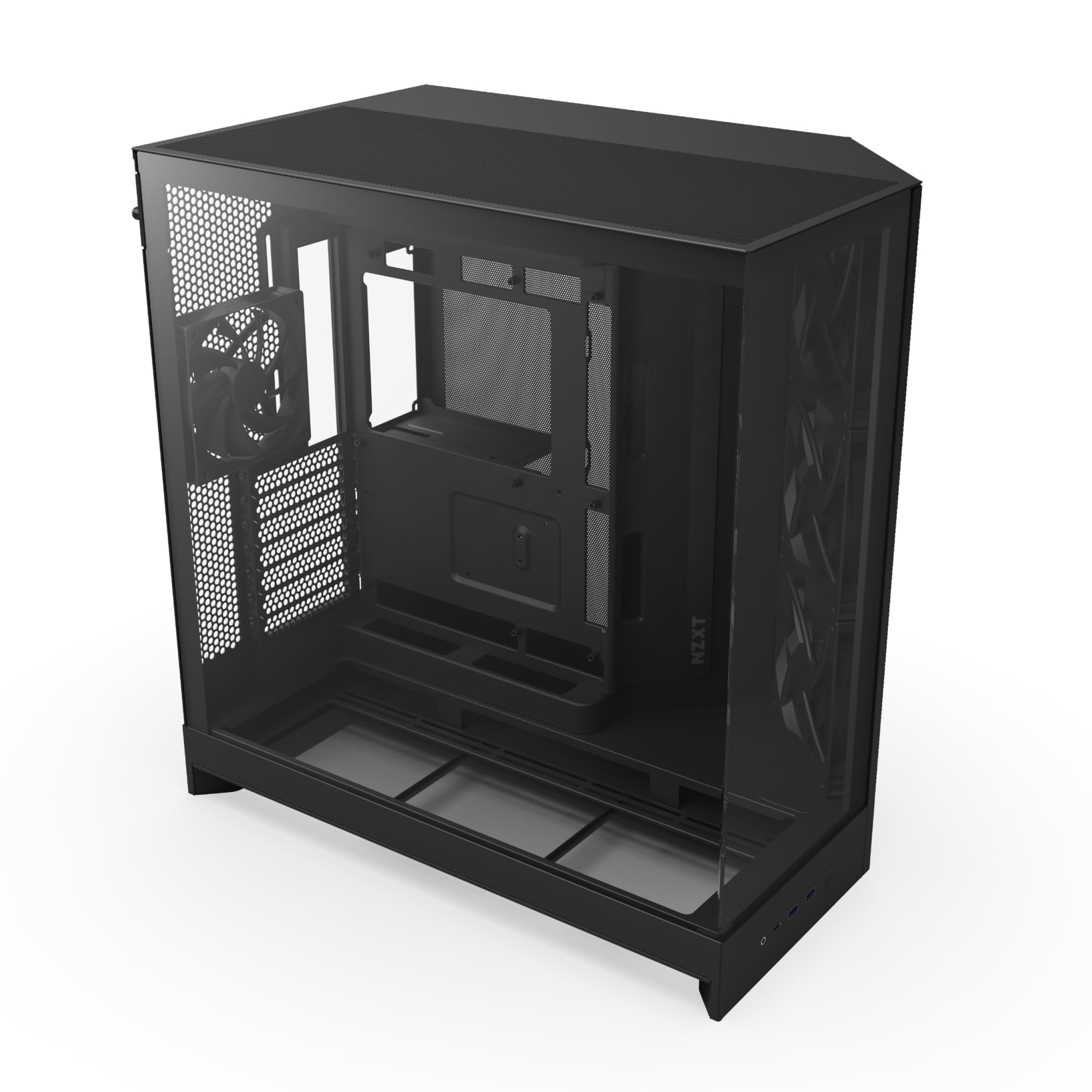
Wraparound glass, a dual-chamber shell, and clearance for a 420mm radiator at the top.
NZXT’s H9 Flow is the big-name premium option, and it earns its tier on radiator clearance alone. It fits up to a 420mm radiator on the top and front-right — a larger radiator size than the 360mm ceiling most of the mid-range picks here offer — and it holds ten internal bays, more than any other case in this roundup. A perforated steel panel with angled front-right fans keeps air moving, and four fans come preinstalled: three F140Q (CV) 140mm fans in the front-right and one F120Q (CV) 120mm fan at the rear. CV means “Case Version,” a 3-pin DC fan rather than a 4-pin PWM unit, so the included fans run at a more fixed speed than the PWM fans in the cheaper cases here.
Panoramic wraparound tempered glass shows the whole build, and the dual-chamber layout separates the main components from the power supply and drives for better thermals and cleaner routing. Cable management is the standout feature: extra-wide channels, built-in Velcro straps, and tie-down points make the rear tray easy to tame, which is why owners so often describe a clean finished interior. It is back-connect ready for rear-connecting motherboards like ASUS BTF and MSI Project Zero, so you can hide the main power connectors entirely from the glass side.
The recurring notes are size and price. This is a physically enormous case — one owner measured it against the MONTECH AIR 903 MAX and found it bigger in every direction — and the same bulk that gives you room can feel like overkill for a modest build. It is also the heaviest case here. For a builder who wants space and quiet over compactness, those are features, not faults. It is the most expensive pick in this lineup, and it delivers on space and radiator capacity in return.
What sells it: 420mm radiator support, ten bays, and best-in-line cable channels make this the roomiest frame in the roundup.
What to weigh: it is the largest and heaviest case here, and the included fans are 3-pin DC rather than PWM.
Choose this if: you want maximum radiator size, the most internal bays, and the easiest cable management in the lineup.
Reconsider if: desk space is limited or you would rather spend the fan budget on PWM units.
Understanding the Specs
Max GPU Length
The longest graphics card your case will physically accept, measured end to end. If your card exceeds the figure, it simply will not seat in the PCIe slot with the panel on. Leave headroom beyond the card’s length for the power cables that plug into its end — a card sitting right at the limit can force the cables into the glass. This is the first number to check before buying any case.
CPU Cooler Height
How tall a tower air cooler the case can swallow before it clashes with the side panel. Big dual-tower air coolers run tall, and a case that clears a modest single-tower cooler may not clear the largest ones. Air coolers here range from 160mm up to 180mm of clearance, and that is the difference between fitting a large cooler or switching to a low-profile unit or an AIO.
Preinstalled Fan Type (PWM vs DC)
PWM fans have a fourth wire that lets your motherboard control their speed in fine steps, so they spin slow and quiet when the PC is idle and ramp up only under load. DC fans, often labeled CV or 3-pin, run near a fixed speed instead. For a case you will live with daily, PWM fans are the ones you want — they stay quiet on a desktop and still deliver full airflow under gaming load.
Fan Size and Airflow
Fan size is measured in millimeters, and a larger 140mm fan moves more air at a lower RPM than a 120mm fan, so it does the same cooling job more quietly. Airflow is measured in CFM (cubic feet per minute), the volume of air a fan moves per minute. A case with four 140mm fans can move more total air than a case with six 120mm fans, which is why fan count alone does not tell the whole airflow story.
Radiator Support
Liquid cooling radiators are sized by their length in millimeters, and the case has to have a mounting position wide enough to hold that length plus the fans attached to it. A 360mm radiator needs a 360mm mount. Check that the top, front, or side of the case lists a radiator size at least as large as your AIO, and remember a thick radiator with fans uses more clearance than a slim one.
Dual-Chamber Design
In a dual-chamber case, the motherboard, GPU, and cooler sit in the front chamber while the power supply and drive cages move into a second chamber behind the motherboard. That separation keeps the power supply’s heat away from your CPU and GPU, and it opens up the space where your cables run, so the visible side stays clean. It is the layout most used in fish-tank style glass cases.
FAQ
Will a full-size ATX motherboard fit all the cases in this list?
How do I know if my graphics card is too long for a case?
Are the preinstalled fans in these cases good enough or should I replace them?
How many fans can each of these cases hold in total?
What is the difference between a 360mm and a 420mm radiator in a case?
How tall can my CPU air cooler be for these ATX cases?
Do these cases support a vertically mounted graphics card?
Can I fit a 240mm AIO in the budget-friendly Zalman S3 TG case?
What does dual-chamber mean and does it actually help cooling?
Is it worth buying a case that already has fans versus one without?
Final Thoughts: The Verdict
For most builders, the atx pc case with fans winner is the Lian Li V100-ATX Mid-Tower V100RX because it does the one thing a case is supposed to do — fit everything without argument. It clears 420mm graphics cards, a 178mm air cooler, and a 360mm top radiator, ships with four PWM ARGB fans that owners genuinely call quiet, and is the top-rated pick in this roundup. If raw airflow and the biggest cooler clearance matter most to you, the MONTECH AIR 903 MAX has the 51% ventilation front panel and 180mm cooler room to back it up. And if your build is going to be water-cooled and shown off, the Antec C5 ARGB gives you seven installed ARGB PWM fans and five internal bays to work with. One honest nudge before you decide: a case is the part you keep through several upgrades, so buying the one with the clearance and fan count you will actually grow into — rather than the cheapest one today — is the choice you will not regret. Pick your GPU length first, match the cooler height second, then let the fan count and the look decide between the finalists.
How We Picked
We do not accept paid placement. Every pick is matched to a real buyer and a real use-case; we do not hands-on test units.
Sources & Methodology
Specifications: manufacturer listings and product documentation. Review insights: verified customer reviews, as of September 2026. Pricing: not shown on this page (it changes often); check the current price via the retailer link.
As an Amazon Associate, Gadgets Feed earns from qualifying purchases. This does not affect which products we feature.