
Our readers keep the lights on and my morning glass full of iced black tea. As an Amazon Associate, I earn from qualifying purchases.
Specs are compiled from manufacturer listings and verified buyer reviews and can change over time — please confirm the key details on the product page before buying.
If your car’s factory door speakers go quiet and thin the moment the bassline drops, you do not need a subwoofer box taking up your trunk — you need a better 6.5-inch driver in the doors. The picks below all share one job: move enough air at 6.5 inches to put real low-end punch in your cabin. Some are drop-in coaxial sets you can fit without cutting metal. Others are component kits with separate tweeters for people chasing accuracy. One up front is the clear favorite, holding a 4.6-star average across 700+ ratings. One quick note before you scroll: this list uses flexible, human-like matching for 6.5-inch speaker size, so it accepts 6.5 and 6-1/2 inch drivers and rejects 6×9, 5.25, and 4×6 sizes. Not every pick is the exact number you searched — the nearest same-type size serves the same purpose, and we tell you which is which.
I’m Min — the founder and writer behind Gadgets Feed. This guide is built by comparing the manufacturers’ published specifications and the patterns across verified customer reviews, so you get each pick’s real strengths and trade-offs instead of marketing spin.
Every option here is a 6.5-inch car speaker judged on cone material, power handling, and how owners describe the low end once it is bolted into a real door. That is exactly the lens we use to rank the bass 6.5 car speakers worth your money.
Our Picks at a Glance

How To Choose The Best Bass 6.5 Car Speakers
Bass from a 6.5-inch door speaker is not magic — it is cone area, cone travel, and clean power working together. Get those three right and a modest set of door drivers will thump noticeably harder than the factory paper cones.
RMS Power Tells You If You Need An Amp
RMS power is the wattage a speaker handles continuously, not the big peak number on the box. A factory head unit typically sends only around 15 watts per channel, so a speaker rated for far more than that will play, but it will sound thin until you feed it real power. Match your speaker’s RMS rating to what your head unit or amplifier can deliver, and you get the clean low-end a high-power speaker is built for.
Cone Material And Surround Shape Drive The Thump
The woofer cone is the piston that pushes air, so its material matters. Mica-injected polypropylene and treated paper cones both resist flex at high volume, which keeps bass tight instead of muddy. A surround is the flexible ring gluing the cone to the frame — a taller, multi-roll surround allows more travel, and more travel is what lets a 6.5-inch driver play lower notes without distorting.
Quick Comparison
| Model | Best For | Speaker Type | RMS Power | Size | Amazon |
|---|---|---|---|---|---|
| HERTZ UNO K-165★ Best Overall | Best overall door upgrade | 2-Way Component | — | 6.5 inches | Amazon |
| Rockford Fosgate R165-SBest for Vocals | Clean crisp factory replacement | 2-Way Component | 40W RMS / 80W peak | 6.5 inches | Amazon |
| DS18 PRO-ZT6Maximum Output | Maximum loudness | 2-Way Coaxial | 225W RMS / 450W Max | 6.5 inches | Amazon |
| Pioneer TS-A653FH | Efficient stock-system upgrade | 2-Way Coaxial | 75W continuous / 340W max | 6.5 inches | Amazon |
| JBL GTO629 | Adjustable treble placement | 2-Way Coaxial | — | 6.5 inches | Amazon |
| Pioneer TS-M651PRO | Open-show sound pressure | 2-Way Component | 120W continuous / 500W max | 6.5 inches | Amazon |
| KICKER 51KSC6504 | Shallow-mount fit without mods | 2-Way Coaxial | — | 6.5 inches | Amazon |
| Alpine S2-S65 | Hi-Res detail on a budget | 2-Way Coaxial | 80W RMS / 240W peak | 6.5 inches | Amazon |
| Memphis PRX60C | Component build with real crossovers | 2-Way Component | — | 6.5 inches | Amazon |
In‑Depth Reviews
1. HERTZ UNO Series K-165 6.5″ Two-Way Component Speaker System (Pair)
Our pick — over 4.5★ from 700+ verified ratings; the strongest balance of quality and price.
Water-repellent cones and neodymium tweeters that wake up tired factory doors
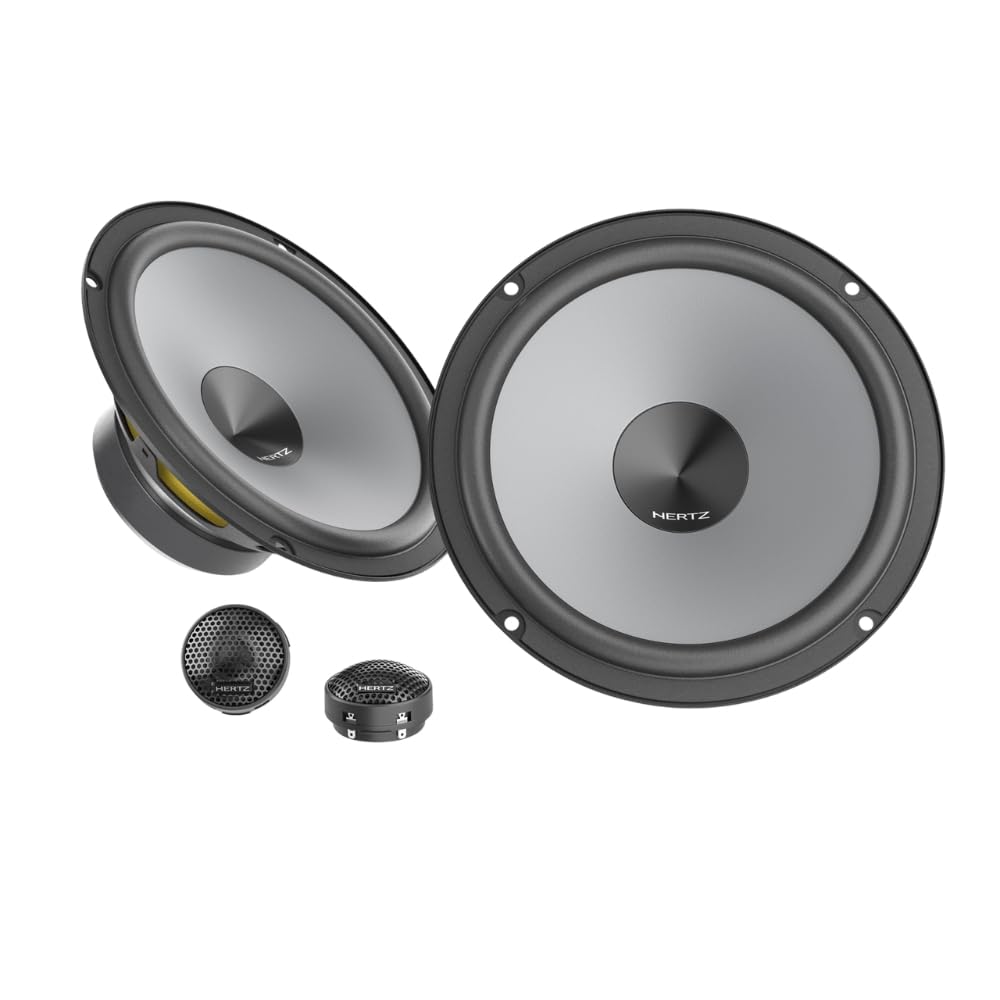
This is the pick for the person who wants more bass without turning the cabin into a project car. Hertz builds the K-165 as a two-way component system — meaning the woofer and the tweeter are separate pieces, so the low notes and the high notes each get their own driver instead of sharing one. The 6.5-inch woofer uses a water-repellent pressed paper cone, which shrugs off the damp that builds up inside a car door.
What wins people over here is how hard it plays at any given wattage. Owners describe an immediate jump in volume and quality over stock drivers, with noticeably fuller bass. Buyers report swapping them into a 2019 Honda Accord Hybrid and getting a bigger, cleaner sound straight away. The component layout also lets you aim the separate tweeter where it belongs, rather than firing your highs at your knees.
The catch is that these reward real power. The sound is natural and clean, but owners mention they “do required power to sound good” — meaning a factory head unit alone will leave them sounding polite rather than punchy. Fit is the other thing to check: some report they slip into factory holes with the screw holes lining up, while an Accord with a factory amp needs the crossovers pulled off the tweeter cables first. Against the budget Alpine S2-S65 below, the Hertz leads on build and cone quality, while the Alpine counters with a lower power ceiling.
clean component separation
- Water-repellent pressed paper cone handles door moisture
- Separate neodymium tweeter you can aim at the driver’s ear
- Plays louder at any given wattage than stock drivers, customers note
- Cone and build quality earn the bulk of praise
install depth check
- Sounds thin on a factory head unit — wants an amp to thump
- Factory-amp cars may need the tweeter crossovers removed
- One buyer found the separate tweeters a touch bright on a stock stereo
component clarity seekers: you want a component set with a moisture-resistant cone and you are ready to feed it clean power from an amp.
shallow door pockets: you are staying on a stock head unit and want plug-and-play bass — the budget Alpine below asks far less of your existing setup.
2. Rockford Fosgate Prime R165-S 6.5” 2-Way Component Speaker System (Pair)
A mica-injected polypropylene cone tuned for crisp, clean vocals rather than window-rattling thump
Rockford Fosgate rates the R165-S at 40 watts RMS and 80 watts peak — modest numbers that tell you exactly who this kit is for. If you want to swap out tired OEM speakers and hear a cleaner, sharper version of your music without adding an amplifier, this is your set. The mica-injected polypropylene cone is the material choice that keeps the midrange crisp, and the 1-inch Mylar balanced dome tweeter handles the top end.
Every purchaser gets two 6.5-inch woofers with grilles, two 1-inch tweeters with integrated crossovers, and all mounting hardware — a genuinely complete kit. That in-line crossover simplifies installation, and the tweeters accommodate flush, surface, and angle mounting so you can place them where they sound best. Reviewers point out the R165-S drops into all eight factory speaker positions in a 2004 Monaro/GTO, with the main speaker fitting with zero modification.
Here is the honest limit: owners who want a low-end shove will find it elsewhere. The consensus is plenty of treble and midrange but not much bass, and one long-term user calls the low end adequate for reference listening, not for bass-heavy listeners. Fit also splits — most find them perfect, but a few note they run smaller than expected for a 6.5-inch driver. Against the DS18 PRO-ZT6 below, the Rockford trades raw output for accuracy — it will not match that speaker’s 225W RMS ceiling, but it will not make your ears ring either.
amp-friendly power handling: crisp, clear sound paired with the right equipment is the refrain, and the old-school build quality earns its share of love too.
bass-light output: this is a clarity-first speaker. If bass is your priority over accuracy, the DS18 PRO-ZT6 below is built for far more low-end output.
amped front stage: a strong fit for anyone who wants a complete component kit that sharpens vocals and highs on a stock system.
subwoofer substitutes: the low end here is adequate for reference listening but will not satisfy anyone chasing deep, heavy thump.
3. DS18 PRO-ZT6 6.5-Inch 2 Way Pro Audio Midrange Speakers with Built-in Bullet Tweeter 4-Ohms 450W Max 225W RMS – Black Metal Mesh Grill (1 Speaker)
Built to be heard from three cars away, at power figures that scare most door speakers
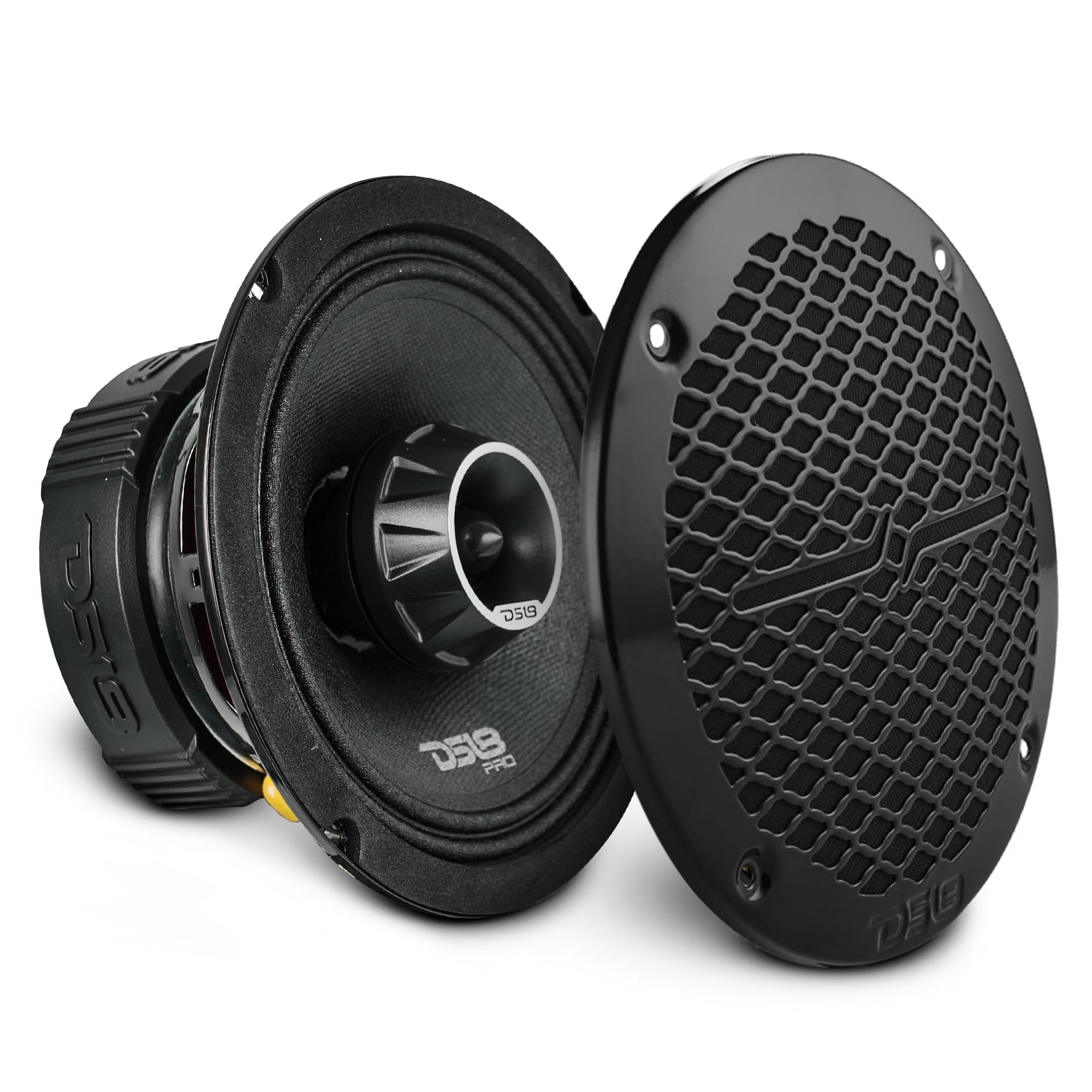
Start with the number that defines this speaker: 225 watts RMS and 450 watts max power at 4 ohms. RMS is the wattage it can take continuously — and 225 of them is a figure most 6.5-inch door drivers cannot touch. A 1-inch high-temperature Kapton voice coil is what survives that heat, holding its shape when the speaker is pushed hard for a long set.
DS18 packs a midrange and a built-in bullet tweeter into one driver, so you get a full range of sound from a single unit that drops into a door hole. Shoppers say running four of them in all doors at roughly 200 watts RMS each with extremely loud, sharp, clear results. On a side-by-side with the Rockford kit above, the DS18 nearly triples it on continuous power — it is a different animal built for volume, not subtlety. The neodymium magnet produces a wider range of tones and handles heavy power at high volume, and the set ships with a black metal mesh grill.
Two things to weigh before you buy. First, this listing is for one speaker, not a pair — you need to buy as many as you need to fill your doors, so a four-door car means four units. Second, durability and fit divide opinion: many report they hold up well and fit perfectly, while some find them questionable on both counts, and a few mention mounting quirks. The sound is also forward and aggressive by design — as owners describe it, these are not for anyone who prefers a softer, warmer tone.
high-volume builds: nothing in this list touches it for raw loudness — 225W RMS is in a class of its own for a 6.5-inch driver.
factory radio users: buyers who want one purchase to cover both doors, since this listing is a single speaker, and anyone who prefers a relaxed, non-fatiguing sound.
4. PIONEER A-Series MAX TS-A653FH 6.5″ 2-Way Coaxial Car Speakers 340W Max

The coax that squeezes real bass out of a weak factory stereo
Sensitivity is the spec that decides whether a speaker sounds loud on a puny factory stereo, and this Pioneer hits 91 dB — a high figure that means it turns even modest power into clear, full sound. That is why it earns its place for anyone who is not adding an amp. Its power handling runs to 340 watts peak and 75 watts continuous, and the frequency response stretches from 40 Hz to 49 kHz, so the low notes and the fine high detail both have room to breathe.
Being a coaxial means the tweeter sits inside the woofer, so it is one unit per door instead of a separate tweeter you have to mount and wire. Buyers report tight, controlled bass with warm, precise vocals and clean highs that are not harsh. The included 6-1/2 inch multi-fit installation adapters widen your mounting options and improve the acoustics. On 1st-gen Chevy Cruze owners found this 4-ohm coax sounded crisper than the matching component version, which threw off the factory 2-ohm setup.
One honest wrinkle: the adapters ship for GM/Chevy, so owners of other brands often need to source make-specific brackets before the job is done, and a couple of buyers with unamped systems wanted an amplifier to pull out real bass. Compared with the Hertz K-165 above, the Pioneer needs far less power to get loud — 91 dB sensitivity versus a speaker that owners say demands an amp — but it gives up the Hertz’s separate, aimable tweeter.
easy coaxial fit: efficiency is the headline — the speakers run well even on a factory head unit’s modest wattage, and owners mention they can hear all the small details in a track.
modest power ceiling: the supplied adapters are cut for GM/Chevy, so plan on a vehicle-specific bracket if you drive anything else.
stock location swaps: drivers keeping their stock head unit who still want audible bass and detail without wiring in an amplifier.
competition SPL goals: your car is not a GM model — you will need to hunt down the right mounting bracket separately.
5. JBL GTO629 Premium 6.5-Inch Co-Axial Speaker – Set of 2
Oversized cones and a swiveling tweeter you can point straight at your ears
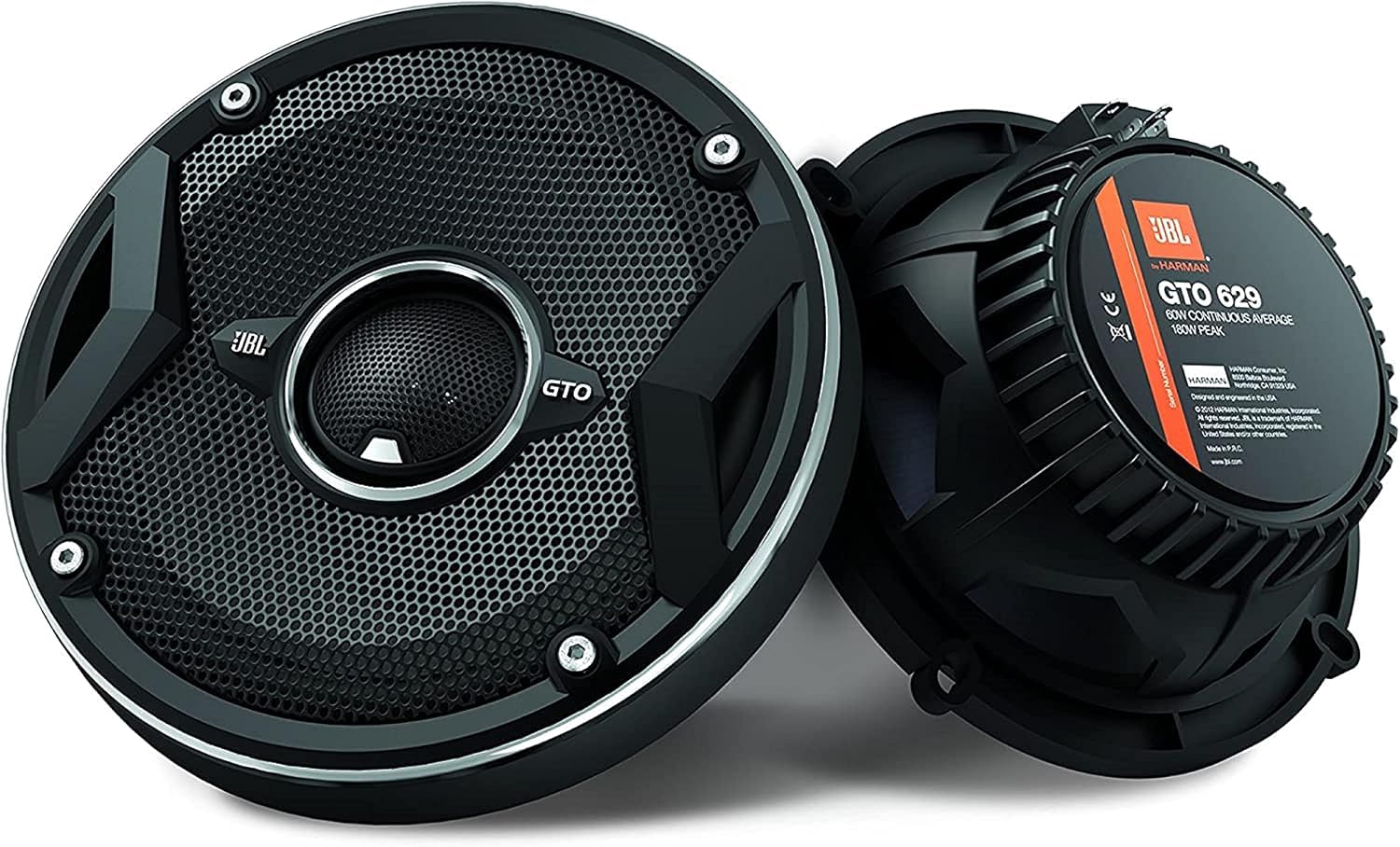
JBL’s trick here is cone size. The carbon-injected Plus One cones are built larger than others in their size class, which means they move more air — and moving more air is exactly what makes more bass. The mounting depth is 2 inches, which matters because a shallow driver slips into tighter door cavities without a fight. A 12dB/octave crossover splits the highs and lows and sends each to the right driver, and the three-ohm impedance helps compensate for the thin factory wiring found in many cars.
The patented UniPivot tweeter is the stand-out feature: you can rotate and aim it at your ears even when the speaker sits low in the door, which fixes the muffled feeling that comes from firing highs at your shins. A dual-level tweeter volume adjustment lets you tune the brightness to taste. Customers note these are a big upgrade over stock, with buyers reporting a simple plug-and-play swap into a 2002 GMC Sierra using GM speaker harness adapters.
Bass expectations need managing, though. Several buyers found the low end lacking even with the equalizer maxed out, pointing to the head unit as the likely bottleneck rather than the speaker. And durability is the one area owners split on, with a handful reporting they did not last a year — so treat these as a value set for a mild build, not a lifer for a high-power system. Next to the Alpine S2-S65 below, the JBL wins on adjustable treble placement, but the Alpine carries the Hi-Res certification this JBL set does not.
all-around daily listening: anyone whose door speakers fire at their ankles and who wants to aim the highs where they can actually hear them.
custom stage builders: the bass is modest without an amplifier, and a few reviewers point out a shorter life than expected under heavy use.
6. Pioneer P.R.O. Series TS-M651PRO 6.5″ Component Car Speakers 500W Max

A lightweight pulp cone built to take 500 watts and stay accurate while it does
Pioneer’s P.R.O. line stands for Reference for Open Show, and the spec backs the name: 500 watts max and 120 watts continuous, with a 94 dB sensitivity that means it gets loud on surprisingly little power. The lightweight pulp cone is the key to keeping distortion low — less cone mass means the driver can start and stop quickly, so bass stays tight instead of smearing. Frequency response runs 50 Hz to 18 kHz.
What owners talk about most is the midrange. Shoppers say these catch warm notes and highs better than the speakers they replaced, with a sharp jump in clarity over budget midrange drivers. The kit suits both mid-bass and midrange duty, so it is flexible whether you are building a two-way front stage or filling doors. Against the DS18 PRO-ZT6 above, this is the more refined of the high-power pair — 120 watts continuous versus 225, but with a lighter cone aimed at accuracy rather than outright volume.
Two caveats. First, do not expect sub-level low end: buyers are clear that you should buy an amp and a sub if hard bass is your goal, and use these for strong mids. Second, installation in tight bays takes work — a Chevy Silverado owner had to modify an adapter and trim the door panels to make them fit. Performance feedback also splits, with some reporting excellent results and a handful who could not get them working.
pro-grade midrange detail
- 500W max / 120W continuous power ceiling
- 94 dB sensitivity — loud without a huge amp
- Lightweight pulp cone keeps distortion low
- Flexible for both mid-bass and midrange duty
needs external amp
- No deep bass — pair with an amp and sub for real low end
- Tight installs may need adapter mods and door-panel trimming
- A few reports of units that never worked from the start
active crossover setups: 120 watts continuous with a 94 dB sensitivity means this fills a cabin loudly without demanding a monster amplifier.
head unit power only: it is a mid-bass and midrange specialist, so anyone chasing sub-deep low end needs an amp and subwoofer alongside it.
7. KICKER 51KSC6504 KS-Series 6.5″ Coaxial Speakers with.75″ tweeters, 4-Ohm, Pair

Zero tweeter protrusion and rubber surrounds that slide straight into factory holes
The reason to pick this Kicker set is fitment, and it depends on one design choice: the tweeters have zero or minimal protrusion, so the speaker sits nearly flush and slides into almost any door without cutting or spacing. That is the difference between a two-hour job and an all-day one. The 6.5-inch woofers use internally dampened polypropylene cones and rubber surrounds, and rubber is the sturdier of the common surround materials — it holds up to moisture and repeated cone travel better than foam.
Owners call the low end solid. Across a rebuilt cabin — VA WRX, C10 trucks, Broncos, and Miatas all show up — the story repeats: strong bass, crisp detail, and noticeably more volume than the factory set, even on a stock head unit. Buyers report they drop right into an ’05 Miata with no modification and stay audible with the top down at 50% volume. The.75-inch tweeters keep the top end bright without dominating.
Durability is the split point: most say they hold up great, while a small number report they did not last. Next to the JBL GTO629 above, the Kicker wins on mounting depth, since the JBL needs a 2-inch cavity while the Kicker’s flush tweeter reduces protrusion.
budget amp upgrades: your door has a shallow cavity and you want strong bass without trimming metal or spacing out the speaker.
warm sound seekers: you plan to keep a weak factory head unit long-term — these open up more with a stronger stereo behind them.
8. Alpine S2-S65 – Next-Generation S-Series 6.5″ Coaxial Speaker Set

Entry-level pricing with a Hi-Res badge and a surround built for cone travel
Two numbers separate this Alpine from the field: it is Hi-Res Audio Certified to reproduce frequencies up to 40 kHz, and its HAMR surround — High Amplitude Multi-Roll — is shaped to let the cone move further than a standard surround allows. More cone travel means more accurate bass. Power handling runs to 240 watts peak and 80 watts RMS, and the 1-inch tweeters are integrated into the coax frame.
The cone blends polypropylene, glass fiber, and mica — a mix chosen for light weight, high output, and low distortion all at once. Owners describe impressive volume that holds together without breaking up, which is what the low-distortion cone is there to deliver. Owners mention swapping these into a 2003 Toyota Land Cruiser with an integrated factory head unit and getting a better range and sound than the blown JBL speakers they replaced, even without bypassing the factory amp.
The honest limits: some owners pair them with subwoofers to get the full low-end picture, and one found the tweeter output light enough that they considered adding a separate tweeter. Fit is generally smooth as a drop-in coax, though a tight factory setup will always cap how much the speaker can shine. It suits buyers who want Hi-Res detail at entry-level pricing, not anyone expecting it to anchor a bass build alone. One buyer in a 2007 Honda Civic Si simply calls it: sounds great.
next-gen material tweeter: HAMR surround technology lets the cone travel further, and that travel is what keeps bass notes accurate instead of flat.
premium price tag: owners often pair these with subs for real low end, and one found the highs light enough to want a separate tweeter.
long-term sound quality: buyers who want Hi-Res certified detail and low-distortion output without stepping into premium pricing.
cheapest option shoppers: a bass-only build — plan on adding subwoofers if deep low end is the goal.
9. Memphis PRX60C Power Reference Series 6.5″ Oversize Component Speakers with 1″ Tweeters – Pair

A true component kit with its own crossovers and tweeters that rotate a full 360 degrees
For a build that puts the low notes and the high notes on separate drivers, this Memphis set delivers the whole kit: polypropylene cone woofers, 1-inch poly dome tweeters, and separate crossovers for each, so the signal gets split properly instead of blended inside one coax frame. The butyl rubber surround is the sturdier choice for long-term cone travel, and the set is sized as a direct factory-application fit. Customers note crisp highs, clear mids, and good bass for the size.
The adjustable tweeter is what buyers single out as the hidden advantage. It rotates a full 360 degrees on any axis, so you can aim the high notes in any direction you want — a rare level of placement control in a kit at this level, and the answer to the common question of whether the tweeters actually move. Reviewers point out swapping these into a 2024 Camry as a dramatic step up from the stock speakers, and one described replacing the tweeters in a Mustang build while keeping the existing midranges, ending up with a brighter, more detailed top end.
Power is the honest catch. Several owners found these underpowered on a factory head unit at around 15 watts per channel, and report that a cheap amplifier with a line-level converter transforms them — two wired at 2 ohms on a 100-watt channel handled power cleanly with no distortion at any volume. On a stock head unit, temper your expectations; add an amplifier and this kit rewards it. It is the most complete component set here, with real crossovers the coaxials above cannot match.
custom fabrication projects: anyone assembling a proper front stage who wants separate crossovers and tweeters they can aim in any direction.
plug-and-play installs: if you are holding onto a stock head unit and will not add an amplifier, the power ceiling here stays out of reach.
Understanding the Specs
RMS Power versus Max Power
RMS is the wattage a speaker can handle continuously, hour after hour — it is the number that tells you what amplifier to pair with it. Max (or peak) power is the brief burst the speaker survives on a transient hit, and it always reads higher. When you compare the DS18 PRO-ZT6 at 225W RMS to the Rockford R165-S at 40W RMS, you are comparing how much sustained power each can take before it distorts. Pick a speaker rated near your amp’s clean output, and you get tight bass instead of clipping.
Cone Material And Surround Design
The cone is the moving piston that pushes air, and its material decides how cleanly it does that job. Mica-injected polypropylene, treated paper, and glass-fiber blends all resist flexing at volume, which keeps bass tight. The surround is the flexible ring around the cone’s edge, and its shape governs cone travel — the Alpine S2-S65’s HAMR (High Amplitude Multi-Roll) surround is built to allow more travel, and more travel lets a 6.5-inch driver reach lower notes. Rubber and butyl rubber surrounds outlast foam ones in the damp environment of a car door.
FAQ
Will 6.5-inch speakers fit my car doors?
Do I need an amplifier to get bass from 6.5-inch speakers?
What is the difference between component and coaxial speakers?
How many watts RMS should my 6.5-inch car speakers handle?
Are 4-ohm or 3-ohm speakers better for factory systems?
How long do aftermarket 6.5-inch speakers last?
Can I install 6.5-inch car speakers myself?
Will bigger magnets or higher wattage give me more bass?
Do component speakers sound better than coaxial speakers for bass?
Should I add a subwoofer if I upgrade to 6.5-inch speakers?
Final Thoughts: The Verdict
For most buyers, the bass 6.5 car speakers winner is the HERTZ UNO Series K-165 because its water-repellent pressed paper cone, separate aimable tweeters, and consistently strong sound quality make it the most complete door upgrade in this lineup. If you want efficiency without an amplifier, grab the Pioneer TS-A653FH at 91 dB. And for maximum output, the DS18 PRO-ZT6 is the one to reach for at 225W RMS. Worth noting: the Memphis PRX60C carries more reviews than the Hertz, but the Hertz holds the stronger record of sound-quality praise among owners building a serious door setup.
How We Picked
We do not accept paid placement. Every pick is matched to a real buyer and a real use-case; we do not hands-on test units.
Sources & Methodology
Specifications: manufacturer listings and product documentation. Review insights: verified customer reviews, as of September 2026. Pricing: not shown on this page (it changes often); check the current price via the retailer link.
As an Amazon Associate, Gadgets Feed earns from qualifying purchases. This does not affect which products we feature.