
Our readers keep the lights on and my morning glass full of iced black tea. As an Amazon Associate, I earn from qualifying purchases.
Specs are compiled from manufacturer listings and verified buyer reviews and can change over time — please confirm the key details on the product page before buying.
A two-year-old does not play gently, and the wrong toy either falls apart in a week or gets ignored by day three. The toys worth your money are the ones that survive being bitten, thrown down the stairs, and dragged across the driveway — then still get picked up again tomorrow. This guide covers nine toddler toys that hold up to that test, sorted by what each one actually does best.
I’m Min — the founder and writer behind Gadgets Feed. This guide is built by comparing the manufacturers’ published specifications and the patterns across verified customer reviews, so you get each pick’s real strengths and trade-offs instead of marketing spin.
You want the toy that fits your kid’s stage, not the one with the loudest box, and this breakdown of 2 year old toys covers what each pick teaches, how it holds up, and who it actually suits.
Our Picks at a Glance


How To Choose The Best 2 Year Old Toys
A two-year-old is in a very specific developmental window. They can walk, they want to do everything themselves, and they learn by grabbing, throwing, and putting things in their mouth. The toy that works at this age is one they can operate alone, that survives rough handling, and that keeps giving them something new to figure out. Here is what actually separates a toy your kid plays with for a year from one that ends up in the donation box by spring.
Match the toy to the real age range, not the birthday
Every toy here lists a manufacturer recommended age, and those ranges matter more than the box art suggests. A toy marked 18 months and up assumes your child has basic walking and grabbing down. A toy marked 6 months and up works for a kid who is still sitting and batting at things. If you buy up too fast, the toy sits untouched for months; if you buy down, your kid masters it in an afternoon and moves on.
Decide between fine motor and gross motor
Fine motor toys work the small muscles — pinching, poking, turning pages, grabbing a magnetic pole. Gross motor toys get the whole body moving — pushing, pulling, walking alongside something. Both matter at this age, and the strongest toy shelves have a mix. Fine motor toys build the hand control your kid needs for drawing and buttons later; gross motor toys burn the energy that makes nap time possible.
Check what small parts can pop off
Two-year-olds put everything in their mouths, so the pieces need to be big enough to grip and too large to swallow. Look for rounded edges, smooth finishes, and pieces that are securely attached or too big to detach. Some picks on this list carry a choking hazard warning for small parts and require supervision — that is normal for the category, but it changes how you store the toy and when you bring it out.
Plan for the batteries before you need them
Most of these toys run on AA or AAA batteries, and some ship with demo batteries that are not built for daily use. Knowing the size before you buy saves a mid-play meltdown. A few picks need no batteries at all, which removes one more thing you have to think about.
Quick Comparison
| Model | Best For | Age Range | Battery Type | Material | Amazon |
|---|---|---|---|---|---|
| LeapFrog Learning Friends 100 Words Book★ Best Overall | Bilingual word learning | 18+ months | 2 x AA | Plastic | Amazon |
| Montessori Magnetic Wooden Fishing GameQuiet Play Pick | Quiet, independent play | 18 months – 3 years | None | Wood | Amazon |
| VTech Pull and Sing PuppyBest for Movement | Getting a toddler moving | 6 months – 3 years | 2 x AAA | Plastic | Amazon |
| LeapFrog Strum and Count Wooden Guitar | Musical exploration | 18 months – 5 years | 3 x AA | Plastic, Wood | Amazon |
| Monster Truck Toys Dinosaur Cars | Cause-and-effect car play | 2+ years | None | Plastic | Amazon |
| VTech Busy Learners Activity Cube | Portable sit-and-play | 6 months – 3 years | 2 x AAA | Plastic | Amazon |
| 2-in-1 Ball Drop & Car Ramp Race Track | Two play modes in one | 12 months – 5 years | None (requires batteries for balls) | Plastic | Amazon |
| SYNARRY Wooden Puzzles for Toddlers | Six puzzles in one set | 18 months – 3 years | None | Wood | Amazon |
| Liberry Baby Balance Bike | Balance and steering practice | 12 – 24 months | None | Alloy Steel | Amazon |
In‑Depth Reviews
1. LeapFrog Learning Friends 100 Words Book
Our pick — over 4.5★ from 96,000+ verified ratings; the strongest balance of quality and price.
The bilingual word book that toddlers reach for on their own, day after day.
Turtle, Tiger and Monkey walk your kid through more than 100 age-appropriate words across categories like pets, animals, food, mealtime, colors, activities, opposites and outside. Touch any word on the page and the book says it out loud, adds a sound effect, then throws in a fun fact. That three-layer response is why kids keep coming back — there is always one more thing to press.
Every word, song and instruction plays in both English and Spanish, so the same book grows with your child from first words to bilingual vocabulary. Press the light-up star button and you get the Learning Friends theme song or My Favorite Word. It runs on 2 AA batteries, which are included for demo purposes only, so grab fresh ones before daily use. The whole thing weighs 1.5 pounds and measures 9.17 x 9.37 x 1.89 inches — which makes it 2.3x larger than the VTech Pull and Sing Puppy at 3.94 x 7.87 x 6.69 inches, a real difference when your toddler wants to carry it to the car.
The thick board pages take real punishment. Buyers report it surviving stairs and furniture throws and still working, which tracks with its 4.8-star rating. What wins people over most is how long it holds attention: kids press the same pages again and again and keep finding new sounds. The volume control is a small but appreciated detail for parents who want a quieter play session. At an 18+ month starting age, it fits the two-year-old window almost perfectly.
Why it leads the pack
- Real bilingual audio — every word and song plays in English and Spanish
- Thick board pages built to survive biting, tossing and stair tumbles
- Light-up star button adds songs on demand, not just word playback
- Over 100 words across nine everyday categories means long-term replay value
Worth knowing before you buy
- Demo batteries are not built for daily use — pick up 2 fresh AA cells
- At 1.5 pounds it is heavier to tote than a small handheld toy
Best for: Parents who want one toy that teaches vocabulary in two languages and survives a toddler’s full attention.
Look elsewhere if: You want something battery-free or your child is still under 18 months — the word-touch feature will not land yet.
2. Montessori Magnetic Wooden Fishing Game for Toddlers 1-3 Years Old
Two wooden poles, ten painted fish, and no batteries or beeping anywhere.
This is the pick for the parent who wants a toy that runs on imagination, not AA cells. The set includes two real wood magnetic poles and 10 vibrant fish figures, each measuring over 1.77 inches high and 0.78 inches wide — big enough for little hands to grip, small enough to be a choking risk that demands supervision. The poles run 6.6 inches tall with a 0.27-inch shaft, sized for a two-year-old’s grip.
The whole set is made of environmental protection wood, each fish painted and polished, chemical smell free, with smooth rounded edges. It is built for ages 18 months to 3 years and the magnets hold strong enough that the fish actually stick when your toddler gets the pole close. Fine motor work, color recognition and stacking all happen in one activity your kid can do alone while you make dinner.
What wins people over here is the craftsmanship — the wood feels solid, not cheap, and owners mention that the pieces hold up well enough to hand down to a younger sibling. The review pages sum it up: “I love the way it was built and it seems super sturdy. Also it’s adorable!” The honest catch is size. Some buyers find the set smaller than the listing photos suggested, so measure the fish against your toddler’s hand before you commit. If your kid is a magnetic-pole enthusiast, this is the one to grab.
A wooden set that earns its keep: With 10 painted fish, 2 magnetic poles and zero battery requirements, this toy works from 18 months to 3 years without any ongoing cost.
Reach for this if: You want a battery-free, quiet toy that builds hand-eye coordination and stands up to daily play.
Think twice if: Your child still mouths everything — the fish are choke-able and require close supervision.
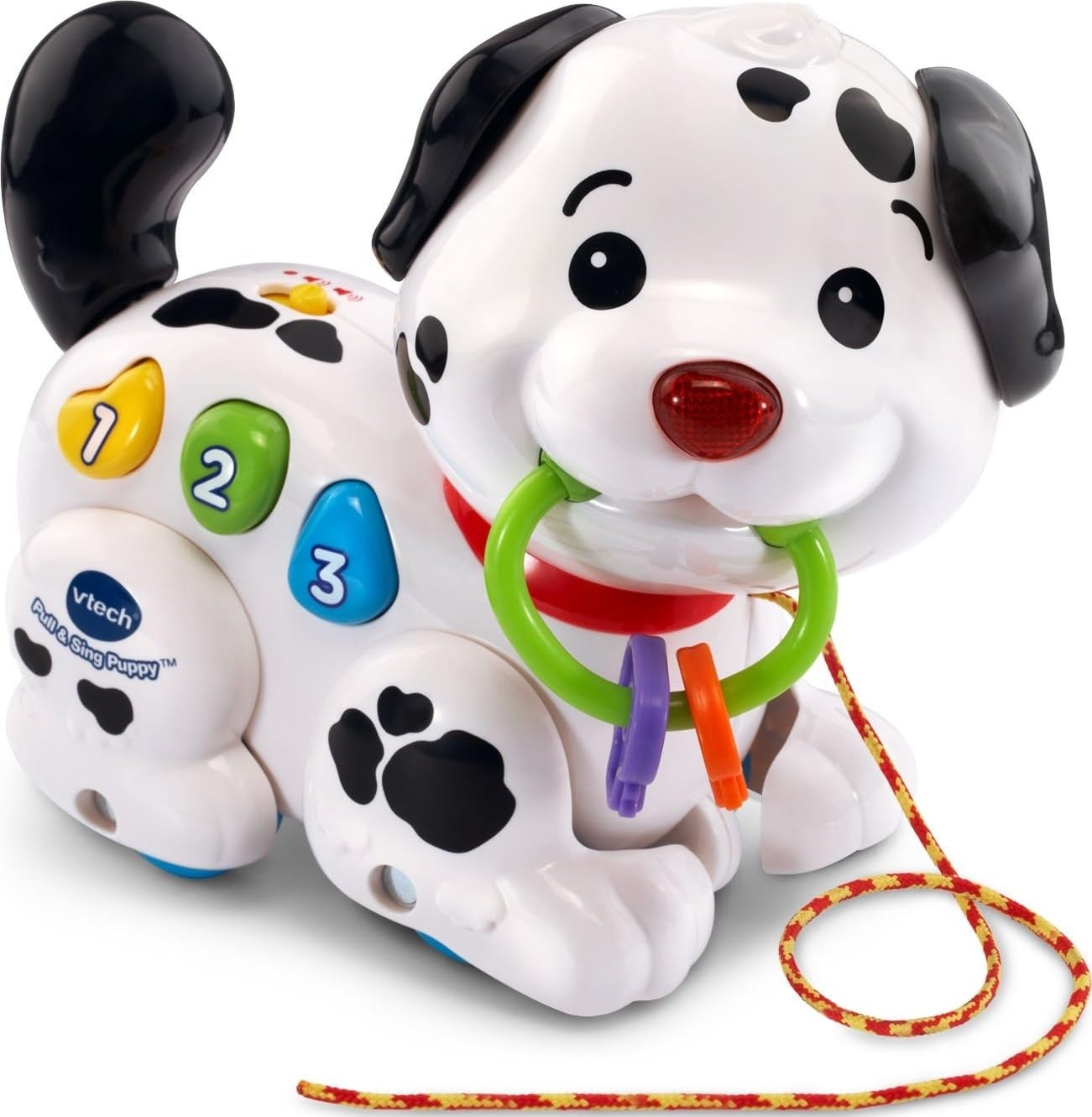
3. VTech Pull and Sing Puppy
A pull-along puppy that turns walking into a game your toddler wants to win.
Hook the cord to the puppy and your toddler gets a moving target that plays music, words and sounds as it rolls. That pull-and-chase loop is the whole point — it builds gross motor skills (the big muscles that walk, pull and chase) without your kid realizing they are exercising. The VTech Pull and Sing Puppy runs on 2 AAA batteries and works for ages 6 months to 3 years.
Three colorful push buttons on the puppy promote fine motor skill development, and the light-up nose flashes along with the voice, sound and musical responses. Press a button and you get numbers, colors and parts of the body taught through music and puppy sounds. The volume is adjustable and customers note that even at higher settings it is not too loud for parents in the same room. It weighs 14.24 ounces and measures 3.94 x 7.87 x 6.69 inches — noticeably more compact than the LeapFrog 100 Words Book above, which makes it easier to stash in a diaper bag.
What wins people over is the sheer playability — the pull-the-string moment where the puppy starts singing keeps toddlers engaged longer than almost anything else on this list, and it stays durable through daily use. The one recurring gripe concerns the string: some owners find it shorter than they’d like, which limits how far a toddler can roam while dragging it. That is a fit issue, not a flaw — if your kid likes pulling toys around the living room, a shorter string just means more trips back and forth. The design also keeps the puppy on the chunkier side, so a tumble onto hard flooring is worth watching.
The movement multiplier: Push or pull to activate music, words and sounds — this is the pick that gets a toddler off the couch and walking around the room.
One small gripe: The pull string is on the short side for some owners, which limits how far your toddler can walk with it.
Best for: Toddlers who are already walking and want a toy that moves with them, plus parents who want adjustable volume.
skip it if: Your child is still crawling or wants a toy they can hold and explore with both hands — the pull-along format is for walkers.
4. LeapFrog Strum and Count Wooden Guitar

The toddler guitar with real strings — the one that keeps them off your actual instrument.
Eight fret keys introduce an octave of colors and numbers, and the guitar neck lights up as your toddler presses them. That light-up feedback is what holds attention: press a key, see it glow, hear the note. Strum the strings to finish the songs, or make your own noise with acoustic guitar, electric guitar or barnyard animal sounds. Move the squirrel’s tail to trigger music and games exploring vocabulary and musical styles.
It runs on 3 AA batteries and fits ages 18 months to 5 years. At 1.2 pounds and 3.07 x 8.86 x 8.5 inches, it is light enough for a two-year-old to hold and strum without help. The body is made with wood that is 100% FSC-certified (that means the wood comes from forests managed to a recognized environmental standard), so it looks like a real instrument on the shelf. Buyers love the muted look of the buttons and the wood finish — it does not scream “plastic toy” the way most toddler instruments do.
The recurring theme from owners is that this toy fills the “I want to play YOUR guitar” gap. One buyer’s toddler was obsessed with a real guitar that was not safe to carry, and this became the safe stand-in. Two sound-level buttons (quiet or loud) mean you control how much noise this makes in your living room. The honest catch: there is no true off switch beyond the on/off button, and there is no volume setting beyond the two levels. For daily play that is fine — for a house that wants silence mid-nap, plan around it. Reviewers point out the real strings hold up to toddler strumming and that it stays a favorite for months.
Real-instrument feel: FSC-certified wood, real strummable strings and eight light-up fret keys — it takes the “real guitar” craving seriously.
Great for: Music-loving toddlers and families who want a wooden toy that looks good on the shelf and stays engaging past age 3.
Not ideal if: You need a silent toy — the on/loud/louder buttons give you volume control but not silence.
5. Monster Truck Toys Dinosaur Cars, Press and Go Light Up Cars
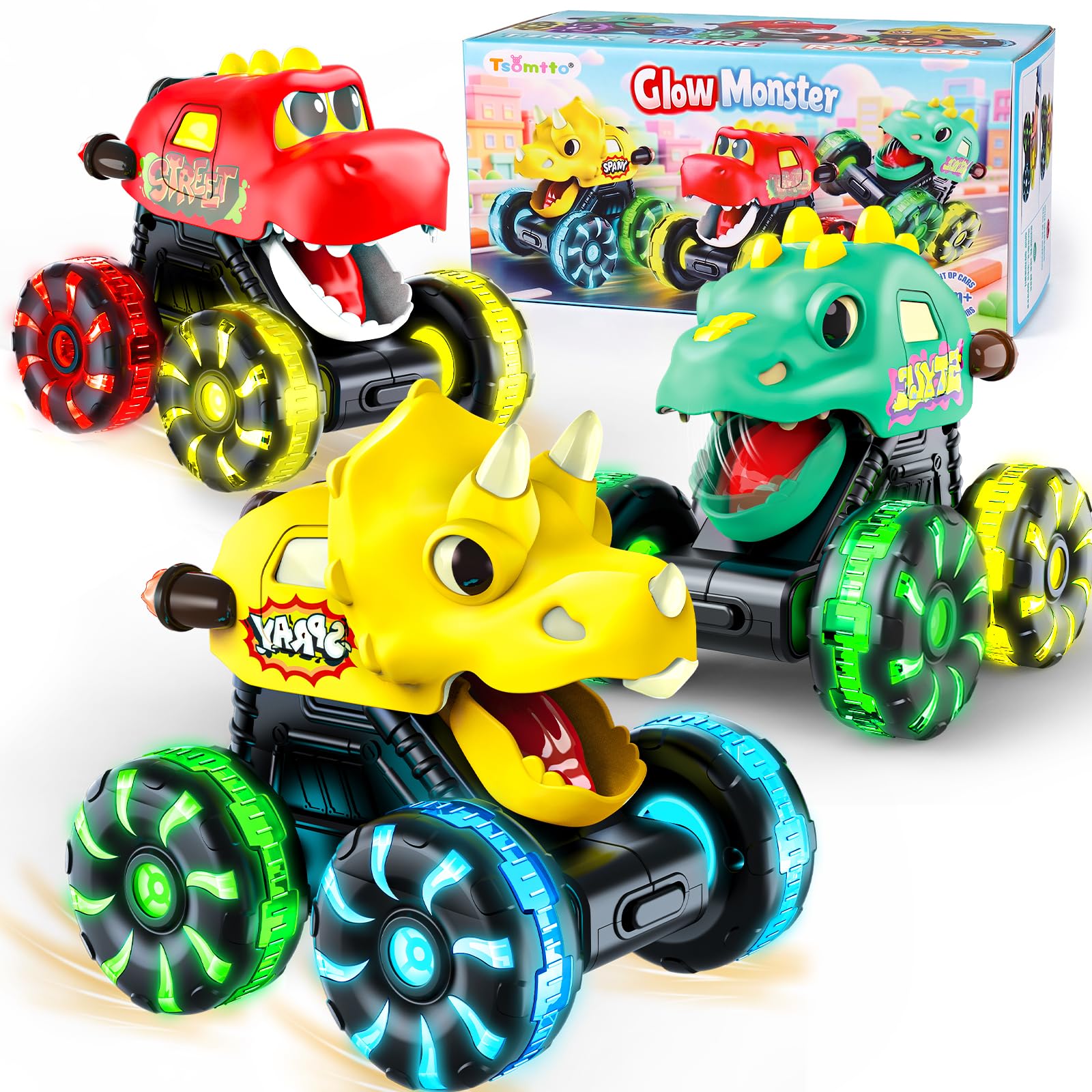
Three dinosaur trucks that launch with a single press and light up as they roll.
The set includes three dinosaur trucks — Tyrannosaurus Rex, Triceratops and Velociraptor. Press down on the truck to store energy, then release and watch it dash forward. All four wheels on each truck carry color-changing LED lights with an LED switch at the front for easy control. The mouths move in a chomping motion as the trucks roll. No batteries required for the trucks themselves — the lights run off the press-and-go motion.
Each truck is made of thickened ABS plastic (that is the same tough plastic used in many impact-resistant toy shells) with non-toxic, BPA-free construction and polished round smooth edges. They are sized for toddlers aged 2 to 4 and the coloring targets sensory and motor skill development. The three-truck format means two kids can play at once without fighting over one car.
What buyers rave about is the instant-reaction play — press it down, let go, it goes. That cause-and-effect loop is exactly what two-year-olds are wired for, and it keeps them re-engaging without adult help. The lights are a bonus that show up on real pavement or a dark carpet, which makes evening play more fun than a plain toy car. The honest trade-off: this set is not recommended for children under three due to small parts, so even a two-year-old needs supervision. Some owners also notice the lights dimming with heavy use over time.
What lands with toddlers
- Press-and-go mechanism needs zero adult help — pure cause and effect
- Color-changing LED wheels make the play visible in low light
- Three trucks means sibling play without the usual tug of war
- Thickened ABS plastic with rounded edges is built for rough handling
Honest limits
- Not recommended for children under 3 — small parts require supervision
- Some shoppers say the LED lights dimming with heavy daily use
Best for: Toddlers who light up at anything with wheels, and parents who want a screen-free cause-and-effect toy with no batteries to replace.
Consider elsewhere if: Your child is under three — the small parts warning means this needs close supervision.
6. VTech Busy Learners Activity Cube, Purple
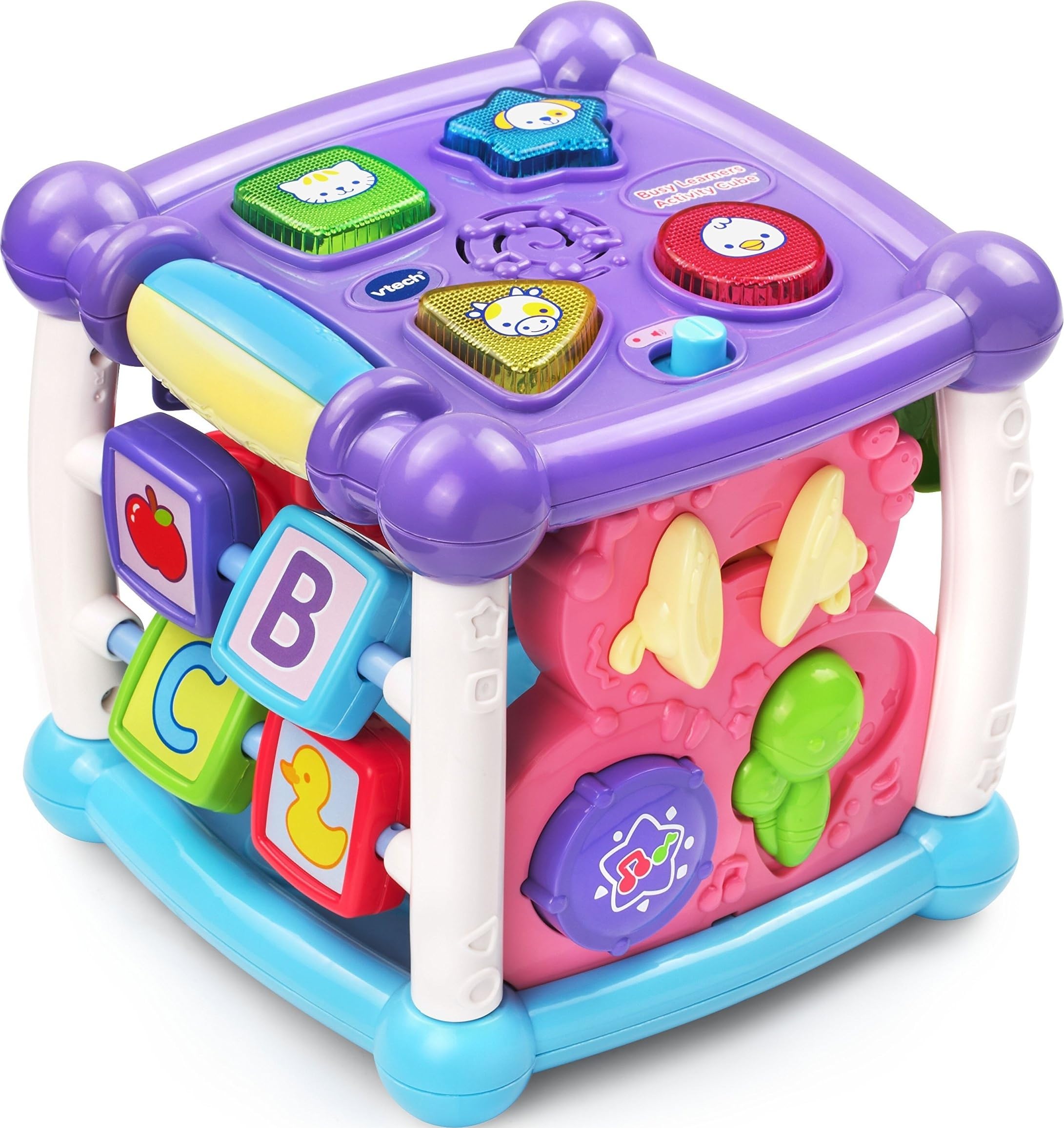
Five sides of buttons, gears and songs — the portable cube that goes from crib to car.
Five sides of play mean five different activities, so a toddler does not run out of things to press. Four light-up buttons introduce animal names, animal sounds and shapes. Across the cube you get 14 interactive features covering colors, shapes, numbers and vocabulary, plus 25 playful songs and melodies. It works for ages 6 months to 3 years and runs on 2 AAA batteries.
A motion sensor activates sounds when the cube is moved, which pulls a toddler’s attention right back to it — and it actually helps babies with sitting up to play. The volume is adjustable and there is an auto shut-off feature, which is a real gift when the toy gets forgotten under a sofa cushion. At 1.4 pounds and 6.2 x 6.2 x 6.5 inches, it is small enough to sit at and light enough to carry around the house.
Built for the grab-and-go life: Five sides of play, a motion sensor that reacts to movement and an auto shut-off feature add up to a cube that goes in a diaper bag without a second thought.
Watch for: The size is smaller than the photos suggest, and some parents find the sound effects repetitive over time.
Best for: Toddlers who need a sit-and-press toy that travels well between rooms, cars and doctor’s waiting rooms.
Think twice if: You want a quiet, battery-free toy — this one runs on 2 AAA batteries and does use sound.
7. 2-in-1 Ball Drop & Car Ramp Race Track Montessori Toy
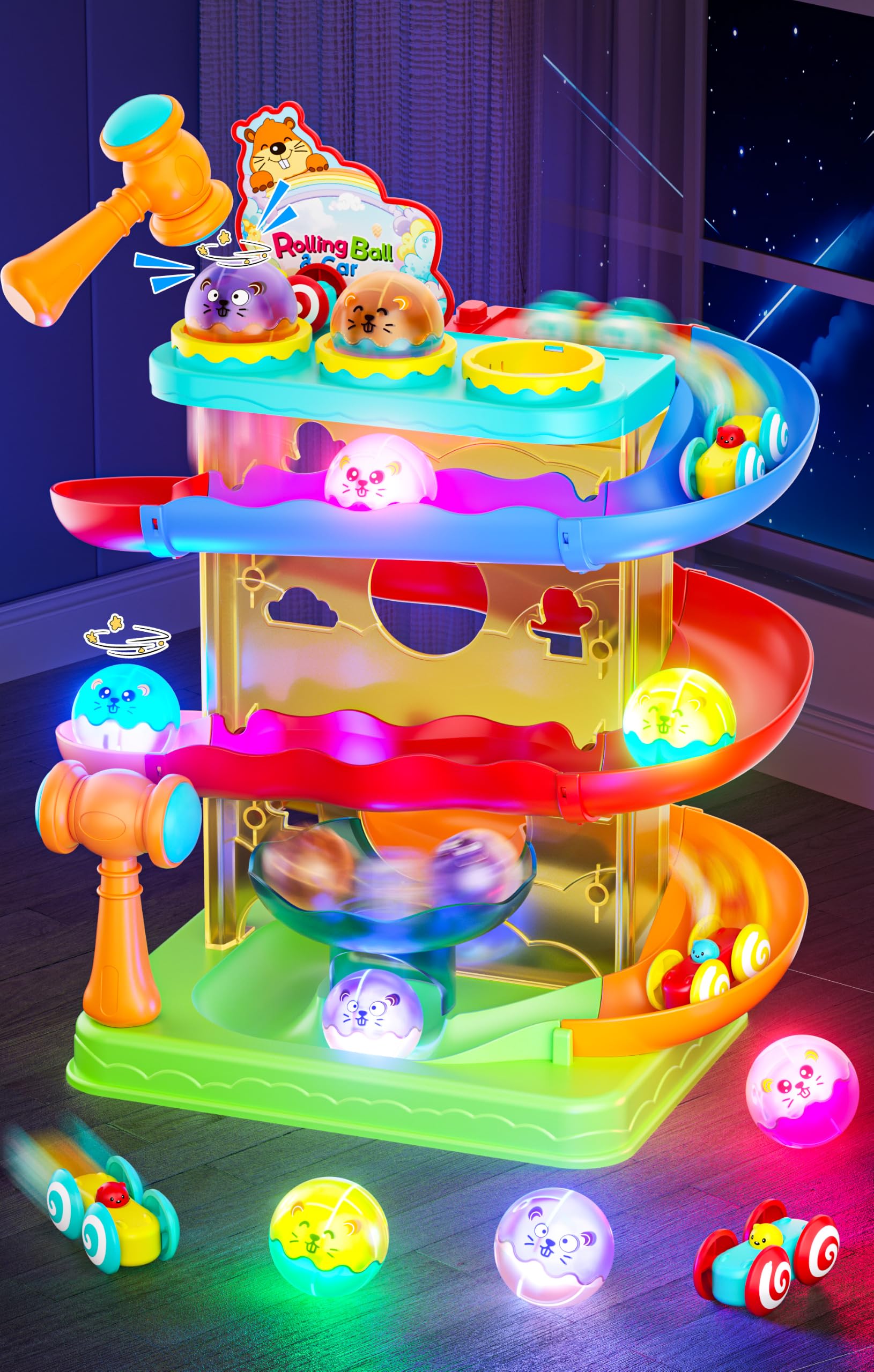
Two toys in one tower — balls down one way, cars down the other.
Three layers of tracks in different colors, three light-up balls and three mini racing cars. Send the balls or the cars down from the top and watch them race the tracks. A hammer lets your toddler knock the balls off the top floor, which teaches cause and effect (the simple “if I do this, that happens” learning that two-year-olds build on). The ball and car launch modes give you two toys in one tower.
Assembly takes about three minutes, and buyers report that the whole thing goes together without headache — one buyer’s review notes it “only took me 3 minutes to build.” The height works out to roughly 12 inches without the sign and 15 inches with it, so it is a tabletop tower rather than a floor-standing playset. It is made from smooth child-safe plastic with rounded edges and large easy-to-grip pieces, and meets US ASTM/CPSIA safety standards (the US toy safety rules covering things like small parts, sharp edges and paint content).
The light-up balls are the star of the show — rolling lights down a track hold a toddler’s attention even when the TV is on. Younger toddlers, around 19 months, catch on quickly and keep the play going for months. The two real gripes to know: the balls sometimes stop lighting after several months (the internal motion sensor can drain the batteries when idle), and the tower does come apart more easily than a one-piece toy. Both are fixable — keep a small screwdriver handy for the battery compartment and expect to reassemble occasionally.
What stands out
- Two launch modes (hammer-drop balls and rolling cars) in a single tower
- Three minutes to build — no tools required from the start
- Light-up balls keep attention even without music playing
- Meets US ASTM/CPSIA toy safety standards
Where it falls short
- Some units come apart during rough play and need reassembling
- Light-up balls can stop working after a few months of heavy use
Best for: Toddlers between 1 and 5 who love both balls and cars and need a toy that fills a whole afternoon.
Look elsewhere if: You want a one-piece, cannot-break toy — this tower is assembled and can come apart in rough play.
8. SYNARRY Wooden Puzzles for Toddlers 1-3, 6XSET with Rack

Six wooden puzzles in one box, with a rack that makes the pieces findable again.
This set packs six wooden puzzles — numbers, letters, shapes, dinosaurs, animals and vehicles — into one gift box, with a storage tray and a wire storage rack included. That rack is the unsung hero: puzzle pieces go back on it instead of scattering under the couch, which cuts tidy-up time to seconds. The puzzles are made from wood with a scratch-resistant, waterproof coating that holds up to daily play, and the pieces are large, thick and solid with smooth edges.
Each puzzle board measures 13.46 inches long by 9.25 inches wide, which gives a two-year-old a full-scene puzzle to complete without overwhelming them. Bright painted images — cute dinosaurs, cartoon animals, vehicles — printed with strictly certified paint keep kids coming back. The wood is free of PVC, latex, phthalates, BPA and lead, so you are not worrying about what happens if a piece goes in the mouth (though supervision is still the rule for any toy at this age).
What wins people over is how much ground this covers in one purchase — six education topics in one set. Owners mention kids learn numbers, letters and shapes from daily puzzle play, and the 13.46 x 9.25-inch boards are easy for little hands to grip and turn. Durability is the one honest caveat: a single piece can snap after months of use if it gets chewed or bent off the puzzle, though normal play holds up fine. The storage rack also fits on a shelf, so the whole set stays organized between play sessions.
Six topics, one purchase: Numbers, letters, shapes, dinosaurs, animals and vehicles all inside a single set with its own storage rack.
One small caveat: Individual puzzle pieces can snap if they get chewed or bent off the board — normal play is fine.
Ideal for: Parents who want one puzzle set that covers numbers, letters, shapes and more — and a rack that keeps pieces off the floor.
pass on it if: Your child is chewing everything — the wooden pieces can snap under that kind of stress.
9. Liberry Baby Balance Bike Ride Toy for 1-2 Years Old, Green

A four-wheel balance bike built for kids who just learned to walk.
The closed wheels on this bike keep a toddler’s feet from getting pinched and add stability, and the four-wheel design keeps the feet in contact with the ground so tipping is harder. It is built for 12 to 24 month olds and the weight comes in at 5 pounds in the spec sheet — light enough for a toddler to drag, heavy enough to feel steady underneath. The seat is adjustable from 9.7 inches to 11 inches so it grows with your child. The applicable child inseam range is 10 to 18 inches, and the frame is strengthened alloy steel.
The handlebars are rubber (safer than foam, and no tearing risk if your toddler chews on them), and the EVA tires (a soft foam-rubber blend) are designed to be quieter and less skid-prone than standard plastic wheels on hard flooring. Customers note the EVA tires leave no marks on wood floors and the four-wheel frame stays stable during solo mounts and dismounts. That stability is the whole reason parents pick this over a two-wheel push bike — the odds of a face-plant go way down when the rider has four points of contact. Maximum load-bearing capacity is 55 pounds.
Reviewers point out some kids still ride it at 3.5 years old, past the listed 12–24 month range, because the seat adjusts from 9.7 to 11 inches. That long shelf life is why the value lands. The bike ships with a letter sticker so you can label the frame with your child’s name. The honest caveat is surfaces: it is best on hardwood, smooth pavement and short grass, and the manuals suggest avoiding uneven roads like gravel paths.
Stability that grows with your kid: Adjustable seat from 9.7 to 11 inches, four wheels on the ground for balance, and a 55-pound max load — this is built to last past age 2.
Perfect for: Toddlers who just started walking and need a stable first bike that helps them practice balance indoors and on smooth pavement.
Not the right pick if: You plan to ride mostly on gravel or very uneven paths — the EVA tires are made for smooth surfaces.
Understanding the Specs
Age range and developmental fit
Every toy here lists a manufacturer recommended age, and that range is about which skills your child already has, not which birthday they just had. A toy marked “18 months and up” assumes walking and grabbing; a toy marked “6 months and up” works for a sitter who is just starting to bat at things. Matching the age range to your child’s actual stage is the single biggest factor in whether a toy gets played with daily or sits on the shelf. When in doubt, buy for the stage your kid is in right now.
Battery type and how many to keep on hand
Most electronic toys on this list run on AA or AAA batteries, and the number matters at the moment the toy dies mid-play. AA cells are the larger cylinder; AAA cells are the smaller, thinner cylinder — and they are not interchangeable, so a toy that takes 2 AA will not accept 2 AAA. Some picks ship with demo batteries that are not built for daily use, so pick up a set of the right size before the wrapping paper comes off. Battery-free picks skip this entirely, which is one less thing to track.
FAQ
What is the best age to introduce a balance bike to a toddler?
How many AA or AAA batteries should I keep on hand for toddler toys?
Is a wooden toy better than a plastic toy for a two-year-old?
How do I know if a toy has parts small enough to be a choking risk?
Will the LeapFrog 100 Words Book really teach my two-year-old words in two languages?
Is the VTech Pull and Sing Puppy loud enough to annoy parents?
Do the light-up balls on the 2-in-1 Ball Drop Toy burn through batteries quickly?
Can two toddlers share the Monster Truck Dinosaur Cars without fighting?
How long will a two-year-old actually play with the wooden puzzles versus the electronic toys?
Are toddler toys with lights and sounds actually educational or just noisy?
Final Thoughts: The Verdict
The best of these 2 year old toys for most families is the LeapFrog Learning Friends 100 Words Book — 100+ words in English and Spanish, thick board pages that survive stair tumbles, and 4.8 stars from tens of thousands of owners. If you want a battery-free, quiet toy that builds fine motor skills, the Montessori Fishing Game is the one to grab. For a toddler who just started walking and needs to burn energy, the Liberry Balance Bike gets them moving with four wheels under them. And if you want the toy that fills a whole afternoon with lights and crashes, the 2-in-1 Ball Drop & Car Ramp Race Track is the one to reach for
How We Picked
We do not accept paid placement. Every pick is matched to a real buyer and a real use-case; we do not hands-on test units.
Sources & Methodology
Specifications: manufacturer listings and product documentation. Review insights: verified customer reviews, as of September 2026. Pricing: not shown on this page (it changes often); check the current price via the retailer link.
As an Amazon Associate, Gadgets Feed earns from qualifying purchases. This does not affect which products we feature.