
Our readers keep the lights on and my morning glass full of iced black tea. As an Amazon Associate, I earn from qualifying purchases.
Specs are compiled from manufacturer listings and verified buyer reviews and can change over time — please confirm the key details on the product page before buying.
Nothing kills a Saturday faster than a front tire that went flat overnight while the grass keeps growing. The fix is not a new mower — it is a matched tire-and-rim set in the exact 13×5.00-6 size your machine was built around. This guide breaks down nine real assemblies so you can match diameter, hub type, and bore to your axle in one order instead of three.
I’m Min — the founder and writer behind Gadgets Feed. This guide is built by comparing the manufacturers’ published specifications and the patterns across verified customer reviews, so you get each pick’s real strengths and trade-offs instead of marketing spin.
Get the hub and bore right and the swap is a ten-minute job in your own garage. 13×5.00-6 tire and rim shopping gets far easier once you know which number on your old wheel actually decides fit.
Our Picks at a Glance


How To Choose The Best 13X5.00-6 Tire And Rim
Three numbers decide whether a 13×5.00-6 tire and rim set bolts straight onto your machine or sits in the garage as a return. You need the axle bore (the hole the axle slides through), the hub type (where that hole sits on the wheel), and the overall tire diameter. Get those three right and everything else is preference. Get one wrong and nothing else matters.
Start with the axle bore, not the tire size
The bore is the single most common reason a wheel gets sent back. A 3/4-inch bore is the most common fit on riding mowers and tillers, and a 5/8-inch bore is the other one you will run into constantly. Many sets now ship with both sleeves so you can switch between the two, which is worth having.
Measure your old axle shaft with calipers or a clean ruler before you order. A set that lists a bore of 3/4 inches will not slide onto a 1-inch shaft no matter how close the tire size looks.
Centered versus offset hub
A centered hub puts the mounting hole in the middle of the wheel, so the tire sits symmetrically on the axle. An offset hub pushes the mounting point toward one side, which is what you find on garden carts and wagons where the wheel sits outside the frame rail. Check which one your old wheel uses — swapping a centered wheel onto an offset application usually means the tire rubs.
Pneumatic, tubed, or flat-free
Air-filled pneumatic tires give the softest ride because the air absorbs bumps, but they can pick up thorn punctures and lose pressure over winter. A tubed tire adds an inner tube inside the casing, which helps hold air but still punctures. A flat-free solid wheel uses dense foam or polyurethane instead of air, so it can never go flat — the trade-off is a firmer, bumpier ride.
Ply rating and load capacity
Ply rating describes how many layers of cord are in the tire casing. A 4-ply tire is beefier than a 2-ply and handles more weight and sharper ground without squirming. Load capacity numbers on these pages are often per wheel rather than per pair, so read the listing carefully before you assume a set can carry double.
Quick Comparison
| Model | Best For | Bore | Hub | Tire Type | Amazon |
|---|---|---|---|---|---|
| GICOOL 13×5.00-6 Tiller Tire & Wheel 2PK★ Best Overall | Tillers and rear-tine machines | 3/4″ | 3-1/8″ Centered | 4-Ply Pneumatic | Amazon |
| Marathon 30326 Flat-Free AssemblyNo-Flat Standard | Riding mowers, no-flat priority | 3/4″ | 3″ Centered | Flat-Free Solid | Amazon |
| Parts Camp 13×5.00-6 Pneumatic PairBest Adapter Kit | Mixed fleet, included adapter kit | 3/4″ or 5/8″ | 3″ Centered | Pneumatic | Amazon |
| NING SHUO 13×5.00-6 Tire and Wheel Set | Compact wheels with spacers | 3/4″ | 6.6″ Centered | Pneumatic | Amazon |
| AR-PRO 13×5.00-6 Tubeless Assembly | Yard tractors and trailers | 3/4″ | 3″ Centered | Tubeless Pneumatic | Amazon |
| GICOOL Flat Free 13×5.00-6 Solid Pair | Rolling acreage, thorn trouble | 3/4″ or 5/8″ | 3″ Centered | Flat-Free PU Foam | Amazon |
| HQPASFY 2 Pack Flat Free Assembly | Flat residential lawns | 3/4″ | 4.6″ Centered | Flat-Free Solid Rubber | Amazon |
| MaxAuto 2Pcs Tire on Wheel | Carts, wheelbarrows, mowers | 3/4″ | 3″ Centered | Pneumatic Tubed | Amazon |
| MerryYard 2-Pack Flat Free with Rim | Offset-hub carts and wagons | 5/8″ Ball Bearing | 2.25″ Offset | Flat-Free PU Foam | Amazon |
In‑Depth Reviews
1. GICOOL 13×5.00-6 Tiller Tire & Wheel 3/4″ Axle, 2PK for Craftsman Troy-Bilt
Our pick — over 4.5★ from 700+ verified ratings; the strongest balance of quality and price.
The tiller set that digs in, holds a load rating of 39, and arrives ready to bolt on.
Rear-tine tillers punish the front wheels harder than any mower does, which is exactly what this pair is built for. The tires are 4-ply — four layers of cord inside the casing — and the tread uses sharp-angled elements for pulling power rather than the rounded turf pattern you would want on a finish lawn. That tread is the defining spec here: it bites in loose ground instead of polishing the surface.
What wins people over is the build quality, with fit close behind. Owners are swapping these onto Earthquake Victory rear tillers and reporting the wheels seat properly and run a genuine clay soil job without complaint, and they also slot onto older Troy-Bilt Super Bronco machines as a like-for-like match. Buyers report the whole set goes on an inch and three-quarter axle without fuss.
The honest catch is the tread itself. It is less aggressive than some factory originals, so if your machine originally came with tall, deep lugs, expect a slightly gentler bite. The rim width also draws split opinion — a few owners measure it narrower than the wheel they pulled off. Neither stops the set doing its job in real ground.
Where It Wins
- 4-ply casing with sharp-angled tread for pulling power in loose ground
- Load index of 39 — the highest in this round-up, well above the 13×5.00-6 competing tiller set at the same size
- Sold as a left-and-right pair, so you are not hunting a matching second wheel
- Vehicles-specific fit across Craftsman, Troy-Bilt, Pony, Earthquake, Champion, and Cub Cadet rear-tine machines
What To Plan Around
- Tread is less aggressive than some factory originals
- Rim width draws split feedback — some owners measure it narrower than stock
- Will not fit a 1-inch axle shaft; verify your axle first
- Occasional unit needs the valve stem straightened before it seats clean
Reach for this one: If you run a rear-tine tiller, cultivatior, or garden tractor on a 3/4-inch axle and want the load rating headroom.
Look elsewhere: If your machine came with deep, aggressive lugs and you want that exact bite reproduced, this tread runs gentler.
2. Marathon 30326 Flat-Free 13×5.00-6 Tire and Wheel Assembly, Centered Hub
The wheel that ends the puncture cycle — no valve, no pressure, no air to lose.
Seven pounds per assembly is the number to hold onto here, and it matters for a real reason: it keeps the front end light enough that steering stays easy on a zero-turn. Compare that to the 14.6 pounds of the GICOOL tiller pair above — this Marathon set is the lighter wheel by roughly half, which is why owners describe turning feeling closer to power steering once it is on.
The 3-inch centered hub with 3/4-inch contractor-grade oil-infused bushings is the other headline figure, and it is where the swap either goes smoothly or needs shimming. The tire itself carries a 350-pound load capacity with a Turf Saver non-marking tread — a rounded profile that rolls over grass without scuffing it. A 6-month warranty against manufacturer defects backs the assembly.
The recurring gripe is a harder ride than air-filled tires and the shimming some hubs need — expect a few washers per side on certain machines. The trade is straightforward: give up some cushion, gain a wheel that never loses pressure.
Ride reality: Solid construction means bumps travel up through the deck, and owners swapping onto Cub Cadet zero-turns have noted the difference versus air-filled tires — yet the same owners call the easier turning worth it.
Hub fit note: The 3-inch hub can come in narrower than a 4-inch factory hub, which is a fit question, not a defect — measure your old hub before ordering.
Best matched to: Riding mower and zero-turn owners who are done patching punctures and want the lightest flat-free feel available.
Second-guess it if: You want the soft, air-cushioned ride of a pneumatic and do not mind topping up pressure through the season.
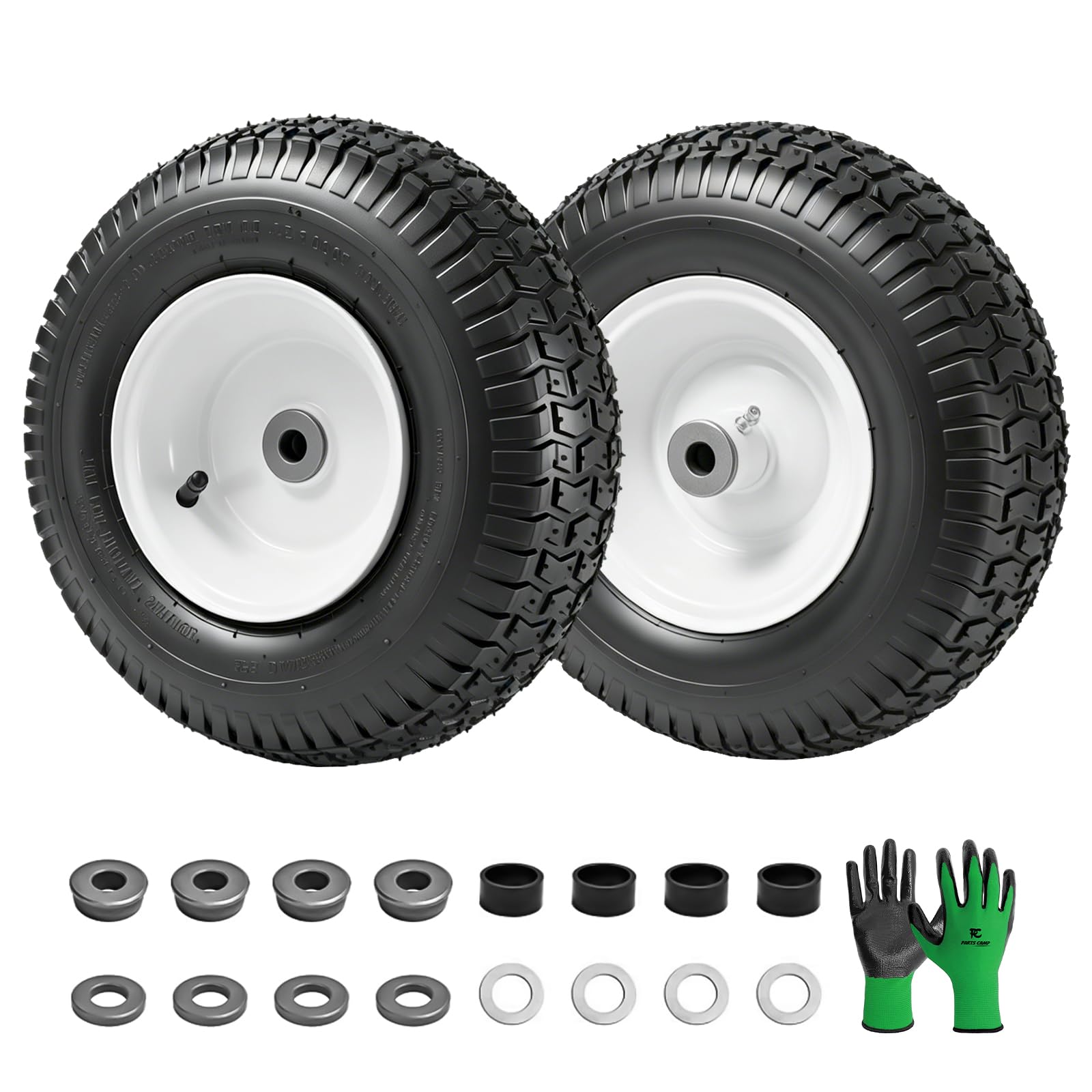
3. Parts Camp 13×5.00-6 Pneumatic Tire and Wheel Replacement
Ships with the bushings, spacers, and steel shims most sets make you buy separately.
The load index here is 300, and that number stands out in this round-up: it sits far above the 39 on the GICOOL tiller set at the top of the list. Those two figures are not measured the same way, but the contrast is real — this is a wheel built for heavier garden equipment rather than a light tiller front end.
What earns this set its place is the accessory box. You get a pre-assembled 3-inch centered hub with a 3/4-inch bore, plus extra 5/8-inch bushings, 1/4-inch and 1/2-inch nylon spacers, and steel spacers — enough to dial in fitment across different axle sizes and hub widths without a second order. The tire diameter is 13 inches and the section width is 4.5 inches, with a pneumatic air-filled design rated to absorb trail shock.
The honest limit is that hub length does not suit every machine from the start. One owner with a TroyBilt Pony found the hub a quarter-inch too long and milled the excess off, then used one of the supplied spacers on the inboard side — a real fix, but a real fifteen minutes with a tool. The valve stem also occasionally arrives cocked, which deflating and straightening solves.
Value read: Owners looking at the adapter kit list as the reason to buy have noted it undercuts the big-name mower brand replacement by a wide margin — one buyer framed it as a fraction of OEM pricing.
One structural note: A few owners mention wheel adapters or hub sleeves giving way before the tire does. It is a small share of a well-liked set, but if you are loading it hard, check the bushing seat now and then.
Pick this if: You want one box that covers both 5/8-inch and 3/4-inch axles and you are comfortable with a possible trim-to-fit hub.
skip it if: You need a guaranteed bolt-on with zero adjustment and want a flat-free wheel instead of air-filled.
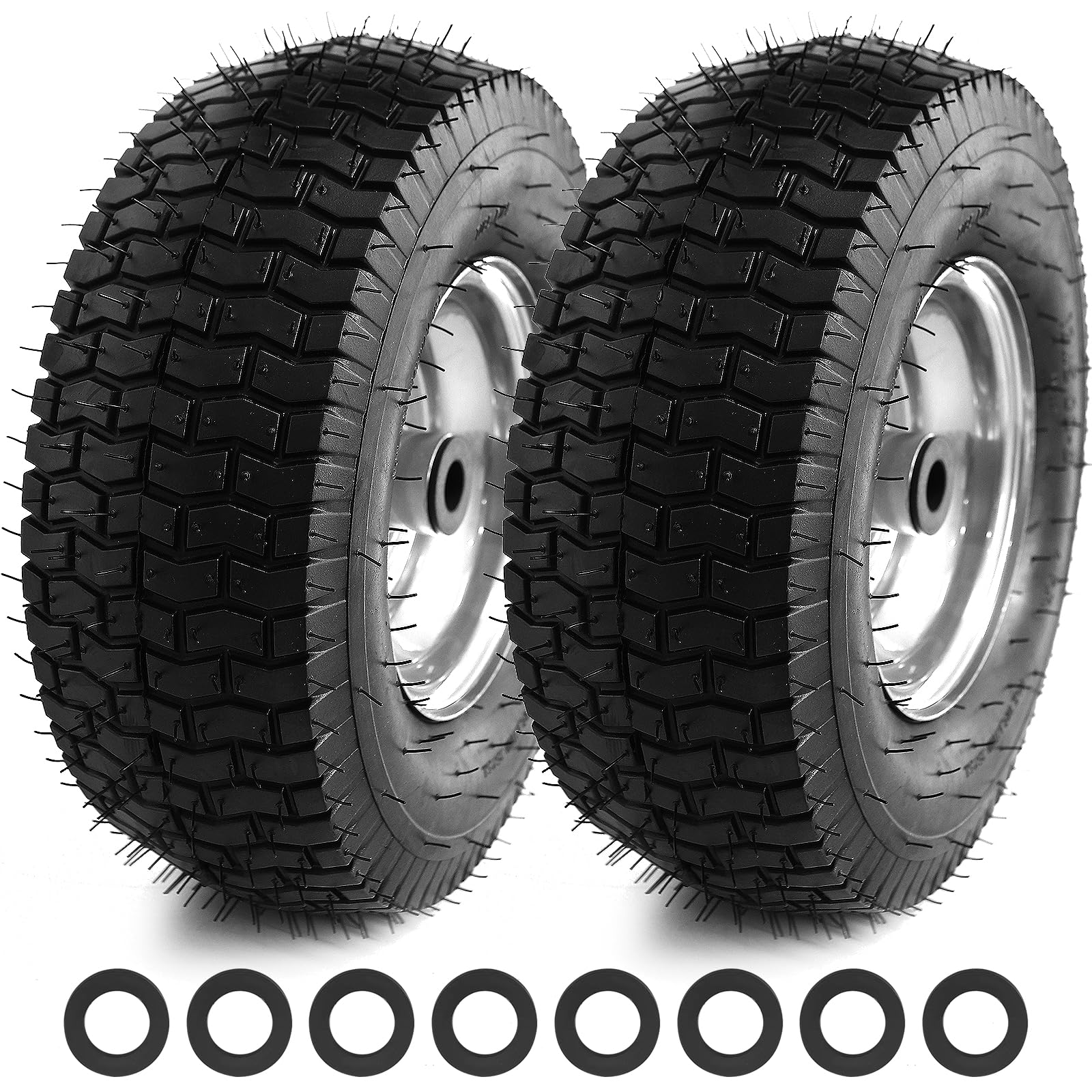
4. NING SHUO 13×5.00-6 Tire and Wheel, Set of 2 Rubber Pneumatic
A compact-hub wheel where the reinforced weld is the reason it holds up.
Six point six inches describes the hub length on this wheel, which is one of the shorter centered hubs in this round-up and the reason it suits compact yard tractors and small trailers rather than full-size riding mowers. The tire runs 13 inches in diameter with a 5.3-inch section width, and the rim itself is listed at 5 inches with a 2.5-inch rim width — a tight, low-profile package.
The standout claim here is the higher load capacity of 540, achieved with high-strength welding in the rim so the wheel does not flex under weight. The tire surface is finished with a fine hair texture intended to cope with weather, and the whole set comes pre-mounted so there is nothing to assemble beyond sliding it onto your axle and tightening the spindle.
Two things to know. The plastic spacers included are the weak link, and buyers have said so plainly — swapping them for sturdier hardware is a cheap upgrade. And the 6.6-inch centered hub will not fit an offset application, so check which type your machine uses first.
Why Buyers Choose It
- Reinforced welded rim built to resist bending under load
- Pre-mounted and pre-assembled — no tire mounting needed
- Compact 6.6-inch centered hub suits smaller yard tractors and trailers
- Thickened rubber tread with a weather-resistant textured surface
Points Worth Weighing
- The included plastic spacers are the weak point — replace them
- Smaller pool of owner feedback than the long-running picks above
- A centered hub will not work on offset-hub carts and wagons
- Compact hub length narrows which tractors it drops onto
The fit: Yard tractors and small utility trailers that run a short centered hub and want welded reinforcement in the rim.
The misfit: Anyone running an offset-hub wagon, or a mower that needs a longer hub to clear the frame.
5. AR-PRO (2-Pack) 13×5.00-6 Tire and Wheel Assembly, 4-Ply Tubeless

The turf-safe tread that rolls across a finish lawn without scuffing it up.
A 4-ply tubeless casing with a maximum inflation of 30 PSI is the short version. That 4-ply construction gives the casing more layers of cord than a budget 2-ply tire, so it resists squirming under a mower deck. The overall diameter is listed at 13.09 inches with a 5-inch width, and the assembly mounts on a 3-inch centered hub with 3/4-inch bushings.
The turf-style tread pattern is the part that earns repeat buyers. It is designed to hold traction while minimizing disturbance to the grass, which matters if you mow a lawn you actually care about rather than a field. Extra axle sleeves come in the box for spacing, and the sets are commonly fitted to John Deere LT180 and Cub Cadet machines.
The honest trade-off is air. These are tubeless pneumatic tires, so they need pressure maintenance and can puncture — and there is a real minority who ran into slow leaks from the bead seal rather than any puncture. Most owners have no such trouble, but if you are done with air entirely, a flat-free wheel is the better road.
Finish quality: Multiple owners running these on older tractors have described them making a tired mower look factory-fresh again, which speaks to the powder-white finish and clean tread lines.
Pressure note: These ship overinflated — owners who aired them down to their machine’s recommended pressure found the ride improved.
Choose these if: You mow a cared-for lawn, want a turf-friendly tread, and do not mind checking air pressure a few times a season.
Pass if: You have already been burned by pneumatic leaks and want a wheel that cannot fail that way.
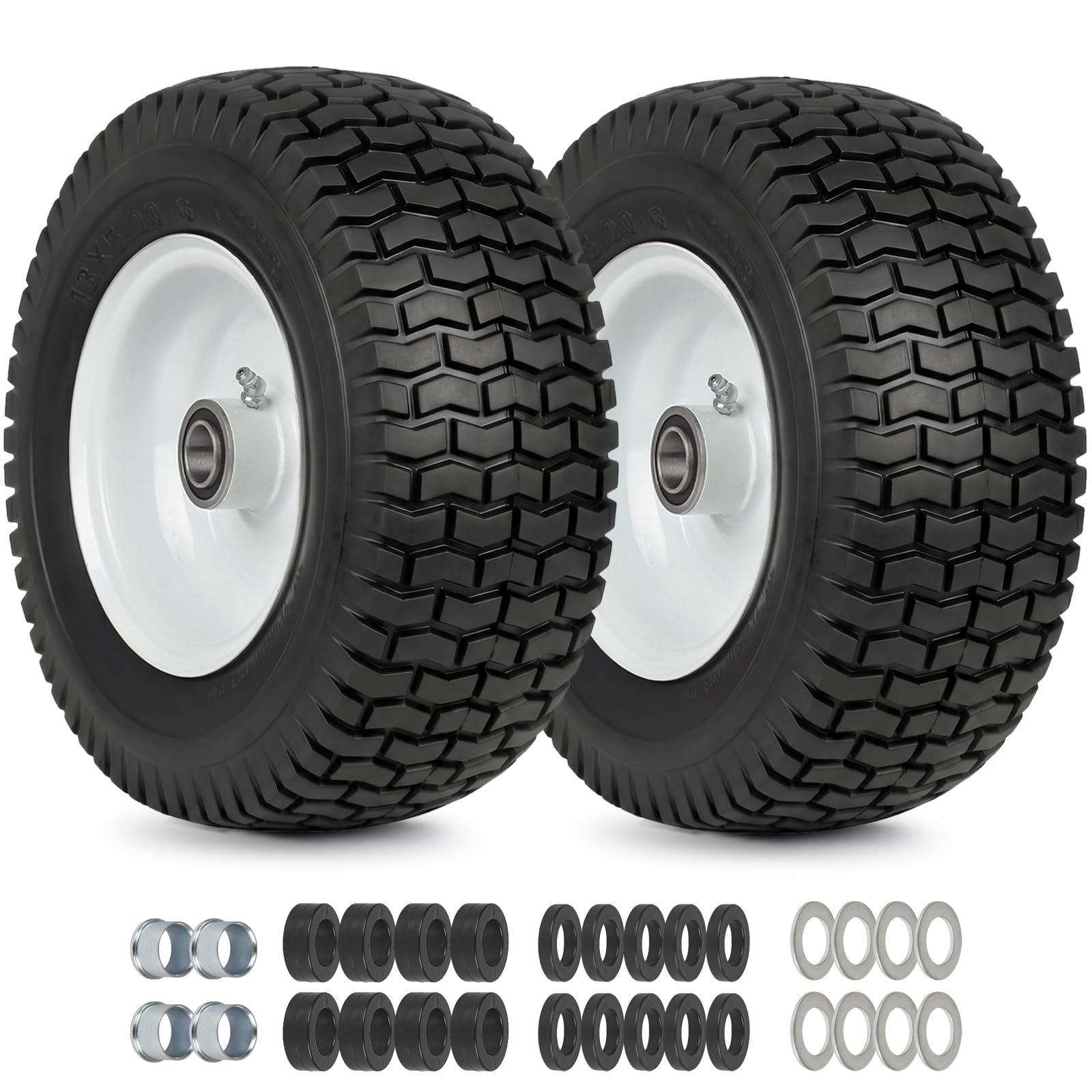
6. GICOOL 13×5.00-6 Flat Free Lawn Mower Tire and Wheel, 3″ Centered Hub
Built for thorn-ridden property where a flat tire ruins an afternoon of mowing.
The solid core here is premium PU foam — polyurethane, a dense plastic-like material rather than air — so there is no inner tube, no valve, and no puncture scenario. That is the whole point of the wheel, and it is why owners running acreage with thorn trees reach for it. The dynamic load capacity is listed at 550, and the centered hub adjusts across a range of 3 inches to 5.5 inches using the supplied spacers.
The adapter kit is generous: four 5/8-inch bearing sleeves, four 1/4-inch and eight 1/2-inch nylon spacers, plus four steel spacers. That covers a lot of axle and hub-width variation without a second purchase. A 2-year manufacturer warranty backs the set, and the turf-friendly tread is cut to reduce friction against grass.
Be straight about what this wheel is: it is a rigid molded replacement for air, not a cushioned ride. The recurring note from owners is a firmer, rougher feel than the pneumatic tires it replaces, and solid tires can develop flat spots if left sitting under load in hot sun. It is also rated for dynamic load only, not for long-term static weight.
Ride trade-off: Anyone coming from air-filled tires will notice the change immediately. Owners on thorn-heavy properties tend to accept it once they stop patching punctures.
Get the axle right: These will not fit a 1-inch axle — that is a fit rule, not a defect, and measuring first avoids a return.
For you if: You mow rough ground with thorn or debris pressure and want to stop dealing with air altogether.
Not for you if: Ride comfort is your priority, or you leave the machine parked loaded in the sun for months at a time.
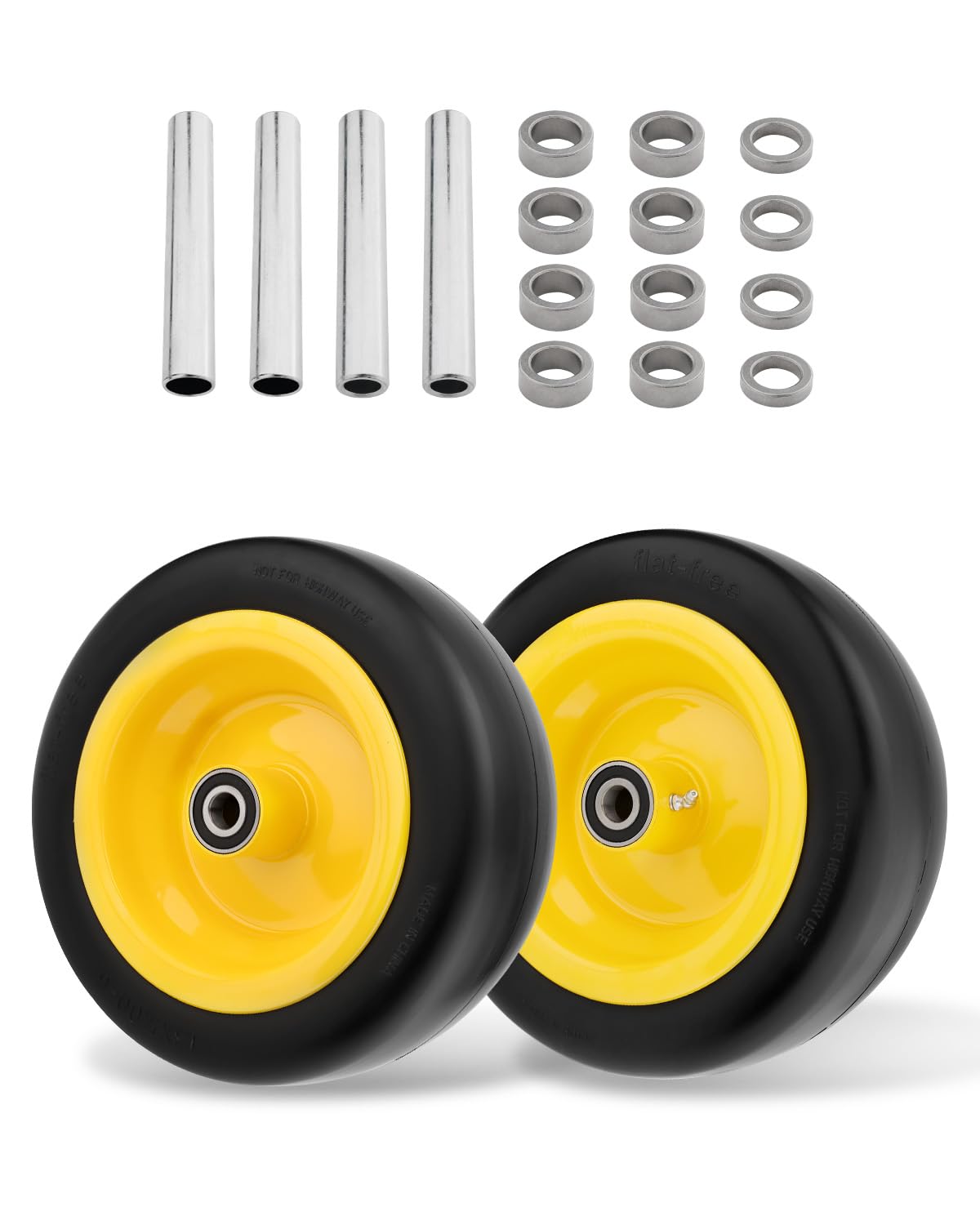
7. HQPASFY 2 Pack 13×5.00-6 Flat Free Tire and Wheel Assembly, 3/4″ Bearing
The solid-rubber wheel with a hub that adjusts from 4.6 to 9.1 inches.
The adjustable centered hub is the reason to look at this set. It runs from 4.6 inches to 9.1 inches with the included washers, which is a much wider range than most fixed-hub wheels in this size, and it makes fitting an oddball mower far less of a guessing game. The rim itself is listed at 8 inches with 8-inch width. The tire diameter shows as 12.2 inches with a 4.6-inch width and a 3/4-inch bearing that also accepts 5/8-inch and 1/2-inch sleeves.
Solid premium rubber construction means no air and no puncture downtime, and owners have come away from the swap happy with the steering feel — several note the front turn improved with these on. A 12-month manufacturer warranty covers defects, and the load capacity of 500 supports heavier loads without complaint.
What you give up is cushioning. This is solid rubber, not air, so bump absorption is limited — owners who relied on pneumatic tires will feel the difference in the front end. That is the honest price of a wheel that never needs a pump.
What Stands Out
- Adjustable centered hub from 4.6 to 9.1 inches — the widest fit range here
- Straight-block tread pattern keeps a low profile over delicate grass
- Sleeves for 5/8-inch and 1/2-inch axles included
- Flat-free solid rubber with a 12-month warranty
Where It Falls Short
- Ride quality runs firm compared with air-filled tires
- Small owner base compared to the long-established wheels here
- Solid rubber gives up cushioning for puncture-proof reliability
- Not intended for highway-use equipment
Worth a look: If your mower has an unusual hub width and you need a permanent-wheel solution that adjusts to fit.
Think twice: If you want the softer ride of air-filled tires and do not have a thorn problem pushing you to solid rubber.
8. MaxAuto 2Pcs 13×5.00-6 Lawnmower Tire on Wheel, 3/4″ Bushing

Covers more ground than any other set here — mowers, carts, wheelbarrows, and compressors.
Start with the tire size, because that is the whole story with this set. It is 13×5.00-6, also written 13x5x6, 13-5-6, 13×5.00×6, and 13 5.00 6, and it is fitted across riding mowers, lawn tractors, garden tractors, wheelbarrows, garden carts, hand trucks, pressure washers, generators, and air compressors. Few wheels in this round-up cover that much equipment. The hub is a 3-inch centered type with a 3/4-inch bushing and a load index of 39.
These are pneumatic tires with an inner tube, and they come with an air valve and a grease fitting — a small touch that makes long-term maintenance easier. Customers note the pair arrives inflated and pre-mounted, with one noting about five minutes of install. Owners running them on John Deere 8Y dump carts and Cub Cadet machines have found them a straightforward swap.
The honest risk is size drift. A few owners have found the tread narrower or taller than the stock tire they replaced, and one went as far as calling the sizing misleading. Measure your old wheel’s diameter, hub length, hub type, and bushing diameter before ordering — all four must match for this to fit.
Maintenance edge: The grease fitting and air valve are what make this set easier to live with than a sealed wheel over time — you can service both the bearing and the pressure.
Size check: Because this set is marketed across so many applications, verify your axle bore and hub type carefully — the listing itself notes that all four dimensions must match.
Pick it up for: Mowers, carts, wheelbarrows, and utility equipment that share the 13×5.00-6 footprint and a 3/4-inch bore.
Leave it if: You need a flat-free wheel or your machine takes an offset hub — this is a centered, tubed pneumatic.
9. MerryYard 2-Pack 13×5.00-6 Flat Free Tire with Rim, 2.25″ Offset Hub

An offset-hub solid wheel for wagons and garden carts where centered wheels will not fit.
Offset hubs are the rare configuration in the 13×5.00-6 world, and this is one of the few sets here that carries one. The hub length is 2.25 inches offset with a 5/8-inch ball bearing — a genuine difference from the 3/4-inch bore centered wheels that dominate this size. It is also built with high-density PU foam around a black powder-coated steel rim, so it cannot leak or burst.
The tread width is 3.6 inches with a 12.2-inch tire diameter, and the manufacturer lists it under several alternate part names including 13x500x6, 500-6, 13×5-6, and 12×5.00-6. The pattern on the tire is cut to add ground grip and improve cooling and drainage, and the load capacity is listed at 300 with a note that it suits dynamic loads rather than static ones. The lightweight build — polyurethane around a steel rim — is what makes it easy to handle on and off the axle.
Two honest limits surface in the field. There is no grease fitting on this set, so you cannot easily service the bearing the way you can on the MaxAuto wheel above. And at least one owner measured the actual diameter smaller than the listed figure, so it is worth checking against your frame clearance before you commit.
Solid and quiet: Owners running two-wheel metal agri-carts and wagons have landed on this set happily, noting the offset hub seats correctly and the polyurethane runs quieter than a pneumatic.
Not for static load: The listing is explicit that this wheel is intended for dynamic loads only, so a parked trailer piled with weight is not its use case.
Suited to: Garden carts, wagons, wheelbarrows, and trolleys that take an offset hub and want a flat-free wheel with no air to maintain.
Wrong pick if: Your machine runs a centered 3/4-inch hub, or you want a grease fitting for bearing maintenance.
Understanding the Specs
Why Axle Bore Comes First
The bore is the hole running through the wheel hub that the axle shaft slides into. A 3/4-inch bore is the most common fit on riding mowers and tillers; a 5/8-inch bore is the other common size. Both must match your shaft before anything else matters — a wheel with the right tire size and the wrong bore will not mount at all. Many sets include both bore sleeves so you can cover either axle.
Hub Type and Hub Length
Hub type describes where the mounting hole sits on the wheel. A centered hub keeps the wheel symmetrical on the axle; an offset hub pushes the mounting point to one side, which is what garden carts and wagons use. Hub length is the measurement of that hub from edge to edge, and it decides whether the wheel clears your machine’s frame or rubs. Measure both your old wheel’s hub length and hub style before ordering.
Reading 13×5.00-6
The first number — 13 — is the tire’s overall diameter in inches. The middle number, 5.00, is the section width across the tire casing, not the tread contact patch. The final 6 is the rim diameter that the tire is designed to mount on. Any set must match all three for the tire and the wheel to work together properly.
Ply Rating and Flat-Free Construction
Ply rating counts the cord layers inside a pneumatic tire’s casing; a 4-ply tire is sturdier than a 2-ply and holds shape better under weight. Flat-free tires skip this by replacing air with a solid foam or polyurethane core that cannot puncture and never needs inflation — the trade-off is a firmer ride and, on some wheels, no way to service a grease point.
FAQ
How do I know if a 13×5.00-6 tire and rim will fit my mower?
What does the 5.00 mean in a 13×5.00-6 tire size?
Are flat-free tires better than air-filled tires for a lawn mower?
Should I choose a tubed or tubeless pneumatic tire?
Can I put 13×5.00-6 wheels on a cart or wheelbarrow as well as a mower?
Why does my new tire sit narrower or taller than the old one?
What is the difference between a centered and an offset hub?
Do you need a 1-inch axle for any of these wheels?
How do the load capacities compare across these wheels?
Will these wheels work on a snowblower or garden cart?
Final Thoughts: The Verdict
The pick that does the most for the most people is the GICOOL 13×5.00-6 Tiller Tire& Wheel 2PK — a 4-ply, sharp-angled tread set that bolts onto Craftsman, Troy-Bilt, Pony, Earthquake, Champion, and Cub Cadet rear-tine machines on a 3/4-inch axle. If you want a wheel that never needs air, the Marathon 30326 Flat-Free is the one to reach for, thanks to its 3-inch centered hub and 3/4-inch contractor-grade bushings. And if you need an offset hub for a garden cart or wagon, the MerryYard 2-Pack is the set that fits where the centered wheels cannot.
How We Picked
We do not accept paid placement. Every pick is matched to a real buyer and a real use-case; we do not hands-on test units.
Sources & Methodology
Specifications: manufacturer listings and product documentation. Review insights: verified customer reviews, as of September 2026. Pricing: not shown on this page (it changes often); check the current price via the retailer link.
As an Amazon Associate, Gadgets Feed earns from qualifying purchases. This does not affect which products we feature.