
Our readers keep the lights on and my morning glass full of iced black tea. As an Amazon Associate, I earn from qualifying purchases.
Specs are compiled from manufacturer listings and verified buyer reviews and can change over time — please confirm the key details on the product page before buying.
If your RV house bank still runs on lead-acid, you are carrying a lot of dead weight for a fraction of the usable power. The question that matters is not “how many amp hours?” but “how many amp hours can I actually use?” A flooded or AGM battery gives you roughly half its rating before voltage sags; a lithium iron phosphate battery delivers the full rating, with a BMS guarding the cells. That shift cuts tongue weight, shortens charge time, and stretches fridge runtime through a rainy boondocking weekend.
I’m Min — the founder and writer behind Gadgets Feed. This guide is built by comparing the manufacturers’ published specifications and the patterns across verified customer reviews, so you get each pick’s real strengths and trade-offs instead of marketing spin.
For an RV owner wiring a lithium house bank, the real decision depends on usable amp hours, cold-weather protection, and physical bulk. Here is a full breakdown of the setups that actually earn their place aboard, all gathered under the banner of the battery bank for rv.
Our Picks at a Glance

How To Choose The Best Battery Bank For Your RV
Choosing a house battery for an RV is different from picking a car battery for two reasons. First, you are not asking for a short, high-current burst — you are asking for hours of steady flow to run lights, a furnace fan, and a compressor fridge. Second, whatever you install lives with you, so weight, footprint, and how much charge you can draw before you hit 50% all matter every single day.
Chemistry and usable amp hours
Lead-acid and AGM batteries are rated in amp hours at a specific discharge rate, but the voltage falls steadily as they drain, and most owners stop drawing around the halfway mark to protect them. A 100 amp hour AGM therefore behaves more like a 50 amp hour battery in the real world. Lithium iron phosphate (LiFePO4 — a lithium chemistry with an iron phosphate cathode that resists heat and keeps voltage steady) holds its voltage across the whole discharge curve, so a 100 amp hour LiFePO4 delivers closer to the full 100 amp hours. This is the single biggest reason RVers switch chemistry.
BMS, cold protection, and Group size
Every lithium battery here contains a BMS (battery management system — a small circuit board that shuts the cells off if they are overcharged, over-drained, overheated, or charged below freezing). The cold-temperature cutoff is the function RV owners lean on most, because charging a lithium cell below freezing damages it permanently. Group size matters too: a Group 31 or 4D tray will accept some of these batteries as a drop-in fit, while others need a mount you build yourself. If your existing tray is molded into the frame, check the footprint before you buy.
Quick Comparison
Every product below is a true deep-cycle house battery rated for storing energy, not for cranking an engine. Scan the capacity, weight, and BMS amperage across rows to spot the trade-offs fast.
| Model | Best For | Capacity | Weight | BMS | Amazon |
|---|---|---|---|---|---|
| Litime 12V 200Ah Mini LiFePO4★ Best Overall | Best Overall — boat & RV power without the bulk | 200 amp_hours | 28 pounds | 200A | Amazon |
| Power Queen 12V 200Ah PLUS LiFePO4Most Capacity Per Pound | Full-time RV living with heavy loads | 200 amp_hours | 22.5 kg | 200A | Amazon |
| ECO-WORTHY 12V 314Ah LiFePO4Biggest Reserve | Off-grid storage with the most usable reserve | 314 amp_hours | 60.4 pounds | 200A | Amazon |
| Litime 12V 230Ah Deep Cycle LiFePO4 | Travel trailers wanting a Group 4D drop-in | 230 amp_hours | 45.3 pounds | 200A | Amazon |
| VATRER POWER 12.8V 460Ah Self-Heating | Four-season boondocking with heat built in | 460 amp_hours | 104.7 pounds | 300A | Amazon |
| DUMFUME 12V 600Ah LiFePO4 | Whole-house backup on wheels | 600 amp_hours | 107.8 pounds | 200A | Amazon |
| Power Queen 12V 100Ah Group 31 LiFePO4 | Trolling motors and lighter RV banks | 100 amp_hours | 24.3 pounds | 100A | Amazon |
| WattCycle 12V 100Ah LiFePO4 Group 24 | Tight Group 24 bays and travel trailers | 100 amp_hours | 23.2 pounds | 100A | Amazon |
| YEAGULCH 12V 150Ah LiFePO4 | Budget lithium with trolling-motor range | 150 amp_hours | 41 pounds | 100A | Amazon |
| WEIZE 12V 100Ah Deep Cycle AGM | Budget lead-acid drop-in, no BMS needed | 100 amp_hours | 60 pounds | — | Amazon |
| DAAKMAX 12V 100Ah Deep Cycle AGM | Cheapest entry into deep-cycle storage | 100 amp_hours | — | — | Amazon |
In‑Depth Reviews
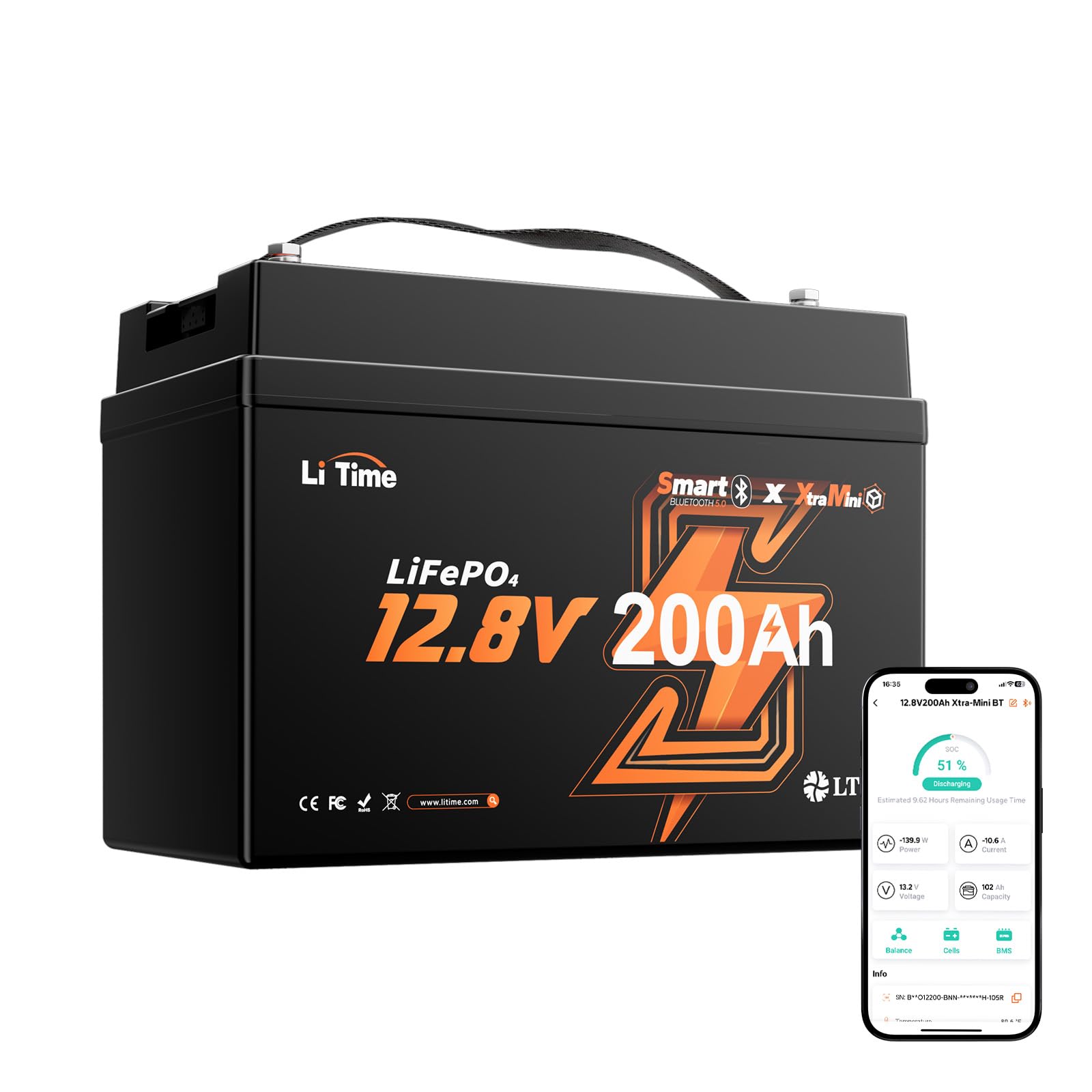
1. Litime 12V 200Ah Mini Trolling Motors LiFePO4 Lithium Battery for RV
Our pick — over 4.5★ from 600+ verified ratings; the strongest balance of quality and price.
A 200 amp hour lithium bank that weighs less than a modest lead-acid one quarter its capacity.
Here is a number that changes the whole conversation: this battery puts 200 amp hours into a case that weighs just 28 pounds and measures 13.11 by 6.93 by 9.45 inches. Compare that with the WEIZE 12V 100Ah AGM further down this list, which carries half the capacity at 63 pounds — that is a 35-pound swing per battery, and it is even more lopsided once you account for usable capacity. A 100 amp hour AGM gives you roughly 50 usable amp hours before voltage sags, while this LiFePO4 bank hands you the full 200 amp hours across the discharge curve. That is the difference between one night of fridge runtime and three.
What buyers keep coming back to on this one is battery quality — it is the aspect that draws the most praise, and a lot of it depends on how the app makes the whole setup transparent. The Litime app pairs over Bluetooth 5.0 and shows real-time state of charge, voltage, and current, so you can check where your bank sits without opening a hatch. Buyers report that two of these wired in series for a 24V Minn Kota trolling motor held 72% after four hours in 25mph gusts, then recharged to 100% in hours through a power station. For an RV owner running a Garmin LiveScope, the same rig ran 10 hours and still showed 83 amp hours remaining. The 200A BMS meets the ABYC E-13 standard and carries triple protection against dust, water, and salt spray, so a splash off the tongue does not end your weekend.
Cold-weather charging is handled automatically: below 32°F the BMS stops charging, and below -4°F it stops discharging, both of which protect the cells from permanent cold damage. Litime claims 6000 deep cycles at 100% depth of discharge — the figure most buyers run their long-term math against. What trips people up is the first-use detail nobody reads in the listing: you have to charge this with a lithium-activation or MPPT charger before the Bluetooth module wakes up. A few buyers also needed an auto-detect converter when swapping out an older RV charger — check what your rig ships with before you pull the trigger.
Why this one leads the list
- 200 amp hours in a 28-pound package — a fraction of the weight of an equivalent lead-acid bank
- Bluetooth 5.0 app shows state of charge, voltage, and current from your phone
- 200A BMS with triple dust/water/salt-spray protection keeps a wet tongue deck safe
- Automatic low-temperature cutoff stops charging below 32°F and discharging below -4°F
- Expandable to 4P4S for a 51.2V, 800Ah, 40.96kWh system without changing gear
What to plan for
- Bluetooth only activates after a lithium-activation or MPPT charger wakes it up
- Not built for starting an engine, a jack, or a golf cart — storage only
- Some RV chargers need an auto-detect converter before this will fully top off
Reach for this if: you want a big, cold-tolerant lithium bank that will not tax your tongue weight.
Look elsewhere if: you need a cranking battery or a drop-in replacement for a failing starter.
2. Power Queen 12V 200Ah PLUS LiFePO4 Lithium Battery with 200A BMS for RV
The 200Ah bank built for owners who never want to see the low-voltage warning again.
If you are shopping for a full-time RV house bank, the energy density here is the headline: 2560Wh of usable storage packed into about 55 pounds, which Power Queen rates at roughly 3X the energy density of lead-acid. It runs 95% usable capacity with a 2% low self-discharge rate and 20+ BMS protections including low-temperature cutoff, and it can expand up to 4 in series at 48V or 4 in parallel for 800Ah. For a rig running an inverter to feed an oven, a TV, or a mini fridge, that expansion headroom is the buffer.
What owners rave about is battery life — the aspect drawing the most positive discussion — and the everyday scenes back it up. One camper ran an oven for an hour and twenty minutes plus a TV and mini PC stream off a single charge with power to spare, and a 55-quart 12V fridge/freezer ran around the clock on the same bank. Someone using it in a full-time RV swapped out two 6V Trojan lead-acids and reports two years of flawless service at around 40 pounds per battery. It also survived a full drain after a fuse blew without needing support, which is the kind of thing you only find out about when you are stuck somewhere off-grid.
The honest catch is weight versus the Litime 200Ah Mini above — this one lands around 55 pounds against that battery’s 28, so if you move your bank between vehicles or handle it alone, the Litime wins on portability. A buyer who bought a “like new” used unit noted it arrived scratched with peeled stickers, though the seller later reached out to confirm the battery was in good shape. If you buy new and want a two-year-serving house bank, this is among the most proven options in the lineup.
Strongest on paper
- 2560Wh energy reserve with up to 95% usable capacity
- Roughly 3X the energy density of lead-acid, per the maker’s claim
- Expandable to 4S at 48V or 4P for 800Ah to scale as your loads grow
- 200A BMS with 20+ active protections including low-temp cutoff
Honest trade-off
- Around 55 pounds each — noticeably heavier than the Litime 200Ah Mini
- A used unit showed up scratched in one buyer’s report, so verify condition on secondary-market purchases
- Bigger footprint than a compact 200Ah bank, so measure your tray first
Built for: full-time RVers running inverters, fridges, and entertainment loads around the clock.
skip it if: you plan to move the bank between vehicles often — the Litime 200Ah Mini is far easier to handle.
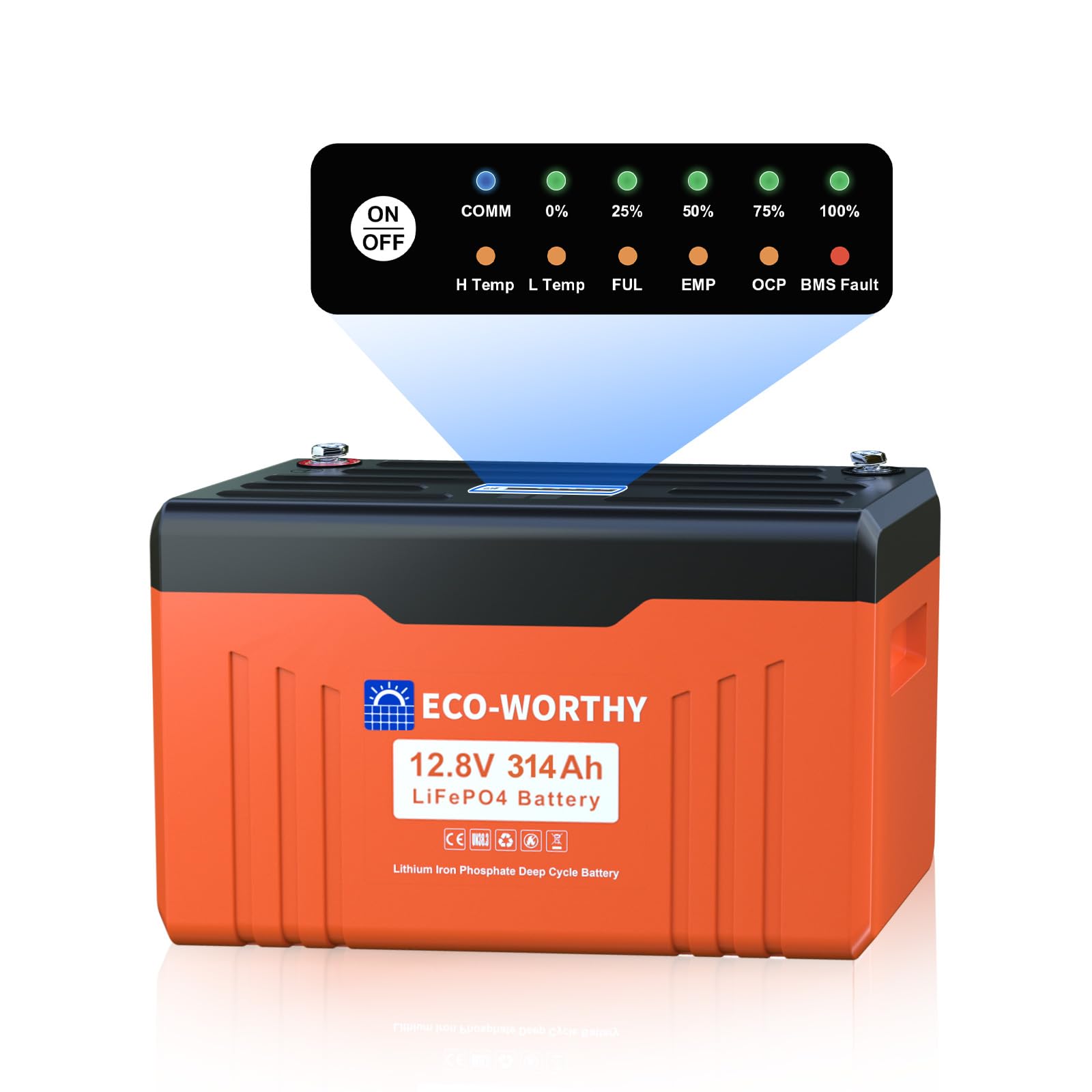
3. ECO-WORTHY 12V 314AH LiFePO4 Lithium Battery Bluetooth with SOC LEDs
314 amp hours and an LED readout that tells you exactly how much daylight you have left.
If your definition of a proper bank is “I can lose the sun for five days and not panic,” start with the 314 amp hours and the 4019.2Wh of stored energy this battery holds. The 200A BMS carries high and low temperature protection that automatically cuts charging when things drop below -7°C (19.4°F), and the built-in buzzer pings you if the battery throws a fault — a useful feature when you are troubleshooting from an app rather than a multimeter. On top of that you get an LED screen on the case itself showing charge percentage and health, plus Bluetooth to the ECO-WORTHY app. Expandable to 4P2S or 2P4S for a 32.15kWh system total.
The build quality draws the most praise from owners, which matters because this bank sits in a steel tray bouncing down gravel roads. One rig replaced a 1200W lead-acid bank with this and now runs 4000W through the same camper, with the case lined in fire-resistant material. A truck-camper owner in Indiana ran it through two days of nonstop rain and still had a week of runtime in reserve; another swapped out two 100Ah gel batteries and calls the switch a fix for their power anxiety. The 60.4-pound case carries handles, which helps when you are hoisting 314 amp hours into a bay.
Battery life is the aspect the reviews are most split on, so plan for that honestly: some owners mention a full week of runtime, while a few mention the battery topping out short of its rating on a full charge. Cold-temperature performance is where the low-temp cutoff shines and where you should double-check your charger will actually push this to 100%. If you are off-grid with a big solar array, the reserve here justifies the footprint and the weight in a way that smaller banks simply cannot.
Best in class for pure reserve: 4019.2Wh stored energy is the highest capacity on this list, and the LED status screen means you can read charge state at a glance without opening an app.
Budget your charge time: 314 amp hours takes longer to refill than a 200Ah bank, and a few customers note it not reaching the full rating — size your solar accordingly.
Made for: serious off-gridders who want the largest usable reserve in the lineup.
Think twice if: your 200Ah bank already covers your needs — you will be hauling 60 pounds you do not use.
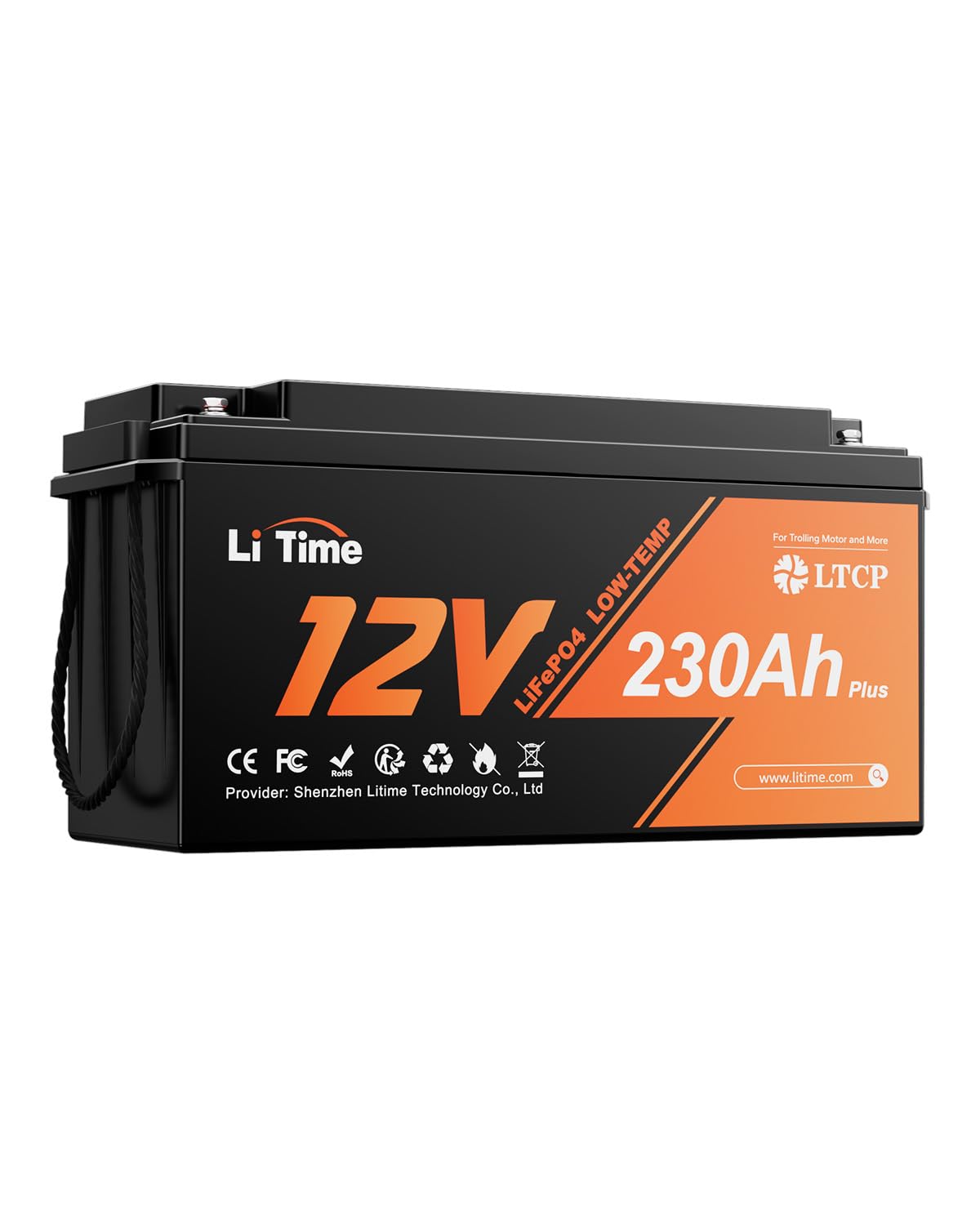
4. Litime 12V 230Ah Deep Cycle LiFePO4 Battery for RV, Camper, Travel Trailer
The battery that slips into a Group 4D tray and saves your spine in the process.
Your travel trailer’s existing battery box is the constraint most buyers forget until they are on their knees with a tape measure. This Litime is built to fit Group 4D boxes and weighs 45.98 pounds, roughly a third of an equivalent lead-acid block — a real upgrade if you swap out a pair of heavy flooded cells without cutting a new mount. It carries a 200A BMS with 20+ safeguards and low-temp protection that pauses charging below 0°C (32°F), and it delivers 230 amp hours usable across the discharge curve. Litime rates it at 4000+ cycles at 100% depth of discharge, with a 10-year lifetime projection.
Owners highlight battery quality as the top praise category, and the practical stories line up. One travel-trailer owner replaced two OEM lead-acid batteries and gained 130 more amp hours with less weight, completed the initial charge in four hours, and had it running in a single afternoon. A Group 4D shopper appreciated the compact footprint versus the old lead-acid slab, and the Bluetooth app made checking state of charge a quick phone tap. It also expands up to 16 batteries in a 4P4S layout for a 48V 920Ah system with a 47.1kWh max output, so building out a bigger bank later does not mean starting over.
One catch worth knowing up front: Bluetooth does not come enabled. You need to wake it with a lithium-activation or MPPT charger on first use, and it is not designed for starting an engine, a golf cart, or a jack. If you are already charging with a modern RV converter, you likely will not notice. If you are on old equipment, plan the charger upgrade as part of the swap.
Why this earns its spot
- Fits existing Group 4D boxes without a mount rebuild
- 230 amp hours at only 45.98 pounds — about one-third the weight of an equivalent lead-acid battery
- 200A BMS with low-temp cutoff at 0°C (32°F)
- Expandable to a 4P4S 48V 920Ah system for 47.1kWh total
Keep in mind
- Bluetooth needs a lithium-activation or MPPT charger to enable on first use
- Not designed for starting batteries, golf carts, or jacks
- Heavier than the 200Ah Mini options despite the smaller capacity bump
The right call for: travel-trailer owners who want a genuine drop-in Group 4D fit without relearning their electrical system.
Not ideal if: you are moving the bank between rigs — the 200Ah Mini is lighter and easier to carry.
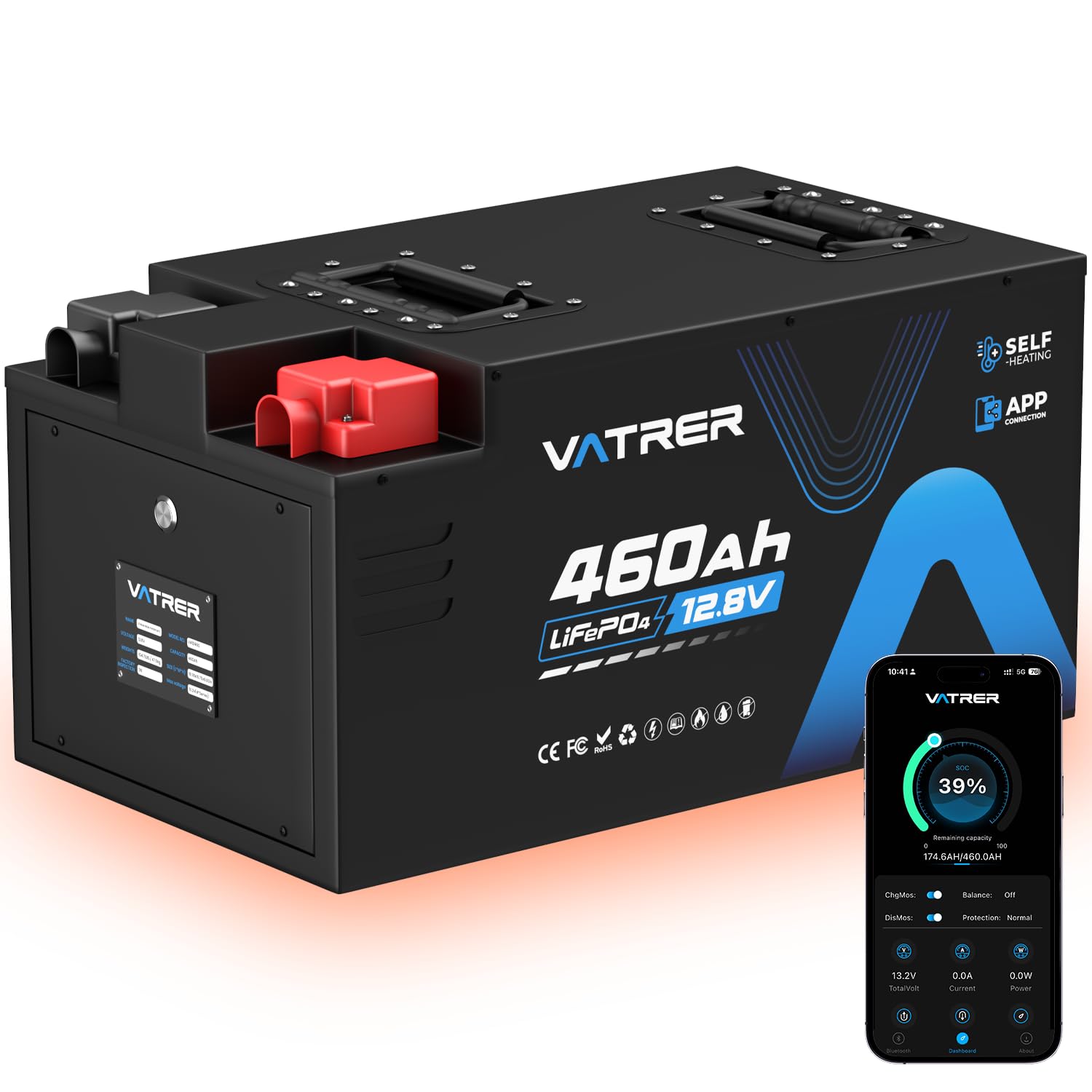
5. VATRER POWER 12.8V 460Ah Self-Heating LiFePO4 RV Battery with APP Monitoring
460 amp hours with a heater inside, so winter camping stops being a compromise.
Most lithium banks give you two choices in freezing weather: put them to sleep and run on shore power, or risk damaging the cells by charging them cold. This VATRER POWER battery solves that with an automatic self-heating function that kicks on when the BMS detects a charger connected between -4°F and 41°F. It warms the cells to 41°F, then begins a normal charge. That is the feature that makes this one the pick for four-season RVers who camp where the overnight temps dip below freezing and still expect to run a furnace, a fridge, and a coffee maker off the bank.
The 300A continuous discharge current is the other stand-out — that is enough to run air conditioners, TVs, and ovens concurrently, which most 100A and 200A banks cannot manage without cutting out. It packs 460 amp hours into a case measuring 18.9 by 10.82 by 9.84 inches, which the maker compares to the energy of five 100Ah batteries at a fraction of the footprint. It expands up to 4P4S for a 51.2V 1840Ah system with a 61.44kW output and 94.2kWh usable energy. App monitoring lets you check current, voltage, temperature, and cycle life from your phone; a main switch on the case handles power at the touch of a button.
What wins people over is the build quality and the reliability of the return voltage — one owner sums up the whole proposition with: “It is worth every penny.” The recurring complaint is Bluetooth range; the app itself works, but the wireless link from a truck camper or an exterior battery box can be spotty. The 104.7-pound case is heavy enough that you will want a second set of hands for installation. Both are worth knowing before you commit to a bank this size.
Why the heater matters: the self-heating cycle auto-engages between -4°F and 41°F, so a cold snap on a ski-trip weekend does not leave your bank frozen and useless.
What to budget for: 104.7 pounds means a two-person install, and Bluetooth range is short enough that you want to be near the battery to monitor it reliably.
Pick this one if: you camp in freezing weather and need a bank that charges itself warm instead of waiting for spring.
Pass if: you are shopping for a lightweight bank — the Litime 200Ah Mini handles the same loads at a quarter of the weight.
6. DUMFUME 12V 600Ah LiFePO4 Lithium Battery Built-in 200A BMS
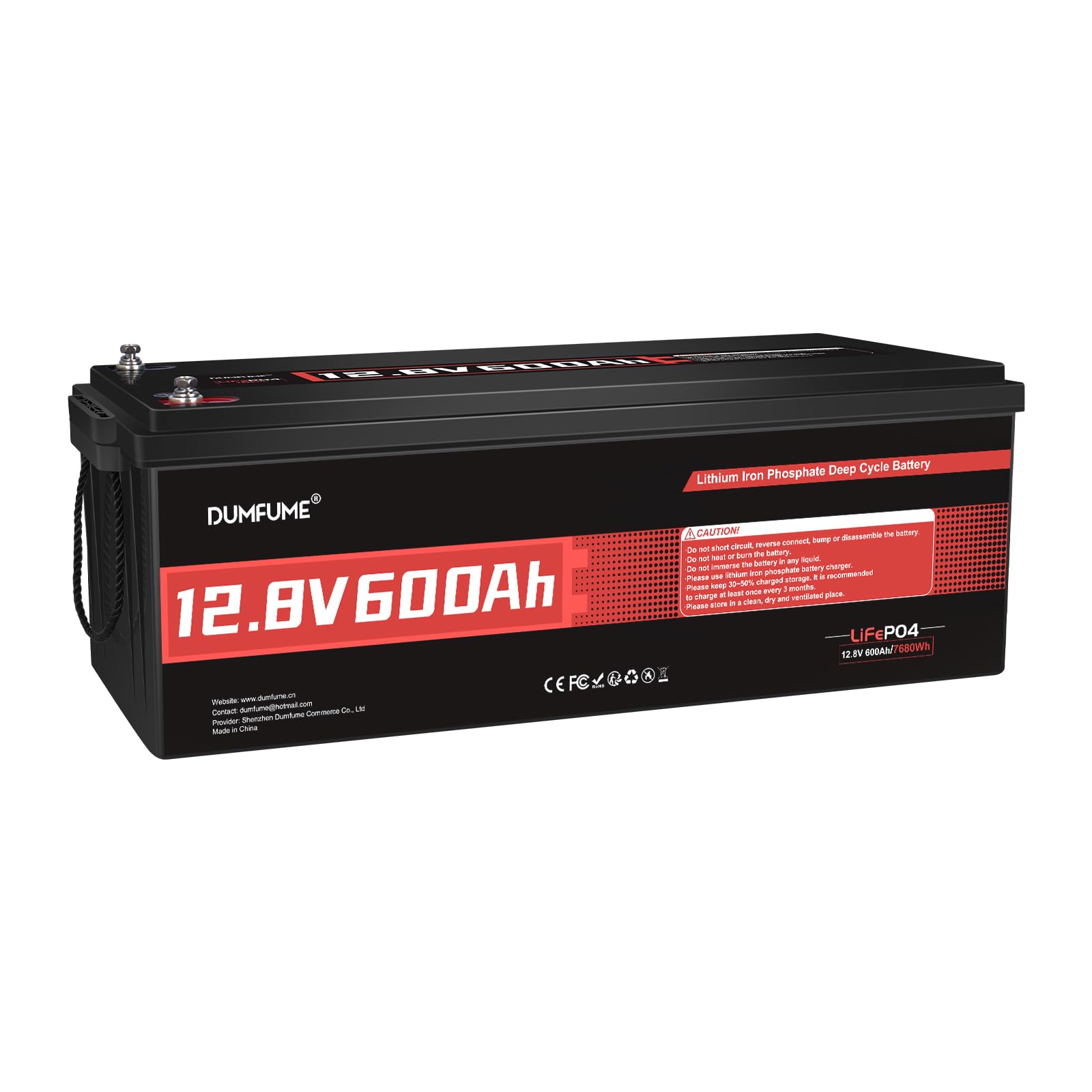
A single block rated at 7.2kWh — the bank you buy when one battery should cover an entire day.
Six hundred amp hours is the kind of capacity that turns an RV house bank into a small home power station. The 7.2kWh reserve is rated by the maker as roughly one day of basic household use (lighting, fridge, small appliances), and it can power air conditioning, a caravan, or a camper off-grid without a second thought. The 200A BMS handles overcharge, over-drain, over-current, and overheating protection, and adds low-temperature cutoff that disconnects charging below 0°C and discharging below -20°C.
The build quality gets the loudest praise, and the everyday results back it up. One RV owner has run two 300Ah versions of this battery in a 1997 Class C with a Victron MultiPlus 2, 800W of solar, and an MPPT 100/50 charge controller, and reports a 7 cubic-foot fridge running without issue. Another owner built out 1228Ah across several units and ran a 12V Gidrox 12k BTU air conditioner for 13 hours straight, with the panel showing 27 hours of runtime remaining. The battery supports series and parallel expansion (up to higher voltages like 24V or 48V or larger capacity banks), and the manufacturer recommends avoiding mixing brands in the same bank to keep current distribution even.
Honest caveat: this is a 107.8-pound battery, so it goes in once and stays put, and the charging capacity is the aspect reviews are most split on — some units need a jump charge from the start to wake the BMS. A small number of longer-term reviewers point out reduced capacity under heavy continuous loads. If you want a single battery that handles an air conditioner plus fridge without expansion wiring, this is the one to weigh against the 460Ah VATRER above.
Where it holds its own
- 7.2kWh usable reserve from a single battery — enough for an air conditioner and fridge combination
- 200A BMS with low-temp cutoff below 0°C charging and -20°C discharging
- Series or parallel expansion supports higher-voltage and higher-capacity builds
- DUMFUME projects a 10-year lifespan at 6000 cycles and 80% depth of discharge.
Fair warning
- 107.8 pounds — a two-person install
- A few units arrive discharged enough to need a jump charge to activate the BMS
- The maker advises against mixing brands in series or parallel — plan bank-wide consistency
Ideal for: RVers running air conditioning off-grid who want one battery to handle the whole load.
Not for you if: you swap batteries between vehicles — 107 pounds is a permanent install, not a portable one.
7. Power Queen 12V 100Ah Group 31 LiFePO4 Lithium Battery for RV, Marine
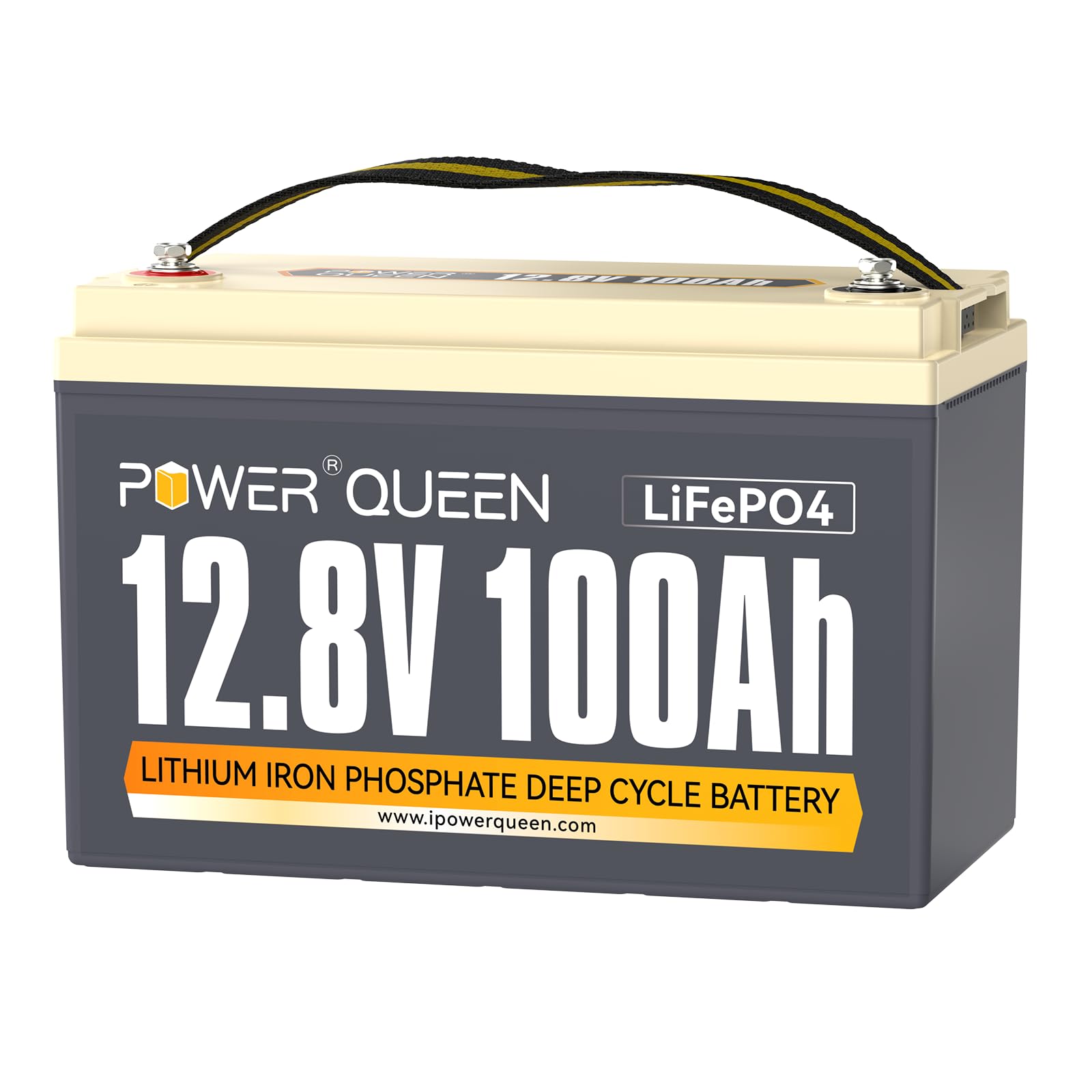
The 100 amp hour lithium that lets a 55-pound-thrust trolling motor run all day and half the night.
Twenty-four pounds is the figure to remember here — this Group 31 LiFePO4 weighs about a third of a lead-acid battery of the same rating, and that matters on a boat where every pound near the transom changes how the hull sits. The 100A BMS covers overcharge, over-drain, short circuit, and overheat protection, and the battery expands up to 4S4P for a 51.2V 400Ah (20.48kWh) system — plenty of headroom for someone building a house bank out of multiple units.
Reliability is the biggest positive story, and the real-world scenes hold up. One reviewer ran a 55-pound-thrust trolling motor through thick grass for 6 hours, then recharged in about 3 hours with an estimated 8 to 10 hours of total runtime. Another ran a 14-mile river trip at 4.3mph full-tilt and 3.1mph cruise, switching batteries at mile 9 — the first one weakened around mile 8.5 and reset at full speed, the second finished strong. There is a well-known observation that these charge faster off a 10A charger than a comparable lead-acid bank, and a boat owner who runs a trolling motor plus two Garmin graphs reports going from 6am to 6pm on a single charge with the voltage barely dipping.
The nuance to plan around is terminal hardware: one owner noted the 6mm bolts with a 13mm head felt cross-thread-prone when stacking multiple lugs, so steady hands (or a tap) help. A small number of units have shown swelling under charge, though the seller’s support team is reportedly responsive when that happens. If you want a lightweight house bank for a smaller RV or a dual-purpose trolling-motor setup, this is a proven, durable pick.
The deciding spec: 24.3 pounds at 100 amp hours beats every other 100Ah option on this list on weight, and the 4S4P expansion ceiling of 51.2V 400Ah keeps future builds open.
Terminal tolerance: the 6mm bolts are fine for a single connection but feel tight when stacking lugs, so use a torque wrench rather than brute force.
The obvious fit for: trolling-motor owners and lighter RV house banks who want lithium reliability at a modest weight penalty.
Consider a bigger bank if: you are running an inverter and an air conditioner — 100 amp hours will run out before dawn.
8. WattCycle 12V 100Ah LiFePO4 Battery, BCI Group 24
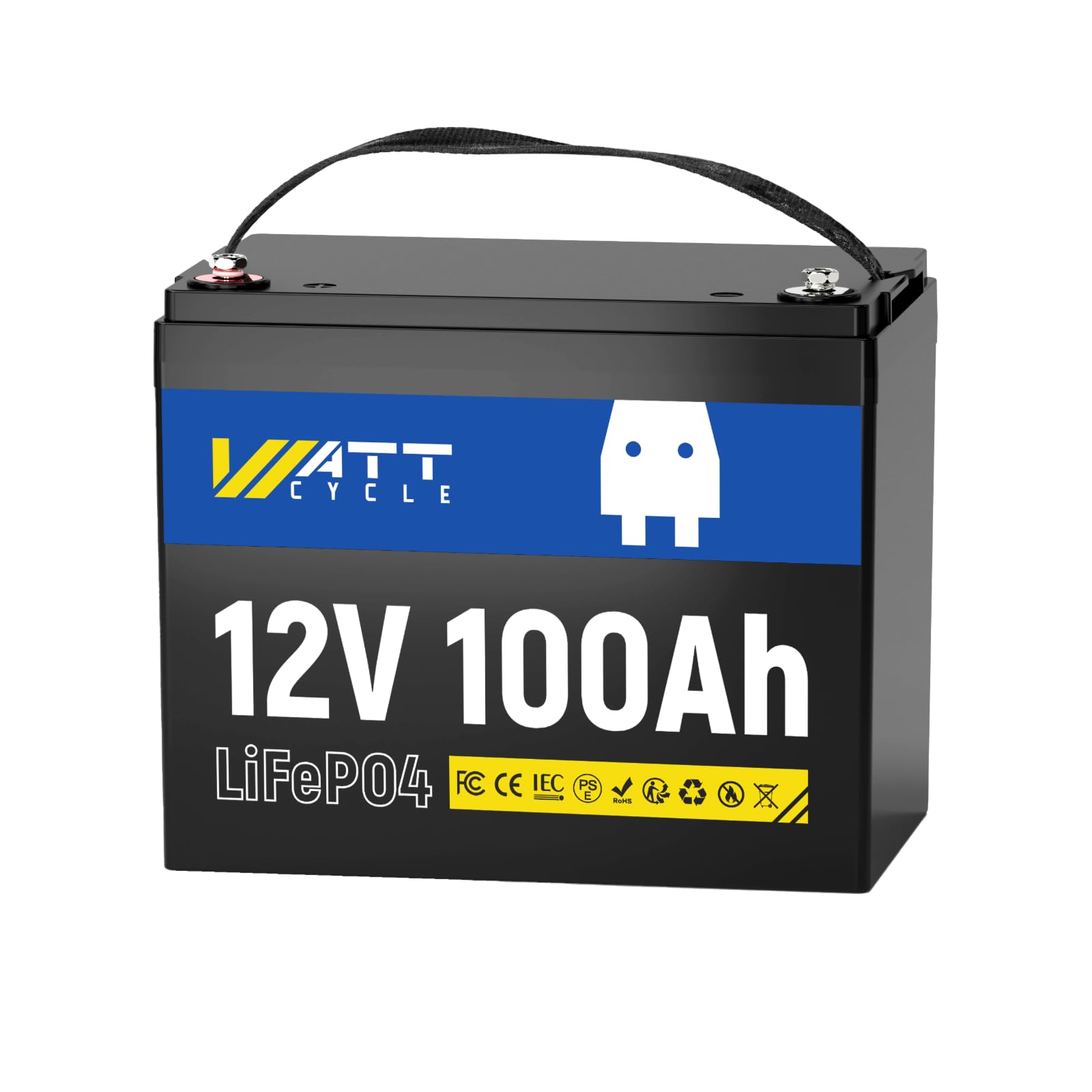
The 23.2-pound Group 24 that disappears into a tray most batteries cannot fit.
Not every RV uses a Group 31 or 4D bay — plenty of older campers and travel trailers are built around the smaller BCI Group 24 box. This WattCycle battery measures 10.2 by 6.6 by 8.2 inches and weighs 23.2 pounds, so it drops straight into that footprint without a shim. Inside you get 100 amp hours at 12.8V, WattCycle uses A+ grade cells rated for up to 15,000 cycles, with a 100A BMS covering overcharge, over-drain, over-current, and short circuit. The battery also carries SDS, UN38.3, FCC, CE, and ROHS certifications, meaning it has been tested to the standards most insurance inspectors want to see.
Battery quality is the highest-count praise on this pick, and the everyday reports back it up. A group of buyers runs these in 2S4P configurations for 24V 400Ah systems, and the built-in 100A BMS disconnects the battery automatically once discharge current crosses 300±50A, which is a real safety line on a boat. The -4°F to 158°F operating range means the battery itself will run in most climates, and it can be wired up to 4 in series or 4 in parallel for 20.48kWh. Weight keeps coming up as the thing owners notice first — a helpful trait in a boat’s transom or an RV’s tongue when you are trying to balance a load.
The fair caveat: charging capability and battery life both come in as mixed aspects in the review data. Some shoppers say great performance, while a handful describe cold-shutdown BMS locks that required a warranty replacement (which WattCycle honored). The tech support has an English-language nuance that a few buyers found frustrating. If you accept the brand is newer and want to bank on the warranty, this remains a strong pick for a Group 24 bay.
The wins you feel daily
- 23.2 pounds at 100 amp hours — one of the lightest lithium batteries here
- Fits a BCI Group 24 box with no modification
- 100A BMS cuts discharge automatically at 300±50A for safety
- Holds up from -4°F to 158°F operating range, so most climates work
What to weigh
- A mixed record on cold-shutdown BMS behavior — the warranty handles it, but plan for the possibility
- Charging capability is a mixed aspect in the reviews, so use a charger rated for LiFePO4
- Newer brand with less of a long-term track record than Litime or Power Queen
The one to grab when: your tray is a Group 24 and nothing larger will fit without drilling.
Size up if: you have room for a Group 31 — the Power Queen above adds little weight and more proven reliability.
9. YEAGULCH 12V 150Ah LiFePO4 Lithium Battery 100A BMS 15000+ Deep Cycle
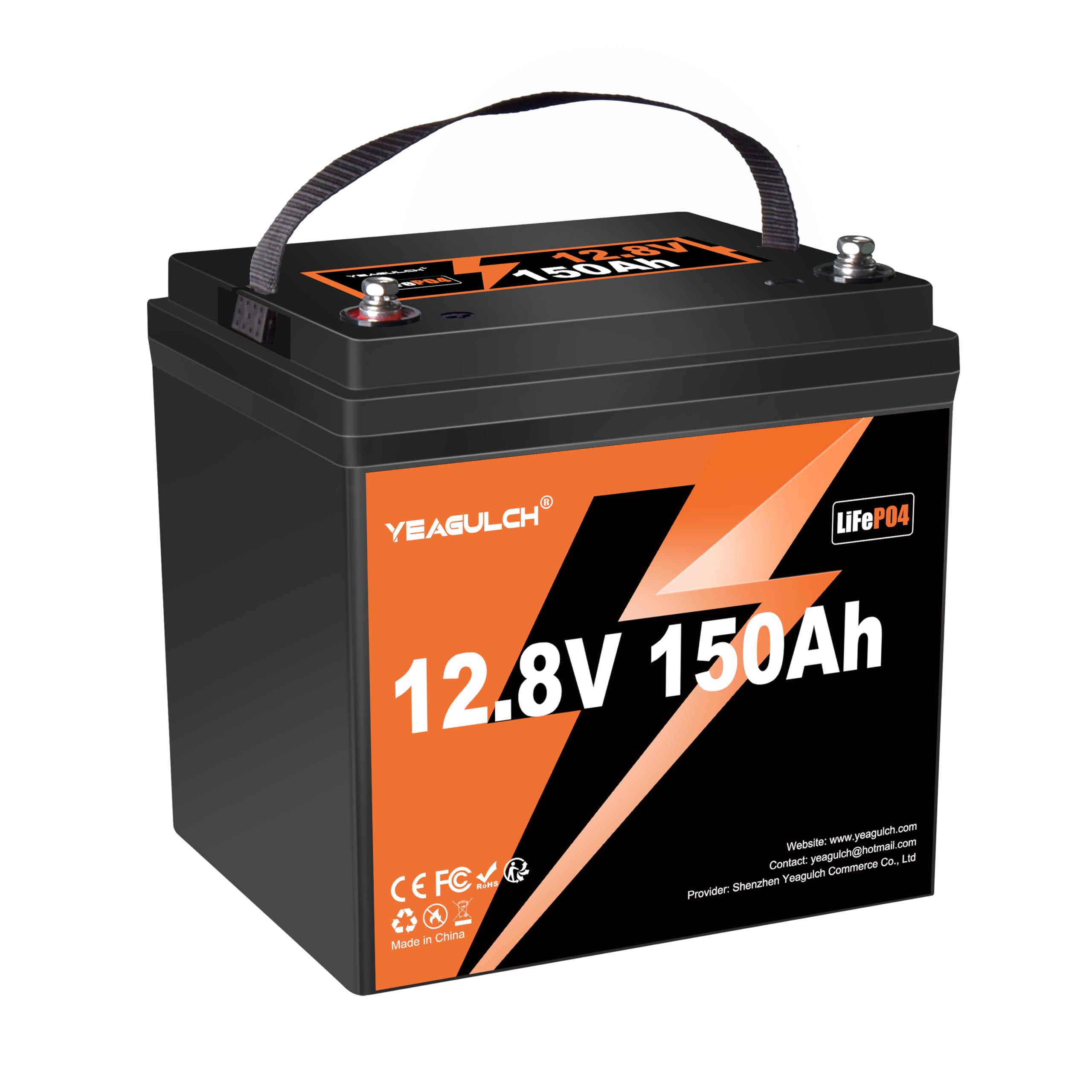
An entry-priced lithium bank rated for 15,000 cycles — the value test for newcomers.
If you want to try lithium without committing to a premium bank, this YEAGULCH delivers 150 amp hours and 1290Wh into a compact 10.01 by 7.68 by 9.84-inch case at 41.03 pounds. The 100A BMS provides overcharge, over-drain, over-current, and overheat protection, with a low-temperature cut-off at 32°F and a high-temperature charging cut-off at 149°F — good enough for most three-season camping. YEAGULCH allows 4S wiring at 51.2V or 4P at 600Ah, and rates the cells at 15,000 cycles at 60% depth of discharge.
The most-repeated review theme here is reliability, and the concrete cases are believable. One owner ran this in a 14-foot Jon Boat with two adults and gear plus a canoe, drained only a third of the charge in a full day of trolling, and recharged in under 20 minutes. A solar-station user has been running one for about six months and reports it still delivering full power — full charge from panels takes about half a day, and the battery sits in a tight space without issue. Another used it for a woofer amplifier setup, pounding all day without missing a beat.
The catch that matters: battery life comes up as a mixed aspect in the reviews, with a few owners reporting faster drain than expected, and it is not a smart battery — there is no Bluetooth, so you will be checking charge with a shunt or a series amp meter rather than a phone. That is a real limitation if you want app-level visibility, but for anyone wanting maximum amp hours on a budget, this is the value play on the list.
Where it shines: 150 amp hours for beginner-lithium money, with an honest cycle rating and a 1290Wh reserve you can wire out to a 51.2V system later.
Know before you buy: no Bluetooth means charge monitoring is a manual affair — budget for a shunt or an amp meter if you want real-time visibility.
The budget pick for: trolling-motor owners and part-time campers who want lithium amp hours without the smart-battery premium.
Look at the WattCycle instead if: you want Bluetooth monitoring and a smaller group size fit.
10. WEIZE 12V 100Ah Deep Cycle AGM Battery, Group Size 31

The old reliable: a maintenance-free AGM that drops into a Group 31 tray and just works.
Some RV owners want a house battery they never have to think about — no Bluetooth pairing, no app, no BMS firmware to update. That is exactly what this WEIZE delivers. It is a 12V 100Ah sealed lead-acid (SLA — a lead-acid battery with no liquid to top up) AGM battery, with a 1150A max discharge current, a 3% self-discharge rate, and a spill-proof maintenance-free design. The terminals are labeled for you: red on the left for positive, black on the right for negative. And it fits the same Group 31 tray that so many RVers already have installed.
The value story here is the anchor: this battery is a straightforward drop-in replacement for a tired lead-acid bank, and it is rated to work without the fluid checks that flooded batteries demand. One user built a 4x100Ah parallel bank feeding a 2000W inverter for a 4.8kWh home backup, running 120V outlets, fans, and garage openers off it — not a Powerwall, but a working setup for the price. Another used it for two years of off-grid RV living with two 150W solar panels and reports no issues running a 700W pure sine inverter for 120V appliances. A third chose it over flooded lead-acid because it is cleaner and more durable, and over gel because gel struggles at high current.
Here is the honest trade-off: at 60 pounds, this battery is nearly three times the weight of the Litime 200Ah Mini above while delivering roughly a quarter of the usable capacity. Weight comes up in the reviews alongside value, and most owners call it out plainly — heavy, but stationary. If you never move your bank and prefer a battery with no electronics inside that could fail, this is the no-frills choice.
Why some owners stay with AGM
- Maintenance-free and spill-proof — no fluid levels to check
- 1150A max discharge current handles starting and inverter loads
- 3% self-discharge rate means it holds charge through long storage periods
- Group 31 form factor is a direct fit in most existing RV trays
The price of staying lead-acid
- 60 pounds — dramatically heavier than lithium alternatives with similar or more usable capacity
- Roughly half the usable amp hours you would get from a lithium 100Ah battery
- No BMS or app — you monitor state of charge with a shunt or a voltmeter
Solid choice when: you want a dependable, maintenance-free AGM drop-in and never plan to move the battery.
Step up to lithium if: you want three times the usable capacity at less than half the weight.
11. DAAKMAX 12V 100ah Deep Cycle AGM Battery Rechargeable SLA Maintenance-Free
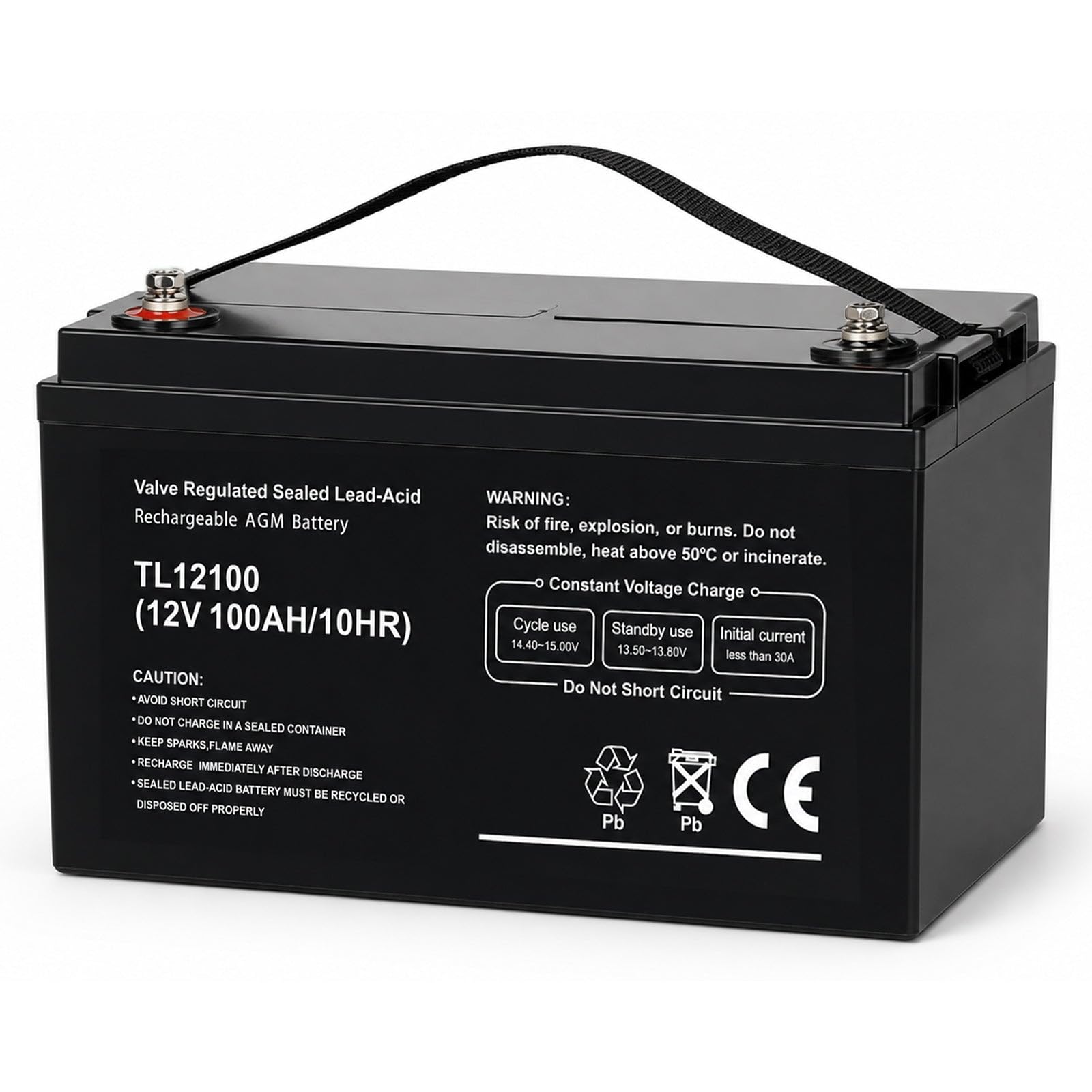
The smallest line item in your bank build — a straightforward 100Ah AGM with no frills.
This is the budget entry into RV house battery territory: a 12V 100Ah sealed AGM battery rated for 1150A max discharge current, with a heavy-duty vibration-resistant ABS casing that protects against leaks in rough conditions. It is rechargeable, maintenance-free, and self-discharges at only 1–3% per month — the lower the number, the longer it holds charge in storage between trips. It arrives with a 1-year warranty. If you are building a small bank for a weekend camper or replacing a tired battery in an older rig, this is the cheapest way onto the list.
Functionality is where owners give this one credit — it works right from the start, and it fits a wide range of applications beyond RVs: UPS backup, camping, off-grid solar, and even some motorcycle and ATV fitments. The battery turned up charged with a strong start, and reviewers highlighted the value as one of the top aspects alongside its fit in a range of vehicles and small-engine applications. In the RV use case, the practical result is the same as the WEIZE above: a maintenance-free, spill-proof block with no electronics inside that can fail.
Two honest notes if you go this route. First, the review pattern includes some longer-term owners who report faster-than-expected capacity loss — battery life is a mixed aspect, so check it periodically if you cycle it heavily. Second, the terminal hardware — square nuts and short screws — can be tricky to assemble in tight spaces, and a couple of owners mentioned needing a pick tool for nut alignment. Neither is a dealbreaker, but plan for a bit of patience on install.
The value case: lowest priced option on the list and maintenance-free, with a 1–3% monthly self-discharge rate that keeps it ready between camping trips.
The install nit: square-nut terminals and short screws are fiddly in tight spaces — have longer screws and a pick tool on hand before you start.
The starter AGM for: weekend campers and small RV builds where budget matters more than weight or usable capacity.
Consider the WEIZE if: you want the same price band with more years of proven service in this niche.
Understanding the Specs
Usable Amp Hours vs Rated Amp Hours
A 100Ah lead-acid battery is usually only drained to about 50% to protect its lifespan, so you really get closer to 50 usable amp hours out of it. A 100Ah LiFePO4 battery holds steady voltage down to a much deeper discharge, and its BMS will protect it, so you get closer to the full rated capacity. That is why a 200Ah lithium bank can feel like four times the capacity of a 200Ah lead-acid bank in practice, and why the weights on this list vary so widely for similar ratings.
Why BMS Amp Rating and Cold Protection Matter
The BMS amp rating is the ceiling on how much current the battery can push at once. A 100A BMS handles trolling motors and light RV loads; a 200A or 300A BMS is what you need for inverters, air conditioners, and ovens. Cold protection is the second safety net — the BMS cuts charging when the cells drop below freezing, which protects them from permanent damage. Some batteries on this list simply pause; others, like the VATRER POWER, actively heat themselves back up so they can resume charging.
Group Size and Physical Fit
Group size is the standard footprint the battery occupies — Group 24 is the smaller bolt-in used in many travel trailers, Group 31 is more common in larger rigs, and Group 4D is the heavy-duty footprint used in big motorhomes. Check what your existing tray was cut for before you buy, because a Group 31 will not drop into a Group 24 slot without a shim or a rebuilt mount. Weight is the other number worth noting: lithium banks run roughly a third to half the weight of a lead-acid equivalent of the same capacity.
Series vs Parallel Expansion
Series wiring stacks voltage — two 12V batteries in series deliver 24V, and four deliver 48V. Parallel wiring stacks capacity — two 100Ah batteries in parallel deliver 200Ah at the same 12V. Most of the batteries on this list support both, with the largest allowing a 4P4S layout for a 51.2V system at higher amp hours. Size your bank around the loads you actually run: an inverter and a fridge demand more headroom than lights and a fan, and the BMS should be rated to carry the peak draw without cutting out.
FAQ
Can I replace my RV’s lead-acid house battery with a lithium one directly?
How much usable capacity do I actually get from a 100Ah RV battery?
Can I charge a lithium RV battery below freezing?
What is the difference between series and parallel wiring for an RV bank?
Do I need a special charger for a LiFePO4 battery?
How much does a good RV battery bank weigh?
Can I add a second battery to my existing RV bank later?
What maintenance do these RV batteries need over time?
Final Thoughts: The Verdict
If you are shopping a battery bank for rv and want the single best all-around pick, the LiTime 12V 200Ah Mini wins on the strength of its combination: 200 amp hours, 28 pounds, a 200A BMS, and self-heating that lets it handle cold weather. It also produces the app-visible data owners actually want. The high capacity comes with a proven service record, and the weight savings over the lead-acid pick is the difference between a bank your springs notice and one they do not.
If you need the absolute reserve, the ECO-WORTHY 314Ah stores the most energy on the list. If you boondock in below-freezing weather, hop on the VATRER POWER 460Ah with the built-in self-heating cycle. And if you want to keep it simple and budget-friendly, the WEIZE 100Ah AGM is a maintenance-free drop-in for an older rig — just understand it will not match lithium on usable amp hours. For most RV owners wiring a fresh house bank, the lithium options here deliver a decade of more usable power at a fraction of the weight, and the total cost of switching has never been lower.
How We Picked
We do not accept paid placement. Every pick is matched to a real buyer and a real use-case; we do not hands-on test units.
Sources & Methodology
Specifications: manufacturer listings and product documentation. Review insights: verified customer reviews, as of September 2026. Pricing: not shown on this page (it changes often); check the current price via the retailer link.
As an Amazon Associate, Gadgets Feed earns from qualifying purchases. This does not affect which products we feature.