
Our readers keep the lights on and my morning glass full of iced black tea. As an Amazon Associate, I earn from qualifying purchases.
Specs are compiled from manufacturer listings and verified buyer reviews and can change over time — please confirm the key details on the product page before buying.
Here is the truth that saves you a wasted winter: a window unit that says “heater” on the box does not always heat. Several of the combos below — even big-name ones — stop producing warmth once the air outside drops below roughly 40°F, and a few owners found the heat function dead on arrival while the cooling side worked perfectly. So the question that actually matters is not how many BTUs they claim, but how the heat side behaves in the temperature range you’ll really face.
I’m Min — the founder and writer behind Gadgets Feed. This guide is built by comparing the manufacturers’ published specifications and the patterns across verified customer reviews, so you get each pick’s real strengths and trade-offs instead of marketing spin.
Some units here sit on the sill and blast 52dB of fan noise; others straddle the wall like a saddle and barely whisper. This guide ranks the cooling-versus-heating trade-offs so you can pick the right AC Heater Window Unit for your room, your window, and your winter.
Our Picks at a Glance
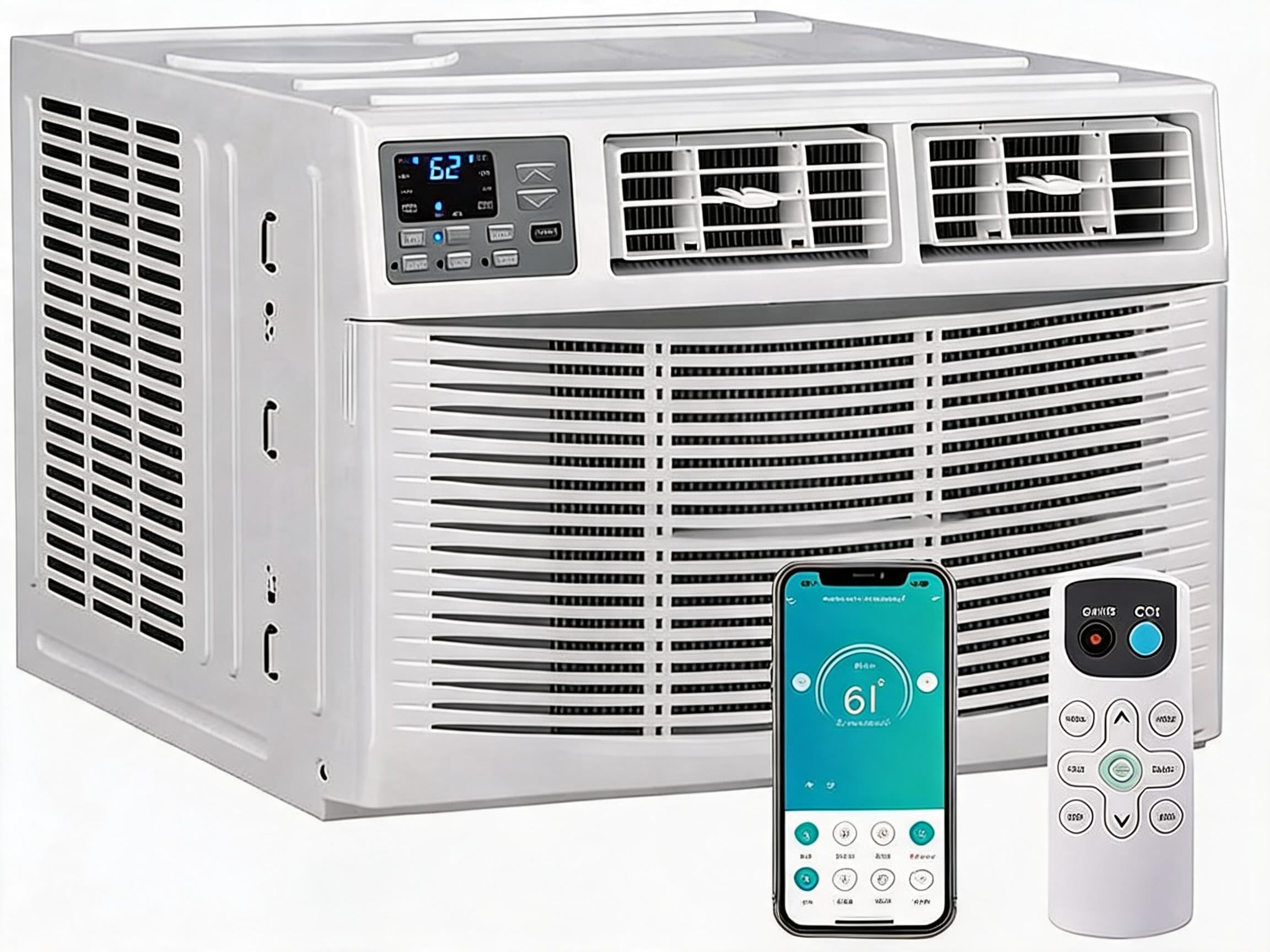

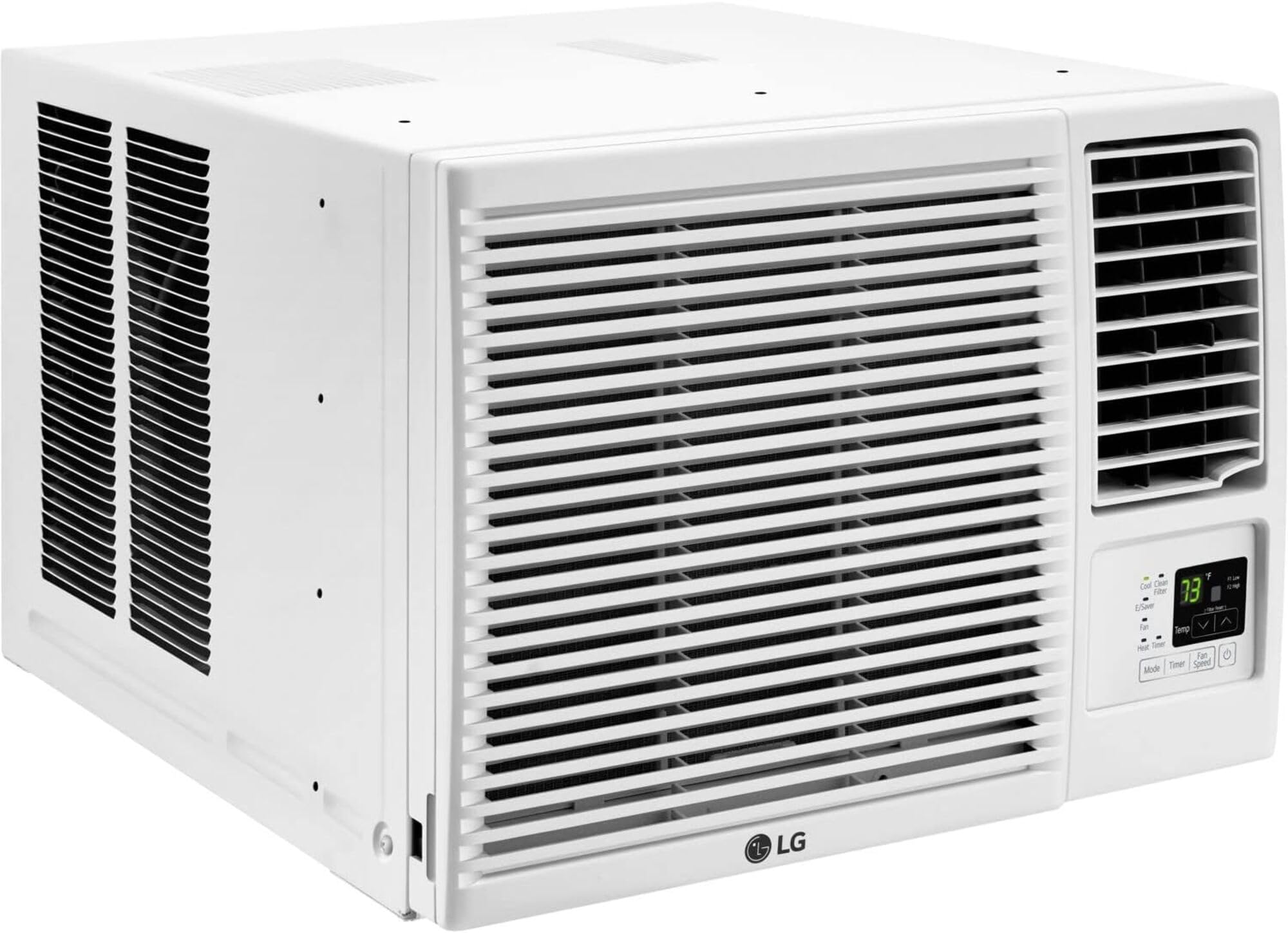
How To Choose The Best AC Heater Window Unit
Buying a window air conditioner with heat is a three-part decision: the room it must handle, the window it must fit, and the outlet it must plug into. Get those three right and almost everything else follows. Get one wrong and you’ll be hauling the box back to the store in a January cold snap.
Match the BTU number to the room, not the marketing
BTU (British Thermal Unit) is simply a measure of how much heat the machine can move. A higher cooling BTU means a bigger room it can handle, so an 8,000 BTU unit is quoted for up to 350 square feet while a 12,000 BTU model is quoted for up to 550 square feet. Buying far more cooling power than the room needs can actually feel clammy and waste electricity, because the compressor short-cycles and never runs long enough to pull the humidity out.
Understand that heating BTUs are their own, smaller number
This is the trap every first-time buyer walks into. A unit can be “8,000 BTU cooling / 3,500 BTU supplemental heating” — two very different figures on the same box. Supplemental heat is designed to take the chill off, not to replace a furnace, and most of these units state plainly that the heat mode is meant for use when the outdoor air sits in a moderate range. If you need real winter warmth in a freezing climate, treat these as a shoulder-season and mild-winter tool, not a primary heat source.
Measure the window before anything else
Measure your window before you buy, because a window AC unit only fits an opening that meets its listed size. The spec sheet gives a required opening width and a minimum vertical opening (how tall the gap must be). A slide-in or saddle design also changes how the unit sits and how much of your view it blocks. Write down both your window’s width and its height, then check the spec line for the specific unit — some fit windows just 24 inches wide, and one here needs a window at least 15.5 inches tall with 24.5 to 36 inches of width.
Check the plug, especially on the big units
Most combo units run on a standard 115V household outlet, which is why you’ll see “115V” printed on nearly every spec sheet here. But once you move into the larger 12,000 BTU class, some models step up to a 230V circuit that may need a dedicated line or an electrician. Confirm your outlet type and amperage before you order — a couple of buyers learned this the hard way after the unit was already from the start.
Quick Comparison
| Model | Best For | Cooling BTU | Heating BTU | Coverage | Amazon |
|---|---|---|---|---|---|
| Patikuin 8,000 BTU 4-in-1 Window AC & Heater★ Best Overall | Year-round apartment use | 8,000 BTU | — | up to 350 sq. ft. | Amazon |
| Midea 8,000 BTU Smart Inverter Window AC with HeatTop Performer | Quiet bedroom cooling | 8,000 BTU | — | up to 350 sq. ft. | Amazon |
| LG 7,600 BTU Window AC with HeatBest for Bedrooms | Steady medium-room climate | 7,500 BTU | — | up to 330 sq. ft. | Amazon |
| ROVSUN 8,000 BTU 4-in-1 Window AC with Heat | Small-window installs | 8,000 BTU | 4,000 BTU | up to 350 sq. ft. | Amazon |
| Keystone 8,000 BTU Window AC with Supplemental Heat | Guest rooms and lofts | 8,000 BTU | 3,500 BTU | up to 350 sq. ft. | Amazon |
| Frigidaire 8,000 BTU Window AC with Supplemental Heat | Quiet small-living-room comfort | 8,000 BTU | — | up to 350 sq. ft. | Amazon |
| ROVSUN 11,000 BTU Inverter Window AC with Heater & WiFi | Smart-home app control | 12,000 BTU | 1,100 BTU | up to 350 sq. ft. | Amazon |
| Keystone 12,000 BTU Window AC with 11,000 BTU Heat | Large rooms to 550 sq. ft. | 12,000 BTU | 11,000 BTU | up to 550 sq. ft. | Amazon |
| Soleus Air 12,000 BTU Saddle-Mount Window AC & Heater | Keeping the window view | 12,000 BTU | 10,000 BTU | — | Amazon |
In‑Depth Reviews
1. Patikuin 8,000 BTU Window Air Conditioner & Heater Combo Dehumidifier, Fan
Our pick — over 4★ from 60+ verified ratings; the strongest balance of quality and price.
One box that cools, heats, dries the air, and moves it around — for a whole apartment
If you want a single window unit that genuinely does four jobs, this Patikuin is the one to start with. It’s an 8,000 BTU cooler, a heater, a dehumidifier, and a fan in the same chassis. The rated coverage is up to 350 square feet, and it runs on a standard household plug. That combination of capability and simplicity is why it sits at the top of this list.
What wins people over is raw performance — the thing owners talk about most is how hard it blows cold. It runs as quiet as 52dB, which is about the level of a normal conversation, so you can sleep or work with it humming along beside you. You get five operating modes, three fan speeds, a four-way air swing, a 24-hour timer, and both ECO and sleep modes. The digital LED display, the remote, the app, and Alexa voice control all reach the same settings, so you can adjust it without getting up. And the washable filter pops out with a reminder light when it’s due for a rinse.
This unit’s heat function is a bonus for cool spring and fall evenings, not a replacement for your furnace in mid-winter. The specs list both heating and cooling, and the four-in-one label is the manufacturer’s own description of the machine. The recurring gripe is noise: several owners note it’s louder than they hoped, and one unit arrived with a bend from shipping. But the value is strong here, and the size-versus-power surprise runs the other way from what you’d expect — owners are consistently shocked at how much cooling this compact box delivers for a whole apartment, not just one room.
Where It Wins
- Four functions in one chassis: cool, heat, dehumidify, fan
- Runs as low as 52dB with a dedicated quiet sleep mode
- Control it four ways — display, remote, app, or Alexa voice
- Washable filter with a reminder light for easy upkeep
- Covers up to 350 sq. ft. on a standard 115V plug
What To Know First
- The recurring complaint is noise — it’s not a silent unit
- At 81.4 lbs it takes two people and a sturdy window to lift
- Heat is a supplemental feature, not a full winter furnace
Reach for this if: you want one affordable window box that cools hard, dries the air, and adds a little warmth in the shoulder seasons for a whole apartment or a large room.
Look elsewhere if: your window faces a freezing January and heat is your main reason for buying — this is a four-in-one comfort unit, not a cold-climate heat pump.
2. Midea 8,000 BTU Smart Inverter Air Conditioner Window Unit with Heat and Dehumidifier
The quiet operator that sips electricity at 45dB and 407 kWh a year
If silence at night is your top priority, this is the machine to beat. Midea quotes 45dB on high — roughly the soft hum of a refrigerator — and that low number is the single spec that defines this pick. Its variable-speed inverter compressor ramps up and down smoothly instead of slamming on and off, so cooling stays steadier and the start-stop clatter is gone. The energy math backs it up: it’s rated at 407 kWh per year versus the 1,838 kWh the Patikuin above lists — that’s the difference between a unit that nibbles at your electric bill and one that takes a real bite.
It’s Energy Star certified, and Midea claims the variable-speed compressor uses up to 35% less energy than the Energy Conservation Standard. You get five modes (Heat, Auto, Cool, Dry, Fan), three fan speeds, a 24-hour timer, ECO saver, and a swing button that tilts the louvers to push air where you want it. The washable filter slides out the front panel, and you can control everything from the panel, the remote, the SmartHome app, or Alexa and Google Assistant by voice. It’s built to fit double-hung windows 24 to 38.5 inches wide with a 14.5-inch vertical opening.
Now the honest part every buyer should hear before ordering. The heat pump in this unit only works when the outside temperature is above 41°F — that’s the manufacturer’s own note, worded as “heat pump function works when outside temp> 41°F.” Owners echo it. As one buyer report puts it, the cooling is “superb” but the thermostat runs inaccurate, the heat cycle is loud, and the room temperature ends up tracking the outdoor air rather than your setting. So if you’re counting on this to warm a room through a hard freeze, it won’t. As a mild-weather heat source and a seriously quiet summer cooler, though, it’s the pick of this group.
The quiet advantage: At 45dB on high and 407 kWh per year, this Midea is the calm, efficient option — noticeably quieter and far easier on the meter than the Patikuin’s 1,838 kWh draw.
The heat ceiling: The heat pump quits above 41°F outside. Below that, you’re on your own for warmth.
Best for: a bedroom or apartment where you want genuinely quiet summer cooling and want your electricity bill to stay low, with occasional mild-weather heat as a bonus.
Skip it for: cold-climate heating — if the outdoor air regularly dips near freezing, this unit will not carry the load.
3. LG 7,600 BTU Window Air Conditioner with Heat, 115V, Cools 330 Sq.Ft.
The steady sleeper — 52dB low mode, auto restart, and a slide-out chassis for service
Picture a unit you install once and forget about, even after the power blinks at 3 a.m. That’s the LG’s real selling point. It has an Auto Restart feature that turns the unit back on at your previous setting the moment power returns after an outage, so you’re not fumbling in the dark to reset it. It also drops to 52dB in low mode, which is a conversation-level hum you can sleep through. The cooling output is 7,500 BTU across 330 square feet, and the chassis slides in and out, which makes servicing far less of a wrestling match than a fixed-body unit.
On the efficiency side, LG’s airflow efficiency is the standout: 205 cubic feet per minute per watt, measured against the Midea’s 0.25 cubic feet per minute per watt — meaning this unit from a spec-sheet perspective operates at a dramatically higher airflow-per-watt. In plain terms, that airflow number tells you how much air the unit moves for each watt of power it draws. It’s a much leaner mover. It also has two cooling, heating, and fan speeds, a washable filter with a light reminder, and a remote control.
Here’s what to go in knowing. The supplemental heat is a shoulder-season tool, and you’ll want to check its behavior in real cold. That’s the beauty of the slide-out chassis (a frame that lets the AC body slide out) — it’s the only unit in this lineup that makes the AC body itself removable, so there’s no wrestling with the whole cabinet when you need to inspect the filters or the unit itself.
The reliability angle: Auto Restart alone earns this a spot — no more crawling behind the unit to reset it after a power blip.
The sizing note: 330 sq. ft. of coverage is the smallest here, so match it to a bedroom or office, not a great room.
Choose this one if: your top priority is a set-and-forget bedroom unit with easy service access and dependable restart after power outages.
Shop on if: you need to heat a large open space or you require real heat output in freezing weather — the coverage here tops out at 330 sq. ft.
4. ROVSUN 8,000 BTU Air Conditioner Window Unit with Heat, 4-in-1 Cooler

A four-in-one with a real 4,000 BTU heater and a rock-bottom 876 kWh annual draw
For the money, no other unit on this list pairs this much function with this little annual energy use. The ROVSUN combines an 8,000 BTU cooler, a 4,000 BTU heater, a dehumidifier, and a fan on a 115V/60Hz plug. Its annual energy consumption is 876 kWh — well under the Patikuin’s 1,838 kWh and far above the Midea’s 407 kWh in efficiency — so it’s a sensible middle ground on running costs. It covers up to 350 square feet, hits 52dB at its quietest, and installs with side panels that slide into the window frame. Temperature control runs from 61°F to 88°F.
What makes this one stand out is a small, practical detail owners notice right away: you can switch off the button lights entirely, which matters if the unit sits in a dark bedroom. The remote and the LED display both reach the fan speed, the 24-hour timer, ECO mode, automatic mode, and fan mode. It uses a scroll compressor, which tends to run smoother and more efficiently than an older reciprocating design, and it ships with detailed instructions and all the mounting parts. Buyers consistently find assembly straightforward, and it fits nicely into tighter windows where larger boxes won’t seat.
Now the catch you’ll want to weigh. This model’s customer feedback notes that some units don’t cool as expected from the start, and volume varies from quiet to noticeably loud depending on the unit. The honest read: it delivers a lot of function per dollar, but it’s a budget-leaning pick in a category where cooling performance is inconsistent at the low end. If you’re a light sleeper in a warm climate and this is your only unit, keep the noise variation in mind.
Reasons Buyers Like It
- Real 4,000 BTU heater — higher heat output than most rivals at this tier
- 876 kWh annual draw: modest running cost for a four-in-one
- Button lights switch off so it stays dark at night
- Comes with a full install kit and clear instructions
The Trade-Offs
- Cooling performance is inconsistent across units, per buyer feedback
- Noise runs the range from quiet to loud
- No app or WiFi — control is display and remote only
Consider this if: you want a four-in-one with a true 4,000 BTU heater and modest running costs, and you’re flexible on noise.
Look past it if: consistent, whisper-quiet cooling is non-negotiable — that’s where this tier tends to wobble.
5. Keystone 8,000 BTU Window Air Conditioner with 3,500 BTU Supplemental Heating
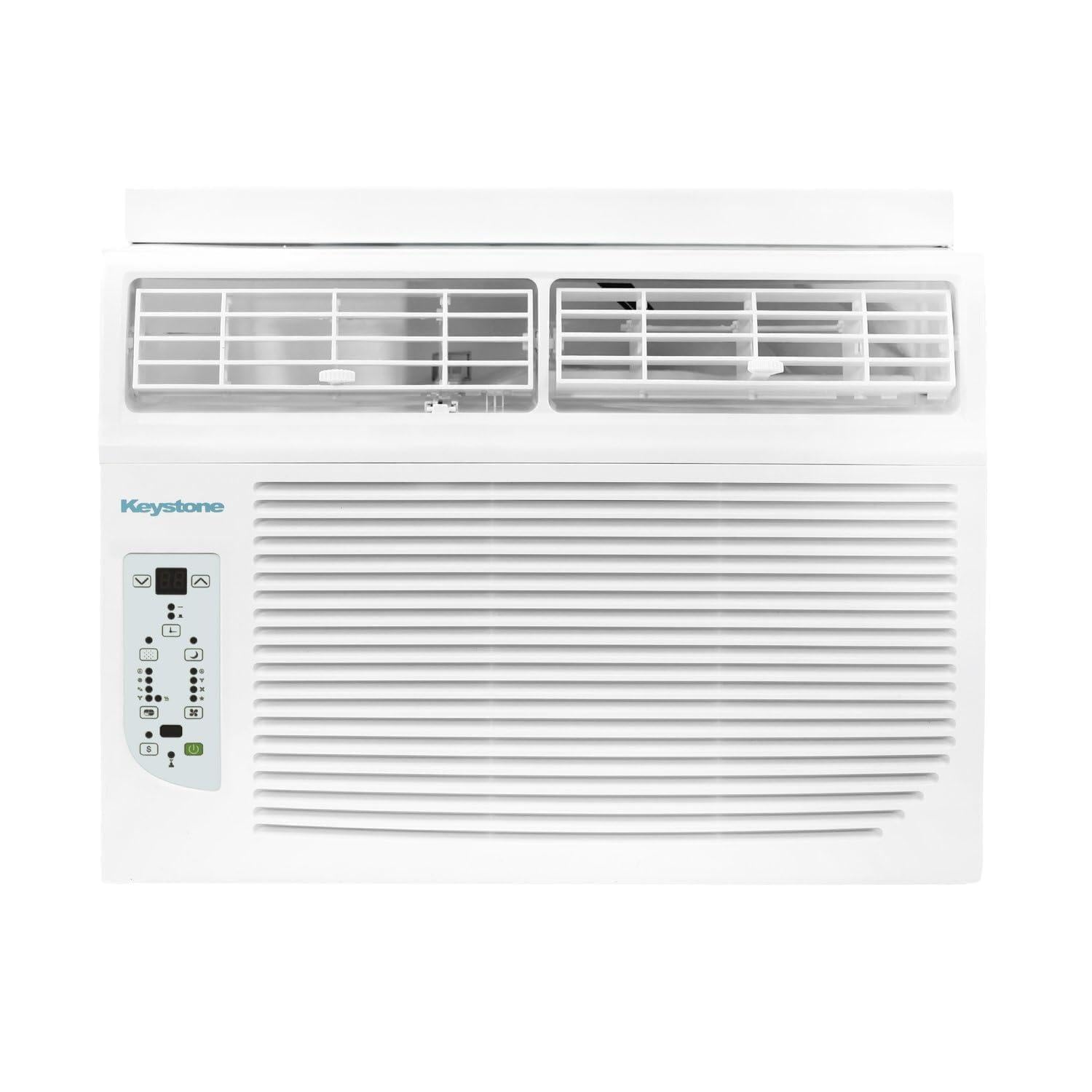
The remote that reads your room — not the window — and cools it to your number
The reason to look at this Keystone is the remote, and it’s a genuinely clever one. The I Sense remote takes the temperature of the room you’re actually sitting in, shows it on its LCD screen, and sends a fresh signal to the unit every three minutes. That’s the fix for the classic window-unit complaint where the thermostat reads the cold glass side of the room instead of your couch. It carries an 8,000 BTU cooler and 3,500 BTU supplemental heater for up to 350 square feet, plus a 4-way air swing, a dehumidifier, and an energy-saver and sleep mode to keep the electric bill in check. And its airflow efficiency of 248 cubic feet per minute per watt sits close to the LG’s 205 figure — this is one of the more air-mover-per-watt units in this lineup.
This isn’t a furnace — the manufacturer is upfront that the heating mode is supplemental and is meant to run when the outdoor air sits between 23 and 76 degrees. In that range, it takes the nip out of a cool evening nicely. Owners also like the remote’s accuracy for cooling, and one reviewer used it to keep a guest room ice-cold through the night on a low fan speed. If your goal is to make a basement or window-less room comfortable in summer while taking the edge off autumn, this machine does the job.
Be straight with yourself about the heat, though. The heat function is widely reported as the weak point — a fair number of owners found it thin for real winter, and some report it fades after the first week or so of use. Treat the heating feature as a light seasonal extra and a reliable cooler, and this becomes an honest value.
The smart-remote edge: The I Sense remote reads the room you’re in every three minutes — real comfort control in a room where the unit sits far from where you sit.
Heat realism: 3,500 BTU supplemental heat handles fall afternoons, not January blizzards.
Worth it for: a room where the AC is far from where you sit and you want reliable, room-accurate cooling with a light heating assist.
Not for: anyone who needs this to be their primary heat source through a hard winter — the warm-air mode is the part reviewers doubt most.
6. Frigidaire 8,000 BTU Window Air Conditioner with Supplemental Heat

A whisper-level 53dB cooler with a light seasonal heat that won’t run you ragged at the meter
The Frigidaire earns its place with quietly strong energy numbers and a calm 53dB run character — the kind of AC you forget is there. Its annual consumption sits at 550 kWh, a big step below the Patikuin’s 1,838 kWh figure and in line with the Midea’s 407 kWh — so on running costs it’s in the efficient group, not the thirsty one. It also carries an 8,000 BTU cooler and a supplemental heat function for up to 350 square feet, which is the standard footprint for this whole class of unit. Between the quiet operation and the lower draw, it’s an easy fit for a bedroom or small living room.
Beyond the cooling core, Frigidaire gives you real flexibility. Six-way directional airflow lets you aim the louvers up, down, left, or right so the cool air actually reaches where you sit instead of bouncing off a wall. Three fan speeds, an Eco Mode that holds your set temperature on less power, a Sleep Mode for quieter night operation, and a Dry Mode that pulls extra moisture from muggy air all come standard. The 24-hour on/off timer lets you schedule it to your day, Auto Restart picks up right where it left off after an outage, and a Clean Filter alert tells you when the washable dust filter needs a rinse.
A note on fit and heat before you commit. This is a physically large unit — one buyer found it barely slid into the window with about an inch of clearance on either side — so measure carefully if your opening is snug. And the supplemental heat is, as the name says, supplemental: a few owners found the heating side didn’t deliver when the weather turned, so count on it for shoulder seasons rather than a cold snap. Get the fit right and it’s an excellent quiet cooler.
Why It Stands Out
- 550 kWh annual draw — one of the leanest here
- Quiet operation at 53dB, ideal for bedrooms
- Six-way airflow direction with three fan speeds
- Eco, Sleep, and Dry modes plus a 24-hour timer
Before You Order
- Bulky chassis may leave very little clearance in a tight window
- Supplemental heat is thin in cold weather
- No app or voice control — remote only
A smart buy for: a bedroom or small living room where quiet cooling and low running costs matter more than smart-home features.
Think twice if: your window opening is narrow or you need the heat mode to stand up to genuine freezing temperatures.
7. ROVSUN 11,000 BTU Inverter Window Air Conditioner with Heater & WiFi
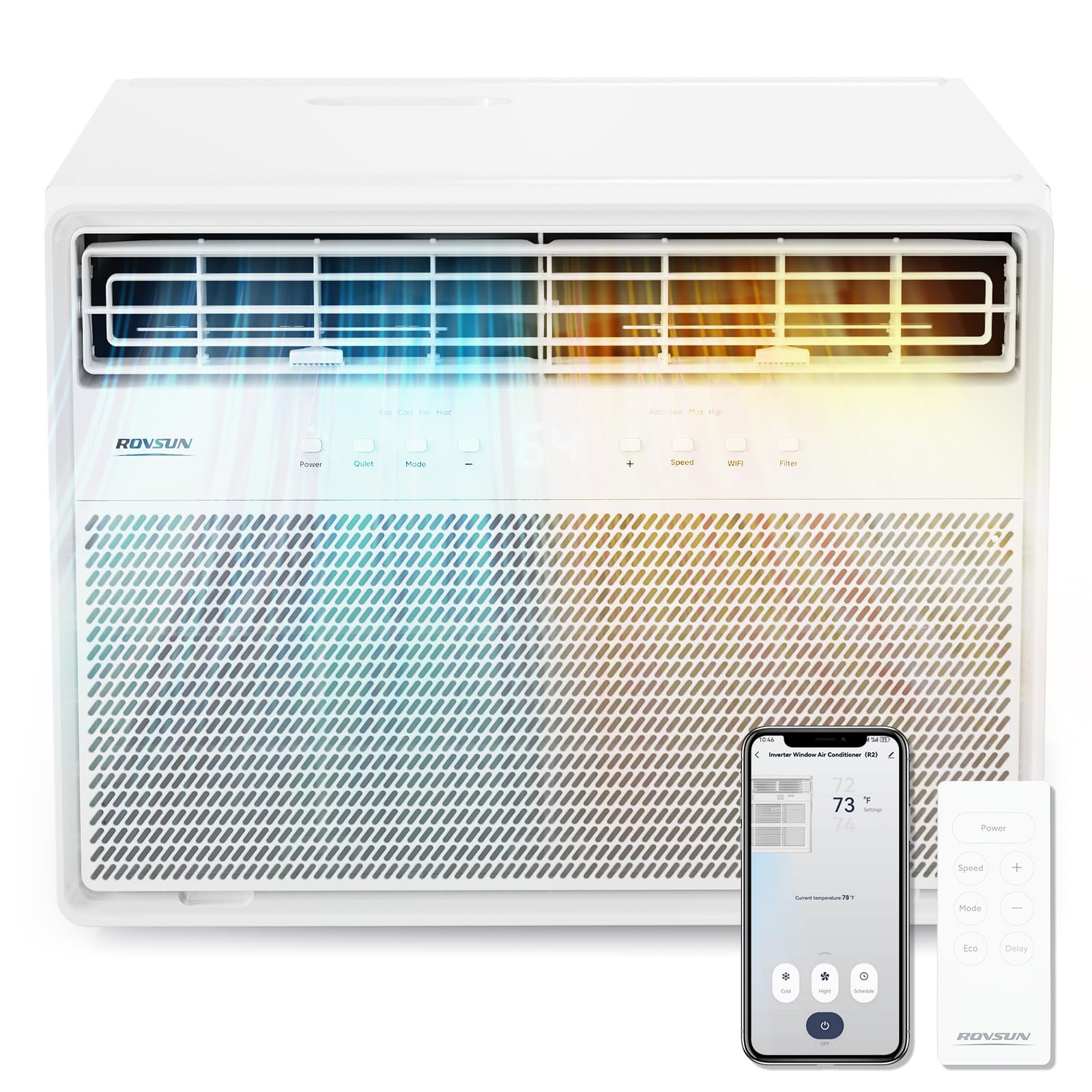
Control it from the couch with your voice, and let the inverter keep it near-silent at 40dB
If running your AC from your phone — or just saying the word to your smart speaker — is what you want, this ROVSUN is built for it. It works with Alexa and Google Assistant by voice, and it connects to its own app so you can set routines and adjust the temperature from anywhere, then walk into a room that’s already at your number. It also carries a variable-speed inverter compressor, which means it changes speed smoothly rather than jolting on and off, and in sleep mode it drops to 40dB — the quietest figure in this entire lineup. The output is listed at 12,000 BTU cooling power with a 1,100 BTU heating function, covering up to 350 square feet. Unlike the Midea above, which stops heating above 41°F outside, this one is designed to run in both directions, though it carries the same caveat that it won’t heat below a set low temperature. It runs on a standard 115V plug and needs a window 24.5 to 36 inches wide and at least 15.5 inches tall.
ROVSUN claims the inverter saves 35% more energy than traditional units, and it backs that with a 13.2 CEER rating and a 520 kWh annual draw — competitive with the efficient Midea and Frigidaire. You get four-way swing for steering the airflow, an eco design, and a temperature range of 64 to 86 degrees. Remember to avoid Cool/ECO below 32 degrees outside and Heat below 5 degrees, per the manufacturer’s own guidance — that’s the honest limit on how far this unit is meant to stretch in winter. It ships with a remote and the side-panel install parts.
The fair-minded caveat: cooling performance is the headline strength across buyer feedback — one reviewer even set it against a previous 14,000 BTU LG and felt this one cooled better — but a small number of units did arrive with damaged or loose side panels, and at least one owner saw the motor struggle after a month. That’s not a pattern so much as a reminder to inspect the box on arrival.
what separates it: 40dB in sleep mode and full app/voice control — no other unit here lets you set routines from your phone and then sleeps this quietly.
The fine print: Side panels occasionally arrive loose or damaged, so open the box and check before install.
Pick this for: a smart-home setup where app scheduling, voice commands, and the quietest possible sleep mode are worth paying for.
Choose a simpler unit if: you just want a dial and a switch and don’t care about WiFi — you’d be paying for features you won’t touch.
8. Keystone 12,000 BTU Window Air Conditioner with 11,000 BTU Supplemental Heating
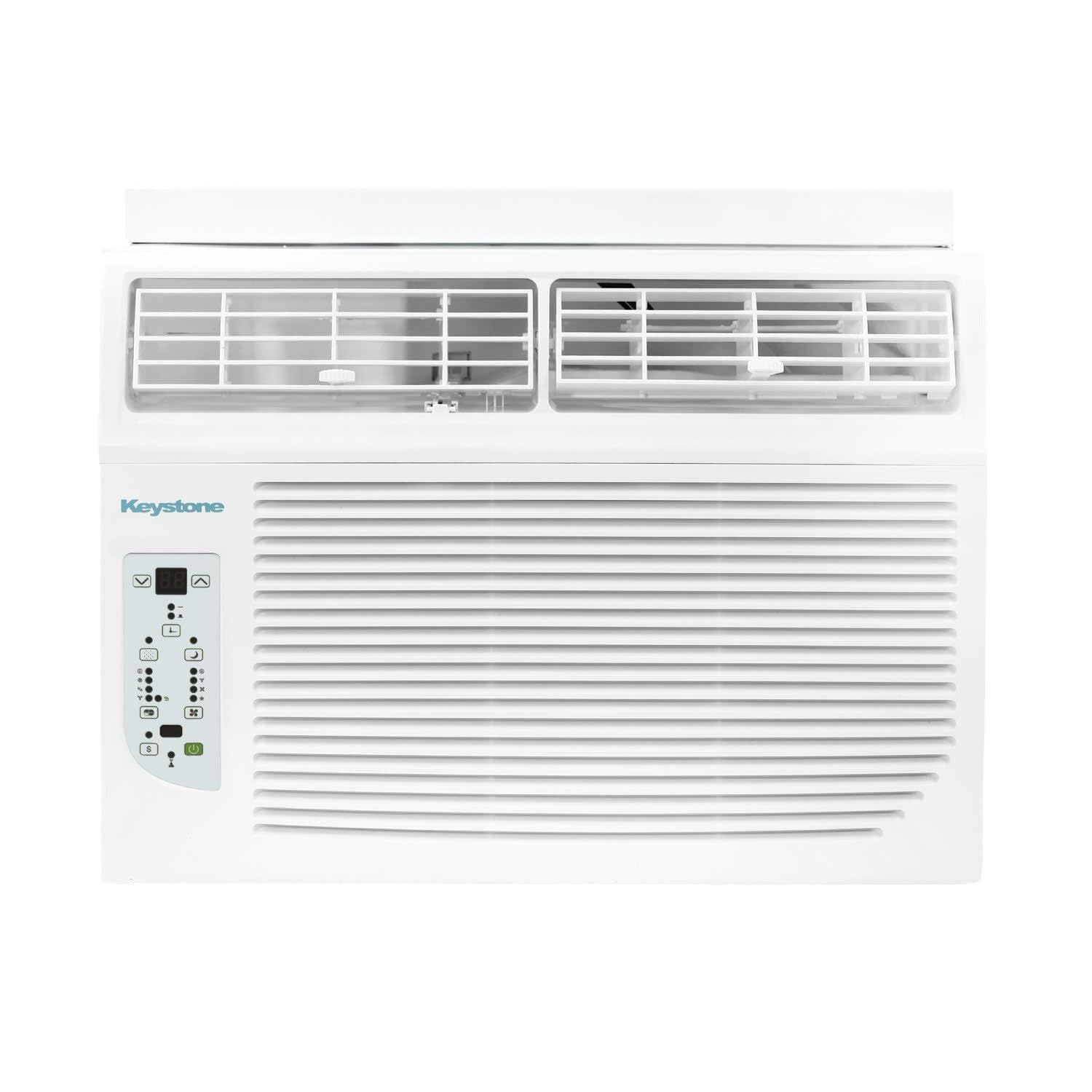
Huge coverage out to 550 square feet and the biggest heating output in the lineup at 11,000 BTU
If you’re cooling a big room and you want the heat function to actually be worth something, this is the Keystone to look at. It packs 12,000 BTU of cooling and 11,000 BTU of supplemental heating, and it stretches to 550 square feet — the largest coverage here, well beyond the 350 sq. ft. ceiling that most of these units share. That makes it the fit for a large living room, a great room, or an open floor. Its airflow efficiency of 279 cubic feet per minute per watt is also among the highest in this group, beating both the LG’s 205 and the Keystone sibling’s 248 — it moves a lot of air per watt, which is exactly what a big space needs.
Because it has more heating muscle than the others, this is the closest thing here to a true four-season unit. The standout feature is that the I Sense remote takes the temperature of the room you’re actually in and re-signals the unit every three minutes, so the cooling aims at your couch, not at the window glass. It has a 4-way air swing, a dehumidifier, a washable filter with a reminder light, and both energy-saver and sleep modes. But there’s a critical install detail many buyers miss: this model is a 230V unit. That’s a higher-voltage circuit than the 115V plug used by most of the others here. Several owners discovered after delivery that their home didn’t have the right outlet, so check your wiring first — you may need a dedicated line or an electrician.
On the cooling, be realistic. Feedback is genuinely mixed — plenty of owners say the AC is powerful and cools fast, and owners in tuned-in use cases are happy, but a few report the heat is weak in a large space and that they had to run it hard to feel warmth. The honest read is that the heat shines in moderate cold where the unit can work efficiently, and the 550 sq. ft. coverage is a large-space advantage that no smaller unit here can match. Pair it with realistic expectations and a compatible outlet, and it does a job nothing else on this list can.
The Case For It
- Covers up to 550 sq. ft. — the largest footprint here
- 11,000 BTU supplemental heat, the biggest heater in this lineup
- 279 CFM per watt airflow efficiency, a top performer
- I Sense remote reads your actual room temperature
What To Sort Out
- Requires 230V power — confirm your outlet before ordering
- Cooling feedback ranges from very strong to lukewarm for some
- Heavier unit, so plan for two people and a solid sill
The pick for: a large room up to 550 sq. ft. where you want strong cooling plus the most heating output of any unit here.
Check first if: your home runs only 115V outlets — you’ll need a 230V circuit before this can plug in.
9. Soleus Air 12,000 BTU Window Air Conditioner with 10,000 BTU Heater, Saddle Mount

It sits on the wall instead of blocking the window — and moves the noise outside with it
This Soleus Air solves the two biggest complaints about window units in one stroke. First, it straddles the wall rather than sitting in the window frame, so it keeps your view and lets you still open the window. Second, because the bulk of the machine hangs on the outside, the noise stays outside too — Soleus lists just 38dB, comparing it to a library, which is the lowest figure in this entire group. It carries a 12,000 BTU cooler and a 10,000 BTU heater, uses a variable-speed inverter compressor for smooth, efficient running, and comes with a window mounting kit and a Wi-Fi app for control. If retaining your window is important — say, in a bedroom or a room with a single view — this is the one unit here designed to do that.
It runs at varying speeds instead of full-blast-or-off, which is what lets it hold a steady temperature while drawing less power than a fixed-speed unit. The whole design straddles a wall opening, and both the cooling and the heating sides run off the same inverter, so you get four-season intent with quiet operation. The reasoning behind the 38dB library comparison is structural: placing the mechanical section outside means the compressor hum and fan whoosh are heard from outside your room, not inside it.
But be clear-eyed about the heat side before you buy, because this is where the reviews get mixed. It heats down to about 40°F outside, adds some warmth at 30°F with efficiency loss, and below freezing stops heating entirely — sometimes throwing a low-temperature error. Reliability is the recurring concern — the majority of owners are happy, but a handful report the heat or AC stopped working after anywhere from a few days to a few weeks, and the heat pump is described as unable to produce hot air below roughly 40 to 45 degrees. If you live in a mild climate and want the view and the silence, this one earns its premium. If you’re in a deep-freeze region, plan for a backup heat source.
The honest verdict: The 38dB library-level quiet and the unhidden window are features no other pick here can match — this is the unit to choose when the view matters and the climate is mild.
The reliability caveat: A small share of units report early heat or cooling failure, so buy where returns are easy and test it thoroughly in the first weeks.
Go for it if: you refuse to give up your window view and want the quietest possible operation in a mild-winter climate.
Steer away if: you’re in freezing winter conditions where heat is a must, or you want the simplest, most failure-proof unit — reliability, not features, is the trade-off you’re accepting.
Understanding the Specs
BTU — Cooling and Heating
BTU, or British Thermal Unit, is the measure of how much heat a unit can move in an hour. The cooling BTU tells you the room size it handles — an 8,000 BTU cooler is quoted for up to 350 square feet, and 12,000 BTU for up to 550. The heating BTU is always a smaller, separate number, and it signals supplemental warmth rather than a furnace. When you read a box that says “8,000 BTU cooling / 3,500 BTU heating,” understand that the second figure is a light seasonal assist, not a full winter heat source.
Decibels and Airflow Efficiency
Decibels (dB) measure how loud the unit runs, and lower is better for sleeping. A 40dB unit is near-whisper, 45dB is a soft refrigerator hum, and 52 or 53dB is a normal conversation. Airflow efficiency, in cubic feet per minute per watt, tells you how much air the unit moves for each watt of power it uses — a higher number means it moves more air for less energy, which matters more the larger the room. Both numbers together describe how pleasant the unit is to live with.
Inverter Compressors and Energy Ratings
An inverter compressor is a motor that ramps its speed up and down to hold a set temperature instead of switching hard on and off. That means fewer temperature swings, less startup noise, and often lower power use — several units here quote inverter savings over traditional fixed-speed motors. Energy Star certification and the annual kilowatt-hour figure on the spec sheet are the practical checkpoints: the lower the kWh per year quoted, the lighter the unit is on your electric bill over a full year.
Window Fit and Voltage
Every window unit lists the window opening it needs. You’ll see a required width range and a minimum vertical opening, and saddle or slide-in designs fit differently than a standard box. Voltage matters just as much: 115V runs on an ordinary household outlet, while 230V needs a higher-voltage circuit that may require a dedicated line or an electrician. Check both your window opening and your outlet type before ordering, then confirm against the specific model’s spec line.
FAQ
Why does my window heater unit stop heating when it gets cold outside?
What size window air conditioner with heat do I need for my room?
Do I need a 230V outlet for a 12,000 BTU window unit?
How many BTUs of heating output do I actually get from a combo unit?
Will a window AC heater unit fit my window opening?
Is an inverter compressor window unit worth the extra cost?
How loud is a window AC heater unit at night?
Can I use a window AC heater unit as my only heat source in winter?
What does airflow efficiency in cubic feet per minute per watt tell me?
Do I need to turn off the button lights to sleep with the unit on?
Final Thoughts: The Verdict
For most people shopping for an ac heater window unit, the Patikuin 8,000 BTU 4-in-1 Window AC & Heater is the pick because it delivers four jobs in one box — cooling, heating, dehumidifying, and fan — and cools a whole apartment on a standard plug for very little money. If quiet is your calling card, the Midea 8,000 BTU Smart Inverter sleeps at 45dB, sips 407 kWh a year, and carries an Energy Star rating that keeps your bill low. And for a large room out to 550 square feet, the Keystone 12,000 BTU brings the biggest heating output in this lineup, provided you confirm a 230V outlet first. One last nudge: whatever you choose, size the cooling BTU to your square footage and decide your heat expectations honestly up front — the units that satisfy their owners longest are the ones matched to the right room and the right season.
How We Picked
We do not accept paid placement. Every pick is matched to a real buyer and a real use-case; we do not hands-on test units.
Sources & Methodology
Specifications: manufacturer listings and product documentation. Review insights: verified customer reviews, as of September 2026. Pricing: not shown on this page (it changes often); check the current price via the retailer link.
As an Amazon Associate, Gadgets Feed earns from qualifying purchases. This does not affect which products we feature.