
Our readers keep the lights on and my morning glass full of iced black tea. As an Amazon Associate, I earn from qualifying purchases.
Specs are compiled from manufacturer listings and verified buyer reviews and can change over time — please confirm the key details on the product page before buying.
If your eyes sting when you open a new cabinet, or the smell of fresh paint lingers for weeks, the thing filling your room is VOCs — volatile organic compounds (chemical gases that evaporate out of paint, glue, new furniture, and resin). A standard HEPA filter will not touch them. HEPA (high-efficiency particulate air) traps solid bits like dust and pollen. Chemical gases sail straight through. To actually clear VOCs, you need a purifier with a serious bed of activated carbon — not a thin carbon-dusted sheet glued to the back of a HEPA pleat. That single distinction decides which of the eleven picks below belongs in your room.
I’m Min — the founder and writer behind Gadgets Feed. This guide is built by comparing the manufacturers’ published specifications and the patterns across verified customer reviews, so you get each pick’s real strengths and trade-offs instead of marketing spin.
Coverage ratings everywhere, but the carbon weight is what decides VOC duty — this breakdown sorts real carbon beds from thin carbon sheets in the best air purifier for voc shortlist. (150 chars)
Our Picks at a Glance

How To Choose The Best Air Purifier For VOC
Shopping for VOC removal is a different job than shopping for dust removal. Dust is a particle problem — HEPA solves it. VOCs are a gas problem — only carbon solves it. Get the carbon side right first, then worry about the rest.
Carbon weight is the whole ballgame
Activated carbon is a sponge for chemical gases. It has millions of tiny pores that grab VOC molecules and hold them. A carbon filter with just a light dusting of carbon saturates fast — sometimes in weeks. A carbon filter with a real bed of carbon pellets or a carbon wrap lasts far longer. If a listing will not tell you how much carbon is inside, that is usually a sign it is not much.
Match CADR to the room you actually have
CADR (clean air delivery rate — how many cubic feet of clean air the unit pushes out per minute) tells you how fast the machine turns over your room. A high CADR in a small room clears smoke and fumes quickly. A low CADR in a big open-plan space never quite catches up. Buy for the room you have, not the room you wish you had.
Count your filter stages before you buy
Most VOC-capable purifiers run three stages: a pre-filter for hair and large debris, a HEPA stage for fine particles, and a carbon stage for gases. Some add a fourth layer of carbon wrap or a gas cartridge. More carbon stages usually mean longer VOC protection between replacements — but also higher replacement cost when the time comes.
Quick Comparison
| Model | Best For | CADR | Carbon Stage | Room Coverage | Amazon |
|---|---|---|---|---|---|
| Levoit EverestAir-P★ Best Overall | Large rooms & smart control | 354 CFM | 60% more carbon vs Vital 200S-P | Up to 2,655 sq ft in 1 hr | Amazon |
| Clorox Medium Room TurboBest For Small Rooms | Small rooms & quick odor bursts | — | Active carbon filter | 215 sq ft (5x/hr), 1,000 sq ft (1x/hr) | Amazon |
| Resiners PurairBest For Resin Artists | Resin & craft workshops | — | H13 HEPA + resin fumes filter | 158.76 ft² (14.4 m²) | Amazon |
| WINIX 5520 | Large rooms on a mid budget | — | High deodorization carbon filter | 1,882 sq ft in 1 hr | Amazon |
| Wyze Smart Air Purifier | Formaldehyde & heavy odor | 350 m³/h | Formaldehyde (Premium) filter | 500 ft² (3x/hr) | Amazon |
| Austin Air it C100CC1 | Travel & small bedrooms | — | VOC carbon wrap | Small spaces / nightstand | Amazon |
| AirDoctor AD2000 | Bedrooms & home offices | — | Activated carbon + potassium permanganate | 1,220 sq ft in 1 hr | Amazon |
| AirDoctor AD3500 | Large open-plan living spaces | — | Activated carbon + potassium permanganate | 2,520 sq ft in 1 hr | Amazon |
| Austin Air HealthMate B400 | Long-haul odor & VOC coverage | — | Activated Carbon + Zeolite (4-stage) | Up to 1,500 sq ft | Amazon |
| ORANSI mod+ | Extra-large rooms & pets | 363 CADR | Carbon 3-in-1 filter | 1,361 sq ft every 30 min | Amazon |
| IQAir GC MultiGas XE | Chemical & gas-heavy environments | — | Activated carbon + gas cartridges | Up to 1,125 sq ft | Amazon |
In-Depth Reviews
1. Levoit Smart Air Purifier for Large Room, Washable Pre-Filter EverestAir-P
Our pick — over 4.5★ from 24,500+ verified ratings; the strongest balance of quality and price.
The Levoit EverestAir-P pairs a 354 CFM CADR with 60% more carbon than the Vital 200S-P — the combination that makes it the strongest carbon-first pick in this lineup.
It clears a large room fast enough to catch a VOC spike before it settles into upholstery, thanks to a 354 CFM clean air delivery rate (CFM means cubic feet of filtered air pushed out every minute). Levoit rates it to filter up to 2,655 square feet in one hour. It also carries a three-channel laser sensor that scans for particles at PM10, PM2.5, and PM1.0 — three different size bands, so the readout shows you not just that air is dirty but roughly what kind of dirt is floating.
Carbon is where this unit earns the top spot. Levoit puts 60% more carbon in the EverestAir-P than in its Vital 200S-P, and that bigger carbon bed is what actually pulls odors and chemical gases out of the air. Owners describe it as effectively silent on sleep mode and fan speed one, going loud only at fan speed four, the turbo setting. As buyers report: “Cleared Quebec wildfire smoke (PM2.5 185→001 in ~2 hrs).” Scheduling through the iPhone app brought a measured room down to a PM2.5 of 2 across 1,800 square feet in one owner’s account. What wins people over most is raw effectiveness — that is the single thing this purifier gets praised for above everything else, and the noise control is a close second.
Set expectations honestly on one point: replacement filters are the recurring cost. Levoit’s own filters run twice a year and a third-party substitute reportedly left a gap and underperformed, so plan on genuine parts. On the size side, at 20.68 pounds and 18.9 x 8.66 x 24.41 inches it is a substantial footprint next to something like the Clorox Turbo, which weighs 5.2 pounds and measures 8.46 x 8.46 x 13.78 inches. If your room is small, that bulk is wasted; if you have a big living area with pets or off-gassing furniture, it earns the space.
what separates it
- 354 CFM CADR drives fast air turnover in large rooms
- 60% more carbon than Levoit’s Vital 200S-P — a genuine VOC-focused carbon bed
- Three-channel laser sensor reads PM10, PM2.5, and PM1.0 in real time
- Smart scenes in the app auto-start the unit when air quality drops
- Washable pre-filter cuts how often you buy replacements
Where It Leaves Room
- At 20.68 pounds and 18.9 x 8.66 x 24.41 inches it takes real floor space
- Genuine Levoit filters run about twice a year — off-brand replacements reportedly underperform
- Fan speed four is genuinely loud, so turbo is a short-burst setting
Best for: big living spaces, pet homes, and anyone who wants the carbon bed and the smart app in one unit.
Think twice if: your room is small enough that the 20.68-pound footprint would be overkill, or if you want a low-cost filter line.
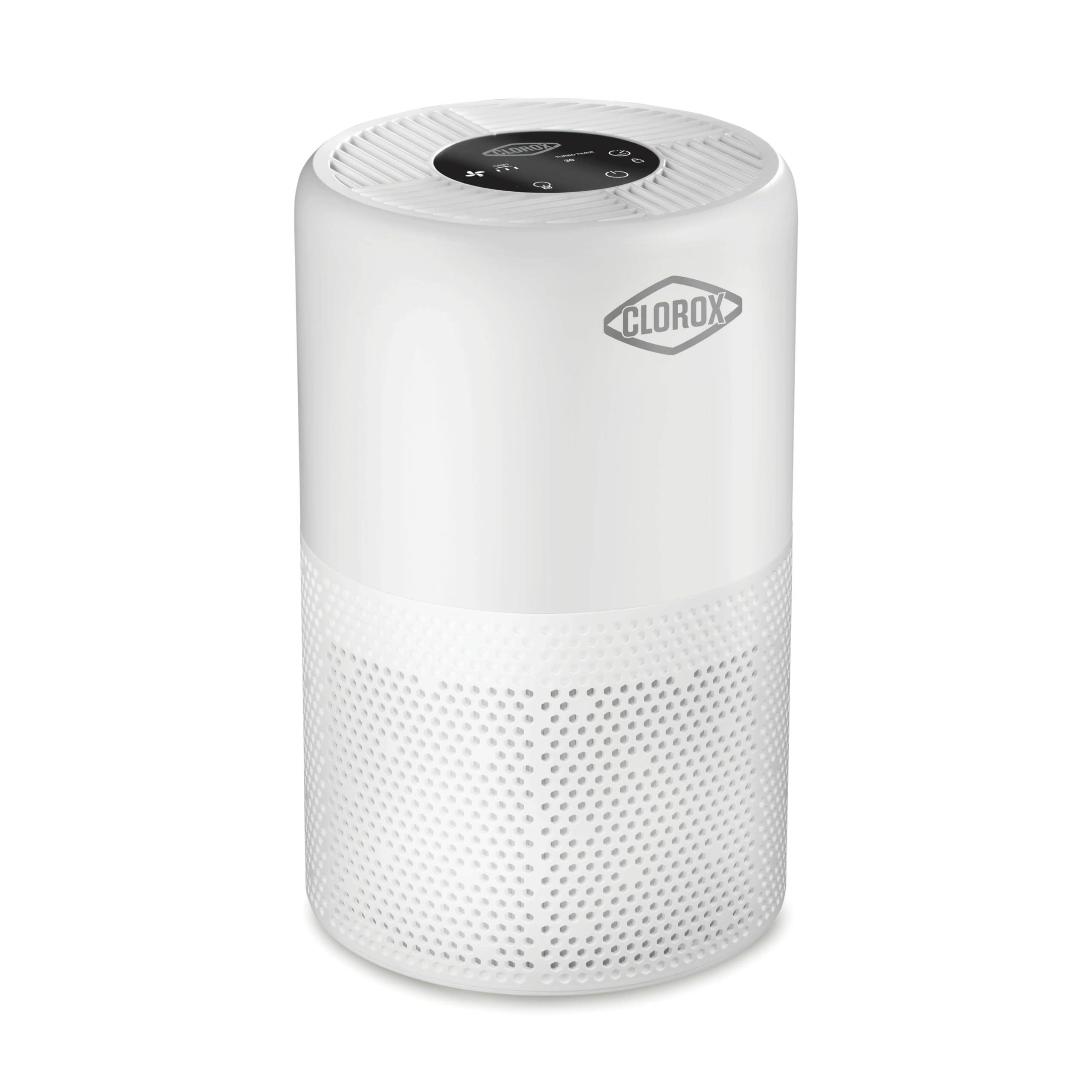
2. Clorox Medium Room Turbo Air Purifiers for Home With True HEPA Filter
When you need the smell gone in twenty minutes, not all day, the Clorox Turbo’s dedicated timer does what a full-time running unit cannot.
A VOC episode is usually short — you finish cooking, you open the paint can, you walk in on a burnt pan. That is the exact window the Clorox Turbo was built for. Set the Turbo Timer for 10, 20, or 30 minutes, pick one of four speeds from low to turbo, and the machine runs full-out to knock down smoke, dust, and cooking odors, then you drop it back down. The three-stage 360° filter (pre-filter, True HEPA, active carbon) pulls air in from all directions rather than just one side, which is why the machine works in a medium room without you repositioning it. Coverage is rated at up to five air changes per hour in a 215-square-foot room, or one air change per hour across a 1,000-square-foot space.
Two things make this one easy to live with. First, it is small and light: 5.2 pounds in an 8.46 x 8.46 x 13.78-inch body, which makes it the easiest unit on this list to move from kitchen to bedroom to home office. Second, it runs quiet on the lower speeds — the fan stages step from near-silent to low hum to moderate, with turbo the only genuinely loud setting. On the job it does best, owners mention: “We have two dogs and I’ve been waking up every morning sneezing. Since using this air purifier I haven’t woke up sneezing.” The three-stage filter is easy to change from the top. Plan on cleaning the filter compartment monthly and replacing the filter element every six to twelve months to keep the carbon from saturating.
The honest limit: this is a small-room tool. In an open-plan space the carbon bed is not sized for heavy chemical loads, and one three-star review argues it only shows a real dust difference on turbo, and turns too loud to keep there. If you want VOC filtration as the primary job, go bigger. If you want a compact, quick-response purifier for a bedroom, kitchen, or small room where you can hear the differences, this one fits neatly.
Front-of-fan winner: the combination of a real turbo timer, a 360° intake, and a 5.2-pound body makes this the fastest-response pick for small spaces.
Keep it honest: the carbon stage here is sized for medium rooms — for heavy off-gassing in a large room, the Levoit EverestAir-P or the AirDoctor AD3500 has the deeper carbon bed.
Grab this if: you want a light, compact purifier that can clear a cooking odor in a small room on a timer.
Skip if: you are fighting a whole-house VOC load and need the carbon to last through weeks of heavy loads.
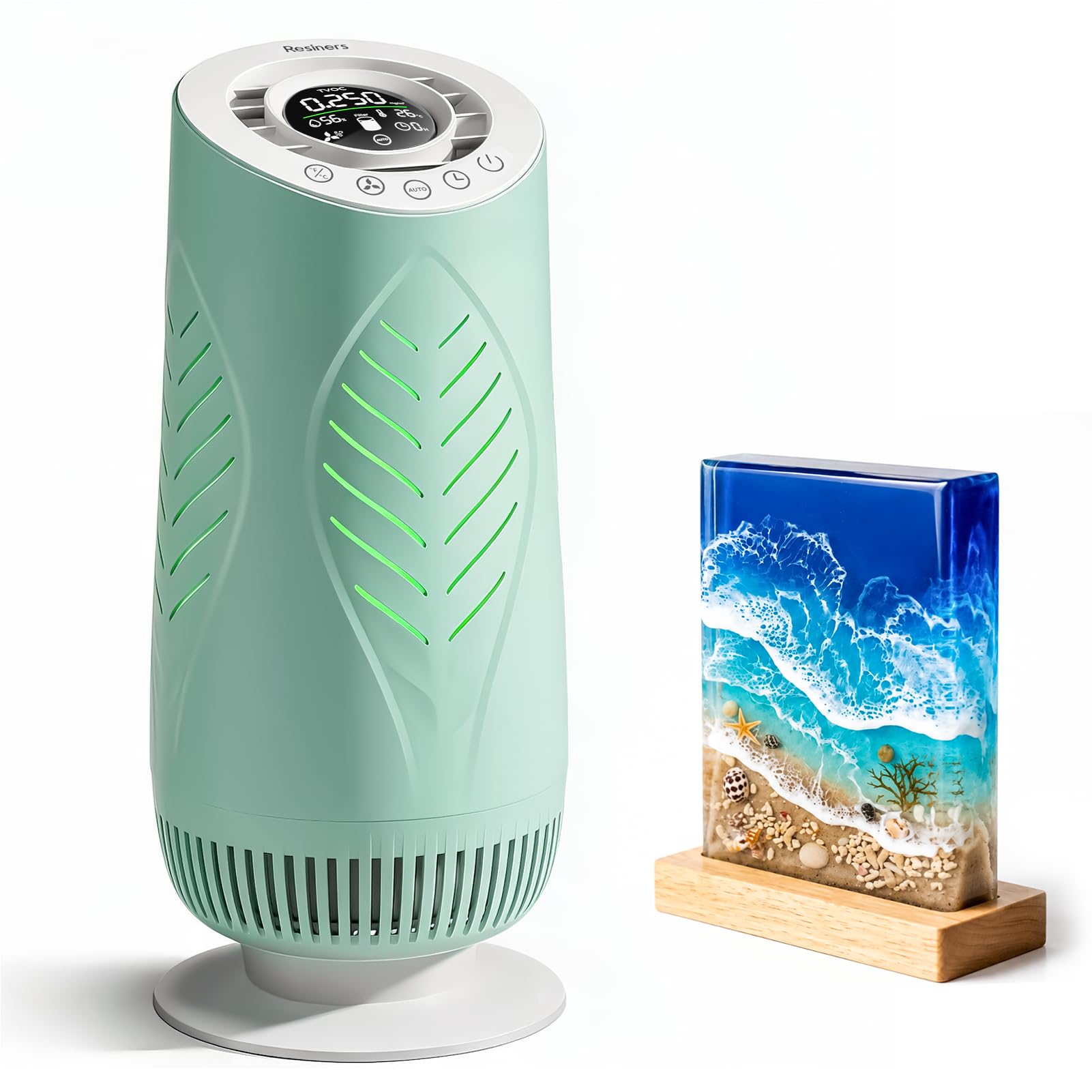
3. Resiners AirPure Air Purifier with H13 True HEPA Filter for Epoxy Resin
Resin fumes are a specific, nasty VOC problem — and Resiners built the Purair to catch exactly that, with a filter rated for it.
Most purifiers in this list were designed for general home air. Resiners designed the Purair around the specific chemical load an epoxy resin artist creates. Resiners states the Purair removes 83.59% of VOCs from epoxy resin fumes in a high-VOC environment, per an SGS-certified test — a lab result, not a guarantee for your workspace. Two filters sit inside: a pre-filter for dust, fibers and hair, and an H13 HEPA combined with a resin-fumes filter rated to catch 99.97% of particles as small as 0.3 μm (microns — millionths of a meter) and to decompose the VOC load. It is CARB-compliant, which is California’s standard for air-cleaning devices.
The feature that wins resin artists over is the display. Resiners runs a real-time air quality sensor with green, yellow, and red LED indicators, plus resin TVOC data on screen. In plain English: the unit tells you when the VOC level is climbing, so you know when to open a window or step out. Auto Mode adjusts fan speed on its own, and there are three manual fan speeds plus a 1-9 hour timer. Coverage is 158.76 ft² (14.4 m²) with a 360° intake and 45° angled outlet that push air farther than a straight vent would. Owners say the tower turns red and the fan ramps up while resin is curing — the machine telling you to step away.
Two things to know before you buy. First, filter life: up to 2,000 hours with replacements recommended every 3-6 months, so budget for that as a recurring cost. Second, the display indicator is fine, but a handful of buyers find it less than perfect — treat the readout as a trend guide, not a lab instrument. In a resin workshop, though, the combination of a filter purpose-built for fumes and a live warning light is genuinely rare.
What it fixes: the specific VOC problem resin artists face every session — the machine was designed for it and carries a filter rated for it.
The trade-off: replacements are 3-6 months on a 2,000-hour filter, so it is a recurring cost of doing resin work with clean air.
For: epoxy resin artists, woodworkers with VOC-heavy finishes, and anyone whose craft creates a specific chemical smell the family notices.
Not for: big open living rooms — 158.76 ft² is a small workspace footprint, not a whole-house solution.
4. WINIX 5520 Air Purifier for Home Large Room
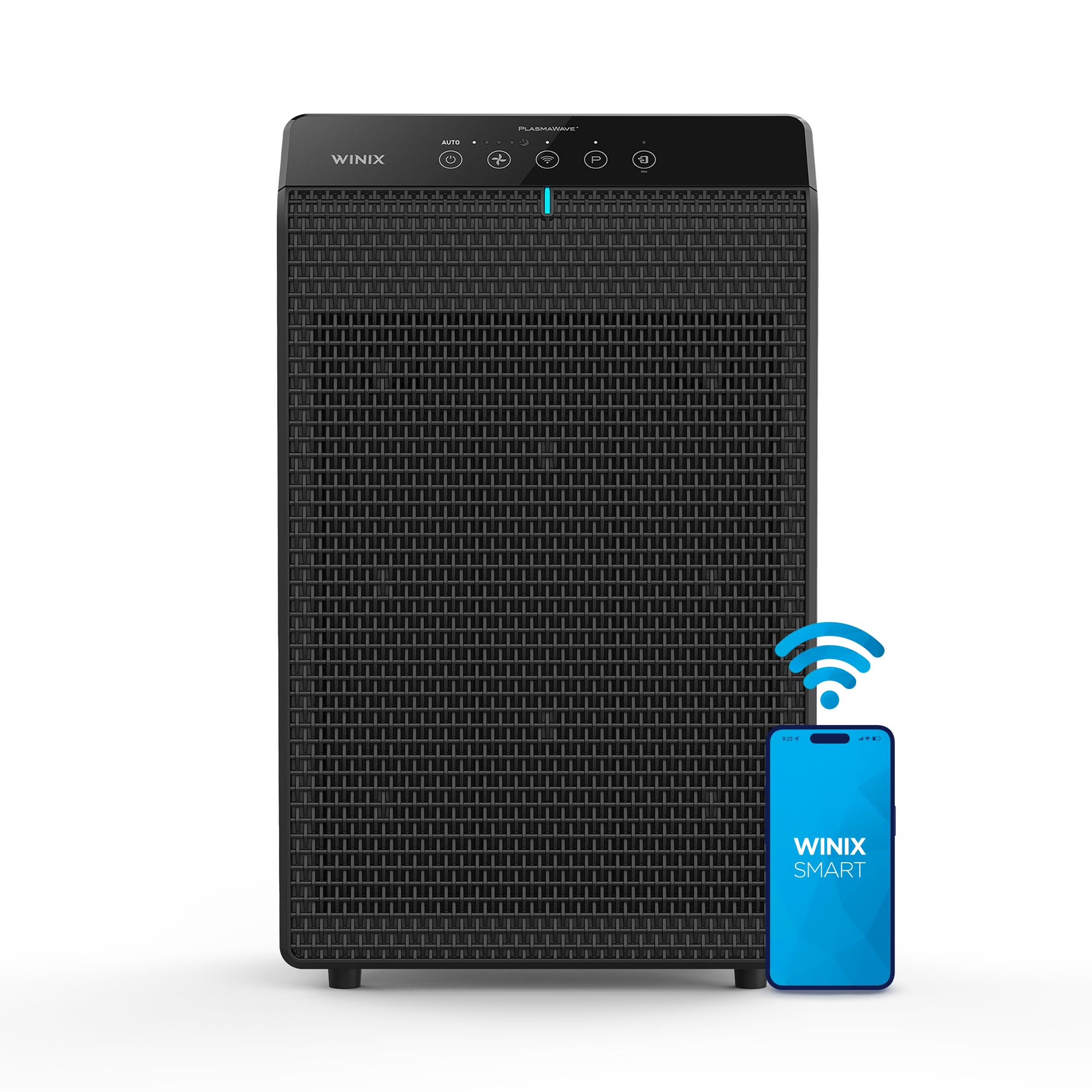
Winix’s 5520 is the steady, quiet, app-connected workhorse that makes VOC and odor control feel like a background job, not a project.
Start with the carbon strategy. Winix uses an Advanced Odor Control Carbon Filter rated to reduce VOCs and household odors from cooking, pets, and smoke, backed by a washable fine mesh pre-filter that catches the big stuff first and preserves the HEPA life behind it. That order — mesh, then carbon, then HEPA — is why this machine stays effective for months in a cooking-heavy kitchen. The AHAM Verified rating at 392 sq ft means an independent body confirmed the unit’s measured performance in that room size, and the specs claim 1,882 sq ft cleaned in one hour, 941 sq ft in 30 minutes, 627 sq ft in 20 minutes, and 470 sq ft in 15 minutes.
The Winix True HEPA stage captures 99.99% of airborne allergens down to 0.3 microns, and the unit runs at 23.5 dB on its slowest speed — about the volume of a quiet bedroom. Auto Mode with the built-in air quality sensor raises fan speed the instant it detects cooking smoke or a dust stir-up, then drops back down. Sleep Mode dims the lights and slows the fan automatically when the room goes dark, then returns to Auto when light returns. The Winix Smart App adds remote monitoring and control. What owners consistently praise above all is the noise control — the slowest setting is the standout feature and the thing that lets this unit live in a bedroom.
The one honest gripe in the reviews is a rare unit that develops a clicking noise in sleep mode — that is a fan imbalance issue on an occasional unit, and Winix issues replacements when it happens. App lag shows up in a few accounts too. Set against that, customers note buying second units, using it against wildfire smoke, and running it full-time during cooking to clear smell. For the carbon filter, use the green filter set for smoke — it is the version Winix engineers for heavier gas loads.
The quiet operator: 23.5 dB on the lowest setting is what makes this the bedroom-friendly pick here — most owners treat noise as the headline feature.
Filter math matters: genuine Winix filters are easy to source, and the washable pre-filter cuts how often you replace the HEPA behind it.
Pick this if: you want a large-room purifier with app control and genuinely quiet sleep operation.
Hold off if: you want a real-time PM2.5 readout on the device — the 5520 uses a color-coded LED indicator rather than a numeric display.
5. Wyze Smart Air Purifier With Formaldehyde Filter (Premium)

Formaldehyde is one of the hardest VOCs to filter, and Wyze makes a dedicated carbon filter specifically for it — a rare targeted answer.
Formaldehyde is the VOC that off-gasses from new furniture, pressed-wood cabinets, and cheap laminates, and it is one of the gases a generic carbon pad struggles with. Wyze sells three filter options for this purifier: Standard (particles, pollen, odor), Special (smoke, ash, smoke smell), and Premium (formaldehyde, heavy odor). The Premium filter is the one designed specifically for the formaldehyde job. That filter-plus-model matching is why a Wyze owner in a strong ozone-adjacent situation was able to say the machine plus the formaldehyde filter knocked down a skunk spray odor in about 30 minutes on turbo mode.
The rest of the unit lines up well. The laser dust sensor scans for airborne particles and auto-adjusts fan speed, controlling from a low of 21 decibels to a high of 54 decibels — low enough that you can sleep beside it. Coverage is rated at 500 ft² over three air changes an hour, built around a 350 m³/h CADR (cubic meters of clean air per hour). The app gives real-time indoor and outdoor air-quality tracking, which lets you see whether the formaldehyde load is coming from inside your home or from outside air coming in. What wins people over is the combination of air-quality feedback and the auto-response — owners note the fan speed visibly ramping up when contaminants appear.
Two real watch-outs. First, the app does not schedule fan speeds — it offers Auto, Sleep, and Off, and nothing in between — which a few buyers view as a limitation. Second, that same auto response is what makes the display actually informative throughout the day, so if you want an advanced schedule-style control, look at the Levoit EverestAir-P instead. In a new-build home, a fresh furniture delivery, or a room with pressed-wood cabinetry, the Wyze’s formaldehyde filter is the direct fix.
Why It Earns Its Slot
- Dedicated formaldehyde carbon filter — a targeted VOC answer most purifiers do not offer
- 21 dB on low is quiet enough to sleep beside
- Laser dust sensor plus real-time indoor and outdoor air-quality tracking in the app
- Three filter options let you match the unit to your specific VOC problem
- Covers 500 ft² at three air changes per hour
Limits To Weigh
- No fan-speed scheduling in the app — only Auto, Sleep, or Off
- Low speeds push modest airflow, so heavy VOC loads want turbo
- Beep cannot be disabled, and filter changes in a bottom-load tray take getting used to
Right fit: new-build homes, fresh-furniture rooms, and anyone chasing a specific formaldehyde problem rather than general dust.
Wrong fit: anyone who wants a fully-scheduled fan speed curve instead of auto-only control.
6. Austin Air it Room Air Purifier With VOC Carbon Wrap, Model C100CC1

Austin Air shrank its carbon-wrap formula into a nightstand-sized box that travels — hotel rooms, small apartments, and offices get the same VOC-tuned filtration.
The carbon wrap is the defining piece. Austin Air builds the C100CC1 around its VOC carbon wrap — a layer of carbon dedicated to filtering chemicals, gases, and VOCs — plus a high-efficiency filter stage that captures airborne particles as small as 0.3 microns. That is the same carbon-first design philosophy the brand puts in its full-size units, scaled down. For a hotel room with stale air, a small bedroom over a garage, or an office with new paint off-gassing behind you, that carbon wrap is the part that actually addresses the airborne chemicals.
Build quality is the second story. The unit is made of steel — durable, and heavy enough that it stays put rather than sliding around a nightstand. Austin Air calls it whisper-quiet and designed for bedrooms, and one review argues the compact form factor fits neatly on a nightstand, which is unusually specific and useful in a category that usually makes you clear a whole corner of floor. One traveler with asthma and significant allergies bought the smaller Austin specifically to take on hotel stays. Reviewers with two decades of loyal use with the larger Austin machines report the same clean-air feel at the smaller scale. The most-raved-about theme in feedback is the improvement in air quality itself — people keep coming back to how clean the air actually feels.
Weight is the honest trade-off. At 12 pounds, the C100CC1 is heavier than any travel-friendly purifier needs to be, and Austin markets it as portable — it fits the description, but it is a car-trip portable, not a backpack portable. The noise level is also mixed at the top setting: quiet enough to sleep beside on low, but not a purifier you will tolerate running full-out while you work. If you want a road-trip purifier that stays true to a real carbon filter, that trade-off is the cost of admission.
What makes it different: it’s a genuine carbon-wrap purifier in a small footprint — rare in the travel-friendly size class.
Where it stumbles: 12 pounds is real weight to haul, and the top speed runs louder than the marketing implies.
Made for: frequent travelers with allergy sensitivity, and anyone who needs VOC filtration in a small secondary room.
Not made for: whole-room coverage in a home — the C100CC1 is designed for small spaces, not living-room scale.
7. AIRDOCTOR AD2000 for Small & Medium Rooms and Small Bedrooms
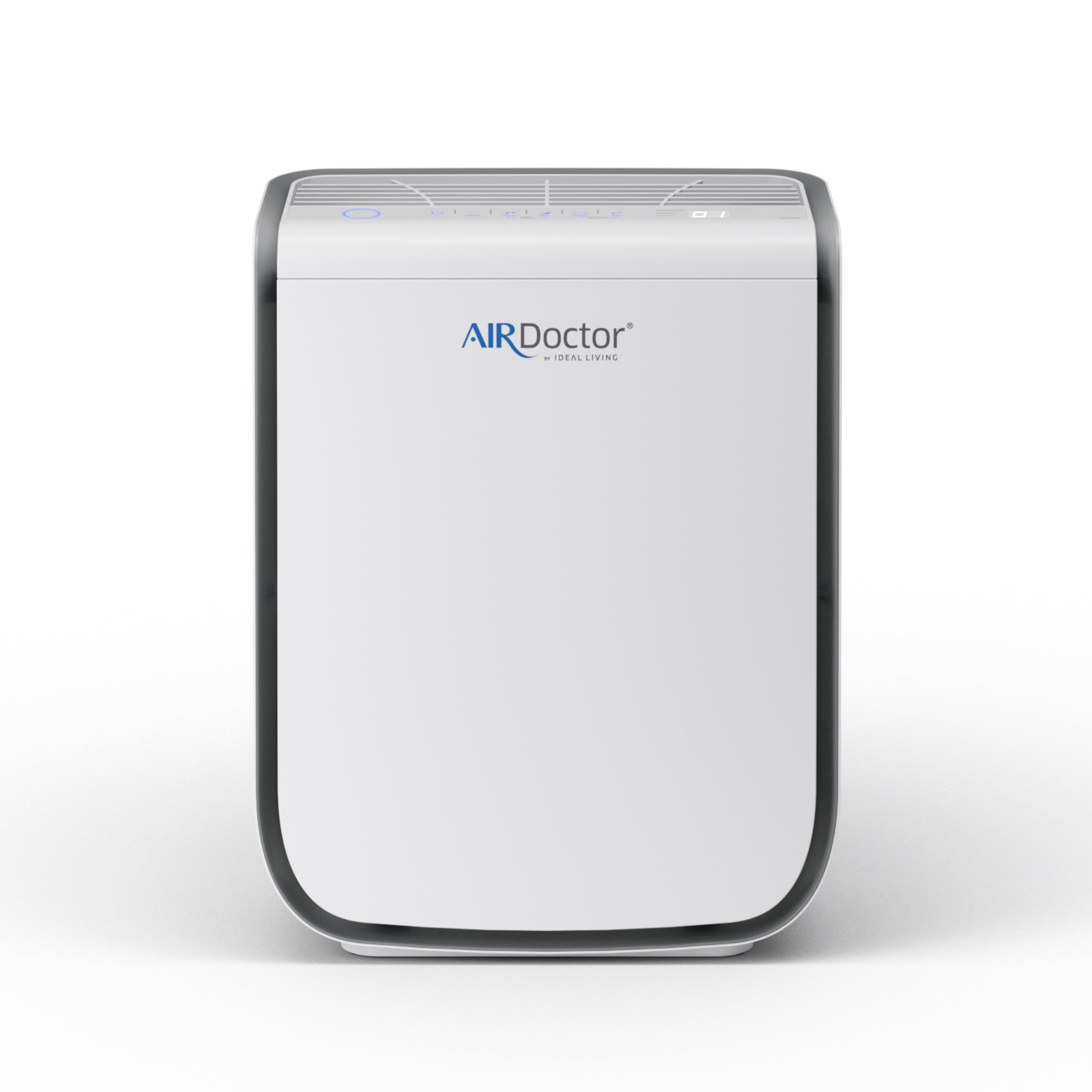
The AD2000’s three-stage filter pairs UltraHEPA with an activated-carbon-and-potassium-permanganate layer — a combination built to break down chemical gases, not just trap them.
Potassium permanganate is the standout ingredient. Standard activated carbon adsorbs VOC molecules — it captures them and holds them. Potassium permanganate goes a step further: it is an oxidizing compound that chemically breaks certain gases down as they pass through. AirDoctor builds both into the AD2000’s premium activated carbon filter, alongside a pre-filter and an UltraHEPA stage. That filter is rated to reduce toxic gases, odors, pet smells, cooking fumes, gas emissions, wildfire smoke, and VOCs. In a bedroom sitting over a garage, or in a home office where new furniture continues off-gassing for weeks, that carbon-plus-permanganate layer is the part doing the VOC job.
The particle stage is also unusually capable. AirDoctor’s UltraHEPA stage is rated to capture 99.99% of airborne particles at 0.003 microns — far finer than the standard HEPA threshold. Rapid cleaning is rated at 305 ft² in 15 minutes and up to 1,220 ft² in one hour, which is a comfortable fit for a bedroom, nursery, or home office. The Halo display runs PM2.5 sensors and shows color-coded air quality, and Auto Mode adjusts fan speed automatically. It carries Genuine AirDoctor replacement guidance: carbon every six months, UltraHEPA every 12 months, with the UltraHEPA filters made in Japan.
Owners describe the AD2000 as the kind of purifier you set to automatic and forget — running it in a small apartment around the clock, letting Auto Mode do the work. The honest caveat is upfront cost and filter cost; both the unit and its replacements sit in the premium bracket, and the value-for-money aspect draws real pushback in reviews. The AD2000 is also FSA and HSA eligible, which softens the outlay if you have a pre-tax health account. For a small-to-medium room where VOC filtration and particle filtration both matter, this is the pick that gets both right in one box.
Built For Chemical Gases
- Activated carbon plus potassium permanganate — carbon traps gases, permanganate breaks them down
- UltraHEPA captures particles at 0.003 microns, far finer than standard HEPA
- Cleans 305 ft² in 15 minutes, up to 1,220 ft² in one hour
- Halo PM2.5 sensor display with Auto Mode and Boost
- FSA and HSA eligible
Where Costs Add Up
- Premium unit price and premium filter replacements — carbon every 6 months, UltraHEPA every 12
- Auto Mode reports as slow to react on a few early units, though replacements fix it
- Indicator lights draw mixed feedback — the display color readout is not for everyone
Reach for this if: you want a bedroom-scale purifier engineered for chemical gases, not just particles.
Look elsewhere if: you want a low ongoing filter cost — the carbon and UltraHEPA replacements run premium.
8. AIRDOCTOR AD3500 Air Purifier
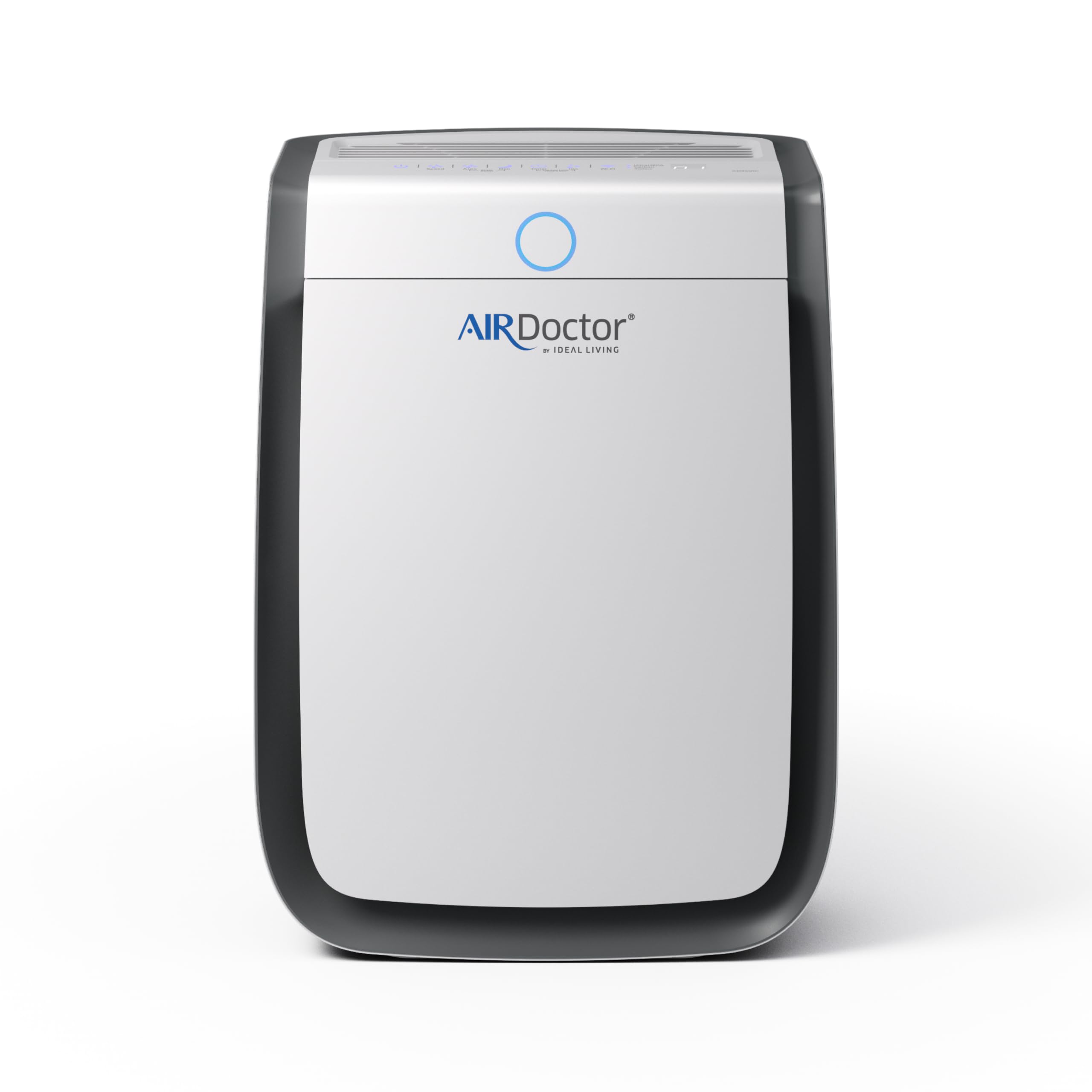
The AD3500 is the AD2000’s bigger sibling — same three-stage chemistry, same UltraHEPA, but scaled to carry a large open-plan living area.
The coverage number is the headline here. Rated to clean 630 ft² in 15 minutes and 2,520 ft² in one hour, this is the unit for the large living-dining-kitchen layout where a small purifier cannot keep up. Same filtration architecture as the smaller AD2000: pre-filter, premium activated carbon with potassium permanganate to reduce toxic gases, odors, cooking fumes, and VOCs, and an UltraHEPA stage rated to capture 99.99% of airborne particles at 0.003 microns. The same Halo PM2.5 sensor system drives Auto Mode with Boost, along with a timer, filter indicator, and four fan speeds. Carbon replacements every six months, UltraHEPA every twelve.
Owners using the AD3500 in real VOC situations report it works to spec. In one home the unit apparently kicked to high when a burnt pizza filled the house with smoke and cleared the air quickly. In another, the writer notes Auto mode visibly ramps to yellow and red during nebulizer use, dishwasher cycles, and cooking — the sensor doing the detection so you do not have to. Two units running in tandem meant waking up with no dry throat and no stuffy nose for one household. In a three-cat home, one owner reports the smell disappeared entirely and her husband’s yearly sinus infections stopped. The most-praised aspect of the AD3500 is raw effectiveness, with cleaning performance close behind.
Two real caveats. First, it is bulky: at 24 pounds and 19.87 x 27.16 x 12.38 inches, plan a real footprint. Second, filters are pricey and the carbon is a pain to swap — the reset sequence (hold timer and ion button for three seconds) is worth learning early. And one thing worth flagging: a couple of buyers consider it pricey, though the value-for-money aspect does sit in the positive column here. If you have the space and the VOC load, the AD3500 earns its place at the top of the large-room tier.
Where It Delivers
- Cleans 630 ft² in 15 minutes, up to 2,520 ft² in one hour — real large-room capacity
- Activated carbon plus potassium permanganate to break down gases and VOCs, not just trap them
- UltraHEPA captures particles at 0.003 microns
- Halo PM2.5 sensor and Auto Mode with Boost, plus timer and four fan speeds
- FSA and HSA eligible
Costs To Know
- At 24 pounds and 19.87 x 27.16 x 12.38 inches it needs real floor space
- Premium filter replacements — carbon every six months, UltraHEPA every twelve
- Turbo is loud enough that it is a short-burst setting, not overnight
Commission this for: large open-plan homes where particle and VOC loads both run heavy, especially with pets or ongoing off-gassing.
Rethink if: you cannot dedicate a corner to a 24-pound unit and you want a low-cost filter life.
9. Austin Air HealthMate Standard Air Purifier, Sandstone, Model B400

A 45-pound steel tank with a 4-stage filter that includes zeolite — Austin Air built this one to walk the same road as you for years.
The filtration stack is where the B400 separates itself. Austin Air uses four stages with an integrated Activated Carbon and Zeolite filter. Zeolite is a mineral that adsorbs certain gas molecules activated carbon does not hold as well, so the combination broadens the range of odors, smoke, and VOCs the bed is set up to catch. Austin Air rates the 4-stage filter to capture dust, pollen, pet dander, mold, smoke, and VOCs across up to 1,500 square feet. Where most units here call for a new filter every six or twelve months, Austin Air rates the B400’s filter for up to five years and warranties it for five.
Build to last is the second strong suit — the B400 runs a steel chassis at 45 pounds, which is why owners who have run it for years describe it as a workhorse. The reported experience is consistent and calm: catches a lot of dust, cleans up smoke and odor, and does not ask for much attention. The most-praised trait in reviews is effectiveness — that is what keeps buyers loyal to the brand for years and pointed back when their old unit needed replacing.
The catch almost all owners point out is size and sound. The B400 is 14.5 x 14.5 x 23 inches and 45 pounds — a fixture, not a piece of furniture you move around. The noisiest setting is genuinely loud and only suitable for daytime use; the lower settings are near-silent and comfortable. Filter replacement cost is also nontrivial and one reviewer reached for a cheaper replacement and was disappointed — stick with genuine Austin Air filters. In an 800-sq-ft apartment near a smoker, the unit cleared most of the neighbor’s smoke indoors on the high setting. For a home where you want the same filter in place for years, the B400 makes the case.
Long-game play: up to five years on one filter plus zeolite in the carbon bed is a genuinely different ownership rhythm from the six- and twelve-month cycles everywhere else.
Price of the tank: 45 pounds and 14.5 x 14.5 x 23 inches mean it owns its spot — and the high setting is loud enough to leave out of bedrooms at speed.
Buy this if: you want VOC and odor filtration with low maintenance and you have a dedicated floor corner for it.
Think again if: you need a portable unit, or you want a filter to swap every year on a lower replacement budget.
10. ORANSI mod+ Air Purifier — Extra-Large Rooms, 3-Stage Air Filter with Carbon

The Oransi mod+ brings a 363 CADR to the big-room game without an app, without an LED light show, and without a filter you replace every season.
Pure performance is the story. Oransi measures the mod+ at a 363 CADR score, verified by AHAM for CADR and CARB Certified Zero Ozone. In real terms that means it cleans 563 square feet in 12.5 minutes at 4.8 air changes per hour, or covers 1,361 square feet every 30 minutes at 2 air changes per hour. That is genuine large-room capacity — kitchens, basements, living rooms, and open-plan spaces where a small unit never catches up. The 3-in-1 filter combines a high-efficiency particle stage with carbon, designed to catch pollen, pet dander, dust, VOCs, odors, wildfire, and cooking smoke in one cartridge. Oransi rates one easy-to-replace filter to last up to 12 months.
Where the carbon side is honest is in the volume of carbon. The 3-in-1 filter is not the heaviest carbon bed in this lineup — owners note the roughly 1-pound activated charcoal layer is fine for everyday odors but modest for a heavy chemical load, so in a home with fresh paint or new pressed-wood furniture you may want to pair it with a second unit that carries a deeper carbon bed. That said, what owners consistently praise most on the mod+ is raw effectiveness — it removes dust, bird dander, and cat hair from the air and cuts dusting from weekly to monthly for one parrot owner. One owner running it 24/7 for two asthmatics reports the dust smell disappeared and one person slept through the night without medication.
The honest setup trade-offs: no app and no LED display panel, which some buyers count as a feature and some as a missing convenience. The touch controls have a slight one-to-two second delay. At 23 pounds and 14 x 14 x 25 inches, it is a substantial footprint but not extreme for a large-room unit. On the noise side it is unbelievably quiet at low speed and noticeably loud at full speed — most owners settle around three-quarter power and find that comfortable for TV watching. If the goal is large-room VOC filtration without app dependencies, the mod+ is the pick.
Straight-Line Performer
- 363 CADR, AHAM Verifide for CADR, CARB Certified Zero Ozone
- Cleans 563 ft² in 12.5 minutes (4.8 ACH) and 1,361 ft² every 30 minutes (2 ACH)
- One 3-in-1 filter rated to last up to 12 months — low cartidge-swap frequency
- Minimal lights for sleep-time use
- Removes dust, pet dander, bird dander, and smoke
Trade-Offs Weighed
- Carbon layer is modest for heavy chemical loads — fine for everyday odors, not for new-furniture off-gassing
- No app, no LED air-quality screen — you do not get real-time readings
- Touch controls have a slight button-delay; full speed runs loud
Standout pick for: large rooms with pets or everyday odor sources where you want strong CADR without app dependence.
Reconsider if: you have a heavy chemical off-gassing problem — the carbon layer here is not sized for that job, and the Levoit EverestAir-P or the AirDoctor AD3500 carries a deeper carbon bed.
11. IQAir GC MultiGas XE Air Purifier Activated Carbon WiFi Enabled 1125 sq ft
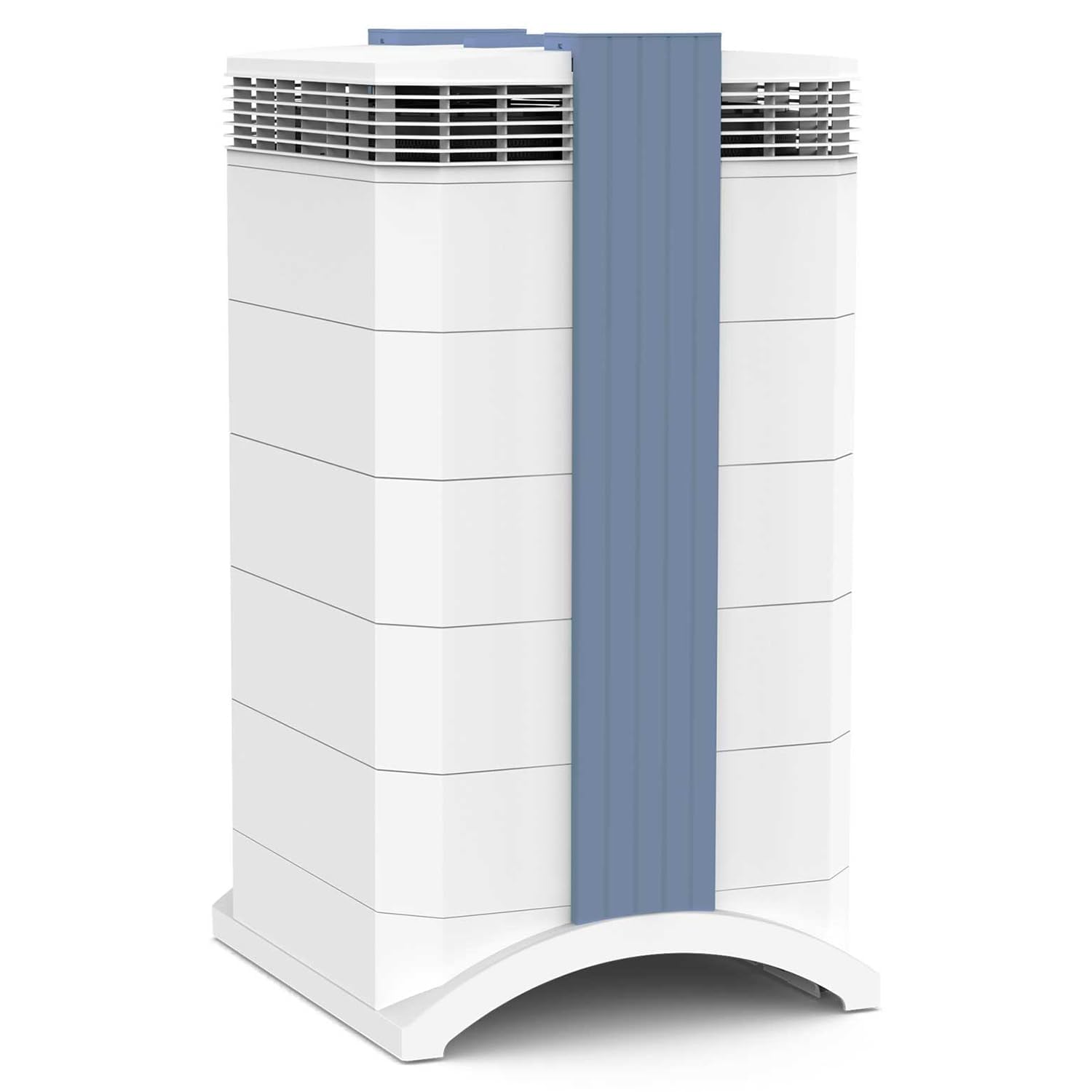
When a regular carbon filter is not enough, IQAir’s GC MultiGas XE builds VOC filtration out of four separate chemical-catching layers — this is the chemical-gas specialist.
The MultiGas XE is the only unit here whose design is explicitly multi-gas. IQAir stacks HyperHEPA with activated carbon, gas cartridges, and post-filter sleeves, rated to capture 99% of targeted pollutants including chemicals, tobacco smoke, and odors. Where a regular unit packs carbon into one filter cartridge, this one separates the job into distinct gas-catching components, which is why IQAir frames it as a comprehensive multigas solution for spaces up to 1,125 sq ft. It is designed and manufactured in Switzerland — EPA Est. No. 97566-CHE-1, CARB EO No. G-24-068 — and each IQAir purifier can be backed by a 10-year limited warranty through the manufacturer.
Smart integration changes how you actually use it. The GC MultiGas XE pairs with the IQAir AirVisual app for real-time monitoring and remote control, and its smart sensors auto-adjust the filtration setting based on current air quality. That auto-response is what makes it usable in a home office or a bedroom without you remembering to hand it tasks. In practice, owners describe it clearing cooking fumes, handling wildfire smoke with ease, and knocking down smells from a home with indoor cats. During the bad Canadian wildfire smoke season, one household described its front door as warped and the unit handling the smoke anyway. On auto, the reported behavior is quiet operation on low and mid, with the yellow/red high-speed response only kicking in when something is cooking or burning.
The honest cost is real: this is the priciest pick in the lineup, it ships in two boxes with the air purifier and filters separate, and IQAir’s warranty structure means buying from some third-party Amazon sellers can void the warranty — buy direct or from an authorized dealer. On the review side, the recurring themes are air quality and actual breathability, with value-for-money scoring as a legitimate pushback. If your VOC problem is serious — chemical off-gassing, formaldehyde, industrial-level gas exposure — the four-layer approach here is the closest thing to a specialist tool in the category.
Specialist approach: HyperHEPA, activated carbon, gas cartridges, and post-filter sleeves make this the most layered gas-fighting architecture in the lineup.
The premium reality: top-tier pricing plus two-box delivery plus a warranty that some Amazon sellers can void — buy direct or from an authorized dealer.
Choose this for: serious chemical-gas problems — off-gassing homes, formaldehyde-sourced headaches, industrial-adjacent air quality — where you need a dedicated multigas design.
Pass on it if: your issue is dust and pet dander only — the four-layer build is overkill for that and you can spend far less on a Levoit or Winix.
Understanding the Specs
CADR — The Speed Number
CADR stands for Clean Air Delivery Rate — how many cubic feet of clean air the purifier pushes out every minute. Higher CADR equals faster air turnover, which means a VOC release gets diluted faster. A CADR in the 350-plus range handles a large living area; a CADR in the low hundreds fits a bedroom. Match CADR to room size and airflow needs, not to marketing language. When a spec sheet lists “up to X square feet in one hour,” divide that feel mentally: the same unit will cover far less square footage at the higher air changes per hour you actually need for active VOC control in a working room.
Activated Carbon — The VOC Workhorse
Activated carbon is the actual mechanism for VOC removal. It has a staggering internal surface area — a gram of high-quality carbon can offer hundreds of square meters of internal pore space — and VOC molecules stick to those pores as air passes through. Two things matter: how much carbon is inside, and how it is packed. A thick, pellet-filled carbon bed holds far more gas than a thin carbon-dusted sheet. Some carbon filters also incorporate potassium permanganate, which oxidizes certain gases instead of simply holding them. When you are choosing between two purifiers at the same CADR, look at the carbon weight or the filter cartridge size — that is the number that decides VOC duty.
FAQ
Does a HEPA filter remove VOCs?
How do I know when my carbon filter is saturated?
Is a bigger CADR always better for VOC removal?
Can an air purifier remove paint fumes and new-furniture smells?
What does AHAM Verifide or CARB certified actually mean?
Are replacement filters or the unit itself the bigger long-term cost?
Will a purifier help with cigarette or wildfire smoke smell?
Do I need a smart app and WiFi connection on a VOC purifier?
Can I run an air purifier in a closed bedroom at night?
Does room size matter more than CADR when picking a VOC purifier?
Final Thoughts: The Verdict
For most people figuring out the best air purifier for voc, the Levoit EverestAir-P is the pick that gets the carbon-first job right — 354 CFM CADR, 60% more carbon than Levoit’s own Vital 200S-P, and a three-channel laser sensor that watches PM10, PM2.5, and PM1.0 in one unit. If your home has a serious chemical-gas problem — new construction off-gassing, formaldehyde, industrial-grade VOCs — the IQAir GC MultiGas XE is the four-layer specialist that treats gas filtration as the whole job rather than a supporting act. For a small room where the VOCs come from a specific hobby like epoxy resin, the Resiners Purair is the only pick here designed around that exact chemistry. And for something quiet enough to sleep beside while it works a bedroom-sized space, the Winix 5520 at 23.5 dB on low is the one most likely to disappear into the background. Between them, one of these eleven treats VOCs as the target — not as a byproduct of dust removal.
How We Picked
We do not accept paid placement. Every pick is matched to a real buyer and a real use-case; we do not hands-on test units.
Sources & Methodology
Specifications: manufacturer listings and product documentation. Review insights: verified customer reviews, as of September 2026. Pricing: not shown on this page (it changes often); check the current price via the retailer link.
As an Amazon Associate, Gadgets Feed earns from qualifying purchases. This does not affect which products we feature.