
Our readers keep the lights on and my morning glass full of iced black tea. As an Amazon Associate, I earn from qualifying purchases.
Specs are compiled from manufacturer listings and verified buyer reviews and can change over time — please confirm the key details on the product page before buying.
If your feet roll inward with every step, the fix is not extra padding — it is a firmer, higher arch shelf that stops the collapse in the first place. Insoles built for pronation hold your arch up and keep your heel centered, which is why so many people who have tried every soft gel cushion end up switching to a rigid orthotic and never going back. This guide covers the ones worth your money, what each is genuinely good at, and where each one falls short.
I’m Min — the founder and writer behind Gadgets Feed. This guide is built by comparing the manufacturers’ published specifications and the patterns across verified customer reviews, so you get each pick’s real strengths and trade-offs instead of marketing spin.
Below you will find the insoles that actually hold an arch, ranked by how well they control a rolling foot and how they feel in real shoes all day. The shortlist of arch support insoles for pronation that follows separates the firm shells from the squishy foam that flattens by lunchtime.
Our Picks at a Glance


How To Choose The Best Arch Support Insoles For Pronation
Pronation is the natural inward roll of your foot as you land. When that roll goes too far, your arch collapses, your ankle caves in, and the strain travels up into your knees and lower back. The insole that helps is the one that props the arch up firmly and keeps your heel locked in place — not the softest one on the shelf.
Firm Support Or Soft Cushion?
This is the decision that trips most people up. A soft foam insole feels great in the store but flattens under your weight within weeks, and once it flattens it stops controlling the roll. A firm to rigid shell, by contrast, holds its shape so the arch stays supported hour after hour. The trade-off is real: a firm shell often needs a short break-in period, and some people find it uncomfortable for the first few days. Start by wearing it a couple of hours a day and build up.
Match The Arch Height To Your Foot
Insoles come in different arch heights, and the right one depends on your foot. Flat or fallen arches usually want a high, rigid support to prop the arch back up, while medium arches do better with a moderate curve. If the arch sits too high you will feel pressure under your instep; if it sits too low you will still roll inward. The heel cup matters just as much — a deep, U-shaped cup cradles your heel and keeps it from sliding side to side, which is half the battle against pronation.
Full-Length Versus 3/4-Length
A full-length insole runs the whole length of your shoe and is easiest to swap between pairs. A 3/4-length insole stops before your toes, which leaves the toe box roomy and makes it a good pick for dress shoes or tight boots where a full insert would crowd your toes. Both can control pronation as long as the arch and heel are firm. Check that your shoe has a removable factory insole — most support insoles are designed to replace it rather than stack on top.
Quick Comparison
| Model | Best For | Rating | Type | Weight | Amazon |
|---|---|---|---|---|---|
| PowerStep Pinnacle★ Best Overall | Everyday pronation and plantar fasciitis | 4.5 | Full-length | 6.4 oz | Amazon |
| Dr. Foot 3/4 OrthoticsCompact Pick | Flat feet that need a high rigid arch | 4.2 | 3/4-length | 3.53 oz | Amazon |
| RooRuns 3/4 Orthotic InsolesBudget Champion | Firm arch control on a budget | 4.1 | 3/4-length | 3.53 oz | Amazon |
| WalkHero Arch Support Inserts | Wide, high-volume athletic shoes | 4.3 | Full-length | 4.66 oz | Amazon |
| VALSOLE Heavy Duty | Heavier users over 220 lbs | 4.3 | Full-length | — | Amazon |
| StnyLabVexo Work Boot Insoles | All-day standing on concrete | 4.4 | Full-length | 7.52 oz | Amazon |
| Protalus T100 Thin Series | Dress shoes and standard-fit sneakers | 4.4 | Full-length thin | 4.8 oz | Amazon |
| Spenco Total Support Max | Overpronation with high arches | 4.4 | Full-length | 5.6 oz | Amazon |
| PowerStep Pinnacle Maxx | Maximum stability for overpronation | 4.5 | Full-length | 5.29 oz | Amazon |
In‑Depth Reviews
1. PowerStep Pinnacle Insoles, Orthotics for Plantar Fasciitis Relief, Made in USA
Our pick — 4.5★ from 31,500+ verified ratings; the strongest balance of quality and price.
The all-day workhorse that props up a rolling arch without turning your shoe into a brick.
For someone who pronates and spends long hours on their feet, the Pinnacle is the insole that keeps showing up at the top of the pile. Its defining number is simple: it is built to fit shoes by size with no trimming required, so you drop it in and go. The dual-layer cushioning under the heel softens each landing, while the arch section is shaped to hold the foot steady and stop the inward roll. That combination is why it earns the top spot on this list, backed by 4.5 stars across 31,000+ ratings.
What wins people over is the sheer reliability of the support. Feet that ache from plantar fasciitis, heel spurs, and the daily grind of pronation tend to feel the difference fast, and owners describe the arch as firm and true to the orthotic feel rather than a soft pad. Size runs accurate, which matters here because a snug fit keeps the insole from sliding forward. At 6.4 ounces it is one of the heftier full-length inserts in this roundup — noticeably heavier than the 3.53-ounce Dr. Foot 3/4 inserts below — and that extra material is what gives it the backbone to hold a high, hard arch over months of use.
The honest catch is the firmness. The shell is hard by design, and a slice of buyers find it too rigid, especially in the first week. It also fits sneakers best; in slim dress shoes it can feel like too much insole. Give it a gradual break-in and it settles into most athletic, walking, running, and work shoes where the factory insole pulls out.
What The Support Delivers
- A firm, contoured arch that resists collapsing under weight — the core fix for an inward-rolling foot
- Dual-layer heel cushioning to soften impact on hard floors and long shifts
- Sized fit with no trimming, so it stays put and swaps cleanly between shoes
Where It Pushes Back
- The shell is genuinely hard — expect an adjustment period before it feels comfortable
- Full-length build suits athletic and work shoes better than narrow dress shoes
Go-to pick: buy this if you pronate, want a proven firm arch, and mostly wear sneakers, walking shoes, or work boots.
Think twice if: you need a thin insert for slim dress shoes or know you dislike a hard arch shelf.
2. Dr. Foot 3/4 Orthotics Shoe Insoles, High Arch Supports Inserts for Flat Feet
A short, light insert that gives a fallen arch real lift without swallowing the whole shoe.
Flat feet and collapsed arches are the target here, and the Dr. Foot handles it with a rigid yet comfortable arch shelf that stops the arch from flattening under your weight. It is a 3/4-length build, meaning it stops short of your toes and leaves the toe box roomy. At just 3.53 ounces — and measuring 6.69 x 3.54 x 1.97 inches against the 14.2 x 1.8 x 4.4-inch PowerStep above — it is the compact, easy-to-swap option for people who move one insert between several pairs.
What people praise most is comfort, and the construction backs it up: a breathable EVA top layer, a sponge middle, and a water droplet-shaped Poron pad under the heel to soak up impact. The deep U-shaped heel cup is the quiet hero — it keeps the foot centered so it does not slide during running, jumping, or everyday walking. Reviewers with flat feet report back and arch discomfort easing within the first week.
The fit note to know: the insert works best anchored in the shoe, and the textured top can push the insole toward the toe as you slide your foot in, so hold it in place during entry. It also asks for a short break-in before it disappears under your foot. Sized for men’s 11.5–14 and women’s 12.5–15 in this X-Large, it is the pick for bigger feet that need support up front and cushioning at the heel.
Best for flat arches: the rigid shell props up a fallen arch and the Poron heel pad softens the landing, a pairing that suits long days on your feet.
Worth knowing: the arch sits high, so give it a few days and keep it steady as you put your foot in.
Reach for this if: you have flat or fallen arches and want a light 3/4 insert you can shift between boots and sneakers.
Look elsewhere if: you want a full-length insole that needs zero attention during entry.
3. Plantar Fasciitis 3/4 Orthotic Insoles, High Arch Supports Orthotic Insoles
A firm 3.5cm arch lift that controls a rolling foot for very little money.
The headline spec is the arch itself: a thickened, 3.5-centimeter high support that stays firm to distribute your weight and ease the pressure on an overworked arch. It is a 3/4-length orthotic with a deep U heel cup for extra stability, made from a high polymer EVA foam that gives targeted cushioning without going mushy. For pronation control on a tight budget, that firm arch is exactly the ingredient you want.
Where it shines is the value-for-foot-relief math — the same job a custom orthotic does, for a fraction of the cost, and buyers describe it as a genuine bargain. The velvet anti-slip top feels soft and breathable, and the design is built to ease stress from flat feet, plantar fasciitis, shin splints, and overpronation. People who stand for a living — walkers, nurses, teachers, chefs — are the ones who tend to get the most out of it.
Here is the trade-off, and it is a real one: this insert runs rigid. Some wearers praise a hard plastic shell that never collapses, while others find it too stiff and firm. A podiatrist who reviewed it flagged that the rigid shell suits flexible flat feet, not rigid ones, and fits athletic shoes better than slim dress shoes. The firmness is not a defect — it is the support mechanism — but it is the part you have to want.
Why it’s here: a firm arch and deep heel cup for pronation control at an entry-level price, in a shape that slips into running shoes and boots.
The firmness caveat: if you need soft cushioning or a low, gentle arch, this will feel hard until you break it in.
Buy it if: you want serious arch control on a budget and wear athletic shoes or wide fit footwear.
skip it if: your feet are rigid and flat, or you live in narrow dress shoes.
4. WalkHero Arch Support Inserts for Women Men, Relieve Plantar Fasciitis
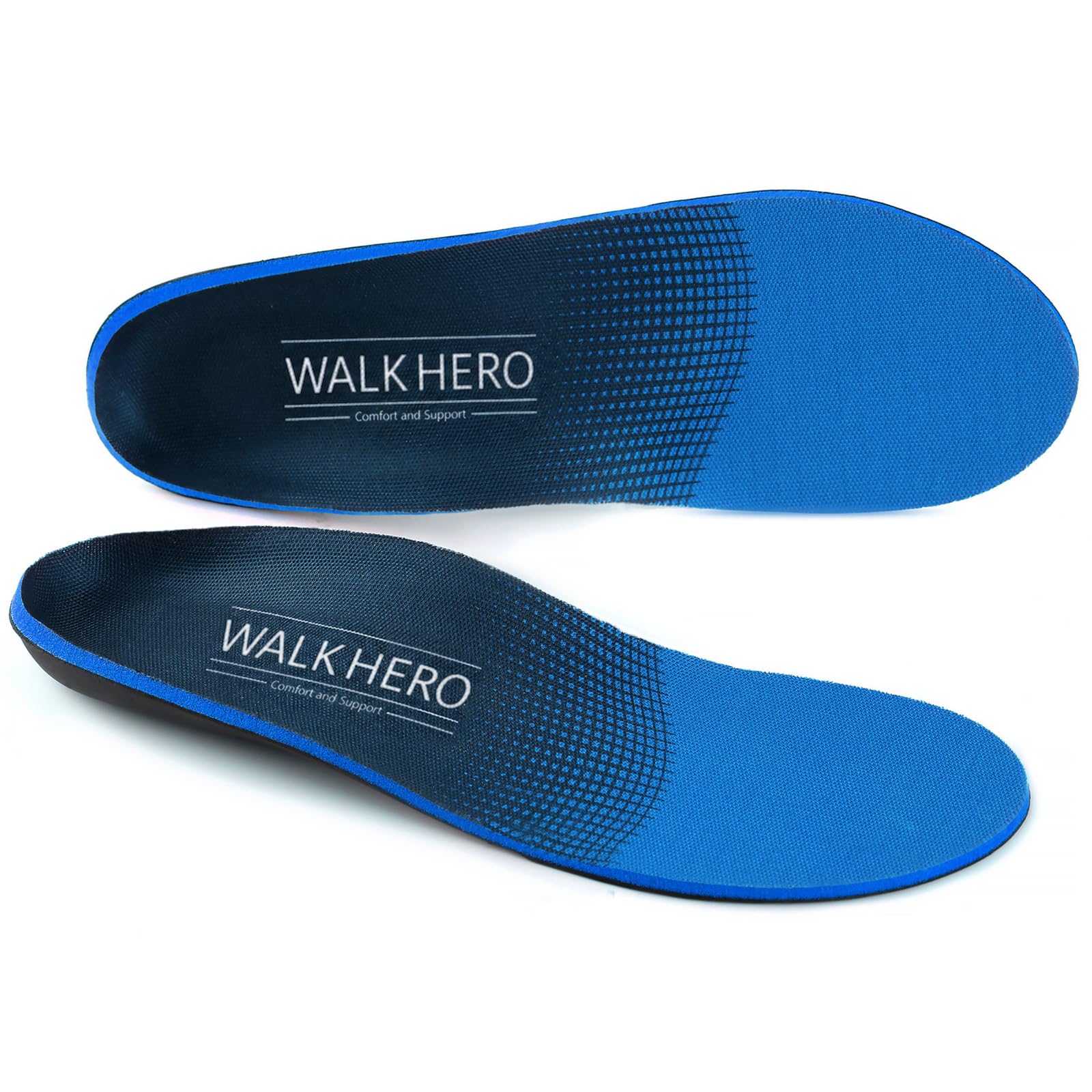
The crowd favorite that turns soft, unsupportive sneakers into shoes you can stand in all day.
What walks in the door with the WalkHero is volume of experience: this is the most-reviewed pick here by far, and the pattern is consistent. Built for wider, high-volume shoes like work boots, basketball shoes, running shoes, and casual shoes, it gives moderate control and support — exactly the right level for a foot that rolls inward a little rather than severely. A deep heel cup holds the foot centered to stabilize each step and protect the heel on landing.
Buyers keep coming back for arch support that feels like real support, not just a soft pillow. It fits people at both ends of the spectrum — from a 200-pound active walker who logs two to three miles a day to bigger users who need a durable shell. The precise sizing and no-trim fit (you order your exact size, so nothing needs cutting) keep it from sliding, which owners describe as a “feel like new shoes” upgrade in worn sneakers.
The recurring complaint is the flip side of that support: several people find the shell too hard, especially at first. That firmness is what controls the roll, so read it as a fit statement rather than a flaw. It suits you if you want a firm arch and a deep cup, and grates if you prefer a plush, springy feel. The premium EVA material (a dense foam that springs back instead of flattening) shrugs off compression and keeps you cool, which is why it holds up so well for everyday work and walking.
What Earns The Hype
- Moderate arch support with a deep heel cup that keeps a mild pronating foot centered and steady
- Premium EVA build for shock absorption and reduced foot fatigue on long days
- Accurate sizing with no trimming needed in most shoes
Read Before You Buy
- The shell is firm and several wearers find it hard underfoot at first
- Best for wider, roomier shoes — it can crowd tighter silhouettes
Best all-rounder: for a mild rolling foot in sneakers or work boots, this is the low-risk everyday support that most people will be happy with.
Pass if: you want a plush, cushioned feel rather than a firm arch underfoot.
5. VALSOLE Heavy Duty Support Pain Relief Orthotics – 220+ lbs

A rigid heavy-duty platform built to stop a rolling arch from caving under extra weight.
When you carry extra weight, every step presses harder on a collapsing arch, and the VALSOLE is built around that specifically. A hard, rigid TPU support plate (a stiff plastic shell) props the arch up and refuses to bow under pressure. A thick ortholite and velvet layer adds cushion on top, while a PU heel pad (polyurethane foam) absorbs the shock of each landing. The deep heel cup cradles the foot to keep it vertical and balanced, which is where the pronation control really comes from.
What buyers report most is comfort and genuine pain relief, and the stories run the gamut. A retail owner on their feet 70 hours a week reports near-zero pain after years of flare-ups. A 175-pound worker covering 20,000 steps a day says the firm arch and heel cushioning keep 12-hour shifts manageable. Festival-goers moshed for four days without complaint. The support handles all arch types, and it slots into casual shoes, sneakers, and wide work boots.
The honest limits: this is a heavy-duty insert, and firmness plus fit are the two things the mixed feedback centers on — some find it too big for tighter shoes and too hard for softer tastes. It is explicitly not suited to formal or leather shoes with a strong wrap, and it asks for a 2–3 hour daily break-in at the start. That said, for someone over 220 pounds chasing real stability, few things here are built this sturdily.
Built for the heavy-footed: a rigid TPU arch and shock-guard heel give the load-bearing stability that lighter insoles cannot hold up under.
Know the fit: size says true but the volume is thick, so it favors roomy shoes and needs a gradual break-in.
Made for you if: you are over 220 pounds and need an arch that will not collapse through a long day on your feet.
Choose something thinner if: you wear slim dress shoes or prefer a soft, cushioned step.
6. Work Boot Orthotic Insoles for Standing All Day, 240+ lbs High Arch Support
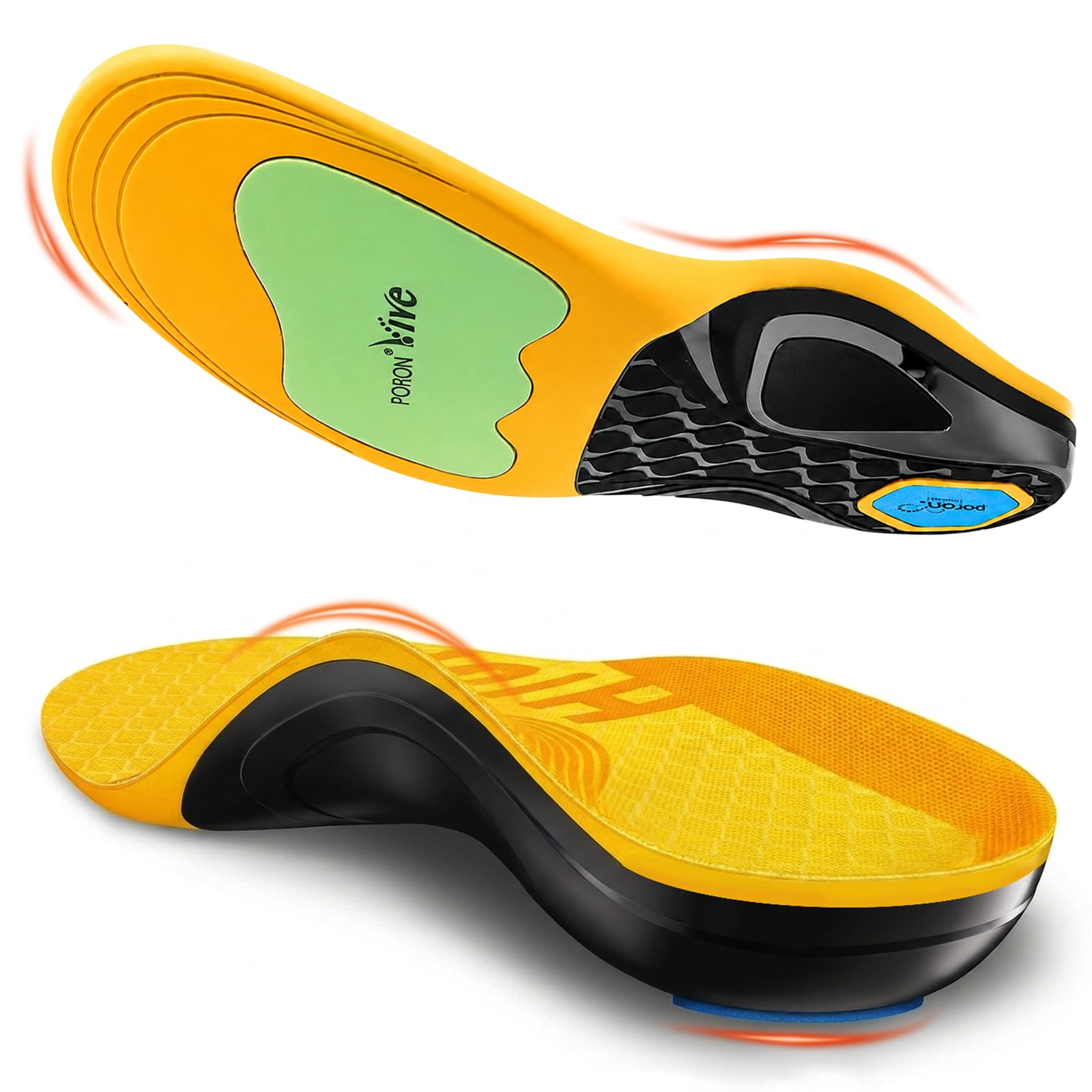
A concrete-floor specialist that holds a firm 1 3/8-inch arch through a full overtime shift.
The spec that defines this one is the rigid TPU plate delivering a firm 1 3/8-inch lift — a high, hard arch that will not flatten the way standard insoles do under hours of standing. Two Poron layers split the shock job: PORON COMFORT under the heel absorbs heel-strike impact, while PORON VIVE in the forefoot springs energy back on push-off. The deep U-shaped heel cup stabilizes every step, and the slim forefoot is shaped to slip into steel-toes without crowding the toe box.
For a warehouse or kitchen worker logging ten-hour shifts on concrete, those details are the daily difference. The broader effect of that support — better foot alignment — reaches into overpronation, flat feet, achilles tendonitis, and everyday heel pain. It comes in five sizes covering Men 5–12 and Women 6–12, and the trim-to-fit setup lets you trace your factory insole and cut along the pre-marked line for a factory-tight result.
The one caveat is the fit routine: because it is trim-to-fit, you have to size it yourself, and the insole sits thick, so it wants roomy shoes. An occasional order arrives in the wrong size, so confirm which size you got before cutting. In the right pair of steel-toes or running sneakers, the firm support and the shock-absorbing heel land as advertised.
Its job to a T: absorb the beating that hard floors hand your knees and lower back, shift after shift.
Worth noting: the insert squeaks on hard floors and adds a little height, so keep it in roomy footwear.
Buy it if: you stand all day on hard flooring and want a firm arch with heel and forefoot cushioning.
Look past it if: you would rather not trim an insole to fit, or need a paper-thin insert for dress shoes.
7. Protalus T100 Thin Series – Patented Stress Relief Premium Shoe Inserts

A thin, low-profile insert that fights pronation inside shoes a bulky orthotic would ruin.
Most pronation insoles are thick and chunky; the T100 is the opposite, a Thin Series insert slim enough for running shoes, dress shoes, oxfords, and casuals like Vans, Nike Free’s, and Sperry shoes. It attacks the rolling problem from a different angle, using a patented Tri-Planar support system that uses counter forces to align the ankle with the heel and reduce the unsafe side-to-side motion behind overpronation and oversupination. The T100 is a full-length insert for men at 4.8 ounces.
What buyers value is quality and daily comfort that holds up — these inserts are built to last, and they outlast the cheaper drugstore inserts that wear out and flatten. They are also the achilles-tendinitis pick in this group: one frequent player found them more effective than ankle wraps, braces, and double socks for that flare-up. In standard-fit shoes they tuck in without crowding the foot.
The catch is that thin means less arch volume. This is alignment support, not a high, hard arch shelf, so a foot that needs a big rigid prop may want a beefier insert from this list instead. And it is a premium pick — priced for its durability and materials — but the value shows up over the long run because you are not replacing it every few months.
The Thin-Shoe Advantage
- Low enough to fit dress shoes, oxfords, and standard sneakers that choke on bulky inserts
- Patented Tri-Planar system aligned to the ankle and heel for pronation and supination control
- Built to last far longer than cheap inserts
The Trade-off
- Thin profile means a lower, less aggressive arch than a rigid orthotic
- Premium cost reflects the materials and lifespan
Ideal for: anyone who needs alignment help inside dress or slim shoes without bulking them out.
Not for you if: your arch needs a tall, rigid shelf rather than a discreet alignment layer.
8. Spenco Total Support Max Shoe Insoles – Orthotic Metatarsal Arch Support
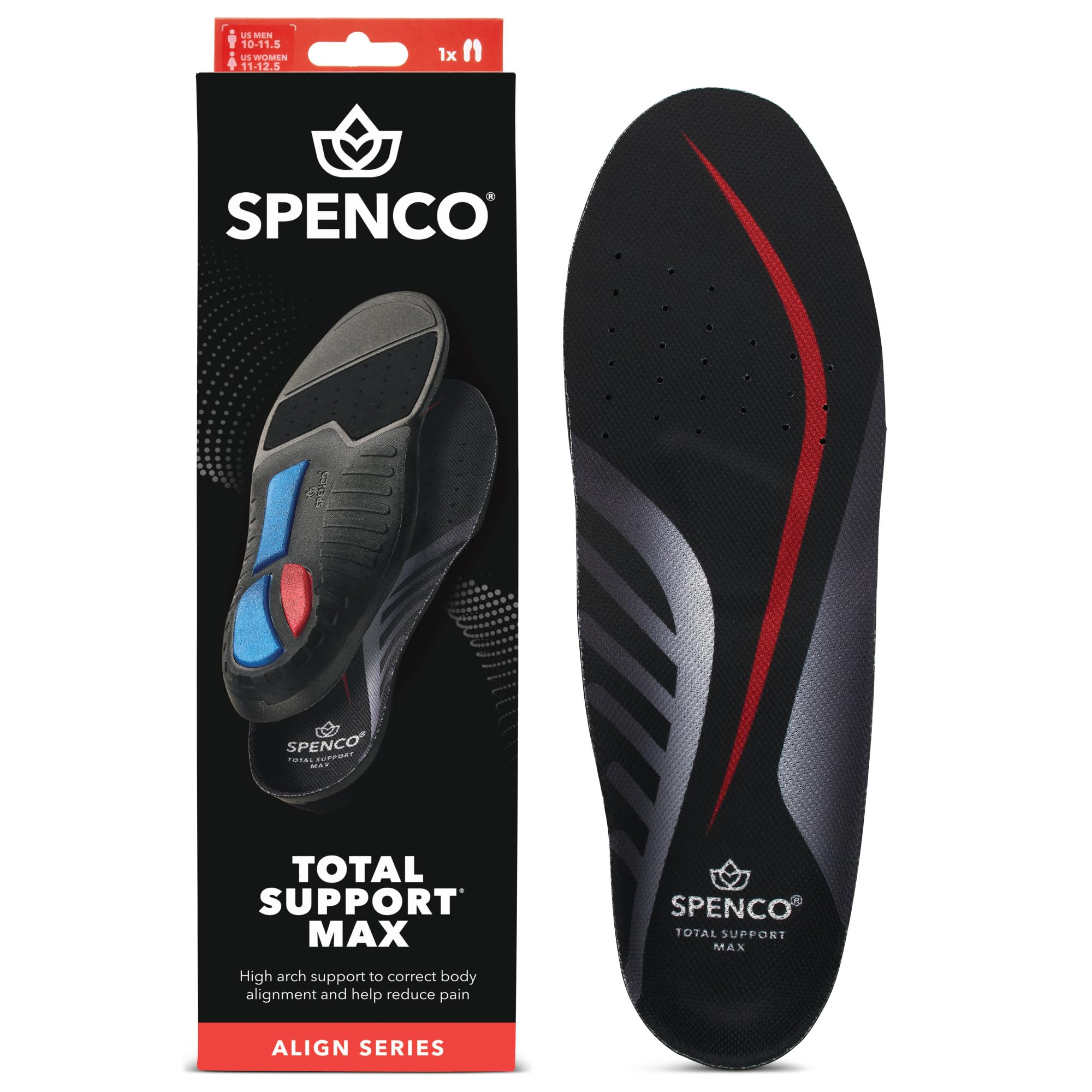
A firm, multi-density orthotic that slows an overpronating foot and cushions the ball of it.
The Spenco Total Support Max is aimed straight at overpronation (when your foot rolls inward too far with each step), and its multi-density build is how it does it. A stiffer support pod works to slow the inward roll, while softer cushioning pods absorb impact at footstrike for a smoother, more controlled step. A firm contoured arch cradles high arches, and the deep heel cup keeps the foot centered. It carries the APMA Seal of Acceptance, and a big-toe cutout is designed to promote natural arch engagement. A metatarsal pad takes pressure off the ball of the foot — a spot many pronation inserts ignore.
For high arches paired with a rolling foot, that combination hits a balance. Owners with severe overpronation and flat feet report better stability and comfort than the custom orthotics they had paid far more for, with a rigid arch that holds its shape and a deep, cushioned heel cup. The ventilation channels and antimicrobial top cover (treated to resist odor-causing microbes) manage heat and moisture, so it stays fresher than a solid shell.
The honest friction points are break-in and placement. The arch runs firm, and a few wearers describe the first days as stepping on rocks before it softens in; it can also squeak until it wears in. One narrow-footed buyer found the arch sat slightly too far back for their foot, which is a sizing-alignment issue rather than a quality one — if that happens, a size or two down may align better. It uses a sized design to minimize trimming.
The high-arch match: a firm contoured cradle that will not collapse, plus a metatarsal pad and a deep heel cup for control.
The reality check: it is stiff from the start and wants a break-in period before it settles under your foot.
Pick this if: you have high arches, overpronate, and want firm multidensity support with forefoot cushioning.
Look elsewhere if: you have a small, narrow foot that needs a lower, gentler arch curve.
9. PowerStep Pinnacle Maxx Orthotic Insoles, Maximum Stability & Comfort

The stability flagship: a firmer shell and an angled heel tuned to stop a hard-pronating foot cold.
Step up from the standard Pinnacle and you get the Maxx — a firmer shell and a firmer arch than the classic, with a squared heel design that sits flat in the shoe and refuses to roll to either side. The feature that earns the “maximum stability” name is the 2-degree medial post (a built-in inward tilt on the inner side), which reinforces foot control and positioning, paired with a deeper heel cup. A 100 percent polyester top fabric keeps the foot comfortable and dry, and a double-layer shock-absorbing EVA base with variable cushioning provides soft, controlled cushioning over the firm base. It swaps between casual, athletic, dress, and work shoes with no trimming required, and it is made in the USA.
For a foot that rolls inward hard, the extra firmness and the medial post are the point — they correct the position instead of just cushioning it. Users range from a size 14 wearer supporting 300+ pounds, where the strong arch held up, to a son whose prescription orthotics were too hard to wear and who found these eased his overpronation and flat feet through double shifts. A foot and ankle surgeon recommended them for tendonitis, and the wearer found relief within a week.
The trade-off is that the Maxx is not a subtle insole: at a heavy 5.29 ounces with a firm, structured feel, it is more insole than some feet want. A handful of wearers over the long run found the arch too firm or not tall enough for their specific foot and swapped to a different structure — so if your arch needs an extreme height, check that the “high arch version” is not the better match for you. For everyone else, this is the closest thing here to a stability orthotic.
Why It’s The Stability Leader
- 2-degree medial post and squared heel reinforce control for a hard-pronating foot
- Firmer shell and arch than the standard Pinnacle for more position correction
- Transfers between shoe types with no trimming and a dry polyester top
Honest Limits
- Firm, structured build feels like a lot of insole if you want soft cushioning
- Not the tallest arch option — very high arches may need the high-arch version
The stability choice: for a hard-rolling foot that needs position correction, not just cushioning, this is the most controlling pick on the list.
Think twice if: you prefer a soft, low-profile feel or need an ultra-tall arch.
Understanding the Specs
Arch Height And Firmness
Arch height is how high the support shelf rises under your instep, and firmness is how rigid that shelf is. A high, firm arch is what controls pronation, because it props the foot up instead of letting it collapse inward. Too high and you feel pressure; too low and you still roll. Firm shells often need a short break-in, but they keep working long after a soft foam insert would have flattened.
Heel Cup And Medial Post
The heel cup is the U-shaped pocket that cradles your heel and keeps it from sliding side to side, which is half of what stops an inward roll. A medial post is a small inward tilt built into the arch side of the insole — it actively guides the foot toward a neutral position. Both features appear across several picks here, and both make the biggest difference for a foot that rolls hard.
FAQ
What is an insole for pronation and how does it work?
Are firm insoles better than soft ones for overpronation?
Will these insoles fit my sneakers or work boots?
How long does it take to get used to pronation insoles?
Do I need a high arch or a medium arch insert?
Can a thin insole still help with pronation?
Should I replace my shoe’s original insole or stack on top?
Which insert is best if I am heavier or stand all day?
Do I need to trim these insoles to fit my shoes?
How long do pronation insoles usually last?
Final Thoughts: The Verdict
For most people dealing with a rolling, inward-collapsing foot, the PowerStep Pinnacle is the safest bet — a proven firm arch, a deep heel cup, and a sized no-trim fit that holds up in sneakers, walking shoes, and work boots. If you have flat or fallen arches and want a light, compact insert you can move between pairs, the Dr. Foot 3/4 Orthotics is the one to reach for. And if you need maximum stability to correct hard overpronation, step up to the PowerStep Pinnacle Maxx with its 2-degree medial post. Any of these three will start holding your arch up from the first walk, so pick the one that matches your foot and your shoes, and give it a few days to break in.
How We Picked
We do not accept paid placement. Every pick is matched to a real buyer and a real use-case; we do not hands-on test units.
Sources & Methodology
Specifications: manufacturer listings and product documentation. Review insights: verified customer reviews, as of September 2026. Pricing: not shown on this page (it changes often); check the current price via the retailer link.
As an Amazon Associate, Gadgets Feed earns from qualifying purchases. This does not affect which products we feature.