
Our readers keep the lights on and my morning glass full of iced black tea. As an Amazon Associate, I earn from qualifying purchases.
Specs are compiled from manufacturer listings and verified buyer reviews and can change over time — please confirm the key details on the product page before buying.
A home camera setup is only worth it if it catches the thing that actually happens — the package lifted off your porch, the car door tried at 2 a.m., the person at the gate who should not be there. This guide sorts the strongest camera surveillance systems for that job: which ones record around the clock without a monthly bill, which ones run entirely on solar, and which ones hold up when the temperature drops below freezing.
I’m Min — the founder and writer behind Gadgets Feed. This guide is built by comparing the manufacturers’ published specifications and the patterns across verified customer reviews, so you get each pick’s real strengths and trade-offs instead of marketing spin.
The list is stacked with mid-range and premium systems first, so you can weigh coverage, resolution, and storage against one another before you commit. Here is the best camera surveillance system for every home layout and budget, sorted by camera count and if you want a cable or a battery running the show.
Our Picks at a Glance

How To Choose The Best Camera Surveillance System
Start with the number one question: how will each camera get its power and carry its video? That single decision decides your whole install, your maintenance routine, and whether you ever see a bill. Everything else — resolution, night vision, storage — follows from there.
Wired PoE versus battery and solar
A PoE (Power over Ethernet) camera runs on one cable that delivers both electricity and a wired video signal. That means no battery to swap and no Wi-Fi dropouts, because the signal never has to fly through the air. The trade-off is that you must route ethernet cable to every camera, which usually means attic or crawlspace work.
Battery and solar cameras skip the cable entirely. A solar panel keeps the battery topped up on an outdoor mount, so you rarely touch it. The catch is placement: a panel in shade may not keep up, and a wireless signal weakens with distance and thick walls.
Resolution, night vision, and storage
More megapixels means more fine detail — enough to make out a face or a plate rather than just a shape. The 4K kits here use 8MP sensors for the sharpest recordings, while 1080p and 2K systems suit tighter budgets and smaller yards. Night vision comes in two flavors: infrared for black-and-white in total darkness, and a spotlight or sensor-based mode for color after dark.
For storage, most wired systems ship with a built-in hard drive that records around the clock with no subscription. Wireless kits often lean on a microSD card or a home base instead. Circle the option that keeps your footage on your own shelf if you would rather not pay monthly.
Quick Comparison
| Model | Best For | Wiring | Resolution | Storage Included | Amazon |
|---|---|---|---|---|---|
| Blink Video Doorbell + Outdoor 4 — 5 camera system★ Best Overall | Wire-free whole-home kit | Battery / wireless | 1080p HD | Cloud trial; local via Sync Module | Amazon |
| eufy Security eufyCam C35 — 4-Cam KitNo-Fee Favorite | No-fee wireless coverage | Battery / wireless | Color night vision | HomeBase Mini, expandable to 1TB | Amazon |
| eufy Security SoloCam E30 — 4-Cam KitSolar Standout | Solar, set-and-forget | Solar / wireless | 2K | microSD up to 128GB | Amazon |
| Blink Outdoor 2K+ — 5 camera system | Sharper cheap wireless | Battery / wireless | 2K | Cloud sub; local via Sync Module | Amazon |
| ANNKE 16 Channel 5MP PoE — 2TB HDD | Wired value on a budget | Wired PoE | 5MP (3K) | 2TB HDD | Amazon |
| aosu D1 Max — 6-Cam Kit | Large yards, big coverage | Solar / wireless | 4K | 32GB, expandable to 1TB | Amazon |
| aosu T2 Ultra 4K — 6 Cam Kit | TrueColor night detail | Solar / wireless | 4K | 32GB, expandable to 1TB | Amazon |
| REOLINK 8CH 4K/8MP — RLK8-800B6 | Reliable wired 24/7 recording | Wired PoE | 4K (8MP) | 2TB HDD | Amazon |
| ANNKE 16 Channel 4K PoE — 4TB HDD | 4K wired with room to grow | Wired PoE | 4K (8MP) | 4TB HDD | Amazon |
| REOLINK 16CH 12MP PoE — RLK16-1200D8-A | Highest resolution wired | Wired PoE | 12MP | 4TB HDD | Amazon |
| ONWOTE 16 Channel 4K PoE — 16 Cameras | Commercial-scale coverage | Wired PoE | 4K (8MP) | 4TB HDD, 20TB max | Amazon |
In‑Depth Reviews
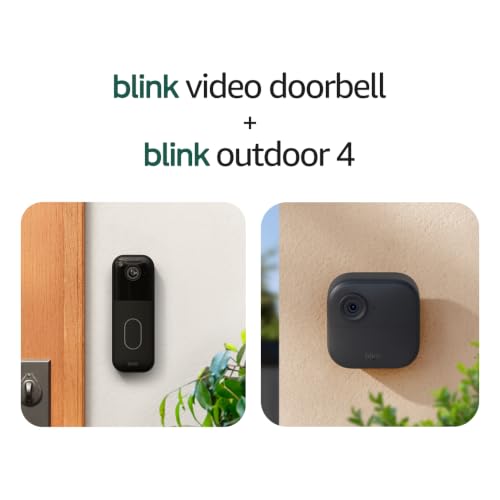
1. Blink Video Doorbell + Outdoor 4 — 5 camera system
Our pick — 4.5★ from 350+ verified ratings; the strongest balance of quality and price.
Five outdoor cameras plus a doorbell that still have power two years from the day you mount them.
If you want the whole property covered without threading a single cable through a wall, this is the package to beat. Blink pairs a second-generation Video Doorbell with five Outdoor 4 cameras and a Sync Module Core, and the headline promise is bold: up to two years of battery life on both device types, running on the AA Energizer lithium batteries in the box. Buyers report a 6-device setup finishing in 34 minutes flat, which is about how long it takes to unbox a wired system’s cabling. Once it is live, the Sync Module Core quietly changes the math — it enables local USB storage, so you are not handcuffed to a cloud plan for every clip.
What wins people over here is visibility. The doorbell captures a head-to-toe view, so you see the whole person and the parcel at their feet in one frame, while the Outdoor 4 adds a wider field of view with dual-zone motion detection that fires faster than the last generation. Night work leans on infrared for black-and-white detail, and both devices carry two-way audio so you can speak before you open the app’s video pane. Owners mention it hooks straight into Alexa, and one sums the experience up plainly: “They are great, they hook up to you phone and Alexa.”
The honest catch is what happens when the trial ends. The camera quality and reliability aspects draw a genuinely mixed reception across the review pages, so plan on subscribing or otherwise managing your clips deliberately rather than assuming free unlimited cloud forever. That is a subscription cost, not a hardware flaw — and it is the trade for skipping the drill entirely.
battery Blink doorbell bundle
- Up to two years of battery on both the doorbell and Outdoor 4 cameras
- Head-to-toe doorbell view keeps the visitor and the parcel in one frame
- Sync Module Core allows local USB storage instead of paying for every clip
- Customers note stable performance — 34-minute six-device setup and three weeks without a dropout
subscription needed clips
- Best cloud features — person alerts and Blink Moments — need a paid Subscription Plan
- Battery cameras depend on a solid Wi-Fi path; walls and distance cut into range
- Camera quality and reliability land on the divided side across the wider review pool
renter friendly setup: you want a complete doorbell-plus-five-camera perimeter with zero wiring in an afternoon.
wired power preferred: you would rather own a hard drive that records everything for free forever.
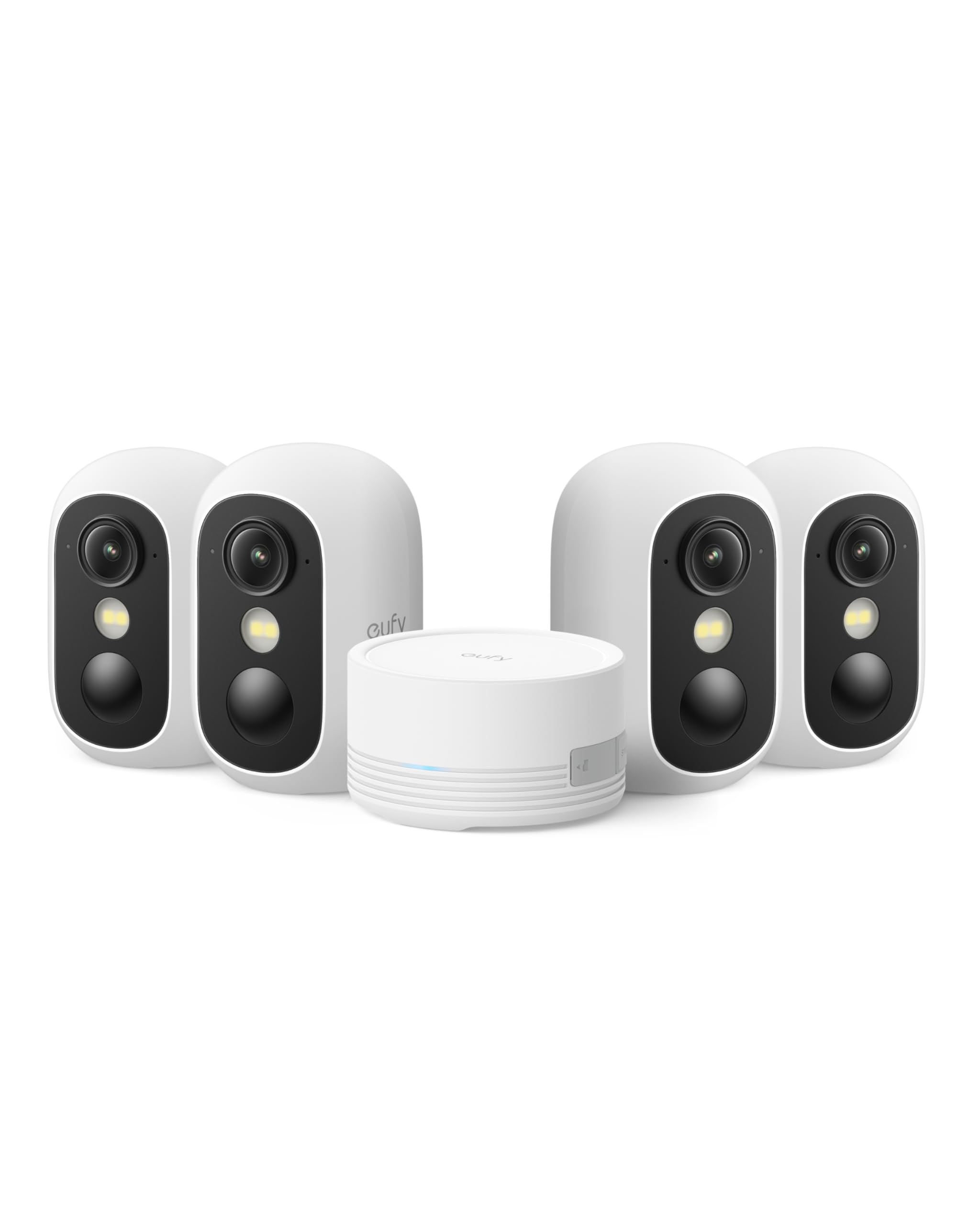
2. eufy Security eufyCam C35 — 4-Cam Kit
Four wireless cameras that show real color after dark and never send you a monthly bill.
The part that defines this kit is what it refuses to charge you for. The included HomeBase Mini open up facial recognition and cross-camera tracking on a one-time purchase — no mandatory subscription for cloud storage, no extra fee for the AI, and no battery replacement cost. Footage lives centrally on the HomeBase, expandable to 1TB, while each camera also carries its own microSD slot that accepts up to 256GB. No mandatory cloud fee plus expandable local storage is rare in a wireless kit, and it is the reason this lands near the top of the list.
Mounting is the other quiet win. Each camera sits on a strong magnetic base that snaps to a metal surface or rests flat — no drilling, and no damage to siding you may not want to touch. The sensor reveals faces and license plates in color without switching on a spotlight, so you get a clear read in the dark rather than a grainy black-and-white silhouette. Reliability shows up in the reviews too: one owner reports the batteries lasting three months with constant activity, and another notes the cameras running online over a month with no issue.
What should you watch for? Setup and quality are what this system is loved for, while connectivity is the one facet that splits opinion, so keep the base near your router. Note too that the camera will not work with HomeBase 2 if you already own older eufy gear — a compatibility detail worth checking before you buy.
local storage eufy kit: anyone who hates a recurring bill but still wants the smart stuff — facial recognition, cross-camera tracking, and a color night read — running on a one-time spend.
app setup quirks: match the number of cameras to your coverage goals, since the four here suit a yard and front entry rather than a sprawling property.
no monthly fees: the renter or first-time buyer who wants a no-fee wireless system that installs without drilling.
cloud storage wanted: your Wi-Fi path to the mounting spots is weak or you still rely on an older eufy home base.
3. eufy Security SoloCam E30 — 4-Cam Kit
Solar panels keep these 2K cameras charged, so the only thing you ever touch is the app.
Two hours of daily sun is all this kit asks for. Each of the four cameras arrives with a removable solar panel, and eufy’s SolarPlus charging keeps the battery topped up on an ongoing basis — which is what makes it the pick for anyone who cannot picture themselves climbing a ladder to swap batteries every few months. Owners in sunny states report the solar keeping the charge above 90%, and one buyer’s reasoning is hard to argue with: “Where I live I get plenty of sunlight so these are the best options with no monthly subscription.”
Coverage is where the 360-degree field of view does its work. The wide view minimizes blind spots, and built-in AI tracks people and vehicles as they cross the yard, sending an alert only when it matters. The 2K clarity holds up day and night, with an f/1.6 aperture lens pulling in more light for the darker hours. On capacity, 2K is a lighter lift than the 4K systems further down this list — enough detail for a porch, yard, or driveway, less than you would get from an 8MP sensor.
Recordings live on a microSD card up to 128GB with no subscription fee, keeping your footage private on your own card. Just size your expectations honestly: this setup leans on quality and easy, wire-free install as its strengths, and a handful of owners hit snags with occasional connectivity dropouts or a card that would not read. For most buyers those are one-offs, not a pattern — but if you need guaranteed 24/7 hard-drive recording, a wired kit will suit you better.
simple one cam: a sunny property where you want four self-charging cameras and no cable runs at all.
full coverage needed: your mounting spots sit in heavy shade or you need the detail only a higher-megapixel sensor delivers.
4. Blink Outdoor 2K+ — 5 camera system
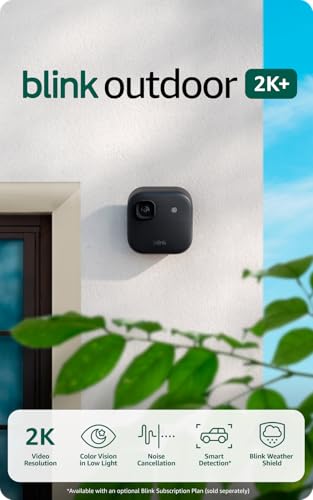
Blink’s sharpest wireless camera yet, pairing a battery life of up to two years with 2K detail and a 4x zoom.
If the last Blink system felt a little soft on detail, this generation answers with 2K video resolution on each of the five included Outdoor 2K+ cameras. That is the jump that matters for its kind — enough to catch subtle textures and defined edges that a 1080p sensor would smear. Buyers consistently single out video quality as the win, and one owner who runs eighteen cameras across multiple packs notes that a newer Blink setup feels more durable with a stronger Wi-Fi link than the original generation.
Two details earn this pick its place. The first is Color Vision in low light, which produces color footage using nothing but ambient light before switching to infrared black-and-white — so a passing car or a face stays readable without a floodlight flipping on. The second is a built-in 4x zoom, which lets you verify a package label or read a driveway plate from the same fixed mount. A weather-resistant IP-65 rating covers rain, dust, and severe weather, and the Sync Module Core is in the box.
Now the part you should genuinely plan around. Blink adds person and vehicle detection only with the optional Subscription Plan, and connectivity and battery life are where this system draws its pushback — owners describe connection fussiness, and a couple of units arrived that simply would not pair. Blink’s customer service did help resolve those cases with replacements, so it reads as a rough first attempt for a few buyers rather than a broken product. The lesson from the wider owner pool is simple: keep your Sync Module and router in open space.
2K Blink clarity: you are trading a small amount of setup patience for the crispest footage Blink offers plus that 4x zoom — a fair deal if you value the video above all else.
sync module required: this is the one system in the line where signal placement really matters, so map your router and module distance before you mount.
budget night vision: you want sharper-than-1080p footage and a two-year battery without moving to a wired kit.
local storage matters: you want every smart feature open up up front, since detection types need a paid plan.
5. ANNKE 16 Channel 5MP PoE — 2TB HDD
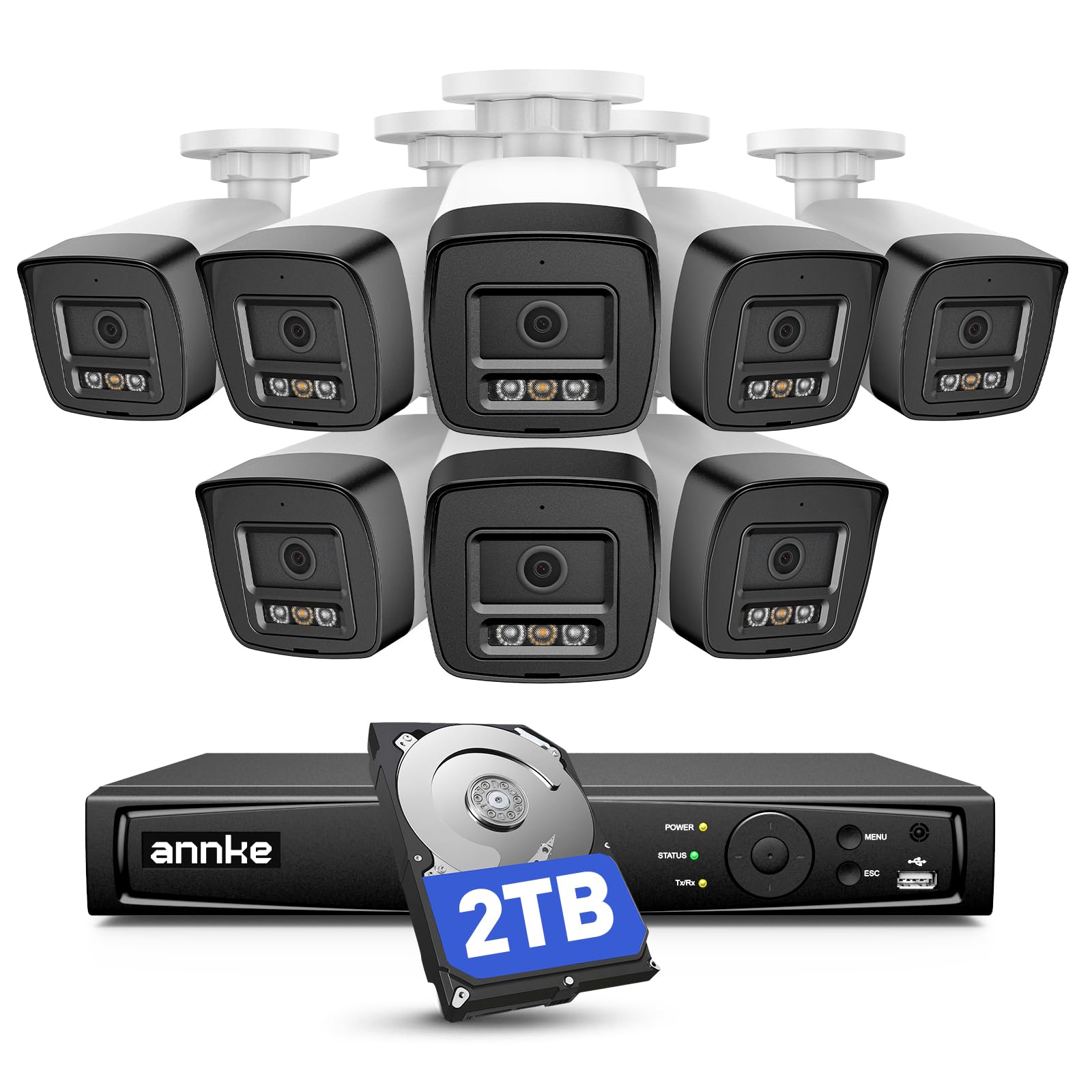
A wired PoE system that runs on a 2TB hard drive and skips the monthly bill entirely.
This is the entry ticket into a cable-powered, no-subscription setup. The NVR ships with a 2TB hard drive pre-installed and eight 5MP PoE cameras, which means every recording lands on storage you own rather than a cloud account. The 5MP sensor shoots at 3072×1728, and the 16:9 image scale fits a modern monitor better than the older 4:3 shape. If you already own a monitor or a spare TV, you get full local viewing with no fee stacked on top.
Where this system flexes is on the cameras themselves. The 2.8mm lens delivers a 123-degree diagonal field of view, which is a wide sweep that catches more of a driveway or a side gate without pointing a second camera at it. A 120dB wide dynamic range keeps footage from blowing out in a bright doorway while the shaded interior stays readable. The ultra-bright red and blue LEDs and a high-decibel siren round out the deterrent, and there is a clever extra: you can record a custom warning in your own voice so an intruder hears a real person rather than a beep.
Running all those cameras on cable is the honest trade. Install is praised as straightforward, and running the ethernet lines is the bulk of the work — no battery swaps, but also no skipping the wire run. A few owners found the desktop software clumsy and hit snags with cable compatibility, so budget a little patience for the initial wiring and the management menu. The 99% human and vehicle detection helps keep the alerts honest once it is set up.
16 channel PoE
- 2TB hard drive included, so 24/7 recording needs no ongoing subscription
- 123-degree diagonal field of view covers wide areas from a single mount
- Record a custom audio warning in your own voice for deterrence
- 120dB wide dynamic range handles tricky bright-and-shadow contrast
wired install work
- Wired install means routing ethernet to every camera
- Desktop software and menu navigation feel dated to some buyers
- Camera quality is the trade-off at this phase — 5MP here, not 4K
large home coverage: you want 24/7 hard-drive recording on a budget and are willing to run the cable.
rental no drilling: you need wireless placement or the finest 4K detail.
6. aosu D1 Max — 6-Cam Kit
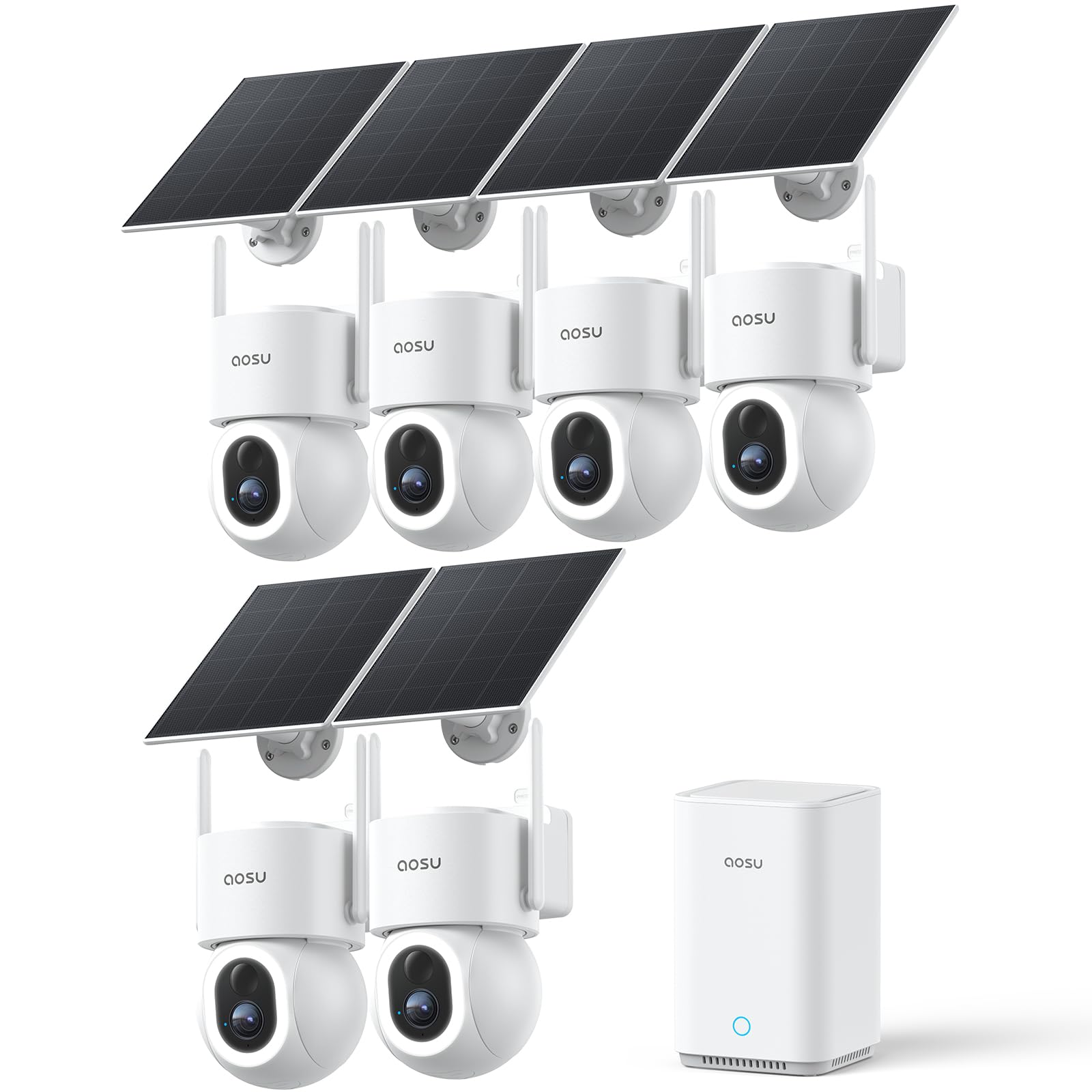
Six 4K cameras on solar, built for a property with more corners than a single camera can ever cover.
When your layout includes detached structures, multiple entry points, and blind spots that a fixed camera cannot reach, this six-camera kit is the answer. Each camera shoots 4K Ultra HD with an 8MP sensor and 6x digital zoom that can read a license plate from up to 33 feet away. The included aosuBase ties the whole group together, running cross-camera tracking so clips from separate cameras stitch into one continuous timeline instead of a scatter of separate alerts — which is exactly what you want when you are trying to piece together what actually happened.
Movement is the other standout. The pan-tilt design rotates to cover a wide outdoor area with fewer blind spots, then automatically follows people and vehicles in motion. Built-in spotlights turn on full-color night vision, while an infrared mode gives you discreet black-and-white when you prefer it. On power, the detached solar panels let you angle the panel for maximum sun even when the camera needs a different position. Reviewers point out the system working well over a hundred feet from base, so a large yard is in range.
Storage here is local with included 32GB, expandable to 1TB, and no subscription is required. The thing to know before you buy is that the app leans on the internet: the local storage is not accessible without a connection, so an ISP outage means no live or stored viewing until it returns. That is fine for a typical connected home, but a problem if you expect footage to stay viewable during an ISP outage. Reliability and battery life also split opinion across owners — one camera draining faster than the rest was the recurring note, usually solved by support sending a replacement.
whole yard watch: a large property that needs six solar cameras and cross-camera tracking under one base.
privacy first setup: you need footage viewable during an internet outage — this system wants a live connection.
7. aosu T2 Ultra 4K — 6 Cam Kit
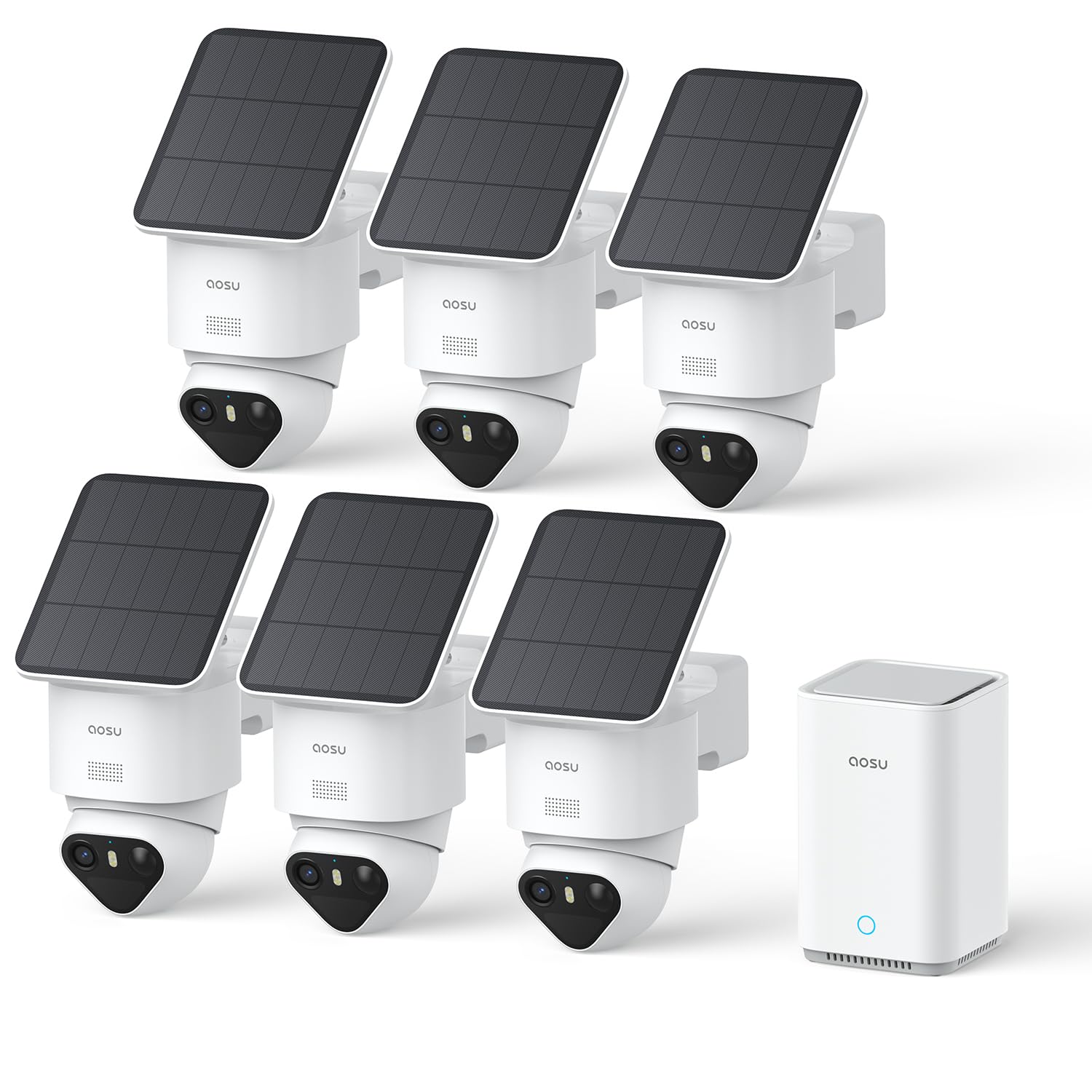
A solar 4K camera that keeps its color after dark, backed by a hefty 9200mAh battery.
The headline feature here is 4K TrueColor Night Vision — vivid color footage at night without floodlights, which is where most camera systems give up and switch to black-and-white. Each of the six cameras carries a 9200mAh battery paired with a detachable solar panel, so daily sunlight shoulders most of the charging work. Shoppers say the panel keeping the battery at a full charge even under eaves and on cloudy days, and the base handles the cameras regardless of whether your home Wi-Fi runs on 2.4GHz or 5GHz.
On coverage, the 360-degree pan-tilt dome moves to eliminate blind spots, then auto-tracks what it sees in real time. Triple AI detection sorts people from passing activity to cut false alerts. Multi-Camera Tracking folds footage from separate cameras into one complete clip, so a single alert shows an event from start to finish rather than making you scroll through scattered fragments. Storage stays local on 32GB built into the aosuBase, expandable up to 1TB, with no subscription required.
Two things are worth pricing in before you decide. Performance and motion detection draw mixed notes — one owner found motion tracking over-sensitive to bugs and cars — and a handful of complaints point to the app leaning on upsells for cloud and hardware. There is also a compatibility caveat: the T2 and its home base do not work with older aosu models, which limits cross-camera tracking if you already own the previous generation.
4K aosu detail: color detail after dark is the reason to pick this over a standard infrared system — faces and plates stay readable in the frame.
pricey six pack: if you are upgrading from older aosu gear, the new base may not talk to what you own, so check before building the system out.
sharp license plates: a buyer who wants the clearest color night footage and solar charging across six cameras.
budget tight now: you need backward compatibility with an older aosu home base or find false triggers over-sensitive.
8. REOLINK 8CH 4K/8MP — RLK8-800B6
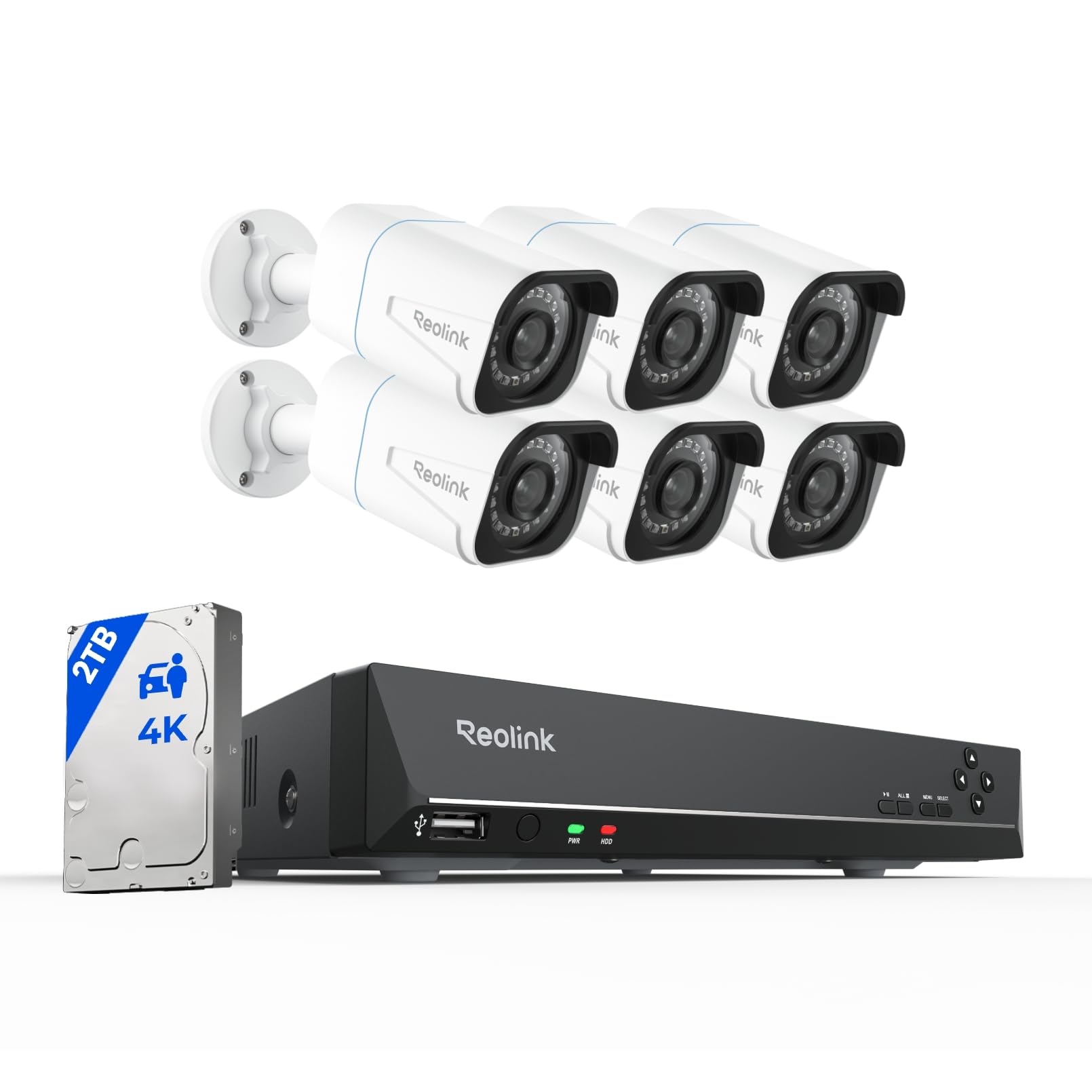
The wired system that records around the clock on its own drive and asks for nothing monthly.
This is the kit for the buyer who wants footage that never depends on Wi-Fi, and it delivers on that promise. The six B800 PoE cameras record real-time 4K Ultra HD footage at 3840 x 2160, wired straight to an 8CH NVR with a 2TB hard drive pre-installed. That combination means 24/7 continuous recording with your own storage, no subscription, and a signal that does not thin out when the network gets busy. The 18 infrared LEDs reach up to 100 feet in darkness, and advanced 3D-DNR noise reduction keeps those late-night frames from turning to mush.
The system also thinks a little before it alerts. Smart person, vehicle, and animal detection reads the shape of what is moving so an animal or a shadow does not fire off a false alarm. Setup is genuinely quick once the cable is run — connect the cameras to the NVR with ethernet, add the device in the free Reolink app, and you are watching live. Owners repeatedly call the daylight 4K image impressive, with one noting clarity up to thirty feet and a plate readable from that same distance.
The caveat sits in reliability and night vision, both of which land on the divided side across the wider owner pool. Some cameras failed within the first couple of weeks, and night detail drops beyond close range — a limitation of even good IR when there is no light at all. Reolink backs the product with a two-year warranty, and the pre-installed drive takes 5 cameras at 4K with audio for roughly six and a half days before it begins overwriting, so plan a bigger drive if you want a longer history.
Reolink 4K NVR
- 2TB hard drive pre-installed for continuous 24/7 recording without a subscription
- 4K resolution at 3840 x 2160 across six wired PoE cameras
- Infrared LEDs reach 100 feet, so a wide driveway stays covered after dark
- Person, vehicle, and animal detection cuts false alarms before they reach your phone
camera cable runs
- Rewiring is the bulk of the install — these are wired cameras, not drop-and-go
- Night clarity fades beyond close range where there is no ambient light
- Reliability draws a divided verdict, with some units failing early
diy poe setup: the buyer who wants wired 4K footage and a built-in drive, paying nothing monthly.
wireless only home: you want to see fine detail at long range in total darkness or mount without running cable.
9. ANNKE 16 Channel 4K PoE — 4TB HDD
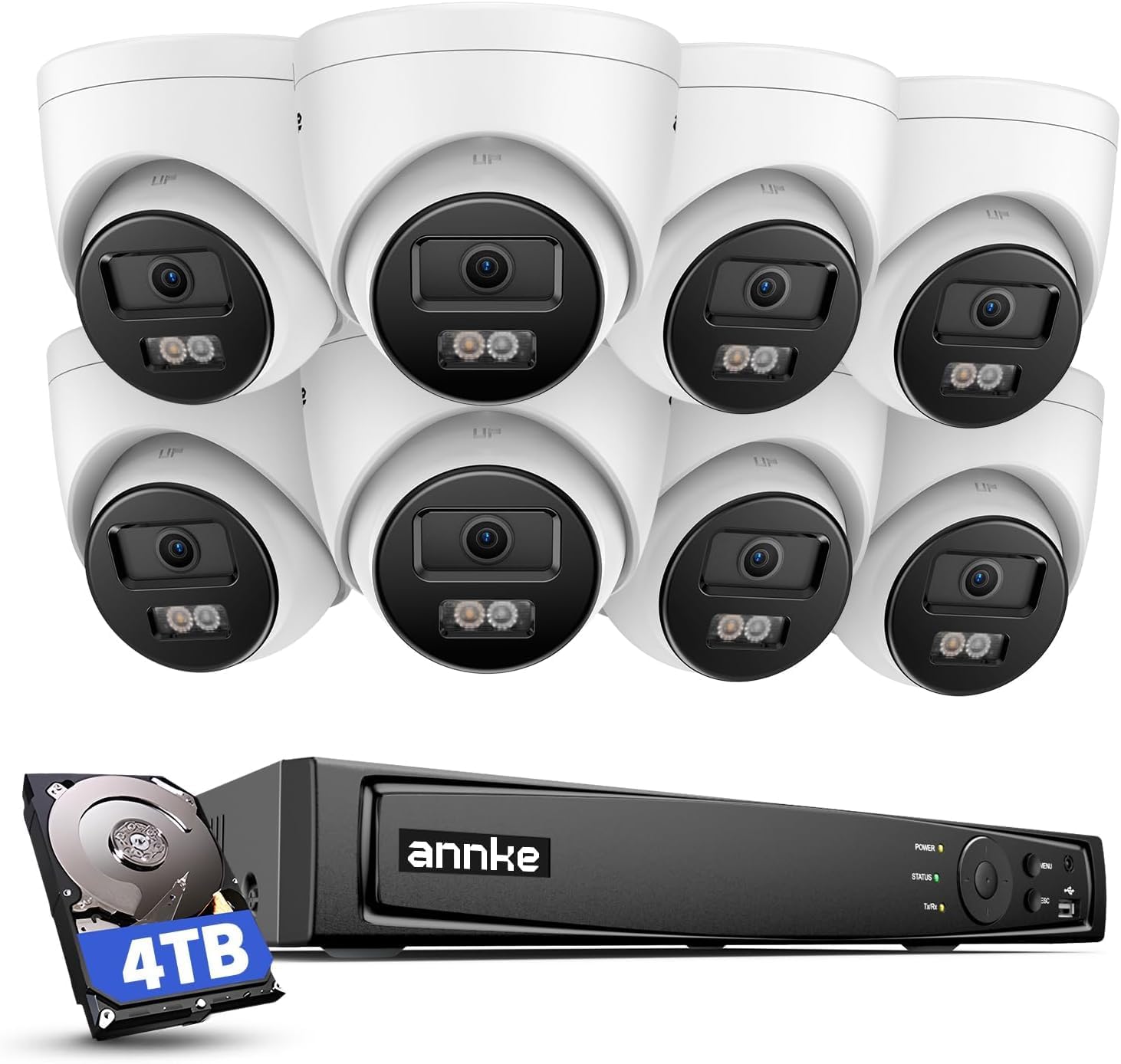
Eight 4K cameras and a 4TB drive that leaves the door open for eight more down the line.
This system is engineered for expansion, and that shapes everything about it. The 16-channel NVR ships with a 4TB hard drive and eight 8MP PoE cameras, with two SATA interfaces that each accept a drive up to 16TB total — so a small business or a carefully planned home can add cameras and storage without replacing the brain. The upgrade value shows in the record time: buyers report eight cameras recording at H.265+ for roughly 27 days on a 3TB drive, so 4TB stretches further still. The day-and-night footage runs at 3840 x 2160, and 120dB wide dynamic range keeps a sunlit doorway from washing out the shaded spots beside it.
The camera feature set earns this pick its place too. Each unit records audio through a built-in mic, so you get a voice with the video instead of a silent recording. Night vision runs in several selectable modes — standard black-and-white infrared, or a spotlight that switches the scene to vivid color. And there is a quiet setup advantage: poE combines power and data in a single cable, so one Cat5 line can feed a whole run rather than separate power and video wires.
The honest trade is in the interface, which splits opinion. Some owners find the app and desktop client straightforward, while others run into camera settings that reset through the client and prefer to configure everything on the NVR directly. Configuring on the NVR instead of the client is a workaround, not a dealbreaker — and the same owner pool consistently praises the image and install experience as the strong suits. Plan on a little patience for the menu and an appreciation for the expansion room.
long recording span: a home or small business that wants a 4K wired base ready to grow to more cameras and larger drives.
small apartment use: you want to do every camera setting from an app alone — this one rewards configuring on the recorder.
10. REOLINK 16CH 12MP PoE — RLK16-1200D8-A
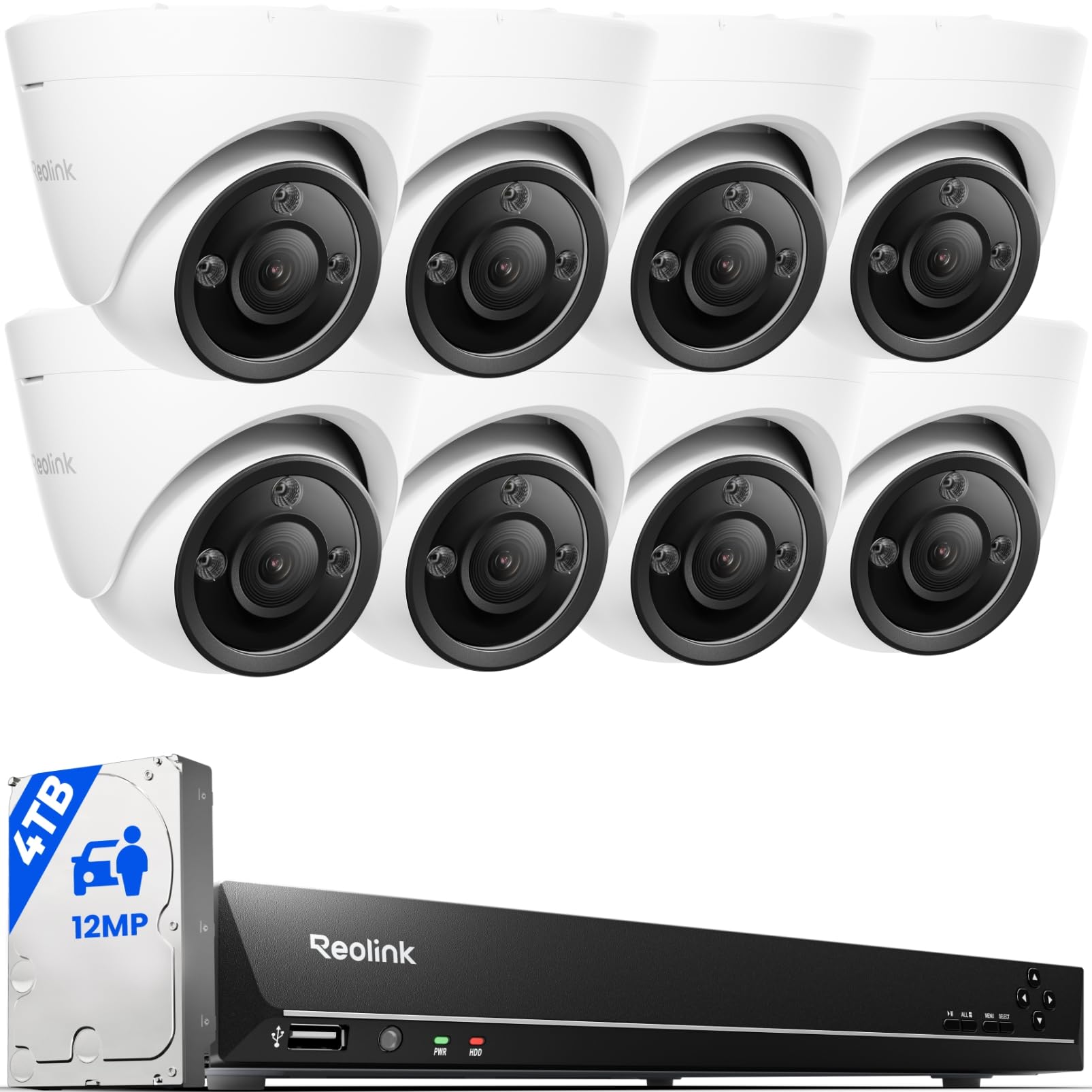
Eight 12MP cameras for the buyer who would rather zoom into detail than guess at a shape.
Twelve megapixels per camera is the number that defines this kit, and it is a clear step above the 8MP 4K systems elsewhere on this list — more pixels means finer detail captured in every frame, which is the difference between a blur and a readable plate. The eight D1200 PoE cameras run to a 16-channel NVR with a 4TB hard drive installed. On capacity, the recorder holds sixteen PoE ports and can be pushed to twenty-four channels if you add plug-in Wi-Fi cameras with the latest firmware, so the system outgrows a fixed eight-camera limit.
Night vision here is a full-color affair. A spotlight lets the 12MP cameras record in color after dark, and you can schedule it to run only during set hours and let infrared handle the rest — so no light wash for most of the night, color only when you want it. Two-way talk is built into every camera, giving you a speaker to speak with family members or greet a visitor from the app. Person, vehicle, and pet detection sorts motion by shape to keep the alerts honest, and buyers repeatedly praise the image clarity as the strong suit.
The recurring caveats are note up front. The cameras mount without lock screws, so a few owners wish they secured more firmly, and 24/7 recording across eight 12MP cameras fills a 4TB drive in about five days — that is the cost of the higher resolution. One owner also had a drive fail inside a year, though reliability as a whole draws a divided rather than negative verdict, and Reolink’s warranty replaced hardware promptly when it was needed.
12MP Reolink detail: twelve megapixels per camera is the most detail on this list, giving you the flexibility to zoom into a wide frame later and still pull a legible face or plate.
huge file sizes: higher resolution eats drive space faster, so build in a larger drive from the start if you want a full week-plus of history from all eight cameras.
wide area coverage: the buyer who values maximum detail per frame and wants a wired base with room to add more cameras.
slow internet plan: the drive fills faster at 12MP, so plan your storage size before you set recording to continuous.
11. ONWOTE 16 Channel 4K PoE — 16 Cameras
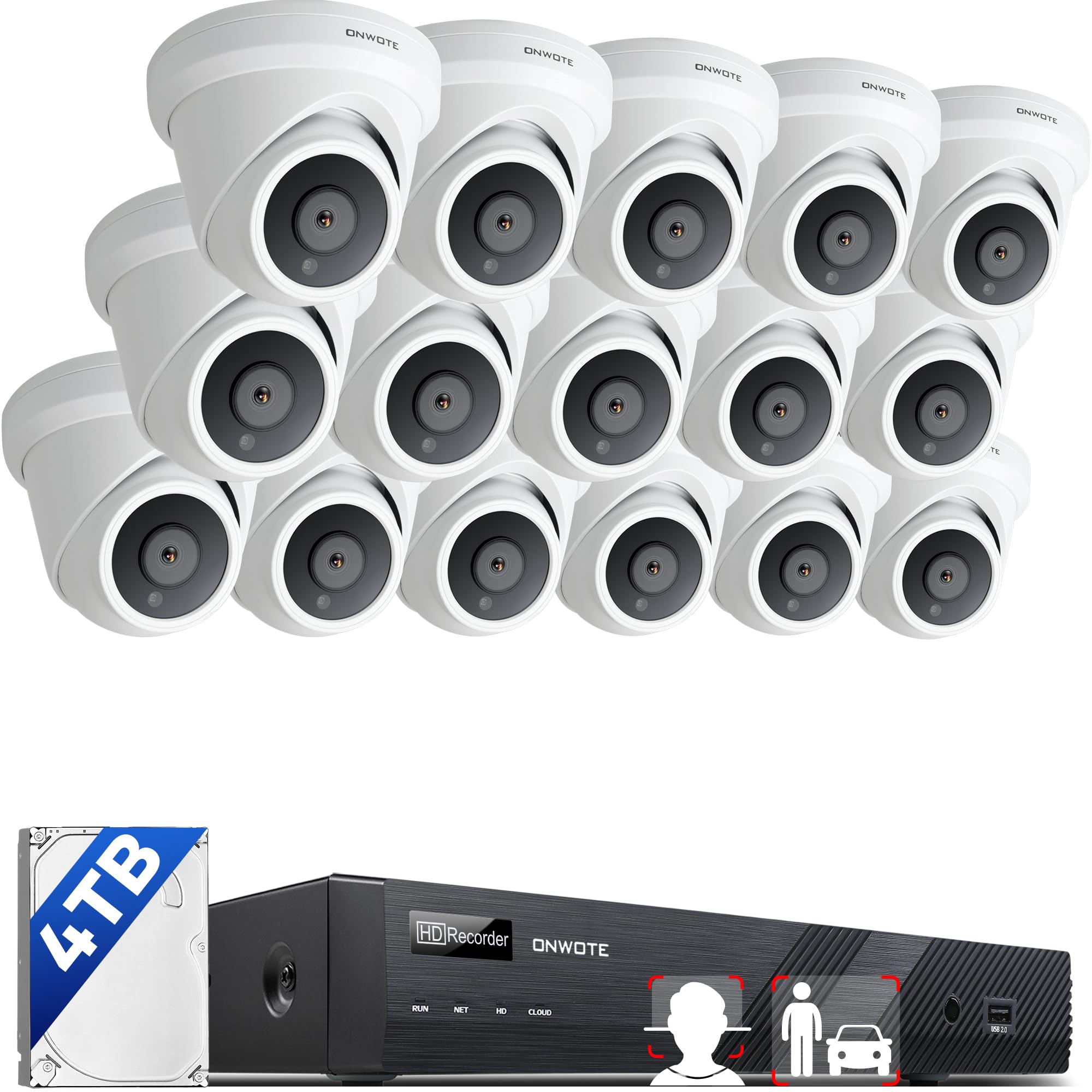
Sixteen 4K cameras on a single NVR — the pick for a business, a big property, or anyone covering serious ground.
Sixteen cameras on one recorder is the scale that defines this system, and it is built for a storefront, a warehouse, or a large multi-structure property. The 4K NVR carries a 4TB hard drive with room to 20TB, and every one of the sixteen 8MP cameras runs on PoE — power and video over one ethernet line, so cabling stays manageable even across a big footprint. Each camera shoots 4K with a 134-degree diagonal field of view, which catches a wide scene from a single mount. Owners mention zooming in on details hundreds of feet out.
The intelligence layer is the standout for a commercial setup. Facial recognition sorts known faces to cut false alarms and save storage, smart AI human and vehicle detection does the same for movement, and AcuSearch lets you locate a subject in footage quickly rather than scrubbing through hours of video. The 16-channel synchronous playback shows all sixteen feeds at once, and the cameras capture audio that the NVR records alongside the video. The IP66-rated metal housing stands up to weather, and customers note the phone and monitor image quality as outstanding.
The trade here is running sixteen cable runs — the labor scales with the camera count, so plan the install carefully. There is also a known issue from the owner pool: the 4TB drive gives roughly six days of continuous recording with all sixteen cameras at 4K, so a bigger drive is worth adding up front for a longer history. One older-system buyer also had several cameras fail after about a year of use, though ONWOTE sent replacements even outside warranty and the system has since run without issue.
commercial property fit: a business or large property that genuinely needs sixteen cameras, facial recognition, and fast footage search on one NVR.
home single user: sixteen PoE runs is real labor, and a 4TB drive fills in about six days at continuous 4K, so budget a larger drive.
Understanding the Specs
Resolution and megapixels
A camera’s megapixel count tells you how much fine detail each frame captures. More pixels means you can zoom into a recording and still make out a face or a plate; fewer pixels means the same shot turns to a blur once you crop in. The 4K systems here use 8MP sensors, one 12MP kit sits at the very top for detail, and 1080p to 2K options suit smaller yards and tighter budgets. Match the resolution to what you need to read — a full plate calls for more pixels than spotting a person at the door.
Wiring and power
How a camera gets power decides your wholeinstall routine. PoE, or Power over Ethernet, sends both electricity and the video signal down a single cable, so a wired camera never needs a battery and never suffers a Wi-Fi dropout — the trade is that you must run that cable to each mount. Battery and solar models skip the wiring entirely: a solar panel keeps the battery topped up on an outdoor camera, and you place it wherever the sun reaches. The wired route suits fixed, permanent coverage; the wire-free route suits renters and awkward mounting spots.
Storage and subscriptions
Where your footage lives decides whether you ever pay monthly. A system with a built-in hard drive, such as a 2TB or 4TB NVR, records continuously onto storage you own, with no recurring bill. Wireless kits often lean on a microSD card, a home base, or a cloud plan instead — and some of the smart features, like person and vehicle alerts, sit behind a paid subscription. If avoiding a monthly fee matters most to you, prioritize a kit with included local storage or an expandable card slot.
Night vision modes
Night vision comes in two main flavors, and knowing the difference keeps you from being disappointed. Infrared, or IR, illuminates a scene with light your eyes cannot see and records in black and white — good in total darkness, but you lose color. A spotlight or a sensor-based low-light mode keeps footage in color, but it needs some ambient light to work. Many systems let you schedule which mode runs when, so you get discreet IR for most of the night and color for the hours that matter most.
FAQ
Do I need a subscription to use a camera surveillance system?
How long does a wireless security camera battery actually last?
What does PoE mean and why does it matter for a security camera?
How much hard drive storage do I need for continuous recording?
Can a wired system work without an internet connection?
Is 4K worth it over 1080p or 2K?
Will a solar-powered security camera work in cloudy weather?
How many cameras do I need to cover a house perimeter?
Final Thoughts: The Verdict
For most homes, the camera surveillance system winner is the Blink Video Doorbell + Outdoor 4 kit because it covers a full property wire-free, promises up to two years of battery on both devices, and includes a Sync Module that allows local storage. If you want the cleanest no-fee wireless footage with color night vision, the eufy eufyCam C35 is the one to reach for. And for a business that needs sixteen 4K cameras, facial recognition, and fast footage search on one NVR, the ONWOTE 16 Channel PoE system earns the spend. Whichever you choose, match the camera count to your entry points and detached structures — the comparison table above lists each kit’s count, so buy the one that covers your layout without a camera to spare.
How We Picked
We do not accept paid placement. Every pick is matched to a real buyer and a real use-case; we do not hands-on test units.
Sources & Methodology
Specifications: manufacturer listings and product documentation. Review insights: verified customer reviews, as of September 2026. Pricing: not shown on this page (it changes often); check the current price via the retailer link.
As an Amazon Associate, Gadgets Feed earns from qualifying purchases. This does not affect which products we feature.