
Our readers keep the lights on and my morning glass full of iced black tea. As an Amazon Associate, I earn from qualifying purchases.
Specs are compiled from manufacturer listings and verified buyer reviews and can change over time — please confirm the key details on the product page before buying.
If your factory door speakers crackle, rattle, or simply give up once you turn the volume past halfway, the fastest fix is a proper pair of amp-friendly coaxials. The pick below the fold already has the confidence of a huge owner base — the Rockford Fosgate P1683 holds the top score here and the biggest review pool, which is why it keeps the pole position.
I’m Min — the founder and writer behind Gadgets Feed. This guide is built by comparing the manufacturers’ published specifications and the patterns across verified customer reviews, so you get each pick’s real strengths and trade-offs instead of marketing spin.
Every door speaker here was chosen for how it behaves once an amplifier is feeding it, and each entry spells out the power handling, driver size, and fit quirks you need before you buy. Every pick below lists its RMS rating, driver size, and mounting depth, so you can match a pair to your door opening and amplifier before you buy.
Our Picks at a Glance


How To Choose The Best Amp Door Speakers
Door speakers live a hard life. They sit low, they get rained on through an open window, and they fight road noise every single mile. A pair matched to your amp’s RMS output plays clean at high volume instead of crackling. Here is what to weigh before you click buy.
Start With Power Handling, Not Headline Watts
The number that matters is RMS — the continuous power a speaker can soak up all day without strain. The giant “max watts” figure on the box is a momentary peak and tells you very little. Match your speaker’s RMS range to what your amplifier reliably puts out, and you get clean, undistorted volume instead of crackle.
Impedance (the electrical load, measured in ohms) is the other half of that equation. A 4-ohm speaker draws more current from the same amp than an 8-ohm unit, so check your amplifier is stable at the load you are feeding it. Most car coaxials here run 4 ohms, with one 3-ohm option in the mix.
Fit Is Half The Battle
A speaker that does not drop into your door hole is useless, no matter how good it sounds. Measure your factory opening first — 6.5-inch and 6×9-inch are the two common door sizes, and a few vehicles take a smaller 3.5-inch dash unit instead. Mounting depth matters too, because a deep magnet can foul a window mechanism.
Sensitivity Decides How Loud You Get For Free
Sensitivity, measured in decibels (dB), tells you how much sound a speaker produces from one watt of power. A higher dB figure means more volume from the same amplifier, which is why an efficient pair can sound surprisingly loud even off a modest head unit. Pair high sensitivity with a clean amp and you rarely need to push anything hard.
Quick Comparison
| Model | Best For | Driver Size | RMS / Max Power | Impedance | Amazon |
|---|---|---|---|---|---|
| Rockford Fosgate P1683 Punch 6×8★ Best Overall | All-round door upgrade | 6 inches | 65W RMS / 130W Max | 4-Ohm | Amazon |
| RECOIL MS65-4P 6.5-Inch MidrangeBudget Champion | Budget loud midrange | 6.5 inches | 300W RMS / 600W Max | 4-Ohm | Amazon |
| BOSS Audio P65.4C 6.5 InchFour-Way Punch | Four-way low-cost punch | 6.54 inches | — / 400W Max | 4-Ohm | Amazon |
| Alpine SXE-6926S 6×9 | Easy 6×9 drop-in | 6×9 inches | 45W RMS / 280W Max | 4-Ohm | Amazon |
| KICKER DSC350 3.5-Inch | Tight dash locations | 3.5 inches | — | 4-Ohm | Amazon |
| CT Sounds BIO-6X9-COX | Balanced 6×9 on a head unit | 6.54 inches | 50W RMS / 100W Max | 4-Ohm | Amazon |
| ORION Cobalt CB65C 6.5″ | Component staging | 6.5 inches | 70W RMS / 280W Max | 4-Ohm | Amazon |
| PRV AUDIO RS69-CX 6×9 | Loud, efficient 6×9 | 6×9 inches | 100W RMS / 200W RMS pair | 4-Ohm | Amazon |
| JBL GTO629 6.5-Inch | Factory swap on big vehicles | 6.5 inches | 60W Rated / 180W Max | 3-Ohm | Amazon |
In‑Depth Reviews
1. Rockford Fosgate P1683 Punch 6×8 3-Way Coaxial Full Range Speakers (Pair)
Our pick — over 4.5★ from 9,500+ verified ratings; the strongest balance of quality and price.
The factory-swap pair that finally makes your door speakers worth amplifying
If you want a real upgrade from worn-out factory speakers without a complicated install, the Rockford Fosgate P1683 Punch 6×8 is the safest pick here. It is a 3-way full-range coaxial (a speaker with three separate drivers built into one frame) with a 6-inch driver, rated for 65 watts RMS (continuous power) and 130 watts peak (short bursts). It comes as a matched pair with mounting hardware and an OEM adapter plate (a bracket that lets it fit your car’s original cutout). That 65W RMS rating works well with many four-channel amps, so the speakers handle real power without the harshness cheap units show when you push them.
What wins people over is the sound: clarity is the runaway favourite here, and buyers describe crisp highs, clean lyrics, and bass punchy enough to rival a factory sub. The 3-way design keeps lows, mids, and highs separated, while the PEI dome tweeter runs through a built-in crossover so the top end stays accurate instead of tinny. Installation is the second thing owners bring up most — the FlexFit basket uses slots rather than fixed screw holes, so you can nudge the frame to line up with your factory holes.
The honest catch is fitment on specific trucks. Several buyers report the pair needs trimming to clear certain 2004 F150 club cab doors, and a few found the volume needs pushing higher than expected. A recurring theme on longevity shows up in the mix as well, so treat these as a solid mid-price set rather than a lifetime component. Compared with the Alpine SXE-6926S 6×9 below, this Fosgate handles more continuous power — 65 watts RMS against 45 watts RMS — while the BOSS P65.4C advertises a far bigger 400-watt peak against this model’s 130 watts.
Where It Earns Its Keep
- 65W RMS / 130W Max handling suits a typical four-channel amp
- 3-way design with PEI dome tweeter and built-in crossover
- FlexFit slotted basket eases alignment with factory holes
- Pair ships with mounting hardware and OEM adapter plate
- Full 1-year Rockford Fosgate warranty
What To Keep In Mind
- Some 2004 F150 club cab doors need trimming to fit
- Bass depth is limited without a separate sub
- Needs more volume than expected on some stock head units
Reach for these if: you want the most proven all-round door upgrade on this list, backed by the largest owner base of any pick here.
Think twice if: you drive a truck cab with a known tight door opening and would rather not trim anything.
2. RECOIL MS65-4P 6.5-Inch Midrange Pro Audio Car Speakers Door Speakers
Six-hundred watts of midrange muscle that lives on the doorstep of a budget build
If your priority is sheer output from a door location without spending premium money, this 6.5-inch midrange coaxials pair is the one to shortlist. The headline spec is the power figure: 300 watts RMS and 600 watts peak as a pair at 4 ohms. That dwarfs the 65W RMS the Fosgate above manages, and it is the reason these hold up under a bridged amp. A 1.5-inch high-temperature Kapton voice coil is what lets them survive that heat without falling apart.
Sound quality is the clear strong point, with owners describing a studio-headphone kind of clarity and no distortion even near full blast. The build quality and value hold up too — this is one of the few pairs where the maker’s pro-audio and car-audio thinking meet. One buyer who ran a Taramp four-channel bridged at 2 ohms noted roughly 200 watts per channel with the gain near zero, which tells you just how little input these need to get loud.
Owners mention pairing them with a “decent amplifier” for the cleanest results, and there is a real warning here: this is a midrange-leaning design, so deep sub-bass is not its job. Several owners flag durability as hit-or-miss over the long haul, and a few vehicles need trimming — one owner fitted them to an Audi S6 with a small trim of the opening. Treat them as a loud, efficient midbass solution you cross over to a sub, not a full-range endgame.
Power versus polish: 300W RMS per pair at 4 ohms is the number to remember — these take amp power that would strain quieter rivals, and the Kapton coil is what keeps them alive under it.
Where they fall short: with no deep low end on tap and variable long-term durability, they work best as part of a system that already includes a subwoofer doing the heavy lifting down low.
Pick these up when: you want maximum door-location volume per dollar and already run a sub.
Look past them if: you need one pair to cover the whole frequency range on its own.
3. BOSS Audio Systems P65.4C 6.5 Inch Car Speakers (Pair), 400 Watts, 4 Way
Four drivers per side and a hard-hitting low end for entry-level builds
Buyers chasing a fuller-sounding door on a tight budget keep landing on this BOSS pair, and the reason is the driver count. It is a 6-1/2-inch four-way speaker with a 400-watt maximum power figure — the biggest peak number in this whole roundup — plus a 4-ohm impedance and a frequency response of 65Hz to 22kHz. The extra drivers do the work: two 3/4-inch piezo tweeters and a 1-1/4-inch mylar cone midrange sit above the 1-1/2-inch aluminum voice coil, so the top and mid regions get their own hardware.
Tight, hard-hitting bass and impressive output are what owners keep talking about, and they note the build looks and feels sturdier than the price suggests. The sensitivity sits at 85 dB at one watt per metre, which is on the lower side — so this is a set that rewards a real amplifier rather than a bare head unit. That 400-watt max rating against the Fosgate’s 130-watt max is the headline contrast, and it is the main reason power-hungry buyers gravitate here.
The catch is installation and fit. Some owners found the mounting straightforward, while others had a genuinely rough time — one person fighting a 2004 BMW 325i needed to pull the magnet cover, trim a panel standoff, and press the speaker in. Sound quality and value carry the day regardless, with a 3-year platinum online dealer warranty when bought through Amazon. For most people, though, a professional install is the smart call.
Why It Pulls Its Weight
- Four-way design with two piezo tweeters and a mylar midrange
- 400W max power handling at 4-ohm impedance
- 65Hz to 22kHz frequency response
- 3-year platinum online dealer warranty via Amazon
Where It Gets Tricky
- 85 dB sensitivity means it wants a real amplifier
- Fitment varies widely by vehicle
- Some installations need panel trimming
The right call for: budget builds that want a four-way layout and a big power ceiling, installed by someone hands-on.
Be wary if: you are dropping these into a door known for shallow, awkward openings.
4. Alpine SXE-6926S 6×9 2-Way Coaxial Speakers (Pair)

A forgiving 6×9 for factory swaps that rarely needs an amp at all
For a 6×9 door opening and a head unit you plan to keep, this Alpine pair slides in with minimal drama. The specs are modest on purpose: 45 watts RMS and 280 watts peak at 4-ohm impedance, with a frequency response of 40Hz to 20kHz and grilles included. It is a 2-way coaxial built on a long fiber natural pulp woofer and a mylar foam tweeter. That lower 45W RMS rating is genuinely an asset if you are running off a factory or aftermarket head unit rather than a dedicated amplifier.
Buyers consistently report the sound is clean and worth the money. One reviewer put it plainly: “For the price if you install these correctly they sound amazing crisp and they have a nice bump to them.” A driver in a 2007 Toyota Solara SE coupe found they “fit like a glove” and noted these need nothing extra to power them. Another in a 2017 F150 XLT thought an amp would be needed, but it was not. Fit and installation both read as strong points in the feedback.
Two honest notes before you buy. The pair does not include speaker wire or mounting screws, so have your own on hand — a small thing that trips people up mid-install. And durability draws some mixed feedback, so these suit a light-to-medium system rather than a full competition rig. Where the Fosgate P1683 handles 65 watts RMS, this Alpine sits lower at 45 watts RMS — comfortable territory for anyone staying off a big amp.
Simple spec, real payoff: 45W RMS and 40Hz-20kHz at 4 ohms mean clean sound from a standard head unit without upgrading anything else.
Bring your own hardware: no wire or mounting screws in the box, so plan for a quick trip to the parts bin.
Suits you if: you want a fuss-free 6×9 door upgrade that performs well without an external amp.
Skip if: you are building a high-power system that will ask far more than 45 watts RMS from each speaker.
5. KICKER DSC350 3.5-Inch (89mm) Coaxial Speakers, 4-Ohm (Pair)

The slim 3.5-inch pair built for dash corners where nothing else will clear
Not every door-and-dash setup has room for a 6.5. If your vehicle tucks a small speaker high in the dash or in a narrow corner, this 3.5-inch pair is the compact option to know. It measures 3.5 inches (89mm) and runs at 4-ohm impedance, with a thin mounting profile designed for tight window-mechanism clearances and minimal tweeter protrusion so it does not foul what is around it. The UV-treated foam surround is a sensible touch for a speaker mounted where the sun bakes it.
What buyers value here is a real jump over the factory part — a bigger, clearer upgrade than the size suggests. Fit earns its own praise across a range of vehicles, including Jeep JL and JT dash locations and a 2010 Nissan Pathfinder. And loud it is: owners note strong high frequencies that stay clean, with one pointing out that a dash set can be ear-piercing, so a little EQ work goes a long way. Extended voice coil technology is behind the clarity.
The main thing to weigh is durability. Some owners say these do not hold up beyond a year, and rattling or noise issues come up as well, so a solid install with proper damping helps. Also expect to sort your own wiring — a set of wire may not be in the box. One buyer had to add spade connectors and a harness or splice four wires on a 2018 RAV4 dash fit. It is a specialist part, not a universal one.
The Case For The Small Format
- 3.5-inch (89mm) size fits tight dash and corner locations
- Thin profile with minimal tweeter protrusion
- UV-treated foam surround for sun-exposed mounting
- Upgrade over stock with clean, strong highs
What Owners Flag
- Durability is a recurring concern past a year
- Rattling and noise issues show up in feedback
- Wire may not be included; splicing often needed
Built for: vehicles with small dash or corner speaker cutouts where a standard size simply will not fit.
Not the pick if: you have room for a 6.5 and want maximum low-end from your door.
6. CT Sounds BIO-6X9-COX 6×9 Inch Coaxial Car Speakers, 200 Watts Max, Pair

A silk-tweeter 6×9 tuned for even balance off a factory head unit or an amp
If you want a 6×9 that sounds even across the range rather than voice-forward, this CT Sounds pair is worth a look. Each speaker is rated for 50 watts RMS with a 100-watt peak, so the pair totals 100 watts RMS and 200 watts peak at 4-ohm impedance. The design combines a silk dome tweeter with a polypropylene woofer in a single coaxial form factor, and it is built to run off either a factory head unit or a multichannel amplifier. That flexibility is the appeal for a driver not sure how deep their build will go.
Buyers single out the sound as the standout — crisp highs and a nicely balanced tonal range get mentioned often, and build quality reads as professional-grade to a number of owners. One install in a 1983 Chevy Silverado paired it with an aftermarket radio and came away preferring the result to a rival brand’s speakers. The included grilles, premium wire, and screws round out a tidy package for the money.
The trade-off is power headroom. One owner found the RMS was simply too low for a demanding setup, calling these good quality but not strong enough for what they were building. Fit also splits opinion — some report a snug, secure drop-in while others hit compatibility snags, and a few skipped the mounting kit and grilles because of the opening. Compared with the Fosgate P1683, this CT Sounds set handles more at the peak but less on the continuous number, 50 watts RMS against the Fosgate’s 65 watts RMS — so it favors a gentler amp.
The balance point: a silk dome tweeter over a polypropylene woofer yields even, crisp sound, and 50W RMS per speaker keeps a standard head unit in its comfort zone.
Watch your power ceiling: builders pushing serious wattage will want more continuous handling than the 50W RMS figure allows.
Pairs nicely with: a stock or mid-level amp setup where even tonal balance matters more than raw output.
Probably not for you if: your build is designed around a high-RMS amplifier.
7. ORION Cobalt CB65C 6.5″ 2-Way Component Speaker System, 280W Pair

A two-way component set that lifts the stage right off the factory floor
When you want the tweeter up high and aimed at your ears instead of glowing at your ankles, a component set beats a coaxial. This Orion pair is exactly that: a 6.5-inch 2-way design with a dedicated woofer for bass plus separate tweeters for the top end. It is rated up to 280 watts peak and 70 watts RMS at 4-ohm impedance, with a frequency response of 70Hz to 20kHz and 88 dB sensitivity. The components — two speakers, two tweeters, hardware, and a manual — let you place the tweeters for a wider, more accurate stage.
Sound quality is the calling card, and owners describe clarity and midbass that beat expectations, plus a wide soundstage. The butyl rubber surround and polypropylene cone are behind that clean output, and the crossovers let you tune the tweeters to taste. One owner who fitted them to a Buick Lucerne found vocals stayed clear at highway speed and the tweeters dropped into the sail panel with an OEM-style look, while the crossovers tucked neatly behind the door panel.
One thing to plan for: the box does not include universal 6.5-to-6.75 mounting adapters, and at least one owner had to wait for adapters before installing. The tweeter crossover also has to be set correctly — on the right terminal, not the wrong one — or it will not sound as intended. Compared with the RECOIL midrange above, which needs a sub for depth, this Orion set brings a stronger midbass foundation of its own, so it stands up better as a standalone upgrade.
What A Component Set Buys You
- Separate tweeters you can aim for a wider stage
- 70W RMS / 280W peak at 4 ohms
- Butyl rubber surround and polypropylene cone
- 88 dB sensitivity for easy drive
Before You Install
- No universal mounting adapters included
- Crossover terminals must be set correctly
Choose this when: you want proper component staging and are happy to mount tweeters and crossovers yourself.
Stick with a coaxial if: you would rather not deal with separate tweeter wiring and adapters.
8. PRV AUDIO 6×9 Inch 2-Way Car Coaxial Speakers 200 Watts per Pair 4 Ohm RS69-CX
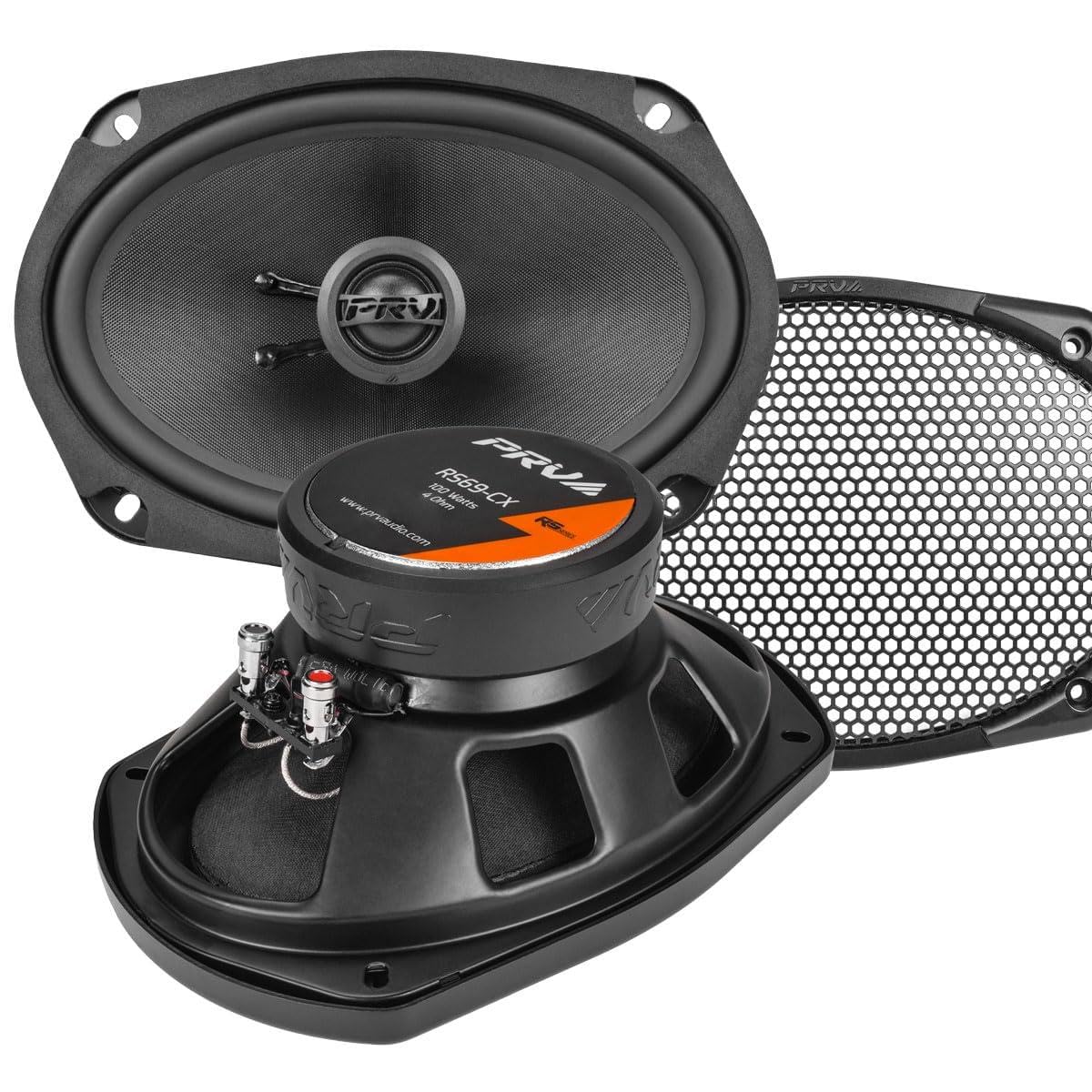
A high-sensitivity 6×9 that gets loud on very little amplifier input
This PRV Audio 6×9 is the efficiency play. It runs at 4-ohm impedance with a 90 dB sensitivity figure, which is the highest in this group, and it is rated for 100 watts RMS per speaker — 200 watts RMS per pair. That high efficiency is the whole point: the maker notes it gets loud extremely easily on modest power, so you do not need a monster amp to hear a difference. A standard frame size is meant to slot into many OEM door locations, and grills and screws are in the box.
Output is what owners talk about. “Very loud and clear with amp” is one take, and others describe big, crisp sound with solid bass, all from an install as simple as a 2011 Toyota Prius. The build reads as substantial — one buyer called them well-built with crisp highs, a full midrange, and tight bass in the 50-to-100-watt RMS range, and praised the neodymium tweeters for dispersing cleanly even in a fixed position.
The honest caveat concerns the top end and break-in. Some find the highs bright or harsh on busy music and suggest a little DSP tuning to tame them, and one owner recommends a slow break-in period. Bass lovers be warned: this is a 2-way coaxial, so a dedicated sub will still do the deepest work. Also, the magnet runs deep, so certain doors may need spacers to mount them cleanly.
The efficiency story: 90 dB sensitivity and 100W RMS per speaker mean serious volume from a very modest amplifier — pair it with a small multi-channel and you are set.
Tame the top: bright highs on dense tracks call for some EQ or DSP work, and the deep magnet may need spacers in tighter doors.
Ideal for: builds that want lots of clean volume without pouring money into a huge amplifier.
Rethink it if: you prefer a soft, warm top end or have very shallow door cavities.
9. JBL GTO629 Premium 6.5-Inch Co-Axial Speaker – Set of 2

Heavy-duty 6.5-inch coaxials that truck and SUV owners keep coming back to
For anyone swapping speakers in a big cab, a truck, or an older sedan, this JBL set has the track record. It is a 6.5-inch 2-way coaxial rated at 60 watts continuous with a 180-watt maximum input, and — unusually here — it runs at 3-ohm impedance rather than 4. The mounting diameter is 5.1 inches and the mounting depth is 2.0 inches, with a frequency response of 53Hz to 21kHz. That 3-ohm load draws a little more from your amp, which is part of why these play loud and full.
Sound quality is the dominant theme in owner feedback, and it shows up in real-world installs across a wide spread of vehicles. One owner described huge, clear sound that filled a Tahoe, and a Harley rider running them on an Electra Glide rated the highway sound the best in a decade. Build quality draws repeated praise too — thick rigid baffles, large pivoting tweeters, and strong magnets even win over buyers who usually run a different brand.
The catch is fitment and durability in harder use. Some vehicles fit perfectly while others hit compatibility snags, so check your particular door before ordering, and expect a harness or adapters in some cars. There is also some mixed feedback on long-term durability under aggressive amp power. Comparing the load to the CT Sounds pair above, this JBL runs 3 ohms (a lower electrical resistance) against 4, and its 60W continuous rating sits above the CT Sounds 50W RMS figure — a meaningful edge if you plan to lean on your amplifier.
Why Big Cabs Love It
- 3-ohm load plays loud and full from a standard amp
- 60W continuous / 180W max handling
- Pivoting tweeters and heavy rigid baffles
- Proven across trucks, SUVs, and cruisers
Fit And Longevity Notes
- Fitment varies by vehicle; check your door first
- Adapters or a harness may be needed
- Durability feedback is mixed under heavy power
The one to grab if: you are upgrading a full-size truck, SUV, or older car and want proven loud, clear sound from a 6.5-inch fit.
Walk away if: your door takes a 6×9 or a 3.5-inch dash unit rather than a 6.5.
Understanding the Specs
RMS Versus Peak Power
RMS is the wattage a speaker handles continuously — the figure that actually matters for matching an amplifier. Peak (or max) power is a brief burst number that tells you far less. When you compare picks, look at the RMS rating first and treat a big max number as headroom, not a target.
Impedance And Your Amplifier
Impedance is the electrical load in ohms. Most door speakers here are 4-ohm, with one 3-ohm set in the group. Lower impedance draws more current from the same amp, so always check your amplifier is stable at the load your chosen speakers present before you wire them up.
Driver Size And Fitment
Size decides whether a speaker drops into your opening — 6.5-inch and 6×9-inch cover most doors, while a 3.5-inch unit suits dash or corner locations. Beyond width, mounting depth matters too, since a deep magnet can foul a window mechanism. Measure before you order to avoid trimming.
Sensitivity In Decibels
Sensitivity, given in dB, is how loud a speaker plays from one watt. A higher figure means more volume from less power, which is why an efficient design can sound impressive off a factory head unit. Pair high sensitivity with a clean amp and you rarely need to push anything hard.
FAQ
Do I really need an amplifier for aftermarket door speakers?
What is the difference between RMS and max watts on door speakers?
Will 6×9 speakers fit my car doors?
What impedance should my amp door speakers be?
Do component speakers sound better than coaxial speakers?
How long do aftermarket door speakers last?
Can I run amp door speakers off my factory head unit?
Do I need mounting adapters for door speakers?
Is a 3-ohm speaker safeon a 4-ohm amplifier?
What size door speakers does a Ford F150 take?
Do I need a subwoofer if I install amp door speakers?
Final Thoughts: The Verdict
For most people, the amp door speakers winner is the Rockford Fosgate P1683 Punch 6×8 because it pairs a sensible 65W RMS / 130W Max rating with a 3-way design, a built-in crossover (a circuit that sends high and low notes to the right driver), and the kind of owner confidence that only a deep install base produces. If you want maximum door-location volume per dollar, grab the RECOIL MS65-4P with its 600W Max pair rating. And for a proven 6.5-inch swap across trucks and older cars, the JBL GTO629 is the one to reach for.
Whatever you choose, match the RMS rating to your amplifier and confirm the driver size clears your door before ordering.
How We Picked
We do not accept paid placement. Every pick is matched to a real buyer and a real use-case; we do not hands-on test units.
Sources & Methodology
Specifications: manufacturer listings and product documentation. Review insights: verified customer reviews, as of September 2026. Pricing: not shown on this page (it changes often); check the current price via the retailer link.
As an Amazon Associate, Gadgets Feed earns from qualifying purchases. This does not affect which products we feature.