
Our readers keep the lights on and my morning glass full of iced black tea. As an Amazon Associate, I earn from qualifying purchases.
Specs are compiled from manufacturer listings and verified buyer reviews and can change over time — please confirm the key details on the product page before buying.
The fastest way to look good on camera is to buy a camera that fixes the two things phones ruin: angle and even skin tone. A proper beauty video camera has a flip screen so you can actually see yourself while you shoot, and a sensor big enough that your face stays bright and smooth instead of grainy. This list runs from entry-level vlogging picks up to full-frame pro bodies, so you can match the camera to how you actually film.
I’m Min — the founder and writer behind Gadgets Feed. This guide is built by comparing the manufacturers’ published specifications and the patterns across verified customer reviews, so you get each pick’s real strengths and trade-offs instead of marketing spin.
Beauty tutorials, GRWM clips, and review channels all live or die on one thing: whether the camera makes your skin look right in real light. The picks below cover that ground, from pocket gimbals to full-frame bodies, and this guide to the best beauty video camera explains exactly which one fits how you shoot.
Our Picks at a Glance


How To Choose The Best Beauty Video Camera
For beauty content, three specs decide whether your footage looks like a tutorial or a confession video: the screen you frame yourself with, the sensor that sets how smooth your skin reads, and the autofocus that keeps your face sharp while your hands move. Get those right and everything else is preference.
The Screen Is Your Mirror
A flip-up or side-articulating screen (a display that swings around to face you) lets you check framing, lighting, and product placement without a second person or a mirror behind the camera. Side-articulating screens swing out to the side, so a tripod or mic mounted on top never blocks your view. That single hinge is the difference between guessing and knowing what the shot looks like.
Sensor Size Sets Skin Tone
A 1-inch or full-frame sensor gathers more light than the tiny sensor in a phone, so skin stays smooth instead of blotchy when you film indoors or at night. Bigger sensors also let you blur the background behind you, which keeps attention on your face rather than the room. This is the spec that separates a camera built for video from a point-and-shoot.
Autofocus And Tracking Keep You Sharp
Face and eye tracking (autofocus that locks onto a face and follows it) matters the moment you lean in to show a product or step back to a full look. Without it, the camera hunts for focus and your face goes soft mid-sentence. Look for phase-detection autofocus and a dedicated tracking mode if you film while moving.
Quick Comparison
| Model | Best For | Sensor | Max Video | Screen | Amazon |
|---|---|---|---|---|---|
| Canon EOS R6 Mark II★ Best Overall | Pro all-rounder | 24.2MP full-frame CMOS | 6K oversampled 4K60p | 3.0-inch vari-angle touchscreen | Amazon |
| DJI Osmo Pocket 3Premium Pick | Pocket gimbal filming | 1″ CMOS | 4K120 | 2″ rotatable screen | Amazon |
| Xtra MuseBest Value | Budget pocket gimbal | 1-inch CMOS | 4K120 | 2-inch touch screen | Amazon |
| Sony ZV-1F | Beginner vlogging | 1″ sensor, 20.1MP | 4K | Side-articulating touchscreen | Amazon |
| Sony ZV-E10 | Grow-into-it creators | 24.2MP APS-C Exmor CMOS | 4K oversampled from 6K | Swivel screen | Amazon |
| Canon EOS R50 | Vloggers and beginners | APS-C RF sensor | Oversampled 4K | Vari-angle touchscreen | Amazon |
| Insta360 Luna Ultra | Travel and sports filming | 1″ main + 1/1.3″ telephoto | 8K30fps with Dolby Vision | Detachable 2″ OLED | Amazon |
| Canon PowerShot G7 X Mark III | Compact creator kit | 20.1MP sensor | 4K UHD uncropped | Flip-up screen | Amazon |
| 8K Digital Camera 64MP | First-time buyers | 64MP photos | 8K video | 3-inch 180° flip screen | Amazon |
In-Depth Reviews
1. Canon EOS R6 Mark II Mirrorless Camera (Body Only)
Our pick — over 4.5★ from 650+ verified ratings; the strongest balance of quality and price.
A 24.2MP full-frame body that keeps skin smooth in dim rooms where phone cameras turn blotchy
The Canon EOS R6 Mark II is the pick for anyone who films beauty or skincare content in real light — near a window, in a bathroom, at night — and needs the footage to still look clean. Its 24.2 effective megapixel full-frame CMOS sensor pulls in far more light than a phone sensor, so your face reads smooth rather than grainy when the light is low. The 3.0-inch, 1.62 million dot Clear View LCD II vari-angle touchscreen swings out to face you, which is exactly what you want for a self-filmed GRWM shot. It arrives as the crowd favorite — 4.7 stars across 600+ owners.
What wins people over is plain quality; the picture and video detail is the thing reviewers keep coming back to, and it holds up for both stills and motion. The 1.62 million dot vari-angle screen is joined by a 0.5-inch OLED electronic viewfinder with 3.69 million dots and a 120 fps refresh rate, so framing in bright light is easy too. Autofocus is the other headline: advanced head, face, and eye detection locks onto a person’s head, face, or even the left or right eye automatically, then tracks the whole subject as they move. For a beauty creator that means your eyes stay tack-sharp even while your hands move in and out of frame holding a product.
On video, it shoots 6K oversampled uncropped 4K movies up to 60 fps, and Full-HD high-frame-rate recording at up to 180 fps — both without overheating. Continuous Full-HD recording runs up to 6 hours. One owner who filmed an 8-hour wedding reported the battery still had life left and was already buying a backup, which tells you a full tutorial session is no problem. The honest limit: the body is sold on its own, so you supply the lens through the Canon RF or EF mount, an extra cost worth planning for. It’s a heavyweight pick for someone who wants the highest ceiling; a pocket gimbal camera will be quicker to grab for a casual clip.
Where It Wins
- 24.2MP full-frame sensor keeps skin clean in low light
- Head, face, and eye detection autofocus tracks the left or right eye automatically
- 6K oversampled 4K at up to 60 fps with no overheating
- Vari-angle touchscreen flips to face you for self-filming
Think About This First
- Body-only — you buy the lens separately
- Heavier and bulkier than a pocket vlogging camera
Reach for this if: you want the best image the list can produce and film in mixed or dim light.
Look elsewhere if: you want a one-handed grab-and-go camera that lives in a pocket.
2. DJI Osmo Pocket 3 Capture More Combo
A 3-axis gimbal pocket camera that shoots one-handed and keeps every clip steady
If you film solo and want the camera to do the steadying for you, the DJI Osmo Pocket 3 is the pick — its 3-axis gimbal mechanical stabilizer holds the shot smooth while you walk, talk, and demonstrate a product. That mechanical arm is a real physical counterweight, not software cropping, so handheld footage stays level even when your hand wobbles. A 1″ CMOS sensor and up to 4K120 resolution deliver clean detail, while the 2″ rotatable screen flips between horizontal and vertical shooting without a second setup. For beauty content, the vertical mode alone saves you a step when you post straight to a vertical feed.
The combo adds a battery handle with a built-in 950mAh battery that increases operating time by 62% and weighs only 2.2 oz, plus a 1/4″-20 mounting thread and a USB-C port for external audio devices. Battery life runs up to 166 minutes on the camera itself. There’s also a wireless lavalier microphone you clip to your collar, with omnidirectional pickup and noise-reduction chips for clear voice in a noisy room — a genuine upgrade over built-in mics when you’re narrating a tutorial. The whole thing is pocket-sized with a 10x digital zoom, D-Log M and 10-bit support, and Active Track 6.0 subject tracking.
What people notice first is the video quality and the ease of use; it’s described as a dream to shoot with, and many found the picture and sound perfect in a clean setup. The recurring note to plan around is value — some owners call it pricey — and the battery benefits from the handle for a long day. Unlike the Canon R6 Mark II above, you give up interchangeable lenses, but you gain a camera that fits in a small bag and is ready in a second.
Fast to shoot: single-handed operation starts a clip in about a second, so a quick tip or demo doesn’t wait for setup.
The audio edge: the included wireless lavalier microphone with noise reduction keeps your voice clean even when the room isn’t.
The shortcut to smooth: best if you film alone and move around, because the gimbal and tracking carry the steadiness for you.
Know the trade: if you want the flexibility to swap lenses, this one stays fixed.
3. Xtra Muse Vlogging Camera with 1” CMOS & 4K/120fps
A 1-inch sensor pocket gimbal that makes handheld beauty clips look far pricier than they are
The Xtra Muse is the value play here: a 1-inch CMOS sensor recording 4K at 120 fps, wrapped around a 3-axis gimbal camera stabilizer, for creators who want smooth footage without a pro-tier outlay. That sensor is the same size class as the pricier pocket gimbals on this list, and the gimbal keeps dancing, running, and hiking shots exceptionally smooth. The 2-inch touch screen flips between horizontal and vertical shooting, and a Master Follow mode keeps you centered in frame while you mount it on a tripod and move. For a creator filming makeup or hair demos, staying the center of the frame without a cameraman is a genuine quality-of-life win.
Color is where this punches up: True 10-bit X-Log modes deliver up to one billion colors, which gives you real room to grade skin tones in post. Autofocus and face and object tracking keep you sharp while you move. Battery life is quoted at 161 minutes, and a pro videographer on the review pages found the image quality rivals gear at a much higher price in decent lighting — a client couldn’t tell the difference. The honest limits: it isn’t weather resistant, and the X-Log mode needs a separate download. A few owners reported SD card errors and overheating during 4K60 video across several cards, so treat it as a fair-weather, mostly-stills-and-casual-clips camera rather than a rugged travel workhorse.
Where the Xtra Muse stands apart from the DJI Osmo Pocket 3 above is value: it delivers the same sensor-size class and gimbal idea for noticeably less, and owners describe it as a solid budget alternative with post-update microphone connectivity. It keeps the essentials — gimbal, 4K, flip screen, tracking — and trims the polish.
The grading win: 10-bit X-Log gives you the color latitude to make skin tones look natural, not flat.
The cost of the value: no weather sealing and a separate X-Log download; some owners hit card and heat issues in heavy 4K60.
Best for the budget-minded: pick this if you want gimbal smoothness and a big sensor without the premium outlay.
Skip the rugged-travel dream: it lacks weather resistance, so a beach or rain shoot is a risk.
4. Sony ZV-1F Compact Digital Camera

A 20mm ultra-wide lens that fits you and the whole product in frame at arm’s length
The Sony ZV-1F is the beginner’s pick because its ultra-wide 20mm lens gets everything in the frame even when you hold the camera at arm’s length — no more cropping your own head out of a selfie clip. A large 1″ sensor paired with an F2 lens keeps skin bright and lets you blur the background, which is the look most beauty channels are chasing. The side-articulating touchscreen swings out for easy selfie framing, and Eye-AF with autofocus tracking keeps your face locked in focus while you talk and gesture. For a first camera, that combination removes the two hardest parts of self-filming: getting in frame and staying sharp.
Sound is handled better than most starter cameras: a directional 3-capsule mic with a wind screen accessory captures your voice clearly, which matters for tutorials where narration carries the clip. The 20mm focal length is wide enough for a product held up close and for a full-face talking shot, and Eye-AF locks onto the eye automatically rather than hunting around the frame. This is what makes it a natural on-ramp for someone moving up from a phone.
The honest trade-offs are battery and fragility: battery life lands around 45 minutes for some owners, so an extra battery or two is a near-mandatory add-on, and the autofocus is delicate enough that a drop can upset it. A handful of owners also find the performance merely adequate in demanding situations. Compared with the Xtra Muse above, the ZV-1F trades the gimbal for a wider lens and cleaner built-in audio — a better fit for stationary talking-head beauty content than run-and-gun clips.
Wide-angle advantage: the 20mm lens keeps you and the product in frame without a tripod or an assistant.
Plan for power: that short battery runtime means buying spares is part of owning this camera.
Ideal first beauty camera: beginner-friendly and forgiving, it’s the smoothest move up from filming on a phone.
Budget the extras: spare batteries are near-essential given the runtime, so factor that in.
5. Sony ZV-E10 APS-C Mirrorless Camera with 16-50mm Lens
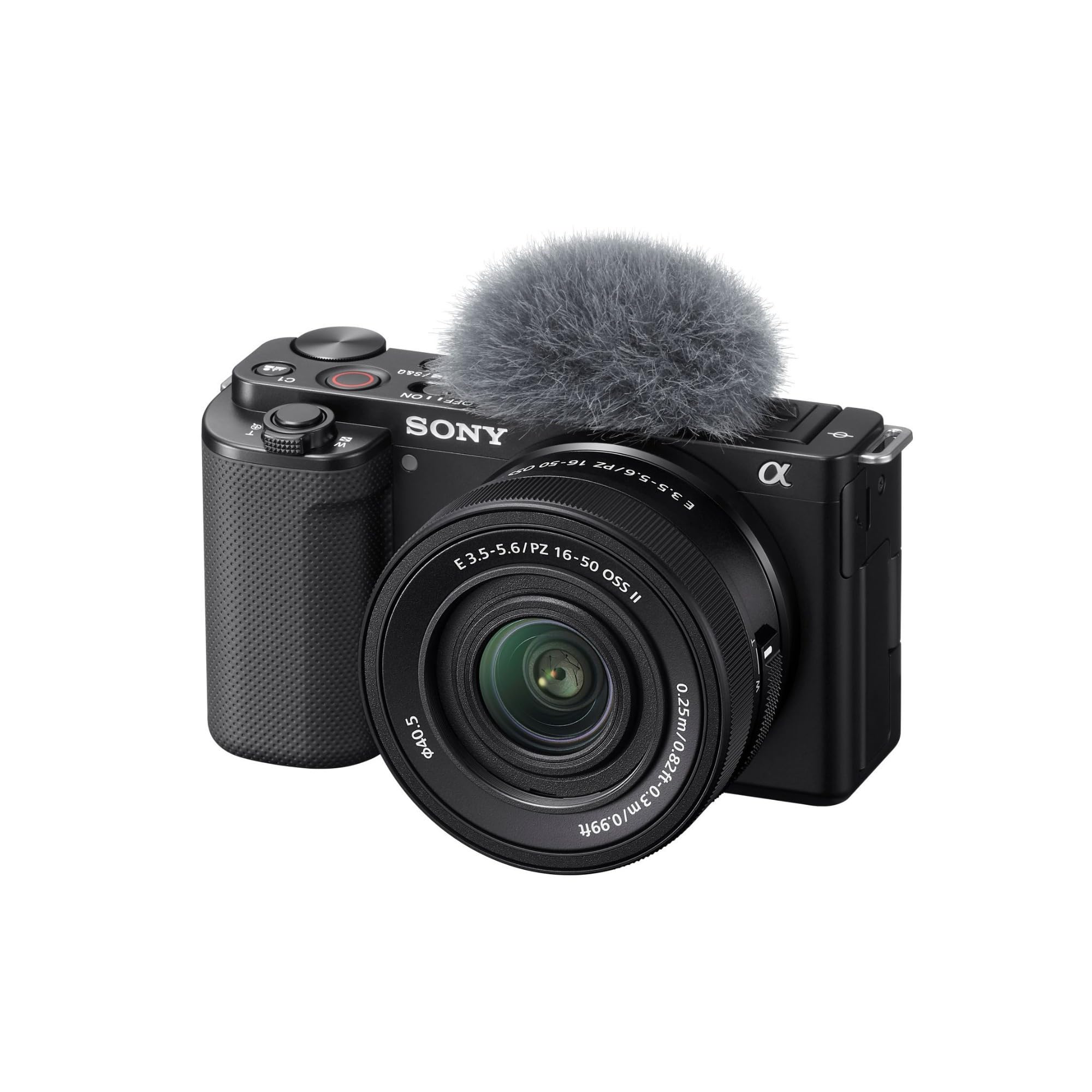
A 24.2MP APS-C camera with a Sony E-mount you grow into as your lens kit expands
The Sony ZV-E10 is for the creator who’s outgrown a fixed-lens vlogging camera and wants room to grow. Its 24.2MP APS-C Exmor CMOS sensor and fast BIONZ X processor capture 4K movie oversampled from 6K with full pixel readout and no pixel binning — meaning every pixel is a real sample, so detail and skin texture hold up. The swivel screen faces you for self-filming, and the included 16-50mm lens covers wide to standard for daily content, portraits, and street shooting. Because the mount is a Sony E, you can move to a different lens later rather than buying a whole new camera.
Two features are built for beauty and product work specifically. The Product Showcase Setting transitions focus from your face to a held-up object automatically, so the camera switches to the lipstick or bottle the moment you raise it — no manual tapping. The Background Defocus button instantly toggles the blurred-background effect on or off with a single press. Together they handle the two moves that define most beauty clips: showing your face, then showing the product. Live streaming works with a single USB cable and no extra hardware or software.
Owners describe it as built for video over stills, and note that the stock lens handles family and everyday footage fine while serious work benefits from an OSS lens or an external stabilizer — stabilization is the growth ceiling to know about. A few reviewers recommend a battery and charger multi-pack for longer sessions. The niche frustration is the companion app, which several find rough. Where the ZV-1F above is a fixed-lens starter, this one lets you change lenses as your needs change.
Why It Earns Its Spot
- Interchangeable Sony E-mount, so you can upgrade lenses later
- Product Showcase Setting switches focus from face to object automatically
- One-press Background Defocus toggle for a blurred background
- 4K oversampled from 6K with no pixel binning for clean detail
The Reality Check
- Best video stability needs an OSS lens or external stabilizer
- The companion phone app draws complaints
Built to grow with you: the right pick if you plan to add lenses as your content and skills expand.
Not the one-trick: look elsewhere if you want stabilized footage straight from the start without an added lens.
6. Insta360 Luna Ultra Creator Bundle
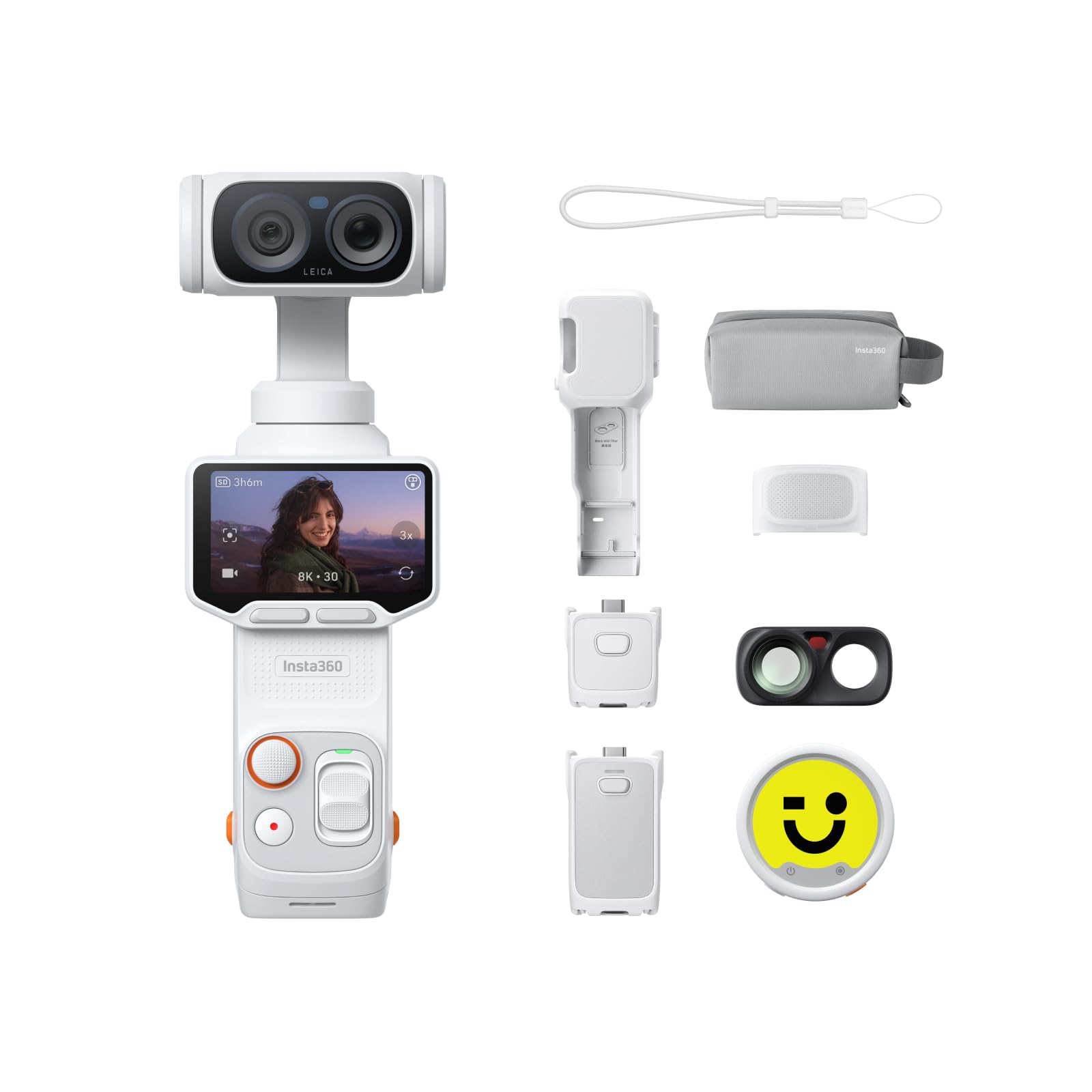
Dual Leica lenses, 8K30fps Dolby Vision, and a detachable 2″ screen you can preview from 20m away
The Insta360 Luna Ultra is built for the creator who films on the move — a three-week trip, a kid’s volleyball game, a crowded night market — and needs one pocket camera to cover it all. A dual Leica lens system pairs a 1″ main sensor with a pro-grade telephoto lens on a 1/1.3″ sensor and F2.0 aperture, so you get both a wide shot and a tight one without switching gear. It shoots up to 8K30fps with Dolby Vision, and the telephoto delivers up to 6× lossless zoom within a 12× range with true optical background blur for natural-looking portraits. For beauty content, that optical blur beats software background effects every time.
Two features stand out for solo shooters. The detachable 2″ OLED touchscreen gives you live preview and remote control up to 20m away, which is how you frame yourself in a group shot or a hands-free demo when nobody’s there to run the camera. And Beauty Mode runs intelligent face recognition that adapts to different skin tones with adjustable tone and smoothing for natural results — a rare honor of the beauty brief built straight into the camera. Add 3-axis mechanical stabilization with AI subject tracking, up to 14 stops of dynamic range, and 10-bit I-Log for grading, and it’s a full creator toolkit in one handheld body.
Battery is a strength: up to 4 hours on a single charge, with fast charging to 80% in just 23 minutes. Owners praise the tracking for holding up where other systems would lose the subject, and the wide lens for capturing a full table setting without distortion. The honest catches are the learning curve around modes and manual exposure, and mixed notes on value and reliability, so it rewards someone willing to learn its menus. Set against the Canon R6 Mark II at the top, this one trades a full-frame sensor for the flexibility of two lenses and a detachable screen.
Beauty Mode on board: adaptive skin-tone recognition with adjustable smoothing means flattering footage without a separate edit.
Learn the menus: the i-Log and manual exposure modes take some study, though the auto modes work fine out of the gate.
The travel-ready toolkit: choose this if you want one pocket camera that does wide, tight, self-framed, and beauty-tuned shots.
Give it a learning weekend: the advanced modes reward patience, so it’s less plug-and-play than a dedicated beginner vlogging camera.
7. Canon EOS R50 Mirrorless Camera with 18-45mm Lens Bundle
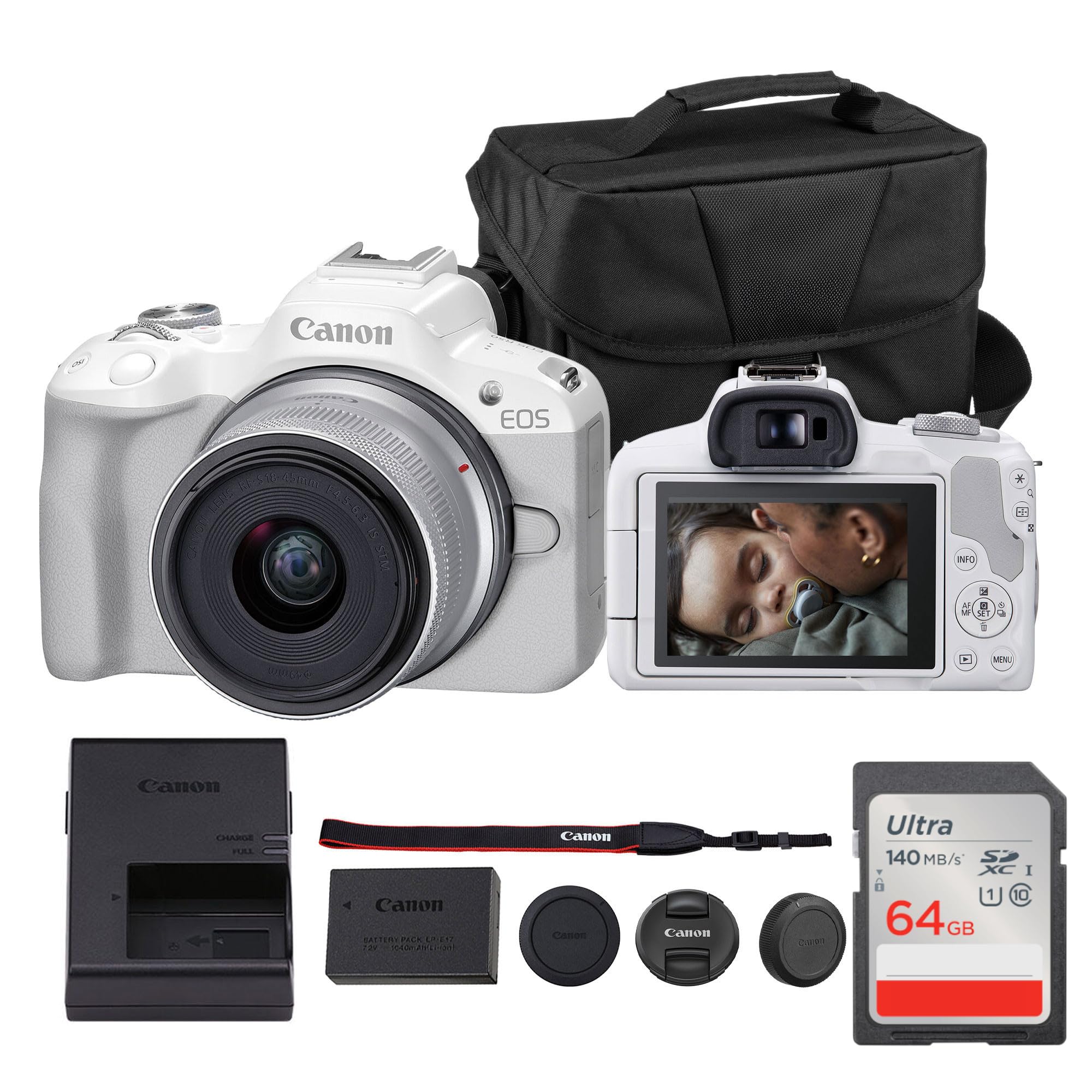
A lightweight APS-C body with Creative Assist and vertical video — the beginner vlog camera done right
For a new creator who wants quality photos and oversampled 4K video without a steep learning curve, the Canon EOS R50 is the sweet-spot pick. It pairs an APS-C RF sensor with an 18-45mm lens that covers wide to standard focal lengths — daily content, portraits, and street shooting all fit in one zoom. Dual Pixel AF II handles face and eye detection with reliable subject tracking, so a talking-head beauty clip stays sharp. The vari-angle touchscreen flips around to face you, and the bundle arrives with a shoulder bag and a 64GB memory card so you can start shooting the day it lands.
Two creator conveniences separate it from a plain starter camera. Creative Assist gives in-camera guidance for settings, so you’re not lost in a menu before your first clip. And vertical shooting makes social-ready footage straight out of the camera, which saves a crop later. The bundle includes a 10-bit capable pipeline and 45 autofocus points, and the whole package is built for small to medium hands — a genuine plus for younger creators or anyone used to the ergonomics of a phone.
What buyers appreciate is the quality for the size: a compact body that travels well and slips into a small bag, with a battery that lasts through a full day of taking hundreds of pictures. Owners contrast it favorably against cheaper cameras whose batteries die in about half an hour, and note the adapter ring lets you reuse other Canon lenses if you have them. The one honest caveat is that the small body feels light with big telephoto lenses, so it’s best with compact glass. Unlike the Xtra Muse above, this is a stills-and-video hybrid rather than a gimbal-first clip machine.
The Standout Strengths
- Oversampled 4K with Dual Pixel AF II face and eye tracking
- Creative Assist and vertical video make social content easy
- Lightweight compact body with a vari-angle touchscreen
- Bundle includes bag and 64GB card to start right away
Good To Know
- Body feels light with large telephoto lenses
- Beginner-oriented, so advanced shooters may outgrow the guidance modes
New-creator friendly: the best all-round first step if you want one camera for both photos and video.
Pair it with compact glass: if you plan on big telephoto lenses, this small body may feel unbalanced in hand.
8. Canon PowerShot G7 X Mark III Vlogging Bundle
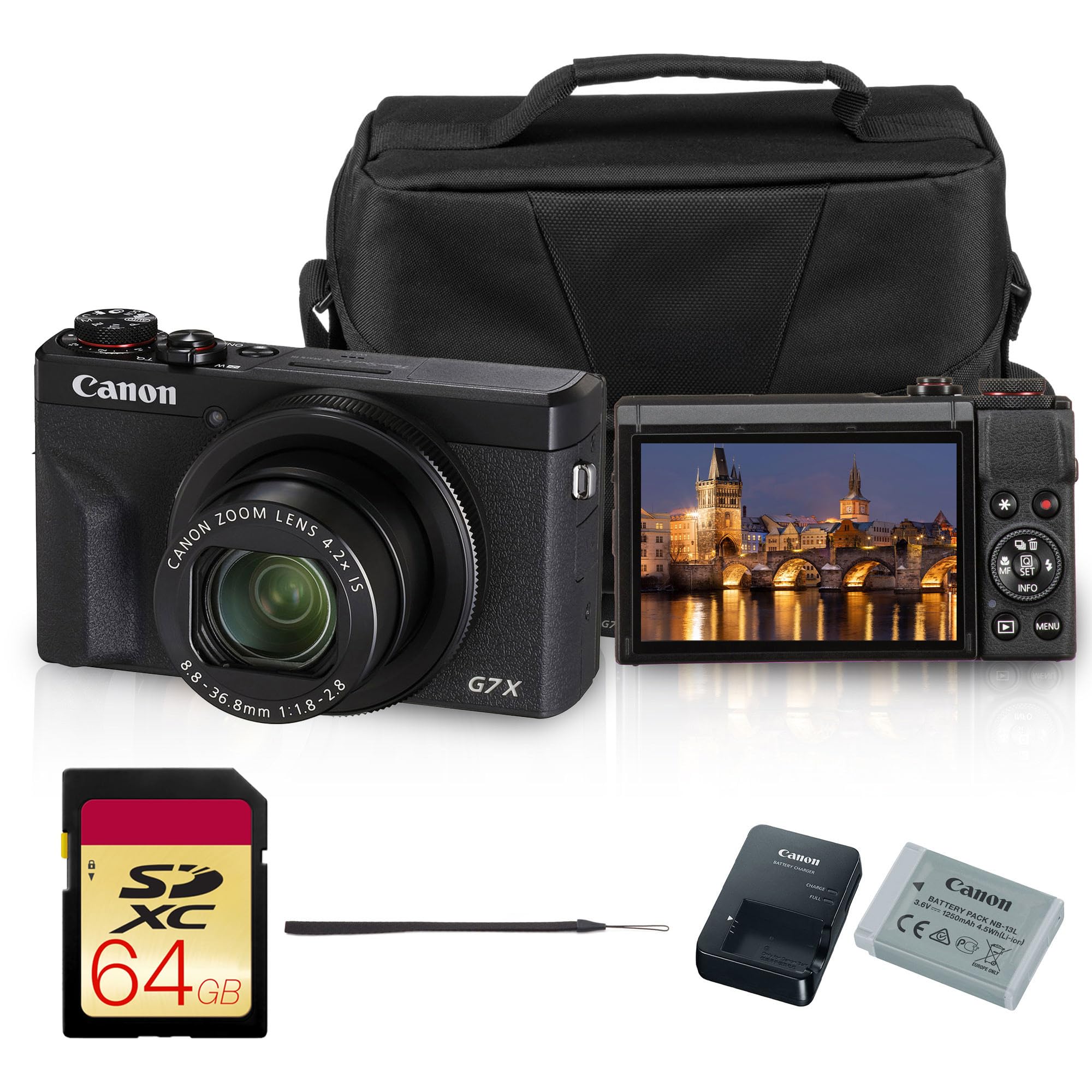
A 20.1MP pocket camera with a flip-up screen that makes latte shots and night-out photos look easy
The Canon PowerShot G7 X Mark III is the creator classic — a compact 20.1MP camera with a bright lens and a flip-up screen that makes filming yourself simple. It captures sharp, vibrant photos in a body small enough to carry anywhere, whether you’re shooting a morning latte, a night out, or vacation views. Videos shoot in 4K UHD with no cropping and the flip-up screen faces you for solo recording, while an external microphone input upgrades your audio. Built-in Wi-Fi and Bluetooth push photos and video straight to your phone through the Canon Camera Connect app, so posting is instant.
Fast autofocus and continuous shooting keep up with kids, pets, and spontaneous moments, and the intuitive touchscreen makes the camera feel natural from the first use. The bundle rounds it out with a battery pack, charger, wrist strap, shoulder bag, and a 64GB memory card. What keeps owners loyal is the quality relative to its size — it takes photos that draw compliments, and setting learning is quick because tutorials are everywhere.
The trade to weigh is battery life, which is quoted at about 1 hour, so a spare battery matters for a long shoot. A small number of owners feel the value for the image quality is a stretch, and one reported a faulty unit that wouldn’t take pictures — rare, but worth checking yours thoroughly on arrival. Set against the Sony ZV-1F above, the G7 X Mark III offers a similar pocketable idea with an optical zoom and a stronger reputation for photo quality.
Pocket and capable: a small body that still delivers crisp photos with instant phone transfer for quick posting.
Mind the runtime: about an hour of battery means packing a spare for anything longer than a short session.
The stylish everyday carry: great if you want one small camera that nails both photos and quick 4K self-clips.
Carry a spare battery: the short runtime is the practical catch on longer shoot days.
9. 8K Digital Camera 64MP with WiFi & 180° Flip Screen
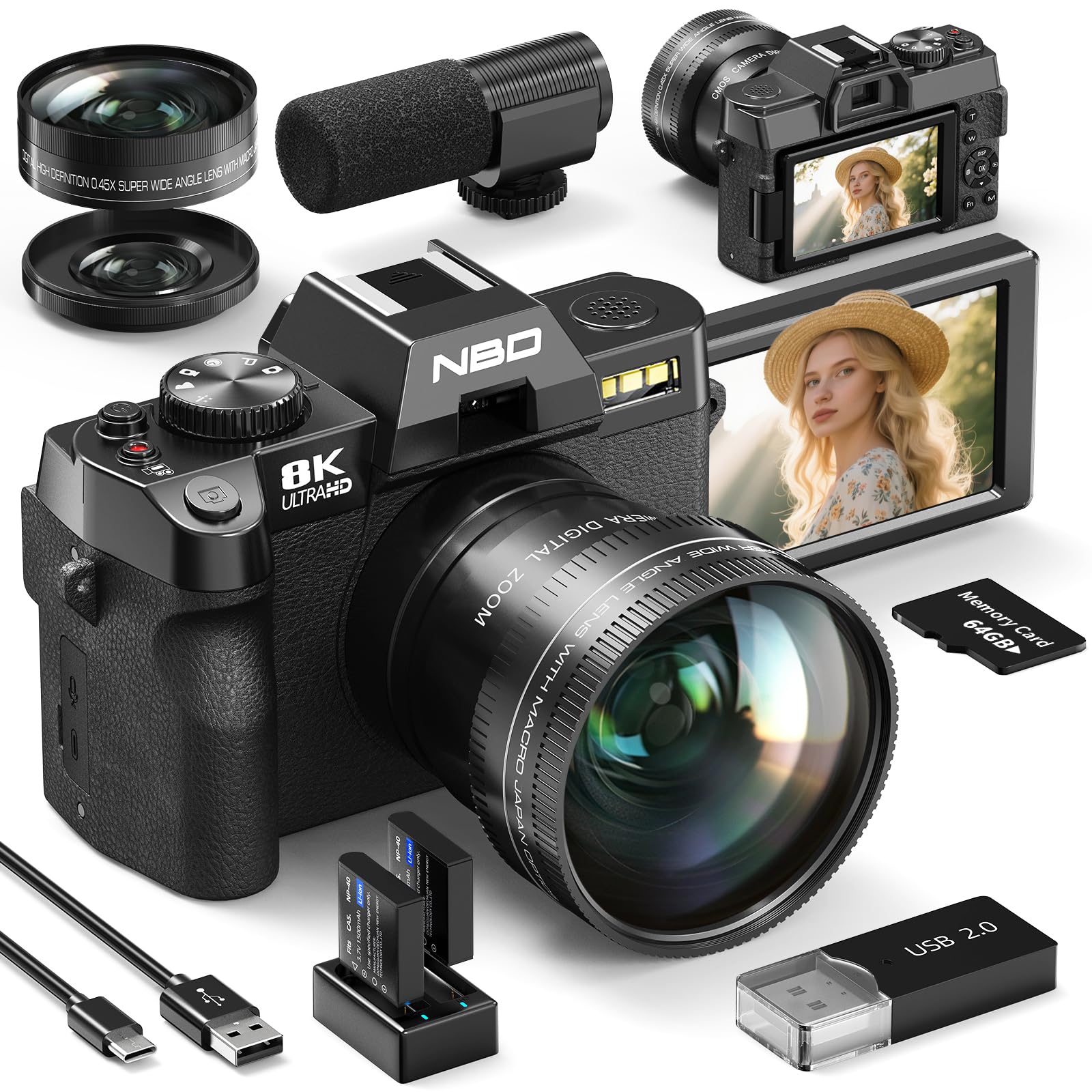
An entry-level kit that hands you the flip screen, the mic, and the memory card in one box
For a first-timer or a gift, the 8K Digital Camera 64MP is the budget-friendly all-in bundle — ultra-clear 8K video recording plus 64MP photos with a 3-inch 180° flip screen for selfies and self-filming. It also offers multiple video modes including 6K/25fps, 5K/30fps, and 4K/60fps, so you’re not locked into one setting. The F1.8 lens with 16X digital zoom pulls distant detail close, and 52mm wide-angle and macro lenses are included for expansive shots and tight close-ups. A built-in fill light brightens low-light shots — a small but real help for a makeup or product close-up shot indoors.
What makes it genuinely beginner-proof is what’s in the box: two large-capacity batteries, a charger, a shoulder strap, a camera bag, a 64GB TF card, a card reader, a microphone, and a USB data cable. There’s nothing extra to buy before you shoot your first clip, and the microphone means your voice narrates cleanly without a separate purchase. Wi-Fi supports fast file transfer for quick sharing, and the lightweight body with a shoulder strap is built for travel and street shooting.
The trade-offs are honest and expected at this tier: it’s a point-and-shoot experience rather than a tunable creative tool, and the autofocus and low-light quality won’t match the 1-inch and full-frame picks above. Buyers report it’s simple to hold and operate, with labeled buttons and preset modes that make it approachable, and note the autofocus handles quick shots well. The rating sits at 3.7 stars across a small pool of reviews, so set expectations as a starter or gift camera, not a channel-defining upgrade. Unlike the Sony ZV-1F above, it hands you accessories up front instead of raw performance.
What You Get
- 3-inch 180° flip screen for selfies and self-filming
- Two batteries, charger, mic, and 64GB card included
- 8K video plus multiple modes down to 4K/60fps
- 52mm wide-angle and macro lenses in the box
The Fine Print
- Image quality sits below the 1-inch and full-frame cameras
- Point-and-shoot control, not a tunable creative kit
Best first step or gift: right for a beginner or a family member who wants everything included and nothing complicated.
Not a channel-builder: if you’re chasing pro-grade skin tone and low-light footage, spend up to the 1-inch tier instead.
Understanding the Specs
Flip vs Side-Articulating Screens
A flip-up screen hinges upward to face you, and a side-articulating screen swings out on an arm to the side. Both let you frame yourself, but a side-articulating screen avoids being blocked by a top-mounted mic or tripod plate, which is why vlogging-focused cameras tend to use it. If you film a lot of self-talking beauty clips, prioritize a screen that faces you without fighting your accessories.
Gimbal vs Electronic Stabilization
A gimbal is a physical motorized arm that holds the camera level as you move, while electronic stabilization crops and shifts the image in software to hide shake. A mechanical gimbal (like the 3-axis systems in the pocket cameras here) keeps footage smooth even when you walk or dance, without cropping away your frame. Electronic-only stabilization is lighter and cheaper but trims the edges of your shot and struggles in low light.
Face and Eye Tracking Autofocus
Face and eye tracking is autofocus that actively locks onto a face or a specific eye and follows it as you move. This keeps you sharp when you lean in to show a product or step back for a full look. Phase-detection autofocus (which measures distance directly rather than by contrast) tends to track faster and more reliably than contrast-only systems, so it’s worth checking which type a camera uses.
Sensor Size and Skin Tone
Sensor size controls how much light the camera gathers. A 1-inch sensor collects far more than a phone or point-and-shoot chip, so skin stays smooth and bright instead of noisy when you film indoors, and a full-frame sensor goes further still. Bigger sensors also let you blur the background behind your face, keeping the focus on your look rather than the room behind you.
FAQ
Do I need a flip screen for filming my own beauty videos?
Is a 1-inch sensor really better than a phone for beauty content?
What does a gimbal do that my hands cannot?
Can these cameras blur the background behind me?
How important is autofocus for beauty tutorials?
Will the lens that comes with a camera be enough?
How long can I film on one charge?
Which camera is best for a beginner with no manual skills?
Can I connect a microphone to these cameras?
Do I need 4K or is 8K overkill for beauty content?
Final Thoughts: The Verdict
For most creators, the beauty video camera winner is the Canon EOS R6 Mark II because its full-frame 24.2MP sensor keeps skin clean in any light and its face and eye autofocus never lets you go soft. If you want a pocket gimbal that steadies every handheld clip and runs up to 166 minutes, grab the DJI Osmo Pocket 3. And for the widest all-in first kit that includes a mic and a memory card from the start, the 8K Digital Camera 64MP is the one to reach for.
Here’s the one honest nudge: the R6 Mark II owns the highest score on the list, sitting just above the other full-frame-class pick, so if you want the safest bet for long-term growth, that’s the one worth locking in first.
How We Picked
We do not accept paid placement. Every pick is matched to a real buyer and a real use-case; we do not hands-on test units.
Sources & Methodology
Specifications: manufacturer listings and product documentation. Review insights: verified customer reviews, as of September 2026. Pricing: not shown on this page (it changes often); check the current price via the retailer link.
As an Amazon Associate, Gadgets Feed earns from qualifying purchases. This does not affect which products we feature.