
Our readers keep the lights on and my morning glass full of iced black tea. As an Amazon Associate, I earn from qualifying purchases.
Specs are compiled from manufacturer listings and verified buyer reviews and can change over time — please confirm the key details on the product page before buying.
Buying a 3D printer for a teenager is really about one question: will it actually print, or will it become a shelf ornament by week two? The printers that survive in a kid’s room are the ones that level themselves, arrive mostly built, and spit out a recognizable object before the excitement wears off.
I’m Min — the founder and writer behind Gadgets Feed. This guide is built by comparing the manufacturers’ published specifications and the patterns across verified customer reviews, so you get each pick’s real strengths and trade-offs instead of marketing spin.
Below you’ll find the features that matter most for young makers, from auto-leveling to build volume. Every pick here is a filament-style FDM machine, ranked to help you choose the right 3d printer for teenagers without the guesswork.
Our Picks at a Glance


How To Choose The Best 3D Printer For Teenagers
A teen’s printer needs to be forgiving above all else. The machine that wins is the one that turns a messy first layer into a clean print without a parent hovering over it. Here is what separates a printer that gets used from one that gets abandoned.
Auto-Leveling And First-Layer Success
Bed leveling (adjusting the print surface so it sits perfectly flat under the nozzle) is the number one reason beginner prints fail. Look for automatic bed leveling and a self-test routine that runs with one tap. When the machine handles leveling itself, a teenager can load filament and press print without learning a fiddly manual process first.
Build Volume: Keychains Or Helmets
Print volume is the maximum size of the object a printer can build, measured in millimeters. A small volume around 100mm suits miniatures and trinkets, while a 220mm or 250mm cube opens up larger props and functional parts. Match the volume to what your teen actually wants to make, because a tiny bed gets limiting fast.
Setup Time And Assembly
Many of these printers arrive fully assembled or mostly built, with setup times listed in minutes. A printer that is ready in ten to fifteen minutes keeps momentum on a birthday or holiday. One that needs hours of assembly and calibration can kill the fun before the first print appears.
Filament And Enclosure Safety
The filament is the plastic spool the printer melts. PLA is the easy, low-odor choice for a bedroom. Some printers add an enclosed body or an air purification system, which matters if your teen wants to try materials like ABS or ASA that give off more fumes. All nine picks here are filament-style FDM printers rather than resin machines, since resin requires careful handling and ventilation.
Quick Comparison
| Model | Best For | Print Volume | Max Speed | Weight | Amazon |
|---|---|---|---|---|---|
| Bambu Lab A1★ Best Overall | Best overall for beginners | — | 10,000 mm/s² accel | 22 pounds | Amazon |
| Entina TINA2S (WiFi Cloud)Compact Pick | Compact cloud-printing starter | 3.9 × 4.7 × 3.9 inches | 200 mm/s | 9.08 pounds | Amazon |
| TINA2S Starter KitBest Starter Kit | Everything-in-the-box gift | — | — | 6.4 pounds | Amazon |
| Entina Tina2C | Fastest first print for kids | 3.9 × 3.9 × 3.9 inches | — | 5.28 pounds | Amazon |
| FLASHFORGE Adventurer 5M | Fast mid-range all-rounder | 220 × 220 × 220 mm | 600 mm/s | 23.8 pounds | Amazon |
| Creality Ender 3 V3 KE | Larger prints on a budget | 250 × 220 × 220 mm | 500 mm/s | 17.16 pounds | Amazon |
| Anycubic Kobra X | Multicolor creativity | 260 × 260 × 260 mm | 600 mm/s | 20.9 pounds | Amazon |
| Creality K1C | Enclosed high-speed upgrade | — | 600 mm/s | 27.3 pounds | Amazon |
| Bambu Lab P1S | Premium enclosed workhorse | 260 × 260 × 260 mm | 500 mm/s | 38.9 pounds | Amazon |
In‑Depth Reviews
1. Bambu Lab A1 3D Printer
Our pick — over 4.5★ from 600+ verified ratings; the strongest balance of quality and price.
The beginner printer that acts like it has done this a thousand times before
For a teenager who wants to print something real on day one, the Bambu Lab A1 removes almost every friction point. It handles its own calibration (the setup adjustments that normally trip up new users), so your teen loads filament and presses go. The numbers behind that ease are real: a 10,000 mm/s² acceleration figure that translates to prints finishing fast, and the crowd favorite status at 4.7 stars across 645 ratings backs up how consistently it delivers.
What wins people over is the sheer reliability. Owners describe it as a no-fuss machine that prints flawlessly right from the start, and the most-praised strength is performance by a wide margin. As buyers put it: “One owner reports it running 16 hours a day making kids’ toys without problems.” One owner even moved over from a fussier Creality model and found the A1 needed no troubleshooting after four months of daily use. This is why it earns the top spot: the A1 does more of the hard work so a beginner does less.
The one honest trade-off is print quality itself, which draws mixed reactions rather than universal praise. Some owners find it exceptional, while others want finer detail than it delivers on certain models. The multi-color feature is also not built in — you need the AMS lite accessory for that. Neither issue makes it a poor choice; it just means buyers chasing absolute maximum detail or instant multicolor should plan around those limits.
What earns it the crown
- Fully automatic calibration means almost no manual setup for a first-timer
- Runs fast enough for long, productive printing sessions at 10,000 mm/s² acceleration
- Proven reliability for continuous daily use making toys and parts
Where it asks for compromise
- Multi-color printing requires the separate AMS lite accessory
- Print quality sits on the middling side for buyers chasing maximum fine detail
Buy it for: a teen who wants fast, reliable prints with the least possible fiddling.
Pass if: you want multicolor included without buying an extra unit or need boutique-level fine detail.
2. Entina TINA2S 3D Printer (WiFi Cloud)
A tiny cloud-connected printer that arrives ready before the excitement fades
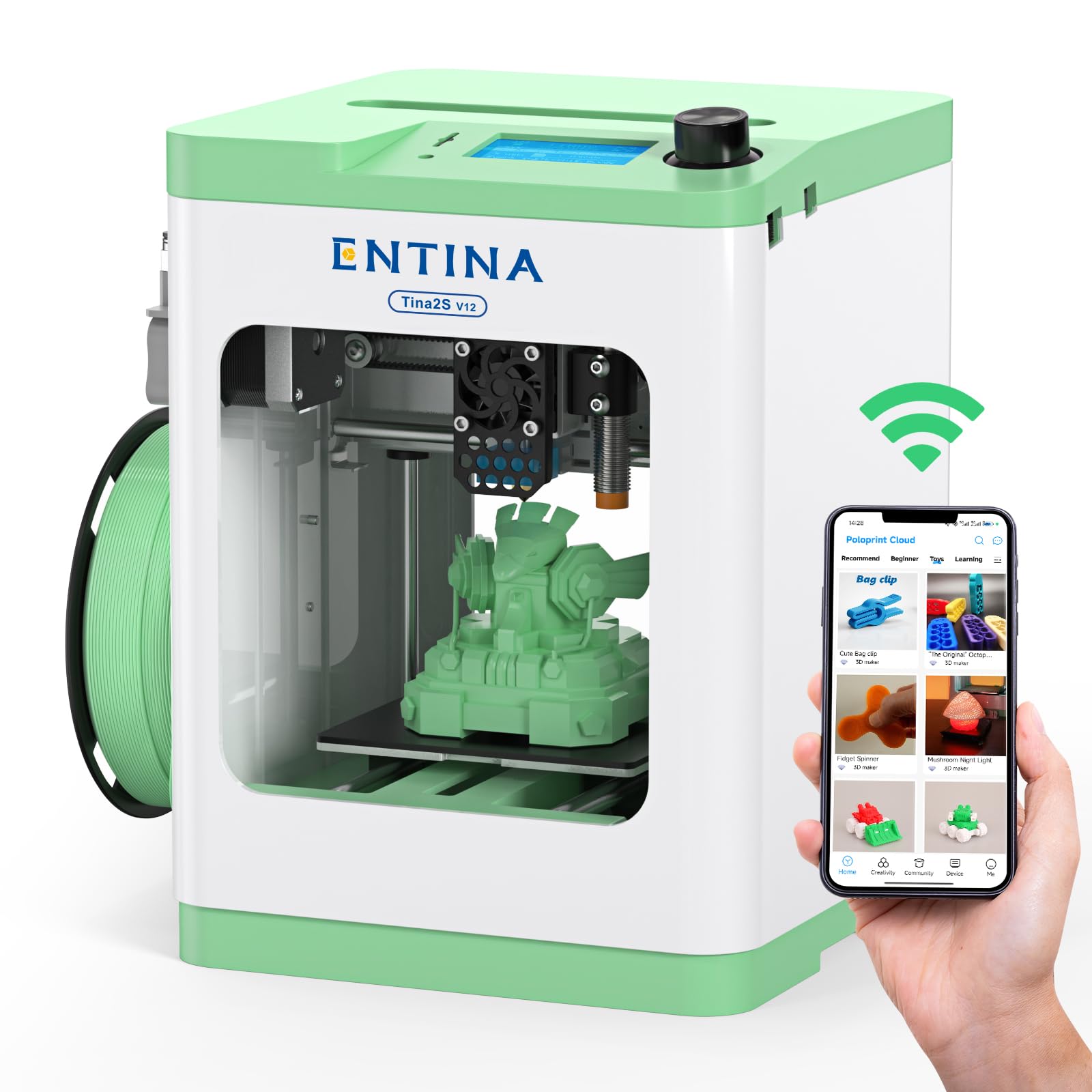
If space is tight and you want a printer a ten-year-old can run solo, the TINA2S is built for exactly that. It ships fully assembled and taps into the Poloprint Cloud app for a library of 1,500+ ready-to-print models, so a teen can start printing within minutes without designing anything first. The 200 mm/s print speed and 0.04mm precision keep small projects moving quickly.
This is also the most travel-friendly pick in the lineup by far. What buyers rave about is the ease of use and the fun factor — the machine is aimed squarely at kids and beginners. As one buyer put it about the setup: “One parent reports their ten-year-old printing happily from day one.”
Here is the honest part: reliability is the most-discussed aspect, and it comes with mixed feedback. Some buyers report it prints dependably, while a few ran into clogging or feed problems over time. A small 3.9 × 4.7 × 3.9-inch print volume also limits a teen to small figures and trinkets rather than big builds. For quick, playful projects it works well; for ambitious prints you will want more machine.
Built for small hands: A fully assembled 9.08-pound printer with a beginner app full of ready-to-print models makes the first day genuinely easy.
The honest catch: Reliability draws mixed reviews and the tiny build volume caps what your teen can make.
Best fit: a young first-timer with limited desk space who wants to print within minutes.
Think twice if: you expect trouble-free long-term use or want to print large models.
3. TINA2S Fully Assembled Mini 3D Printer Starter Kit
The one that comes with the filament, the models and the software already loaded
The defining feature here is that nothing else is required to get going. This starter kit bundles the mini printer with 10M of PLA filament, a microSD card pre-loaded with model designs and slicing software, and the accessories a beginner needs. Print quality is the most-praised strength by a wide margin, with ease of use right behind it, and the machine auto-levels so a kid can start without learning bed adjustment.
Compared with the cloud-first Entina TINA2S above, this version leans on what is in the box rather than an app catalog. It weighs just 6.4 pounds and stays compact at 8.3 x 8.3 x 11.4 inches, so it fits a dorm or bedroom shelf without drama. Owners consistently report it prints well and that children take to it quickly.
Two things are worth flagging for a parent. First, this model has no heated bed and is built for PLA filament only, so heat-resistant materials are off the table. Second, the compact build volume limits prints to mini figures and trinkets rather than large builds. Both are normal for a mini printer, but they shape what your teen can realistically make.
Ready from the start: Filament, models and slicing software all arrive included, so there is no extra shopping trip before the first print.
Know before you buy: PLA-only printing and a small build area keep this a trinket machine, not a large-project printer.
Choose this if: you want a gift that works the moment it is unboxed, complete with starter filament.
Look elsewhere if: your teen dreams of printing big or wants to try filaments beyond PLA.
4. Entina Tina2C 3D Printer for Kids & Beginners
The quickest path from box to first print, with AI tools to spark ideas
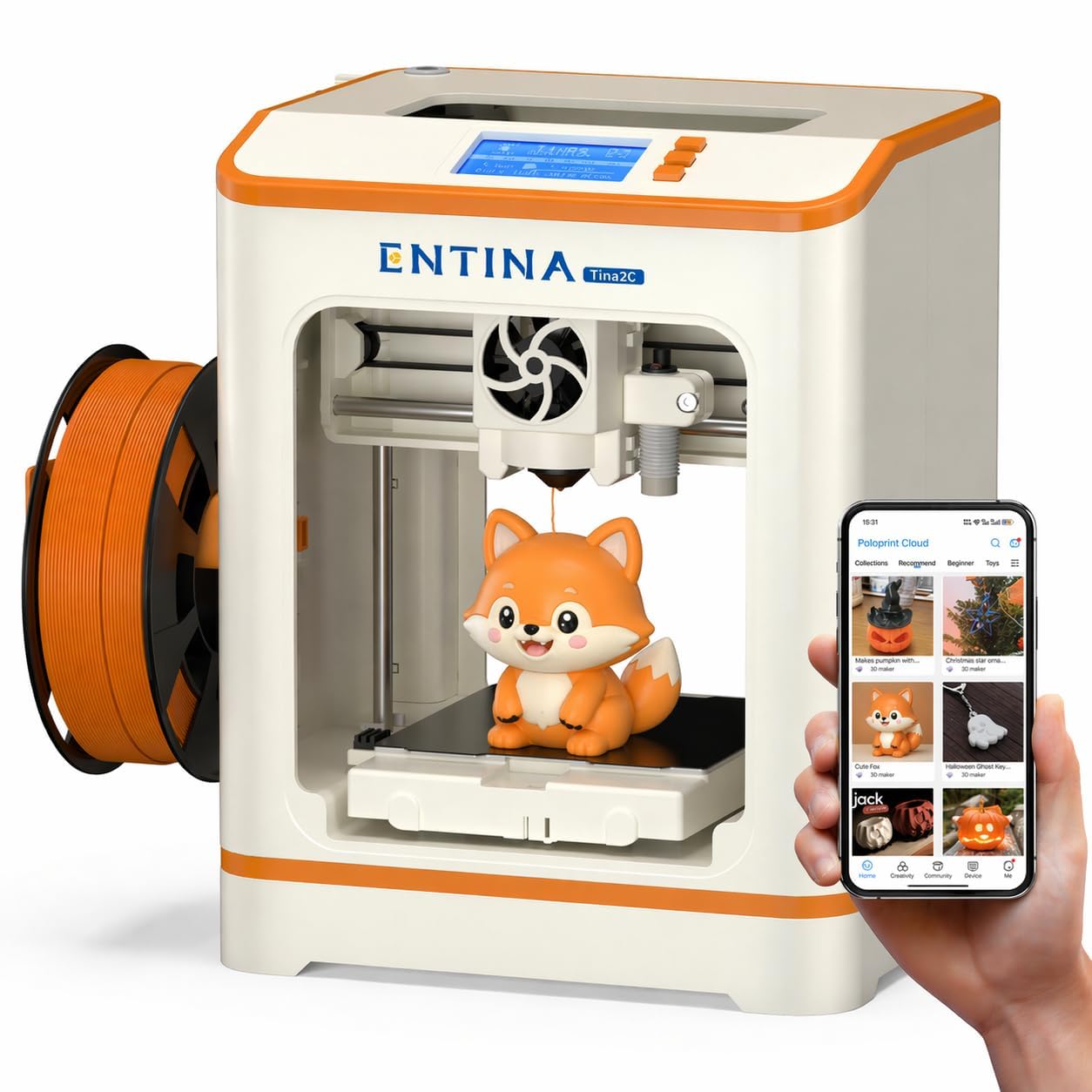
Entina built the Tina2C around getting a kid printing almost immediately. Guided setup through the Poloprint Cloud app means a first print can start in as fast as 8 minutes, and the app adds AI-powered search and photo-to-print features. The 20+ creative modules and regularly updated STEM courses turn the printer into something closer to a learning toy than a workshop tool.
At 5.28 pounds it is the lightest printer in this whole lineup, which makes it easy for a younger kid to reposition and store. It keeps the small-but-safe kit going with rounded edges, low-noise operation and a 3.9 × 3.9 × 3.9-inch print volume suited to small projects. Power-loss recovery is a nice touch: if the print is interrupted, it can pick up where it left off rather than wasting the whole job.
The trade-off is the same compact-printer limit you see across the mini class — small builds only. There is also the occasional unit-quality gripe, which shows up as an outlier rather than a pattern. This printer is aimed at a specific younger maker, and it hits that target cleanly.
Made for quick wins
- First print possible in as fast as 8 minutes via the app
- AI photo-to-print and 20+ creative modules keep ideas flowing
- Lightest pick here at 5.28 pounds for easy handling
Kept intentionally small
- 3.9 × 3.9 × 3.9-inch volume rules out large prints
- Occasional unit-quality issues appear among otherwise happy owners
Ideal for: a younger kid who needs a guided, app-driven first printer and quick wins.
Not the pick if: your teenager already wants to print big parts and push the machine hard.
5. FLASHFORGE Adventurer 5M 3D Printer

When your teen has outgrown the toylike starters and wants real speed
The Adventurer 5M is the pick for a teenager climbing past beginner territory. Its headline is speed: a 600 mm/s maximum with a Core XY system and up to 20,000 mm/s² acceleration, which the maker says reaches 600 mm/s in about 0.025 seconds. That pairs with a 220 × 220 × 220mm build volume big enough for functional parts, props and larger figures.
Setup is friendlier than those numbers suggest. One-click leveling handles the first-layer prep, and the maker lists a 10-minute path from unboxing to printing. What owners praise most is performance, with ease of use close behind — this machine has a reputation for doing a lot of work well out of the gate, including steady adhesion to its dual-sided PEI plate.
The honest caveat is print quality, which gets mixed feedback. Some owners get clean results print after print, while others report inconsistent extrusion on certain units. That makes this a printer for a teen who is comfortable tuning settings rather than a nervous first-timer. When it is dialed in, it flies.
Why it earns its place: A 600 mm/s top speed and generous 220 × 220 × 220mm volume make it the value choice for a teen ready to print bigger and faster.
The fine print: Print quality draws mixed feedback, so it suits a tinkerer more than a plug-and-play beginner.
Pick this if: your teenager is ready to learn tuning and wants speed plus a larger build area.
Skip if: you need the most forgiving beginner experience with zero fiddling.
6. Creality Ender 3 V3 KE 3D Printer

A big-boy printer that still holds a beginner’s hand through the setup
If your teen wants to print bigger models, the Ender 3 V3 KE gives you a 250 × 220 × 220mm build volume (about the size of a large shoebox) without a nightmare setup. It prints at up to 500 mm/s (millimeters per second) with an 8000 mm/s² acceleration (how fast it reaches that speed), so large prints finish faster. The X-axis runs on a linear rail with a 0.04 friction coefficient — the maker’s term for smooth motion that reduces ringing and ghosting (wavy lines and blurry edges).
The flexible side here is interesting, too. With its 60W ceramic heater and a copper nozzle it reaches 300°C printing, which opens up filaments like PETG, ABS, TPU and ASA on top of standard PLA. One-tap self-test handles Z offset and auto leveling, and the Creality Cloud app supplies free models so a teen has plenty to chew on without designing anything.
Where this printer demands honesty is reliability. It is the most-discussed aspect and the feedback is genuinely split: plenty of owners print happily for months, while others report it failing after a handful of prints or hitting bed-adhesion trouble. That is a real consideration for a teen who wants a machine that simply works every time. Treat this as a capable but involved printer.
Built to go big
- 250 × 220 × 220mm volume for larger props and parts
- 300°C hotend opens up PETG, ABS, TPU and ASA filaments
- Linear rail X-axis keeps motion smooth at up to 500 mm/s
What to watch
- Reliability feedback is split, with some units struggling early
- Bed adhesion reports are divided among owners
Worth it for: a teen who wants a large build area and the freedom to try tougher filaments.
Reconsider if: you want the most predictable, low-maintenance machine for a total beginner.
7. Anycubic Kobra X Multicolor 3D Printer
Four colors from the start, so a teen’s prints arrive vibrant without extra add-ons
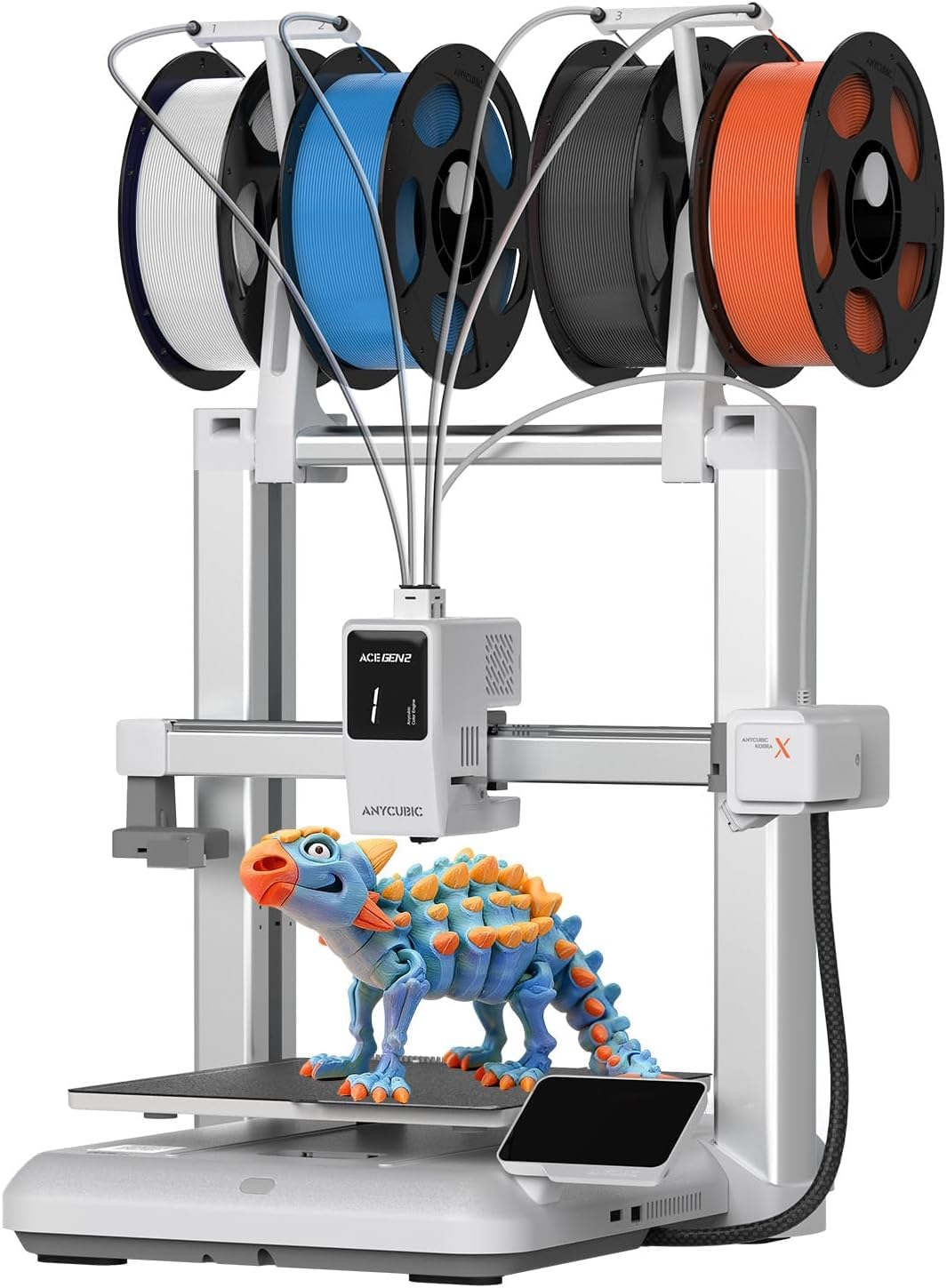
Multicolor printing is usually an expensive add-on, but the Kobra X builds four colors in from the start, and the palette can expand to 19 colors with additional ACE 2 Pro units. That is a big deal for a teen who wants prints to look finished rather than monochrome. It backs that up with real speed: a 600 mm/s maximum and hardened steel nozzle, with the maker claiming a 14-minute Benchy benchmark.
Getting a good first layer is handled by the LeviQ 3.0 leveling system, which uses a 49-point calibration and is described as ready to print 15 minutes after unboxing. The 260 × 260 × 260mm build volume is among the largest here, and dual-band 2.4G/5G WiFi with LAN support keeps remote monitoring stable. Owners mention excellent print quality and genuinely fast project turnaround.
The most-discussed aspect is reliability, and it comes with mixed feedback — some customers note flawless runs, while a few ran into clogging or feed trouble after a couple of months. TPU also tends to string on this machine. Overall it is a strong multicolor choice whose long-term consistency can vary unit to unit.
Colour without the add-on: It prints in four colors right from the start and can expand to 19 colors, so your teen can make multi-colored models without buying extra hardware — unlike single-color rivals.
Fair warning: Reliability and clogging feedback is mixed, and TPU prints tend to string.
Made for: a teen who wants colorful, fast prints and a large build volume straight away.
Look past it if: rock-solid long-term reliability matters more to you than multicolor fun.
8. Creality K1C 3D Printer

For the teen who wants an enclosed, quieter machine that handles tougher filament
The K1C stands out for two reasons a parent usually cares about: an enclosed chamber and a quieter footprint. Its silent mode drops noise to 45dB, and the enclosed design plus activated carbon filtration helps manage the odors that tougher filaments produce. It also ships with an AI camera as standard, so you can check on a print remotely and catch problems like foreign objects or failed extrusion.
Speed is not sacrificed for the enclosure. A CoreXY system pushes a 600 mm/s maximum with a 20,000 mm/s² acceleration figure. The clog-free direct extruder and tri-metal “Unicorn” nozzle handle wear-resistant filaments like PLA-CF and PET-CF, and one-tap auto-calibration readies the bed for a level first layer. Owners rate build quality and setup among the top strengths here.
Reliability is the aspect most discussed, and it comes with mixed feedback — some machines run for months without issue, while others report failures within weeks. Durability reports are similarly split. That makes the K1C a rewarding pick for a patient teen but a gamble for anyone wanting a hands-off first machine.
Quiet and contained: A 45dB silent mode, enclosed chamber and carbon filtration make it the cleanest choice for a shared bedroom.
The honest risk: Reliability and durability feedback is mixed, so some units need support attention early.
Good match for: a teen who wants an enclosed, quieter printer for advanced filaments like carbon fiber.
Hold off if: you need guaranteed out-of-the-box reliability above all else.
9. Bambu Lab P1S 3D Printer

The full-size enclosed workhorse for a teen who has gone all-in on making
If your teenager has moved past trinkets and wants a serious enclosed machine, the P1S is the premium answer. Its fully enclosed body improves print performance for advanced filaments, and with the Bambu Lab AMS connected it can print up to 16 colors. Setup takes about 15 minutes, and the maker lists a 500 mm/s speed with a 20,000 mm/s² acceleration figure, plus auto bed leveling for a clean first layer every time.
Its build volume matches the Kobra X at 260 × 260 × 260mm (about the size of a small microwave), so your teen can print large models. It handles a wide range of filament (the plastic string that feeds the printer) — PLA, PETG, TPU, PVA, PET, ABS and ASA on the ideal list, with PA and PC supported. Reviewers point out that ease of use is what they praise most, with quick setup a close second. The enclosing chamber (a closed box around the print area) is repeatedly called out as a plus for materials like ASA that need a controlled environment.
The realistic snags are minor but worth knowing. Build quality and adhesion both draw mixed feedback, a rare unit develops feed trouble after the first month, and this machine does not like carbon or glass fiber reinforced filaments. It is also the heaviest pick here at 38.9 pounds, so it stays put. For a committed young maker, none of that dulls the appeal.
Built for serious makers
- Fully enclosed body improves results with advanced filaments
- Up to 16 colors with the AMS for eye-catching prints
- Quick 15-minute setup and auto bed leveling
Worth knowing
- Carbon and glass fiber reinforced filaments are not recommended
- Build quality and adhesion feedback is mixed, and it is heavy at 38.9 pounds
The premium choice for: a teenager ready for an enclosed machine and multi-color printing at scale.
Overkill if: your teen is just starting out and may not stick with the hobby.
Understanding the Specs
Acceleration vs Top Speed
Acceleration (measured in mm/s²) is how quickly the print head reaches its top speed, while top speed (in mm/s) is the ceiling it can hit. Both matter for how fast a print finishes, but acceleration is what makes a machine feel snappy on real models. For a teenager printing toys and small parts, strong acceleration keeps wait times short without needing the absolute highest top speed.
Build Volume And What Fits
Build volume is the printable box, listed as width × depth × height in millimeters. A mini printer around 100mm handles miniatures, keychains and trinkets, while a 220mm or 260mm cube fits larger props, figures and functional parts. Match this to what your teen actually wants to make, because upgrading later means buying a whole new machine.
Auto-Leveling And First-Layer Success
Auto-leveling measures and adjusts the gap between the nozzle and the print surface so the first layer sticks evenly. It removes the single biggest source of beginner frustration. Some machines go further with one-tap self-tests and multi-point calibration, both of which keep a teen printing instead of troubleshooting.
Filament Types And Enclosure
Filament is the plastic spool the printer melts layer by layer. PLA is the easiest, lowest-odor choice for a bedroom, while PETG, ABS, TPU and ASA offer different strengths but often want more heat or an enclosed chamber. An enclosed body or air filtration system helps manage the output of higher-temperature filaments, which matters in a home setting.
FAQ
Is a 3D printer safe for a teenager to use alone?
How long does it take to set up a beginner 3D printer?
What is the difference between auto-leveling and manual leveling?
Do I need an enclosed 3D printer for a teen’s bedroom?
Which filament should a beginner start with?
How big a print volume does a teenager actually need?
Can these 3D printers run from a phone app?
What maintenance does a teen’s 3D printer need?
Is multicolor printing worth it for a beginner?
Do these printers need a special power supply or circuit?
Final Thoughts: The Verdict
For most families, the 3d printer for teenagers winner is the Bambu Lab A1 because it takes calibration off the table and lets a beginner print reliably from the start. If your teen is captivated by multicolor and fast results, grab the Anycubic Kobra X. And for those first playful projects in a small space, the fully assembled TINA2S Starter Kit is the one to reach for.
One practical tip before you buy: match the machine to where your teen is right now. A nervous first-timer does best with an auto-leveling beginner model, while a committed young maker will get far more from a larger, faster machine.
How We Picked
We do not accept paid placement. Every pick is matched to a real buyer and a real use-case; we do not hands-on test units.
Sources & Methodology
Specifications: manufacturer listings and product documentation. Review insights: verified customer reviews, as of September 2026. Pricing: not shown on this page (it changes often); check the current price via the retailer link.
As an Amazon Associate, Gadgets Feed earns from qualifying purchases. This does not affect which products we feature.