
Our readers keep the lights on and my morning glass full of iced black tea. As an Amazon Associate, I earn from qualifying purchases.
Specs are compiled from manufacturer listings and verified buyer reviews and can change over time — please confirm the key details on the product page before buying.
Most failed prints are not your printer’s fault — they start at the spool. If your nozzle keeps clogging, your layers keep splitting, or your filament snaps mid-print, the fix is usually a better-rolled spool with a tighter diameter spec. This guide sorts out nine real PLA options, what each does best, and which fits the printing you actually do. Silk showpieces, high-speed blends, and workhorse rolls all behave differently, and the wrong pick wastes time and material.
I’m Min — the founder and writer behind Gadgets Feed. This guide is built by comparing the manufacturers’ published specifications and the patterns across verified customer reviews, so you get each pick’s real strengths and trade-offs instead of marketing spin.
Every spool below is judged on the three specs that trip up new printers: diameter tolerance, print temperature, and speed ceiling. Whether you print glossy decorative pieces or tough functional parts, this breakdown of the best 3D PLA filament turns your next roll into a straight comparison.
Our Picks at a Glance


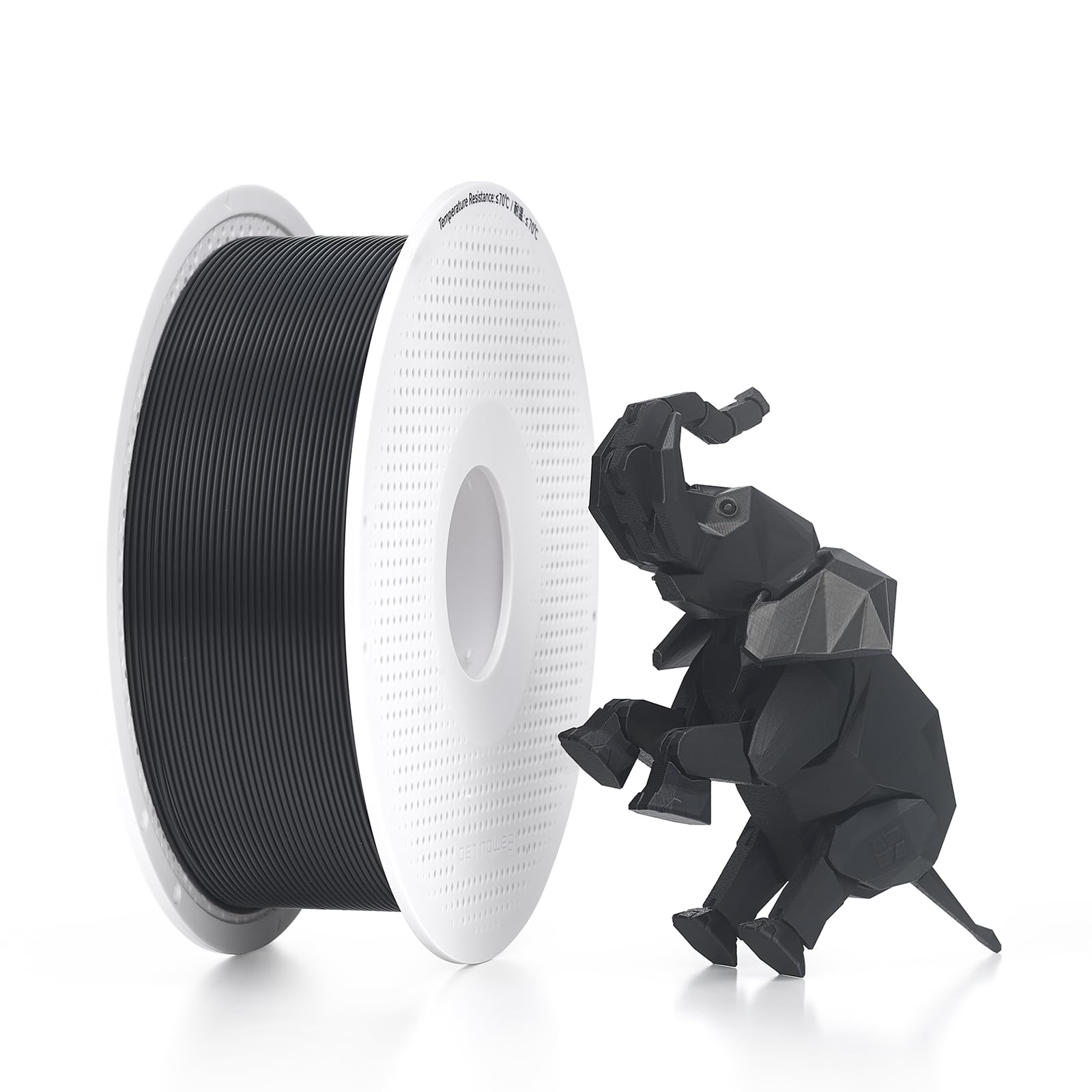
How To Choose The Best 3D PLA Filament
PLA is a plastic filament made from renewable plant starches, and it is the easiest material to print with because it melts at low temperatures and lets you work without a heated chamber. Almost every spool here is sold in the same 1.75mm diameter, so the real differences hide in three things: how tightly the width is controlled, how the surface looks, and how fast your printer can push it.
Diameter Tolerance Decides Your Clogs
A 1.75mm spool is never perfectly round, so the maker lists a tolerance — the allowed plus-or-minus wobble in that width. At ±0.02mm the filament feeds like a ruler-straight rod, so your layers stay even and you almost never jam the nozzle. At wider specs, a fat spot can drag in the hot end and a thin one can starve the layer.
Finish Changes How Your Print Looks and Feels
Standard PLA dries to a matte everyday surface. Silk blends, spun with an additive that makes them glossy, come out shiny and hide layer lines on display models — but they tend to be a touch more brittle. Matte finishes take the glare away entirely, so filling, sanding, and paint grab evenly with nothing to strip first.
Match Spool Count to How You Print
Single 1kg spools suit one-color projects and long pieces you print in a session. If your printer has a multi-color system, start with a bundle of 250g rolls, because small spools let you stack several colors in one print without risking a half-used kilogram drying out.
Quick Comparison
| Model | Best For | Diameter Tolerance | Spool Weight | Material | Amazon |
|---|---|---|---|---|---|
| LANDU Silk Tri-Color PLA★ Best Overall | Glossy display prints | ±0.02mm | 1 kg | Polylactic Acid | Amazon |
| iSANMATE Matte Tri Colors PLABest Color Shift | Rapid color shifts | ±0.03mm | 0.5 kg | Polylactic Acid | Amazon |
| Bambu Lab PLABest for Bambu Printers | Bambu AMS owners | ±0.03mm | 1 kg | Polylactic Acid | Amazon |
| Kretrum Silk Dual Color Bundle | Variety on a budget | ±0.02mm | 4 × 250g | Polylactic Acid | Amazon |
| JAYO Rapid PLA Bundle | High-speed printing | ±0.02mm | 8 × 250g | Polylactic Acid | Amazon |
| Creality PLA 4-Pack | Everyday reliability | ±0.02mm | 4 × 1 kg | Polylactic Acid | Amazon |
| ANYCUBIC PLA Multicolor Bundle | ACE Pro printers | ±0.02mm | 4 × 1 kg | Polylactic Acid | Amazon |
| ANYCUBIC PLA Plus Bundle | Tough functional parts | ±0.02mm | 4 × 1 kg | Polylactic Acid | Amazon |
| Dynta Beginner 250g Set | First-printer learning | ±0.02mm | 6 × 250g | Polylactic Acid | Amazon |
In‑Depth Reviews
1. LANDU Silk Tri-Color PLA Filament 1.75mm 1Kg
Our pick — over 4.5★ from 450+ verified ratings; the strongest balance of quality and price.
Three colors in one strand, and a glossy sheen that makes single-color prints look flat by comparison.
This is the spool you load when the finished piece is going on a shelf, not into a toolbox. It squeezes three colors — silk red, blue, and green — into a single strand, so the color shifts across your print as it rises, and the silk additive leaves a polished, reflective surface. That sheen means display models, gifts, and decorative pieces come off the bed looking like they were finished by hand, and you skip the sanding step entirely.
Where it wins is consistency of shape. The diameter holds to ±0.02mm — the tightest tolerance in this lineup — so the strand flows through the hot end without the fat spots that drag and jam. Owners lean on exactly that: the quality is what people bring up most, with color the runner-up. A maker running one of these on an AMS 2 in a Bambu P2S summed up the experience well: “I’m nearly done with the spool and all my prints have turned out great!” The glossy finish reads on everything from a 25mm mini to a full planter.
One tailored note on the roll itself: this is a 1kg spool at 35.27 ounces of material, enough for a long series of small prints or one large decorative piece. That is double the 0.5kg iSANMATE roll below, so you get roughly twice the print time between spool swaps. The honest trade-off is brittleness — silk PLA is stiffer than standard PLA, so slim thin parts can crack under force, and it belongs on display pieces rather than load-bearing ones.
silk sheen shifts hue
- ±0.02mm tolerance — the tightest spec here, so fewer nozzle clogs and cleaner layers
- Tri-color silk red, blue, and green in one strand, so gradients happen with zero extra setup
- Neat, tangle-free winding that keeps long overnight prints feeding without knots
- Silk sheen hides layer lines and saves you post-processing
brittle after long prints
- Silk PLA runs more brittle than plain PLA — fragile on thin, load-bearing parts
- The multi-color effect is decorative, not a match for engineering parts that need full strength
display pieces: Buy this for decorative models, gifts, and any print that lives on display where the shiny color-shift is the point.
load-bearing parts: If you need tough functional brackets or clips that take load, standard PLA is the smarter spool.
2. iSANMATE Matte Tri Colors PLA Filament 1.75mm
Colors that flip fast enough that a single figurine shows several hues in one pass.
For anyone printing small, detailed objects that should look like a different color from every angle, this is the roll that surprises. It uses a coextrusion build — three colors pressed together into one strand — so the color shift kicks in over short distances rather than needing meters of filament to reveal the next shade. That matters most on compact prints like a 60mm rose or a little desk figure, where other brands barely rotate through one color before the model tops out. Color is the dominant topic among buyers for good reason.
It prints inside a wide temperature window of 190°C to 220°C, which is broader than typical PLA and gives you more room to dial in a clean surface, and it runs anywhere from 30 to 600mm/s. Dimensional accuracy sits at ±0.03mm. The filament arrives already dried for 24 hours and vacuum-sealed, so it is ready to load on arrival — though it pulls moisture easily, and a resealable aluminum foil bag between prints keeps it working.
The catch here is real and worth knowing before you buy. On a Bambulab P1S, buyers report the filament clogs the nozzle unless the glass top is removed so the chamber runs cooler. That is a printer-specific quirk tied to a hot build chamber, not a bad spool, but factor it in. This is a 0.5kg roll — half the material of the LANDU spool above — so it is best for sampling and small runs rather than a marathon batch of large pieces.
matte hides layer lines: A 205°C nozzle and 35°C bed produced clean results on a Centauri Carbon, with the color changing so quickly that rotating a printed rose showed a fresh palette on each side.
color shifts mid-spool: Makers printing multi-color miniatures, vases, and fast-turn decorative pieces who want the color banding tight rather than gradual.
miniatures: You print small, colorful objects and want the distinct hues packed into short lengths of filament.
clearance fits: You run an enclosed printer with a glass top on and want zero fuss — the spool and chamber heat do not always see eye to eye.
3. Bambu Lab PLA 3D Printer Filament 1.75mm RFID 1kg
The spool that sets its own temperature the moment you load it, if you own a Bambu machine.
If your printer is a Bambu Lab, this is the least-effort roll on the list. The spool carries an RFID chip — a tiny tag that talks to the printer — so Bambu Studio recognizes the filament automatically and loads the correct temperature, flow, and speed settings with no manual entry. That removes the single most common source of first-print failures: a wrong setting typed in by hand. It arrives with a reusable spool and holds ±0.03mm diameter accuracy, a spec the maker ties to smooth, bubble-free extrusion.
The word that keeps surfacing in buyer feedback is “flawless” — feeding smoothly, laying down clean layers, and staying free of clogs, stringing, and warping. Compatibility is the runner-up strength, since the roll is built to slot straight into Bambu’s AMS system and configure itself. A print-batch owner put it simply: “Can’t go wrong with Bambu filament in a bambu printer.” The package also pushes a greener angle, pairing the reusable spool with access to the MakerWorld model library.
The genuine caveat is brittleness, not of the fresh spool but of leftovers. Owners mention that older, brittle rolls can shed debris into the tubing, and clearing it out takes a bit of troubleshooting before a new roll feeds cleanly. Standard-PLA toughness means this is a solid everyday workhorse. And there’s your spec contrast: at ±0.03mm it holds a slightly looser tolerance than the ±0.02mm on the LANDU and Creality rolls — a real, if minor, difference that the auto-configured settings help offset.
Bambu owners: Bambu Lab owners who want to drop a spool in and let the printer set itself up with no guesswork.
open printers: Anyone on a non-Bambu printer, where the RFID advantage simply does not apply.
4. Kretrum Silk Dual Color 3D Printer Filament Bundle

Four two-tone silk spools in one box, so every print can wear a different pair of colors.
Instead of one big roll, this bundle hands you four 250g spools — rose and blue, red and gold, violet and green, and blue and green — each a dual-color silk that blends two shades as it prints and shifts as you turn the finished piece. The total material is 1kg, matching a single full spool, but split across four colors so your printer’s multi-color system can switch between them mid-print. Colors come out vibrant, and the surface carries the same glossy silk texture as the LANDU roll.
Precision is where this bundle quietly impresses. It holds ±0.02mm dimensional accuracy, and the spools are wound to feed without crossing turns. Buyers keep coming back for the color range — one family has reordered the same set more than once, and the colors hold up regardless of how far down the roll a print starts. Each spool arrives vacuum-sealed after drying, and the filament prints across a nozzle range of 190°C to 230°C, so it tolerates a fair bit of tuning room.
There are two things to plan for. Silk PLA is glazed and more brittle than standard PLA, so tiny parts with moving joints can snap under pressure, and the individual spools are small at 250g each. The spools themselves are cardboard rather than plastic, which is a cleaner choice once empty but needs a slightly gentler hand. Treat it as a color-exploration kit, not a high-volume bulk buy.
dual tone spools: Dual-color silk keeps the two shades shifting across a single print, so a rose or a phone stand looks hand-painted from any angle.
needs slow speeds: Small spools plus a brittle silk finish mean this bundle rewards decoration and light display parts over anything that takes a knock.
vase mode: Makers who want to experiment with several two-tone colors without committing a full kilo to any one shade.
fast drafts: You need one large continuous spool for oversized prints or tough functional parts.
5. JAYO Rapid PLA 3D Printer Filament Bundle 2KG
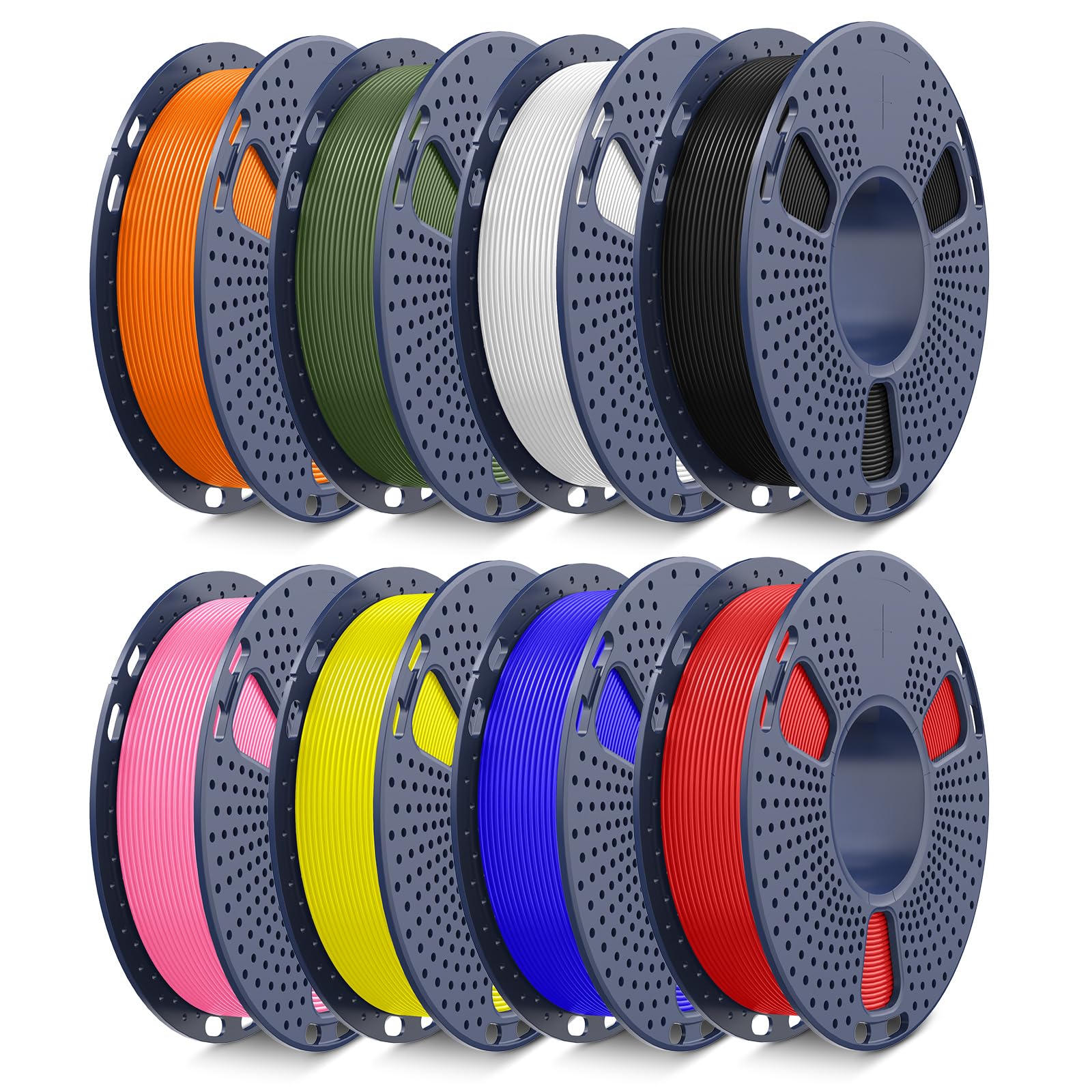
Built to keep up when your printer is running flat out at high speed.
Most PLA starts to under-extrude when you push a fast printer hard — the strand cannot melt and flow quickly enough. This is the roll formulated to keep up. It claims a printing range from 50mm/s all the way to 600mm/s, with a ±0.02mm tolerance that keeps the bead even no matter how fast the head is moving. Owners run it at both everyday and high speeds: it draws clean lines at 60mm/s and holds quality at 350mm/s, the sort of pace where slower blends start to struggle.
The bundle unpacks eight 250g spools for 2kg total across black, white, blue, red, pink, orange, yellow, and olive green. Quality is what buyers praise most, with value for money a close second — eight colors in one box covers a lot of projects without buying eight separate rolls. Each spool is dried for 24 hours and vacuum-sealed, and the fast-cooling blend is tuned to hold up on overhangs, so bridges and steep angles sag less. Filament clips keep the loose ends tidy between sessions.
Here is the one thing that keeps it from perfection. On a Creality K1C pushed to 300mm/s at 230°C, the prints came out fast and clean, but a knot showed up a quarter of the way into one spool, forcing a pause to sort out the tangle. Almost all the feedback is positive, and that single snag is easy to clear if you watch the first layer. And worth the comparison: this bundle splits 2kg across eight 250g spools, so you get a lot of sampling room, unlike the single-color 1kg rolls — great for color changes, less so if you just want one long continuous print.
bulk brackets: You run a fast printer and want a bundle of colors that keeps pace without under-extruding at speed.
fine detail: Your machine tops out at slow speeds, in which case a standard PLA roll costs less for the same result.
6. Creality PLA 3D Printer Filament 4KG

Four full kilos of the black, white, blue, and red you burn through on everyday parts.
This is the roll for the maker who prints constantly and wants no surprises. You get four 1kg spools in the four colors most people reach for — black, white, blue, and red — which is 4kg of material in one box, the most in this line-up. The PLA is made with low warping and low shrinkage, and it prints odorless, so it is friendly to run indoors in a home office or garage setup. The finish is a standard gloss rather than silk, a clean everyday look that suits brackets, tools, and replacement parts as much as display pieces.
It holds the tight ±0.02mm dimensional accuracy and is wound mechanically with a manual check so the line feeds evenly and avoids snaps and breaks. Buyers describe it as reliable across many rolls, with black and white doing most of the heavy lifting. One print-batch owner reports running it on a Bambu Lab PS1 AMS with no clogs, jams, tangles, or feed issues at all. Printability is the strength reviewers point to most: the spools feed smoothly and the results come out consistent.
The honest note here is color consistency from batch to batch, which is the most-discussed point and genuinely mixed — some rolls match beautifully and others run different shades of the same color, so do not rely on two spools of red matching across separate orders. A smaller, rarer gripe is winding: a roll here and there carries an overlap that needs a quick pause to sort. Both are a fair and expected trade-off on a value four-pack.
four kilo value: Four kilos across the classic four colors, precision-held at ±0.02mm, covers a serious run of prototyping and light-duty parts without a mid-project reorder.
spool storage bulk: If an exact color match matters for a multi-part build, print the pieces from a single spool rather than two.
print farms: Regular printers who want a big pile of the standard colors and reliable, low-hassle extrusion.
single spool users: You need matching colors across separate batches — silk or single-color rolls hold shade more tightly.
7. ANYCUBIC 3D Printer Filament Multicolor PLA Bundle 4KG
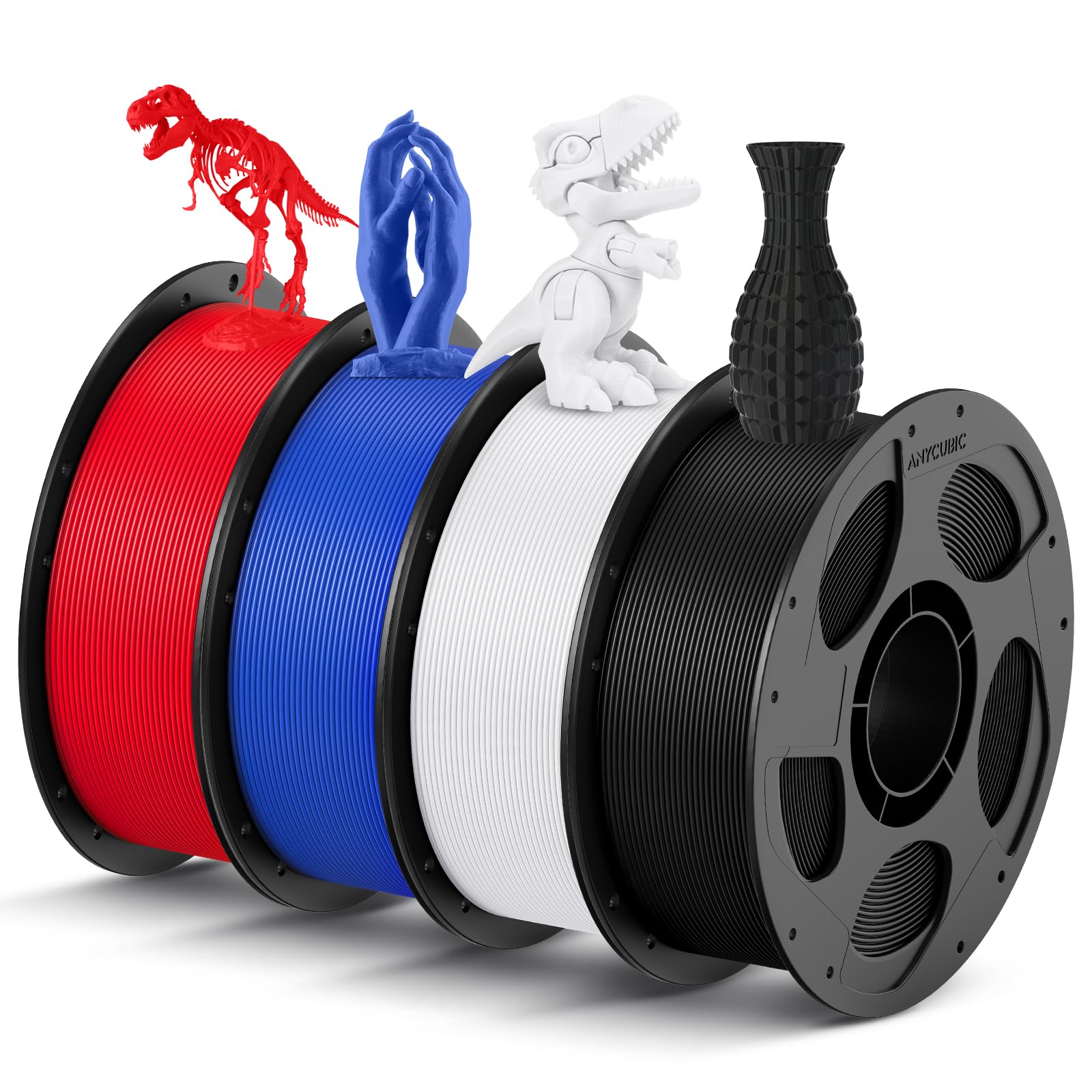
A four-kilo bundle that talks to Anycubic’s own multi-color system automatically.
If you own an Anycubic printer with the ACE Pro multi-color unit, this bundle does the setup for you. Each spool carries an intelligent identification chip that the ACE Pro reads, so the machine recognizes the filament and loads the right print information without you punching in settings by hand. The four 1kg spools come in black, white, blue, and red, giving you the core colors in one delivery. Diameter holds to ±0.02mm, which keeps the flow even so the layers merge cleanly and bridging comes out tidier.
The winding is the quiet win. Each spool is rolled so the strand leaves without crossing turns, which cuts the pulling and twisting that leads to clogs, and it resists warping while giving a glossy finish. Quality is the top thing buyers praise, with performance a close second — the vivid colors print sharp, and one AllHallows user put it to work on 100cm lithophane boxes that held up well. The spools also fit the AMS2 Pro, so they play nicely beyond the Anycubic ecosystem too.
The real-world wobble to know about is a single-color dud within the pack. Customers note that red has been the temperamental one — running awful while the other three print great, most likely from a higher-moisture spool. It is rare, isolated to one color in an otherwise strong four-pack, and easy to address by drying the roll. The spools are fully reusable, so the hardware keeps working long after the filament is gone.
gift sets: Anycubic owners running the ACE Pro who want plug-and-print color swaps with auto-recognized spools.
color matching: You want guaranteed quality across all four colors with no chance of one roll underperforming.
8. ANYCUBIC PLA Plus (PLA+), 3D Printer Filament 1.75mm Bundle
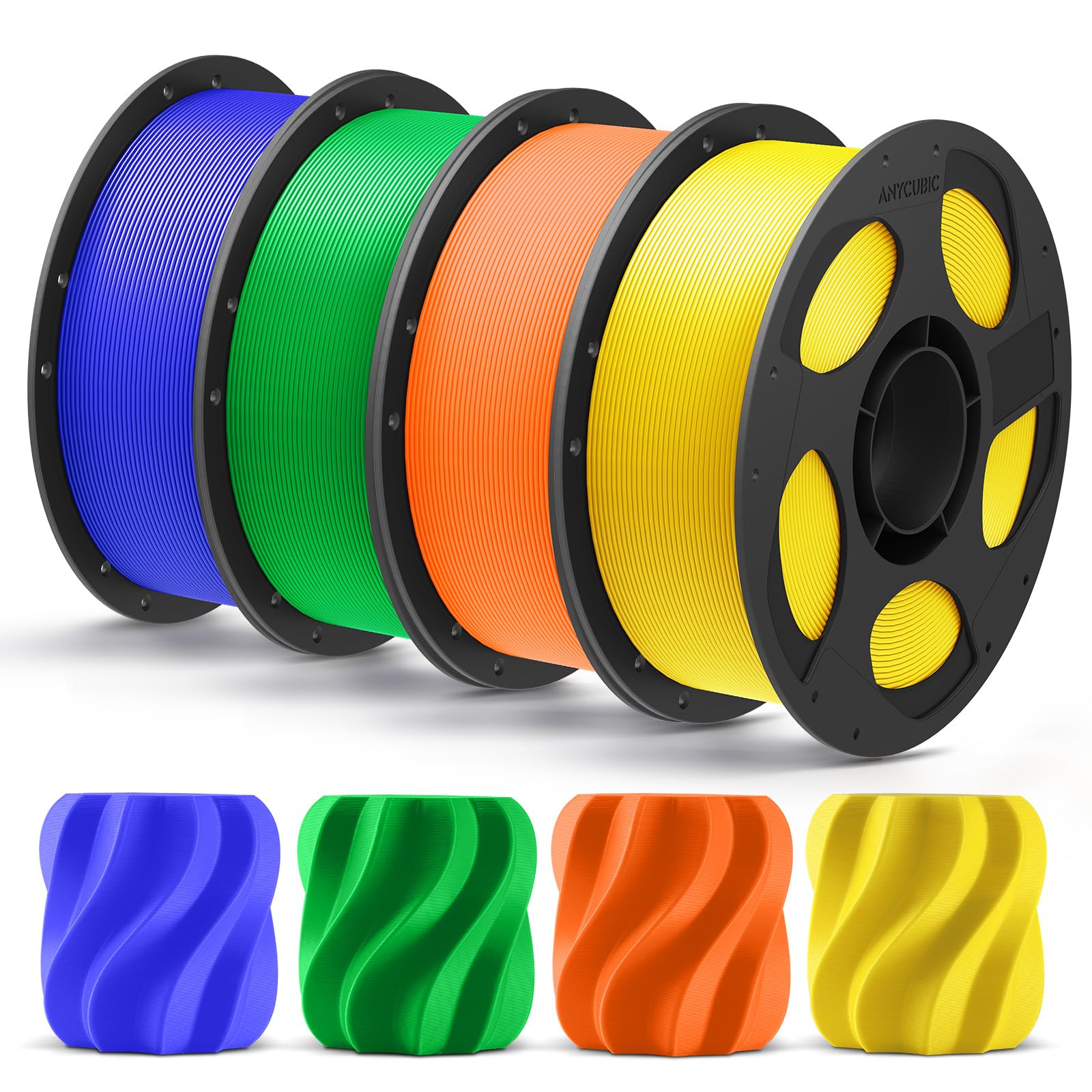
Standard PLA’s stiffness, dialed back toward impact resistance for parts that take a hit.
PLA+ is the middle ground between easy-printing standard PLA and tougher engineering plastics. This blend is developed for high toughness and a degree of impact resistance, so it resists snapping when a finished part gets knocked around and suits things like craft models, artwork, and light engineering components. It holds ±0.02mm dimensional accuracy with minimal shrinkage, which together keep the layers bonded and hold off the cracks and warping that ruin fine prints. It also runs across most FDM printers and even 3D printing pens, so it travels across whatever machine you own.
You get four 1kg spools in blue, green, orange, and yellow — bold colors that steer clear of the usual black-and-white utility set. The winding is tidy, left with no crossing turns, and the spools easily lock the filament in place after a print so the loose end does not spring free. Quality is the aspect buyers praise most here, and PLA+ earns its keep as a step up from standard PLA for parts that need to hold shape under a little force.
The card to play here is spool-winding sharpness. Reviewers point out that a winding defect can stop the filament from unwinding cleanly mid-print — one run stalled a 17-hour print with two hours to go — and the seller’s response to that was fast, offering a replacement roll or refund. That is a rare event on an otherwise tidy bundle, but the fix is simple: check a new spool unwinds freely before kicking off a long job.
tougher than basic: Four kilos of tough PLA+ in vivid colors, precision-held at ±0.02mm, takes the everyday print in a more durable direction than standard PLA allows.
stringy at high temp: Give a fresh spool a quick test-unwind before a marathon print and the winding risk disappears.
functional parts: You want sturdier, tougher parts than standard PLA gives and prefer a bolder color set than the usual core four.
decor only: Purely decorative prints, where standard PLA does the same job for less.
9. Dynta 250g PLA 3D Printer Filament for Beginners

Six small spools that let a new printer owner try every color before committing to a full kilo.
The first thing a new printer owner does is burn through experiments, so a set of six 250g spools — black, white, red, green, blue, and purple — for 1.5kg total is a smart starting point. You learn how each color prints and how your machine behaves without sinking a full kilogram into one shade you might not even like. The spools are wound onto a 53mm universal narrow bore, made to fit mainstream machines like the Creality Ender-3 V3 series, Bambu Lab A1 mini, and FlashForge Adventurer 5M without a custom bracket.
Each roll, dried and vacuum-sealed with a desiccant packet, stays tangle-free and bubble-free out of the bag, and the ±0.02mm accuracy holds the flow steady. The printing window is wide at 190°C to 230°C on the nozzle and 45°C to 60°C on the heated bed, which makes dialing in a first profile forgiving. The blend is made from renewable plant starches — corn, cassava, and sugarcane — so the material itself is plant-based. Reviewers report clean results on everything they printed, with no clogging.
Two things matter before you buy. The narrow 53mm spool fits standard axles but not extra-thick holders over that bore, so check your printer’s axle width first. The maker’s own guidance is to use the set within three months of opening for best results.
first printer: You are new to printing and want an affordable way to sample colors and learn your machine on small jobs.
large projects: You have a printer with an axle wider than 53mm, where this narrow spool simply will not seat.
Understanding the Specs
Diameter Tolerance
This is the plus-or-minus wiggle allowed in the 1.75mm width of the filament — the single number that decides how reliably it feeds. A tighter tolerance like ±0.02mm means the strand stays close to its stated width, so it extrudes evenly and rarely jams the nozzle. A looser tolerance like ±0.03mm leaves a little more room for a fat spot to drag or a thin one to starve your layer. For prints that need crisp detail and long unattended runs, reach for the tightest spec you can find.
Print Speed and Temperature Range
The temperature range is the window of nozzle heat the filament tolerates, such as 190°C to 220°C or 190°C to 230°C, and a wider window is easier to tune for a clean surface. Print speed is how fast your printer can push the strand before the material cannot melt fast enough — a fast blend handles the high-speed setting on a quick printer, while a standard roll is happiest at everyday speeds. Match the speed rating to what your machine can actually do.
FAQ
Will 1.75mm PLA work in my 3D printer?
What does diameter tolerance mean for my prints?
Is silk PLA as strong as standard PLA?
What temperature should I print PLA at?
Can I use these PLA spools with a Bambu Lab AMS?
How do I keep opened PLA filament from going bad?
Are small 250g spools worse than 1kg spools?
Is fast-printing PLA worth it for a slower printer?
Final Thoughts: The Verdict
For most makers, the 3d pla filament winner is the LANDU Silk Tri-Color PLA — rated 4.7 stars by 400+ owners, with the tightest ±0.02mm tolerance here and a tri-color silk sheen for display prints. If you run a Bambu Lab machine and want the spool to configure itself, grab the Bambu Lab PLA. And for high-speed printing across eight colors, the JAYO Rapid PLA Bundle is the one to reach for.
How We Picked
We do not accept paid placement. Every pick is matched to a real buyer and a real use-case; we do not hands-on test units.
Sources & Methodology
Specifications: manufacturer listings and product documentation. Review insights: verified customer reviews, as of September 2026. Pricing: not shown on this page (it changes often); check the current price via the retailer link.
As an Amazon Associate, Gadgets Feed earns from qualifying purchases. This does not affect which products we feature.