
Our readers keep the lights on and my morning glass full of iced black tea. As an Amazon Associate, I earn from qualifying purchases.
Specs are compiled from manufacturer listings and verified buyer reviews and can change over time — please confirm the key details on the product page before buying.
If your curves come out wavy and your resaw cuts wander, the saw is rarely the villain — blade tension, guide bearings, and motor power are. This guide sorts ten real benchtop and floor-standing bandsaws by the specs that actually change your cuts: throat depth, resaw height, motor amps, and blade length.
I’m Min — the founder and writer behind Gadgets Feed. This guide is built by comparing the manufacturers’ published specifications and the patterns across verified customer reviews, so you get each pick’s real strengths and trade-offs instead of marketing spin.
Bandsaws cut curves and resaw thick stock in one pass, so matching blade length and cut height to your projects matters more than brand name. Below, the bandsaw for woodworking picks are ranked by real cut capacity.
Our Picks at a Glance

How To Choose The Best Bandsaw For Woodworking
A bandsaw is a narrow blade running on two wheels, and everything that goes wrong in a cut traces back to four numbers: resaw height, throat width, motor amps, and blade length. Get those right for your projects and the rest is tuning.
Resaw Height and Throat Depth Set Your Limit
Resaw height is how tall a board you can stand up and slice — a saw with 3.5 inches of cut height handles small craft stock, while 13 inches lets you split thick slabs in one pass. Throat depth is how far the blade sits from the column, and it decides how wide a panel you can steer through a curve.
Motor Amps and Speeds: Hardwood Versus Softwood
Motor amps tell you how much resistance the saw pushes through before it bogs down in dense hardwood like oak or maple. Two-speed saws let you drop to a slower feet-per-minute (FPM) setting for hardwoods and spin faster for softwoods and plywood.
Blade Length, Blade Width, and Dust Collection
Each saw runs one blade length, so write it down before you order replacements. Width matters too: a narrow blade cuts tight curves, while a wider blade tracks straighter for resawing. A dust port keeps the cut line visible, and the bigger the port, the less you sweep up afterward.
Quick Comparison
| Model | Best For | Cutting Height | Throat / Width | Motor | Amazon |
|---|---|---|---|---|---|
| Band Saw, 10-Inch Dual-Speed★ Best Overall | Curves and multi-angle work | 4-3/4 in | 9-5/8 in | 1/2 HP, 5.3 A | Amazon |
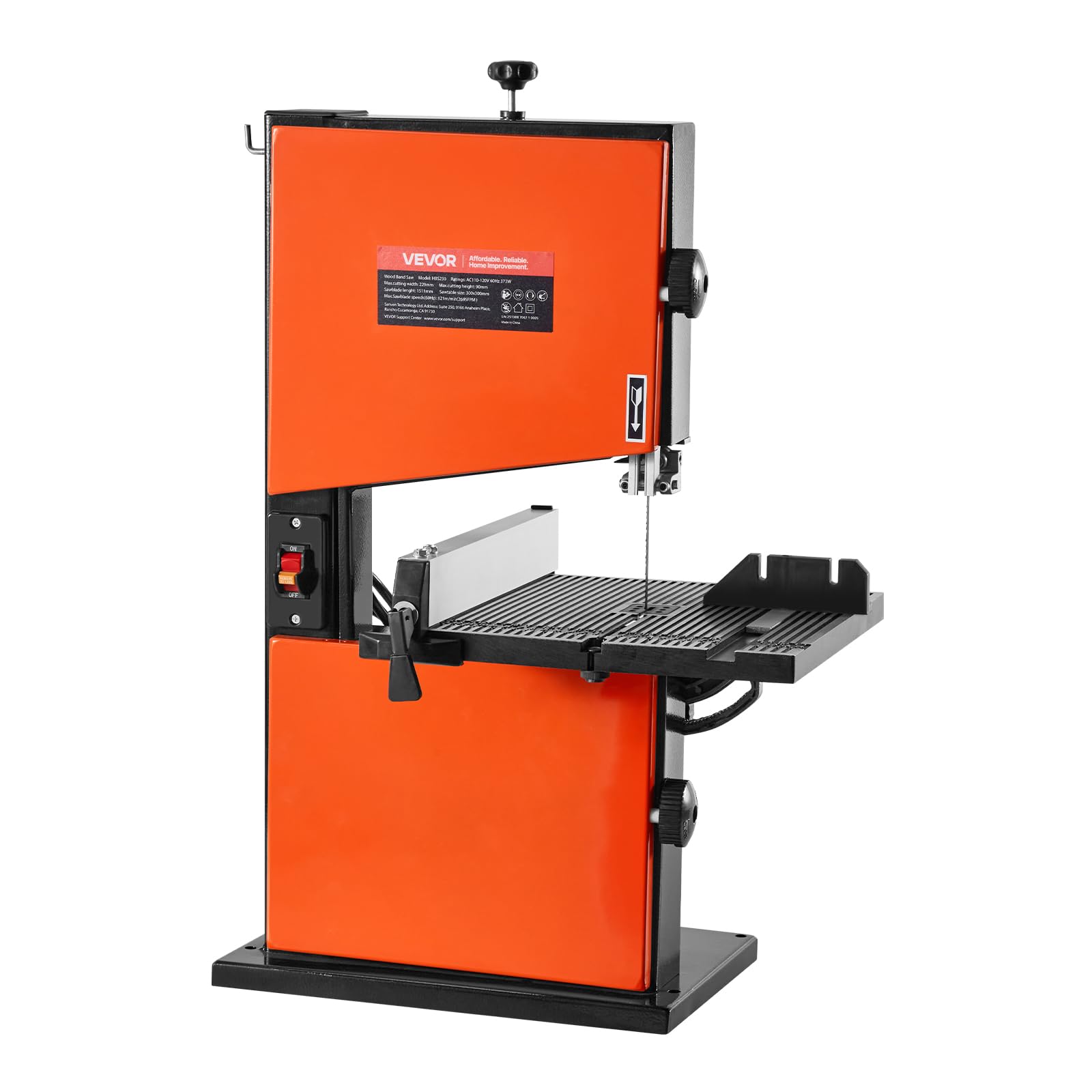
| VEVOR 9-Inch BenchtopBudget Entry | Small-shop benchtop entry | 3.5 in | 9 in | 1/2 HP, 373 W | Amazon |
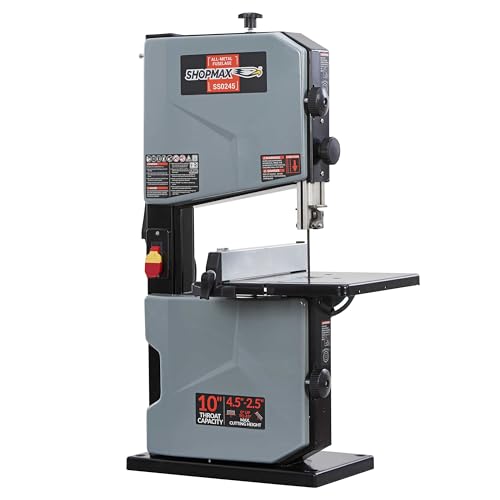
| SHOPMAX 10-inch BenchtopBuilt Heavy | Heavy steel build on a budget | 4.5 in | 10 in | 4.2 A | Amazon |
| 9 Inch Benchtop (VIGO POWER) | Quiet home workshop cutting | — | 9 in | 2.8 A, 1725 RPM | Amazon |
| WOODSKIL 10-Inch with Stand | Furniture and panel work | 5-1/8 in | 10 in | 3.4 A | Amazon |
| WEN 10-Inch with Stand | Weekend-warrior resawing | 6 in | 9-3/4 in | 3.5 A | Amazon |
| Rikon 10 Inch with Stand | Carving and small projects | — | 10 in | — | Amazon |
| JET 14″ JWBS-14SFX | Serious resawing in a home shop | 13 in | 13-1/2 in | 1.75 HP | Amazon |
| Laguna MBAND1412-175 | Large-table curve and resaw work | 12 in | — | 1-3/4 HP | Amazon |
| JET 15-Inch JWBS-15 | Production-level resawing | — | 15 in | 1-3/4 HP, 15 A | Amazon |
In‑Depth Reviews
1. Band Saw, 10-Inch Bandsaw for Woodworking, 1515 & 3280 FPM Dual-Speed Bandsaw
Our pick — over 4.5★ from 90+ verified ratings; the strongest balance of quality and price.
Two speeds (1515 and 3280 FPM) and a 20.5 x 17.5-inch steel table cover hardwood and softwood in one benchtop saw.
Here is the tightest combination of capability and price on the list: a 20.5 x 17.5-inch steel table, a 70-1/2 inch blade, and a 1/2 HP, 5.3 amp motor that handles both hardwoods and softwoods without swapping machines. Switch to the 1515 FPM low speed for oak and maple — the slower blade clears chips without burning the edge. Crank it up to 3280 FPM and softwood, plywood, and pine sail through with a finish that rarely needs sanding.
Capacity is where this saw earns its keep. You get 4-3/4 inches of cut height and a 9-5/8 inch throat, so you can slice cabinet panels and cut tight curves on the same setup. The table tilts 45 degrees right and 5 degrees left, which covers bevel joints and most angled trim work. A quick-release lever drops blade tension in one pull, so a blade change is a two-minute job instead of a stripped-knuckle wrestling match.
The honest trade-off lives at the fence. The dual-sided fence assembly’s unanchored end can shift when you lock it down, so if you’re chasing a perfect rip line on a wide board, clamp or re-check it first. The adjustability that makes this saw so flexible is also its most finicky feature — expect to spend setup time dialing in the guide bearings before chasing tolerances.
What Earns It Top Spot
- Two speeds (1515 and 3280 FPM) cover hardwood and softwood in one machine
- 1/2 HP, 5.3 amp motor starts fast and holds power without stalling
- Quick-release blade tension makes swaps fast
- Detachable dual-sided fence lets you work either side of the table
- 2.5-inch dust extraction port keeps the cut line visible
Where It Costs You Time
- The unanchored fence end can shift under clamping pressure
- Adjustability adds setup time before your first good cut
- At this weight and footprint it stays put once placed
Reach for this if: you want one benchtop saw that handles hardwood, softwood, bevel cuts, and general curve work with minimal fuss.
Look elsewhere if: you need to resaw tall slabs or cut very wide panels — this class of saw tops out at 4-3/4 inches of cut height.
2. VEVOR Band Saw, 9-Inch, Woodworking Benchtop Bandsaw with 1/2 HP Motor
A 60-inch blade and 9-inch cut width make this a light-duty starter saw for softwood trim and craft cuts.
If your projects are trim, small boxes, and craft cuts under 3.5 inches tall, this saw covers the basics without eating bench space. The 60-inch blade and 9-inch cut width keep it firmly in the light-duty lane, and the 11.8 x 11.8-inch cast aluminum table tilts 45 degrees right and 5 degrees left for angled cuts. A key-detachable switch means you can lock the saw out when it’s sitting idle, which is a quiet nod to anyone sharing a garage with kids.
On softwoods and pressure-treated stock it does the job, and owners who moved up from a tired 12-inch saw report the compact footprint suits small shops. Cut to the hardwoods, though, and the story changes — the motor bogs down on walnut, oak, and maple when you push a thicker piece through. Buyers report the assembly and blade alignment can demand patience; one frustrated owner documented hours of setup work and a missing retaining ring. That’s a design trade-off you need to know before buying.
One source of friction that owners mention repeatedly: replacement parts are hard to source, so a broken guide or worn part means buying a whole new machine. If you value fixability, weigh that against the low entry price.
Where it fits: beginners cutting softwood trim and simple curves under 3.5 inches tall, or anyone who needs a benchtop unit with minimal footprint.
The honest limit: hardwood resawing isn’t the job for this motor — the half-horsepower setup stalls when the wood density climbs.
Buy it for: light-duty work, softwoods, small shop corners, and getting your feet wet without a big commitment.
Don’t buy it for: hardwood ripping or anything that needs a strong, consistent push through dense stock.
3. SHOPMAX 4.2 Amp 10-inch Benchtop Band Saw
The 4.2-amp induction motor drives 4.5-inch-deep cuts and 10-inch widths with low vibration.
Pick this one up and the first thing you notice is weight — 54.7 pounds against the VEVOR’s 40.8 pounds. That extra mass sits right where you want it on a benchtop saw, quieting vibration and giving you a stable base while you push stock through. The 4.2-amp induction motor handles 4.5-inch-deep cuts and 10-inch widths, and the numbers back up the price gap against the VEVOR: 4.2 amps vs 5.3 amps on the dual-speed pick, with a wider 10-inch cut width than either 9-inch saw.
The 67.4-inch blade (with blade stock from 0.14 to 0.47 inches) means wider blade options for straight resaw runs. Quick worktable tilts up to 45 degrees, and the fence setup is designed for curved work where you want stability instead of a wobbly miter gauge. Ball bearings under the table carry the workload without the rumble you feel on cheaper saws.
The caveat is the old one with heavy benchtop saws: at nearly 55 pounds it’s semi-portable at best — a wheeled base is the practical upgrade. And because the cutting performance is more modest than the build, a beginner who wants one saw to do everything should look at the dual-speed pick above.
What Stands Out
- 4.2-amp induction motor runs smooth and quiet under load
- 10-inch width and 4.5-inch depth cut through a wide range of stock
- Heavy-duty steel construction at 54.7 pounds anchors the cut
- Ball bearings deliver smooth, accurate cutting
- Quick worktable angle changes up to 45 degrees
Where It Stops Short
- Cutting performance is honest but not to the dual-speed pick’s level
- Not portable at almost 55 pounds — plan on a cart or fixed spot
- Fence-focused design trades miter-gauge flexibility for stability
Best fit: woodcarvers and small-shop users who want a heavy, quiet, vibration-resistant benchtop saw with a 10-inch cutting width.
Skip if: you want a single machine to handle both heavy resaw runs and miter-gauge crosscuts — the range is tight here.
4. 9 Inch Benchtop Band Saw for Woodworking, 2.8A Portable Bandsaw
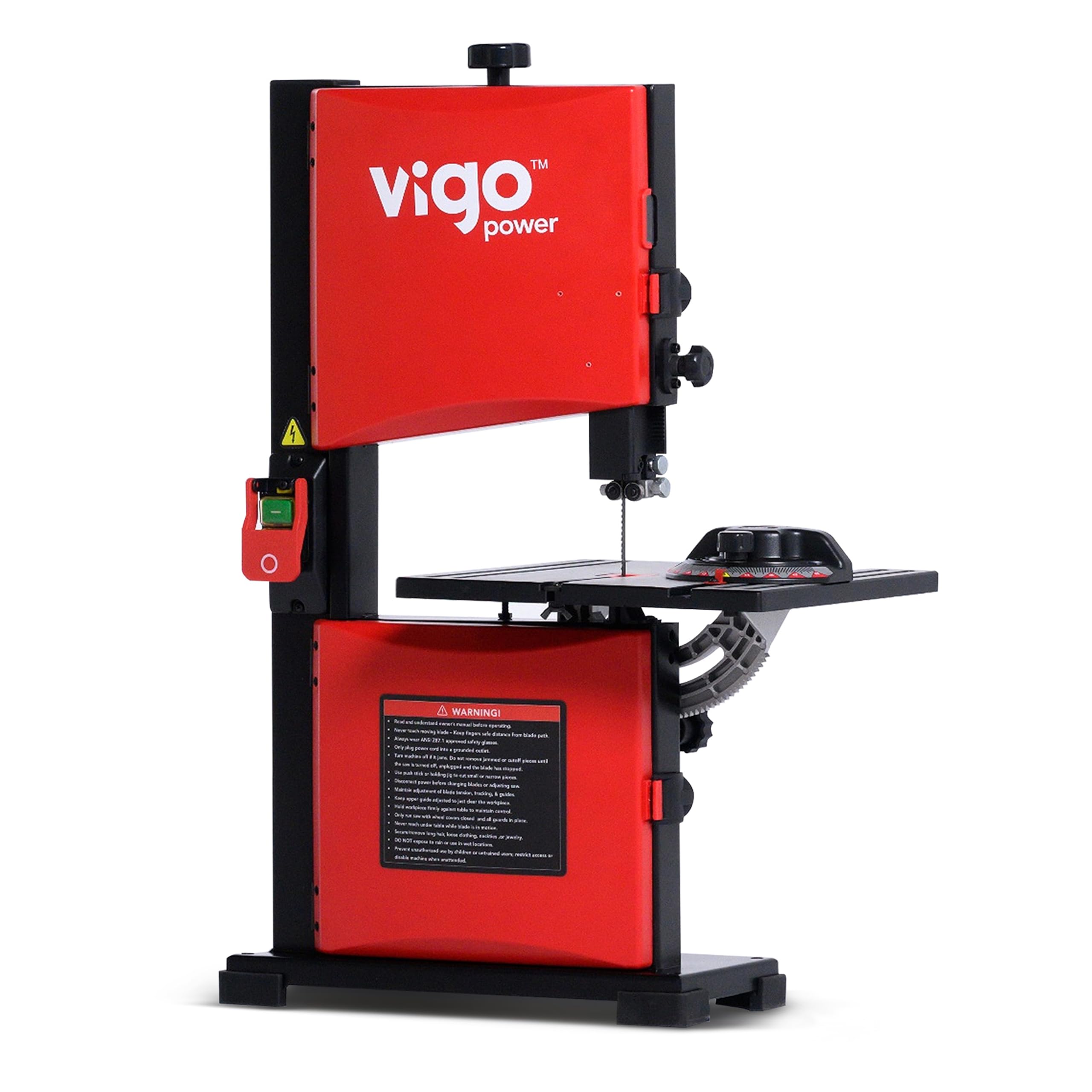
The 2.8-amp induction motor runs at 1725 RPM, trading peak power for quiet, low-vibration operation.
If a garage workshop means noise complaints, this is the saw to look at first. The 2.8-amp, 1725 RPM induction motor trades peak power for quiet, smooth operation and low vibration — a real advantage in a shared wall situation. The 12 x 12-inch cast aluminum table tops the SHOPMAX setup for workspace and still tilts 0 to 45 degrees for bevels.
Two speeds (1700 and 2500 FPM) cover wood, plywood, and plastic, and the built-in blade-tracking window lets you check blade position without tearing the housing apart. An oversized paddle switch and removable safety key give you quick shutoff and lock-out without hunting for a small toggle.
The honest trade: this machine isn’t built for hardwoods under load. A 2.8 amp motor is lighter than the SHOPMAX’s 4.2 amps and the dual-speed saw’s 5.3 amps, so it’s a light-duty curve and craft saw, not a resaw station. It runs quieter than either, but expect to feel it slow down on thick oak.
The case for it: quiet, smooth operation for a home garage, with a 12 x 12-inch table and two speeds that cover most everyday craft and DIY wood.
The catch: lighter motor output means hardwood work needs patience — feed rates on dense stock are slow, and a sharper blade helps a lot.
Right for: home DIYers, garage woodworkers, and anyone who needs low noise while working inside a shared space.
Wrong for: resawing hardwood slabs or running long production sessions — the motor output just isn’t sized for it.
5. WOODSKIL 10-Inch Benchtop Bandsaw with Stand, 3.4A Dual-Speed
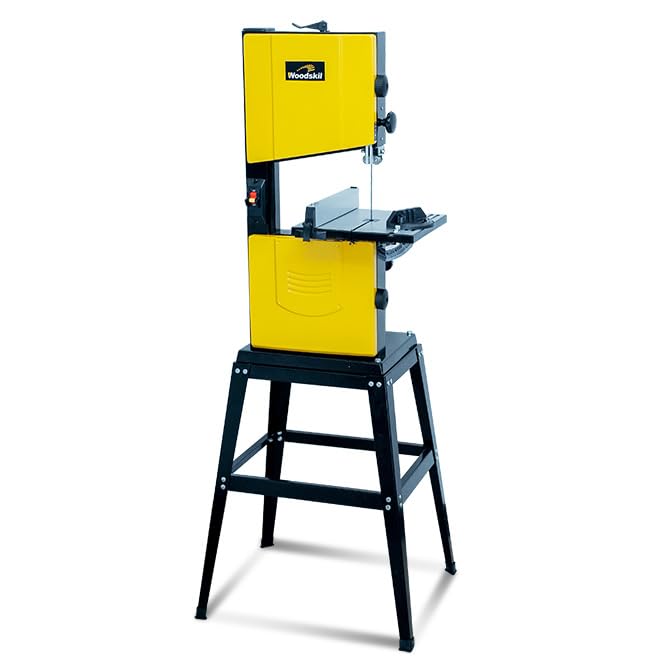
A 10-inch throat and 5-1/8 inch cut height handle cabinet panels, furniture legs, and 4×4 lumber in one pass.
Woodskil’s calling card is the quick tension system: one lift of the handle releases blade tension, and a rotation dials in fine adjustment without tools. For anyone swapping blades between a narrow curve blade and a resaw blade, that translates to minutes saved on every change. The stand is included, the 10-inch throat handles wide panels, and the 5-1/8 inch cut height accepts 4×4 lumber in one pass.
The 2360 and 3000 FPM speeds cover the two big jobs — slow for oak and maple, faster for softwood and plywood. And this saw gets two names right: users describe it as easy to use and adjust, and the value proposition comes up again and again. Blade tension, tool-free doors, ball-bearing guides supporting the blade — the details add up to a saw that runs cleaner than its price suggests.
Where buyers push back is blade durability and build feel: some note the stock blade doesn’t last on heavy resaw work, and the fence is functional but basic. That’s typical for this class, and a blade upgrade plus a careful fence setup clears most of it.
What People Keep Coming Back For
- Quick-lift tension handle speeds blade swaps
- Two speeds (2360 FPM hardwood, 3000 FPM softwood) handle a wide range
- 10-inch throat depth cuts wide cabinet and shelving panels
- 5-1/8 inch cut height clears 4×4 lumber
- Metal stand and included fence deliver a working setup from the start
The Real Friction Points
- Stock blade dulls quickly on heavy resawing — plan on an upgrade
- Build quality feels lighter than the price bracket suggests
- Fence is functional but not precision — dial it in carefully
Perfect fit: furniture builders and home shop users who want a stand-mounted saw with easy blade swaps and a 10-inch throat.
Not the pick if: you plan to resaw tall material daily — the 5-1/8 inch cut height and stock blade leave room for a stronger saw.
6. WEN Band Saw with Stand, 10-Inch, 3.5-Amp, Two-Speed (BA3962)

Six inches of cut height and a 9-3/4 inch width give this stand-mounted saw the deepest resaw capacity under the floor models.
WEN packs more capability into this stand-mounted saw than most of the benchtop crowd. The 3.5 amp motor drives cuts up to six inches deep and 9-3/4 inches wide — that’s the deepest cut height on this list short of the JET and Laguna floor models. The 14-1/8 x 12-1/2 inch cast aluminum table bevels up to 45 degrees, and the 72-inch blade accepts widths from 1/8 inch up to 1/2 inch.
The two speeds (1520 and 2620 FPM) cover the slow-hardwood / fast-softwood split, and users report it resaws 4-inch poplar without drama. This saw has built a following for being the class-over-par performer — one long-time owner noted cutting a 5.5 x 6.5-inch glued hardwood block into thin slices on this saw, which is right at the edge of its capacity.
The honest limits: the stock blade is basic, and experienced owners upgrade to a wider resaw blade for thicker material. Blade stability and adjustability draw mixed feedback, so plan on careful tuning before your first serious project. And the fence is a clamp-and-go affair rather than a precision tool.
The pitch: real six-inch resawing, a stand-mounted design, and a work light — the most cut height you can get in this price class.
The friction: stock blade is thin for serious resaw work, and the fence leans utilitarian — both easy upgrades but extra cost.
Choose it for: weekend-warrior woodworkers who need real six-inch resaw capacity and don’t mind a blade and fence upgrade down the road.
Pass on it if: you want a factory-tuned precision setup from the start — expect to spend setup time dialing the blade guides.
7. Rikon 10 Inch Bandsaw With Stand

A cast iron table and welded steel column and frame keep this 10-inch saw flat and vibration-free under load.
Rikon builds this saw around a cast iron table and a welded steel column and frame, which are two structural choices that separate a stable tool from a wobbly one. The tool-less upper and lower blade guides let you adjust blade support without hunting for hex keys, and the quick-release tension system brings blade swaps into the few-seconds range.
Owners who bought this for carving and small projects lean on two things: the small footprint that fits a tight shop, and the included 3/8 inch blade that cuts clean right from the start. Large tension hand wheel, 70.5-inch blade, 45-degree cutting angle — this saw handles curves and bevels without needing a lot of bench space.
The gripe on this class is resaw power: at 10 inches of capacity with a modest motor, pushing a 2×4 through for a full-height resaw can let the blade wander. The rip fence on Rikon’s version has a light-pressure drift that some owners have worked around by clamping it — worth knowing before you take on a long rip.
Why It Stays on the Bench
- Cast iron table stays flat and stable under load
- Tool-less upper and lower blade guides make adjustments fast
- Quick-release tension system and large hand wheel simplify blade changes
- Welded steel column and frame resist vibration
- Small footprint suits tight shop spaces
Where It Asks Patience
- Rip fence drifts slightly under load — clamp it for critical cuts
- Smaller-than-expected table feel relative to the spec sheet
- Resaw work needs slow, deliberate feeds
Pick it when: you want cast iron stability, tool-less guides, and a compact bench saw for carving and small furniture work.
Look past it when: you need to resaw tall stock or rip wide boards — this class of 10-inch saw tops out fast when the material gets thick.
8. JET 14″ Woodworking Band Saw, 1.75 HP, 13″ Deep-Cut Resaw Capacity

A 13-inch resaw capacity and 1.75 HP capacitor-run motor slice thick slabs into bookmatched panels in one pass.
Two specs define this saw: a 13-inch resaw capacity and a 116-inch blade loop running under a 1.75 HP capacitor-run motor. Together they let you stand a thick slab upright and slice it into bookmatched panels or veneer without a second machine. The 360-square-inch ground cast iron table tilts 0 to 45 degrees right on a diecast-and-steel trunnion, and it accepts blade widths from 1/8 inch up to 3/4 inch — a useful range that covers both tight scroll cuts and fast resaw runs with a 13-1/2 inch throat.
Owners rank it up there with the best-built machines in the category — assembly takes a couple of hours, and the saw arrives heavy, square, and stable once set up. It chews through 6 x 8-inch seasoned oak without hesitation, and once you cut that kind of stock easily, going back to a smaller benchtop saw is hard to imagine.
The real consideration is weight and power supply. At 272 pounds this is a floor-standing tool that wants to live in one place, and the 115/230V 1-phase setup recommends a 20-amp circuit — so plan the electrical side before it arrives. Blade is sold separately, which catches some buyers off guard.
What Sets This Class Apart
- 13-inch resaw capacity slices thick slabs in one pass
- 1.75 HP capacitor-run motor with 116-inch blade loop
- 360 sq. in. cast iron table tilts 0 to 45 degrees right
- Blade range of 1/8 to 3/4 inch covers scroll and resaw work
- Backed by JET’s 5-year warranty and parts support
What to Plan Around
- Heavier and larger than any benchtop — needs dedicated floor space
- Assembly and alignment take time and often want a helper
- Blade is sold separately — plan for a fresh blade purchase
Reach for this if: you’re moving from a benchtop saw to a real resaw station and need 13 inches of cut height with room to grow.
Think twice if: your shop can’t accommodate a 272-pound floor saw — the JET 14″ JWBS-14SFX is a serious commitment in space and setup.
9. Laguna Tools MBAND1412-175 14 x 12 Bandsaw
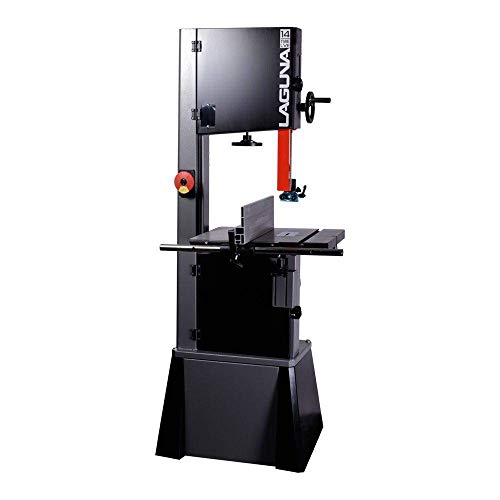
A 21-1/2 x 16-inch table and a 1-3/4 HP motor — the saw for anyone whose shop revolves around curves.
Laguna’s chassis is built around the guides and the table. A 21-1/2 x 16 inch cast iron table gives you room to swing a wide panel through a curve, and it tilts 45 degrees right and 7 degrees left for angled work, with a 90-degree positive stop. The dual-voltage 1-3/4 HP motor (pre-wired at 115 volts, TEFC, 14/7 amps) puts this in the same power league as the JET 14″ — both run 1-3/4 to 1.75 HP, but the Laguna pairs that power with a dramatically larger table surface.
The 115-inch blade length, 12-inch resaw capacity, and blade widths from 1/8 to 3/4 inch let this saw handle both scroll work and modest resawing without a second machine. Owners describe it as sturdy enough to hold a blade steady while cutting, with the tension window and tracking window making adjustment less of a guessing game.
The two honest friction points: blade changes and lower guide adjustments take patience, and the optional work light trails a shadow across the cut instead of illuminating it. Neither stops you cutting, but both are worth knowing before you commit.
What Earns Its Place
- Largest table of the mid-tier picks at 21-1/2 x 16 inches
- 1-3/4 HP dual-voltage motor (115/230) with 12-inch resaw capacity
- Laguna guides and ball-bearing top and bottom blade support
- Tension and tracking windows make setup visible
- 45-degree right tilt plus 7-degree left with a 90-degree positive stop
The Trade-offs
- Guide adjustment and blade changes need patience
- Work light casts shadows rather than lighting the cut line
- Weighs in heavy and needs dedicated floor space
Ideal for: dedicated curve work, large-panel projects, and buyers who value a big cast iron table over portability.
Not ideal for: anyone who needs quick assembly-to-first-cut flow or an out-of-the-box lighting solution — you’ll work around both.
10. JET 15-Inch Woodworking Bandsaw, 1-3/4 HP, 115/230V 1Ph (Model JWBS-15)

A 15-inch throat and a 133-inch blade — the saw that turns veneer slicing into a routine job.
Every spec on this machine leans toward professional-grade capacity: a 133-inch blade loop, a 15-inch throat, 1-3/4 HP, and a 15-amp motor wired for 115 or 230 volts. That’s the widest cutting width on this list, and the deepest resaw passes on stock with the right blade. A rigid four-sided guide post with rack and pinion adjustment holds blade support steady across the full cut height — a meaningful upgrade over saws where the guide post flexes under load.
The table is precision-ground cast iron for stability, and the fence runs a micro-adjustable dual-position side plate, which makes fine blade drift corrections a dial rather than a hammer. Owners consistently praise how easy blade changes are, and the 6-TPI blade that ships in the box works well enough to get a feel for the saw before you upgrade to a resaw blade.
The trade-offs are logistics: this is a very heavy machine, the one-person assembly is a real challenge, and the on/off switch and blade tension release feel slightly over-engineered compared to their function. The included blade is also a starter blade, not a long-term solution.
Why It’s the High-Capacity Pick
- 15-inch throat and 133-inch blade loop for wide work
- 1-3/4 HP, 15-amp motor on 115/230V 1-phase wiring
- Toolless, independently adjustable upper and lower ball-bearing guides
- Fence with micro-adjustable dual-position side plate
- Precision-ground cast iron table
What to Weigh
- Very heavy — one-person assembly is difficult
- Switch and tension release feel overbuilt for their job
- Included blade is a starter, not a keeper
Choose it when: you’re running a shop that needs real resaw capacity and veneer slicing on a production schedule.
Move on if: you work solo in a tight space — this machine needs help to assemble and space to live.
Understanding the Specs
Resaw Height and Throat Width
Resaw height is the tallest board your saw can stand up and slice in one pass — a 3.5-inch saw is for small craft stock, a 13-inch saw for splitting slabs into bookmatched panels. Throat width is how wide a board you can steer through the blade, and it decides whether you can cut curves on a full-size cabinet panel or only narrow pieces. Both numbers should match your common projects before you buy.
Motor Amps and Blade Speed
Motor amps measure how much resistance your saw pushes through before it stalls — a 2.8 amp motor is light duty, a 5.3 amp or 1.75 HP motor handles hardwood. Blade speed in FPM (feet per minute) is how fast the blade travels: slower speeds cut dense hardwood cleanly, faster speeds finish softwood and plywood quickly, and two-speed saws let you choose per project.
Blade Length and Width
Every bandsaw runs one specific blade length, so write it down before you order replacements — the wrong loop simply won’t fit. Blade width decides how the saw tracks: a 1/8-inch blade turns tight curves, a 3/4-inch blade holds a straight line through thick resaw cuts. Choose the blade for the job and accept that you’ll swap blades as your projects change.
Dust Port and Work Light
A dust port connects the saw to a shop vacuum and keeps the cut line visible while you work, since a clear line means a stable cut. Port diameter matters: a 2-inch port pairs with most shop vacs, a 4-inch port needs a full dust collection system. A work light adds visibility inside the blade guard, though the position and quality of the light vary widely from saw to saw.
FAQ
What resaw height do I need for cutting 4×4 lumber?
Can a benchtop bandsaw resaw hardwood like oak and maple?
What blade length does each bandsaw use?
Is a benchtop bandsaw enough for furniture building?
What is the difference between a benchtop and a floor-standing bandsaw?
How often should I change a bandsaw blade?
Do bandsaws come with a stand and fence included?
How much space does a bandsaw take in a home shop?
Can I cut metal with a woodworking bandsaw?
Is blade tension adjustment hard to learn on a bandsaw?
Do I need a dust collection system for a bandsaw?
Final Thoughts: The Verdict
For most home woodworkers, the bandsaw for woodworking winner is the QD-KYOHO 10-Inch Dual-Speed because it combines two speeds, a 5.3 amp motor, and a tilting table in one benchtop package that owners describe as the right tool for the job. If you want furniture-grade resaw capacity and a stand, grab the WOODSKIL 10-Inch with Stand — a solid performer with a 10-inch throat and 5-1/8 inch cut height. And for a floor-standing resaw station that handles 13 inches in one pass, the JET 14″ JWBS-14SFX is the one to reach for — its 1.75 HP motor and 116-inch blade loop make thick slabs a routine job.
How We Picked
We do not accept paid placement. Every pick is matched to a real buyer and a real use-case; we do not hands-on test units.
Sources & Methodology
Specifications: manufacturer listings and product documentation. Review insights: verified customer reviews, as of September 2026. Pricing: not shown on this page (it changes often); check the current price via the retailer link.
As an Amazon Associate, Gadgets Feed earns from qualifying purchases. This does not affect which products we feature.