
Our readers keep the lights on and my morning glass full of iced black tea. As an Amazon Associate, I earn from qualifying purchases.
Specs are compiled from manufacturer listings and verified buyer reviews and can change over time — please confirm the key details on the product page before buying.
A Golden Retriever puppy’s coat looks like soft fluff but hides a dense double coat that mats behind the ears, under the collar, and along the tail feathering. A slicker with short pins skates over the topcoat; one with stiff bare pins scratches tender puppy skin. Every pick below is a slicker-style brush with pins long enough to reach the undercoat and tips gentle enough for a puppy still learning to sit still.
Each pick below is based on the manufacturer’s published specs and patterns across verified customer reviews.
Pin length, head size, and cleaning setup decide which of these nine brushes fits your puppy’s coat. This breakdown of the brush for golden retriever puppy covers nine picks with real owner feedback behind each one.
Our Picks at a Glance

How To Choose The Best Brush For Golden Retriever Puppy
A Golden Retriever puppy grows a double coat — a soft, dense undercoat that traps loose fur, plus a longer topcoat that carries the golden color. Your brush has to get past the topcoat to reach the undercoat without dragging on sensitive skin. Here is what actually changes the outcome.
Pin Length And Pin Angle
Short pins skate over the topcoat and leave the undercoat matted. Long pins, angled at the tip, slip under the topcoat and lift loose fur instead of yanking it. On a young puppy, the pin shape matters as much as the length — a bent or angled tip is far gentler against the skin than a straight needle.
Ball Tips Versus Bare Tips
Ball-tipped pins have a tiny rounded knob on the end, which protects skin during short strokes on thin-coated areas like the face and legs. Bare angled pins reach deeper into dense fur. Many owners pick one for detail work and one for the body.
Head Size For A Growing Dog
A puppy-sized head — roughly 3 to 4 inches wide — gives you control around the ears, feet, and chest. A large head covers the back and flanks faster, which is useful as your puppy grows into a full-size Retriever. Some owners buy a small brush for the puppy stage and a large one later.
Quick Comparison
| Model | Best For | Pin Type | Head Size | Weight | Amazon |
|---|---|---|---|---|---|
| Chris Christensen Mark II Slicker Brush★ Best Overall | Puppy coats and detail work | High-grade steel, 12mm | 3.5″ x 2″ | 1.6 ounces | Amazon |
| Jelly Pet Universal Slicker BrushBest Value | Everyday deshedding at home | Firm, angled pins over ¾” deep | — | 4 ounces | Amazon |
| Warren London Gentle Touch Slicker BrushGentlest Pick | Puppies and sensitive skin | Soft pins, fine and soft coats | 4″ x 2″ | 2.89 ounces | Amazon |
| Pink Slicker Brush for Long Haired Dog | Multi-piece grooming set | Coated, ball-tipped stainless steel | 140° curved surface | 7.05 ounces | Amazon |
| Swihauk Self Cleaning Slicker Brush | Heavy shedding clean-up | Metal teeth with rounded tips | — | 8.82 ounces | Amazon |
| Golden Retriever Dog Brush Double-Sided | Two-tool grooming in one | Deshedding blade plus brush | — | 4.97 ounces | Amazon |
| Slicker Brush for Dogs (We Love Doodles) | Curly and dense puppy coats | Stainless steel, ~1″ angled pins | 4″L x 2″W x 8″H | 5 ounces | Amazon |
| PawsltlveShine Dog Slicker Brush | Dense double coats | Long, soft, bent pins | Large | 3.67 ounces | Amazon |
| 2-in-1 Slicker Brush & Comb (ARTarlei) | Matted curly coats | Stainless pins plus detangling comb | Large brush head | 7.83 ounces | Amazon |
In‑Depth Reviews
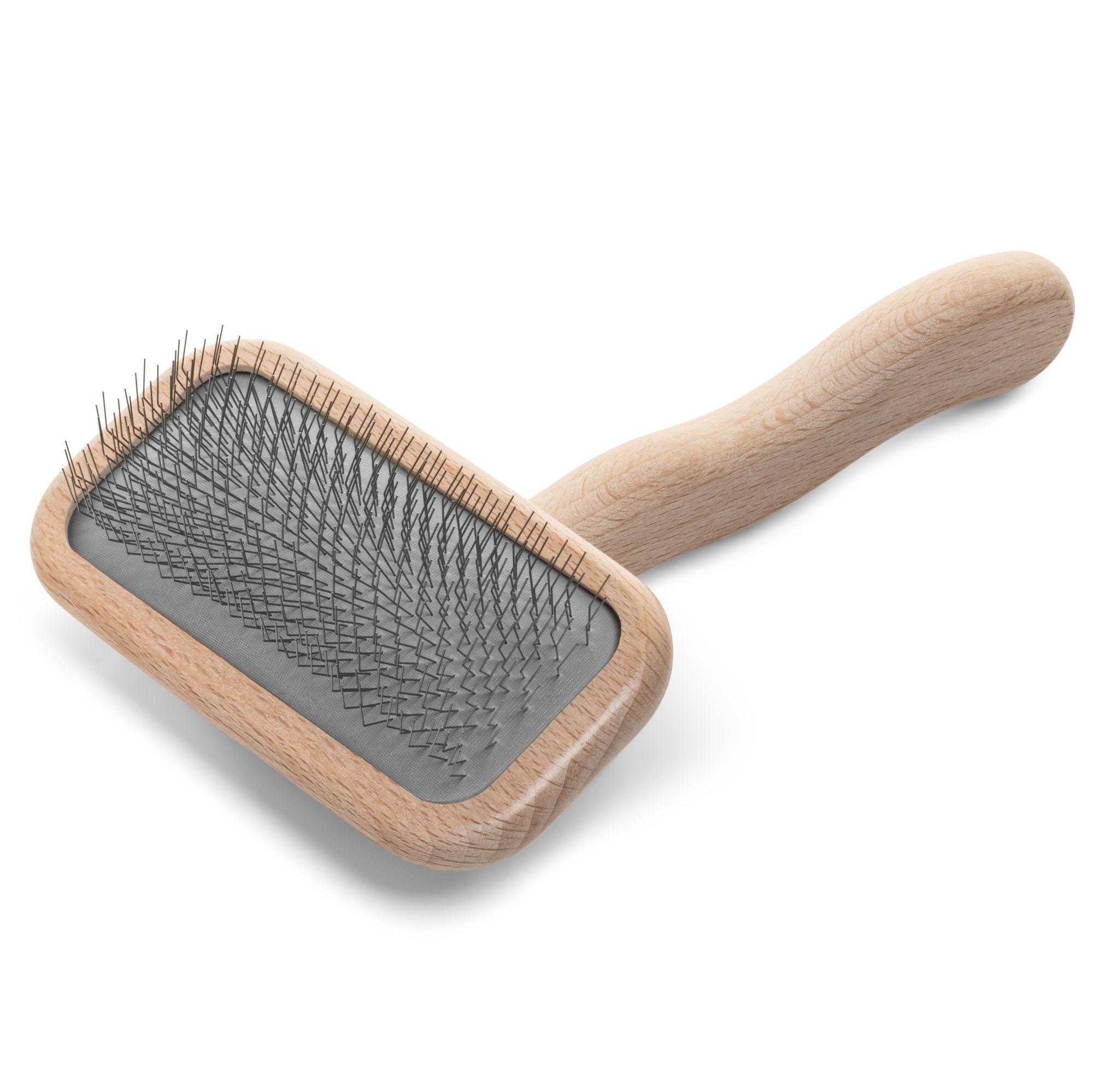
1. Chris Christensen Mark II Slicker Brush for Dogs
Our pick — over 4.5★ from 850+ verified ratings; the strongest balance of quality and price.
A compact German-made slicker built for puppy coats — and it lifts undercoat without making your dog flinch.
The Mark II is the smallest brush in the Chris Christensen lineup, and that barely-there 1.6-ounce body is the whole reason it works so well on a wriggling Golden Retriever puppy. It’s 2.5 times lighter than the Jelly Pet below, which matters when you’re holding a brush for fifteen minutes while your puppy twists and sits and twists again. At 12mm, those stainless pins reach down through a puppy’s soft undercoat without scraping bare skin, and each pin sits in a flexible pad cushioned by a 1/4-inch foam base.
The 3.5-inch by 2-inch head is the smart choice for detail work: legs, feet, around the ears, and inside the feathering on the tail. If you’ve ever tried one of those oversized slickers with knobby tips, you already know why the Chris Christensen’s bare angled pins matter — they work through a mat instead of catching in it. You don’t need a show ring to benefit from the 6.25-inch beechwood body either; the contoured handle sits naturally whether you brush left-handed, right-handed, or upside down.
The catch is durability. Detangling is the strongest thing owners describe here, but the 1/4-inch foam pad has been known to wear or detach over time, and the brush is priced like a tool you keep for years, not months. Detangling is also what wins people over — over 30 owners single it out as the brush’s real skill. A recurring note from owners with cross-Poodle breeds is that the pins feel sharp against the skin if you press too hard.
What seasoned Retriever owners notice
- At 1.6 ounces, it’s light enough to brush a wriggling puppy without hand fatigue
- 12mm pins reach through a soft puppy undercoat, and the flexible pad lets them move with the coat instead of against it
- 3.5″ x 2″ head keeps control tight around the ears, feet, and tail feathering
- Detangling is the brush’s strongest reputation among owners of Cavaliers, Cockers, and cross-Poodle puppies
Where it asks for patience
- Handmade in Germany with a 6-month warranty, but some buyers report the cushioned pad loosening before that
- Pins can feel sharp on thinner skin if you brush hard — use light passes on face and legs
- The size is deliberately small; on a full-grown Golden you’ll be covering ground slowly
Choose it when: your puppy is small-breed-cross, Cavapoo, Cockapoo, or a Retriever pup you want to groom gently through the first year.
Pick a bigger head if: you’re working a full-size adult Golden with lots of body to cover in one pass.
2. Jelly Pet Universal Slicker Brush for Dogs
Longer pins than most slickers — this one actually reaches the undercoat on a thick Retriever puppy.
Jelly Pet calls this the “Tuffer Than Tangles” brush, and that extra length is the whole story: each firm pin reaches more than ¾ of an inch deep and is angled at the tip to grab undercoat instead of sliding over the topcoat. On a Golden Retriever puppy, that angle is the difference between lifting loose fur and just stirring the surface. It’s built for shedding breeds — German Shepherds, Malamutes, Australian Shepherds, Golden Retrievers, Springers — so the pin firmness is dialed in for exactly the coat your puppy is growing into.
At 4 ounces, it sits heavier in your hand than the Chris Christensen on the previous pick, and it’s also 30% larger in its shipping footprint. That extra size doesn’t hurt when you’re working the back and flanks, since a bigger, contoured head gets to hard-to-reach areas with fewer strokes. The plastic body is waterproof, meaning you can brush in the tub without worrying about the bristle pad warping or the handle soaking.
The honest trade-off is durability in the handle. The brush runs firmly on the pin side, which is right for undercoat but can feel aggressive on delicate puppy skin, so ease off on the ears and belly. Pet groomers with long experience report the plastic handle coming apart with only a modest amount of glue at the factory joint — a fixable annoyance, not a fatal flaw, but worth knowing if you plan to hand this down as your puppy grows.
Where the pins shine: that ¾-inch angled reach is exactly what removes Retriever undercoat and short, thick doodle fur between groomer visits. Owners with Bernese-cross and long-coated doodle dogs consistently say the extra pin length does more work per stroke than their old short-pin slicker.
The one gripe to size correctly: a few owners have had the handle joint come loose early. If you buy one, treat the handle gently — the brush head and pins themselves hold up well.
Reach for this if: you want maximum pin length and a waterproof body at an entry-level tier — it handles Retriever undercoat confidently.
Look elsewhere if: you plan to brush a very young puppy with delicate skin and prefer softer, ball-tipped pins rather than firm bare pins.
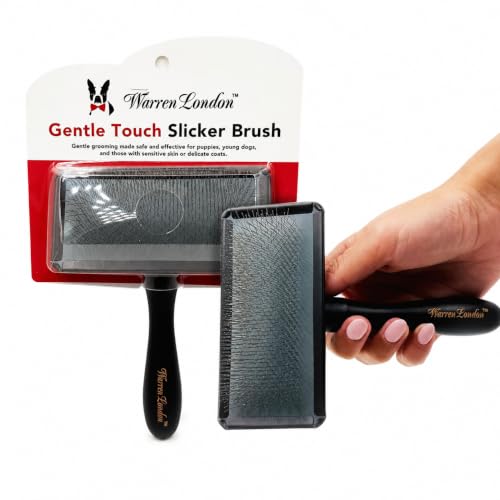
3. Warren London Gentle Touch Slicker Brush for Puppies
The soft-pin option that a first-time puppy owner reaches for when their dog flinches at other brushes.
If your Golden Retriever puppy is still deciding whether brushing is okay, this is the brush to start with. The pins are soft rather than firm, so loose fur lifts away without an aggressive tug, and the compact 4-inch by 2-inch head keeps you in control around the smaller areas — the face, the chest, under the legs, and the inside of the ears. The Warren London runs lighter than the Jelly Pet above, which makes those longer first grooming sessions far easier on your wrist.
Two things stand out in how owners actually use it. One is that it works for a wide range of small long-haired puppies — Shih Tzus, Maltese, Pomeranians, Bichons, and Schnauzer beards all come up. The other is how often professional groomers mention it alongside a much more expensive Chris Christensen brush, saying the Warren London detangles effectively while staying gentler on the coat. That’s a serious compliment at this tier.
The caveat is coverage on a heavier coat. Soft pins on a dense young Retriever undercoat mean you’ll make more passes than you would with a firm-pin brush, and on a truly matted spot you’ll want a detangling comb as a partner. Owners of very dense double-coated dogs sometimes find it slower than they expected. Softer pin brushes also require a level brush angle — tip them too far and the pin ends can catch bare skin on the legs and belly.
Why owners reach for it: the softer, protective pin feel and the ease on the wrist are the two things that keep coming up — a very good sign for a puppy still learning to tolerate the brush.
Know before you buy: this is a gentle tool, not a heavy undercoat stripper. On a mature Retriever with a full winter coat, you’ll want a longer-pin option alongside it.
Ideal for: a puppy whose first few brushing sessions have gone poorly and needs to build positive associations.
Skip it for: light-duty work on thin, low-shed coats — it’s tuned for longer, softer fur, not short single coats.
4. Pink Slicker Brush for Long Haired Dog with Wooden Handle
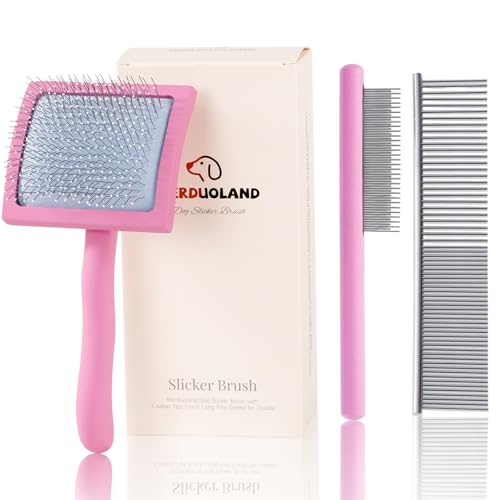
A three-piece grooming set that hands you every tool for a puppy’s first grooming routine in one box.
Instead of one brush, this set ships with three: a slicker brush with long, denser, softer pins and ball tips; a wide-and-narrow-tooth comb for dander and trapped fur; and a 2-in-1 detangling handle comb with long and short metal teeth that works topcoat and undercoat at once. For a new puppy owner who doesn’t yet know which tool suits which part of the coat, having all three in hand removes the guesswork. The stainless ball-tipped pins on the main slicker are rounded at the end, which is exactly what you want near a puppy’s face, feet, and chest.
The slicker’s curved 140-degree surface is designed to work with how you naturally hold the brush — you follow the curve of the dog’s body rather than fighting it. The 270+ pins give plenty of coverage so you’re not making double passes. The handle has a coated, skin-feel finish that adds grip, and the whole set weighs 7.05 ounces, which is heavier than the compact picks above but reasonable once you’re holding three tools rather than one.
Where this set is honest about its limits: the ball tips are a great comfort feature, but they are not the right tool for serious, set-in matting. Owners with heavily matted dogs consistently say you’ll want a separate dematting comb or the detangling teeth of the handle comb — which the set conveniently includes — for the worst spots. Beyond that, the whole set is an efficient, low-fuss starter kit rather than a fine-tuned specialist tool.
What the set gets right
- Three tools in one purchase covers slicker-brush, comb, and detangling-comb work from day one
- Ball-tipped stainless pins are skin-friendly near the face, feet, and chest
- 140° curved head follows the natural line of the dog’s body for efficient strokes
- 270+ pins per head mean fewer passes and more consistent coat coverage
Where it runs into trouble
- Ball tips are gentle but weak against truly matted fur — the comb side of the set does that work
- At 7.05 ounces across the set, it’s clearly heavier than the compact Chris Christensen or Warren London
The right fit for: a new puppy owner who wants one purchase that covers slicker, comb, and detangling tasks without buying three separate tools.
Harder to justify if: you already own a good slicker and just want a specialist dematting tool — the ball tips here aren’t the right answer for set-in mats.
5. Swihauk Self Cleaning Slicker Brush

The push-button brush that empties onto the bin in one press — built for the shedding years ahead.
A Golden Retriever puppy’s coat is going to get serious. The Swihauk is the pick for owners who want to start a real deshedding habit now and keep it going for the next decade of shedding. The self-cleaning button releases the collected fur so you don’t pick hair out of bristles by hand, and the retractable bristle plate wipes clean in seconds. Owners describe the difference plainly: no more rinsing the brush under the tap, no more pulling clumps out with your fingers after every session.
The rounded plastic bristle tips are stated to be gentle on a pet’s skin while still firm enough to lift loose fur — a tricky balance that this brush manages according to how owners describe it. It works on long and short hair, and it’s specifically mentioned for Golden Retrievers. At 8.82 ounces it’s the heaviest pick in this guide, which is the price you pay for the stainless-steel-and-mechanism build — the button, spring, and retracting plate add real mass.
The one honest caveat is the mechanical feel. Some owners say the frame feels lighter-duty than its weight suggests, and the button has a bit of play when you press it. Functionally it still works as advertised, and the hair release is described as easy. If you want an heirloom-grade grooming tool, the Chris Christensen or PawsltlveShine will feel better in your hand; if you want daily shedding handled fast, the Swihauk wins the routine.
The self-cleaning payoff: the push-button release is the standout feature — hair drops away in seconds, which is why this brush gets used far more often than models that need to be picked clean by hand.
One thing to keep in mind: the retract button has some mechanical play, and a few owners describe the frame as lighter-feeling than they expected. Functionally it still releases fur cleanly.
Best if: you want a high-frequency daily brush you won’t dread cleaning, and your priority is shedding control once the undercoat comes in.
Not the pick if: you want a premium feel and long-term build quality as your top priority — the mechanism doesn’t feel as refined as the price-adjacent premium options.
6. Golden Retriever Dog Brush Double-Sided Grooming Tool
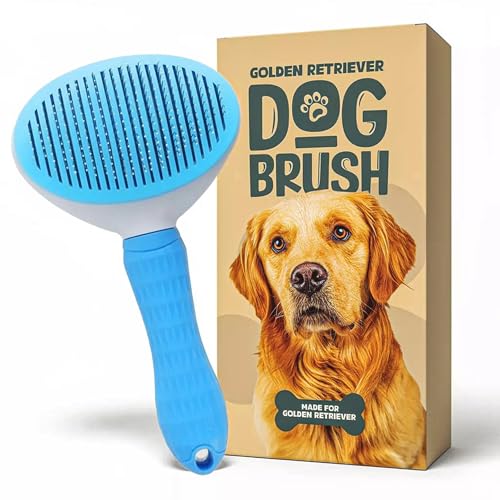
One tool, two jobs — a deshedding blade on one side and a detangling brush on the other — built for the breed in your living room.
The concept is strong: flip one way for the deshedding blade that strips loose undercoat, flip the other for the soft-bristled detangling brush. The non-slip ergonomic handle is genuinely useful during a long Retriever grooming session, and the whole tool weighs under 5 ounces, which is light enough for a puppy-stage brushing routine. Owners of thick double-coated Retrievers who got the right version describe it as the only brush that actually pulled hair off their dog.
This is also the brush in this guide with the widest range of owner sentiment. Reviewers report strong results on goldens when the tool matches what was advertised, and the tool itself has serious fit-for-purpose design — the deshedding blade reaches undercoat that plain slicker brushes miss. The bristles are soft and rounded, which is the right call for a puppy’s skin sensitivity during the early sessions.
The catch is consistency. Some buyers receive a version without the advertised second side, and a couple report the tool pulling more than they’d like on their dogs — though a puppy’s coat is thinner than an adult’s, so the same blade that strips loose fur from an adult Retriever tends to be too aggressive for a young puppy undercoat. Treat the deshedding blade as the tool to grow into, and the brush side as the day-one option for a young Retriever pup. That framing also means if your pup is over-sensitive, this is the pick to be cautious with.
Where it earns its place: a deshedding blade built for the breed plus a soft-bristle brush side in one tool, on a non-slip handle, at a mid-tier price. Owners with adult goldens who got the full two-sided version describe lifting real fur off the coat.
The inconsistency to know about: the deshedding blade side is aggressive enough that it’s not ideal for a puppy undercoat — save it for the adult coat and use the brush side on a young pup. Some units ship missing the advertised second side, so check yours on arrival.
Buy it for: an older puppy or adult Retriever whose undercoat needs real blade work, and you want that plus a softer brush side in one tool.
Think twice for: a very young Retriever puppy — the deshedding blade may be more aggressive than a delicate first-year coat wants.
7. Slicker Brush for Dogs by We Love Doodles

Nearly an inch of angled stainless pin — a set made for curly, dense coats and the puppies who wear them.
The We Love Doodles slicker is one of the few brushes in this guide where a professional groomer drew a direct comparison to the Chris Christensen tier, and the pin spec explains why: almost 1 inch of stainless steel pin, each one bent and angled at roughly 45 degrees so it slides through a coat instead of stabbing at the skin. That’s the difference between a brush that reaches undercoat and a brush that skates on top of it. The 5-ounce wooden-handled build sits comfortably in your hand for a longer Retriever brushing session.
Curly and dense coats are the design target here — Goldendoodles, Labradoodles, Poodles, and by extension the wavy-feathered coat of a Golden Retriever puppy. The shape is a 4-inch by 2-inch oval with a wood handle and stainless bristles. Detangling is the brush’s strongest reputation across owner feedback, with owners of Yorkies, Cavapoos, and doodles all reporting it handles mats, knots, and fluff without sending their dog running. A puppy who tolerated her first brushing with it is exactly the kind of result the roughly-an-inch pin length is designed to produce.
Two honest points. First, on a coat without undercoat — like a Yorkie’s — the angled pins reach the skin a little too readily if you press, so use a light hand on short single coats. Second, the brush is priced notably above the entry-level tier, which is fair given the pin quality and the professional-groomer comparison, but it’s not the budget option. Also note — on a coat without undercoat, you need to be careful not to brush the skin directly.
Where it earns its reputation: roughly 1 inch of stainless pin, bent at about 45 degrees, gives the depth to work undercoat on dense and curly coats without scratching. The wooden oval handle feels solid and stable in the hand.
The honest fit note: the long pins reach the skin easily, which is great for curly coats but can feel stiff on a thin single-coat puppy. Ease off on the ears, legs, and belly.
The one for: owners of curly-coated puppies or dense-coated Retrievers who want a single brush that reaches undercoat with real depth.
Rethink it for: a thin single-coated breed where the long angled pins might feel strong against bare skin.
8. PawsltlveShine Dog Slicker Brush
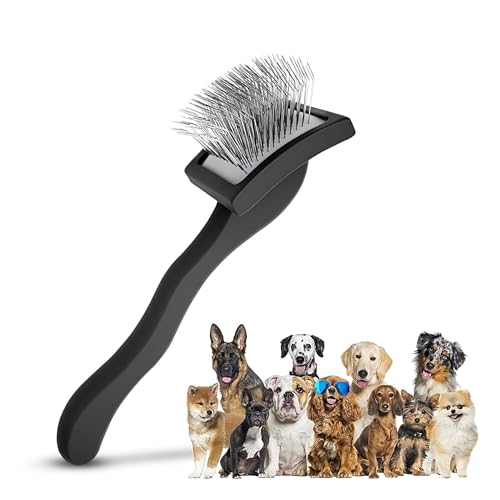
A 3.67-ounce curved-head brush built for thick double coats — the lightest premium pick in this lineup.
For anyone tired of fighting a heavy brush through a thick coat, the PawsltlveShine is the standout: at 3.67 ounces it’s the lightest premium-headed brush here, thanks to a build that leans on a curved stainless head rather than a chunky handle. The curved design follows the natural contours of the dog’s body, and the long soft pins are bent and angled so they brush effectively without scratching the skin. That combination — long pins plus a bent tip plus a light body — is exactly the formula that works well when your puppy’s coat starts thickening into a real Retriever undercoat.
Owners who’ve moved to this larger long-pin brush report it works faster on matted fur than their older shorter-pin slicker, and the well-spaced stainless teeth glide through thick double coats without discomfort. A Pomeranian owner and several Retriever and doodle owners all describe it as easy on the dog as well as effective at removing tangles and loose fur. The curved head covers more coat surface per stroke, so a grooming session doesn’t drag on.
The two real cautions: on a short, tight coat the long pins aren’t the right tool — they want depth. And like any curved long-pin brush, proper angle matters; tip it the wrong way and the pin ends can push into the skin rather than glide. On a Golden Retriever puppy whose coat is fully in, the angle is easy to get right because the curve helps you follow the body. Feathering and tail are the areas where this brush shines.
Why it earns the top tier
- 3.67 ounces makes it the lightest premium long-pin brush in this guide — noticeably easy on the wrist
- Curved head follows the body contour, so long grooming sessions don’t need constant repositioning
- Long soft bent pins reach undercoat on thick coats like a Retriever’s without scratching skin
- Stainless teeth are well-spaced to glide through dense fur without pulling
Where it asks for care
- Long pins aren’t right for short, tight coats — they’re built for depth
- Correct brush angle matters; tip it the wrong way and the pin ends push into skin rather than glide
Best matched to: a Golden Retriever puppy whose coat has thickened up, or any dense double-coated breed that needs long pins and a light hand.
Move on if: your dog has a short, tight coat with little undercoat — the long angled pins are more than that coat needs.
9. 2-in-1 Slicker Brush & Comb by ARTarlei

A pairing of angled-pin slicker plus anti-static stainless comb — built to take on real matting during the puppy coat change.
The puppy coat change is where a young Golden Retriever is most likely to blow its baby fur out in tangled clumps, and this two-piece set is aimed at exactly that job. The slicker’s elongated, flexible stainless pins are designed to navigate deep into thick coats, while the companion comb has rounded, anti-static teeth for working through tougher tangles, especially around the eyes and ears — the two places you least want to yank. When used every day, several owners with long-coated dogs report the pins work quickly on the daily knots and snarls.
The Retriever-specific results are strong when the tool holds together. Owners describe lifting real undercoat from a Golden Retriever with a long coat and cutting the shed dramatically. One Retriever owner in the country credits the same brush with pulling burdocks out of her dog’s fur with a single run over them. And there’s a very practical detail: at first glance the pins look aggressively pointy, but the pins are not actually sharp — used with a light hand, dogs seem to enjoy the process. For a dog still deciding whether to love brushing, that’s a win.
The one downside is attachment quality on the brush base. Some owners mention the cover or the bristle head detaching after a few weeks to a few months, which makes the brush unusable once it stops holding. There’s variation between units, but it’s a real risk worth knowing about. If yours holds, this is among the most capable mat-attacking tools at this tier.
What works: deep-reaching angled slicker pins plus a rounded anti-static comb handles real mats and burdocks that a single slicker struggles with — especially the round-the-eye and ear detail work.
The risk to size: some units have had the bristle head or base cover detach after a few weeks. When it holds, it holds well; inspect the fit when yours arrives.
Pick it for: a Retriever puppy or doodle in the coat-change window who gets real matting and needs a brush plus a detailed comb in one purchase.
Consider alternatives if: you want a single tool with a long service life and less attachment risk.
Understanding the Specs
Pin Length And Reach
Pin length is the distance the bristle travels into the fur before it stops. On a Golden Retriever puppy, pins shorter than roughly half an inch barely tickle the topcoat and leave undercoat behind. Pins around 12mm (just under half an inch) are the balance for a puppy coat — deep enough to reach undercoat, short enough to stay controllable around delicate areas. Longer pins — the ones around three-quarters of an inch or more — go deeper and are the right call once the coat thickens up.
Pins, Ball Tips, And Angled Ends
The tip of the pin changes how the brush feels to your dog. Ball tips have a tiny rounded knob at the end — they protect skin on thinner areas like the face and belly, but they don’t dig through matting. Angled or bent bare tips slip into dense fur more readily and are what you want for undercoat work on a Retriever. Firm pins remove more shed hair but press harder on the skin; soft pins are gentler but need more passes. Many owners end up owning one of each.
FAQ
What is the best type of brush for a Golden Retriever puppy?
Are ball-tipped pins better for a puppy?
How often should I brush a Golden Retriever puppy?
Do I need a separate comb and a slicker brush?
How do I stop my puppy from hating the brush?
Is a self-cleaning brush worth it for a Retriever puppy?
Will a brush for a Golden Retriever puppy work on an adult Retriever?
What is the difference between a soft-pin brush and a firm-pin brush?
How do I clean slicker brush pins after a grooming session?
Should I use a slicker or an undercoat rake on a Golden Retriever puppy?
Final Thoughts: The Verdict
The
How We Picked
We do not accept paid placement. Every pick is matched to a real buyer and a real use-case; we do not hands-on test units.
Sources & Methodology
Specifications: manufacturer listings and product documentation. Review insights: verified customer reviews, as of September 2026. Pricing: not shown on this page (it changes often); check the current price via the retailer link.
As an Amazon Associate, Gadgets Feed earns from qualifying purchases. This does not affect which products we feature.