
Our readers keep the lights on and my morning glass full of iced black tea. As an Amazon Associate, I earn from qualifying purchases.
Specs are compiled from manufacturer listings and verified buyer reviews and can change over time — please confirm the key details on the product page before buying.
Cold water creeping over your ankles ruins a fishing day faster than a slow bite. The right pair of boots keeps that water on the outside, grips slick river rock and wet boat decks, and still lets you stand in them for hours without your feet cooking. This guide narrows the field to nine genuinely waterproof options — from knee-high rubber work boots to felt-soled wading boots with swappable traction — and explains in plain words who each one actually fits.
I’m Min — the founder and writer behind Gadgets Feed. This guide is built by comparing the manufacturers’ published specifications and the patterns across verified customer reviews, so you get each pick’s real strengths and trade-offs instead of marketing spin.
Sizing, sole type, and insulation matter more than brand name here, and getting them wrong means wet socks by noon. The list below covers every boot style you will actually run into while shopping for the boots for fishing.
Our Picks at a Glance

How To Choose The Best Boots For Fishing
Start with the water you actually fish. A muddy farm pond, a slick limestone riverbed, and a wet aluminum boat deck each demand a different sole, and no single boot wins on all three. Get that one question right and everything else — height, insulation, fit — falls into place quickly.
Match the sole to the ground under you
Felt soles grip slick, algae-covered rock better than anything else, which is why you see them on dedicated wading boots. Deep lugged rubber is the all-rounder for mud, grass, and gravel. A swappable system lets one boot do both, which is a real advantage if you fish different rivers across a season. Non-marking, oil-resistant rubber belongs on a boat, where a scuff on a white deck is its own small disaster.
Decide how high the water will come
Ankle-height deck boots handle spray, shallow launches, and wet grass. Knee-high rubber boots push through mud and standing water. Wading boots sit in a different category entirely — they are built to work with waders, and the shaft and sizing reflect that. Be honest about the deepest water you will stand in, then buy for that.
Pick insulation by season, not by habit
Neoprene keeps feet warm in cold water, but the same insulation that saves you in November turns your feet into a swamp in July. If you fish year-round, a lighter or uninsulated boot plus a good sock beats one heavy boot for everything.
Quick Comparison
| Model | Best For | Style | Closure | Sole | Amazon |
|---|---|---|---|---|---|
| Korkers Men’s Darkhorse★ Best Overall | River wading | Wading boot | BOA M2 dial | Interchangeable | Amazon |
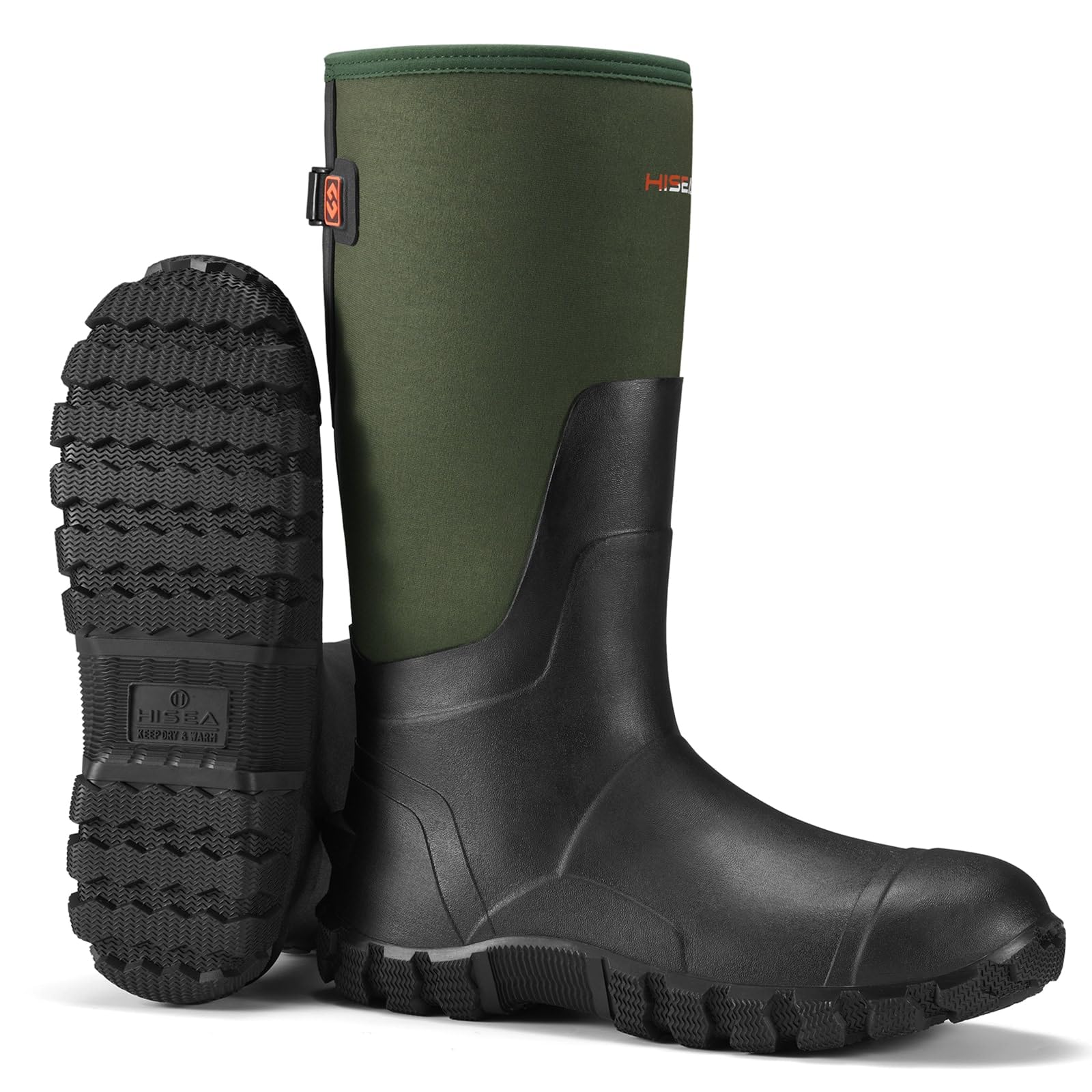
| HISEA Men’s Rain BootsBest Value | Cold, muddy work | Knee-high rubber | Pull-on | Deep lug | Amazon |
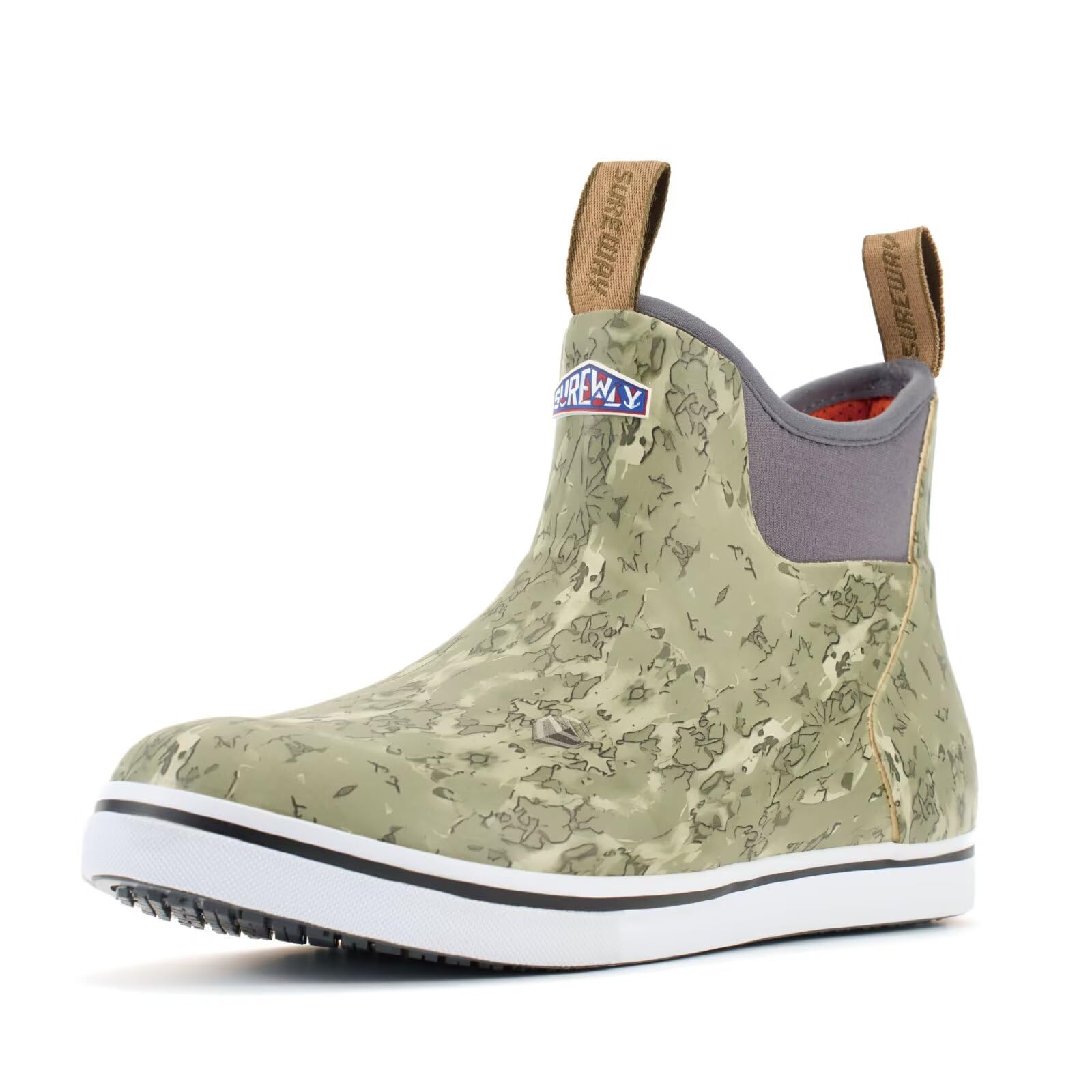
| SUREWAY Men’s Deck BootsTop Performer | Boat and bank | Ankle deck | Slip-on | SRC-rated | Amazon |
| Hunthor Men’s Fishing Boots | Stream wading | Ankle deck | Pull-on | Slip-resistant | Amazon |
| Kalkal Rubber Boots | Mud and cold | Mid-calf rubber | Pull-on | Wide-lug | Amazon |
| BASSDASH Explorer-DG | Everyday boat wear | 6″ ankle deck | Pull-on | Slip-resistant | Amazon |
| Korkers Greenback | Long river days | Wading boot | Quick cinch laces | Interchangeable | Amazon |
| Grundéns DECK-BOSS | Commercial deck work | 15″ deck boot | Pull-on | High-traction rubber | Amazon |
| NRS Boundary | Cold kayak fishing | Knee-length neoprene | Pull-on | High-grip rubber | Amazon |
In‑Depth Reviews
1. Korkers Men’s Darkhorse Fishing / Wading Boot
Our pick — over 4.5★ from 350+ verified ratings; the strongest balance of quality and price.
Two pairs of soles, one dial, and nothing left to tie on a freezing riverbank
If you wade rivers rather than stand on a deck, this is the pair the category is built around, and it is the highest-rated boot in this group at 4.8 stars across 350+ ratings. What you notice first is the OmniTrax system, a set of swappable soles that lets you bolt on felt for slick rock or a studded Kling-On sole for gravel without buying a second boot. For a wade angler who fishes more than one kind of river bottom, that one feature alone justifies the price.
Then there is the BOA M2 dial — a twist-to-tighten lacing system that replaces knots entirely. You crank it snug with wet, numb fingers and pop it loose to get the boot off, which is why ease of use runs second only to comfort in what owners talk about. The upper is a hydrophobic material with an abrasion-resistant finish and a tonal camo pattern, meaning it sheds water instead of soaking it. Inside, water runs through internal channels and out ports in the midsole, so the boot drains instead of turning into a bucket.
On the foot, the 3PFS Achilles stabilization is the quiet hero — it holds your heel steady so you are not fighting the boot all day in current. The recurring gripe is honest and specific: the base plates that hold the swappable soles come off easily but are fiddly to reattach, and swapping felt for studded rubber takes patience. One buyer sized up from a 9 to a 10 to fit a plantar fasciitis insert. Weighing 4 pounds, these are not a light pair to hike in, so treat them as a wading tool, not a trail shoe.
What wade anglers rave about
- Comfort is the most-praised trait, with 60 owners singling it out
- BOA M2 dial means zero knots with cold or wet hands
- Swappable felt and Kling-On soles adapt to changing river bottom
- Internal drainage channels push water out through midsole ports
Honest friction points
- Base plates reattach with difficulty after a sole swap
- 4 pounds per pair is real weight on a long hike in
- Needs sizing up if you wear a custom orthotic insert
Buy it if: you wade moving water and want one boot that covers felt-legal rivers and gravel bars alike.
Think twice if: you want a grab-and-go boot for the dock — the sole-swapping ritual is more machine than those days call for.
2. HISEA Men’s Rain Boots with Steel Shank
Knee-high rubber with a steel spine, built for mud that wants to keep you
The HISEA’s 5mm neoprene and smooth natural rubber shell keep feet warm down to 14°F. That 5mm layer is the key spec — it puts serious foam between your foot and cold groundwater, so you can stand on an icy bank or launch without numb toes. The maker’s own guide notes you should not wear them for heavy labor above 86°F, since that same insulation traps heat.
Underfoot sits an integrated steel shank, a metal strip that stiffens the arch and spreads pressure. That is what stops your feet screaming after hours of digging through muck, and the maker also credits the shank with puncture resistance against nails and sharp debris. The expandable back gussets with cinch buckles adjust around thick calves and bulky overalls. A rear kick tab lets you step out hands-free at the end of the day.
The recurring complaint is the sole — a handful of reviewers wore through the bottom on abrasive surfaces, and one reported it lasted about a month and a half of daily use before holes tore through. Sized correctly, this is a boot for occasional hard fishing days, not eight-hour shifts on concrete. Fit is genuinely split: some say true to size, others went up. Buyers report a 13 needed a bigger size, and the maker itself says to size down between sizes. Wash the mud off and dry them in shade, and the lifetime warranty backs the manufacturing.
The standout number: Warmth down to 14°F from 5mm neoprene plus a rubber shell is not a figure most rubber boots in this class can put on the table. Quality is the most-praised trait here, with over 100 reviewers pointing to it.
The one to watch: The deep lug outsole is engineered for mud and soil, and the maker notes daily friction on gravel or asphalt accelerates wear. That is a genuine trade-off, not a defect — this is a mud boot, so keep the pavement out of the rotation.
Reach for these: if you fish cold, muddy, low-light water and want full knee protection without a wader.
Look elsewhere: if your fishing means long walks on concrete or asphalt — the lugs will not thank you.
3. SUREWAY Men’s Deck Boots Non-Slip Fishing & Boating Boot
The boots that get you from wet dock to dry kitchen floor without a wobble
The headline spec is the SRC-rated outsole — an official slip-resistance rating — that is also non-marking and oil-resistant. Kicking fish slime off a wet boat deck while wearing these is a different experience than doing it in a smooth-soled boot, and they leave no black scuffs on white gelcoat.
Construction is neoprene rubber with reinforced toe, heel, and pull tabs, and the insole has built-in channels that move moisture through the footbed rather than letting it pool. It is 100% waterproof and fit is generous — “slightly wider” in the maker’s words. Owners who wear wider sizes or bunions tend to like the men’s sizing for the extra room. Pull tabs and a heel notch make them genuinely hands-free to get on and off.
One thing to know before you buy: the break-in period can rub at the ankle for the first four hours. That fades — the buyers who wore them in eight-hour shifts had no complaint after — but a band-aid or a half-size up is worth it for the first day. There is also a rubber-boot reality to accept: the non-breathable upper means feet can sweat in summer, and some wearers notice cold water temperature through the sole. Size up if you want toe room.
The case for these deck boots
- SRC-rated slip resistance plus non-marking, oil-resistant sole
- 100% waterproof with a slightly wider fit for wide feet
- Reinforced toe, heel, and pull tabs hold up to daily abuse
- Channelled insole moves moisture away from the footbed
What to plan for
- Break-in ankle rubbing is common for the first few hours
- No breathability through the rubber — expect sweat on hot days
- Only full sizes are offered, so half-size wearers must choose
Best matched to: boat, dock, and bank anglers who want one boot for the wet parts of the day and the dry parts after.
Temper your expectations if: you need genuine half-size precision or wear heavy socks inside — the fit is wide, and the rubber keeps warmth but also keeps sweat.
4. Hunthor Men’s Fishing Boots Waterproof Deck Boots

A lightweight ankle boot that pulls on in one motion and drains fast
The Hunthor is the ankle-height deck boot for anglers who want to step into a stream without the bulk of a knee-high rubber shell. Breathable 3mm neoprene lines the inside; a fully sealed rubber shell wraps the outside for 100% waterproofing. The EVA memory foam insole gives arch support and airflow, and an insole board underneath adds stability. A reflective tab is a small detail that pays off if you’re launching at dawn or walking back in low light.
Owners seem to like it for two reasons: waterproofing first and value for money second. Buyers repeatedly note dry feet on walks and fishing trips, and one described it as replacing wet work boots outright. The anti-slip outsole has a dedicated drainage pattern — a channeled tread that pushes water out from under you instead of letting it sit there — and it handles all-terrain conditions with a firm, grippy feel. If you’re the kind of angler who needs a boot for the drive, the launch, and the stream edge, this is the one that quietly gets out of the way.
The main friction point is sizing. Fit is the boot’s most-discussed trait overall, and the story is not simple — some find it true, others find it runs tight, and multiple owners recommend going a full size up. The top opening is also on the generous side, so it can feel loose on a narrow ankle. If you have flat feet, one buyer found the stock arch support insufficient and added an insert. That is a small, fixable trade-off in a boot that otherwise nails its job.
Plain-English verdict: If your fishing mostly happens at ankle depth — a dock, a stream edge, a shallow launch — this boot covers it comfortably and at a fair price for what it is.
The catch to plan for: Size up. Owners consistently point in that direction, and the wide top opening means a loose fit is the likely complaint if you stick with your street size.
Tailored to: anglers who wade shallow streams and want an easy, light pull-on boot rather than a full rubber shell.
Not the one for: anyone standing in water deeper than ankle height — the deck-boot cut cannot reach up and save you.
5. Kalkal Rubber Boots for Men Waterproof Insulated Mid Calf
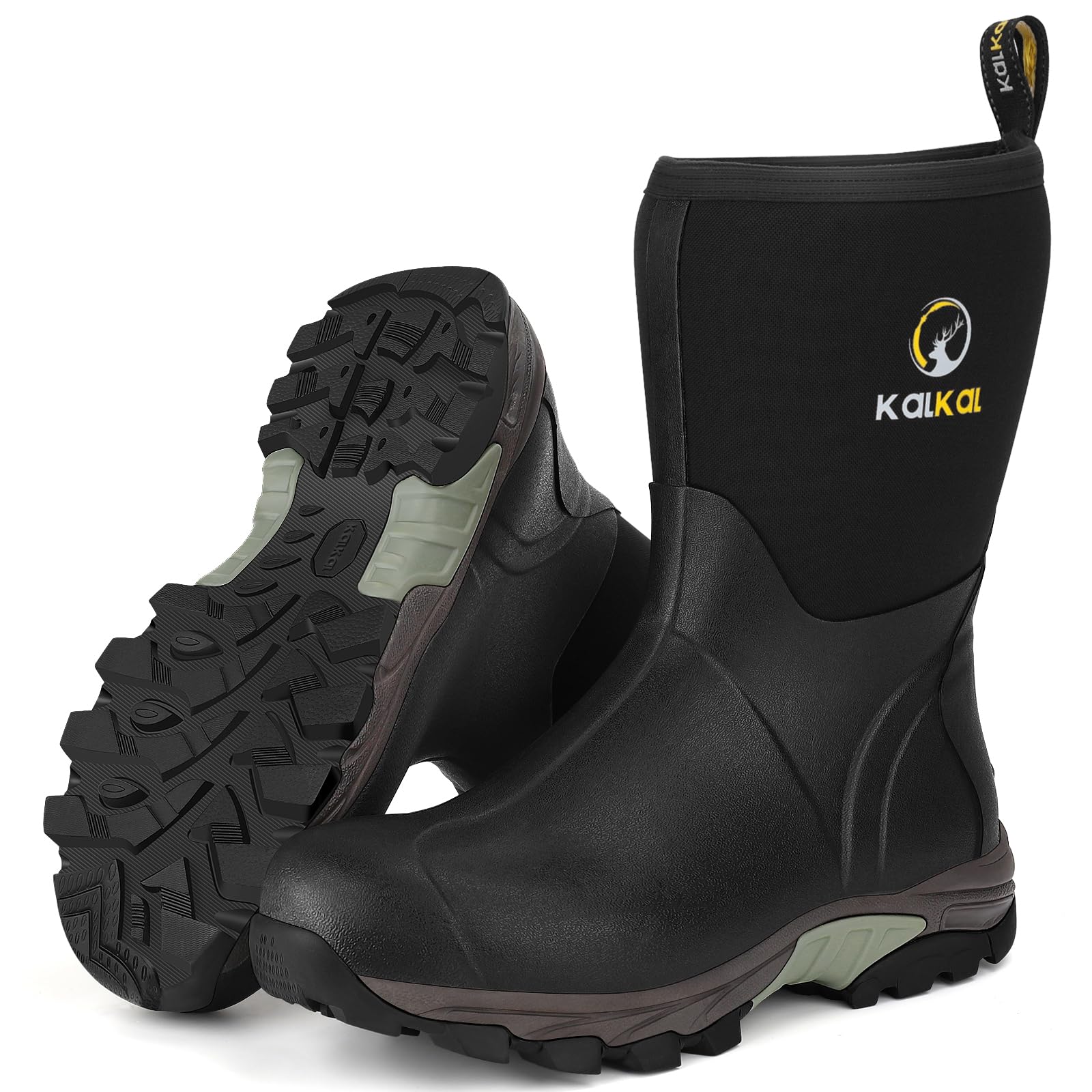
Warmth first, mud second — the boot for cold mornings in the marsh
Kalkal wraps the foot in 6mm neoprene insulation beneath a waterproof rubber shell, and that number is the reason these keep feet warm in rain, snow, and cold groundwater. The shaft climbs to mid-calf, which hits the height most bank anglers want — enough to step through mud and standing water without the full knee coverage of a work boot. It is the warmest layer of insulation on this list and the one to consider if cold, wet fishing days are your normal.
Quality is the most-praised trait here, with over 90 owners citing it, followed closely by comfort. Owners mention using them for metal detecting in wet, muddy fields and for daily stall mucking, and one has run them a year and would rebuy without hesitation. The wide-lug outsole has a specific virtue: it releases mud and dirt rather than packing them in, which keeps traction alive through a long walk in soft ground. Traction on mud and slick rock draws steady praise, and the boots get on and off without bending over.
Here is where it needs to be honest: durability is mixed. The bulk of owners say they hold up well, but some reviewers report the soles coming apart after a month of regular use. That is the trade-off of a rubber boot at this price. Note also that sizing skips half sizes — one owner caught between a 7.5 found neither 7 nor 8 ideal. Insulation is moderate, not expedition-grade, so a snow day with thin socks will feel cold.
Where it shines: Cold-weather mud work — the 6mm insulation is the standout spec, and traction on wet slopes and slick rock is repeatedly what owners call out.
Where to be realistic: Rigorous daily use will test the sole. Buy this for fishing, not for sixteen-hour industrial shifts, and it rewards accordingly.
Made for: cold-weather bank fishers, marsh hunters, and anyone who wants warmth from the ankle up at a fair price.
Choose differently if: you need half-size precision or a boot that survives daily industrial wear on abrasive ground.
6. BASSDASH Explorer-DG Men’s 6” Waterproof Deck Boots

The tournament-day boot that stays dry through a full day on the water
BASSDASH built this 6″ deck boot for the angler who is on the boat tournament-to-tournament and wants one pair to cover it all. It is fully waterproof with a slip-resistant sole, and it pulls on and off without a fight. The 6″ height covers everyday deck and launch duty without the knee-high bulk some anglers find restrictive. At this price, what you genuinely get is a boot you can wear daily, clean easily, and not baby.
Owners single out the grip and the dry feet most often, and one long-time bass angler reported no water ingress pushing the boat off a beach even in chop. The treaded sole grips wet boat deck, mud, and snow. Owners describe the boots as true to size with no foot sliding, and easy to clean between trips. The maker’s care guide is also worth following since it explicitly recommends conditioning the rubber parts to prevent cracking and splitting — a two-minute job that stretches the boot’s life.
The honest drawbacks are the pull tab and the print. One buyer had the rear pull tag rip off the right shoe and called the experience a total loss. Separately, the printed pattern on the boot does wear off over time, which owners treat as expected for the material rather than a defect. Otherwise this is a boot whose owners are unusually pleased for the money, and a few have bought a second pair.
Why people come back for a second pair
- Waterproof enough for a full fishing tournament without a wet sock
- Slip-resistant tread handles wet boat deck, mud, and snow
- True to size and easy to clean between trips
- Printed pattern is expected to wear, which owners accept at this price
Worth knowing before you buy
- A rear pull tab ripping off is a reported defect on a minority of pairs
- Rubber gets warm above about 50°F if you’re moving
- Sole is flat enough that hard packing or shifts will eventually wear it
Dialed in for: day-in-day-out boat anglers who want a light, true-to-size boot that just does the job.
Look past it if: you need high-cut coverage for deep wading — six inches is exactly six inches, and no more.
7. Korkers Greenback Wading Boots with Interchangeable Felt and Kling-On Soles

Lighter than the Darkhorse, lighter on the wallet, and still fully swappable
If the Darkhorse above is a bit too much boot — or a bit too heavy at 4 pounds — the Korkers Greenback is the step-down that keeps the same OmniTrax interchangeable sole system. Bolt on felt for slick river rock, swap to a rubber sole for gravel, and never buy two pairs. The greenback laces use a quick cinch system, which means you can tighten the boot with one pull instead of tying it. It weighs 4.3 pounds, so it is a wading boot not a light walker, and comes with a one-year warranty.
What owners celebrate most is comfort — the single most-praised trait here, with over 100 owners calling it out — and it shows up most in sole-feel. The complaint that ruber sides peel back on some pairs is the honest counterweight, and that is worth knowing if you use them heavily. On the positive side, hydrobic materials mean accelerated dry times, which reduces the risk of spreading invasive species between rivers, and internal drainage channels push water out through midsole ports. Abrasion-resistant materials and strategically placed seams minimize wear points.
Fit is where you need to pay attention. Sizing is mixed — one owner normally a 9.5 went up to 11 to fit a polypro liner sock and a 3.5mm neoprene bootie. That sounds extreme until you understand that wading boots are designed to fit OVER wader stocking feet, not bare feet. Buy for the wader bootie, not your bare foot. Once fitted correctly, owners describe a roomy toe box, plenty of space for neoprene, and a truly comfortable feel on long river days.
What makes the Greenback a keeper
- OmniTrax swappable soles let one boot cover felt and rubber rivers
- Comfort is the runaway strength — over 100 owners name it
- Quick cinch laces take seconds to tighten with wet hands
- Hydrophobic materials dry fast and help slow invasive species spread
The reality check
- Rubber sides peeling back is reported on a minority of heavy-use pairs
- Sizing demands sizing-up discipline for wader booties
- No BOA dial here — you tighten with laces instead
Best suited to: river and fly anglers who need swappable traction without paying Darkhorse prices.
Give it a miss if: you want the twist-dial BOA feel — that upgrade lives one pick up on this list.
8. Grundéns DECK-BOSS Fishing Boot
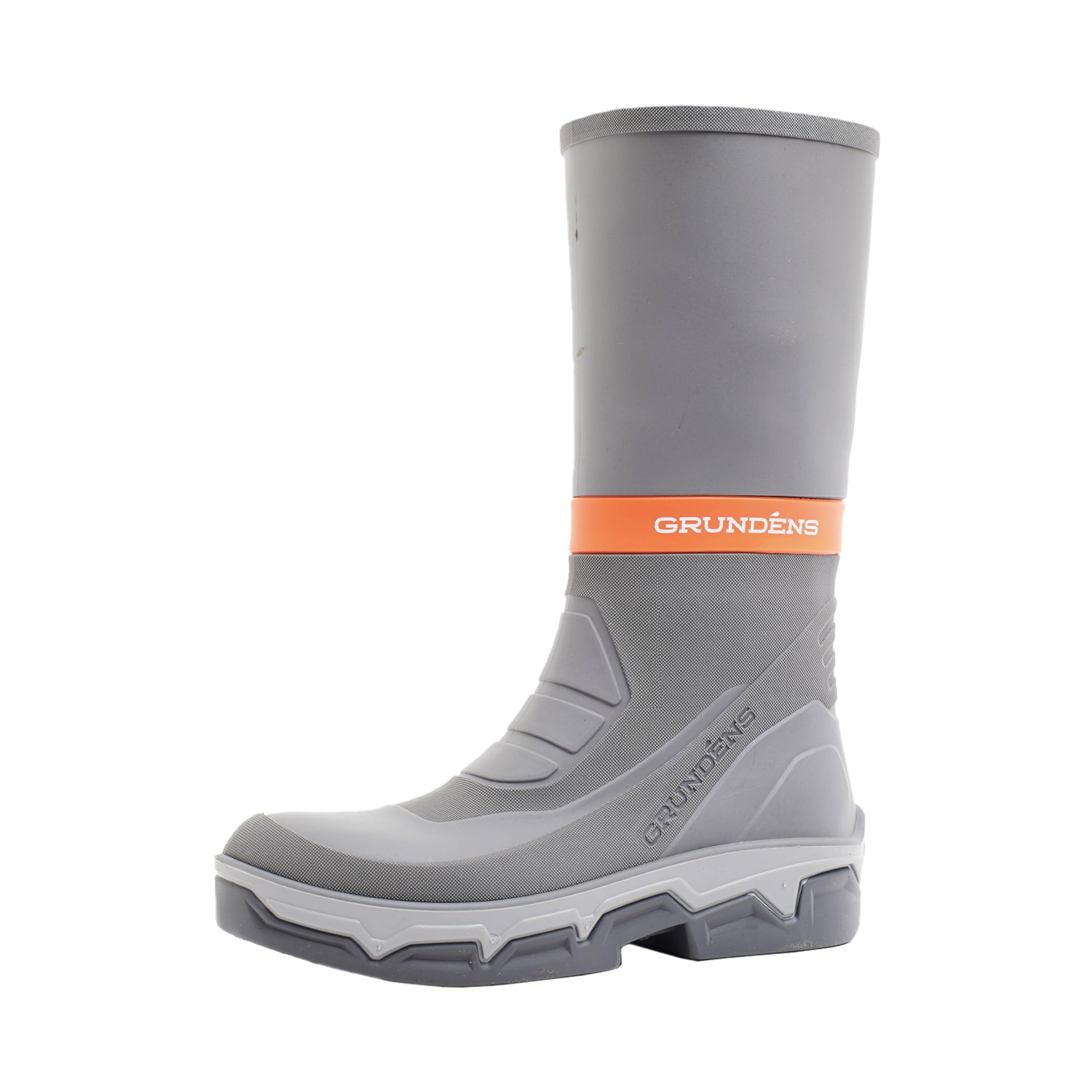
Built for the working deckhand who stands in the same boots all day
You get commercial-grade protection from the Grundéns Deck-Boss, built at 15 inches tall — high enough to shield your lower leg from spray, splash, and slop on a working deck. A thicker insole absorbs shock, and an anti-odor cooling liner keeps the boots from smelling like the bilge after a long shift. The seams are minimized, which is the difference between a boot that lasts a season and one that doesn’t.
What owners praise most about this boot is quality — the runaway strength of the Deck-Boss by a wide margin. One commercial fisherman who had run other rubber brands for years pointed out how the Grundéns held up where the others had torn at the seams and leaked repeatedly. Water resistance, comfort, and grip all draw appreciated praise, and one owner noted confidence standing on slimy boat floors. If you’re making a living on a deck, this is the exact boot for it.
The known gripe is fit around the leg. The ankle section is deliberately narrow — that is where the boot’s clean profile comes from — but for some wearers, that tightness makes them hard to pull on and even harder to remove. Customers note needing a boot jack to get them off, and one large-footed wearer could not get them off at all. That is a genuine fit signal, not a durability concern, and sizing up or choosing carefully around calf size is the workaround.
The signature spec: 15 inches of coverage and an anti-odor cooling liner make this the deck boot built for long shifts, not short trips.
The genuine fit note: A narrow ankle section makes these harder to remove than most boots of this height. If you have wide feet or a high instep, plan accordingly.
A strong match for: commercial fishermen and serious offshore anglers who need a working deck boot that lasts.
Wrong pick if: you have a wide or high-instance foot, or need a boot you can slip off with a toe push.
9. NRS Boundary Neoprene Water Boots

Knee-length neoprene for cold mornings and muddy launches
The NRS Boundary is the boot kayak anglers and cold-water paddlers keep reaching for — knee-length neoprene with a high-grip rubber sole, built for muddy launches and wet carry-overs. What wins people over is quality, the runaway standout in how owners describe it by a wide margin. Just behind is comfort, and together those two traits define this boot: it is the one you put on at the launch and forget about until you take it off at the truck.
The neoprene does two jobs at once. It insulates, so cold water hitting the shaft does not send a chill up your leg — great for cold weather kayaking and fishing. It also stretches, so the boot bends with your ankle instead of fighting it — owners repeatedly compare the feel to a pair of tennis shoes rather than a stiff boot. Traction holds up on mud, gravel, and ice, which is exactly the kind of terrain a canoe or kayak launch throws at you.
Here is the honest friction: sizing is unreliable. The brand’s fit runs narrow at the ball of the foot, and some owners with wide feet found a snugger feel than expected. Sizing down is the standard advice — one owner normally a women’s 6.5 to 7 sized down to a 6 — and the brand skips half sizes entirely, which is real friction for someone between sizes. There is also a strong new-rubber smell from the start that fades, and the top cinch is not a dry seal when you submerge past the boot. Plan for all of that and the boot rewards you.
Why cold-water paddlers love it: Snug, flexible ankle and knee-length protection that keeps feet warm and dry in cold water, then dries to a soft, natural feel.
Honest caveat: No half sizes, and the fit runs narrow. Between women’s and men’s sizing, double-check the chart before ordering.
Perfect for the paddler who: launches a kayak from a muddy slip and wants warm, flexible, grippy feet before and after.
Skip these if: you need a precise fit in half sizes or have wide feet — this is one boot where sizing down and choosing carefully is not optional.
Understanding the Specs
Neoprene Thickness (mm)
Neoprene is the foam layer that keeps cold water away from your skin, and the number in millimeters tells you how much of it you are getting. A higher number — 5mm or 6mm — means a warmer, more insulated boot for cold water and winter fishing. The trade-off is heat: the same thickness that saves you in November can make your feet uncomfortably hot in summer. If you fish year-round, keep a lighter sock for the warm months and let insulation handle the cold ones.
Sole Type and Slip Resistance
The sole is where your fishing actually happens — it is what holds you on slick river rock, muddy banks, and wet aluminum decks. Felt soles grip algae-covered rock best and are required or banned depending on local rules. Deep lugged rubber handles mud and grass with ease and sheds dirt as you walk. A rated outsole — like the SRC rating found on the SUREWAY deck boot — carries an official slip-resistance certification and is non-marking so it will not scuff a boat deck.
FAQ
Do I need wading boots or regular fishing boots?
How do I size wading boots over neoprene wader boots?
Are felt soles better than rubber for river fishing?
How warm are insulated rubber boots for cold-weather fishing?
Do fishing boots run true to size?
How should I care for rubber fishing boots so they last?
Will rubber boots make my feet sweat?
What makes a good slip-resistant sole for boat decks?
Are neoprene fishing boots good for kayak fishing?
How high should fishing boots be for muddy launches?
Final Thoughts: The Verdict
For most wading anglers, the best overall pick is the Korkers Darkhorse, because the swappable OmniTrax soles plus the BOA dial cover more water conditions than any single-sole boot on this list. If warm feet in cold mud is your priority, the HISEA Men’s Rain BootsNRS Boundary is built for exactly that. And if you need a light, true-to-size boot you can wear every day on the boat and forget about, the BASSDASH Explorer-DG quietly does the job at a fair price.
Before you buy, check your local rules on felt soles — felt is banned in some waters. The two Korkers boots here solve that with their swappable OmniTrax system (interchangeable soles you can switch out). The Darkhorse, rated 4.8 stars across 350+ ratings, is the one to grab for that flexibility.
How We Picked
We do not accept paid placement. Every pick is matched to a real buyer and a real use-case; we do not hands-on test units.
Sources & Methodology
Specifications: manufacturer listings and product documentation. Review insights: verified customer reviews, as of September 2026. Pricing: not shown on this page (it changes often); check the current price via the retailer link.
As an Amazon Associate, Gadgets Feed earns from qualifying purchases. This does not affect which products we feature.