
Our readers keep the lights on and my morning glass full of iced black tea. As an Amazon Associate, I earn from qualifying purchases.
Specs are compiled from manufacturer listings and verified buyer reviews and can change over time — please confirm the key details on the product page before buying.
Swapping a car battery takes about ten minutes. Re-teaching your car everything it forgot can take far longer. A memory saver is a small adapter that feeds your vehicle’s computer a trickle of power while the main battery is out, so your radio stations, clock, seat positions, and idle relearn data stay exactly where you left them. This guide covers the seven that do that job best.
I’m Min — the founder and writer behind Gadgets Feed. This guide is built by comparing the manufacturers’ published specifications and the patterns across verified customer reviews, so you get each pick’s real strengths and trade-offs instead of marketing spin.
Some units clip to a second car battery, some run a built-in rechargeable pack, and one relies on a plain 9-volt. Here is how to pick the right one for your driveway. The smartest way to keep your radio presets, clock, and ECU codes alive is a dependable auto battery memory saver that matches how you actually work.
Our Picks at a Glance

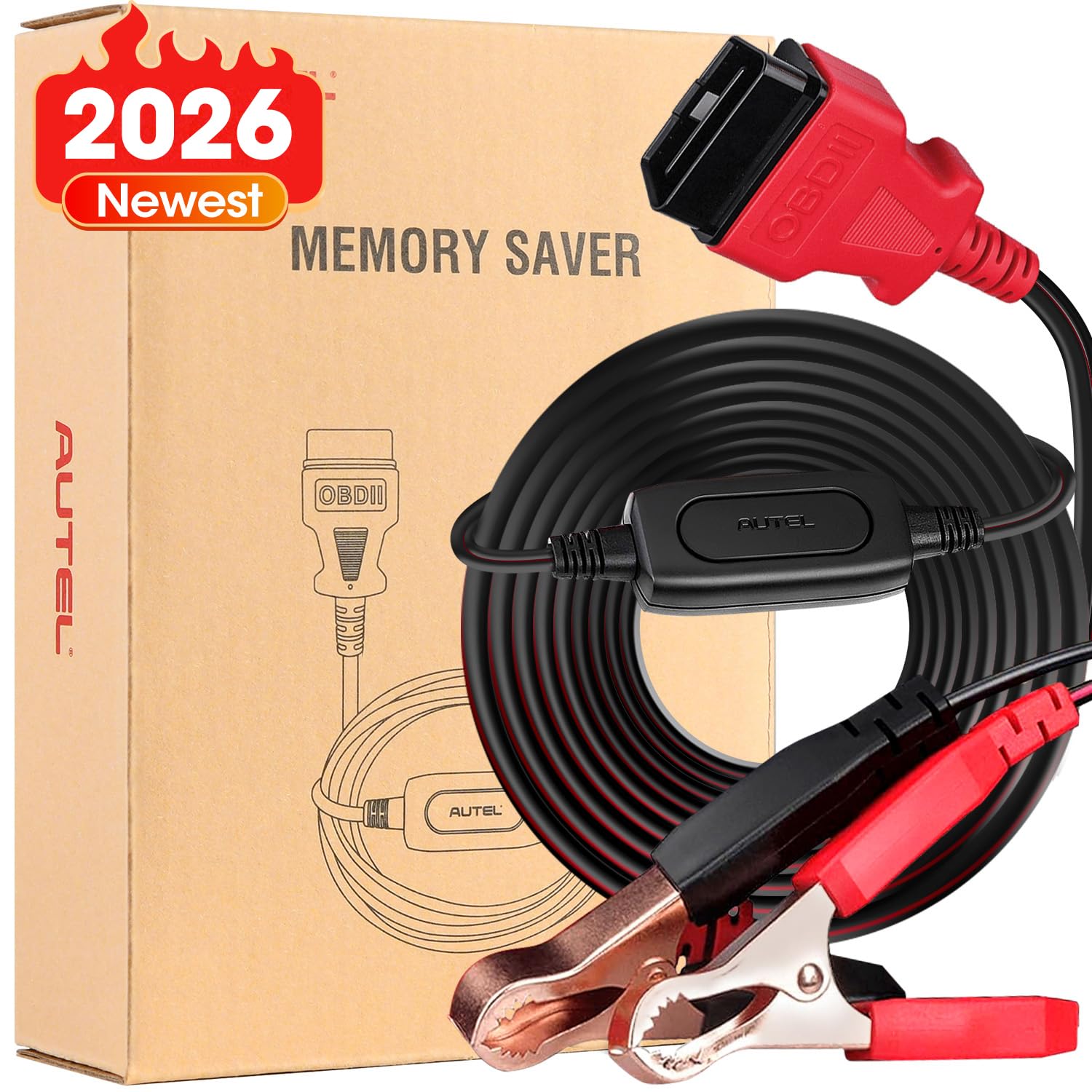
How To Choose The Best Auto Battery Memory Saver
Every memory saver does the same basic job: it keeps a small, steady voltage on your car’s computer (the ECU, short for engine control unit) while the main battery is disconnected. What separates a frustrating one from a good one depends on four practical things.
Where It Plugs In
The connection point decides how easy the job is. An OBDII connector (the 16-pin diagnostic port under your dash) plugs in directly and works even when the ignition is off. A cigarette-lighter plug taps a 12V outlet instead, which can be fussy on newer cars. Alligator clips grab a spare battery’s terminals and give you the most flexibility. Match the connector to the port your car actually has before you buy.
What Powers The Backup
The saver itself does not make power — it borrows it. Some units have a sealed rechargeable battery built in, so they are self-contained. Others clip to a second car battery, a jump pack, or even a 9-volt household battery. The rule that matters: if your backup drops below roughly 10 volts, your car’s computer loses its memory and you are back to reprogramming. The Autel units build in a voltmeter for exactly this reason.
Protection Features To Insist On
A built-in fuse (often 3 or 4 amps) blocks an overload before it damages your car’s wiring. Reverse-polarity protection stops damage if you accidentally clip positive to negative. A visible LED or display confirms power is actually flowing before you pull the terminal — so you are not guessing in the dark.
Quick Comparison
| Model | Best For | Connection | Backup Power | Protection | Amazon |
|---|---|---|---|---|---|
| EZRED MS4000★ Best Overall | Repair shops and frequent swaps | Direct-wired OBDII | Built-in 12V 4.5Ah SLA battery | 4-amp circuit breaker | Amazon |
| Autel MaxiBAS BTMS (2026)Top Performer | DIYers wanting the highest-rated kit | 16-pin OBDII | 12V backup via alligator clips | Surge protection, 3 LED status lights | Amazon |
| Autel MaxiBAS BTMS | Long-cable reach and mixed vehicles | 16-pin OBDII | 12V backup via alligator clips | Voltmeter, reverse-polarity protection | Amazon |
| E-Z Red MSBD28 | Budget-sensitive home mechanics | OBDII plus cigarette lighter | Borrowed 12V jump pack | Relies on external pack fuse | Amazon |
| Mem Retain AC/9V Combo | Wall-power option at the bench | OBDII connector | AC adapter or 9V battery | Safe voltage blocking diode | Amazon |
| Mem Retain USB/9V | Backup pack users on a tight space | OBDII connector | USB adapter or 9V battery | Safe voltage blocking diode | Amazon |
| AUTOOL BT30 | Drain-hunting and diagnosis work | OBDII with alligator clips | Any 12V DC source | 3-amp fuse, anti-reverse clamp | Amazon |
In‑Depth Reviews
1. EZRED MS4000 Automotive Memory Saver With Built In Charger, Black
Our pick — 4.5★ from 450+ verified ratings; the strongest balance of quality and price.
The self-contained workhorse that needs nothing but its own inner battery
The MS4000 does not ask you to hunt down a spare battery, a jump pack, or a wall outlet — it carries its own power. Inside the housing sits a 12 volt, 4.5 amp hour sealed lead acid battery (a rechargeable pack that holds its charge between jobs). That means you can pull up to a car with one tool in hand and get straight to work, which is exactly the kind of speed the crowd favorite earns its reputation for.
The connection is just as direct. A hard-wired OBDII connector plugs straight into the vehicle’s diagnostic port under the dash, so there is no cigarette-lighter adapter to lose and no clips to seat correctly. What wins people over is how faithfully it holds onto the little things: radio presets, the dash clock, keyless entry codes, GPS memory, TPMS, and alarm settings all survive the swap. Buyers report the sort of clean result a first-timer hopes for — an owner swapping a battery in one go put it plainly: “Great product works well I was able to change my battery with no problem. It didn’t have to reprogram anything.”
An overload trips the tool instead of frying your car’s wiring, thanks to a built-in 4 amp circuit breaker (a self-resetting safety switch that cuts power when current runs too high). At 1.9 pounds it is light enough to keep on a shelf or toss in a roadside kit. Two things a buyer should know going in. The rechargeable pack is a sealed lead acid type (a spill-proof, top-up-needed battery) that wants periodic top-ups to stay healthy, and the folks happiest with this unit tend to be garages and shops that disconnect batteries often enough to justify its premium tier. For someone changing one battery every few years, a simpler borrowed-power model can cover the same ground.
Where It Earns Its Keep
- Self-contained 12V 4.5Ah sealed lead acid battery — no second power source required
- Hard-wired OBDII connector eliminates adapter guesswork
- 4 amp circuit breaker guards the car’s wiring
- Trusted across hundreds of owners for saving codes, clocks, and keyless entry settings
The Honest Caveats
- Built-in battery needs routine charging to stay ready
- Priced in the upper tier versus clip-style savers
- Direct-wired connector means no cigarette-lighter flexibility
Reach for this if: you disconnect batteries regularly and want one self-powered tool that needs nothing else to work.
Look elsewhere if: you change one battery every few years and would rather borrow power from a jump pack you already own.
2. 2026 Autel MaxiBAS BTMS OBD2 Memory Saver, for All 12V Vehicles
Three little LEDs that tell you the whole story before you touch a terminal
Here is the part most savers hide from you: whether your backup power is actually strong enough. This Autel answers that with three indicator lights. Two green means the connection is good. Three green means your backup battery is above 10 volts — safe to proceed. Three red means it has dropped below 10 volts, and you should charge up before risking your settings.
The hardware backs it up. A standard 16-pin OBDII plug runs to the dash port while two alligator clips grab a 12V backup battery, red to positive and black to negative. Built-in surge protection and polarity-reverse detection stop damage if you cross the clips by mistake. At 100 grams the whole tool is light in the hand, and it works on all OBDII 12V vehicles from 1996 onward — the maker puts compatibility at 99% of the market.
It also plays nicely with unconventional power sources. One clever owner adapted it to run off a Makita 18V-to-12V power-tool adapter instead of a second car battery, and it still worked. The one honest catch: how long it holds memory rides entirely on the backup battery you feed it. With a 12V 7Ah backup, real-world use runs about 15 minutes — plenty for a swap, not an overnight job — and car modules draw a constant 100-850mA that slowly drains it. If you tend to take your time or leave panels apart, keep a charger nearby.
Why the lights matter: a memory saver fails silently. The LEDs turn “I hope this works” into “I know this works,” which is worth real money when a botched job means reprogramming seats, windows, and idle data from scratch.
One caveat worth knowing: the maker’s own caution says not to open doors, run lights, or start the car during the swap — an active device can overload the OBD connector.
When it wins: you want maximum confidence and the highest owner satisfaction in the group, with visual proof the job is going right.
When to pause: pair it with a well-charged backup battery — a weak one is the only thing standing between this tool and a flawless battery change.
3. Autel OBD2 Memory Saver for Car Battery, MaxiBAS BTMS for All 12V Vehicles
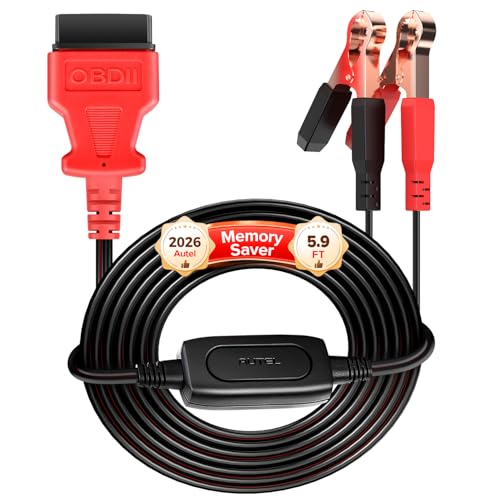
Five-foot-nine of copper wire that reaches the donor car without a shuffle
Reaching a second vehicle is the small headache that ruins an otherwise easy battery swap, and this Autel attacks it head-on with a 5.9-foot thickened copper cable. That length lets you park a donor car alongside and still leave the backup battery in place — one owner confirmed the cable “was long enough that I was able to connect it to a battery in another vehicle without removing that battery.”
The working end is a 16-pin OBDII connector, and Autel pairs it with a built-in voltage meter plus reverse-polarity protection. That meter does double duty: it checks whether your backup battery holds enough juice before you start, and it flags the mistake of clipping positive to negative before any damage happens. The two alligator clips are built with a strong bite to stay put, and bright LED indicators show the connection is live.
Autel rates it for all 12V vehicles — passenger cars, light trucks, pickups, and SUVs — for both mechanics and home DIYers. Compared with Autel’s other BTMS model, this one trades the triple status-light readout for a longer cable and a voltmeter, so the choice is reach versus readout. The recurring note in the feedback is that even 5.9 feet can feel tight when garages are cramped and both cars nose in; measure your parking setup if side-by-side space is limited.
The standout spec: that 5.9ft runs longer than the typical saver lead, which is the difference between a solo job and a two-person shuffle.
Also worth noting: the plug-and-play 16-pin OBDII end works regardless of ignition state, so you can leave the key out of it entirely.
Pick this one when: your donor battery and the job car need a little distance between them, and you want voltmeter confirmation before you commit.
Think twice if: your driveway offers only tight, head-in parking where even a 5.9ft run will be a stretch.
4. E-Z Red MSBD28 Auto Memory Saver

A twelve-dollar cable that replaces a fifty-dollar shop visit
This is the entry point into memory saving, and it is a clever one. The MSBD28 has no battery of its own — it borrows power from a portable jump pack or a second car and routes it into your vehicle while you swap the main battery. Anyone with a jump starter already sitting in the trunk has the hard part covered, making this the nearly free way onto the ladder.
The dual connection is its real strength. One end drops into the OBDII port; the other can tap a cigarette lighter, which lets you borrow from a second car when no portable pack is handy. Owners mention the cord reaches fine for side-by-side parking, and an indicator light confirms power is flowing. A do-it-yourself swap with this tool avoids the professional-replacement charge, and it is reusable for the next battery.
At 7.2 ounces and plastic-bodied it is featherlight and easy to stash. Two honest limits to weigh. Because it borrows an external pack, a weak or easily-throttled jump pack means your settings are only as safe as that pack’s voltage. And the coiled wiring is stiff — noticeably so in cold weather — so you may fight it a little when seating the plugs. The advice from experienced users: keep the positive cable clear of ground so you do not blow the inline fuse and lose memory.
Why It Saves Money
- No built-in battery to maintain or charge separately
- Works with OBDII or cigarette-lighter connection
- Reusable across every future battery change
- Ultra-light 7.2-ounce plastic body
What To Watch
- Depends on your jump pack’s voltage for protection
- Coiled wiring turns stiff, especially in cold
- Memory is lost if the positive cable contacts ground and blows the fuse
Best for: the practical DIYer who already owns a jump pack and wants the lowest-cost reliable way to protect settings.
Skip if: you would rather not depend on a second power source and want the saver to carry its own.
5. Original Brand AC/9v Battery Powered OBD ll Connector Vehicle Memory Saver Combo Pack

Two power options in one kit — a wall outlet indoors or a 9V battery anywhere
For work happening in a garage with a nearby outlet, this combo pack offers something none of the battery-only savers can: plug it into a wall and you are done. The second option is a 9-volt battery for when you are stuck in a parking lot with no socket in sight. That flexibility makes it the value-friendly two-way option.
Inside, a safe voltage blocking diode protects against a wrong-way current in either power mode. It plugs into the OBDII port and holds the engine computer, clock, and radio memory steady while the main battery is out, preserving radio presets, ECM codes, and throttle learned settings. The 4.2-ounce body is light, and customers note things like “It works like it’s supposed to and can either be plugged in or run on a 9 V battery.”
The trade-off lives in the 9-volt route. Owners who have used it note that a single 9V battery can sag and drop the voltage enough to lose memory — which explains why some users report failures while others have zero trouble. Run it on wall power when you can, and treat the 9V as emergency backup. A handful of users also flag the OBDII plug design, where the wires exit the side of the connector, as slightly awkward to seat in tight dash spaces.
The unique angle: wall power means unlimited runtime during garage jobs, with no battery to charge or second car to borrow from ever.
The real limit: if you lean on the 9V battery instead of an outlet, expect a weaker hold on memory — so reserve that mode for short, quick swaps.
Suits: the home mechanic who does battery work in a garage with an outlet and wants an option that never runs out of power.
Reconsider if: you are usually on the road with no socket nearby and worried a 9V battery will fade mid-job.
6. USB/9V Powered OBD Connector Memory Saver for Vehicle Battery Replacement/Disconnect Short/Long Term Memory Storage

Feeds off the USB charger you already own — if it supplies enough current
USB power sounds like the laziest possible way to save a car’s memory, and for many people it works. Plug the OBDII end into the dash, run the other end to a USB adapter or a 9V battery, and the blocking diode keeps the current flowing the right direction. The tool keeps radio presets, diagnostic codes, and ECU learned procedures alive through the swap — and it carries this same protection as its AC-powered sibling, just with a USB plug in place of the wall cord.
The catch is hiding in the current rating. Inside, a small converter steps 5 volts up to 12 volts and tops out at 800mA — so it needs a USB source that can deliver at least 2A, not a weak phone charger. The people who get clean results use a beefy 2A wall wart; power banks that throttle their output can quietly wipe your car’s settings mid-job. Owners have measured a car pulling 15W through a 5V 3A port, which exceeds the cable’s rating — a warning sign to keep an eye on your source.
Instructions are included and the seller support draws praise, which makes setup easier for first-timers. The safer default some users reach for is the plain 9V battery route, especially when they are not certain their USB supply is strong enough. If you go USB, grab a wall adapter rated well above the minimum and keep a 9V battery as a fallback.
Why It’s Handy
- Runs off a common USB adapter or a 9V battery
- Safe voltage blocking diode on board
- Clear included instructions and responsive seller support
- Compact and easy to store in a glovebox
Where It Needs Care
- Needs a USB source delivering at least 2A — weak chargers can wipe settings
- A throttling power bank is a genuine risk
- 9V mode has a weaker hold on memory than a strong wired source
Made for: tinkerers who already keep a good 2A USB wall adapter or a 9V battery on hand and want the least fussy carry-along.
Look elsewhere if: you cannot guarantee a strong USB current, where an alligator-clip saver feeding off a full car battery is the safer bet.
7. AUTOOL OBD II Car Memory Saver Cable 12V Vehicle ECU Emergency Power Supply Cable Digital Display OBD II Battery Leakage Detective Kit with 3A Fuse & 2 Alligator Clips

A memory saver that also hunts down the electrical leak draining your battery
Most savers do one job. The AUTOOL BT30 does two. On top of feeding power to your ECU through the OBDII port (the under-dash diagnostic socket every car since 1996 has), it includes a leakage-detection routine: pull the fuses in the car’s box one at a time, watch the current reading, and when it drops sharply, you have found the circuit draining your battery. The onboard display shows voltage in red and current in blue, so you can read both at a glance. Leakage detection is rare at this price.
The power handling is broad. It works with any 12V DC source — a running starter, a 12V lead-acid battery, or a 12V automotive outlet. A 3-amp fuse sits inside for overload protection, and the current clamp is built with anti-reverse protection so a backward connection simply will not light up or draw power. Reviewers point out real-world success keeping radio presets intact on a 2023 Subaru Legacy at a chilly 19°F, and this author counts the ability to run the tool off a home alarm-system battery as a genuine stroke of ingenuity.
There is a precondition that trips up new owners: the car’s main battery must be disconnected for the tool to draw current. If the original battery is still hooked up and charged, nothing flows and the reading looks dead. The 3-amp fuse can also blow if you leave non-ECU fuses in place during a swap, which is what the instructions warn about — pull them or you risk a failed job. It carries a 3-year warranty and lifetime technical support.
Two jobs in one box: the leakage-detection mode is something no other pick here offers, so a single tool can chase a parasitic drain and guard your settings on the next swap.
Worth planning around: the fuse-pulling requirement adds a step that a straightforward OBDII saver skips, so bring patience for the first battery change.
Reach for this if: you are chasing a battery drain and want a saver that doubles as a diagnostic tool with a live voltage and current readout.
Hold off if: you want the simplest possible swap and would rather not deal with pulling fuses to protect the internal 3-amp fuse.
Understanding the Specs
Backup Voltage And Current
Your car’s computer needs a steady supply to hold its memory, and the number that matters is voltage. If it dips below roughly 10 volts, the ECU gives up and forgets. That is why the Autel units build in a voltmeter and the AUTOOL displays live voltage and current. Under load, a car’s modules can pull anywhere from a light trickle up to hundreds of milliamps, and a weak source — a tired 9V battery or a throttling USB power bank — can sag under that draw. Feed your saver from a healthy 12V source whenever the job allows.
Connection Type And Protection
The OBDII port is the modern default: it is always powered for diagnostics and works with the ignition off. Cigarette-lighter plugs reach a 12V outlet instead but can be unreliable on some newer cars. Alligator clips grab a donor battery and give the most reach. Pair whichever you choose with protection — a 3 or 4 amp fuse to catch an overload and reverse-polarity detection to stop damage if clips get crossed. A visible LED or meter is what turns a silent gamble into a confident job.
FAQ
Will a memory saver work on my 2023 car with all its electronics?
How long can a memory saver hold the car’s memory during a battery change?
Do I need to pull the car’s fuses before using a memory saver?
Is OBDII or cigarette-lighter connection better for a memory saver?
Can I power a memory saver from a USB power bank?
What happens if I connect the memory saver clips backwards?
Do I really lose my radio presets and clock without a memory saver?
Which memory saver is best if I do not have a second car to borrow from?
Can a memory saver also help find a battery drain?
Does a memory saver come with a backup battery included?
Final Thoughts: The Verdict
For most people changing their own battery, the auto battery memory saver winner is the EZRED MS4000 because its built-in rechargeable battery means no second car, no jump pack, and no outlet — just one self-powered tool that holds your codes and settings. If you want visual confirmation before you commit, grab the 2026 Autel MaxiBAS BTMS with its three-LED status readout. And for diagnosing a battery drain while you protect your settings, the AUTOOL BT30 is the one to reach for. Whichever you pick, spending a little now beats reprogramming your car from scratch.
How We Picked
We do not accept paid placement. Every pick is matched to a real buyer and a real use-case; we do not hands-on test units.
Sources & Methodology
Specifications: manufacturer listings and product documentation. Review insights: verified customer reviews, as of September 2026. Pricing: not shown on this page (it changes often); check the current price via the retailer link.
As an Amazon Associate, Gadgets Feed earns from qualifying purchases. This does not affect which products we feature.