
Our readers keep the lights on and my morning glass full of iced black tea. As an Amazon Associate, I earn from qualifying purchases.
Specs are compiled from manufacturer listings and verified buyer reviews and can change over time — please confirm the key details on the product page before buying.
That flexibility is the whole point of this list: every pick here is the right size and the same type of equipment you were searching for, just in the nearest real-world capacity. Read this first so you never feel misled.
I’m Min — the founder and writer behind Gadgets Feed. This guide is built by comparing the manufacturers’ published specifications and the patterns across verified customer reviews, so you get each pick’s real strengths and trade-offs instead of marketing spin.
Cooling a large space starts with one question: can you mount an outdoor unit? If yes, a ductless mini split (a system with one outdoor unit and wall-mounted indoor heads) can cool several rooms at once. If no, a window unit that drops into an existing frame is your path. Your windows, your wiring, and how many rooms you need comfortable decide which 27000 btu air conditioner fits your home.
Our Picks at a Glance
How To Choose The Best 27000 BTU Air Conditioner
Before you pick a model, decide two things: how many rooms you need cool at the same time, and what kind of power and installation you are willing to deal with. Size matters less than those two answers, because a 24,000 BTU and a 28,000 BTU unit cool a nearly identical space when you look at the numbers. The gap between them is small — the real difference is how the unit moves cold air into the room.
Mini Split vs Window: Pick Your Installation Reality
A window unit slides into an existing frame and runs on standard household power. A mini split uses an outdoor condenser connected by line sets to wall-mounted indoor air handlers, and almost all of them in this capacity class run on 208–230V power. That means a dedicated circuit and, in practice, a licensed HVAC technician. If you rent, move often, or want the simplest possible install, the window unit wins. If you want quiet multi-room comfort and a cleaner look, the mini split is worth the extra effort.
Read the SEER2 Number Before You Buy
SEER2 is the efficiency rating that tells you roughly how much electricity the unit uses to produce a given amount of cooling — a higher number generally means lower running costs. A 20 SEER2 system and a 22 SEER2 system are in the same ballpark, but the SEER2 number is the most reliable single spec for comparing running costs between two units.
Quick Comparison
| Model | Best For | Cooling Power | Type | Zones | Amazon |
|---|---|---|---|---|---|
| Senville Mini Split 28000 BTU★ Best Overall | Whole-home multi-room cooling | 28000 BTU | Mini-Split, Dual Zone | 2 | Amazon |
| ROVSUN 28000 BTU Tri Zone | Three separate rooms on one system | 28000 BTU | Mini-Split, Tri Zone | 3 | Amazon |
| Albott 3 Zone Mini Split | Three rooms on a tighter budget | 27000 BTU | Mini-Split, 3 Zone | 3 | Amazon |
| Frigidaire 24,000 BTU Smart Inverter Window | One big room, no technician needed | 24000 BTU | Window | 1 | Amazon |
In‑Depth Reviews
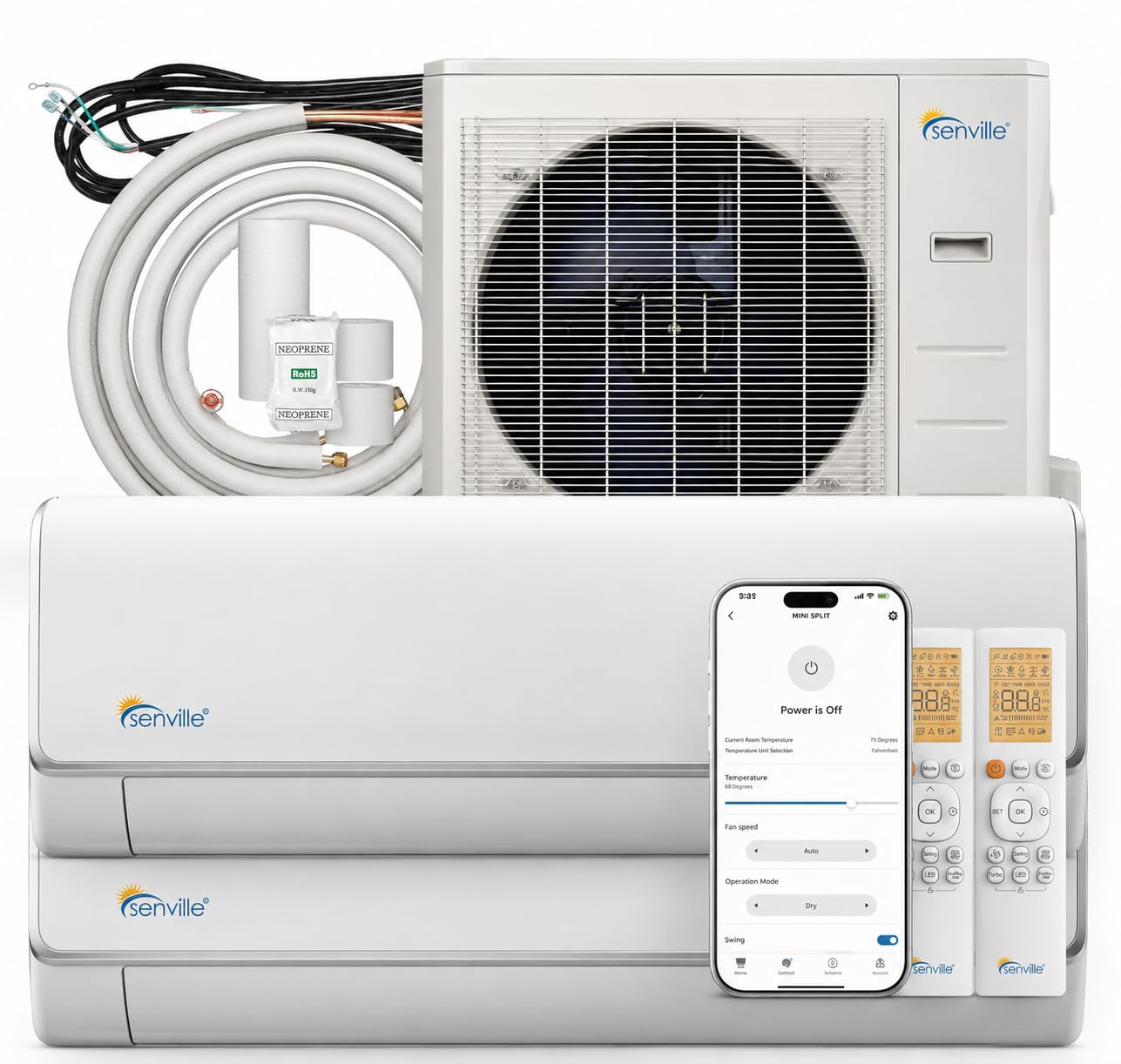
1. Senville Mini Split Air Conditioner Heat Pump, White, Dual Zone, 28000 BTU
Our pick — 4.5★ from 200+ verified ratings; the strongest balance of quality and price.
Two rooms, one condenser, and a heat pump that carries you through winter too.
You get the most cooling power per dollar in this group when you buy the Senville — a 28,000 BTU system with two indoor air handlers and an outdoor condenser. That capacity gap is real and measurable: Senville offers 28,000 BTU against the Frigidaire’s 24,000 BTU, so it comfortably covers the multi-room duty the Frigidaire was never built for. The system covers roughly 1500 square feet on 208–230V power. Both units in the system can hold their own temperatures, so the bedroom and the living room don’t have to agree. It’s ETL listed, AHRI certified, and Energy Star rated.
The heat pump side wins people over most: it heats efficiently in low outdoor temperatures, not just cools. What owners bring up the most is the overall build quality, followed closely by performance on both cooling and heat. Quiet operation comes up often too, alongside the fact that most installs go in smoothly. The money question is the one splinter — some see it as worth every penny and others less so, which is the honest picture for a system this size. And the Wi-Fi setup is fiddly: a repeat gripe is that pairing it to your network takes patience and a few resets.
Where it really shines is the running-cost math. Owners who swapped out an older AC report lower power bills and a comfortable house at a higher thermostat setting. One caveat worth knowing: the warranty covers parts and compressor only, so if a technician has to come out, you pay the HVAC labor. One owner reports a high-pitch noise in the first 24 hours that a reset didn’t fix — the installer resolved it and it has run well since.
What makes it the top pick
- 28000 BTU covers a roughly 1500 sq ft home with two independently controlled air handlers
- Heat pump functionality means it heats too, not just cools
- Energy Star, ETL listed and AHRI certified for efficiency and safety standards
- Quiet enough that the sound of running it never comes up as a complaint
Honest trade-offs to weigh
- Wi-Fi pairing is the recurring frustration — expect to fuss with it
- Warranty is parts and compressor only; HVAC labor is on you
- 208–230V power and a professional install are required
Made for this buyer: a homeowner cooling two rooms with a condenser that also handles winter heat.
Skip the hassle if: you want a plug-and-play unit you install yourself — a window model is far simpler.
2. ROVSUN 28000 BTU Tri Zone WIFI Mini Split AC/Heating System, 20 SEER2 3 Zone (9K/12K/12K) BTU
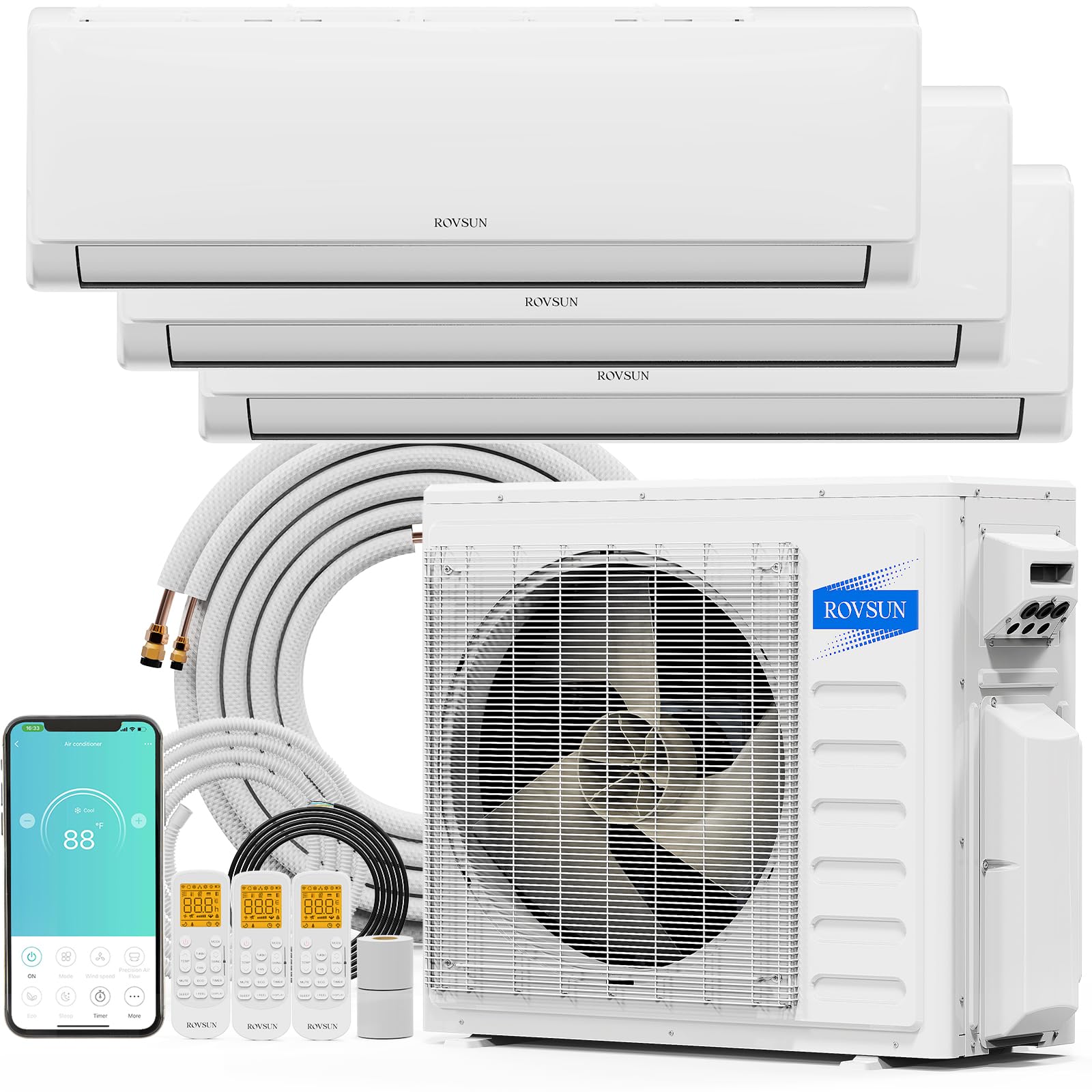
Three rooms, three remotes, one outdoor unit — the multi-room specialist.
The ROVSUN is the pick for anyone who needs to cool three separate spaces without buying three separate machines. One outdoor 28,000 BTU condenser feeds three indoor air handlers — a 9,000 BTU plus two 12,000 BTU heads — each with its own controller and its own temperature setting. It runs on 208–230V power and is ETL and AHRI certified. The condenser is pre-charged up to 25 feet, and the kit ships with three indoor units, one outdoor unit, three remotes, and three 25-foot line sets.
Like the Senville above, this is a heat pump — it cools, heats, dehumidifies, and fans, with an inverter compressor working across roughly -4℉ to 122℉ ambient temperatures. A running theme across the reviews is quality, then ease of installation, then cooling performance, then noise level. Cools-fast comes up repeatedly, and owners note the multi-room design means one room’s split doesn’t drag down another. The 20 SEER2 rating is a step below the Albott’s 22 SEER2, so it’s efficient but not the efficiency leader in this group.
Here’s an honest wrinkle: reliability gets mixed feedback from owners, and it’s the most-discussed topic in the ROVSUN reviews. Most buyers report the system working well, but the unit is demanding about installation. One reviewer noted an E0 error on a head unit and a heat cycle that shut down on one zone — that reflects the reality that this install is unforgiving of shortcuts. You’ll need a vacuum pump, a flare kit, and patience for the metric-and-standard fitting mix. Several owners note that pre-charged lines don’t mean zero work; extra parts and extra cost are normal. The genuinely strong point is support — several reviews mention customer service resolving issues and standing behind the product.
The real story: the ROVSUN delivers 28000 BTU across 3 independently controlled zones — a 9K plus two 12K air handlers — for a multi-room home that needs separate temperature control.
The fine print: the 20 SEER2 rating trails the Albott’s 22 SEER2, and installation is genuinely technician-grade. This isn’t a weekend DIY project unless you already own a vacuum pump and flare tools.
Pick this one if: you have three rooms to cool and you’re fine bringing in a licensed HVAC tech to do it right.
Think harder if: you want one unit, one room, and a two-hour install — this is overkill.
3. Albott 3 Zone Mini Split AC System, Wifi Enabled, 9K+9K+9K BTU, 22 SEER2
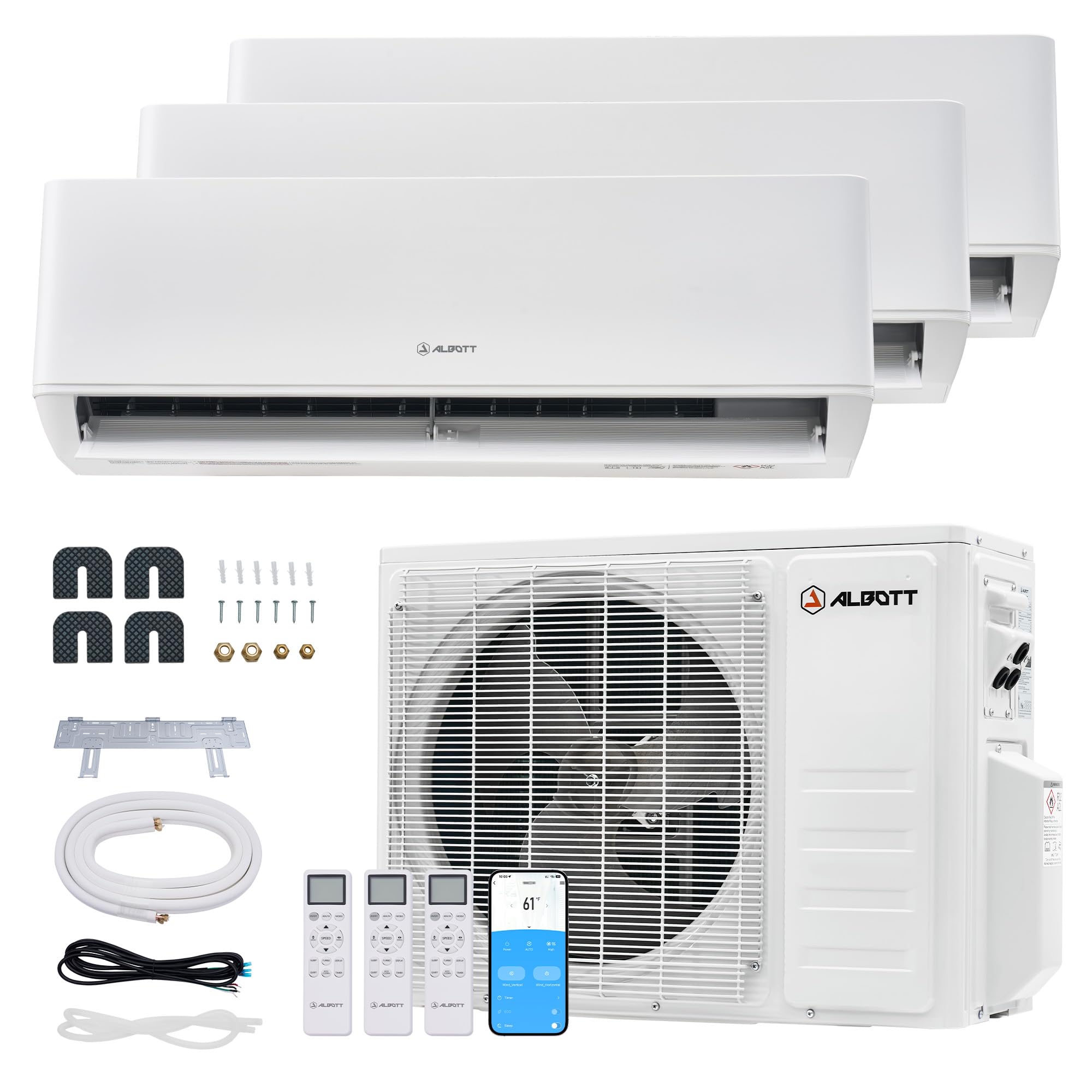
The 27000 BTU number you searched, split across three quiet rooms.
The Albott is the only pick rated at exactly 27,000 BTU, and it backs that with the highest efficiency in this group: a 22 SEER2 rating (SEER2 measures how efficiently a system turns electricity into cooling — higher is better). It runs three 9,000 BTU indoor air handlers (the wall units that blow cold air into each room), so you can cool three bedrooms or a home office wing at once. It covers up to 1200 square feet across three zones. An auto-defrost function on the outdoor unit keeps it running in cold weather. Every zone has its own temperature control, and a sleep mode keeps the indoor heads quiet enough for light sleepers.
Smart control runs through a built-in Wi-Fi module and an app, so you can adjust temperatures from your phone before you walk in the door. On efficiency, it’s worth being precise: 22 SEER2 beats both the ROVSUN’s 20 SEER2 and is well ahead of the Frigidaire’s window-class performance, meaning less electricity for the same cooling. Energy Star certification backs that up. What owners praise is how straightforward the install is for a professional — one review describes a clean DIY attempt that still recommends a pro do the final hookup. The system runs quietly, indoors and out, and several owners note it doubles as a heat pump through winter.
The honest caveat: this system demands a lot from your install. Owners mention that the cooling feels weaker than the rated capacity suggests. One buyer mentioned a prior 24,000 BTU split was replaced by this system, and another noted 18,000 BTU window units cooled a space faster. If you want zones far apart, you must buy additional tubing and connection wire separately — common for three-zone systems. Set expectations accordingly.
What stands out: a 27,000 BTU rating across three zones with 22 SEER2 and Energy Star certification — the efficiency leader of this group.
Consider carefully: extra tubing and connection wire are sold separately for far-apart zones, and cooling performance feedback is real-world mixed. Bring a pro in to spec the line-set lengths correctly.
The smart pick for: a three-zone home where the efficiency rating matters as much as the cooling capacity.
Pass on this if: your three rooms sit far apart — the extra tubing cost adds up fast.
4. Frigidaire 24,000 BTU Smart Inverter Window Air Conditioner with Wi-Fi

No technician, no line sets, no 220V circuit — just a window and a friend to help lift.
If your building won’t allow an outdoor condenser or you’re renting, the Frigidaire window unit is the practical answer. It’s a 24,000 BTU window air conditioner with an inverter compressor (the part that adjusts its own speed to hold a steady temperature). That’s less capacity than the Senville’s 28,000 BTU, but it drops into a standard window frame and runs on regular household power. Energy Star certification rates it at 850 kilowatt hours per year. It cools up to 1,020 square feet — one big room or an open-plan living-and-kitchen layout.
Owners who’ve compared this to older window units say the inverter is the reason it feels different — the system cools faster on startup and stays steady once it’s there. The 6-way directional airflow lets you aim cold air toward one side of a room instead of straight down. Three fan speeds plus a Dry Mode (which pulls moisture out of the air without full cooling) make this feel more flexible than the simple window units it replaces. A 24-hour timer, a remote, and Clean Filter alerts round out the convenience features — the filter itself is washable and reusable.
Wi-Fi and app control set it apart from a basic box: you can run it from your phone and pair it with Alexa or Google Home. The recurring complaint is vibration noise — one owner reports it starting about a month in, and several note the unit is quietest on the low setting. Two people should do the install because it’s heavier than a small window unit, and one owner notes it comes with support brackets that make a permanent install easier. This is the pick for someone who wants strong 24,000 BTU cooling in one large room without any of the multi-room complexity of the mini splits above.
Why window shoppers choose it
- 24000 BTU and 1020 sq ft of coverage without a professional install
- Inverter compressor for steadier temperatures and quieter operation
- Wi-Fi, app control, Alexa and Google Home compatibility built in
- 850 kWh per year energy use under Energy Star certification
Set your expectations
- Vibration noise is a recurring note — often beginning weeks into ownership
- It’s heavy enough that two people should handle the install
- Cooling power sits below the mini splits in this list — right for one room, not three
Right for you if: you need to cool one big room and won’t deal with an outdoor condenser or electrical work.
Look elsewhere if: you need multi-room climate control — this is a one-room solution by design.
Understanding the Specs
BTU — The Capacity Number
BTU stands for British Thermal Unit, and it’s the measure of how much heat the unit can pull out of a room in an hour. The higher the number, the larger the space it can cool. In this group the range runs from 24,000 BTU up to 28,000 BTU, which covers everything from a 1,020-square-foot open room to a 1,500-square-foot home. A unit that’s too small for the space runs constantly and never quite catches up; one that’s too large cools unevenly and wastes power. Match the BTU to your actual room size, not the biggest number on the shelf.
SEER2 — The Efficiency Rating
SEER2 is an efficiency score — think of it as miles-per-gallon for your air conditioner. The higher the number, the less electricity the unit uses to deliver the same cooling, so a 22 SEER2 system typically costs less to run than a 20 SEER2 one. It’s the most useful number for comparing running costs between two units, because it accounts for the whole system, not just one component. Energy Star certification usually accompanies a strong SEER2 score and is a simple quality-and-efficiency flag to look for.
FAQ
Why don’t many air conditioners come in exactly 27000 BTU?
Do I need a licensed HVAC technician to install these?
Will a 24000 BTU air conditioner cool my house or only one room?
Can I cool three separate rooms without installing three AC units?
Are these mini split units only air conditioners or do they heat too?
What is the difference between 20 SEER2 and 22 SEER2 for my bill?
Do these units work with Alexa and Google Home?
How long do the line sets need to be and can I extend them?
Are window units quieter or louder than mini splits?
What does Energy Star certification actually mean for these units?
Final Thoughts: The Verdict
For most people hunting a huge-capacity air conditioner, the winner is the Senville Mini Split — it holds the top rating in this group and the highest usefulness-per-dollar ratio of any pick here, with 28,000 BTU across two zones and a heat pump that carries you through winter. If you need three rooms comfortable, the ROVSUN delivers the most zones for the money and brings strong owner support. And if the exact 27000 btu air conditioner number is what you’re after, the Albott is the one rated at precisely that, with the best efficiency score in the group. Anyone who can’t install a mini split — renters especially — should look at the Frigidaire.
How We Picked
We do not accept paid placement. Every pick is matched to a real buyer and a real use-case; we do not hands-on test units.
Sources & Methodology
Specifications: manufacturer listings and product documentation. Review insights: verified customer reviews, as of September 2026. Pricing: not shown on this page (it changes often); check the current price via the retailer link.
As an Amazon Associate, Gadgets Feed earns from qualifying purchases. This does not affect which products we feature.